<?xml version="1.0" encoding="UTF-8"?>
<rdf:RDF xmlns:rdf="http://www.w3.org/1999/02/22-rdf-syntax-ns#" xmlns:prism="http://prismstandard.org/namespaces/basic/2.0/" xmlns:dc="http://purl.org/dc/elements/1.1/" xmlns:syn="http://purl.org/rss/1.0/modules/syndication/" xmlns:content="http://purl.org/rss/1.0/modules/content/" xmlns="http://purl.org/rss/1.0/">
  <channel rdf:about="http://publish.aps.org/">
    <title>Physical Review: Spintronics</title>
    <link>http://publish.aps.org/</link>
    <description>Spintronics articles published in Physical Review Journals</description>
    <syn:updatePeriod>hourly</syn:updatePeriod>
    <syn:updateFrequency>1</syn:updateFrequency>
    <syn:updateBase>2012-02-09T21:06:14-05:00</syn:updateBase>
    <dc:creator>rss@aps.org</dc:creator>
    <dc:publisher>assocpub@aps.org</dc:publisher>
    <dc:date>2012-02-09T21:06:14-05:00</dc:date>
    <dc:language>en</dc:language>
    <dc:rights>Copyright © 2012 the American Physical Society. Personal use only, all commercial or other reuse prohibited</dc:rights>
    <prism:copyright>Copyright © 2012 the American Physical Society</prism:copyright>
    <prism:rightsAgent>assocpub@aps.org</prism:rightsAgent>
    <items>
      <rdf:Seq>
        <rdf:li rdf:resource="http://link.aps.org/doi/10.1103/PhysRevB.85.035325"/>
        <rdf:li rdf:resource="http://link.aps.org/doi/10.1103/PhysRevB.85.024535"/>
        <rdf:li rdf:resource="http://link.aps.org/doi/10.1103/PhysRevB.85.035446"/>
        <rdf:li rdf:resource="http://link.aps.org/doi/10.1103/PhysRevLett.108.056601"/>
        <rdf:li rdf:resource="http://link.aps.org/doi/10.1103/PhysRevB.85.014523"/>
        <rdf:li rdf:resource="http://link.aps.org/doi/10.1103/PhysRevB.85.041309"/>
        <rdf:li rdf:resource="http://link.aps.org/doi/10.1103/PhysRevB.85.014420"/>
        <rdf:li rdf:resource="http://link.aps.org/doi/10.1103/PhysRevB.85.035205"/>
        <rdf:li rdf:resource="http://link.aps.org/doi/10.1103/PhysRevB.85.045415"/>
        <rdf:li rdf:resource="http://link.aps.org/doi/10.1103/PhysRevB.85.045406"/>
        <rdf:li rdf:resource="http://link.aps.org/doi/10.1103/PhysRevLett.108.017202"/>
        <rdf:li rdf:resource="http://link.aps.org/doi/10.1103/PhysRevLett.108.017402"/>
        <rdf:li rdf:resource="http://link.aps.org/doi/10.1103/PhysRevLett.108.017602"/>
        <rdf:li rdf:resource="http://link.aps.org/doi/10.1103/PhysRevLett.108.016601"/>
        <rdf:li rdf:resource="http://link.aps.org/doi/10.1103/PhysRevB.84.214307"/>
        <rdf:li rdf:resource="http://link.aps.org/doi/10.1103/PhysRevB.84.241408"/>
        <rdf:li rdf:resource="http://link.aps.org/doi/10.1103/PhysRevB.84.235441"/>
        <rdf:li rdf:resource="http://link.aps.org/doi/10.1103/PhysRevB.84.224424"/>
        <rdf:li rdf:resource="http://link.aps.org/doi/10.1103/PhysRevB.84.235436"/>
        <rdf:li rdf:resource="http://link.aps.org/doi/10.1103/PhysRevLett.107.266801"/>
        <rdf:li rdf:resource="http://link.aps.org/doi/10.1103/PhysRevLett.107.257202"/>
        <rdf:li rdf:resource="http://link.aps.org/doi/10.1103/PhysRevB.84.224403"/>
        <rdf:li rdf:resource="http://link.aps.org/doi/10.1103/PhysRevB.84.245303"/>
        <rdf:li rdf:resource="http://link.aps.org/doi/10.1103/PhysRevB.84.214417"/>
        <rdf:li rdf:resource="http://link.aps.org/doi/10.1103/PhysRevB.84.245411"/>
        <rdf:li rdf:resource="http://link.aps.org/doi/10.1103/PhysRevB.84.235204"/>
        <rdf:li rdf:resource="http://link.aps.org/doi/10.1103/PhysRevLett.107.249901"/>
        <rdf:li rdf:resource="http://link.aps.org/doi/10.1103/PhysRevB.84.214501"/>
        <rdf:li rdf:resource="http://link.aps.org/doi/10.1103/PhysRevB.84.235201"/>
        <rdf:li rdf:resource="http://link.aps.org/doi/10.1103/PhysRevB.84.235409"/>
      </rdf:Seq>
    </items>
  </channel>
  <item rdf:about="http://link.aps.org/doi/10.1103/PhysRevB.85.035325">
    <title>High-frequency electrical charge and spin control in a single InGaAs quantum dot</title>
    <link>http://link.aps.org/doi/10.1103/PhysRevB.85.035325</link>
    <description>Author(s): J. Nannen, W. Quitsch, S. Eliasson, T. Kümmell, and G. Bacher&lt;br/&gt;&lt;p&gt;We report on the charging behavior of a single self-assembled InGaAs quantum dot with unpolarized and spin-polarized electrons under direct current (DC) and high-frequency biasing. The tunnel coupling of the quantum dot to a spin-polarized electron reservoir leads to characteristic voltage dependenc...&lt;/p&gt;&lt;br/&gt;[Phys. Rev. B 85, 035325] Published Tue Jan 31, 2012</description>
    <content:encoded><![CDATA[<p>Author(s): J. Nannen, W. Quitsch, S. Eliasson, T. Kümmell, and G. Bacher</p><p> We report on the charging behavior of a single self-assembled InGaAs quantum dot with unpolarized and spin-polarized electrons under direct current (DC) and high-frequency biasing. The tunnel coupling of the quantum dot to a spin-polarized electron reservoir leads to characteristic voltage dependenc...</p><p>[Phys. Rev. B 85, 035325] Published Tue Jan 31, 2012</p>]]></content:encoded>
    <dc:title>High-frequency electrical charge and spin control in a single InGaAs quantum dot</dc:title>
    <dc:creator>J. Nannen, W. Quitsch, S. Eliasson, T. Kümmell, and G. Bacher</dc:creator>
    <dc:date>2012-01-31T10:00:00-05:00</dc:date>
    <dc:rights>Personal use only, all commercial or other reuse prohibited</dc:rights>
    <dc:identifier>doi:10.1103/PhysRevB.85.035325</dc:identifier>
    <dc:source>Phys. Rev. B 85, 035325 (2012)</dc:source>
    <dc:type>article</dc:type>
    <prism:publicationName>Physical Review B</prism:publicationName>
    <prism:volume>85</prism:volume>
    <prism:number>3</prism:number>
    <prism:publicationDate>2012-01-31T10:00:00-05:00</prism:publicationDate>
    <prism:doi>10.1103/PhysRevB.85.035325</prism:doi>
    <prism:url>http://link.aps.org/doi/10.1103/PhysRevB.85.035325</prism:url>
    <prism:startingPage>035325</prism:startingPage>
    <dc:subject>Semiconductors II: surfaces, interfaces, microstructures, and related topics</dc:subject>
    <prism:section>Semiconductors II: surfaces, interfaces, microstructures, and related topics</prism:section>
  </item>
  <item rdf:about="http://link.aps.org/doi/10.1103/PhysRevB.85.024535">
    <title>Fermi gas with attractive potential and arbitrary spin in a one-dimensional trap: Phase diagram for S=3/2, 5/2, 7/2, and 9/2</title>
    <link>http://link.aps.org/doi/10.1103/PhysRevB.85.024535</link>
    <description>Author(s): P. Schlottmann and A. A. Zvyagin&lt;br/&gt;&lt;p&gt;A gas of ultracold &lt;span&gt;&lt;sup&gt;6&lt;/sup&gt;&lt;/span&gt;Li atoms (effective spin 1/2) confined to an elongated trap with one-dimensional properties is a candidate to display three different phases: (i) fermions bound in Cooper-pair-like states, (ii) unbound spin-polarized particles, and (iii) a mixed phase in which Cooper bound states...&lt;/p&gt;&lt;br/&gt;[Phys. Rev. B 85, 024535] Published Mon Jan 30, 2012</description>
    <content:encoded><![CDATA[<p>Author(s): P. Schlottmann and A. A. Zvyagin</p><p> A gas of ultracold <span><sup>6</sup></span>Li atoms (effective spin 1/2) confined to an elongated trap with one-dimensional properties is a candidate to display three different phases: (i) fermions bound in Cooper-pair-like states, (ii) unbound spin-polarized particles, and (iii) a mixed phase in which Cooper bound states...</p><p>[Phys. Rev. B 85, 024535] Published Mon Jan 30, 2012</p>]]></content:encoded>
    <dc:title>Fermi gas with attractive potential and arbitrary spin in a one-dimensional trap: Phase diagram for S=3/2, 5/2, 7/2, and 9/2</dc:title>
    <dc:creator>P. Schlottmann and A. A. Zvyagin</dc:creator>
    <dc:date>2012-01-30T10:00:00-05:00</dc:date>
    <dc:rights>Personal use only, all commercial or other reuse prohibited</dc:rights>
    <dc:identifier>doi:10.1103/PhysRevB.85.024535</dc:identifier>
    <dc:source>Phys. Rev. B 85, 024535 (2012)</dc:source>
    <dc:type>article</dc:type>
    <prism:publicationName>Physical Review B</prism:publicationName>
    <prism:volume>85</prism:volume>
    <prism:number>2</prism:number>
    <prism:publicationDate>2012-01-30T10:00:00-05:00</prism:publicationDate>
    <prism:doi>10.1103/PhysRevB.85.024535</prism:doi>
    <prism:url>http://link.aps.org/doi/10.1103/PhysRevB.85.024535</prism:url>
    <prism:startingPage>024535</prism:startingPage>
    <dc:subject>Superfluidity and superconductivity</dc:subject>
    <prism:section>Superfluidity and superconductivity</prism:section>
  </item>
  <item rdf:about="http://link.aps.org/doi/10.1103/PhysRevB.85.035446">
    <title>Thermal equilibration and thermally induced spin currents in a thin-film ferromagnet on a substrate</title>
    <link>http://link.aps.org/doi/10.1103/PhysRevB.85.035446</link>
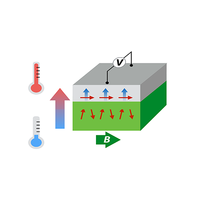
    <description>Author(s): Matthew R. Sears and Wayne M. Saslow&lt;br/&gt;&lt;p&gt;Recent spin-Seebeck experiments on thin ferromagnetic films apply a temperature difference &lt;span&gt;&lt;span style="font-style: italic;"&gt;Δ&lt;/span&gt;&lt;span style="font-style: italic;"&gt;T&lt;/span&gt;&lt;sub&gt;&lt;span style="font-style: italic;"&gt;x&lt;/span&gt;&lt;/sub&gt;&lt;/span&gt; along the length &lt;span&gt;&lt;span style="font-style: italic;"&gt;x&lt;/span&gt;&lt;/span&gt; and measure a (transverse) voltage difference &lt;span&gt;&lt;span style="font-style: italic;"&gt;Δ&lt;/span&gt;&lt;span style="font-style: italic;"&gt;V&lt;/span&gt;&lt;sub&gt;&lt;span style="font-style: italic;"&gt;y&lt;/span&gt;&lt;/sub&gt;&lt;/span&gt; along the width &lt;span&gt;&lt;span style="font-style: italic;"&gt;y&lt;/span&gt;&lt;/span&gt;. The connection between these involves: (1) thermal equilibration between sample and substrate, (2) spin currents alon...&lt;/p&gt;&lt;br/&gt;[Phys. Rev. B 85, 035446] Published Mon Jan 30, 2012</description>
    <content:encoded><![CDATA[<p>Author(s): Matthew R. Sears and Wayne M. Saslow</p><p> Recent spin-Seebeck experiments on thin ferromagnetic films apply a temperature difference <span><span style="font-style: italic;">Δ</span><span style="font-style: italic;">T</span><sub><span style="font-style: italic;">x</span></sub></span> along the length <span><span style="font-style: italic;">x</span></span> and measure a (transverse) voltage difference <span><span style="font-style: italic;">Δ</span><span style="font-style: italic;">V</span><sub><span style="font-style: italic;">y</span></sub></span> along the width <span><span style="font-style: italic;">y</span></span>. The connection between these involves: (1) thermal equilibration between sample and substrate, (2) spin currents alon...</p><p>[Phys. Rev. B 85, 035446] Published Mon Jan 30, 2012</p>]]></content:encoded>
    <dc:title>Thermal equilibration and thermally induced spin currents in a thin-film ferromagnet on a substrate</dc:title>
    <dc:creator>Matthew R. Sears and Wayne M. Saslow</dc:creator>
    <dc:date>2012-01-30T10:00:00-05:00</dc:date>
    <dc:rights>Personal use only, all commercial or other reuse prohibited</dc:rights>
    <dc:identifier>doi:10.1103/PhysRevB.85.035446</dc:identifier>
    <dc:source>Phys. Rev. B 85, 035446 (2012)</dc:source>
    <dc:type>article</dc:type>
    <prism:publicationName>Physical Review B</prism:publicationName>
    <prism:volume>85</prism:volume>
    <prism:number>3</prism:number>
    <prism:publicationDate>2012-01-30T10:00:00-05:00</prism:publicationDate>
    <prism:doi>10.1103/PhysRevB.85.035446</prism:doi>
    <prism:url>http://link.aps.org/doi/10.1103/PhysRevB.85.035446</prism:url>
    <prism:startingPage>035446</prism:startingPage>
    <dc:subject>Surface physics, nanoscale physics, low-dimensional systems</dc:subject>
    <prism:section>Surface physics, nanoscale physics, low-dimensional systems</prism:section>
  </item>
  <item rdf:about="http://link.aps.org/doi/10.1103/PhysRevLett.108.056601">
    <title>Hall Effect of Spin-Chirality Origin in a Triangular-Lattice Helimagnet Fe_{1.3}Sb</title>
    <link>http://link.aps.org/doi/10.1103/PhysRevLett.108.056601</link>
    <description>Author(s): Y. Shiomi, M. Mochizuki, Y. Kaneko, and Y. Tokura&lt;br/&gt;&lt;p&gt;We report on a topological Hall effect possibly induced by scalar spin chirality in a quasi-two-dimensional helimagnet &lt;span&gt;Fe&lt;sub&gt;1+δ&lt;/sub&gt;Sb&lt;/span&gt;. In the low-temperature region where the spins on interstitial-Fe (concentration &lt;span&gt;&lt;span style="font-style: italic;"&gt;δ&lt;/span&gt;∼0.3&lt;/span&gt;) intervening the 120° spin-ordered triangular planes tend to freeze, a nontrivial comp...&lt;/p&gt;&lt;br/&gt;[Phys. Rev. Lett. 108, 056601] Published Mon Jan 30, 2012</description>
    <content:encoded><![CDATA[<p>Author(s): Y. Shiomi, M. Mochizuki, Y. Kaneko, and Y. Tokura</p><p> We report on a topological Hall effect possibly induced by scalar spin chirality in a quasi-two-dimensional helimagnet <span>Fe<sub>1+δ</sub>Sb</span>. In the low-temperature region where the spins on interstitial-Fe (concentration <span><span style="font-style: italic;">δ</span>∼0.3</span>) intervening the 120° spin-ordered triangular planes tend to freeze, a nontrivial comp...</p><p>[Phys. Rev. Lett. 108, 056601] Published Mon Jan 30, 2012</p>]]></content:encoded>
    <dc:title>Hall Effect of Spin-Chirality Origin in a Triangular-Lattice Helimagnet Fe_{1.3}Sb</dc:title>
    <dc:creator>Y. Shiomi, M. Mochizuki, Y. Kaneko, and Y. Tokura</dc:creator>
    <dc:date>2012-01-30T10:00:00-05:00</dc:date>
    <dc:rights>Personal use only, all commercial or other reuse prohibited</dc:rights>
    <dc:identifier>doi:10.1103/PhysRevLett.108.056601</dc:identifier>
    <dc:source>Phys. Rev. Lett. 108, 056601 (2012)</dc:source>
    <dc:type>article</dc:type>
    <prism:publicationName>Physical Review Letters</prism:publicationName>
    <prism:volume>108</prism:volume>
    <prism:number>5</prism:number>
    <prism:publicationDate>2012-01-30T10:00:00-05:00</prism:publicationDate>
    <prism:doi>10.1103/PhysRevLett.108.056601</prism:doi>
    <prism:url>http://link.aps.org/doi/10.1103/PhysRevLett.108.056601</prism:url>
    <prism:startingPage>056601</prism:startingPage>
    <dc:subject>Condensed Matter: Electronic Properties, etc.</dc:subject>
    <prism:section>Condensed Matter: Electronic Properties, etc.</prism:section>
  </item>
  <item rdf:about="http://link.aps.org/doi/10.1103/PhysRevB.85.014523">
    <title>Josephson-like spin current in junctions composed of antiferromagnets and ferromagnets</title>
    <link>http://link.aps.org/doi/10.1103/PhysRevB.85.014523</link>
    <description>Author(s): A. Moor, A. F. Volkov, and K. B. Efetov&lt;br/&gt;&lt;p&gt;We study Josephson-like junctions formed by materials with antiferromagnetic (AF) order parameters. As an antiferromagnet, we consider a two-band material in which a spin density wave (SDW) arises. This could be Fe-based pnictides in the temperature interval &lt;span&gt;&lt;span style="font-style: italic;"&gt;T&lt;/span&gt;&lt;sub&gt;c&lt;/sub&gt;≤&lt;span style="font-style: italic;"&gt;T&lt;/span&gt;≤&lt;span style="font-style: italic;"&gt;T&lt;/span&gt;&lt;sub&gt;N&lt;/sub&gt;&lt;/span&gt;, where &lt;span&gt;&lt;span style="font-style: italic;"&gt;T&lt;/span&gt;&lt;sub&gt;c&lt;/sub&gt;&lt;/span&gt; and &lt;span&gt;&lt;span style="font-style: italic;"&gt;T&lt;/span&gt;&lt;sub&gt;N&lt;/sub&gt;&lt;/span&gt; are the critical...&lt;/p&gt;&lt;br/&gt;[Phys. Rev. B 85, 014523] Published Fri Jan 27, 2012</description>
    <content:encoded><![CDATA[<p>Author(s): A. Moor, A. F. Volkov, and K. B. Efetov</p><p> We study Josephson-like junctions formed by materials with antiferromagnetic (AF) order parameters. As an antiferromagnet, we consider a two-band material in which a spin density wave (SDW) arises. This could be Fe-based pnictides in the temperature interval <span><span style="font-style: italic;">T</span><sub>c</sub>≤<span style="font-style: italic;">T</span>≤<span style="font-style: italic;">T</span><sub>N</sub></span>, where <span><span style="font-style: italic;">T</span><sub>c</sub></span> and <span><span style="font-style: italic;">T</span><sub>N</sub></span> are the critical...</p><p>[Phys. Rev. B 85, 014523] Published Fri Jan 27, 2012</p>]]></content:encoded>
    <dc:title>Josephson-like spin current in junctions composed of antiferromagnets and ferromagnets</dc:title>
    <dc:creator>A. Moor, A. F. Volkov, and K. B. Efetov</dc:creator>
    <dc:date>2012-01-27T10:00:00-05:00</dc:date>
    <dc:rights>Personal use only, all commercial or other reuse prohibited</dc:rights>
    <dc:identifier>doi:10.1103/PhysRevB.85.014523</dc:identifier>
    <dc:source>Phys. Rev. B 85, 014523 (2012)</dc:source>
    <dc:type>article</dc:type>
    <prism:publicationName>Physical Review B</prism:publicationName>
    <prism:volume>85</prism:volume>
    <prism:number>1</prism:number>
    <prism:publicationDate>2012-01-27T10:00:00-05:00</prism:publicationDate>
    <prism:doi>10.1103/PhysRevB.85.014523</prism:doi>
    <prism:url>http://link.aps.org/doi/10.1103/PhysRevB.85.014523</prism:url>
    <prism:startingPage>014523</prism:startingPage>
    <dc:subject>Superfluidity and superconductivity</dc:subject>
    <prism:section>Superfluidity and superconductivity</prism:section>
  </item>
  <item rdf:about="http://link.aps.org/doi/10.1103/PhysRevB.85.041309">
    <title>Shot noise induced by electron-nuclear spin-flip scattering in a nonequilibrium quantum wire</title>
    <link>http://link.aps.org/doi/10.1103/PhysRevB.85.041309</link>
    <description>Author(s): Kensaku Chida, Masayuki Hashisaka, Yoshiaki Yamauchi, Shuji Nakamura, Tomonori Arakawa, Tomoki Machida, Kensuke Kobayashi, and Teruo Ono&lt;br/&gt;&lt;p&gt;We study the shot noise (nonequilibrium current fluctuation) associated with dynamic nuclear polarization in a nonequilibrium quantum wire (QW) fabricated in a two-dimensional electron gas. We observe that the spin-polarized conductance quantization of the QW in the integer quantum Hall regime colla...&lt;/p&gt;&lt;br/&gt;&lt;img src="http://publish.aps.org/images/icons/prbsugg30x30.jpg" alt="PRB Editors' Suggestion"/&gt; &lt;img src="http://publish.aps.org/images/icons/rapid30x30.gif" width="30" height="30" alt="Rapid Communication"/&gt; &lt;br/&gt;[Phys. Rev. B 85, 041309] Published Thu Jan 26, 2012</description>
    <content:encoded><![CDATA[<p>Author(s): Kensaku Chida, Masayuki Hashisaka, Yoshiaki Yamauchi, Shuji Nakamura, Tomonori Arakawa, Tomoki Machida, Kensuke Kobayashi, and Teruo Ono</p><p><img src="http://publish.aps.org/images/icons/prbsugg30x30.jpg" alt="PRB Editors' Suggestion"/> <img src="http://publish.aps.org/images/icons/rapid30x30.gif" width="30" height="30" alt="Rapid Communication"/>  We study the shot noise (nonequilibrium current fluctuation) associated with dynamic nuclear polarization in a nonequilibrium quantum wire (QW) fabricated in a two-dimensional electron gas. We observe that the spin-polarized conductance quantization of the QW in the integer quantum Hall regime colla...</p><p>[Phys. Rev. B 85, 041309] Published Thu Jan 26, 2012</p>]]></content:encoded>
    <dc:title>Shot noise induced by electron-nuclear spin-flip scattering in a nonequilibrium quantum wire</dc:title>
    <dc:creator>Kensaku Chida, Masayuki Hashisaka, Yoshiaki Yamauchi, Shuji Nakamura, Tomonori Arakawa, Tomoki Machida, Kensuke Kobayashi, and Teruo Ono</dc:creator>
    <dc:date>2012-01-26T10:00:00-05:00</dc:date>
    <dc:rights>Personal use only, all commercial or other reuse prohibited</dc:rights>
    <dc:identifier>doi:10.1103/PhysRevB.85.041309</dc:identifier>
    <dc:source>Phys. Rev. B 85, 041309 (2012)</dc:source>
    <dc:type>article</dc:type>
    <prism:publicationName>Physical Review B</prism:publicationName>
    <prism:volume>85</prism:volume>
    <prism:number>4</prism:number>
    <prism:publicationDate>2012-01-26T10:00:00-05:00</prism:publicationDate>
    <prism:doi>10.1103/PhysRevB.85.041309</prism:doi>
    <prism:url>http://link.aps.org/doi/10.1103/PhysRevB.85.041309</prism:url>
    <prism:startingPage>041309</prism:startingPage>
    <dc:subject>Semiconductors II: surfaces, interfaces, microstructures, and related topics</dc:subject>
    <prism:section>Semiconductors II: surfaces, interfaces, microstructures, and related topics</prism:section>
  </item>
  <item rdf:about="http://link.aps.org/doi/10.1103/PhysRevB.85.014420">
    <title>Tuning magnetic relaxation by oblique deposition</title>
    <link>http://link.aps.org/doi/10.1103/PhysRevB.85.014420</link>
    <description>Author(s): I. Barsukov, P. Landeros, R. Meckenstock, J. Lindner, D. Spoddig, Zi-An Li, B. Krumme, H. Wende, D. L. Mills, and M. Farle&lt;br/&gt;&lt;p&gt;Oblique deposition conditions of Si were used to create a periodic compositional defect matrix in Fe&lt;span&gt;&lt;sub&gt;3&lt;/sub&gt;&lt;/span&gt;Si&lt;span&gt;&lt;/span&gt;/MgO(001) thin films. The modified growth conditions provoke shadow effects, which lead to a two-magnon scattering channel with twofold symmetry in the film plane. Its axis is controlled by the sam...&lt;/p&gt;&lt;br/&gt;[Phys. Rev. B 85, 014420] Published Thu Jan 19, 2012</description>
    <content:encoded><![CDATA[<p>Author(s): I. Barsukov, P. Landeros, R. Meckenstock, J. Lindner, D. Spoddig, Zi-An Li, B. Krumme, H. Wende, D. L. Mills, and M. Farle</p><p> Oblique deposition conditions of Si were used to create a periodic compositional defect matrix in Fe<span><sub>3</sub></span>Si<span></span>/MgO(001) thin films. The modified growth conditions provoke shadow effects, which lead to a two-magnon scattering channel with twofold symmetry in the film plane. Its axis is controlled by the sam...</p><p>[Phys. Rev. B 85, 014420] Published Thu Jan 19, 2012</p>]]></content:encoded>
    <dc:title>Tuning magnetic relaxation by oblique deposition</dc:title>
    <dc:creator>I. Barsukov, P. Landeros, R. Meckenstock, J. Lindner, D. Spoddig, Zi-An Li, B. Krumme, H. Wende, D. L. Mills, and M. Farle</dc:creator>
    <dc:date>2012-01-19T10:00:00-05:00</dc:date>
    <dc:rights>Personal use only, all commercial or other reuse prohibited</dc:rights>
    <dc:identifier>doi:10.1103/PhysRevB.85.014420</dc:identifier>
    <dc:source>Phys. Rev. B 85, 014420 (2012)</dc:source>
    <dc:type>article</dc:type>
    <prism:publicationName>Physical Review B</prism:publicationName>
    <prism:volume>85</prism:volume>
    <prism:number>1</prism:number>
    <prism:publicationDate>2012-01-19T10:00:00-05:00</prism:publicationDate>
    <prism:doi>10.1103/PhysRevB.85.014420</prism:doi>
    <prism:url>http://link.aps.org/doi/10.1103/PhysRevB.85.014420</prism:url>
    <prism:startingPage>014420</prism:startingPage>
    <dc:subject>Magnetism</dc:subject>
    <prism:section>Magnetism</prism:section>
  </item>
  <item rdf:about="http://link.aps.org/doi/10.1103/PhysRevB.85.035205">
    <title>Amplification of spin-filtering effect by magnetic field in GaAsN alloys</title>
    <link>http://link.aps.org/doi/10.1103/PhysRevB.85.035205</link>
    <description>Author(s): V. K. Kalevich, M. M. Afanasiev, A. Yu. Shiryaev, and A. Yu. Egorov&lt;br/&gt;&lt;p&gt;The effect of a longitudinal magnetic field on the optical spin orientation and spin-dependent recombination in dilute nitrides GaAsN has been studied for the first time. We have found that intensity &lt;span&gt;&lt;span style="font-style: italic;"&gt;I&lt;/span&gt;&lt;/span&gt; and circular polarization degree &lt;span&gt;&lt;span style="font-style: italic;"&gt;ρ&lt;/span&gt;&lt;/span&gt; of the edge photoluminescence, excited in GaAsN alloys by circu...&lt;/p&gt;&lt;br/&gt;[Phys. Rev. B 85, 035205] Published Tue Jan 17, 2012</description>
    <content:encoded><![CDATA[<p>Author(s): V. K. Kalevich, M. M. Afanasiev, A. Yu. Shiryaev, and A. Yu. Egorov</p><p> The effect of a longitudinal magnetic field on the optical spin orientation and spin-dependent recombination in dilute nitrides GaAsN has been studied for the first time. We have found that intensity <span><span style="font-style: italic;">I</span></span> and circular polarization degree <span><span style="font-style: italic;">ρ</span></span> of the edge photoluminescence, excited in GaAsN alloys by circu...</p><p>[Phys. Rev. B 85, 035205] Published Tue Jan 17, 2012</p>]]></content:encoded>
    <dc:title>Amplification of spin-filtering effect by magnetic field in GaAsN alloys</dc:title>
    <dc:creator>V. K. Kalevich, M. M. Afanasiev, A. Yu. Shiryaev, and A. Yu. Egorov</dc:creator>
    <dc:date>2012-01-17T10:00:00-05:00</dc:date>
    <dc:rights>Personal use only, all commercial or other reuse prohibited</dc:rights>
    <dc:identifier>doi:10.1103/PhysRevB.85.035205</dc:identifier>
    <dc:source>Phys. Rev. B 85, 035205 (2012)</dc:source>
    <dc:type>article</dc:type>
    <prism:publicationName>Physical Review B</prism:publicationName>
    <prism:volume>85</prism:volume>
    <prism:number>3</prism:number>
    <prism:publicationDate>2012-01-17T10:00:00-05:00</prism:publicationDate>
    <prism:doi>10.1103/PhysRevB.85.035205</prism:doi>
    <prism:url>http://link.aps.org/doi/10.1103/PhysRevB.85.035205</prism:url>
    <prism:startingPage>035205</prism:startingPage>
    <dc:subject>Semiconductors I: bulk</dc:subject>
    <prism:section>Semiconductors I: bulk</prism:section>
  </item>
  <item rdf:about="http://link.aps.org/doi/10.1103/PhysRevB.85.045415">
    <title>Interplay between topological insulators and superconductors</title>
    <link>http://link.aps.org/doi/10.1103/PhysRevB.85.045415</link>
    <description>Author(s): Jian Wang, Cui-Zu Chang, Handong Li, Ke He, Duming Zhang, Meenakshi Singh, Xu-Cun Ma, Nitin Samarth, Maohai Xie, Qi-Kun Xue, and M. H. W. Chan&lt;br/&gt;&lt;p&gt;Topological insulators are insulating in the bulk but possess metallic surface states protected by time-reversal symmetry. Here, we report on a detailed electronic transport study in high-quality Bi&lt;span&gt;&lt;sub&gt;2&lt;/sub&gt;&lt;/span&gt;Se&lt;span&gt;&lt;sub&gt;3&lt;/sub&gt;&lt;/span&gt; topological insulator thin films contacted by superconducting (In, Al, and W) electrodes. The res...&lt;/p&gt;&lt;br/&gt;[Phys. Rev. B 85, 045415] Published Tue Jan 10, 2012</description>
    <content:encoded><![CDATA[<p>Author(s): Jian Wang, Cui-Zu Chang, Handong Li, Ke He, Duming Zhang, Meenakshi Singh, Xu-Cun Ma, Nitin Samarth, Maohai Xie, Qi-Kun Xue, and M. H. W. Chan</p><p> Topological insulators are insulating in the bulk but possess metallic surface states protected by time-reversal symmetry. Here, we report on a detailed electronic transport study in high-quality Bi<span><sub>2</sub></span>Se<span><sub>3</sub></span> topological insulator thin films contacted by superconducting (In, Al, and W) electrodes. The res...</p><p>[Phys. Rev. B 85, 045415] Published Tue Jan 10, 2012</p>]]></content:encoded>
    <dc:title>Interplay between topological insulators and superconductors</dc:title>
    <dc:creator>Jian Wang, Cui-Zu Chang, Handong Li, Ke He, Duming Zhang, Meenakshi Singh, Xu-Cun Ma, Nitin Samarth, Maohai Xie, Qi-Kun Xue, and M. H. W. Chan</dc:creator>
    <dc:date>2012-01-10T10:00:00-05:00</dc:date>
    <dc:rights>Personal use only, all commercial or other reuse prohibited</dc:rights>
    <dc:identifier>doi:10.1103/PhysRevB.85.045415</dc:identifier>
    <dc:source>Phys. Rev. B 85, 045415 (2012)</dc:source>
    <dc:type>article</dc:type>
    <prism:publicationName>Physical Review B</prism:publicationName>
    <prism:volume>85</prism:volume>
    <prism:number>4</prism:number>
    <prism:publicationDate>2012-01-10T10:00:00-05:00</prism:publicationDate>
    <prism:doi>10.1103/PhysRevB.85.045415</prism:doi>
    <prism:url>http://link.aps.org/doi/10.1103/PhysRevB.85.045415</prism:url>
    <prism:startingPage>045415</prism:startingPage>
    <dc:subject>Surface physics, nanoscale physics, low-dimensional systems</dc:subject>
    <prism:section>Surface physics, nanoscale physics, low-dimensional systems</prism:section>
  </item>
  <item rdf:about="http://link.aps.org/doi/10.1103/PhysRevB.85.045406">
    <title>Tailoring magnetoresistance at the atomic level: An ab initio study</title>
    <link>http://link.aps.org/doi/10.1103/PhysRevB.85.045406</link>
    <description>Author(s): Kun Tao, V. S. Stepanyuk, I. Rungger, and S. Sanvito&lt;br/&gt;&lt;p&gt;The possibility of manipulating the tunneling magnetoresistance (TMR) of antiferromagnetic nanostructures is predicted in the framework of &lt;span style="font-style: italic;"&gt;ab initio&lt;/span&gt; calculations. By the example of a junction composed of an antiferromagnetic dimer and a spin-polarized scanning tunneling microscopy tip we show that t...&lt;/p&gt;&lt;br/&gt;[Phys. Rev. B 85, 045406] Published Thu Jan 05, 2012</description>
    <content:encoded><![CDATA[<p>Author(s): Kun Tao, V. S. Stepanyuk, I. Rungger, and S. Sanvito</p><p> The possibility of manipulating the tunneling magnetoresistance (TMR) of antiferromagnetic nanostructures is predicted in the framework of <span style="font-style: italic;">ab initio</span> calculations. By the example of a junction composed of an antiferromagnetic dimer and a spin-polarized scanning tunneling microscopy tip we show that t...</p><p>[Phys. Rev. B 85, 045406] Published Thu Jan 05, 2012</p>]]></content:encoded>
    <dc:title>Tailoring magnetoresistance at the atomic level: An ab initio study</dc:title>
    <dc:creator>Kun Tao, V. S. Stepanyuk, I. Rungger, and S. Sanvito</dc:creator>
    <dc:date>2012-01-05T10:00:00-05:00</dc:date>
    <dc:rights>Personal use only, all commercial or other reuse prohibited</dc:rights>
    <dc:identifier>doi:10.1103/PhysRevB.85.045406</dc:identifier>
    <dc:source>Phys. Rev. B 85, 045406 (2012)</dc:source>
    <dc:type>article</dc:type>
    <prism:publicationName>Physical Review B</prism:publicationName>
    <prism:volume>85</prism:volume>
    <prism:number>4</prism:number>
    <prism:publicationDate>2012-01-05T10:00:00-05:00</prism:publicationDate>
    <prism:doi>10.1103/PhysRevB.85.045406</prism:doi>
    <prism:url>http://link.aps.org/doi/10.1103/PhysRevB.85.045406</prism:url>
    <prism:startingPage>045406</prism:startingPage>
    <dc:subject>Surface physics, nanoscale physics, low-dimensional systems</dc:subject>
    <prism:section>Surface physics, nanoscale physics, low-dimensional systems</prism:section>
  </item>
  <item rdf:about="http://link.aps.org/doi/10.1103/PhysRevLett.108.017202">
    <title>Electrostatic Spin Crossover in a Molecular Junction of a Single-Molecule Magnet Fe_{2}</title>
    <link>http://link.aps.org/doi/10.1103/PhysRevLett.108.017202</link>
    <description>Author(s): Hua Hao, XiaoHong Zheng, LingLing Song, RuiNing Wang, and Zhi Zeng&lt;br/&gt;&lt;p&gt;Spin crossover by means of an electric bias is investigated by spin-polarized density-functional theory calculations combined with the Keldysh nonequilibrium Green’s technique in a molecular junction, where an individual single-molecule magnet &lt;span&gt;Fe&lt;sub&gt;2&lt;/sub&gt;(acpybutO)(O&lt;sub&gt;2&lt;/sub&gt;CMe)(NCS)&lt;sub&gt;2&lt;/sub&gt;&lt;/span&gt; is sandwiched between two inf...&lt;/p&gt;&lt;br/&gt;[Phys. Rev. Lett. 108, 017202] Published Thu Jan 05, 2012</description>
    <content:encoded><![CDATA[<p>Author(s): Hua Hao, XiaoHong Zheng, LingLing Song, RuiNing Wang, and Zhi Zeng</p><p> Spin crossover by means of an electric bias is investigated by spin-polarized density-functional theory calculations combined with the Keldysh nonequilibrium Green’s technique in a molecular junction, where an individual single-molecule magnet <span>Fe<sub>2</sub>(acpybutO)(O<sub>2</sub>CMe)(NCS)<sub>2</sub></span> is sandwiched between two inf...</p><p>[Phys. Rev. Lett. 108, 017202] Published Thu Jan 05, 2012</p>]]></content:encoded>
    <dc:title>Electrostatic Spin Crossover in a Molecular Junction of a Single-Molecule Magnet Fe_{2}</dc:title>
    <dc:creator>Hua Hao, XiaoHong Zheng, LingLing Song, RuiNing Wang, and Zhi Zeng</dc:creator>
    <dc:date>2012-01-05T10:00:00-05:00</dc:date>
    <dc:rights>Personal use only, all commercial or other reuse prohibited</dc:rights>
    <dc:identifier>doi:10.1103/PhysRevLett.108.017202</dc:identifier>
    <dc:source>Phys. Rev. Lett. 108, 017202 (2012)</dc:source>
    <dc:type>article</dc:type>
    <prism:publicationName>Physical Review Letters</prism:publicationName>
    <prism:volume>108</prism:volume>
    <prism:number>1</prism:number>
    <prism:publicationDate>2012-01-05T10:00:00-05:00</prism:publicationDate>
    <prism:doi>10.1103/PhysRevLett.108.017202</prism:doi>
    <prism:url>http://link.aps.org/doi/10.1103/PhysRevLett.108.017202</prism:url>
    <prism:startingPage>017202</prism:startingPage>
    <dc:subject>Condensed Matter: Electronic Properties, etc.</dc:subject>
    <prism:section>Condensed Matter: Electronic Properties, etc.</prism:section>
  </item>
  <item rdf:about="http://link.aps.org/doi/10.1103/PhysRevLett.108.017402">
    <title>Coherent Optical Control of the Spin of a Single Hole in an InAs/GaAs Quantum Dot</title>
    <link>http://link.aps.org/doi/10.1103/PhysRevLett.108.017402</link>
    <description>Author(s): T. M. Godden, J. H. Quilter, A. J. Ramsay, Yanwen Wu, P. Brereton, S. J. Boyle, I. J. Luxmoore, J. Puebla-Nunez, A. M. Fox, and M. S. Skolnick&lt;br/&gt;&lt;p&gt;We demonstrate coherent optical control of a single hole spin confined to an &lt;span&gt;InAs/GaAs&lt;/span&gt; quantum dot. A superposition of hole-spin states is created by fast (10–100 ps) dissociation of a spin-polarized electron-hole pair. Full control of the hole spin is achieved by combining coherent rotations about ...&lt;/p&gt;&lt;br/&gt;[Phys. Rev. Lett. 108, 017402] Published Thu Jan 05, 2012</description>
    <content:encoded><![CDATA[<p>Author(s): T. M. Godden, J. H. Quilter, A. J. Ramsay, Yanwen Wu, P. Brereton, S. J. Boyle, I. J. Luxmoore, J. Puebla-Nunez, A. M. Fox, and M. S. Skolnick</p><p> We demonstrate coherent optical control of a single hole spin confined to an <span>InAs/GaAs</span> quantum dot. A superposition of hole-spin states is created by fast (10–100 ps) dissociation of a spin-polarized electron-hole pair. Full control of the hole spin is achieved by combining coherent rotations about ...</p><p>[Phys. Rev. Lett. 108, 017402] Published Thu Jan 05, 2012</p>]]></content:encoded>
    <dc:title>Coherent Optical Control of the Spin of a Single Hole in an InAs/GaAs Quantum Dot</dc:title>
    <dc:creator>T. M. Godden, J. H. Quilter, A. J. Ramsay, Yanwen Wu, P. Brereton, S. J. Boyle, I. J. Luxmoore, J. Puebla-Nunez, A. M. Fox, and M. S. Skolnick</dc:creator>
    <dc:date>2012-01-05T10:00:00-05:00</dc:date>
    <dc:rights>Personal use only, all commercial or other reuse prohibited</dc:rights>
    <dc:identifier>doi:10.1103/PhysRevLett.108.017402</dc:identifier>
    <dc:source>Phys. Rev. Lett. 108, 017402 (2012)</dc:source>
    <dc:type>article</dc:type>
    <prism:publicationName>Physical Review Letters</prism:publicationName>
    <prism:volume>108</prism:volume>
    <prism:number>1</prism:number>
    <prism:publicationDate>2012-01-05T10:00:00-05:00</prism:publicationDate>
    <prism:doi>10.1103/PhysRevLett.108.017402</prism:doi>
    <prism:url>http://link.aps.org/doi/10.1103/PhysRevLett.108.017402</prism:url>
    <prism:startingPage>017402</prism:startingPage>
    <dc:subject>Condensed Matter: Electronic Properties, etc.</dc:subject>
    <prism:section>Condensed Matter: Electronic Properties, etc.</prism:section>
  </item>
  <item rdf:about="http://link.aps.org/doi/10.1103/PhysRevLett.108.017602">
    <title>Cyclotron Motion in the Vicinity of a Lifshitz Transition in Graphite</title>
    <link>http://link.aps.org/doi/10.1103/PhysRevLett.108.017602</link>
    <description>Author(s): M. Orlita, P. Neugebauer, C. Faugeras, A.-L. Barra, M. Potemski, F. M. D. Pellegrino, and D. M. Basko&lt;br/&gt;&lt;p&gt;Graphite, a model (semi)metal with trigonally warped bands, is investigated with a magnetoabsorption experiment and viewed as an electronic system in the vicinity of the Lifshitz transition. A characteristic pattern of up to 20 cyclotron resonance harmonics has been observed. This large number of re...&lt;/p&gt;&lt;br/&gt;[Phys. Rev. Lett. 108, 017602] Published Wed Jan 04, 2012</description>
    <content:encoded><![CDATA[<p>Author(s): M. Orlita, P. Neugebauer, C. Faugeras, A.-L. Barra, M. Potemski, F. M. D. Pellegrino, and D. M. Basko</p><p> Graphite, a model (semi)metal with trigonally warped bands, is investigated with a magnetoabsorption experiment and viewed as an electronic system in the vicinity of the Lifshitz transition. A characteristic pattern of up to 20 cyclotron resonance harmonics has been observed. This large number of re...</p><p>[Phys. Rev. Lett. 108, 017602] Published Wed Jan 04, 2012</p>]]></content:encoded>
    <dc:title>Cyclotron Motion in the Vicinity of a Lifshitz Transition in Graphite</dc:title>
    <dc:creator>M. Orlita, P. Neugebauer, C. Faugeras, A.-L. Barra, M. Potemski, F. M. D. Pellegrino, and D. M. Basko</dc:creator>
    <dc:date>2012-01-04T10:00:00-05:00</dc:date>
    <dc:rights>Personal use only, all commercial or other reuse prohibited</dc:rights>
    <dc:identifier>doi:10.1103/PhysRevLett.108.017602</dc:identifier>
    <dc:source>Phys. Rev. Lett. 108, 017602 (2012)</dc:source>
    <dc:type>article</dc:type>
    <prism:publicationName>Physical Review Letters</prism:publicationName>
    <prism:volume>108</prism:volume>
    <prism:number>1</prism:number>
    <prism:publicationDate>2012-01-04T10:00:00-05:00</prism:publicationDate>
    <prism:doi>10.1103/PhysRevLett.108.017602</prism:doi>
    <prism:url>http://link.aps.org/doi/10.1103/PhysRevLett.108.017602</prism:url>
    <prism:startingPage>017602</prism:startingPage>
    <dc:subject>Condensed Matter: Electronic Properties, etc.</dc:subject>
    <prism:section>Condensed Matter: Electronic Properties, etc.</prism:section>
  </item>
  <item rdf:about="http://link.aps.org/doi/10.1103/PhysRevLett.108.016601">
    <title>Spin Relaxation near the Metal-Insulator Transition: Dominance of the Dresselhaus Spin-Orbit Coupling</title>
    <link>http://link.aps.org/doi/10.1103/PhysRevLett.108.016601</link>
    <description>Author(s): Guido A. Intronati, Pablo I. Tamborenea, Dietmar Weinmann, and Rodolfo A. Jalabert&lt;br/&gt;&lt;p&gt;We identify the Dresselhaus spin-orbit coupling as the source of the dominant spin-relaxation mechanism in the impurity band of a wide class of &lt;span&gt;&lt;span style="font-style: italic;"&gt;n&lt;/span&gt;&lt;/span&gt;-doped zinc blende semiconductors. The Dresselhaus hopping terms are derived and incorporated into a tight-binding model of impurity sites, and they are sh...&lt;/p&gt;&lt;br/&gt;[Phys. Rev. Lett. 108, 016601] Published Tue Jan 03, 2012</description>
    <content:encoded><![CDATA[<p>Author(s): Guido A. Intronati, Pablo I. Tamborenea, Dietmar Weinmann, and Rodolfo A. Jalabert</p><p> We identify the Dresselhaus spin-orbit coupling as the source of the dominant spin-relaxation mechanism in the impurity band of a wide class of <span><span style="font-style: italic;">n</span></span>-doped zinc blende semiconductors. The Dresselhaus hopping terms are derived and incorporated into a tight-binding model of impurity sites, and they are sh...</p><p>[Phys. Rev. Lett. 108, 016601] Published Tue Jan 03, 2012</p>]]></content:encoded>
    <dc:title>Spin Relaxation near the Metal-Insulator Transition: Dominance of the Dresselhaus Spin-Orbit Coupling</dc:title>
    <dc:creator>Guido A. Intronati, Pablo I. Tamborenea, Dietmar Weinmann, and Rodolfo A. Jalabert</dc:creator>
    <dc:date>2012-01-03T10:00:00-05:00</dc:date>
    <dc:rights>Personal use only, all commercial or other reuse prohibited</dc:rights>
    <dc:identifier>doi:10.1103/PhysRevLett.108.016601</dc:identifier>
    <dc:source>Phys. Rev. Lett. 108, 016601 (2012)</dc:source>
    <dc:type>article</dc:type>
    <prism:publicationName>Physical Review Letters</prism:publicationName>
    <prism:volume>108</prism:volume>
    <prism:number>1</prism:number>
    <prism:publicationDate>2012-01-03T10:00:00-05:00</prism:publicationDate>
    <prism:doi>10.1103/PhysRevLett.108.016601</prism:doi>
    <prism:url>http://link.aps.org/doi/10.1103/PhysRevLett.108.016601</prism:url>
    <prism:startingPage>016601</prism:startingPage>
    <dc:subject>Condensed Matter: Electronic Properties, etc.</dc:subject>
    <prism:section>Condensed Matter: Electronic Properties, etc.</prism:section>
  </item>
  <item rdf:about="http://link.aps.org/doi/10.1103/PhysRevB.84.214307">
    <title>Hole spin relaxation and intervalley electron scattering in germanium</title>
    <link>http://link.aps.org/doi/10.1103/PhysRevB.84.214307</link>
    <description>Author(s): Eric J. Loren, J. Rioux, C. Lange, J. E. Sipe, H. M. van Driel, and Arthur L. Smirl&lt;br/&gt;&lt;p&gt;Hole spin relaxation and intervalley electron scattering in bulk Ge at 300 K are distinguished and selectively investigated using a spectrally, temporally, and polarization-resolved pump-probe differential transmission technique that takes advantage of the indirect band gap nature of Ge and of the d...&lt;/p&gt;&lt;br/&gt;[Phys. Rev. B 84, 214307] Published Wed Dec 28, 2011</description>
    <content:encoded><![CDATA[<p>Author(s): Eric J. Loren, J. Rioux, C. Lange, J. E. Sipe, H. M. van Driel, and Arthur L. Smirl</p><p> Hole spin relaxation and intervalley electron scattering in bulk Ge at 300 K are distinguished and selectively investigated using a spectrally, temporally, and polarization-resolved pump-probe differential transmission technique that takes advantage of the indirect band gap nature of Ge and of the d...</p><p>[Phys. Rev. B 84, 214307] Published Wed Dec 28, 2011</p>]]></content:encoded>
    <dc:title>Hole spin relaxation and intervalley electron scattering in germanium</dc:title>
    <dc:creator>Eric J. Loren, J. Rioux, C. Lange, J. E. Sipe, H. M. van Driel, and Arthur L. Smirl</dc:creator>
    <dc:date>2011-12-28T10:00:00-05:00</dc:date>
    <dc:rights>Personal use only, all commercial or other reuse prohibited</dc:rights>
    <dc:identifier>doi:10.1103/PhysRevB.84.214307</dc:identifier>
    <dc:source>Phys. Rev. B 84, 214307 (2011)</dc:source>
    <dc:type>article</dc:type>
    <prism:publicationName>Physical Review B</prism:publicationName>
    <prism:volume>84</prism:volume>
    <prism:number>21</prism:number>
    <prism:publicationDate>2011-12-28T10:00:00-05:00</prism:publicationDate>
    <prism:doi>10.1103/PhysRevB.84.214307</prism:doi>
    <prism:url>http://link.aps.org/doi/10.1103/PhysRevB.84.214307</prism:url>
    <prism:startingPage>214307</prism:startingPage>
    <dc:subject>Dynamics, dynamical systems, lattice effects</dc:subject>
    <prism:section>Dynamics, dynamical systems, lattice effects</prism:section>
  </item>
  <item rdf:about="http://link.aps.org/doi/10.1103/PhysRevB.84.241408">
    <title>Nonlinear interaction of spin and charge currents in graphene</title>
    <link>http://link.aps.org/doi/10.1103/PhysRevB.84.241408</link>
    <description>Author(s): I. J. Vera-Marun, V. Ranjan, and B. J. van Wees&lt;br/&gt;&lt;p&gt;We describe a nonlinear interaction between charge currents and spin currents which arises from the energy dependence of the conductivity. This allows nonmagnetic contacts to be used for measuring and controlling spin signals. We choose graphene as a model system to study these effects and predict i...&lt;/p&gt;&lt;br/&gt;&lt;img src="http://publish.aps.org/images/icons/rapid30x30.gif" width="30" height="30" alt="Rapid Communication"/&gt; &lt;br/&gt;[Phys. Rev. B 84, 241408] Published Tue Dec 27, 2011</description>
    <content:encoded><![CDATA[<p>Author(s): I. J. Vera-Marun, V. Ranjan, and B. J. van Wees</p><p><img src="http://publish.aps.org/images/icons/rapid30x30.gif" width="30" height="30" alt="Rapid Communication"/>  We describe a nonlinear interaction between charge currents and spin currents which arises from the energy dependence of the conductivity. This allows nonmagnetic contacts to be used for measuring and controlling spin signals. We choose graphene as a model system to study these effects and predict i...</p><p>[Phys. Rev. B 84, 241408] Published Tue Dec 27, 2011</p>]]></content:encoded>
    <dc:title>Nonlinear interaction of spin and charge currents in graphene</dc:title>
    <dc:creator>I. J. Vera-Marun, V. Ranjan, and B. J. van Wees</dc:creator>
    <dc:date>2011-12-27T10:00:00-05:00</dc:date>
    <dc:rights>Personal use only, all commercial or other reuse prohibited</dc:rights>
    <dc:identifier>doi:10.1103/PhysRevB.84.241408</dc:identifier>
    <dc:source>Phys. Rev. B 84, 241408 (2011)</dc:source>
    <dc:type>article</dc:type>
    <prism:publicationName>Physical Review B</prism:publicationName>
    <prism:volume>84</prism:volume>
    <prism:number>24</prism:number>
    <prism:publicationDate>2011-12-27T10:00:00-05:00</prism:publicationDate>
    <prism:doi>10.1103/PhysRevB.84.241408</prism:doi>
    <prism:url>http://link.aps.org/doi/10.1103/PhysRevB.84.241408</prism:url>
    <prism:startingPage>241408</prism:startingPage>
    <dc:subject>Surface physics, nanoscale physics, low-dimensional systems</dc:subject>
    <prism:section>Surface physics, nanoscale physics, low-dimensional systems</prism:section>
  </item>
  <item rdf:about="http://link.aps.org/doi/10.1103/PhysRevB.84.235441">
    <title>Theory of ac spin current noise and spin conductance through a quantum dot in the Kondo regime: Equilibrium case</title>
    <link>http://link.aps.org/doi/10.1103/PhysRevB.84.235441</link>
    <description>Author(s): C. P. Moca, I. Weymann, and G. Zarand&lt;br/&gt;&lt;p&gt;We analyze the equilibrium frequency-dependent spin current noise and spin conductance through a quantum dot in the local moment regime. Spin current correlations behave markedly differently from charge correlations. Equilibrium spin correlations are characterized by two universal scaling functions ...&lt;/p&gt;&lt;br/&gt;[Phys. Rev. B 84, 235441] Published Tue Dec 27, 2011</description>
    <content:encoded><![CDATA[<p>Author(s): C. P. Moca, I. Weymann, and G. Zarand</p><p> We analyze the equilibrium frequency-dependent spin current noise and spin conductance through a quantum dot in the local moment regime. Spin current correlations behave markedly differently from charge correlations. Equilibrium spin correlations are characterized by two universal scaling functions ...</p><p>[Phys. Rev. B 84, 235441] Published Tue Dec 27, 2011</p>]]></content:encoded>
    <dc:title>Theory of ac spin current noise and spin conductance through a quantum dot in the Kondo regime: Equilibrium case</dc:title>
    <dc:creator>C. P. Moca, I. Weymann, and G. Zarand</dc:creator>
    <dc:date>2011-12-27T10:00:00-05:00</dc:date>
    <dc:rights>Personal use only, all commercial or other reuse prohibited</dc:rights>
    <dc:identifier>doi:10.1103/PhysRevB.84.235441</dc:identifier>
    <dc:source>Phys. Rev. B 84, 235441 (2011)</dc:source>
    <dc:type>article</dc:type>
    <prism:publicationName>Physical Review B</prism:publicationName>
    <prism:volume>84</prism:volume>
    <prism:number>23</prism:number>
    <prism:publicationDate>2011-12-27T10:00:00-05:00</prism:publicationDate>
    <prism:doi>10.1103/PhysRevB.84.235441</prism:doi>
    <prism:url>http://link.aps.org/doi/10.1103/PhysRevB.84.235441</prism:url>
    <prism:startingPage>235441</prism:startingPage>
    <dc:subject>Surface physics, nanoscale physics, low-dimensional systems</dc:subject>
    <prism:section>Surface physics, nanoscale physics, low-dimensional systems</prism:section>
  </item>
  <item rdf:about="http://link.aps.org/doi/10.1103/PhysRevB.84.224424">
    <title>Fully spin-dependent transport of triangular graphene flakes</title>
    <link>http://link.aps.org/doi/10.1103/PhysRevB.84.224424</link>
    <description>Author(s): Tomoya Ono, Tadashi Ota, and Yoshiyuki Egami&lt;br/&gt;&lt;p&gt;The magnetic moment and spin-polarized electron transport properties of triangular graphene flakes surrounded by boron nitride sheets (BNC structures) are studied by first-principles calculation based on density functional theory. Their dependence on the BNC structure is discussed, revealing that sm...&lt;/p&gt;&lt;br/&gt;[Phys. Rev. B 84, 224424] Published Wed Dec 21, 2011</description>
    <content:encoded><![CDATA[<p>Author(s): Tomoya Ono, Tadashi Ota, and Yoshiyuki Egami</p><p> The magnetic moment and spin-polarized electron transport properties of triangular graphene flakes surrounded by boron nitride sheets (BNC structures) are studied by first-principles calculation based on density functional theory. Their dependence on the BNC structure is discussed, revealing that sm...</p><p>[Phys. Rev. B 84, 224424] Published Wed Dec 21, 2011</p>]]></content:encoded>
    <dc:title>Fully spin-dependent transport of triangular graphene flakes</dc:title>
    <dc:creator>Tomoya Ono, Tadashi Ota, and Yoshiyuki Egami</dc:creator>
    <dc:date>2011-12-21T10:00:00-05:00</dc:date>
    <dc:rights>Personal use only, all commercial or other reuse prohibited</dc:rights>
    <dc:identifier>doi:10.1103/PhysRevB.84.224424</dc:identifier>
    <dc:source>Phys. Rev. B 84, 224424 (2011)</dc:source>
    <dc:type>article</dc:type>
    <prism:publicationName>Physical Review B</prism:publicationName>
    <prism:volume>84</prism:volume>
    <prism:number>22</prism:number>
    <prism:publicationDate>2011-12-21T10:00:00-05:00</prism:publicationDate>
    <prism:doi>10.1103/PhysRevB.84.224424</prism:doi>
    <prism:url>http://link.aps.org/doi/10.1103/PhysRevB.84.224424</prism:url>
    <prism:startingPage>224424</prism:startingPage>
    <dc:subject>Magnetism</dc:subject>
    <prism:section>Magnetism</prism:section>
  </item>
  <item rdf:about="http://link.aps.org/doi/10.1103/PhysRevB.84.235436">
    <title>Chiral heat transport in driven quantum Hall and quantum spin Hall edge states</title>
    <link>http://link.aps.org/doi/10.1103/PhysRevB.84.235436</link>
    <description>Author(s): Liliana Arrachea and Eduardo Fradkin&lt;br/&gt;&lt;p&gt;We consider a model for an edge state of electronic systems in the quantum Hall regime with filling &lt;span&gt;&lt;span style="font-style: italic;"&gt;ν&lt;/span&gt;=1&lt;/span&gt; and in the quantum spin Hall regime. In both cases, the system is in contact with two reservoirs by tunneling at point contacts. Both systems are locally driven by applying an ac voltage in one of...&lt;/p&gt;&lt;br/&gt;[Phys. Rev. B 84, 235436] Published Wed Dec 21, 2011</description>
    <content:encoded><![CDATA[<p>Author(s): Liliana Arrachea and Eduardo Fradkin</p><p> We consider a model for an edge state of electronic systems in the quantum Hall regime with filling <span><span style="font-style: italic;">ν</span>=1</span> and in the quantum spin Hall regime. In both cases, the system is in contact with two reservoirs by tunneling at point contacts. Both systems are locally driven by applying an ac voltage in one of...</p><p>[Phys. Rev. B 84, 235436] Published Wed Dec 21, 2011</p>]]></content:encoded>
    <dc:title>Chiral heat transport in driven quantum Hall and quantum spin Hall edge states</dc:title>
    <dc:creator>Liliana Arrachea and Eduardo Fradkin</dc:creator>
    <dc:date>2011-12-21T10:00:00-05:00</dc:date>
    <dc:rights>Personal use only, all commercial or other reuse prohibited</dc:rights>
    <dc:identifier>doi:10.1103/PhysRevB.84.235436</dc:identifier>
    <dc:source>Phys. Rev. B 84, 235436 (2011)</dc:source>
    <dc:type>article</dc:type>
    <prism:publicationName>Physical Review B</prism:publicationName>
    <prism:volume>84</prism:volume>
    <prism:number>23</prism:number>
    <prism:publicationDate>2011-12-21T10:00:00-05:00</prism:publicationDate>
    <prism:doi>10.1103/PhysRevB.84.235436</prism:doi>
    <prism:url>http://link.aps.org/doi/10.1103/PhysRevB.84.235436</prism:url>
    <prism:startingPage>235436</prism:startingPage>
    <dc:subject>Surface physics, nanoscale physics, low-dimensional systems</dc:subject>
    <prism:section>Surface physics, nanoscale physics, low-dimensional systems</prism:section>
  </item>
  <item rdf:about="http://link.aps.org/doi/10.1103/PhysRevLett.107.266801">
    <title>Predicted Signatures of the Intrinsic Spin Hall Effect in Closed Systems</title>
    <link>http://link.aps.org/doi/10.1103/PhysRevLett.107.266801</link>
    <description>Author(s): Manuel Valín-Rodríguez&lt;br/&gt;&lt;p&gt;We study a two-dimensional electron system in the presence of spin-orbit interaction. It is shown analytically that the spin-orbit interaction acts as a transversal effective electric field, whose orientation depends on the sign of the &lt;span&gt;&lt;span style="font-style: italic;"&gt;z&lt;/span&gt;̂&lt;/span&gt;-axis spin projection. This effect does not require any drivin...&lt;/p&gt;&lt;br/&gt;[Phys. Rev. Lett. 107, 266801] Published Mon Dec 19, 2011</description>
    <content:encoded><![CDATA[<p>Author(s): Manuel Valín-Rodríguez</p><p> We study a two-dimensional electron system in the presence of spin-orbit interaction. It is shown analytically that the spin-orbit interaction acts as a transversal effective electric field, whose orientation depends on the sign of the <span><span style="font-style: italic;">z</span>̂</span>-axis spin projection. This effect does not require any drivin...</p><p>[Phys. Rev. Lett. 107, 266801] Published Mon Dec 19, 2011</p>]]></content:encoded>
    <dc:title>Predicted Signatures of the Intrinsic Spin Hall Effect in Closed Systems</dc:title>
    <dc:creator>Manuel Valín-Rodríguez</dc:creator>
    <dc:date>2011-12-19T10:00:00-05:00</dc:date>
    <dc:rights>Personal use only, all commercial or other reuse prohibited</dc:rights>
    <dc:identifier>doi:10.1103/PhysRevLett.107.266801</dc:identifier>
    <dc:source>Phys. Rev. Lett. 107, 266801 (2011)</dc:source>
    <dc:type>article</dc:type>
    <prism:publicationName>Physical Review Letters</prism:publicationName>
    <prism:volume>107</prism:volume>
    <prism:number>26</prism:number>
    <prism:publicationDate>2011-12-19T10:00:00-05:00</prism:publicationDate>
    <prism:doi>10.1103/PhysRevLett.107.266801</prism:doi>
    <prism:url>http://link.aps.org/doi/10.1103/PhysRevLett.107.266801</prism:url>
    <prism:startingPage>266801</prism:startingPage>
    <dc:subject>Condensed Matter: Electronic Properties, etc.</dc:subject>
    <prism:section>Condensed Matter: Electronic Properties, etc.</prism:section>
  </item>
  <item rdf:about="http://link.aps.org/doi/10.1103/PhysRevLett.107.257202">
    <title>Graphene as a Reversible Spin Manipulator of Molecular Magnets</title>
    <link>http://link.aps.org/doi/10.1103/PhysRevLett.107.257202</link>
    <description>Author(s): Sumanta Bhandary, Saurabh Ghosh, Heike Herper, Heiko Wende, Olle Eriksson, and Biplab Sanyal&lt;br/&gt;&lt;p&gt;One of the primary objectives in molecular nanospintronics is to manipulate the spin states of organic molecules with a &lt;span&gt;&lt;span style="font-style: italic;"&gt;d&lt;/span&gt;&lt;/span&gt;-electron center, by suitable external means. In this Letter, we demonstrate by first principles density functional calculations, as well as second order perturbation theory, that...&lt;/p&gt;&lt;br/&gt;[Phys. Rev. Lett. 107, 257202] Published Thu Dec 15, 2011</description>
    <content:encoded><![CDATA[<p>Author(s): Sumanta Bhandary, Saurabh Ghosh, Heike Herper, Heiko Wende, Olle Eriksson, and Biplab Sanyal</p><p> One of the primary objectives in molecular nanospintronics is to manipulate the spin states of organic molecules with a <span><span style="font-style: italic;">d</span></span>-electron center, by suitable external means. In this Letter, we demonstrate by first principles density functional calculations, as well as second order perturbation theory, that...</p><p>[Phys. Rev. Lett. 107, 257202] Published Thu Dec 15, 2011</p>]]></content:encoded>
    <dc:title>Graphene as a Reversible Spin Manipulator of Molecular Magnets</dc:title>
    <dc:creator>Sumanta Bhandary, Saurabh Ghosh, Heike Herper, Heiko Wende, Olle Eriksson, and Biplab Sanyal</dc:creator>
    <dc:date>2011-12-15T10:00:00-05:00</dc:date>
    <dc:rights>Personal use only, all commercial or other reuse prohibited</dc:rights>
    <dc:identifier>doi:10.1103/PhysRevLett.107.257202</dc:identifier>
    <dc:source>Phys. Rev. Lett. 107, 257202 (2011)</dc:source>
    <dc:type>article</dc:type>
    <prism:publicationName>Physical Review Letters</prism:publicationName>
    <prism:volume>107</prism:volume>
    <prism:number>25</prism:number>
    <prism:publicationDate>2011-12-15T10:00:00-05:00</prism:publicationDate>
    <prism:doi>10.1103/PhysRevLett.107.257202</prism:doi>
    <prism:url>http://link.aps.org/doi/10.1103/PhysRevLett.107.257202</prism:url>
    <prism:startingPage>257202</prism:startingPage>
    <dc:subject>Condensed Matter: Electronic Properties, etc.</dc:subject>
    <prism:section>Condensed Matter: Electronic Properties, etc.</prism:section>
  </item>
  <item rdf:about="http://link.aps.org/doi/10.1103/PhysRevB.84.224403">
    <title>Spin scattering and spin-polarized hybrid interface states at a metal-organic interface</title>
    <link>http://link.aps.org/doi/10.1103/PhysRevB.84.224403</link>
    <description>Author(s): T. Methfessel, S. Steil, N. Baadji, N. Großmann, K. Koffler, S. Sanvito, M. Aeschlimann, M. Cinchetti, and H. J. Elmers&lt;br/&gt;&lt;p&gt;Spin scattering at the interface formed between metallic Fe and Cu-phthalocyanine molecules is investigated by spin-polarized scanning tunneling spectroscopy and spin-resolved photoemission. The results are interpreted using first-principles electronic structure theory. The combination of experiment...&lt;/p&gt;&lt;br/&gt;[Phys. Rev. B 84, 224403] Published Fri Dec 09, 2011</description>
    <content:encoded><![CDATA[<p>Author(s): T. Methfessel, S. Steil, N. Baadji, N. Großmann, K. Koffler, S. Sanvito, M. Aeschlimann, M. Cinchetti, and H. J. Elmers</p><p> Spin scattering at the interface formed between metallic Fe and Cu-phthalocyanine molecules is investigated by spin-polarized scanning tunneling spectroscopy and spin-resolved photoemission. The results are interpreted using first-principles electronic structure theory. The combination of experiment...</p><p>[Phys. Rev. B 84, 224403] Published Fri Dec 09, 2011</p>]]></content:encoded>
    <dc:title>Spin scattering and spin-polarized hybrid interface states at a metal-organic interface</dc:title>
    <dc:creator>T. Methfessel, S. Steil, N. Baadji, N. Großmann, K. Koffler, S. Sanvito, M. Aeschlimann, M. Cinchetti, and H. J. Elmers</dc:creator>
    <dc:date>2011-12-09T10:00:00-05:00</dc:date>
    <dc:rights>Personal use only, all commercial or other reuse prohibited</dc:rights>
    <dc:identifier>doi:10.1103/PhysRevB.84.224403</dc:identifier>
    <dc:source>Phys. Rev. B 84, 224403 (2011)</dc:source>
    <dc:type>article</dc:type>
    <prism:publicationName>Physical Review B</prism:publicationName>
    <prism:volume>84</prism:volume>
    <prism:number>22</prism:number>
    <prism:publicationDate>2011-12-09T10:00:00-05:00</prism:publicationDate>
    <prism:doi>10.1103/PhysRevB.84.224403</prism:doi>
    <prism:url>http://link.aps.org/doi/10.1103/PhysRevB.84.224403</prism:url>
    <prism:startingPage>224403</prism:startingPage>
    <dc:subject>Magnetism</dc:subject>
    <prism:section>Magnetism</prism:section>
  </item>
  <item rdf:about="http://link.aps.org/doi/10.1103/PhysRevB.84.245303">
    <title>Theory of spin blockade, charge ratchet effect, and thermoelectrical behavior in serially coupled quantum dot system</title>
    <link>http://link.aps.org/doi/10.1103/PhysRevB.84.245303</link>
    <description>Author(s): David M.-T. Kuo, Shiue-Yuan Shiau, and Yia-chung Chang&lt;br/&gt;&lt;p&gt;The charge transport of serially coupled quantum dots (SCQD) connected to the metallic electrodes is theoretically investigated in the Coulomb blockade regime. A closed-form expression for the tunneling current of SCQD in the weak interdot hopping limit is obtained by solving an extended two-site Hu...&lt;/p&gt;&lt;br/&gt;[Phys. Rev. B 84, 245303] Published Fri Dec 09, 2011</description>
    <content:encoded><![CDATA[<p>Author(s): David M.-T. Kuo, Shiue-Yuan Shiau, and Yia-chung Chang</p><p> The charge transport of serially coupled quantum dots (SCQD) connected to the metallic electrodes is theoretically investigated in the Coulomb blockade regime. A closed-form expression for the tunneling current of SCQD in the weak interdot hopping limit is obtained by solving an extended two-site Hu...</p><p>[Phys. Rev. B 84, 245303] Published Fri Dec 09, 2011</p>]]></content:encoded>
    <dc:title>Theory of spin blockade, charge ratchet effect, and thermoelectrical behavior in serially coupled quantum dot system</dc:title>
    <dc:creator>David M.-T. Kuo, Shiue-Yuan Shiau, and Yia-chung Chang</dc:creator>
    <dc:date>2011-12-09T10:00:00-05:00</dc:date>
    <dc:rights>Personal use only, all commercial or other reuse prohibited</dc:rights>
    <dc:identifier>doi:10.1103/PhysRevB.84.245303</dc:identifier>
    <dc:source>Phys. Rev. B 84, 245303 (2011)</dc:source>
    <dc:type>article</dc:type>
    <prism:publicationName>Physical Review B</prism:publicationName>
    <prism:volume>84</prism:volume>
    <prism:number>24</prism:number>
    <prism:publicationDate>2011-12-09T10:00:00-05:00</prism:publicationDate>
    <prism:doi>10.1103/PhysRevB.84.245303</prism:doi>
    <prism:url>http://link.aps.org/doi/10.1103/PhysRevB.84.245303</prism:url>
    <prism:startingPage>245303</prism:startingPage>
    <dc:subject>Semiconductors II: surfaces, interfaces, microstructures, and related topics</dc:subject>
    <prism:section>Semiconductors II: surfaces, interfaces, microstructures, and related topics</prism:section>
  </item>
  <item rdf:about="http://link.aps.org/doi/10.1103/PhysRevB.84.214417">
    <title>Measurement of perpendicular spin torque at high bias via the pulsed switching phase diagram</title>
    <link>http://link.aps.org/doi/10.1103/PhysRevB.84.214417</link>
    <description>Author(s): Seung-Young Park, Younghun Jo, and Kyung-Jin Lee&lt;br/&gt;&lt;p&gt;We report an experimental method to estimate the bias dependence of the perpendicular spin torque in magnetic tunnel junctions. This method utilizes the pulse-width-dependent change in the switching phase diagram and addresses the perpendicular-torque-driven precessional switching at high-bias range...&lt;/p&gt;&lt;br/&gt;[Phys. Rev. B 84, 214417] Published Fri Dec 09, 2011</description>
    <content:encoded><![CDATA[<p>Author(s): Seung-Young Park, Younghun Jo, and Kyung-Jin Lee</p><p> We report an experimental method to estimate the bias dependence of the perpendicular spin torque in magnetic tunnel junctions. This method utilizes the pulse-width-dependent change in the switching phase diagram and addresses the perpendicular-torque-driven precessional switching at high-bias range...</p><p>[Phys. Rev. B 84, 214417] Published Fri Dec 09, 2011</p>]]></content:encoded>
    <dc:title>Measurement of perpendicular spin torque at high bias via the pulsed switching phase diagram</dc:title>
    <dc:creator>Seung-Young Park, Younghun Jo, and Kyung-Jin Lee</dc:creator>
    <dc:date>2011-12-09T10:00:00-05:00</dc:date>
    <dc:rights>Personal use only, all commercial or other reuse prohibited</dc:rights>
    <dc:identifier>doi:10.1103/PhysRevB.84.214417</dc:identifier>
    <dc:source>Phys. Rev. B 84, 214417 (2011)</dc:source>
    <dc:type>article</dc:type>
    <prism:publicationName>Physical Review B</prism:publicationName>
    <prism:volume>84</prism:volume>
    <prism:number>21</prism:number>
    <prism:publicationDate>2011-12-09T10:00:00-05:00</prism:publicationDate>
    <prism:doi>10.1103/PhysRevB.84.214417</prism:doi>
    <prism:url>http://link.aps.org/doi/10.1103/PhysRevB.84.214417</prism:url>
    <prism:startingPage>214417</prism:startingPage>
    <dc:subject>Magnetism</dc:subject>
    <prism:section>Magnetism</prism:section>
  </item>
  <item rdf:about="http://link.aps.org/doi/10.1103/PhysRevB.84.245411">
    <title>Adatoms in graphene as a source of current polarization: Role of the local magnetic moment</title>
    <link>http://link.aps.org/doi/10.1103/PhysRevB.84.245411</link>
    <description>Author(s): Matheus P. Lima, Antônio J. R. da Silva, and A. Fazzio&lt;br/&gt;&lt;p&gt;We theoretically investigate spin-resolved currents flowing in large-area graphene, with and without defects, doped with single atoms of noble metals (&lt;span&gt;Cu&lt;/span&gt;, &lt;span&gt;Ag&lt;/span&gt;, and &lt;span&gt;Au&lt;/span&gt;) and &lt;span&gt;3&lt;span style="font-style: italic;"&gt;d&lt;/span&gt;&lt;/span&gt;-transition metals (&lt;span&gt;Mn&lt;/span&gt;, &lt;span&gt;Fe&lt;/span&gt;, &lt;span&gt;Co&lt;/span&gt;, and &lt;span&gt;Ni&lt;/span&gt;). We show that the presence of a local magnetic moment is a necessary but not sufficient...&lt;/p&gt;&lt;br/&gt;[Phys. Rev. B 84, 245411] Published Fri Dec 09, 2011</description>
    <content:encoded><![CDATA[<p>Author(s): Matheus P. Lima, Antônio J. R. da Silva, and A. Fazzio</p><p> We theoretically investigate spin-resolved currents flowing in large-area graphene, with and without defects, doped with single atoms of noble metals (<span>Cu</span>, <span>Ag</span>, and <span>Au</span>) and <span>3<span style="font-style: italic;">d</span></span>-transition metals (<span>Mn</span>, <span>Fe</span>, <span>Co</span>, and <span>Ni</span>). We show that the presence of a local magnetic moment is a necessary but not sufficient...</p><p>[Phys. Rev. B 84, 245411] Published Fri Dec 09, 2011</p>]]></content:encoded>
    <dc:title>Adatoms in graphene as a source of current polarization: Role of the local magnetic moment</dc:title>
    <dc:creator>Matheus P. Lima, Antônio J. R. da Silva, and A. Fazzio</dc:creator>
    <dc:date>2011-12-09T10:00:00-05:00</dc:date>
    <dc:rights>Personal use only, all commercial or other reuse prohibited</dc:rights>
    <dc:identifier>doi:10.1103/PhysRevB.84.245411</dc:identifier>
    <dc:source>Phys. Rev. B 84, 245411 (2011)</dc:source>
    <dc:type>article</dc:type>
    <prism:publicationName>Physical Review B</prism:publicationName>
    <prism:volume>84</prism:volume>
    <prism:number>24</prism:number>
    <prism:publicationDate>2011-12-09T10:00:00-05:00</prism:publicationDate>
    <prism:doi>10.1103/PhysRevB.84.245411</prism:doi>
    <prism:url>http://link.aps.org/doi/10.1103/PhysRevB.84.245411</prism:url>
    <prism:startingPage>245411</prism:startingPage>
    <dc:subject>Surface physics, nanoscale physics, low-dimensional systems</dc:subject>
    <prism:section>Surface physics, nanoscale physics, low-dimensional systems</prism:section>
  </item>
  <item rdf:about="http://link.aps.org/doi/10.1103/PhysRevB.84.235204">
    <title>Two-photon indirect optical injection and two-color coherent control in bulk silicon</title>
    <link>http://link.aps.org/doi/10.1103/PhysRevB.84.235204</link>
    <description>Author(s): J. L. Cheng, J. Rioux, and J. E. Sipe&lt;br/&gt;&lt;p&gt;Using an empirical pseudopotential description of electron states and an adiabatic bond charge model for phonon states in bulk silicon, we theoretically investigate two-photon indirect optical injection of carriers and spins and two-color coherent control of the motion of the injected carriers and s...&lt;/p&gt;&lt;br/&gt;[Phys. Rev. B 84, 235204] Published Tue Dec 06, 2011</description>
    <content:encoded><![CDATA[<p>Author(s): J. L. Cheng, J. Rioux, and J. E. Sipe</p><p> Using an empirical pseudopotential description of electron states and an adiabatic bond charge model for phonon states in bulk silicon, we theoretically investigate two-photon indirect optical injection of carriers and spins and two-color coherent control of the motion of the injected carriers and s...</p><p>[Phys. Rev. B 84, 235204] Published Tue Dec 06, 2011</p>]]></content:encoded>
    <dc:title>Two-photon indirect optical injection and two-color coherent control in bulk silicon</dc:title>
    <dc:creator>J. L. Cheng, J. Rioux, and J. E. Sipe</dc:creator>
    <dc:date>2011-12-06T10:00:00-05:00</dc:date>
    <dc:rights>Personal use only, all commercial or other reuse prohibited</dc:rights>
    <dc:identifier>doi:10.1103/PhysRevB.84.235204</dc:identifier>
    <dc:source>Phys. Rev. B 84, 235204 (2011)</dc:source>
    <dc:type>article</dc:type>
    <prism:publicationName>Physical Review B</prism:publicationName>
    <prism:volume>84</prism:volume>
    <prism:number>23</prism:number>
    <prism:publicationDate>2011-12-06T10:00:00-05:00</prism:publicationDate>
    <prism:doi>10.1103/PhysRevB.84.235204</prism:doi>
    <prism:url>http://link.aps.org/doi/10.1103/PhysRevB.84.235204</prism:url>
    <prism:startingPage>235204</prism:startingPage>
    <dc:subject>Semiconductors I: bulk</dc:subject>
    <prism:section>Semiconductors I: bulk</prism:section>
  </item>
  <item rdf:about="http://link.aps.org/doi/10.1103/PhysRevLett.107.249901">
    <title>Erratum: Enhancement of the Spin Accumulation at the Interface between a Spin-Polarized Tunnel Junction and a Semiconductor [Phys. Rev. Lett. 102, 036601 (2009)]</title>
    <link>http://link.aps.org/doi/10.1103/PhysRevLett.107.249901</link>
    <description>Author(s): M. Tran, H. Jaffrès, C. Deranlot, J.-M. George, A. Fert, A. Miard, and A. Lemaître&lt;br/&gt;[Phys. Rev. Lett. 107, 249901] Published Tue Dec 06, 2011</description>
    <content:encoded><![CDATA[<p>Author(s): M. Tran, H. Jaffrès, C. Deranlot, J.-M. George, A. Fert, A. Miard, and A. Lemaître</p><p>[Phys. Rev. Lett. 107, 249901] Published Tue Dec 06, 2011</p>]]></content:encoded>
    <dc:title>Erratum: Enhancement of the Spin Accumulation at the Interface between a Spin-Polarized Tunnel Junction and a Semiconductor [Phys. Rev. Lett. 102, 036601 (2009)]</dc:title>
    <dc:creator>M. Tran, H. Jaffrès, C. Deranlot, J.-M. George, A. Fert, A. Miard, and A. Lemaître</dc:creator>
    <dc:date>2011-12-06T10:00:00-05:00</dc:date>
    <dc:rights>Personal use only, all commercial or other reuse prohibited</dc:rights>
    <dc:identifier>doi:10.1103/PhysRevLett.107.249901</dc:identifier>
    <dc:source>Phys. Rev. Lett. 107, 249901 (2011)</dc:source>
    <dc:type>article</dc:type>
    <prism:publicationName>Physical Review Letters</prism:publicationName>
    <prism:volume>107</prism:volume>
    <prism:number>24</prism:number>
    <prism:publicationDate>2011-12-06T10:00:00-05:00</prism:publicationDate>
    <prism:doi>10.1103/PhysRevLett.107.249901</prism:doi>
    <prism:url>http://link.aps.org/doi/10.1103/PhysRevLett.107.249901</prism:url>
    <prism:startingPage>249901</prism:startingPage>
    <dc:subject>Errata</dc:subject>
    <prism:section>Errata</prism:section>
  </item>
  <item rdf:about="http://link.aps.org/doi/10.1103/PhysRevB.84.214501">
    <title>Spin superconductor in ferromagnetic graphene</title>
    <link>http://link.aps.org/doi/10.1103/PhysRevB.84.214501</link>
    <description>Author(s): Qing-feng Sun, Zhao-tan Jiang, Yue Yu, and X. C. Xie&lt;br/&gt;&lt;p&gt;We show a spin superconductor in ferromagnetic graphene as the counterpart to the charge superconductor in which a spin-polarized electron-hole pair plays the role of the spin &lt;span&gt;2(&lt;span style="font-style: italic;"&gt;ℏ&lt;/span&gt;/2)&lt;/span&gt; “Cooper pair” with a neutral charge. We present a BCS-type theory for the spin superconductor. With the “London-type ...&lt;/p&gt;&lt;br/&gt;[Phys. Rev. B 84, 214501] Published Fri Dec 02, 2011</description>
    <content:encoded><![CDATA[<p>Author(s): Qing-feng Sun, Zhao-tan Jiang, Yue Yu, and X. C. Xie</p><p> We show a spin superconductor in ferromagnetic graphene as the counterpart to the charge superconductor in which a spin-polarized electron-hole pair plays the role of the spin <span>2(<span style="font-style: italic;">ℏ</span>/2)</span> “Cooper pair” with a neutral charge. We present a BCS-type theory for the spin superconductor. With the “London-type ...</p><p>[Phys. Rev. B 84, 214501] Published Fri Dec 02, 2011</p>]]></content:encoded>
    <dc:title>Spin superconductor in ferromagnetic graphene</dc:title>
    <dc:creator>Qing-feng Sun, Zhao-tan Jiang, Yue Yu, and X. C. Xie</dc:creator>
    <dc:date>2011-12-02T10:00:00-05:00</dc:date>
    <dc:rights>Personal use only, all commercial or other reuse prohibited</dc:rights>
    <dc:identifier>doi:10.1103/PhysRevB.84.214501</dc:identifier>
    <dc:source>Phys. Rev. B 84, 214501 (2011)</dc:source>
    <dc:type>article</dc:type>
    <prism:publicationName>Physical Review B</prism:publicationName>
    <prism:volume>84</prism:volume>
    <prism:number>21</prism:number>
    <prism:publicationDate>2011-12-02T10:00:00-05:00</prism:publicationDate>
    <prism:doi>10.1103/PhysRevB.84.214501</prism:doi>
    <prism:url>http://link.aps.org/doi/10.1103/PhysRevB.84.214501</prism:url>
    <prism:startingPage>214501</prism:startingPage>
    <dc:subject>Superfluidity and superconductivity</dc:subject>
    <prism:section>Superfluidity and superconductivity</prism:section>
  </item>
  <item rdf:about="http://link.aps.org/doi/10.1103/PhysRevB.84.235201">
    <title>Cr in diamond: A first-principles study</title>
    <link>http://link.aps.org/doi/10.1103/PhysRevB.84.235201</link>
    <description>Author(s): E. M. Benecha and E. B. Lombardi&lt;br/&gt;&lt;p&gt;We report &lt;span style="font-style: italic;"&gt;ab initio&lt;/span&gt; pseudopotential DFT calculations on the energetic stability and magnetic ordering of Cr in diamond at various lattice sites and charge states and show that Cr is most stable at the divacancy site in diamond, with the lowest formation energy occurring in &lt;span&gt;&lt;span style="font-style: italic;"&gt;n&lt;/span&gt;&lt;/span&gt;- or &lt;span&gt;&lt;span style="font-style: italic;"&gt;p&lt;/span&gt;&lt;/span&gt;-type diamond, comp...&lt;/p&gt;&lt;br/&gt;[Phys. Rev. B 84, 235201] Published Thu Dec 01, 2011</description>
    <content:encoded><![CDATA[<p>Author(s): E. M. Benecha and E. B. Lombardi</p><p> We report <span style="font-style: italic;">ab initio</span> pseudopotential DFT calculations on the energetic stability and magnetic ordering of Cr in diamond at various lattice sites and charge states and show that Cr is most stable at the divacancy site in diamond, with the lowest formation energy occurring in <span><span style="font-style: italic;">n</span></span>- or <span><span style="font-style: italic;">p</span></span>-type diamond, comp...</p><p>[Phys. Rev. B 84, 235201] Published Thu Dec 01, 2011</p>]]></content:encoded>
    <dc:title>Cr in diamond: A first-principles study</dc:title>
    <dc:creator>E. M. Benecha and E. B. Lombardi</dc:creator>
    <dc:date>2011-12-01T10:00:00-05:00</dc:date>
    <dc:rights>Personal use only, all commercial or other reuse prohibited</dc:rights>
    <dc:identifier>doi:10.1103/PhysRevB.84.235201</dc:identifier>
    <dc:source>Phys. Rev. B 84, 235201 (2011)</dc:source>
    <dc:type>article</dc:type>
    <prism:publicationName>Physical Review B</prism:publicationName>
    <prism:volume>84</prism:volume>
    <prism:number>23</prism:number>
    <prism:publicationDate>2011-12-01T10:00:00-05:00</prism:publicationDate>
    <prism:doi>10.1103/PhysRevB.84.235201</prism:doi>
    <prism:url>http://link.aps.org/doi/10.1103/PhysRevB.84.235201</prism:url>
    <prism:startingPage>235201</prism:startingPage>
    <dc:subject>Semiconductors I: bulk</dc:subject>
    <prism:section>Semiconductors I: bulk</prism:section>
  </item>
  <item rdf:about="http://link.aps.org/doi/10.1103/PhysRevB.84.235409">
    <title>Theory of transport through noncollinear single-electron spin-valve transistors</title>
    <link>http://link.aps.org/doi/10.1103/PhysRevB.84.235409</link>
    <description>Author(s): Stephan Lindebaum and Jürgen König&lt;br/&gt;&lt;p&gt;We study the electronic transport through a noncollinear single-electron spin-valve transistor. It consists of a small metallic island weakly coupled to two ferromagnetic leads with noncollinear magnetization directions. The electric current is influenced by Coulomb charging and by spin accumulation...&lt;/p&gt;&lt;br/&gt;[Phys. Rev. B 84, 235409] Published Thu Dec 01, 2011</description>
    <content:encoded><![CDATA[<p>Author(s): Stephan Lindebaum and Jürgen König</p><p> We study the electronic transport through a noncollinear single-electron spin-valve transistor. It consists of a small metallic island weakly coupled to two ferromagnetic leads with noncollinear magnetization directions. The electric current is influenced by Coulomb charging and by spin accumulation...</p><p>[Phys. Rev. B 84, 235409] Published Thu Dec 01, 2011</p>]]></content:encoded>
    <dc:title>Theory of transport through noncollinear single-electron spin-valve transistors</dc:title>
    <dc:creator>Stephan Lindebaum and Jürgen König</dc:creator>
    <dc:date>2011-12-01T10:00:00-05:00</dc:date>
    <dc:rights>Personal use only, all commercial or other reuse prohibited</dc:rights>
    <dc:identifier>doi:10.1103/PhysRevB.84.235409</dc:identifier>
    <dc:source>Phys. Rev. B 84, 235409 (2011)</dc:source>
    <dc:type>article</dc:type>
    <prism:publicationName>Physical Review B</prism:publicationName>
    <prism:volume>84</prism:volume>
    <prism:number>23</prism:number>
    <prism:publicationDate>2011-12-01T10:00:00-05:00</prism:publicationDate>
    <prism:doi>10.1103/PhysRevB.84.235409</prism:doi>
    <prism:url>http://link.aps.org/doi/10.1103/PhysRevB.84.235409</prism:url>
    <prism:startingPage>235409</prism:startingPage>
    <dc:subject>Surface physics, nanoscale physics, low-dimensional systems</dc:subject>
    <prism:section>Surface physics, nanoscale physics, low-dimensional systems</prism:section>
  </item>
</rdf:RDF>