<?xml version="1.0" encoding="UTF-8"?>
<rdf:RDF xmlns:taxo="http://purl.org/rss/1.0/modules/taxonomy/" xmlns:syn="http://purl.org/rss/1.0/modules/syndication/" xmlns:rdf="http://www.w3.org/1999/02/22-rdf-syntax-ns#" xmlns:admin="http://webns.net/mvcb/" xmlns:prism="http://prismstandard.org/namespaces/1.2/basic/" xmlns:dc="http://purl.org/dc/elements/1.1/" xmlns="http://purl.org/rss/1.0/">
  <channel rdf:about="http://prl.aps.org/">
    <title>PRL: Soft Matter, Biological, and Interdisciplinary Physics</title>
    <link>http://prl.aps.org/</link>
    <description>Recently published articles in Phys. Rev. Lett. in the Table of Content section "Soft Matter, Biological, and Interdisciplinary Physics"</description>
    <dc:language>en-us</dc:language>
    <dc:rights>Copyright (c) 2008 The American Physical Society</dc:rights>
    <dc:date>2008-05-07T08:09:22-04:00</dc:date>
    <dc:publisher>assocpub@aps.org</dc:publisher>
    <dc:creator>rss@aps.org</dc:creator>
    <syn:updatePeriod>hourly</syn:updatePeriod>
    <syn:updateFrequency>4</syn:updateFrequency>
    <syn:updateBase>2008-05-07T08:09:22-04:00</syn:updateBase>
    <prism:rightsAgent>rss@aps.org</prism:rightsAgent>
    <items>
      <rdf:Seq>
        <rdf:li rdf:resource="http://link.aps.org/doi/10.1103/PhysRevLett.100.188302"/>
        <rdf:li rdf:resource="http://link.aps.org/doi/10.1103/PhysRevLett.100.188301"/>
        <rdf:li rdf:resource="http://link.aps.org/doi/10.1103/PhysRevLett.100.188102"/>
        <rdf:li rdf:resource="http://link.aps.org/doi/10.1103/PhysRevLett.100.188101"/>
        <rdf:li rdf:resource="http://link.aps.org/doi/10.1103/PhysRevLett.100.178305"/>
        <rdf:li rdf:resource="http://link.aps.org/doi/10.1103/PhysRevLett.100.178304"/>
        <rdf:li rdf:resource="http://link.aps.org/doi/10.1103/PhysRevLett.100.177801"/>
        <rdf:li rdf:resource="http://link.aps.org/doi/10.1103/PhysRevLett.100.178303"/>
        <rdf:li rdf:resource="http://link.aps.org/doi/10.1103/PhysRevLett.100.178103"/>
        <rdf:li rdf:resource="http://link.aps.org/doi/10.1103/PhysRevLett.100.178302"/>
        <rdf:li rdf:resource="http://link.aps.org/doi/10.1103/PhysRevLett.100.178301"/>
        <rdf:li rdf:resource="http://link.aps.org/doi/10.1103/PhysRevLett.100.178102"/>
        <rdf:li rdf:resource="http://link.aps.org/doi/10.1103/PhysRevLett.100.178101"/>
        <rdf:li rdf:resource="http://link.aps.org/doi/10.1103/PhysRevLett.100.168301"/>
        <rdf:li rdf:resource="http://link.aps.org/doi/10.1103/PhysRevLett.100.168105"/>
        <rdf:li rdf:resource="http://link.aps.org/doi/10.1103/PhysRevLett.100.168104"/>
        <rdf:li rdf:resource="http://link.aps.org/doi/10.1103/PhysRevLett.100.168103"/>
        <rdf:li rdf:resource="http://link.aps.org/doi/10.1103/PhysRevLett.100.168102"/>
        <rdf:li rdf:resource="http://link.aps.org/doi/10.1103/PhysRevLett.100.167802"/>
        <rdf:li rdf:resource="http://link.aps.org/doi/10.1103/PhysRevLett.100.168101"/>
        <rdf:li rdf:resource="http://link.aps.org/doi/10.1103/PhysRevLett.100.167801"/>
        <rdf:li rdf:resource="http://link.aps.org/doi/10.1103/PhysRevLett.100.158701"/>
        <rdf:li rdf:resource="http://link.aps.org/doi/10.1103/PhysRevLett.100.158104"/>
        <rdf:li rdf:resource="http://link.aps.org/doi/10.1103/PhysRevLett.100.158303"/>
        <rdf:li rdf:resource="http://link.aps.org/doi/10.1103/PhysRevLett.100.158302"/>
        <rdf:li rdf:resource="http://link.aps.org/doi/10.1103/PhysRevLett.100.158103"/>
        <rdf:li rdf:resource="http://link.aps.org/doi/10.1103/PhysRevLett.100.158102"/>
        <rdf:li rdf:resource="http://link.aps.org/doi/10.1103/PhysRevLett.100.158003"/>
        <rdf:li rdf:resource="http://link.aps.org/doi/10.1103/PhysRevLett.100.158002"/>
        <rdf:li rdf:resource="http://link.aps.org/doi/10.1103/PhysRevLett.100.158001"/>
      </rdf:Seq>
    </items>
  </channel>
  <item rdf:about="http://link.aps.org/doi/10.1103/PhysRevLett.100.188302">
    <title>Analytic Expressions for the Statistics of the Primitive-Path Length in Entangled Polymers</title>
    <link>http://link.aps.org/doi/10.1103/PhysRevLett.100.188302</link>
    <description>Author(s): Renat N. Khaliullin and Jay D. Schieber&lt;br/&gt;An analytic expression is proposed for the primitive-path length of entangled polymer chains. The expression is derived from statistical mechanics of a chain that is a random walk with randomly scattered entanglements. The only parameters are the number of Kuhn steps in the chain and a dimensionless...&lt;br/&gt;[Phys. Rev. Lett. 100, 188302] Published Mon May 05, 2008</description>
    <dc:creator>Renat N. Khaliullin and Jay D. Schieber</dc:creator>
    <dc:date>2008-05-05T00:00:00-04:00</dc:date>
    <dc:rights>Personal use only, all commercial or other reuse prohibited</dc:rights>
    <dc:identifier>10.1103/PhysRevLett.100.188302</dc:identifier>
    <dc:source>Phys. Rev. Lett. 100, 188302</dc:source>
    <dc:format>text/html</dc:format>
    <dc:type>article</dc:type>
    <prism:publicationName>Physical Review Letters</prism:publicationName>
    <prism:volume>100</prism:volume>
    <prism:issueIdentifier>18</prism:issueIdentifier>
    <prism:publicationDate>2008-05-05T00:00:00-04:00</prism:publicationDate>
    <prism:startingPage>188302</prism:startingPage>
    <dc:subject>Soft Matter, Biological, and Interdisciplinary Physics</dc:subject>
    <prism:section>Soft Matter, Biological, and Interdisciplinary Physics</prism:section>
  </item>
  <item rdf:about="http://link.aps.org/doi/10.1103/PhysRevLett.100.188301">
    <title>Phase Transition to Bundles of Flexible Supramolecular Polymers</title>
    <link>http://link.aps.org/doi/10.1103/PhysRevLett.100.188301</link>
    <description>Author(s): B. A. Huisman, P. G. Bolhuis, and A. Fasolino&lt;br/&gt;We report Monte&#160;Carlo simulations of the self-assembly of supramolecular polymers based on a model of patchy particles. We find a first-order phase transition, characterized by hysteresis and nucleation, toward a solid bundle of polymers, of length much greater than the average gas phase length. We...&lt;br/&gt;[Phys. Rev. Lett. 100, 188301] Published Mon May 05, 2008</description>
    <dc:creator>B. A. Huisman, P. G. Bolhuis, and A. Fasolino</dc:creator>
    <dc:date>2008-05-05T00:00:00-04:00</dc:date>
    <dc:rights>Personal use only, all commercial or other reuse prohibited</dc:rights>
    <dc:identifier>10.1103/PhysRevLett.100.188301</dc:identifier>
    <dc:source>Phys. Rev. Lett. 100, 188301</dc:source>
    <dc:format>text/html</dc:format>
    <dc:type>article</dc:type>
    <prism:publicationName>Physical Review Letters</prism:publicationName>
    <prism:volume>100</prism:volume>
    <prism:issueIdentifier>18</prism:issueIdentifier>
    <prism:publicationDate>2008-05-05T00:00:00-04:00</prism:publicationDate>
    <prism:startingPage>188301</prism:startingPage>
    <dc:subject>Soft Matter, Biological, and Interdisciplinary Physics</dc:subject>
    <prism:section>Soft Matter, Biological, and Interdisciplinary Physics</prism:section>
  </item>
  <item rdf:about="http://link.aps.org/doi/10.1103/PhysRevLett.100.188102">
    <title>Differential Dynamic Microscopy: Probing Wave Vector Dependent Dynamics with a Microscope</title>
    <link>http://link.aps.org/doi/10.1103/PhysRevLett.100.188102</link>
    <description>Author(s): Roberto Cerbino and Veronique Trappe&lt;br/&gt;We demonstrate the use of an ordinary white-light microscope for the study of the q-dependent dynamics of colloidal dispersions. Time series of digital video images are acquired in bright field with a fast camera, and image differences are Fourier analyzed as a function of the time delay between the...&lt;br/&gt;&lt;img src="http://prola.aps.org/graphics/prlsugg30x30.gif" width="30" height="30" alt="PRL Editors' Suggestion"/&gt;&lt;br/&gt;[Phys. Rev. Lett. 100, 188102] Published Mon May 05, 2008</description>
    <dc:creator>Roberto Cerbino and Veronique Trappe</dc:creator>
    <dc:date>2008-05-05T00:00:00-04:00</dc:date>
    <dc:rights>Personal use only, all commercial or other reuse prohibited</dc:rights>
    <dc:identifier>10.1103/PhysRevLett.100.188102</dc:identifier>
    <dc:source>Phys. Rev. Lett. 100, 188102</dc:source>
    <dc:format>text/html</dc:format>
    <dc:type>article</dc:type>
    <prism:publicationName>Physical Review Letters</prism:publicationName>
    <prism:volume>100</prism:volume>
    <prism:issueIdentifier>18</prism:issueIdentifier>
    <prism:publicationDate>2008-05-05T00:00:00-04:00</prism:publicationDate>
    <prism:startingPage>188102</prism:startingPage>
    <dc:subject>Soft Matter, Biological, and Interdisciplinary Physics</dc:subject>
    <prism:section>Soft Matter, Biological, and Interdisciplinary Physics</prism:section>
  </item>
  <item rdf:about="http://link.aps.org/doi/10.1103/PhysRevLett.100.188101">
    <title>Out-of-Equilibrium Dynamics of Gene Expression and the Jarzynski Equality</title>
    <link>http://link.aps.org/doi/10.1103/PhysRevLett.100.188101</link>
    <description>Author(s): Johannes Berg&lt;br/&gt;In order to express specific genes at the right time, the transcription of genes is regulated by the presence and absence of transcription factor molecules. With transcription factor concentrations undergoing constant changes, gene transcription takes place out of equilibrium. In this Letter we disc...&lt;br/&gt;&lt;img src="http://prola.aps.org/graphics/prlsugg30x30.gif" width="30" height="30" alt="PRL Editors' Suggestion"/&gt;&lt;br/&gt;[Phys. Rev. Lett. 100, 188101] Published Mon May 05, 2008</description>
    <dc:creator>Johannes Berg</dc:creator>
    <dc:date>2008-05-05T00:00:00-04:00</dc:date>
    <dc:rights>Personal use only, all commercial or other reuse prohibited</dc:rights>
    <dc:identifier>10.1103/PhysRevLett.100.188101</dc:identifier>
    <dc:source>Phys. Rev. Lett. 100, 188101</dc:source>
    <dc:format>text/html</dc:format>
    <dc:type>article</dc:type>
    <prism:publicationName>Physical Review Letters</prism:publicationName>
    <prism:volume>100</prism:volume>
    <prism:issueIdentifier>18</prism:issueIdentifier>
    <prism:publicationDate>2008-05-05T00:00:00-04:00</prism:publicationDate>
    <prism:startingPage>188101</prism:startingPage>
    <dc:subject>Soft Matter, Biological, and Interdisciplinary Physics</dc:subject>
    <prism:section>Soft Matter, Biological, and Interdisciplinary Physics</prism:section>
  </item>
  <item rdf:about="http://link.aps.org/doi/10.1103/PhysRevLett.100.178305">
    <title>Fluctuation Forces and Wetting Layers in Colloid-Polymer Mixtures</title>
    <link>http://link.aps.org/doi/10.1103/PhysRevLett.100.178305</link>
    <description>Author(s): Y. Hennequin, D. G. Aarts, J. O. Indekeu, H. N. Lekkerkerker, and D. Bonn&lt;br/&gt;We present confocal microscopy experiments on the wetting of phase-separated colloid-polymer mixtures. We observe that an unusually thick wetting layer of the colloid-rich phase forms at the walls of the glass container that holds the mixture. Because of the ultralow interfacial tension between the ...&lt;br/&gt;[Phys. Rev. Lett. 100, 178305] Published Fri May 02, 2008</description>
    <dc:creator>Y. Hennequin, D. G. Aarts, J. O. Indekeu, H. N. Lekkerkerker, and D. Bonn</dc:creator>
    <dc:date>2008-05-02T00:00:00-04:00</dc:date>
    <dc:rights>Personal use only, all commercial or other reuse prohibited</dc:rights>
    <dc:identifier>10.1103/PhysRevLett.100.178305</dc:identifier>
    <dc:source>Phys. Rev. Lett. 100, 178305</dc:source>
    <dc:format>text/html</dc:format>
    <dc:type>article</dc:type>
    <prism:publicationName>Physical Review Letters</prism:publicationName>
    <prism:volume>100</prism:volume>
    <prism:issueIdentifier>17</prism:issueIdentifier>
    <prism:publicationDate>2008-05-02T00:00:00-04:00</prism:publicationDate>
    <prism:startingPage>178305</prism:startingPage>
    <dc:subject>Soft Matter, Biological, and Interdisciplinary Physics</dc:subject>
    <prism:section>Soft Matter, Biological, and Interdisciplinary Physics</prism:section>
  </item>
  <item rdf:about="http://link.aps.org/doi/10.1103/PhysRevLett.100.178304">
    <title>Density Dependent Interactions and Structure of Charged Colloidal Dispersions in the Weak Screening Regime</title>
    <link>http://link.aps.org/doi/10.1103/PhysRevLett.100.178304</link>
    <description>Author(s): L. F. Rojas-Ochoa, R. Casta&#241;eda-Priego, V. Lobaskin, A. Stradner, F. Scheffold, and P. Schurtenberger&lt;br/&gt;We determine the structure of charge-stabilized colloidal suspensions at low ionic strength over an extended range of particle volume fractions using a combination of light and small angle neutron scattering experiments. The variation of the structure factor with concentration is analyzed within a o...&lt;br/&gt;[Phys. Rev. Lett. 100, 178304] Published Fri May 02, 2008</description>
    <dc:creator>L. F. Rojas-Ochoa, R. Casta&#241;eda-Priego, V. Lobaskin, A. Stradner, F. Scheffold, and P. Schurtenberger</dc:creator>
    <dc:date>2008-05-02T00:00:00-04:00</dc:date>
    <dc:rights>Personal use only, all commercial or other reuse prohibited</dc:rights>
    <dc:identifier>10.1103/PhysRevLett.100.178304</dc:identifier>
    <dc:source>Phys. Rev. Lett. 100, 178304</dc:source>
    <dc:format>text/html</dc:format>
    <dc:type>article</dc:type>
    <prism:publicationName>Physical Review Letters</prism:publicationName>
    <prism:volume>100</prism:volume>
    <prism:issueIdentifier>17</prism:issueIdentifier>
    <prism:publicationDate>2008-05-02T00:00:00-04:00</prism:publicationDate>
    <prism:startingPage>178304</prism:startingPage>
    <dc:subject>Soft Matter, Biological, and Interdisciplinary Physics</dc:subject>
    <prism:section>Soft Matter, Biological, and Interdisciplinary Physics</prism:section>
  </item>
  <item rdf:about="http://link.aps.org/doi/10.1103/PhysRevLett.100.177801">
    <title>Proton Momentum Distribution of Liquid Water from Room Temperature to the Supercritical Phase</title>
    <link>http://link.aps.org/doi/10.1103/PhysRevLett.100.177801</link>
    <description>Author(s): C. Pantalei, A. Pietropaolo, R. Senesi, S. Imberti, C. Andreani, J. Mayers, C. Burnham, and G. Reiter&lt;br/&gt;Measurements of the proton momentum distribution n(p) in water from ambient conditions to above the supercritical point are compared with theoretical calculations based on a recently developed polarizable water model. The n(p) along the H-bond direction is narrower in the dense phases, and approache...&lt;br/&gt;[Phys. Rev. Lett. 100, 177801] Published Fri May 02, 2008</description>
    <dc:creator>C. Pantalei, A. Pietropaolo, R. Senesi, S. Imberti, C. Andreani, J. Mayers, C. Burnham, and G. Reiter</dc:creator>
    <dc:date>2008-05-02T00:00:00-04:00</dc:date>
    <dc:rights>Personal use only, all commercial or other reuse prohibited</dc:rights>
    <dc:identifier>10.1103/PhysRevLett.100.177801</dc:identifier>
    <dc:source>Phys. Rev. Lett. 100, 177801</dc:source>
    <dc:format>text/html</dc:format>
    <dc:type>article</dc:type>
    <prism:publicationName>Physical Review Letters</prism:publicationName>
    <prism:volume>100</prism:volume>
    <prism:issueIdentifier>17</prism:issueIdentifier>
    <prism:publicationDate>2008-05-02T00:00:00-04:00</prism:publicationDate>
    <prism:startingPage>177801</prism:startingPage>
    <dc:subject>Soft Matter, Biological, and Interdisciplinary Physics</dc:subject>
    <prism:section>Soft Matter, Biological, and Interdisciplinary Physics</prism:section>
  </item>
  <item rdf:about="http://link.aps.org/doi/10.1103/PhysRevLett.100.178303">
    <title>Magic Angles and Cross-Hatching Instability in Hydrogel Fracture</title>
    <link>http://link.aps.org/doi/10.1103/PhysRevLett.100.178303</link>
    <description>Author(s): T. Baumberger, C. Caroli, D. Martina, and O. Ronsin&lt;br/&gt;The full 2D analysis of roughness profiles of fracture surfaces resulting from quasistatic crack propagation in gelatin gels reveals an original behavior characterized by (i)&#160;strong anisotropy with maximum roughness at V-independent symmetry-preserving angles and (ii)&#160;a subcritical instability lea...&lt;br/&gt;[Phys. Rev. Lett. 100, 178303] Published Thu May 01, 2008</description>
    <dc:creator>T. Baumberger, C. Caroli, D. Martina, and O. Ronsin</dc:creator>
    <dc:date>2008-05-01T00:00:00-04:00</dc:date>
    <dc:rights>Personal use only, all commercial or other reuse prohibited</dc:rights>
    <dc:identifier>10.1103/PhysRevLett.100.178303</dc:identifier>
    <dc:source>Phys. Rev. Lett. 100, 178303</dc:source>
    <dc:format>text/html</dc:format>
    <dc:type>article</dc:type>
    <prism:publicationName>Physical Review Letters</prism:publicationName>
    <prism:volume>100</prism:volume>
    <prism:issueIdentifier>17</prism:issueIdentifier>
    <prism:publicationDate>2008-05-01T00:00:00-04:00</prism:publicationDate>
    <prism:startingPage>178303</prism:startingPage>
    <dc:subject>Soft Matter, Biological, and Interdisciplinary Physics</dc:subject>
    <prism:section>Soft Matter, Biological, and Interdisciplinary Physics</prism:section>
  </item>
  <item rdf:about="http://link.aps.org/doi/10.1103/PhysRevLett.100.178103">
    <title>Instabilities and Pattern Formation in Active Particle Suspensions: Kinetic Theory and Continuum Simulations</title>
    <link>http://link.aps.org/doi/10.1103/PhysRevLett.100.178103</link>
    <description>Author(s): David Saintillan and Michael J. Shelley&lt;br/&gt;We use kinetic theory and nonlinear continuum simulations to study the collective dynamics in suspensions of self-propelled particles. The stability of aligned suspensions is first analyzed, and we demonstrate that such suspensions are always unstable to fluctuations, a result that generalizes previ...&lt;br/&gt;[Phys. Rev. Lett. 100, 178103] Published Tue Apr 29, 2008</description>
    <dc:creator>David Saintillan and Michael J. Shelley</dc:creator>
    <dc:date>2008-04-29T00:00:00-04:00</dc:date>
    <dc:rights>Personal use only, all commercial or other reuse prohibited</dc:rights>
    <dc:identifier>10.1103/PhysRevLett.100.178103</dc:identifier>
    <dc:source>Phys. Rev. Lett. 100, 178103</dc:source>
    <dc:format>text/html</dc:format>
    <dc:type>article</dc:type>
    <prism:publicationName>Physical Review Letters</prism:publicationName>
    <prism:volume>100</prism:volume>
    <prism:issueIdentifier>17</prism:issueIdentifier>
    <prism:publicationDate>2008-04-29T00:00:00-04:00</prism:publicationDate>
    <prism:startingPage>178103</prism:startingPage>
    <dc:subject>Soft Matter, Biological, and Interdisciplinary Physics</dc:subject>
    <prism:section>Soft Matter, Biological, and Interdisciplinary Physics</prism:section>
  </item>
  <item rdf:about="http://link.aps.org/doi/10.1103/PhysRevLett.100.178302">
    <title>Role of External Flow and Frame Invariance in Stochastic Thermodynamics</title>
    <link>http://link.aps.org/doi/10.1103/PhysRevLett.100.178302</link>
    <description>Author(s): Thomas Speck, Jakob Mehl, and Udo Seifert&lt;br/&gt;For configurational changes of soft matter systems affected or caused by external hydrodynamic flow, we identify applied work, exchanged heat, and entropy change on the level of a single trajectory. These expressions guarantee invariance of stochastic thermodynamics under a change of frame of refere...&lt;br/&gt;[Phys. Rev. Lett. 100, 178302] Published Mon Apr 28, 2008</description>
    <dc:creator>Thomas Speck, Jakob Mehl, and Udo Seifert</dc:creator>
    <dc:date>2008-04-28T00:00:00-04:00</dc:date>
    <dc:rights>Personal use only, all commercial or other reuse prohibited</dc:rights>
    <dc:identifier>10.1103/PhysRevLett.100.178302</dc:identifier>
    <dc:source>Phys. Rev. Lett. 100, 178302</dc:source>
    <dc:format>text/html</dc:format>
    <dc:type>article</dc:type>
    <prism:publicationName>Physical Review Letters</prism:publicationName>
    <prism:volume>100</prism:volume>
    <prism:issueIdentifier>17</prism:issueIdentifier>
    <prism:publicationDate>2008-04-28T00:00:00-04:00</prism:publicationDate>
    <prism:startingPage>178302</prism:startingPage>
    <dc:subject>Soft Matter, Biological, and Interdisciplinary Physics</dc:subject>
    <prism:section>Soft Matter, Biological, and Interdisciplinary Physics</prism:section>
  </item>
  <item rdf:about="http://link.aps.org/doi/10.1103/PhysRevLett.100.178301">
    <title>Viscoelastic Thin Polymer Films under Transient Residual Stresses: Two-Stage Dewetting on Soft Substrates</title>
    <link>http://link.aps.org/doi/10.1103/PhysRevLett.100.178301</link>
    <description>Author(s): S. Al Akhrass, G. Reiter, S. Y. Hou, M. H. Yang, Y. L. Chang, F. C. Chang, C. F. Wang, and A. C.-M. Yang&lt;br/&gt;A nonmonotonic, two-stage dewetting behavior was observed for spin coated thin viscoelastic polymer films on soft elastic substrates. At times shorter than the relaxation time of the polymer (t&lt;&#964;_{rep} ), dewetting generated deep trenches in the soft rubbery substrate which, in turn, almost stopped dewetting. At later stages (t&#8811;&#964;_{rep} ), dewetting accelerated, accompanied by an unstable rim. However, holes nucleated at t&lt;&#964;_{rep} showed only this second-stage behavior. Our observations are attributed to large elastic deformations in the substrate caused by transient residual stresses within the film.&lt;br/&gt;[Phys. Rev. Lett. 100, 178301] Published Mon Apr 28, 2008</description>
    <dc:creator>S. Al Akhrass, G. Reiter, S. Y. Hou, M. H. Yang, Y. L. Chang, F. C. Chang, C. F. Wang, and A. C.-M. Yang</dc:creator>
    <dc:date>2008-04-28T00:00:00-04:00</dc:date>
    <dc:rights>Personal use only, all commercial or other reuse prohibited</dc:rights>
    <dc:identifier>10.1103/PhysRevLett.100.178301</dc:identifier>
    <dc:source>Phys. Rev. Lett. 100, 178301</dc:source>
    <dc:format>text/html</dc:format>
    <dc:type>article</dc:type>
    <prism:publicationName>Physical Review Letters</prism:publicationName>
    <prism:volume>100</prism:volume>
    <prism:issueIdentifier>17</prism:issueIdentifier>
    <prism:publicationDate>2008-04-28T00:00:00-04:00</prism:publicationDate>
    <prism:startingPage>178301</prism:startingPage>
    <dc:subject>Soft Matter, Biological, and Interdisciplinary Physics</dc:subject>
    <prism:section>Soft Matter, Biological, and Interdisciplinary Physics</prism:section>
  </item>
  <item rdf:about="http://link.aps.org/doi/10.1103/PhysRevLett.100.178102">
    <title>Domain Formation in the Plasma Membrane: Roles of Nonequilibrium Lipid Transport and Membrane Proteins</title>
    <link>http://link.aps.org/doi/10.1103/PhysRevLett.100.178102</link>
    <description>Author(s): Jun Fan, Maria Sammalkorpi, and Mikko Haataja&lt;br/&gt;Compositional lipid domains (&#8220;lipid rafts&#8221;) in plasma membranes are believed to be important components of many cellular processes. The mechanisms by which cells regulate the sizes and lifetimes of these spatially extended domains are poorly understood at the moment. Here we show that the compet...&lt;br/&gt;[Phys. Rev. Lett. 100, 178102] Published Mon Apr 28, 2008</description>
    <dc:creator>Jun Fan, Maria Sammalkorpi, and Mikko Haataja</dc:creator>
    <dc:date>2008-04-28T00:00:00-04:00</dc:date>
    <dc:rights>Personal use only, all commercial or other reuse prohibited</dc:rights>
    <dc:identifier>10.1103/PhysRevLett.100.178102</dc:identifier>
    <dc:source>Phys. Rev. Lett. 100, 178102</dc:source>
    <dc:format>text/html</dc:format>
    <dc:type>article</dc:type>
    <prism:publicationName>Physical Review Letters</prism:publicationName>
    <prism:volume>100</prism:volume>
    <prism:issueIdentifier>17</prism:issueIdentifier>
    <prism:publicationDate>2008-04-28T00:00:00-04:00</prism:publicationDate>
    <prism:startingPage>178102</prism:startingPage>
    <dc:subject>Soft Matter, Biological, and Interdisciplinary Physics</dc:subject>
    <prism:section>Soft Matter, Biological, and Interdisciplinary Physics</prism:section>
  </item>
  <item rdf:about="http://link.aps.org/doi/10.1103/PhysRevLett.100.178101">
    <title>Statistical Thermodynamics of the Stability of Multivalent Ligand-Receptor Complexes</title>
    <link>http://link.aps.org/doi/10.1103/PhysRevLett.100.178101</link>
    <description>Author(s): D. J. Diestler and E. W. Knapp&lt;br/&gt;Multivalent ligands can form ligand-receptor complexes that are orders of magnitude more stable than their monovalent counterparts. A theory of this &#8220;enhancement effect&#8221; based on fundamental principles of statistical thermodynamics is presented. A key finding is a simple analytical expression th...&lt;br/&gt;[Phys. Rev. Lett. 100, 178101] Published Mon Apr 28, 2008</description>
    <dc:creator>D. J. Diestler and E. W. Knapp</dc:creator>
    <dc:date>2008-04-28T00:00:00-04:00</dc:date>
    <dc:rights>Personal use only, all commercial or other reuse prohibited</dc:rights>
    <dc:identifier>10.1103/PhysRevLett.100.178101</dc:identifier>
    <dc:source>Phys. Rev. Lett. 100, 178101</dc:source>
    <dc:format>text/html</dc:format>
    <dc:type>article</dc:type>
    <prism:publicationName>Physical Review Letters</prism:publicationName>
    <prism:volume>100</prism:volume>
    <prism:issueIdentifier>17</prism:issueIdentifier>
    <prism:publicationDate>2008-04-28T00:00:00-04:00</prism:publicationDate>
    <prism:startingPage>178101</prism:startingPage>
    <dc:subject>Soft Matter, Biological, and Interdisciplinary Physics</dc:subject>
    <prism:section>Soft Matter, Biological, and Interdisciplinary Physics</prism:section>
  </item>
  <item rdf:about="http://link.aps.org/doi/10.1103/PhysRevLett.100.168301">
    <title>Hexagonal Order in Crystalline and Columnar Phases of Hard Rods</title>
    <link>http://link.aps.org/doi/10.1103/PhysRevLett.100.168301</link>
    <description>Author(s): Eric Grelet&lt;br/&gt;We report a study of colloidal suspensions of highly monodisperse semiflexible chiral rodlike viruses, denoted fd, in the range of high concentrations. Small angle x-ray scattering experiments reveal the existence of two hexagonal phases: the first one is crystalline and the second one is hexatic co...&lt;br/&gt;&lt;img src="http://prola.aps.org/graphics/prlsugg30x30.gif" width="30" height="30" alt="PRL Editors' Suggestion"/&gt;&lt;br/&gt;[Phys. Rev. Lett. 100, 168301] Published Thu Apr 24, 2008</description>
    <dc:creator>Eric Grelet</dc:creator>
    <dc:date>2008-04-24T00:00:00-04:00</dc:date>
    <dc:rights>Personal use only, all commercial or other reuse prohibited</dc:rights>
    <dc:identifier>10.1103/PhysRevLett.100.168301</dc:identifier>
    <dc:source>Phys. Rev. Lett. 100, 168301</dc:source>
    <dc:format>text/html</dc:format>
    <dc:type>article</dc:type>
    <prism:publicationName>Physical Review Letters</prism:publicationName>
    <prism:volume>100</prism:volume>
    <prism:issueIdentifier>16</prism:issueIdentifier>
    <prism:publicationDate>2008-04-24T00:00:00-04:00</prism:publicationDate>
    <prism:startingPage>168301</prism:startingPage>
    <dc:subject>Soft Matter, Biological, and Interdisciplinary Physics</dc:subject>
    <prism:section>Soft Matter, Biological, and Interdisciplinary Physics</prism:section>
  </item>
  <item rdf:about="http://link.aps.org/doi/10.1103/PhysRevLett.100.168105">
    <title>Narrow-Escape Time Problem: Time Needed for a Particle to Exit a Confining Domain through a Small Window</title>
    <link>http://link.aps.org/doi/10.1103/PhysRevLett.100.168105</link>
    <description>Author(s): O. B&#233;nichou and R. Voituriez&lt;br/&gt;The time needed for a particle to exit a confining domain through a small window, called the narrow-escape time (NET), is a limiting factor of various processes, such as some biochemical reactions in cells. Obtaining an estimate of the mean NET for a given geometric environment is therefore a requis...&lt;br/&gt;[Phys. Rev. Lett. 100, 168105] Published Wed Apr 23, 2008</description>
    <dc:creator>O. B&#233;nichou and R. Voituriez</dc:creator>
    <dc:date>2008-04-23T00:00:00-04:00</dc:date>
    <dc:rights>Personal use only, all commercial or other reuse prohibited</dc:rights>
    <dc:identifier>10.1103/PhysRevLett.100.168105</dc:identifier>
    <dc:source>Phys. Rev. Lett. 100, 168105</dc:source>
    <dc:format>text/html</dc:format>
    <dc:type>article</dc:type>
    <prism:publicationName>Physical Review Letters</prism:publicationName>
    <prism:volume>100</prism:volume>
    <prism:issueIdentifier>16</prism:issueIdentifier>
    <prism:publicationDate>2008-04-23T00:00:00-04:00</prism:publicationDate>
    <prism:startingPage>168105</prism:startingPage>
    <dc:subject>Soft Matter, Biological, and Interdisciplinary Physics</dc:subject>
    <prism:section>Soft Matter, Biological, and Interdisciplinary Physics</prism:section>
  </item>
  <item rdf:about="http://link.aps.org/doi/10.1103/PhysRevLett.100.168104">
    <title>Analysis of DNA Elasticity</title>
    <link>http://link.aps.org/doi/10.1103/PhysRevLett.100.168104</link>
    <description>Author(s): R. P. Linna and K. Kaski&lt;br/&gt;With a model that incorporates hydrodynamics directly, we show that flow experiments can be used for detecting some characteristics of the DNA elasticity which manifest themselves clearly at large length scales but cannot be observed by mechanical forcing experiments even at very small length scales...&lt;br/&gt;[Phys. Rev. Lett. 100, 168104] Published Wed Apr 23, 2008</description>
    <dc:creator>R. P. Linna and K. Kaski</dc:creator>
    <dc:date>2008-04-23T00:00:00-04:00</dc:date>
    <dc:rights>Personal use only, all commercial or other reuse prohibited</dc:rights>
    <dc:identifier>10.1103/PhysRevLett.100.168104</dc:identifier>
    <dc:source>Phys. Rev. Lett. 100, 168104</dc:source>
    <dc:format>text/html</dc:format>
    <dc:type>article</dc:type>
    <prism:publicationName>Physical Review Letters</prism:publicationName>
    <prism:volume>100</prism:volume>
    <prism:issueIdentifier>16</prism:issueIdentifier>
    <prism:publicationDate>2008-04-23T00:00:00-04:00</prism:publicationDate>
    <prism:startingPage>168104</prism:startingPage>
    <dc:subject>Soft Matter, Biological, and Interdisciplinary Physics</dc:subject>
    <prism:section>Soft Matter, Biological, and Interdisciplinary Physics</prism:section>
  </item>
  <item rdf:about="http://link.aps.org/doi/10.1103/PhysRevLett.100.168103">
    <title>Dynamics and Steady States in Excitable Mobile Agent Systems</title>
    <link>http://link.aps.org/doi/10.1103/PhysRevLett.100.168103</link>
    <description>Author(s): Fernando Peruani and Gustavo J. Sibona&lt;br/&gt;We study the spreading of excitations in 2D systems of mobile agents where the excitation is transmitted when a quiescent agent keeps contact with an excited one during a nonvanishing time. We show that the steady states strongly depend on the spatial agent dynamics. Moreover, the coupling between e...&lt;br/&gt;[Phys. Rev. Lett. 100, 168103] Published Wed Apr 23, 2008</description>
    <dc:creator>Fernando Peruani and Gustavo J. Sibona</dc:creator>
    <dc:date>2008-04-23T00:00:00-04:00</dc:date>
    <dc:rights>Personal use only, all commercial or other reuse prohibited</dc:rights>
    <dc:identifier>10.1103/PhysRevLett.100.168103</dc:identifier>
    <dc:source>Phys. Rev. Lett. 100, 168103</dc:source>
    <dc:format>text/html</dc:format>
    <dc:type>article</dc:type>
    <prism:publicationName>Physical Review Letters</prism:publicationName>
    <prism:volume>100</prism:volume>
    <prism:issueIdentifier>16</prism:issueIdentifier>
    <prism:publicationDate>2008-04-23T00:00:00-04:00</prism:publicationDate>
    <prism:startingPage>168103</prism:startingPage>
    <dc:subject>Soft Matter, Biological, and Interdisciplinary Physics</dc:subject>
    <prism:section>Soft Matter, Biological, and Interdisciplinary Physics</prism:section>
  </item>
  <item rdf:about="http://link.aps.org/doi/10.1103/PhysRevLett.100.168102">
    <title>Interactions of Multiple Strain Pathogen Diseases in the Presence of Coinfection, Cross Immunity, and Arbitrary Strain Diversity</title>
    <link>http://link.aps.org/doi/10.1103/PhysRevLett.100.168102</link>
    <description>Author(s): L. J. Abu-Raddad, B. I. van der Ventel, and N. M. Ferguson&lt;br/&gt;A model for coinfection in multiple strain infectious diseases is developed to incorporate coinfection statuses, immune and infection history, and cross immunity. It is solved for the symmetric interior equilibrium through the use of a ladder operator formalism inspired by quantum mechanical methods...&lt;br/&gt;[Phys. Rev. Lett. 100, 168102] Published Wed Apr 23, 2008</description>
    <dc:creator>L. J. Abu-Raddad, B. I. van der Ventel, and N. M. Ferguson</dc:creator>
    <dc:date>2008-04-23T00:00:00-04:00</dc:date>
    <dc:rights>Personal use only, all commercial or other reuse prohibited</dc:rights>
    <dc:identifier>10.1103/PhysRevLett.100.168102</dc:identifier>
    <dc:source>Phys. Rev. Lett. 100, 168102</dc:source>
    <dc:format>text/html</dc:format>
    <dc:type>article</dc:type>
    <prism:publicationName>Physical Review Letters</prism:publicationName>
    <prism:volume>100</prism:volume>
    <prism:issueIdentifier>16</prism:issueIdentifier>
    <prism:publicationDate>2008-04-23T00:00:00-04:00</prism:publicationDate>
    <prism:startingPage>168102</prism:startingPage>
    <dc:subject>Soft Matter, Biological, and Interdisciplinary Physics</dc:subject>
    <prism:section>Soft Matter, Biological, and Interdisciplinary Physics</prism:section>
  </item>
  <item rdf:about="http://link.aps.org/doi/10.1103/PhysRevLett.100.167802">
    <title>Dynamics of a Bouncing Droplet onto a Vertically Vibrated Interface</title>
    <link>http://link.aps.org/doi/10.1103/PhysRevLett.100.167802</link>
    <description>Author(s): T. Gilet, D. Terwagne, N. Vandewalle, and S. Dorbolo&lt;br/&gt;Low viscosity (&lt;100&#8201;&#8201;cSt) silicon oil droplets are placed on a high viscosity (1000&#160;cSt) oil bath that vibrates vertically. The viscosity difference ensures that the droplet is more deformed than the bath interface. Droplets bounce periodically on the bath when the acceleration of its sinusoidal motion is larger than a threshold value. The threshold is minimum for a particular frequency of excitation: droplet and bath motions are in resonance. The bouncing droplet has been modeled by considering the deformation of the droplet and the lubrication force exerted by the air layer between the droplet and the bath. Threshold values are predicted and found to be in good agreement with our measurements.&lt;br/&gt;[Phys. Rev. Lett. 100, 167802] Published Wed Apr 23, 2008</description>
    <dc:creator>T. Gilet, D. Terwagne, N. Vandewalle, and S. Dorbolo</dc:creator>
    <dc:date>2008-04-23T00:00:00-04:00</dc:date>
    <dc:rights>Personal use only, all commercial or other reuse prohibited</dc:rights>
    <dc:identifier>10.1103/PhysRevLett.100.167802</dc:identifier>
    <dc:source>Phys. Rev. Lett. 100, 167802</dc:source>
    <dc:format>text/html</dc:format>
    <dc:type>article</dc:type>
    <prism:publicationName>Physical Review Letters</prism:publicationName>
    <prism:volume>100</prism:volume>
    <prism:issueIdentifier>16</prism:issueIdentifier>
    <prism:publicationDate>2008-04-23T00:00:00-04:00</prism:publicationDate>
    <prism:startingPage>167802</prism:startingPage>
    <dc:subject>Soft Matter, Biological, and Interdisciplinary Physics</dc:subject>
    <prism:section>Soft Matter, Biological, and Interdisciplinary Physics</prism:section>
  </item>
  <item rdf:about="http://link.aps.org/doi/10.1103/PhysRevLett.100.168101">
    <title>Visible Fluorescence Spectroscopy of Single Proteins at Liquid-Helium Temperature</title>
    <link>http://link.aps.org/doi/10.1103/PhysRevLett.100.168101</link>
    <description>Author(s): Satoru Fujiyoshi, Masanori Fujiwara, and Michio Matsushita&lt;br/&gt;Fluorescence spectroscopy of single proteins at liquid-helium temperatures reveals a relation between structural dynamics and biological functions of the proteins. The technical difficulties in detecting visible fluorescence are chromatic aberration and optical background. They were overcome by a ne...&lt;br/&gt;[Phys. Rev. Lett. 100, 168101] Published Tue Apr 22, 2008</description>
    <dc:creator>Satoru Fujiyoshi, Masanori Fujiwara, and Michio Matsushita</dc:creator>
    <dc:date>2008-04-22T00:00:00-04:00</dc:date>
    <dc:rights>Personal use only, all commercial or other reuse prohibited</dc:rights>
    <dc:identifier>10.1103/PhysRevLett.100.168101</dc:identifier>
    <dc:source>Phys. Rev. Lett. 100, 168101</dc:source>
    <dc:format>text/html</dc:format>
    <dc:type>article</dc:type>
    <prism:publicationName>Physical Review Letters</prism:publicationName>
    <prism:volume>100</prism:volume>
    <prism:issueIdentifier>16</prism:issueIdentifier>
    <prism:publicationDate>2008-04-22T00:00:00-04:00</prism:publicationDate>
    <prism:startingPage>168101</prism:startingPage>
    <dc:subject>Soft Matter, Biological, and Interdisciplinary Physics</dc:subject>
    <prism:section>Soft Matter, Biological, and Interdisciplinary Physics</prism:section>
  </item>
  <item rdf:about="http://link.aps.org/doi/10.1103/PhysRevLett.100.167801">
    <title>Energy Landscape, Antiplasticization, and Polydispersity Induced Crossover of Heterogeneity in Supercooled Polydisperse Liquids</title>
    <link>http://link.aps.org/doi/10.1103/PhysRevLett.100.167801</link>
    <description>Author(s): Sneha Elizabeth Abraham, Sarika Maitra Bhattacharrya, and Biman Bagchi&lt;br/&gt;Polydispersity is found to have a significant effect on the potential energy landscape; the average inherent structure energy decreases with polydispersity. Increasing polydispersity at a fixed volume fraction decreases the glass transition temperature and the fragility of glass formation analogous ...&lt;br/&gt;[Phys. Rev. Lett. 100, 167801] Published Tue Apr 22, 2008</description>
    <dc:creator>Sneha Elizabeth Abraham, Sarika Maitra Bhattacharrya, and Biman Bagchi</dc:creator>
    <dc:date>2008-04-22T00:00:00-04:00</dc:date>
    <dc:rights>Personal use only, all commercial or other reuse prohibited</dc:rights>
    <dc:identifier>10.1103/PhysRevLett.100.167801</dc:identifier>
    <dc:source>Phys. Rev. Lett. 100, 167801</dc:source>
    <dc:format>text/html</dc:format>
    <dc:type>article</dc:type>
    <prism:publicationName>Physical Review Letters</prism:publicationName>
    <prism:volume>100</prism:volume>
    <prism:issueIdentifier>16</prism:issueIdentifier>
    <prism:publicationDate>2008-04-22T00:00:00-04:00</prism:publicationDate>
    <prism:startingPage>167801</prism:startingPage>
    <dc:subject>Soft Matter, Biological, and Interdisciplinary Physics</dc:subject>
    <prism:section>Soft Matter, Biological, and Interdisciplinary Physics</prism:section>
  </item>
  <item rdf:about="http://link.aps.org/doi/10.1103/PhysRevLett.100.158701">
    <title>Who&#8217;s Talking First? Consensus or Lack Thereof in Coevolving Opinion Formation Models</title>
    <link>http://link.aps.org/doi/10.1103/PhysRevLett.100.158701</link>
    <description>Author(s): Cecilia Nardini, Bal&#225;zs Kozma, and Alain Barrat&lt;br/&gt;We investigate different opinion formation models on adaptive network topologies. Depending on the dynamical process, rewiring can either (i)&#160;lead to the elimination of interactions between agents in different states, and accelerate the convergence to a consensus state or break the network in nonin...&lt;br/&gt;[Phys. Rev. Lett. 100, 158701] Published Fri Apr 18, 2008</description>
    <dc:creator>Cecilia Nardini, Bal&#225;zs Kozma, and Alain Barrat</dc:creator>
    <dc:date>2008-04-18T00:00:00-04:00</dc:date>
    <dc:rights>Personal use only, all commercial or other reuse prohibited</dc:rights>
    <dc:identifier>10.1103/PhysRevLett.100.158701</dc:identifier>
    <dc:source>Phys. Rev. Lett. 100, 158701</dc:source>
    <dc:format>text/html</dc:format>
    <dc:type>article</dc:type>
    <prism:publicationName>Physical Review Letters</prism:publicationName>
    <prism:volume>100</prism:volume>
    <prism:issueIdentifier>15</prism:issueIdentifier>
    <prism:publicationDate>2008-04-18T00:00:00-04:00</prism:publicationDate>
    <prism:startingPage>158701</prism:startingPage>
    <dc:subject>Soft Matter, Biological, and Interdisciplinary Physics</dc:subject>
    <prism:section>Soft Matter, Biological, and Interdisciplinary Physics</prism:section>
  </item>
  <item rdf:about="http://link.aps.org/doi/10.1103/PhysRevLett.100.158104">
    <title>Mechanical Unfolding and Refolding Pathways of Ubiquitin</title>
    <link>http://link.aps.org/doi/10.1103/PhysRevLett.100.158104</link>
    <description>Author(s): A. Imparato and A. Pelizzola&lt;br/&gt;Mechanical unfolding and refolding of ubiquitin are studied by Monte&#160;Carlo simulations of a G&#333; model with binary variables. The exponential dependence of the time constants on the force is verified, and folding and unfolding lengths are computed, with good agreement with experimental results. Furt...&lt;br/&gt;[Phys. Rev. Lett. 100, 158104] Published Fri Apr 18, 2008</description>
    <dc:creator>A. Imparato and A. Pelizzola</dc:creator>
    <dc:date>2008-04-18T00:00:00-04:00</dc:date>
    <dc:rights>Personal use only, all commercial or other reuse prohibited</dc:rights>
    <dc:identifier>10.1103/PhysRevLett.100.158104</dc:identifier>
    <dc:source>Phys. Rev. Lett. 100, 158104</dc:source>
    <dc:format>text/html</dc:format>
    <dc:type>article</dc:type>
    <prism:publicationName>Physical Review Letters</prism:publicationName>
    <prism:volume>100</prism:volume>
    <prism:issueIdentifier>15</prism:issueIdentifier>
    <prism:publicationDate>2008-04-18T00:00:00-04:00</prism:publicationDate>
    <prism:startingPage>158104</prism:startingPage>
    <dc:subject>Soft Matter, Biological, and Interdisciplinary Physics</dc:subject>
    <prism:section>Soft Matter, Biological, and Interdisciplinary Physics</prism:section>
  </item>
  <item rdf:about="http://link.aps.org/doi/10.1103/PhysRevLett.100.158303">
    <title>Osmotic Propulsion: The Osmotic Motor</title>
    <link>http://link.aps.org/doi/10.1103/PhysRevLett.100.158303</link>
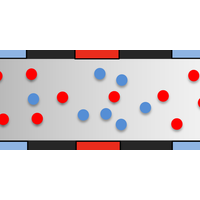
    <description>Author(s): Ubaldo M. C&#243;rdova-Figueroa and John F. Brady&lt;br/&gt;A model for self-propulsion of a colloidal particle&#8212;the osmotic motor&#8212;immersed in a dispersion of &#8220;bath&#8221; particles is presented. The nonequilibrium concentration of bath particles induced by a surface chemical reaction creates an osmotic pressure imbalance on the motor causing it to move. Th...&lt;br/&gt;[Phys. Rev. Lett. 100, 158303] Published Thu Apr 17, 2008</description>
    <dc:creator>Ubaldo M. C&#243;rdova-Figueroa and John F. Brady</dc:creator>
    <dc:date>2008-04-17T00:00:00-04:00</dc:date>
    <dc:rights>Personal use only, all commercial or other reuse prohibited</dc:rights>
    <dc:identifier>10.1103/PhysRevLett.100.158303</dc:identifier>
    <dc:source>Phys. Rev. Lett. 100, 158303</dc:source>
    <dc:format>text/html</dc:format>
    <dc:type>article</dc:type>
    <prism:publicationName>Physical Review Letters</prism:publicationName>
    <prism:volume>100</prism:volume>
    <prism:issueIdentifier>15</prism:issueIdentifier>
    <prism:publicationDate>2008-04-17T00:00:00-04:00</prism:publicationDate>
    <prism:startingPage>158303</prism:startingPage>
    <dc:subject>Soft Matter, Biological, and Interdisciplinary Physics</dc:subject>
    <prism:section>Soft Matter, Biological, and Interdisciplinary Physics</prism:section>
  </item>
  <item rdf:about="http://link.aps.org/doi/10.1103/PhysRevLett.100.158302">
    <title>Dynamics of Polyelectrolyte Transport through a Protein Channel as a Function of Applied Voltage</title>
    <link>http://link.aps.org/doi/10.1103/PhysRevLett.100.158302</link>
    <description>Author(s): L. Brun, M. Pastoriza-Gallego, G. Oukhaled, J. Math&#233;, L. Bacri, L. Auvray, and J. Pelta&lt;br/&gt;We study the transport of dextran sulfate through a protein channel as a function of applied voltage. Below 60&#160;mV, the chain&#8217;s entrance to the pore is hindered by an entropic barrier; above 60&#160;mV, the strong local electric field forces the chain entrance. The effective charge of the polyelectrol...&lt;br/&gt;[Phys. Rev. Lett. 100, 158302] Published Thu Apr 17, 2008</description>
    <dc:creator>L. Brun, M. Pastoriza-Gallego, G. Oukhaled, J. Math&#233;, L. Bacri, L. Auvray, and J. Pelta</dc:creator>
    <dc:date>2008-04-17T00:00:00-04:00</dc:date>
    <dc:rights>Personal use only, all commercial or other reuse prohibited</dc:rights>
    <dc:identifier>10.1103/PhysRevLett.100.158302</dc:identifier>
    <dc:source>Phys. Rev. Lett. 100, 158302</dc:source>
    <dc:format>text/html</dc:format>
    <dc:type>article</dc:type>
    <prism:publicationName>Physical Review Letters</prism:publicationName>
    <prism:volume>100</prism:volume>
    <prism:issueIdentifier>15</prism:issueIdentifier>
    <prism:publicationDate>2008-04-17T00:00:00-04:00</prism:publicationDate>
    <prism:startingPage>158302</prism:startingPage>
    <dc:subject>Soft Matter, Biological, and Interdisciplinary Physics</dc:subject>
    <prism:section>Soft Matter, Biological, and Interdisciplinary Physics</prism:section>
  </item>
  <item rdf:about="http://link.aps.org/doi/10.1103/PhysRevLett.100.158103">
    <title>Polymer-Induced Tubulation in Lipid Vesicles</title>
    <link>http://link.aps.org/doi/10.1103/PhysRevLett.100.158103</link>
    <description>Author(s): F. Campelo and A. Hern&#225;ndez&#8211;Machado&lt;br/&gt;A mechanism of extraction of tubular membranes from a lipid vesicle is presented. A concentration gradient of anchoring amphiphilic polymers generates tubes from budlike vesicle protrusions. We explain this mechanism in the framework of the Canham-Helfrich model. The energy profile is analytically c...&lt;br/&gt;[Phys. Rev. Lett. 100, 158103] Published Thu Apr 17, 2008</description>
    <dc:creator>F. Campelo and A. Hern&#225;ndez&#8211;Machado</dc:creator>
    <dc:date>2008-04-17T00:00:00-04:00</dc:date>
    <dc:rights>Personal use only, all commercial or other reuse prohibited</dc:rights>
    <dc:identifier>10.1103/PhysRevLett.100.158103</dc:identifier>
    <dc:source>Phys. Rev. Lett. 100, 158103</dc:source>
    <dc:format>text/html</dc:format>
    <dc:type>article</dc:type>
    <prism:publicationName>Physical Review Letters</prism:publicationName>
    <prism:volume>100</prism:volume>
    <prism:issueIdentifier>15</prism:issueIdentifier>
    <prism:publicationDate>2008-04-17T00:00:00-04:00</prism:publicationDate>
    <prism:startingPage>158103</prism:startingPage>
    <dc:subject>Soft Matter, Biological, and Interdisciplinary Physics</dc:subject>
    <prism:section>Soft Matter, Biological, and Interdisciplinary Physics</prism:section>
  </item>
  <item rdf:about="http://link.aps.org/doi/10.1103/PhysRevLett.100.158102">
    <title>Kinetic Limitations of Cooperativity-Based Drug Delivery Systems</title>
    <link>http://link.aps.org/doi/10.1103/PhysRevLett.100.158102</link>
    <description>Author(s): Nicholas A. Licata and Alexei V. Tkachenko&lt;br/&gt;We study theoretically a novel drug delivery system that utilizes the overexpression of certain proteins in cancerous cells for cell-specific chemotherapy. The system consists of dendrimers conjugated with &#8220;keys&#8221; (ex: folic acid) which &#8220;key-lock&#8221; bind to particular cell-membrane proteins (ex...&lt;br/&gt;[Phys. Rev. Lett. 100, 158102] Published Thu Apr 17, 2008</description>
    <dc:creator>Nicholas A. Licata and Alexei V. Tkachenko</dc:creator>
    <dc:date>2008-04-17T00:00:00-04:00</dc:date>
    <dc:rights>Personal use only, all commercial or other reuse prohibited</dc:rights>
    <dc:identifier>10.1103/PhysRevLett.100.158102</dc:identifier>
    <dc:source>Phys. Rev. Lett. 100, 158102</dc:source>
    <dc:format>text/html</dc:format>
    <dc:type>article</dc:type>
    <prism:publicationName>Physical Review Letters</prism:publicationName>
    <prism:volume>100</prism:volume>
    <prism:issueIdentifier>15</prism:issueIdentifier>
    <prism:publicationDate>2008-04-17T00:00:00-04:00</prism:publicationDate>
    <prism:startingPage>158102</prism:startingPage>
    <dc:subject>Soft Matter, Biological, and Interdisciplinary Physics</dc:subject>
    <prism:section>Soft Matter, Biological, and Interdisciplinary Physics</prism:section>
  </item>
  <item rdf:about="http://link.aps.org/doi/10.1103/PhysRevLett.100.158003">
    <title>Acoustic Probing of the Jamming Transition in an Unconsolidated Granular Medium</title>
    <link>http://link.aps.org/doi/10.1103/PhysRevLett.100.158003</link>
    <description>Author(s): X. Jacob, V. Aleshin, V. Tournat, P. Leclaire, W. Lauriks, and V. E. Gusev&lt;br/&gt;Experimentally determined dispersion relations for acoustic waves guided along the mechanically free surface of an unconsolidated granular packed structure provide information on the elasticity of granular media at very low pressures that are naturally controlled by the gravitational acceleration an...&lt;br/&gt;[Phys. Rev. Lett. 100, 158003] Published Thu Apr 17, 2008</description>
    <dc:creator>X. Jacob, V. Aleshin, V. Tournat, P. Leclaire, W. Lauriks, and V. E. Gusev</dc:creator>
    <dc:date>2008-04-17T00:00:00-04:00</dc:date>
    <dc:rights>Personal use only, all commercial or other reuse prohibited</dc:rights>
    <dc:identifier>10.1103/PhysRevLett.100.158003</dc:identifier>
    <dc:source>Phys. Rev. Lett. 100, 158003</dc:source>
    <dc:format>text/html</dc:format>
    <dc:type>article</dc:type>
    <prism:publicationName>Physical Review Letters</prism:publicationName>
    <prism:volume>100</prism:volume>
    <prism:issueIdentifier>15</prism:issueIdentifier>
    <prism:publicationDate>2008-04-17T00:00:00-04:00</prism:publicationDate>
    <prism:startingPage>158003</prism:startingPage>
    <dc:subject>Soft Matter, Biological, and Interdisciplinary Physics</dc:subject>
    <prism:section>Soft Matter, Biological, and Interdisciplinary Physics</prism:section>
  </item>
  <item rdf:about="http://link.aps.org/doi/10.1103/PhysRevLett.100.158002">
    <title>Direct Observation of Medium-Range Crystalline Order in Granular Liquids Near the Glass Transition</title>
    <link>http://link.aps.org/doi/10.1103/PhysRevLett.100.158002</link>
    <description>Author(s): Keiji Watanabe and Hajime Tanaka&lt;br/&gt;Collective behavior of driven granular matter is often strikingly analogous to that of thermal systems. Here we use a vibrated quasi-two-dimensional granular matter as a model system and investigate the mechanism of the liquid-glass transition. We demonstrate by direct observation the existence of l...&lt;br/&gt;[Phys. Rev. Lett. 100, 158002] Published Wed Apr 16, 2008</description>
    <dc:creator>Keiji Watanabe and Hajime Tanaka</dc:creator>
    <dc:date>2008-04-16T00:00:00-04:00</dc:date>
    <dc:rights>Personal use only, all commercial or other reuse prohibited</dc:rights>
    <dc:identifier>10.1103/PhysRevLett.100.158002</dc:identifier>
    <dc:source>Phys. Rev. Lett. 100, 158002</dc:source>
    <dc:format>text/html</dc:format>
    <dc:type>article</dc:type>
    <prism:publicationName>Physical Review Letters</prism:publicationName>
    <prism:volume>100</prism:volume>
    <prism:issueIdentifier>15</prism:issueIdentifier>
    <prism:publicationDate>2008-04-16T00:00:00-04:00</prism:publicationDate>
    <prism:startingPage>158002</prism:startingPage>
    <dc:subject>Soft Matter, Biological, and Interdisciplinary Physics</dc:subject>
    <prism:section>Soft Matter, Biological, and Interdisciplinary Physics</prism:section>
  </item>
  <item rdf:about="http://link.aps.org/doi/10.1103/PhysRevLett.100.158001">
    <title>Heating Mechanism Affects Equipartition in a Binary Granular System</title>
    <link>http://link.aps.org/doi/10.1103/PhysRevLett.100.158001</link>
    <description>Author(s): Hong-Qiang Wang and Narayanan Menon&lt;br/&gt;Two species of particles in a binary granular system typically do not have the same mean kinetic energy, in contrast to the equipartition of energy required in equilibrium. We investigate the role of the heating mechanism in determining the extent of nonequipartition of kinetic energy. In most exper...&lt;br/&gt;[Phys. Rev. Lett. 100, 158001] Published Wed Apr 16, 2008</description>
    <dc:creator>Hong-Qiang Wang and Narayanan Menon</dc:creator>
    <dc:date>2008-04-16T00:00:00-04:00</dc:date>
    <dc:rights>Personal use only, all commercial or other reuse prohibited</dc:rights>
    <dc:identifier>10.1103/PhysRevLett.100.158001</dc:identifier>
    <dc:source>Phys. Rev. Lett. 100, 158001</dc:source>
    <dc:format>text/html</dc:format>
    <dc:type>article</dc:type>
    <prism:publicationName>Physical Review Letters</prism:publicationName>
    <prism:volume>100</prism:volume>
    <prism:issueIdentifier>15</prism:issueIdentifier>
    <prism:publicationDate>2008-04-16T00:00:00-04:00</prism:publicationDate>
    <prism:startingPage>158001</prism:startingPage>
    <dc:subject>Soft Matter, Biological, and Interdisciplinary Physics</dc:subject>
    <prism:section>Soft Matter, Biological, and Interdisciplinary Physics</prism:section>
  </item>
</rdf:RDF>