Scientists have found seven astrophysical tau neutrinos—particles that are notoriously difficult to detect—in an analysis of data from the IceCube Neutrino Observatory in Antarctica.

[Phys. Rev. Lett. 132, 151001] Published Thu Apr 11, 2024
]]>Scientists have found seven astrophysical tau neutrinos—particles that are notoriously difficult to detect—in an analysis of data from the IceCube Neutrino Observatory in Antarctica.
[Phys. Rev. Lett. 132, 151001] Published Thu Apr 11, 2024
]]>Vorticity has recently been suggested to be a property of highly spinning black holes. The connection between vorticity and limiting spin represents a universal feature shared by objects of maximal microstate entropy, so-called saturons. Using -ball-like saturons as a laboratory for black holes, we…
[Phys. Rev. Lett. 132, 151402] Published Thu Apr 11, 2024
]]>Recent surveys have discovered a population of faint supernovae, known as Ca-rich gap transients, inferred to originate from explosive ignitions of white dwarfs. In addition to their unique spectra and luminosities, these supernovae have an unusual spatial distribution and are predominantly found at…
[Phys. Rev. Lett. 132, 151401] Published Tue Apr 09, 2024
]]>The intrinsic presence of ghosts in the symmetric teleparallel framework is elucidated. We illustrate our general arguments in theories by studying perturbations in the three inequivalent spatially flat cosmologies. Two of these branches exhibit reduced linear spectra, signalling they are infin…
[Phys. Rev. Lett. 132, 141401] Published Mon Apr 01, 2024
]]>A theoretical proposal presents a framework for microscopic explanation of the entropy of astrophysical black holes.

[Phys. Rev. Lett. 132, 141501] Published Mon Apr 01, 2024
]]>A proof-of-principle search for dark-photon dark-matter particles surpasses existing constraints for a mass ~50 μeV by about two orders of magnitude.

[Phys. Rev. Lett. 132, 131004] Published Thu Mar 28, 2024
]]>A theoretical framework is presented for the computation of the gravitational analog of the Raman effect.

[Phys. Rev. Lett. 132, 131401] Published Thu Mar 28, 2024
]]>High-frequency gravitational waves (HFGWs) carry a wealth of information on the early Universe with a tiny comoving horizon and astronomical objects of small scale but with dense energy. We demonstrate that the nearby planets, such as Earth and Jupiter, can be utilized as a laboratory for detecting …
[Phys. Rev. Lett. 132, 131402] Published Thu Mar 28, 2024
]]>Using observations made with an array of thousands of particle detectors, researchers have uncovered an important clue about cosmic rays that originate from outside of our Galaxy.

[Phys. Rev. Lett. 132, 131002] Published Tue Mar 26, 2024
]]>The cosmic large-scale structure (LSS) provides a unique testing ground for connecting fundamental physics to astronomical observations. Modeling the LSS requires numerical -body simulations or perturbative techniques that both come with distinct shortcomings. Here we present the first unified nume…
[Phys. Rev. Lett. 132, 131003] Published Tue Mar 26, 2024
]]>We searched for antideuterons (’s) in the cosmic-ray events observed during the BESS-Polar II flight at solar minimum in 2007–2008 but found no candidates. The resulting 95% C.L. upper limit on the flux is in an energy range from 0.163 to . The re…
[Phys. Rev. Lett. 132, 131001] Published Mon Mar 25, 2024
]]>We present a numerical calculation of the expectation value of the quantum angular-momentum current flux density for a scalar field in the Unruh state near the inner horizon of a Kerr–de Sitter black hole. Our results indicate that this flux diverges as in a suitable Kruskal coordinate such tha…
[Phys. Rev. Lett. 132, 121501] Published Thu Mar 21, 2024
]]>The clumpy structure of a ring of gas ejected by the progenitor star of the supernova 1987A could have formed when vortices in the gas interacted.

[Phys. Rev. Lett. 132, 111201] Published Wed Mar 13, 2024
]]>Gravitational waves with frequencies below 1 nHz are notoriously difficult to detect. With periods exceeding current experimental lifetimes, they induce slow drifts in observables rather than periodic correlations. Observables with well-known intrinsic contributions provide a means to probe this reg…
[Phys. Rev. Lett. 132, 101403] Published Fri Mar 08, 2024
]]>Dark matter (DM) particles with sufficiently large cross sections may scatter as they travel through Earth’s bulk. The corresponding changes in the DM flux give rise to a characteristic daily modulation signal in detectors sensitive to DM-electron interactions. Here, we report results obtained from …
[Phys. Rev. Lett. 132, 101006] Published Thu Mar 07, 2024
]]>Higher-order spatial laser modes have recently been investigated as candidates for reducing test-mass thermal noise in ground-based gravitational-wave detectors such as advanced LIGO. In particular, higher-order Hermite-Gauss (HG) modes have gained attention within the community for their more robus…
[Phys. Rev. Lett. 132, 101402] Published Thu Mar 07, 2024
]]>We use multimessenger observations of the neutron star merger event GW170817 to derive new constraints on axionlike particles (ALPs) coupling to photons. ALPs are produced via Primakoff and photon coalescence processes in the merger, escape the remnant, and decay back into two photons, giving rise t…
[Phys. Rev. Lett. 132, 101003] Published Tue Mar 05, 2024
]]>The metastable hypermassive neutron star produced in the coalescence of two neutron stars can copiously produce axions that radiatively decay into photons. These photons can form a fireball with characteristic temperature smaller than 1 MeV. By relying on x-ray observations of GW170817/G…
[Phys. Rev. Lett. 132, 101004] Published Tue Mar 05, 2024
]]>We investigate the effect of resonant spin conversion of the neutrinos induced by the geometrical phase in a twisting magnetic field. We find that the geometrical phase originating from the rotation of the transverse magnetic field along the neutrino trajectory can trigger a resonant spin conversion…
[Phys. Rev. Lett. 132, 101005] Published Tue Mar 05, 2024
]]>The precise modeling of binary black hole coalescences in generic planar orbits is a crucial step to disentangle dynamical and isolated binary formation channels through gravitational-wave observations. The merger regime of such coalescences exhibits a significantly higher complexity compared to the…
[Phys. Rev. Lett. 132, 101401] Published Tue Mar 05, 2024
]]>We propose a novel experimental method for probing light dark matter candidates. We show that an electro-optical material’s refractive index is modified in the presence of a coherently oscillating dark matter background. A high-precision resonant Michelson interferometer can be used to read out this…
[Phys. Rev. Lett. 132, 101001] Published Mon Mar 04, 2024
]]>IceCube Collaboration has previously reported evidence for a neutrino signal from a Seyfert galaxy NGC 1068. This may suggest that all Seyfert galaxies emit neutrinos. To test this hypothesis, we identify the best candidate neutrino sources among nearby Seyfert galaxies, based on their hard x-ray pr…
[Phys. Rev. Lett. 132, 101002] Published Mon Mar 04, 2024
]]>We derive an effective field theory describing a pair of gravitationally interacting point particles in an expansion in their mass ratio, also known as the self-force (SF) expansion. The 0SF dynamics are trivially obtained to all orders in Newton’s constant by the geodesic motion of the light body i…
[Phys. Rev. Lett. 132, 091402] Published Thu Feb 29, 2024
]]>We analytically solve the problem of Bose star growth in the bath of gravitationally interacting particles. We find that after nucleation of this object, the bath is described by a self-similar solution of the kinetic equation. Together with the conservation laws, this fixes mass evolution of the Bo…
[Phys. Rev. Lett. 132, 091001] Published Tue Feb 27, 2024
]]>Binary coalescences are known sources of gravitational waves (GWs) and they encompass combinations of black holes (BHs) and neutron stars (NSs). Here we show that when BHs are embedded in magnetic fields (’s) larger than approximately , charged particles colliding around their event horizons…
[Phys. Rev. Lett. 132, 091401] Published Tue Feb 27, 2024
]]>The QCD axion needs not be an exact pseudoscalar for solving the strong problem. Its imperfectness can play a profound role cosmologically. We propose effective operators, where the Peccei-Quinn field linearly couples to standard model particles, provide a dynamical solution to the domain wall pr…
[Phys. Rev. Lett. 132, 081003] Published Fri Feb 23, 2024
]]>Pulsar timing arrays (PTAs) have reported evidence for a stochastic gravitational wave (GW) background at nanohertz frequencies, possibly originating in the early Universe. We show that the spectral shape of the low-frequency (causality) tail of GW signals sourced at temperatures around is …
[Phys. Rev. Lett. 132, 081001] Published Tue Feb 20, 2024
]]>We introduce and study the first class of signals that can probe the dark matter in mesogenesis, which will be observable at current and upcoming large volume neutrino experiments. The well-motivated mesogenesis scenario for generating the observed matter-antimatter asymmetry necessarily has dark ma…
[Phys. Rev. Lett. 132, 081002] Published Tue Feb 20, 2024
]]>The new JWST observatory is revealing far more bright galaxies in the early Universe than anyone predicted, and astrophysicists have more than one explanation for the puzzle.

[Phys. Rev. Lett. 132, 061002] Published Fri Feb 09, 2024
]]>We show that ATLAS, a collider detector, can measure the flux of high-energy supernova neutrinos, which can be produced from days to months after the explosion. Using Monte Carlo simulations for predicted fluxes, we find at most starting events and throughgoing events from a super…
[Phys. Rev. Lett. 132, 061001] Published Thu Feb 08, 2024
]]>Binary systems of supermassive black holes are promising sources of low-frequency gravitational waves (GWs) and bright electromagnetic emission. Pulsar timing array GW searches for individual binaries have been limited to only a few candidate systems due to computational demands, which get worse as …
[Phys. Rev. Lett. 132, 061401] Published Mon Feb 05, 2024
]]>Dark matter is typically assumed not to couple to the photon at tree level. While annihilation to photons through quark loops is often considered in indirect detection searches, such loop-level effects are usually neglected in direct detection, as they are typically subdominant to tree-level dark-ma…
[Phys. Rev. Lett. 132, 051001] Published Wed Jan 31, 2024
]]>We present the measurement of the cosmic ray proton spectrum from 50 TeV to 1.3 PeV using extensive air shower events recorded by the ground-based GRAPES-3 experiment between 1 January 2014 and 26 October 2015 with a live time of 460 day. Our measurements provide an overlap with direct obse…
[Phys. Rev. Lett. 132, 051002] Published Wed Jan 31, 2024
]]>We develop a relativistic perturbation theory for scalar clouds around rotating black holes. We first introduce a relativistic product and corresponding orthogonality relation between modes, extending a recent result for gravitational perturbations. We then derive the analog of time-dependent pertur…
[Phys. Rev. Lett. 132, 051401] Published Wed Jan 31, 2024
]]>With excellent energy resolution and ultralow-level radiogenic backgrounds, the high-purity germanium detectors in the Majorana Demonstrator enable searches for several classes of exotic dark matter (DM) models. In this work, we report new experimental limits on keV-scale sterile neutrino DM via the…
[Phys. Rev. Lett. 132, 041001] Published Tue Jan 23, 2024
]]>We use explainable neural networks to connect the evolutionary history of dark matter halos with their density profiles. The network captures independent factors of variation in the density profiles within a low-dimensional representation, which we physically interpret using mutual information. With…
[Phys. Rev. Lett. 132, 031001] Published Fri Jan 19, 2024
]]>Regular black hole spacetimes are obtained from an effective Lagrangian for quantum Einstein gravity. The interior matter is modeled as a dust fluid, which interacts with the geometry through a multiplicative coupling function denoted as . The specific functional form of is deduced from asymptoti…
[Phys. Rev. Lett. 132, 031401] Published Fri Jan 19, 2024
]]>When hypothetical neutrino secret interactions () are large, they form a fluid in a supernova (SN) core, flow out with sonic speed, and stream away as a fireball. For the first time, we tackle the complete dynamical problem and solve all steps, systematically using relativistic hydrodynamics. The…
[Phys. Rev. Lett. 132, 021002] Published Thu Jan 11, 2024
]]>We show, for the first time, radio measurements of the depth of shower maximum () of air showers induced by cosmic rays that are compared to measurements of the established fluorescence method at the same location. Using measurements at the Pierre Auger Observatory we show full compatibility bet…
[Phys. Rev. Lett. 132, 021001] Published Mon Jan 08, 2024
]]>In recent years, there has been significant interest in the field of extended black hole thermodynamics, where the cosmological constant and/or other coupling parameters are treated as thermodynamic variables. Drawing inspiration from the Iyer-Wald formalism, which reveals the intrinsic and universa…
[Phys. Rev. Lett. 132, 021401] Published Mon Jan 08, 2024
]]>We investigate the detectability of gravitational waves that have been lensed by a spinless stellar-mass black hole, with respect to the advanced LIGO. By solving the full relativistic linear wave equations in the spacetime of a Schwarzschild black hole, we find that the strong gravity can create un…
[Phys. Rev. Lett. 132, 011401] Published Wed Jan 03, 2024
]]>The LHAASO Collaboration detected the gamma ray burst GRB 221009A at energies above 500 GeV with a tail extending up to 18 TeV, whose spectral analysis has presently been performed up to 7 TeV for the lower energy instrument LHAASO-WCDA only, with no indication of a cutoff. Soon thereafter, Carpet-2…
[Phys. Rev. Lett. 131, 251001] Published Mon Dec 18, 2023
]]>A recent discovery of additional mechanism of electroluminescence (EL) in noble gases due to the neutral bremsstrahlung (NBrS) effect led to a prediction that NBrS EL should be present in noble liquids as well. A theoretical model of NBrS EL in noble liquids was developed accordingly in the framewor…
[Phys. Rev. Lett. 131, 241001] Published Tue Dec 12, 2023
]]>We compute the radiation reacted momentum impulse , spin kick , and scattering angle between two scattered spinning massive bodies (black holes or neutron stars) using the supersymmetric worldline quantum field theory formalism up to fourth post-Minkowskian (4PM) order. Our calculation…
[Phys. Rev. Lett. 131, 241402] Published Tue Dec 12, 2023
]]>We propose novel thermodynamic inequalities that apply to stationary asymptotically anti–de Sitter (AdS) black holes. These inequalities incorporate the thermodynamic volume and refine the reverse isoperimetric inequality. To assess the validity of our conjectures, we apply them to a wide range of a…
[Phys. Rev. Lett. 131, 241401] Published Mon Dec 11, 2023
]]>Primordial magnetic fields (PMF) can enhance baryon perturbations on scales below the photon mean free path. However, a magnetically driven baryon fluid becomes turbulent near recombination, thereby damping out baryon perturbations below the turbulence scale. In this Letter, we show that the initial…
[Phys. Rev. Lett. 131, 231002] Published Fri Dec 08, 2023
]]>We perform three-dimensional general-relativistic magnetohydrodynamic simulations with weak interactions of binary neutron-star (BNS) mergers resulting in a long-lived remnant neutron star, with properties typical of galactic BNS and consistent with those inferred for the first observed BNS merger G…
[Phys. Rev. Lett. 131, 231402] Published Fri Dec 08, 2023
]]>Supercomputer simulations of the weather on a hot Jupiter reveal a previously unseen storm pattern in which cyclones are repeatedly generated and destroyed.

[Phys. Rev. Lett. 131, 231201] Published Thu Dec 07, 2023
]]>The gravitational waves emitted by a perturbed black hole ringing down are well described by damped sinusoids, whose frequencies are those of quasinormal modes. Typically, first-order black hole perturbation theory is used to calculate these frequencies. Recently, it was shown that second-order effe…
[Phys. Rev. Lett. 131, 231401] Published Wed Dec 06, 2023
]]>It is often stated that the observation of high-energy neutrinos from an astrophysical source would constitute indisputable proof for the acceleration of hadronic cosmic rays. Here, we point out that there exists a purely leptonic mechanism to produce TeV-scale neutrinos in astrophysical environment…
[Phys. Rev. Lett. 131, 231001] Published Tue Dec 05, 2023
]]>For any given network of detectors, and for any given integration time, even in the idealized limit of negligible instrumental noise, the intrinsic time variation of the isotropic component of the stochastic gravitational wave background (SGWB) induces a limit on how accurately the anisotropies in t…
[Phys. Rev. Lett. 131, 221403] Published Thu Nov 30, 2023
]]>Light dark fermions can mass mix with the standard model (SM) neutrinos. As a result, through oscillations and scattering, they can equilibrate in the early universe. Interactions of the dark fermion generically suppress such production at high temperatures but enhance it at later times. We find tha…
[Phys. Rev. Lett. 131, 221001] Published Tue Nov 28, 2023
]]>When two black holes merge, the late stage of gravitational wave emission is a superposition of exponentially damped sinusoids. According to the black hole no-hair theorem, this ringdown spectrum depends only on the mass and angular momentum of the final black hole. An observation of more than one r…
[Phys. Rev. Lett. 131, 221402] Published Tue Nov 28, 2023
]]>Spinning black holes may have a hidden higher-spin gauge symmetry.

[Phys. Rev. Lett. 131, 221401] Published Mon Nov 27, 2023
]]>We propose a novel dark matter detection method utilizing the excitation of superconducting transmon qubits. Assuming the hidden photon dark matter of a mass of , the classical wave-matter oscillation induces an effective ac electric field via the small kinetic mixing with the ordinary pho…
[Phys. Rev. Lett. 131, 211001] Published Wed Nov 22, 2023
]]>We use a result of Hawking and Gilkey to define a Euclidean path integral of gravity and matter which has the special property of being independent of the choice of basis in the space of fields. This property allows the path integral to also describe physical regimes that do not admit position bases…
[Phys. Rev. Lett. 131, 211501] Published Wed Nov 22, 2023
]]>An early-Universe spike in dark energy could resolve a disagreement between two cosmic-expansion-rate measurements, but such a spike may conflict with observations of quasar spectra.

[Phys. Rev. Lett. 131, 201001] Published Fri Nov 17, 2023
]]>The balance between the abundance of primordial black holes and non-Gaussianities is reanalyzed in light of the recent NANOGrav data.

[Phys. Rev. Lett. 131, 201401] Published Mon Nov 13, 2023
]]>Detailed measurements of the spectral structure of cosmic-ray electrons and positrons from 10.6 GeV to 7.5 TeV are presented from over 7 years of observations with the CALorimetric Electron Telescope (CALET) on the International Space Station. The instrument, consisting of a charge detector, an imag…
[Phys. Rev. Lett. 131, 191001] Published Thu Nov 09, 2023
]]>We report results of a search for dark-matter–nucleon interactions via a dark mediator using optimized low-energy data from the PandaX-4T liquid xenon experiment. With the ionization-signal-only data and utilizing the Migdal effect, we set the most stringent limits on the cross section for dark matt…
[Phys. Rev. Lett. 131, 191002] Published Thu Nov 09, 2023
]]>We show that the Kontsevich-Segal (KS) criterion, applied to the complex saddles that specify the semiclassical no-boundary wave function, acts as a selection mechanism on inflationary scalar field potentials. Completing the observable phase of slow-roll inflation with a no-boundary origin, the KS c…
[Phys. Rev. Lett. 131, 191501] Published Wed Nov 08, 2023
]]>Using relativistic supernova simulations of massive progenitor stars with a quark-hadron equation of state (EOS) and a purely hadronic EOS, we identify a distinctive feature in the gravitational-wave signal that originates from a buoyancy-driven mode ( mode) below the proto-neutron star convection …
[Phys. Rev. Lett. 131, 191201] Published Tue Nov 07, 2023
]]>Observations of the cosmic microwave background (CMB) have cemented the notion that the large-scale Universe is both statistically homogeneous and isotropic. But is it invariant also under reflections? To probe this we require parity-sensitive statistics: for scalar observables, the simplest is the …
[Phys. Rev. Lett. 131, 181001] Published Fri Nov 03, 2023
]]>Fine-tuning generic but smooth spherically symmetric initial data for general relativity to the threshold of dynamical black hole formation creates arbitrarily large curvatures, mediated by a universal self-similar solution that acts as an intermediate attractor. For vacuum gravitational waves, howe…
[Phys. Rev. Lett. 131, 181401] Published Mon Oct 30, 2023
]]>We perform a Bayesian analysis of NANOGrav 15-yr and IPTA DR2 pulsar timing residuals and show that the recently detected stochastic gravitational-wave background is compatible with a stochastic gravitational-wave background produced by bubble dynamics during a cosmological first-order phase transit…
[Phys. Rev. Lett. 131, 171404] Published Thu Oct 26, 2023
]]>If ultralight dark matter particles exist, they can contribute no more than 70% of the dark matter between Earth and a set of monitored pulsars.
[Phys. Rev. Lett. 131, 171001] Published Wed Oct 25, 2023
]]>We present a new, simulation-based inference method to compute the angular power spectrum of the distribution of foreground gravitational-wave transient events. As a first application of this method, we use the binary black hole mergers observed during the LIGO, Virgo, and KAGRA third observation ru…
[Phys. Rev. Lett. 131, 171403] Published Wed Oct 25, 2023
]]>Coating thermal noise is one of the dominant noise sources in current gravitational wave detectors and ultimately limits their ability to observe weaker or more distant astronomical sources. This Letter presents investigations of mixed with () as a coating material. We find that, …
[Phys. Rev. Lett. 131, 171401] Published Mon Oct 23, 2023
]]>The quest for complete observables in general relativity has been a long-standing open problem. We employ methods from descriptive set theory to show that no complete observable on rich enough collections of spacetimes is Borel definable. In fact, we show that it is consistent with the Zermelo-Fraen…
[Phys. Rev. Lett. 131, 171402] Published Mon Oct 23, 2023
]]>We study the nonlinear dynamics of axion inflation, capturing for the first time the inhomogeneity and full dynamical range during strong backreaction, till the end of inflation. Accounting for inhomogeneous effects leads to a number of new relevant results, compared to spatially homogeneous studies…
[Phys. Rev. Lett. 131, 151003] Published Fri Oct 13, 2023
]]>We present the precision measurements of 11 years of daily cosmic positron fluxes in the rigidity range from 1.00 to 41.9 GV based on positrons collected with the Alpha Magnetic Spectrometer (AMS) aboard the International Space Station. The positron fluxes show distinctly different time vari…
[Phys. Rev. Lett. 131, 151002] Published Thu Oct 12, 2023
]]>Using the supersymmetric, spinning worldline quantum field theory formalism, we compute the conservative spin-orbit part of the momentum impulse , spin kick , and scattering angle from the scattering of two spinning massive bodies (black holes or neutron stars) up to fourth post-Minkow…
[Phys. Rev. Lett. 131, 151401] Published Wed Oct 11, 2023
]]>Interstellar magnetic fields perturb the trajectories of cosmic rays, making it difficult to identify their sources. A new survey of gamma radiation produced when cosmic rays interact with the interstellar medium should help in this identification.

[Phys. Rev. Lett. 131, 151001] Published Mon Oct 09, 2023
]]>We propose a new probe of inflationary gravitational waves (IGWs): the cross-correlation of the lensing of inflationary -mode polarization with a large-scale structure (LSS) tracer, which can also be a cosmic microwave background (CMB) lensing map. This is equivalent to measuring a three-point func…
[Phys. Rev. Lett. 131, 131001] Published Tue Sep 26, 2023
]]>Black holes may be less unique than previously thought, as the expansion due to a cosmological constant can hold apart a pair of holes and allow them to mimic a single black hole.

[Phys. Rev. Lett. 131, 131401] Published Mon Sep 25, 2023
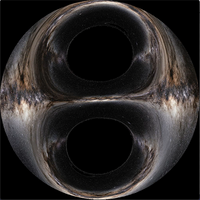
]]>When general relativity is coupled to bosonic matter, two spinning black holes can in principle form a stable molecule with quantum effects balancing gravitational effects.
[Phys. Rev. Lett. 131, 121401] Published Thu Sep 21, 2023
]]>A collective effort involving various theoretical frameworks results in the successful gravitational wave phasing of nonspinning compact binary systems on quasicircular orbits up to the 4.5 post-Newtonian order.
[Phys. Rev. Lett. 131, 121402] Published Thu Sep 21, 2023
]]>Polarization of the cosmic microwave background (CMB) is sensitive to new physics violating parity symmetry, such as the presence of a pseudoscalar “axionlike” field. Such a field may be responsible for early dark energy (EDE), which is active prior to recombination and provides a solution to the so…
[Phys. Rev. Lett. 131, 121001] Published Mon Sep 18, 2023
]]>We make the case that there can be no low-redshift solution to the tension. To robustly answer this question, we use a very flexible parametrization for the dark energy equation of state such that every cosmological distance still allowed by data exists within this prior volume. To then answer wh…
[Phys. Rev. Lett. 131, 111002] Published Fri Sep 15, 2023
]]>Starburst galaxies are well-motivated astrophysical emitters of high-energy gamma rays. They are well-known cosmic-ray “reservoirs,” thanks to their expected large magnetic field turbulence which confine high-energy protons for . Over such long times, cosmic-ray transport can be significa…
[Phys. Rev. Lett. 131, 111003] Published Fri Sep 15, 2023
]]>Axions can be copiously produced in localized regions of neutron star magnetospheres where the ambient plasma is unable to efficiently screen the induced electric field. As these axions stream away from the neutron star they can resonantly transition into photons, generating a large broadband contri…
[Phys. Rev. Lett. 131, 111004] Published Fri Sep 15, 2023
]]>The large scale limit of the galaxy power spectrum provides a unique window into the early Universe through a possible detection of scale dependent bias produced by primordial non Gaussianities. On such large scales, relativistic effects could become important and be confused for a primordial signal…
[Phys. Rev. Lett. 131, 111201] Published Fri Sep 15, 2023
]]>The majority of extensions to general relativity (GR) display mathematical pathologies—higher derivatives, character change in equations that can be classified within partial differential equation theory, and even unclassifiable ones—that cause severe difficulties to study them, especially in dynami…
[Phys. Rev. Lett. 131, 111403] Published Fri Sep 15, 2023
]]>The asymptotic symmetry algebra of four-dimensional Einstein gravity in the asymptotically flat context has been shown recently to be the direct sum of the Poincaré algebra and of an infinite-dimensional Abelian algebra (with central charge) that includes the Bondi-Metzner-Sachs supertranslations. T…
[Phys. Rev. Lett. 131, 111402] Published Thu Sep 14, 2023
]]>A joint analysis of data from the CMB, weak lensing, peculiar velocities, and galaxy clustering, shows that an extension of the concordance cosmological model which includes the suppression of the growth of cosmic structure can alleviate two widely discussed cosmological tensions.

[Phys. Rev. Lett. 131, 111001] Published Mon Sep 11, 2023
]]>The quasinormal mode spectrum of black holes is unstable under small perturbation of the potential and has observational consequences in time signals. Such signals might be experimentally difficult to observe and probing this instability will be a technical challenge. Here, we investigate the spectr…
[Phys. Rev. Lett. 131, 111401] Published Mon Sep 11, 2023
]]>We report the first result of a direct search for a cosmic axion background ()—a relativistic background of axions that is not dark matter—performed with the axion haloscope, the Axion Dark Matter eXperiment (ADMX). Conventional haloscope analyses search for a signal with a narrow bandwidth, as p…
[Phys. Rev. Lett. 131, 101002] Published Fri Sep 08, 2023
]]>A numerical study tests how entangled particles may have a dual description involving connection via nontraversable wormholes.

[Phys. Rev. Lett. 131, 101001] Published Tue Sep 05, 2023
]]>The cosmological lithium problem—that theory predicts a primordial abundance far higher than the observed value—has resisted decades of attempts by cosmologists, nuclear physicists, and astronomers alike to root out systematics. We reconsider this problem in the setting of the standard model extende…
[Phys. Rev. Lett. 131, 091003] Published Fri Sep 01, 2023
]]>A theoretical analysis suggests that certain rotating black holes might be sensitive probes of quantum gravity.

[Phys. Rev. Lett. 131, 091402] Published Thu Aug 31, 2023
]]>We show that it is possible for fermion condensation of the Nambu-Jona-Lasinio type to induce a nonsingular bounce that smoothly connects a phase of slow contraction to a phase of expansion. A chiral condensate—a nonzero vacuum expectation value of the spinor bilinear —can form spontaneously af…
[Phys. Rev. Lett. 131, 091001] Published Tue Aug 29, 2023
]]>Exotic spin-dependent interactions involving new light particles address key questions in modern physics. Interactions between polarized neutrons () and unpolarized nucleons () occur in three forms: , , and , where is the spin and ’s are the corresponding coupling c…
[Phys. Rev. Lett. 131, 091002] Published Tue Aug 29, 2023
]]>Dark matter (DM) from the galactic halo can accumulate in neutron stars and transmute them into sub- black holes if the dark matter particles are heavy, stable, and have interactions with nucleons. We show that nondetection of gravitational waves from mergers of such low-mass black holes can co…
[Phys. Rev. Lett. 131, 091401] Published Tue Aug 29, 2023
]]>Over 10 years ago, Fermi observed an excess of GeV gamma rays from the Galactic Center whose origin is still under debate. One explanation for this excess involves annihilating dark matter, another requires an unresolved population of millisecond pulsars concentrated at the Galactic Center. In this …
[Phys. Rev. Lett. 131, 081401] Published Fri Aug 25, 2023
]]>We show that self-dual gravity in Euclidean four-dimensional anti–de Sitter space () can be described by a scalar field with a cubic interaction written in terms of a deformed Poisson bracket, providing a remarkably simple generalization of the Plebanski action for self-dual gravity in flat spac…
[Phys. Rev. Lett. 131, 081501] Published Thu Aug 24, 2023
]]>We performed a series of 1381 full numerical simulations of high energy collision of black holes to search for the maximum recoil velocity after their merger. We consider equal mass binaries with opposite spins pointing along their orbital plane and perform a search of spin orientations, impact para…
[Phys. Rev. Lett. 131, 071401] Published Fri Aug 18, 2023
]]>A beyond-standard-model interaction between neutrinos could show up in future supernovae observations.

[Phys. Rev. Lett. 131, 071002] Published Tue Aug 15, 2023
]]>We present the first dedicated -ray analysis of Jupiter, using 12 years of data from the Fermi Telescope. We find no robust evidence of -ray emission, and set upper limits of on the Jovian -ray flux. We point out that Jupiter is an advantageous dark matter (DM) target due to i…
[Phys. Rev. Lett. 131, 071001] Published Mon Aug 14, 2023
]]>We present the first simulations of core-collapse supernovae in axial symmetry with feedback from fast neutrino flavor conversion (FFC). Our schematic treatment of FFCs assumes instantaneous flavor equilibration under the constraint of lepton-number conservation individually for each flavor. Systema…
[Phys. Rev. Lett. 131, 061401] Published Mon Aug 07, 2023
]]>Measurements of the highest-energy radiation from the Sun ever seen highlight the need for better solar models.

[Phys. Rev. Lett. 131, 051201] Published Thu Aug 03, 2023
]]>