<?xml version="1.0" encoding="UTF-8"?>
<rdf:RDF xmlns:rdf="http://www.w3.org/1999/02/22-rdf-syntax-ns#" xmlns:prism="http://prismstandard.org/namespaces/basic/2.0/" xmlns:dc="http://purl.org/dc/elements/1.1/" xmlns:syn="http://purl.org/rss/1.0/modules/syndication/" xmlns:content="http://purl.org/rss/1.0/modules/content/" xmlns="http://purl.org/rss/1.0/">
  <channel rdf:about="http://journals.aps.org/prmaterials/">
    <title>Recent Articles in Phys. Rev. Materials</title>
    <link>http://journals.aps.org/prmaterials/</link>
    <description>Recent articles in Physical Review Materials</description>
    <syn:updatePeriod>hourly</syn:updatePeriod>
    <syn:updateFrequency>1</syn:updateFrequency>
    <syn:updateBase>2026-04-11T15:16:38+00:00</syn:updateBase>
    <dc:creator>rss@aps.org</dc:creator>
    <dc:publisher>assocpub@aps.org</dc:publisher>
    <dc:date>2026-04-11T15:16:38+00:00</dc:date>
    <dc:language>en</dc:language>
    <dc:rights>Copyright © 2026 the American Physical Society. Personal use only, all commercial or other reuse prohibited</dc:rights>
    <prism:copyright>Copyright © 2026 the American Physical Society</prism:copyright>
    <prism:rightsAgent>assocpub@aps.org</prism:rightsAgent>
    <items>
      <rdf:Seq>
        <rdf:li rdf:resource="http://link.aps.org/doi/10.1103/gt8b-1psw"/>
        <rdf:li rdf:resource="http://link.aps.org/doi/10.1103/c324-pb9t"/>
        <rdf:li rdf:resource="http://link.aps.org/doi/10.1103/sj53-qws1"/>
        <rdf:li rdf:resource="http://link.aps.org/doi/10.1103/fdrt-2chf"/>
        <rdf:li rdf:resource="http://link.aps.org/doi/10.1103/nzv9-dskm"/>
        <rdf:li rdf:resource="http://link.aps.org/doi/10.1103/nlt7-52tc"/>
        <rdf:li rdf:resource="http://link.aps.org/doi/10.1103/2jy6-qxm5"/>
        <rdf:li rdf:resource="http://link.aps.org/doi/10.1103/53st-7q5j"/>
        <rdf:li rdf:resource="http://link.aps.org/doi/10.1103/6qn6-9zrz"/>
        <rdf:li rdf:resource="http://link.aps.org/doi/10.1103/y1gy-9sfq"/>
        <rdf:li rdf:resource="http://link.aps.org/doi/10.1103/sbr9-3lr2"/>
        <rdf:li rdf:resource="http://link.aps.org/doi/10.1103/mrqn-qy9z"/>
        <rdf:li rdf:resource="http://link.aps.org/doi/10.1103/r4hc-dvmr"/>
        <rdf:li rdf:resource="http://link.aps.org/doi/10.1103/lc66-t2m8"/>
        <rdf:li rdf:resource="http://link.aps.org/doi/10.1103/rbf1-cp89"/>
        <rdf:li rdf:resource="http://link.aps.org/doi/10.1103/1g59-ccgq"/>
        <rdf:li rdf:resource="http://link.aps.org/doi/10.1103/ng2j-nrfv"/>
        <rdf:li rdf:resource="http://link.aps.org/doi/10.1103/4bd1-y268"/>
        <rdf:li rdf:resource="http://link.aps.org/doi/10.1103/yx3x-1hs9"/>
        <rdf:li rdf:resource="http://link.aps.org/doi/10.1103/bvsc-f2xt"/>
        <rdf:li rdf:resource="http://link.aps.org/doi/10.1103/ynbm-hkrp"/>
        <rdf:li rdf:resource="http://link.aps.org/doi/10.1103/zhk4-flgd"/>
        <rdf:li rdf:resource="http://link.aps.org/doi/10.1103/9ldc-sk6x"/>
        <rdf:li rdf:resource="http://link.aps.org/doi/10.1103/jzns-js96"/>
        <rdf:li rdf:resource="http://link.aps.org/doi/10.1103/4wwn-75qm"/>
        <rdf:li rdf:resource="http://link.aps.org/doi/10.1103/l85m-lqqq"/>
        <rdf:li rdf:resource="http://link.aps.org/doi/10.1103/wt54-nm7b"/>
        <rdf:li rdf:resource="http://link.aps.org/doi/10.1103/djlm-1y1h"/>
        <rdf:li rdf:resource="http://link.aps.org/doi/10.1103/7w2l-q7xq"/>
        <rdf:li rdf:resource="http://link.aps.org/doi/10.1103/wjcq-jv1c"/>
        <rdf:li rdf:resource="http://link.aps.org/doi/10.1103/hkqw-qzxr"/>
        <rdf:li rdf:resource="http://link.aps.org/doi/10.1103/gyfq-2c26"/>
        <rdf:li rdf:resource="http://link.aps.org/doi/10.1103/sts8-xtks"/>
        <rdf:li rdf:resource="http://link.aps.org/doi/10.1103/dzwg-bnpp"/>
        <rdf:li rdf:resource="http://link.aps.org/doi/10.1103/fl5l-dhn3"/>
        <rdf:li rdf:resource="http://link.aps.org/doi/10.1103/wblc-phl6"/>
        <rdf:li rdf:resource="http://link.aps.org/doi/10.1103/mlh4-htxv"/>
        <rdf:li rdf:resource="http://link.aps.org/doi/10.1103/297b-7fpm"/>
        <rdf:li rdf:resource="http://link.aps.org/doi/10.1103/t697-7fn5"/>
        <rdf:li rdf:resource="http://link.aps.org/doi/10.1103/stkn-vhrr"/>
        <rdf:li rdf:resource="http://link.aps.org/doi/10.1103/t4m3-jjdn"/>
        <rdf:li rdf:resource="http://link.aps.org/doi/10.1103/k82w-8zf3"/>
        <rdf:li rdf:resource="http://link.aps.org/doi/10.1103/qmhs-x85x"/>
        <rdf:li rdf:resource="http://link.aps.org/doi/10.1103/4q1c-97bp"/>
        <rdf:li rdf:resource="http://link.aps.org/doi/10.1103/f95y-1l6b"/>
        <rdf:li rdf:resource="http://link.aps.org/doi/10.1103/nkc5-rtds"/>
        <rdf:li rdf:resource="http://link.aps.org/doi/10.1103/7p4w-38fj"/>
        <rdf:li rdf:resource="http://link.aps.org/doi/10.1103/6v8t-117b"/>
        <rdf:li rdf:resource="http://link.aps.org/doi/10.1103/3z2q-cm7x"/>
        <rdf:li rdf:resource="http://link.aps.org/doi/10.1103/pc8w-hz4t"/>
        <rdf:li rdf:resource="http://link.aps.org/doi/10.1103/clxx-jhmg"/>
        <rdf:li rdf:resource="http://link.aps.org/doi/10.1103/1qnp-fmm8"/>
        <rdf:li rdf:resource="http://link.aps.org/doi/10.1103/w9bd-w7rl"/>
        <rdf:li rdf:resource="http://link.aps.org/doi/10.1103/hqlp-dcvl"/>
        <rdf:li rdf:resource="http://link.aps.org/doi/10.1103/9rsl-fjvx"/>
        <rdf:li rdf:resource="http://link.aps.org/doi/10.1103/hds1-yls4"/>
        <rdf:li rdf:resource="http://link.aps.org/doi/10.1103/9rny-g949"/>
        <rdf:li rdf:resource="http://link.aps.org/doi/10.1103/5k42-345z"/>
        <rdf:li rdf:resource="http://link.aps.org/doi/10.1103/zc3z-vbhw"/>
        <rdf:li rdf:resource="http://link.aps.org/doi/10.1103/qvqx-lqgz"/>
        <rdf:li rdf:resource="http://link.aps.org/doi/10.1103/5z9j-qrhh"/>
        <rdf:li rdf:resource="http://link.aps.org/doi/10.1103/jd9y-2b1n"/>
        <rdf:li rdf:resource="http://link.aps.org/doi/10.1103/kk8v-1b2l"/>
        <rdf:li rdf:resource="http://link.aps.org/doi/10.1103/9fqb-jflv"/>
        <rdf:li rdf:resource="http://link.aps.org/doi/10.1103/tg1g-s7r2"/>
        <rdf:li rdf:resource="http://link.aps.org/doi/10.1103/4s4p-7zkj"/>
        <rdf:li rdf:resource="http://link.aps.org/doi/10.1103/l913-4x5y"/>
        <rdf:li rdf:resource="http://link.aps.org/doi/10.1103/8l57-yqsx"/>
        <rdf:li rdf:resource="http://link.aps.org/doi/10.1103/r8nl-tjh6"/>
        <rdf:li rdf:resource="http://link.aps.org/doi/10.1103/bwtd-x5cj"/>
        <rdf:li rdf:resource="http://link.aps.org/doi/10.1103/x4rr-s7m5"/>
        <rdf:li rdf:resource="http://link.aps.org/doi/10.1103/ncdl-n17w"/>
        <rdf:li rdf:resource="http://link.aps.org/doi/10.1103/vpqh-b5qq"/>
        <rdf:li rdf:resource="http://link.aps.org/doi/10.1103/h2lj-slbg"/>
        <rdf:li rdf:resource="http://link.aps.org/doi/10.1103/41sh-vktd"/>
        <rdf:li rdf:resource="http://link.aps.org/doi/10.1103/w4ww-f72m"/>
        <rdf:li rdf:resource="http://link.aps.org/doi/10.1103/q6pd-7trs"/>
        <rdf:li rdf:resource="http://link.aps.org/doi/10.1103/s8xh-m9qb"/>
        <rdf:li rdf:resource="http://link.aps.org/doi/10.1103/65bn-63kj"/>
        <rdf:li rdf:resource="http://link.aps.org/doi/10.1103/6psb-3ksf"/>
        <rdf:li rdf:resource="http://link.aps.org/doi/10.1103/lbnv-g8p5"/>
        <rdf:li rdf:resource="http://link.aps.org/doi/10.1103/3xqz-qzr7"/>
        <rdf:li rdf:resource="http://link.aps.org/doi/10.1103/c2hc-lyp2"/>
        <rdf:li rdf:resource="http://link.aps.org/doi/10.1103/tp35-8fff"/>
        <rdf:li rdf:resource="http://link.aps.org/doi/10.1103/9vbd-xqtn"/>
        <rdf:li rdf:resource="http://link.aps.org/doi/10.1103/krt3-7bx3"/>
        <rdf:li rdf:resource="http://link.aps.org/doi/10.1103/ctlt-xxch"/>
        <rdf:li rdf:resource="http://link.aps.org/doi/10.1103/qt4n-2qf8"/>
        <rdf:li rdf:resource="http://link.aps.org/doi/10.1103/t948-9sjk"/>
        <rdf:li rdf:resource="http://link.aps.org/doi/10.1103/61vn-39dq"/>
        <rdf:li rdf:resource="http://link.aps.org/doi/10.1103/9bsm-klkq"/>
        <rdf:li rdf:resource="http://link.aps.org/doi/10.1103/tv12-d5vs"/>
        <rdf:li rdf:resource="http://link.aps.org/doi/10.1103/3fxb-cd53"/>
        <rdf:li rdf:resource="http://link.aps.org/doi/10.1103/2bh3-t78c"/>
        <rdf:li rdf:resource="http://link.aps.org/doi/10.1103/kd5v-grhn"/>
        <rdf:li rdf:resource="http://link.aps.org/doi/10.1103/ky29-nq89"/>
        <rdf:li rdf:resource="http://link.aps.org/doi/10.1103/tbhp-ml3m"/>
        <rdf:li rdf:resource="http://link.aps.org/doi/10.1103/xf5s-kdyv"/>
        <rdf:li rdf:resource="http://link.aps.org/doi/10.1103/9wld-rh32"/>
        <rdf:li rdf:resource="http://link.aps.org/doi/10.1103/sdwt-177m"/>
      </rdf:Seq>
    </items>
  </channel>
  <item rdf:about="http://link.aps.org/doi/10.1103/gt8b-1psw">
    <title>Reststrahlen band and optical bandgaps in semiconducting CrN films</title>
    <link>http://link.aps.org/doi/10.1103/gt8b-1psw</link>
    <description>Author(s): Duc V. Dinh, Xiang Lü, Oliver Brandt, Dilara Sen, Olivia Fairlamb, Frank Peiris, Farihatun Lima, Alexander Bordovalos, Suresh Chaulagain, Ambalanath Shan, and Nikolas J. Podraza&lt;br/&gt;&lt;p&gt;We present a comprehensive optical characterization of 200-nm-thick CrN(111) films grown simultaneously on ${\mathrm{Al}}_{2}{\mathrm{O}}_{3}(0001)$ and $\mathrm{AlN}\text{/}{\mathrm{Al}}_{2}{\mathrm{O}}_{3}(0001)$ using plasma-assisted molecular beam epitaxy. Spectroscopic ellipsometry, spanning th…&lt;/p&gt;&lt;br/&gt;[Phys. Rev. Materials 10, 044602] Published Fri Apr 10, 2026</description>
    <content:encoded><![CDATA[<p>Author(s): Duc V. Dinh, Xiang Lü, Oliver Brandt, Dilara Sen, Olivia Fairlamb, Frank Peiris, Farihatun Lima, Alexander Bordovalos, Suresh Chaulagain, Ambalanath Shan, and Nikolas J. Podraza</p><p>We present a comprehensive optical characterization of 200-nm-thick CrN(111) films grown simultaneously on <math xmlns="http://www.w3.org/1998/Math/MathML"><mrow><msub><mi>Al</mi><mn>2</mn></msub><msub><mi mathvariant="normal">O</mi><mn>3</mn></msub><mrow><mo>(</mo><mn>0001</mn><mo>)</mo></mrow></mrow></math> and <math xmlns="http://www.w3.org/1998/Math/MathML"><mrow><mi>AlN</mi><mtext>/</mtext><msub><mi>Al</mi><mn>2</mn></msub><msub><mi mathvariant="normal">O</mi><mn>3</mn></msub><mrow><mo>(</mo><mn>0001</mn><mo>)</mo></mrow></mrow></math> using plasma-assisted molecular beam epitaxy. Spectroscopic ellipsometry, spanning the far-infrared to ultraviolet range (<math xmlns="http://www.w3.org/1998/Math/MathML"><mrow><mn>0.04</mn><mo>–</mo><mn>5.5</mn><mspace width="0.28em"></mspace><mi>eV</mi></mrow></math>), is conducted at room tempe…</p><br/><p>[Phys. Rev. Materials 10, 044602] Published Fri Apr 10, 2026</p>]]></content:encoded>
    <dc:title>Reststrahlen band and optical bandgaps in semiconducting CrN films</dc:title>
    <dc:creator>Duc V. Dinh, Xiang Lü, Oliver Brandt, Dilara Sen, Olivia Fairlamb, Frank Peiris, Farihatun Lima, Alexander Bordovalos, Suresh Chaulagain, Ambalanath Shan, and Nikolas J. Podraza</dc:creator>
    <dc:date>2026-04-10T10:00:00+00:00</dc:date>
    <dc:rights>Personal use only, all commercial or other reuse prohibited</dc:rights>
    <dc:source>Phys. Rev. Materials 10, 044602 (2026)</dc:source>
    <dc:type>article</dc:type>
    <dc:identifier>doi:10.1103/gt8b-1psw</dc:identifier>
    <prism:doi>10.1103/gt8b-1psw</prism:doi>
    <prism:publicationName>Physical Review Materials</prism:publicationName>
    <prism:volume>10</prism:volume>
    <prism:number>4</prism:number>
    <prism:publicationDate>2026-04-10T10:00:00+00:00</prism:publicationDate>
    <prism:url>http://link.aps.org/doi/10.1103/gt8b-1psw</prism:url>
    <prism:startingPage>044602</prism:startingPage>
    <dc:subject>Semiconducting materials</dc:subject>
    <prism:section>Semiconducting materials</prism:section>
  </item>
  <item rdf:about="http://link.aps.org/doi/10.1103/c324-pb9t">
    <title>Ultrafast laser-induced anisotropic structural dynamics of five-fold twinned silver nanowires</title>
    <link>http://link.aps.org/doi/10.1103/c324-pb9t</link>
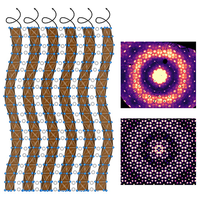
    <description>Author(s): Wentao Wang, Shuaishuai Sun, Wenli Gao, Kaixin Zhu, Huanfang Tian, Huaixin Yang, and Jianqi Li&lt;br/&gt;&lt;p&gt;Ultrafast transmission electron microscopy, a powerful tool for visualizing ultrafast structural dynamics, is harnessed here to reveal the full-cycle reversible dynamics of five-fold twinned silver nanowires across picosecond to microsecond timescales. On the picosecond timescale, a two-step process was identified: a fast electron-phonon coupling step and a slower step ascribed to hot electron decay due to trap states. Anisotropic phonon-phonon interactions, arising from the one-dimensional structure of the silver nanowires, drive energy transfer from the radial to the axial direction on the nanosecond scale. The subsequent recovery of the lattice occurs on the microsecond scale. These findings pave the way for advanced ultrafast device applications.&lt;/p&gt;&lt;img src="//cdn.journals.aps.org/journals/PRMATERIALS/key_images/10.1103/c324-pb9t.png" width="200" height=\"100\"&gt;&lt;br/&gt;[Phys. Rev. Materials 10, 046002] Published Fri Apr 10, 2026</description>
    <content:encoded><![CDATA[<p>Author(s): Wentao Wang, Shuaishuai Sun, Wenli Gao, Kaixin Zhu, Huanfang Tian, Huaixin Yang, and Jianqi Li</p><p>Ultrafast transmission electron microscopy, a powerful tool for visualizing ultrafast structural dynamics, is harnessed here to reveal the full-cycle reversible dynamics of five-fold twinned silver nanowires across picosecond to microsecond timescales. On the picosecond timescale, a two-step process was identified: a fast electron-phonon coupling step and a slower step ascribed to hot electron decay due to trap states. Anisotropic phonon-phonon interactions, arising from the one-dimensional structure of the silver nanowires, drive energy transfer from the radial to the axial direction on the nanosecond scale. The subsequent recovery of the lattice occurs on the microsecond scale. These findings pave the way for advanced ultrafast device applications.</p><img src="//cdn.journals.aps.org/journals/PRMATERIALS/key_images/10.1103/c324-pb9t.png" width="200" height=\"100\"><br/><p>[Phys. Rev. Materials 10, 046002] Published Fri Apr 10, 2026</p>]]></content:encoded>
    <dc:title>Ultrafast laser-induced anisotropic structural dynamics of five-fold twinned silver nanowires</dc:title>
    <dc:creator>Wentao Wang, Shuaishuai Sun, Wenli Gao, Kaixin Zhu, Huanfang Tian, Huaixin Yang, and Jianqi Li</dc:creator>
    <dc:date>2026-04-10T10:00:00+00:00</dc:date>
    <dc:rights>Personal use only, all commercial or other reuse prohibited</dc:rights>
    <dc:source>Phys. Rev. Materials 10, 046002 (2026)</dc:source>
    <dc:type>article</dc:type>
    <dc:identifier>doi:10.1103/c324-pb9t</dc:identifier>
    <prism:doi>10.1103/c324-pb9t</prism:doi>
    <prism:publicationName>Physical Review Materials</prism:publicationName>
    <prism:volume>10</prism:volume>
    <prism:number>4</prism:number>
    <prism:publicationDate>2026-04-10T10:00:00+00:00</prism:publicationDate>
    <prism:url>http://link.aps.org/doi/10.1103/c324-pb9t</prism:url>
    <prism:startingPage>046002</prism:startingPage>
    <dc:subject>Nanomaterials</dc:subject>
    <prism:section>Nanomaterials</prism:section>
  </item>
  <item rdf:about="http://link.aps.org/doi/10.1103/sj53-qws1">
    <title>High-throughput screening assisted discovery of a stable two-dimensional cobalt structure</title>
    <link>http://link.aps.org/doi/10.1103/sj53-qws1</link>
    <description>Author(s): Zixuan Xie, Baoxing Zhai, Wanru Nie, Heng Zhang, Zhuo Xu, Qian Chen, Ruiqing Cheng, and Jun He&lt;br/&gt;&lt;p&gt;The search for room-temperature ferromagnetic two-dimensional materials is crucial for the development of future functional spintronic devices. In this study, combining a global minimum search method of the free energy surfaces by the CALYPSO software, we have predicted a two-dimensional cobalt stru…&lt;/p&gt;&lt;br/&gt;[Phys. Rev. Materials 10, 044002] Published Thu Apr 09, 2026</description>
    <content:encoded><![CDATA[<p>Author(s): Zixuan Xie, Baoxing Zhai, Wanru Nie, Heng Zhang, Zhuo Xu, Qian Chen, Ruiqing Cheng, and Jun He</p><p>The search for room-temperature ferromagnetic two-dimensional materials is crucial for the development of future functional spintronic devices. In this study, combining a global minimum search method of the free energy surfaces by the CALYPSO software, we have predicted a two-dimensional cobalt stru…</p><br/><p>[Phys. Rev. Materials 10, 044002] Published Thu Apr 09, 2026</p>]]></content:encoded>
    <dc:title>High-throughput screening assisted discovery of a stable two-dimensional cobalt structure</dc:title>
    <dc:creator>Zixuan Xie, Baoxing Zhai, Wanru Nie, Heng Zhang, Zhuo Xu, Qian Chen, Ruiqing Cheng, and Jun He</dc:creator>
    <dc:date>2026-04-09T10:00:00+00:00</dc:date>
    <dc:rights>Personal use only, all commercial or other reuse prohibited</dc:rights>
    <dc:source>Phys. Rev. Materials 10, 044002 (2026)</dc:source>
    <dc:type>article</dc:type>
    <dc:identifier>doi:10.1103/sj53-qws1</dc:identifier>
    <prism:doi>10.1103/sj53-qws1</prism:doi>
    <prism:publicationName>Physical Review Materials</prism:publicationName>
    <prism:volume>10</prism:volume>
    <prism:number>4</prism:number>
    <prism:publicationDate>2026-04-09T10:00:00+00:00</prism:publicationDate>
    <prism:url>http://link.aps.org/doi/10.1103/sj53-qws1</prism:url>
    <prism:startingPage>044002</prism:startingPage>
    <dc:subject>Two-dimensional materials</dc:subject>
    <prism:section>Two-dimensional materials</prism:section>
  </item>
  <item rdf:about="http://link.aps.org/doi/10.1103/fdrt-2chf">
    <title>Unveiling thermal transport properties of defective $β−\mathrm{G}{\mathrm{a}}_{2}{\mathrm{O}}_{3}$ through machine learning potentials</title>
    <link>http://link.aps.org/doi/10.1103/fdrt-2chf</link>
    <description>Author(s): Yang Su, Jin Yan, Meiyang Yu, Chen Shen, Yuhao Fu, Tianhang Zhou, and Lijun Zhang&lt;br/&gt;&lt;p&gt;Machine learning potentials (MLPs) have been widely used in predicting the thermal transport properties of &lt;math xmlns="http://www.w3.org/1998/Math/MathML" display="inline"&gt;&lt;mi&gt;β&lt;/mi&gt;&lt;/math&gt;-Ga&lt;math xmlns="http://www.w3.org/1998/Math/MathML" display="inline"&gt;&lt;msub&gt;&lt;mrow&gt;&lt;/mrow&gt;&lt;mn&gt;2&lt;/mn&gt;&lt;/msub&gt;&lt;/math&gt;O&lt;math xmlns="http://www.w3.org/1998/Math/MathML" display="inline"&gt;&lt;msub&gt;&lt;mrow&gt;&lt;/mrow&gt;&lt;mn&gt;3&lt;/mn&gt;&lt;/msub&gt;&lt;/math&gt;. However, there are few reports on MLPs specifically considering complex defects in &lt;math xmlns="http://www.w3.org/1998/Math/MathML" display="inline"&gt;&lt;mi&gt;β&lt;/mi&gt;&lt;/math&gt;-Ga&lt;math xmlns="http://www.w3.org/1998/Math/MathML" display="inline"&gt;&lt;msub&gt;&lt;mrow&gt;&lt;/mrow&gt;&lt;mn&gt;2&lt;/mn&gt;&lt;/msub&gt;&lt;/math&gt;O&lt;math xmlns="http://www.w3.org/1998/Math/MathML" display="inline"&gt;&lt;msub&gt;&lt;mrow&gt;&lt;/mrow&gt;&lt;mn&gt;3&lt;/mn&gt;&lt;/msub&gt;&lt;/math&gt;. In this study, the authors trained a deep neural network MLP model to quantify how different intrinsic point defects suppress the thermal conductivity of &lt;math xmlns="http://www.w3.org/1998/Math/MathML" display="inline"&gt;&lt;mi&gt;β&lt;/mi&gt;&lt;/math&gt;-Ga&lt;math xmlns="http://www.w3.org/1998/Math/MathML" display="inline"&gt;&lt;msub&gt;&lt;mrow&gt;&lt;/mrow&gt;&lt;mn&gt;2&lt;/mn&gt;&lt;/msub&gt;&lt;/math&gt;O&lt;math xmlns="http://www.w3.org/1998/Math/MathML" display="inline"&gt;&lt;msub&gt;&lt;mrow&gt;&lt;/mrow&gt;&lt;mn&gt;3&lt;/mn&gt;&lt;/msub&gt;&lt;/math&gt;. These results provide atomic-level insight into thermal transport in defective &lt;math xmlns="http://www.w3.org/1998/Math/MathML" display="inline"&gt;&lt;mi&gt;β&lt;/mi&gt;&lt;/math&gt;-Ga&lt;math xmlns="http://www.w3.org/1998/Math/MathML" display="inline"&gt;&lt;msub&gt;&lt;mrow&gt;&lt;/mrow&gt;&lt;mn&gt;2&lt;/mn&gt;&lt;/msub&gt;&lt;/math&gt;O&lt;math xmlns="http://www.w3.org/1998/Math/MathML" display="inline"&gt;&lt;msub&gt;&lt;mrow&gt;&lt;/mrow&gt;&lt;mn&gt;3&lt;/mn&gt;&lt;/msub&gt;&lt;/math&gt;, offering guidance for thermal-management strategies and establishing a general workflow for investigating thermal physics in complex semiconductor materials.&lt;/p&gt;&lt;img src="//cdn.journals.aps.org/journals/PRMATERIALS/key_images/10.1103/fdrt-2chf.png" width="200" height=\"100\"&gt;&lt;br/&gt;[Phys. Rev. Materials 10, 044601] Published Thu Apr 09, 2026</description>
    <content:encoded><![CDATA[<p>Author(s): Yang Su, Jin Yan, Meiyang Yu, Chen Shen, Yuhao Fu, Tianhang Zhou, and Lijun Zhang</p><p>Machine learning potentials (MLPs) have been widely used in predicting the thermal transport properties of <math xmlns="http://www.w3.org/1998/Math/MathML" display="inline"><mi>β</mi></math>-Ga<math xmlns="http://www.w3.org/1998/Math/MathML" display="inline"><msub><mrow></mrow><mn>2</mn></msub></math>O<math xmlns="http://www.w3.org/1998/Math/MathML" display="inline"><msub><mrow></mrow><mn>3</mn></msub></math>. However, there are few reports on MLPs specifically considering complex defects in <math xmlns="http://www.w3.org/1998/Math/MathML" display="inline"><mi>β</mi></math>-Ga<math xmlns="http://www.w3.org/1998/Math/MathML" display="inline"><msub><mrow></mrow><mn>2</mn></msub></math>O<math xmlns="http://www.w3.org/1998/Math/MathML" display="inline"><msub><mrow></mrow><mn>3</mn></msub></math>. In this study, the authors trained a deep neural network MLP model to quantify how different intrinsic point defects suppress the thermal conductivity of <math xmlns="http://www.w3.org/1998/Math/MathML" display="inline"><mi>β</mi></math>-Ga<math xmlns="http://www.w3.org/1998/Math/MathML" display="inline"><msub><mrow></mrow><mn>2</mn></msub></math>O<math xmlns="http://www.w3.org/1998/Math/MathML" display="inline"><msub><mrow></mrow><mn>3</mn></msub></math>. These results provide atomic-level insight into thermal transport in defective <math xmlns="http://www.w3.org/1998/Math/MathML" display="inline"><mi>β</mi></math>-Ga<math xmlns="http://www.w3.org/1998/Math/MathML" display="inline"><msub><mrow></mrow><mn>2</mn></msub></math>O<math xmlns="http://www.w3.org/1998/Math/MathML" display="inline"><msub><mrow></mrow><mn>3</mn></msub></math>, offering guidance for thermal-management strategies and establishing a general workflow for investigating thermal physics in complex semiconductor materials.</p><img src="//cdn.journals.aps.org/journals/PRMATERIALS/key_images/10.1103/fdrt-2chf.png" width="200" height=\"100\"><br/><p>[Phys. Rev. Materials 10, 044601] Published Thu Apr 09, 2026</p>]]></content:encoded>
    <dc:title>Unveiling thermal transport properties of defective $β−\mathrm{G}{\mathrm{a}}_{2}{\mathrm{O}}_{3}$ through machine learning potentials</dc:title>
    <dc:creator>Yang Su, Jin Yan, Meiyang Yu, Chen Shen, Yuhao Fu, Tianhang Zhou, and Lijun Zhang</dc:creator>
    <dc:date>2026-04-09T10:00:00+00:00</dc:date>
    <dc:rights>Personal use only, all commercial or other reuse prohibited</dc:rights>
    <dc:source>Phys. Rev. Materials 10, 044601 (2026)</dc:source>
    <dc:type>article</dc:type>
    <dc:identifier>doi:10.1103/fdrt-2chf</dc:identifier>
    <prism:doi>10.1103/fdrt-2chf</prism:doi>
    <prism:publicationName>Physical Review Materials</prism:publicationName>
    <prism:volume>10</prism:volume>
    <prism:number>4</prism:number>
    <prism:publicationDate>2026-04-09T10:00:00+00:00</prism:publicationDate>
    <prism:url>http://link.aps.org/doi/10.1103/fdrt-2chf</prism:url>
    <prism:startingPage>044601</prism:startingPage>
    <dc:subject>Semiconducting materials</dc:subject>
    <prism:section>Semiconducting materials</prism:section>
  </item>
  <item rdf:about="http://link.aps.org/doi/10.1103/nzv9-dskm">
    <title>Electronic-entropy-driven solid-solid phase transitions in elemental metals</title>
    <link>http://link.aps.org/doi/10.1103/nzv9-dskm</link>
    <description>Author(s): S. Azadi, S. M. Vinko, A. Principi, T. D. Kühne, and M. S. Bahramy&lt;br/&gt;&lt;p&gt;We compute the thermodynamic phase diagram of 17 elemental metals with hexagonal-close-packed (hcp), face-centered-cubic (fcc), and body-centered-cubic (bcc) crystal structures using finite-temperature density functional theory. Helmholtz free-energy differences between competing hcp, fcc, and bcc p…&lt;/p&gt;&lt;br/&gt;[Phys. Rev. Materials 10, 045001] Published Thu Apr 09, 2026</description>
    <content:encoded><![CDATA[<p>Author(s): S. Azadi, S. M. Vinko, A. Principi, T. D. Kühne, and M. S. Bahramy</p><p>We compute the thermodynamic phase diagram of 17 elemental metals with hexagonal-close-packed (hcp), face-centered-cubic (fcc), and body-centered-cubic (bcc) crystal structures using finite-temperature density functional theory. Helmholtz free-energy differences between competing hcp, fcc, and bcc p…</p><br/><p>[Phys. Rev. Materials 10, 045001] Published Thu Apr 09, 2026</p>]]></content:encoded>
    <dc:title>Electronic-entropy-driven solid-solid phase transitions in elemental metals</dc:title>
    <dc:creator>S. Azadi, S. M. Vinko, A. Principi, T. D. Kühne, and M. S. Bahramy</dc:creator>
    <dc:date>2026-04-09T10:00:00+00:00</dc:date>
    <dc:rights>Personal use only, all commercial or other reuse prohibited</dc:rights>
    <dc:source>Phys. Rev. Materials 10, 045001 (2026)</dc:source>
    <dc:type>article</dc:type>
    <dc:identifier>doi:10.1103/nzv9-dskm</dc:identifier>
    <prism:doi>10.1103/nzv9-dskm</prism:doi>
    <prism:publicationName>Physical Review Materials</prism:publicationName>
    <prism:volume>10</prism:volume>
    <prism:number>4</prism:number>
    <prism:publicationDate>2026-04-09T10:00:00+00:00</prism:publicationDate>
    <prism:url>http://link.aps.org/doi/10.1103/nzv9-dskm</prism:url>
    <prism:startingPage>045001</prism:startingPage>
    <dc:subject>Other electronic materials</dc:subject>
    <prism:section>Other electronic materials</prism:section>
  </item>
  <item rdf:about="http://link.aps.org/doi/10.1103/nlt7-52tc">
    <title>Gate-tunable ferromagnetism in ${\mathrm{Cr}}_{2}{\mathrm{Si}}_{2}{\mathrm{Te}}_{6}$ thin flakes</title>
    <link>http://link.aps.org/doi/10.1103/nlt7-52tc</link>
    <description>Author(s): Changhong Yuan, Yutong Wang, Xu Yan, Kunya Yang, Wenxin Cheng, Yating Jiang, Qiuyan Shi, Xingyu Jiang, Xuewei Wang, Zhiyu Huang, Yuhan Jin, Beiyi Zhu, Jie Yuan, Mingquan He, Quansheng Wu, and Qihong Chen&lt;br/&gt;&lt;p&gt;While intrinsic two-dimensional (2D) ferromagnetic (FM) materials hold great promise for spintronic applications, external control over both electrical and magnetic properties is crucial. Here, we demonstrate effective modulation of electronic and magnetic characteristics of ${\mathrm{Cr}}_{2}{\math…&lt;/p&gt;&lt;br/&gt;[Phys. Rev. Materials 10, L041401] Published Thu Apr 09, 2026</description>
    <content:encoded><![CDATA[<p>Author(s): Changhong Yuan, Yutong Wang, Xu Yan, Kunya Yang, Wenxin Cheng, Yating Jiang, Qiuyan Shi, Xingyu Jiang, Xuewei Wang, Zhiyu Huang, Yuhan Jin, Beiyi Zhu, Jie Yuan, Mingquan He, Quansheng Wu, and Qihong Chen</p><p>While intrinsic two-dimensional (2D) ferromagnetic (FM) materials hold great promise for spintronic applications, external control over both electrical and magnetic properties is crucial. Here, we demonstrate effective modulation of electronic and magnetic characteristics of <math xmlns="http://www.w3.org/1998/Math/MathML"><mrow><msub><mi mathvariant="normal">Cr</mi><mn>2</mn></msub><msub><mi mathvariant="normal">Si</mi><mn>2</mn></msub><msub><mi mathvariant="normal">Te</mi><mn>6</mn></msub></mrow></math> (CST) through …</p><br/><p>[Phys. Rev. Materials 10, L041401] Published Thu Apr 09, 2026</p>]]></content:encoded>
    <dc:title>Gate-tunable ferromagnetism in ${\mathrm{Cr}}_{2}{\mathrm{Si}}_{2}{\mathrm{Te}}_{6}$ thin flakes</dc:title>
    <dc:creator>Changhong Yuan, Yutong Wang, Xu Yan, Kunya Yang, Wenxin Cheng, Yating Jiang, Qiuyan Shi, Xingyu Jiang, Xuewei Wang, Zhiyu Huang, Yuhan Jin, Beiyi Zhu, Jie Yuan, Mingquan He, Quansheng Wu, and Qihong Chen</dc:creator>
    <dc:date>2026-04-09T10:00:00+00:00</dc:date>
    <dc:rights>Personal use only, all commercial or other reuse prohibited</dc:rights>
    <dc:source>Phys. Rev. Materials 10, L041401 (2026)</dc:source>
    <dc:type>article</dc:type>
    <dc:identifier>doi:10.1103/nlt7-52tc</dc:identifier>
    <prism:doi>10.1103/nlt7-52tc</prism:doi>
    <prism:publicationName>Physical Review Materials</prism:publicationName>
    <prism:volume>10</prism:volume>
    <prism:number>4</prism:number>
    <prism:publicationDate>2026-04-09T10:00:00+00:00</prism:publicationDate>
    <prism:url>http://link.aps.org/doi/10.1103/nlt7-52tc</prism:url>
    <prism:startingPage>L041401</prism:startingPage>
    <dc:subject>Magnetic, ferroelectric, and multiferroic materials</dc:subject>
    <prism:section>Magnetic, ferroelectric, and multiferroic materials</prism:section>
  </item>
  <item rdf:about="http://link.aps.org/doi/10.1103/2jy6-qxm5">
    <title>Low temperature two-fluid state in $\mathrm{Sm}{\mathrm{B}}_{6}$</title>
    <link>http://link.aps.org/doi/10.1103/2jy6-qxm5</link>
    <description>Author(s): Sayantan Ghosh, Sugata Paul, Tamoghna Chattoraj, Ritesh Kumar, Zachary Fisk, and S. S. Banerjee&lt;br/&gt;&lt;p&gt; Comprehensive study using DC transport, specific heat, magnetization, and two-coil mutual inductance measurements unveils an understanding of three temperature regimes in $\mathrm{Sm}{\mathrm{B}}_{6}$: (i) $T≥\phantom{\rule{4pt}{0ex}}{T}^{*}$ ($∼62\phantom{\rule{0.16em}{0ex}}\mathrm{K}$), (ii) ${T}…&lt;/p&gt;&lt;br/&gt;[Phys. Rev. Materials 10, L042001] Published Thu Apr 09, 2026</description>
    <content:encoded><![CDATA[<p>Author(s): Sayantan Ghosh, Sugata Paul, Tamoghna Chattoraj, Ritesh Kumar, Zachary Fisk, and S. S. Banerjee</p><p> Comprehensive study using DC transport, specific heat, magnetization, and two-coil mutual inductance measurements unveils an understanding of three temperature regimes in <math xmlns="http://www.w3.org/1998/Math/MathML"><mrow><mi>Sm</mi><msub><mi mathvariant="normal">B</mi><mn>6</mn></msub></mrow></math>: (i) <math xmlns="http://www.w3.org/1998/Math/MathML"><mrow><mi>T</mi><mo>≥</mo><mspace width="4pt"></mspace><msup><mrow><mi>T</mi></mrow><mo>*</mo></msup></mrow></math> (<math xmlns="http://www.w3.org/1998/Math/MathML"><mrow><mo>∼</mo><mn>62</mn><mspace width="0.16em"></mspace><mi mathvariant="normal">K</mi></mrow></math>), (ii) <math xmlns="http://www.w3.org/1998/Math/MathML"><msub><mi>T</mi><mi>g</mi></msub><mo> </mo><mrow><mrow><mo>(</mo><mo>∼</mo><mn>23</mn><mspace width="0.16em"></mspace><mi mathvariant="normal">K</mi><mo>)</mo></mrow><mspace width="0.16em"></mspace><mo>≤</mo><mi>T</mi><mo>&lt;</mo><msup><mrow><mi>T</mi></mrow><mo>*</mo></msup></mrow></math>, and (iii) <math xmlns="http://www.w3.org/1998/Math/MathML"><mrow><mi>T</mi><mo>&lt;</mo><msub><mi>T</mi><mi>g</mi></msub></mrow></math>. Onset of Kondo breakdown below <math xmlns="http://www.w3.org/1998/Math/MathML"><msup><mrow><mi>T</mi></mrow><mo>*</mo></msup></math> releases disorder-driven mag…</p><br/><p>[Phys. Rev. Materials 10, L042001] Published Thu Apr 09, 2026</p>]]></content:encoded>
    <dc:title>Low temperature two-fluid state in $\mathrm{Sm}{\mathrm{B}}_{6}$</dc:title>
    <dc:creator>Sayantan Ghosh, Sugata Paul, Tamoghna Chattoraj, Ritesh Kumar, Zachary Fisk, and S. S. Banerjee</dc:creator>
    <dc:date>2026-04-09T10:00:00+00:00</dc:date>
    <dc:rights>Personal use only, all commercial or other reuse prohibited</dc:rights>
    <dc:source>Phys. Rev. Materials 10, L042001 (2026)</dc:source>
    <dc:type>article</dc:type>
    <dc:identifier>doi:10.1103/2jy6-qxm5</dc:identifier>
    <prism:doi>10.1103/2jy6-qxm5</prism:doi>
    <prism:publicationName>Physical Review Materials</prism:publicationName>
    <prism:volume>10</prism:volume>
    <prism:number>4</prism:number>
    <prism:publicationDate>2026-04-09T10:00:00+00:00</prism:publicationDate>
    <prism:url>http://link.aps.org/doi/10.1103/2jy6-qxm5</prism:url>
    <prism:startingPage>L042001</prism:startingPage>
    <dc:subject>Other electronic materials</dc:subject>
    <prism:section>Other electronic materials</prism:section>
  </item>
  <item rdf:about="http://link.aps.org/doi/10.1103/53st-7q5j">
    <title>Effect of W in Cu-Zr-W thin films: Molecular dynamics simulations and experimental verification</title>
    <link>http://link.aps.org/doi/10.1103/53st-7q5j</link>
    <description>Author(s): Hassan Ataalite, Jiri Houska, Deepika Thakur, Michaela Cervena, and Petr Zeman&lt;br/&gt;&lt;p&gt;We investigate the effects of W incorporation into Cu-Zr thin film metallic glasses using molecular dynamics (MD) simulations combined with magnetron sputtering. All studies are carried out in the whole range of W concentrations (0 to 100 at.%) and the MD studies also in a wide range of incident ene…&lt;/p&gt;&lt;br/&gt;[Phys. Rev. Materials 10, 043402] Published Wed Apr 08, 2026</description>
    <content:encoded><![CDATA[<p>Author(s): Hassan Ataalite, Jiri Houska, Deepika Thakur, Michaela Cervena, and Petr Zeman</p><p>We investigate the effects of W incorporation into Cu-Zr thin film metallic glasses using molecular dynamics (MD) simulations combined with magnetron sputtering. All studies are carried out in the whole range of W concentrations (0 to 100 at.%) and the MD studies also in a wide range of incident ene…</p><br/><p>[Phys. Rev. Materials 10, 043402] Published Wed Apr 08, 2026</p>]]></content:encoded>
    <dc:title>Effect of W in Cu-Zr-W thin films: Molecular dynamics simulations and experimental verification</dc:title>
    <dc:creator>Hassan Ataalite, Jiri Houska, Deepika Thakur, Michaela Cervena, and Petr Zeman</dc:creator>
    <dc:date>2026-04-08T10:00:00+00:00</dc:date>
    <dc:rights>Personal use only, all commercial or other reuse prohibited</dc:rights>
    <dc:source>Phys. Rev. Materials 10, 043402 (2026)</dc:source>
    <dc:type>article</dc:type>
    <dc:identifier>doi:10.1103/53st-7q5j</dc:identifier>
    <prism:doi>10.1103/53st-7q5j</prism:doi>
    <prism:publicationName>Physical Review Materials</prism:publicationName>
    <prism:volume>10</prism:volume>
    <prism:number>4</prism:number>
    <prism:publicationDate>2026-04-08T10:00:00+00:00</prism:publicationDate>
    <prism:url>http://link.aps.org/doi/10.1103/53st-7q5j</prism:url>
    <prism:startingPage>043402</prism:startingPage>
    <dc:subject>Crystal growth, crystallization, and kinetics</dc:subject>
    <prism:section>Crystal growth, crystallization, and kinetics</prism:section>
  </item>
  <item rdf:about="http://link.aps.org/doi/10.1103/6qn6-9zrz">
    <title>Glassy polymers' strain-hardening moduli scale with their statistical-segment volumes</title>
    <link>http://link.aps.org/doi/10.1103/6qn6-9zrz</link>
    <description>Author(s): Robert S. Hoy&lt;br/&gt;&lt;p&gt;Using molecular dynamics simulations, we show that a widely accepted theoretical prediction for glassy-polymeric strain-hardening moduli (${G}_{R}∝{ρ}_{e}$, where ${ρ}_{e}$ is the entanglement density) fails badly for semiflexible polymers. By postulating that the length, energy, and strain scales c…&lt;/p&gt;&lt;br/&gt;[Phys. Rev. Materials 10, 045603] Published Wed Apr 08, 2026</description>
    <content:encoded><![CDATA[<p>Author(s): Robert S. Hoy</p><p>Using molecular dynamics simulations, we show that a widely accepted theoretical prediction for glassy-polymeric strain-hardening moduli (<math xmlns="http://www.w3.org/1998/Math/MathML"><mrow><msub><mi>G</mi><mi>R</mi></msub><mo>∝</mo><msub><mi>ρ</mi><mi>e</mi></msub></mrow></math>, where <math xmlns="http://www.w3.org/1998/Math/MathML"><msub><mi>ρ</mi><mi>e</mi></msub></math> is the entanglement density) fails badly for semiflexible polymers. By postulating that the length, energy, and strain scales controlling <math xmlns="http://www.w3.org/1998/Math/MathML"><msub><mi>G</mi><mi>R</mi></msub></math> are t…</p><br/><p>[Phys. Rev. Materials 10, 045603] Published Wed Apr 08, 2026</p>]]></content:encoded>
    <dc:title>Glassy polymers' strain-hardening moduli scale with their statistical-segment volumes</dc:title>
    <dc:creator>Robert S. Hoy</dc:creator>
    <dc:date>2026-04-08T10:00:00+00:00</dc:date>
    <dc:rights>Personal use only, all commercial or other reuse prohibited</dc:rights>
    <dc:source>Phys. Rev. Materials 10, 045603 (2026)</dc:source>
    <dc:type>article</dc:type>
    <dc:identifier>doi:10.1103/6qn6-9zrz</dc:identifier>
    <prism:doi>10.1103/6qn6-9zrz</prism:doi>
    <prism:publicationName>Physical Review Materials</prism:publicationName>
    <prism:volume>10</prism:volume>
    <prism:number>4</prism:number>
    <prism:publicationDate>2026-04-08T10:00:00+00:00</prism:publicationDate>
    <prism:url>http://link.aps.org/doi/10.1103/6qn6-9zrz</prism:url>
    <prism:startingPage>045603</prism:startingPage>
    <dc:subject>Soft, molecular, and amorphous materials</dc:subject>
    <prism:section>Soft, molecular, and amorphous materials</prism:section>
  </item>
  <item rdf:about="http://link.aps.org/doi/10.1103/y1gy-9sfq">
    <title>Continuous transition from palladium clusters to nanocrystals simulated by machine learning potential</title>
    <link>http://link.aps.org/doi/10.1103/y1gy-9sfq</link>
    <description>Author(s): Ziyi Liang, Luneng Zhao, Hongsheng Liu, Junfeng Gao, and Feng Ding&lt;br/&gt;&lt;p&gt;Understanding the atomic evolution from cluster to nanocrystal has long been a challenge in nanoscience. Here, an accurate machine learning potential (MLP) of elemental Pd was developed. The large-scale capacity of this MLP affords long-time simulated annealing for a cross-scale study of Pd&lt;math xmlns="http://www.w3.org/1998/Math/MathML" display="inline"&gt;&lt;msub&gt;&lt;mrow&gt;&lt;/mrow&gt;&lt;mi&gt;n&lt;/mi&gt;&lt;/msub&gt;&lt;/math&gt; nanostructures (&lt;math xmlns="http://www.w3.org/1998/Math/MathML" display="inline"&gt;&lt;mi&gt;n&lt;/mi&gt;&lt;/math&gt;=12 - 21856), revealing a continuous transition from discrete clusters to bulk-like nanocrystals and the critical size at which the transition occurs. This study paves the way for studies on other clusters.&lt;/p&gt;&lt;img src="//cdn.journals.aps.org/journals/PRMATERIALS/key_images/10.1103/y1gy-9sfq.png" width="200" height=\"100\"&gt;&lt;br/&gt;[Phys. Rev. Materials 10, 046001] Published Wed Apr 08, 2026</description>
    <content:encoded><![CDATA[<p>Author(s): Ziyi Liang, Luneng Zhao, Hongsheng Liu, Junfeng Gao, and Feng Ding</p><p>Understanding the atomic evolution from cluster to nanocrystal has long been a challenge in nanoscience. Here, an accurate machine learning potential (MLP) of elemental Pd was developed. The large-scale capacity of this MLP affords long-time simulated annealing for a cross-scale study of Pd<math xmlns="http://www.w3.org/1998/Math/MathML" display="inline"><msub><mrow></mrow><mi>n</mi></msub></math> nanostructures (<math xmlns="http://www.w3.org/1998/Math/MathML" display="inline"><mi>n</mi></math>=12 - 21856), revealing a continuous transition from discrete clusters to bulk-like nanocrystals and the critical size at which the transition occurs. This study paves the way for studies on other clusters.</p><img src="//cdn.journals.aps.org/journals/PRMATERIALS/key_images/10.1103/y1gy-9sfq.png" width="200" height=\"100\"><br/><p>[Phys. Rev. Materials 10, 046001] Published Wed Apr 08, 2026</p>]]></content:encoded>
    <dc:title>Continuous transition from palladium clusters to nanocrystals simulated by machine learning potential</dc:title>
    <dc:creator>Ziyi Liang, Luneng Zhao, Hongsheng Liu, Junfeng Gao, and Feng Ding</dc:creator>
    <dc:date>2026-04-08T10:00:00+00:00</dc:date>
    <dc:rights>Personal use only, all commercial or other reuse prohibited</dc:rights>
    <dc:source>Phys. Rev. Materials 10, 046001 (2026)</dc:source>
    <dc:type>article</dc:type>
    <dc:identifier>doi:10.1103/y1gy-9sfq</dc:identifier>
    <prism:doi>10.1103/y1gy-9sfq</prism:doi>
    <prism:publicationName>Physical Review Materials</prism:publicationName>
    <prism:volume>10</prism:volume>
    <prism:number>4</prism:number>
    <prism:publicationDate>2026-04-08T10:00:00+00:00</prism:publicationDate>
    <prism:url>http://link.aps.org/doi/10.1103/y1gy-9sfq</prism:url>
    <prism:startingPage>046001</prism:startingPage>
    <dc:subject>Nanomaterials</dc:subject>
    <prism:section>Nanomaterials</prism:section>
  </item>
  <item rdf:about="http://link.aps.org/doi/10.1103/sbr9-3lr2">
    <title>Hidden layered structures from carbon-analog metastability in metal dichalcogenides</title>
    <link>http://link.aps.org/doi/10.1103/sbr9-3lr2</link>
    <description>Author(s): Shota Ono&lt;br/&gt;&lt;p&gt;Carbon exhibits both a layered ground-state structure that produces two-dimensional (2D) nanosheets and a nonlayered diamond structure created under high pressure conditions. Motivated by this metastability relationship, we revisit the ground state structure of metal dichalcogenides that are known t…&lt;/p&gt;&lt;br/&gt;[Phys. Rev. Materials 10, 044001] Published Tue Apr 07, 2026</description>
    <content:encoded><![CDATA[<p>Author(s): Shota Ono</p><p>Carbon exhibits both a layered ground-state structure that produces two-dimensional (2D) nanosheets and a nonlayered diamond structure created under high pressure conditions. Motivated by this metastability relationship, we revisit the ground state structure of metal dichalcogenides that are known t…</p><br/><p>[Phys. Rev. Materials 10, 044001] Published Tue Apr 07, 2026</p>]]></content:encoded>
    <dc:title>Hidden layered structures from carbon-analog metastability in metal dichalcogenides</dc:title>
    <dc:creator>Shota Ono</dc:creator>
    <dc:date>2026-04-07T10:00:00+00:00</dc:date>
    <dc:rights>Personal use only, all commercial or other reuse prohibited</dc:rights>
    <dc:source>Phys. Rev. Materials 10, 044001 (2026)</dc:source>
    <dc:type>article</dc:type>
    <dc:identifier>doi:10.1103/sbr9-3lr2</dc:identifier>
    <prism:doi>10.1103/sbr9-3lr2</prism:doi>
    <prism:publicationName>Physical Review Materials</prism:publicationName>
    <prism:volume>10</prism:volume>
    <prism:number>4</prism:number>
    <prism:publicationDate>2026-04-07T10:00:00+00:00</prism:publicationDate>
    <prism:url>http://link.aps.org/doi/10.1103/sbr9-3lr2</prism:url>
    <prism:startingPage>044001</prism:startingPage>
    <dc:subject>Two-dimensional materials</dc:subject>
    <prism:section>Two-dimensional materials</prism:section>
  </item>
  <item rdf:about="http://link.aps.org/doi/10.1103/mrqn-qy9z">
    <title>Low-temperature charge-density-wave transition in ordered intermetallic ${γ}^{′}\text{−}{\mathrm{U}}_{2}\mathrm{Mo}$</title>
    <link>http://link.aps.org/doi/10.1103/mrqn-qy9z</link>
    <description>Author(s): Somesh Bhattacharya, Kumar Bharti, V. B. Jayakrishnan, Mayuri Kamble, K. Ali, Joydipta Banerjee, Amrit Prakash, A. Arya, P. D. Babu, Dipanshu Bansal, and P. S. Ghosh&lt;br/&gt;&lt;p&gt;Intermetallic nuclear fuel materials, in particular the uranium alloyed with Zr, Mo, Nb, Ti, offer superior swelling, fabrication, and fuel-cladding chemical reaction properties, among others. However, similar to pure $α$-uranium, the alloyed uranium compositions exhibit susceptibility to a charge-d…&lt;/p&gt;&lt;br/&gt;[Phys. Rev. Materials 10, 045401] Published Tue Apr 07, 2026</description>
    <content:encoded><![CDATA[<p>Author(s): Somesh Bhattacharya, Kumar Bharti, V. B. Jayakrishnan, Mayuri Kamble, K. Ali, Joydipta Banerjee, Amrit Prakash, A. Arya, P. D. Babu, Dipanshu Bansal, and P. S. Ghosh</p><p>Intermetallic nuclear fuel materials, in particular the uranium alloyed with Zr, Mo, Nb, Ti, offer superior swelling, fabrication, and fuel-cladding chemical reaction properties, among others. However, similar to pure <math xmlns="http://www.w3.org/1998/Math/MathML"><mi>α</mi></math>-uranium, the alloyed uranium compositions exhibit susceptibility to a charge-den…</p><br/><p>[Phys. Rev. Materials 10, 045401] Published Tue Apr 07, 2026</p>]]></content:encoded>
    <dc:title>Low-temperature charge-density-wave transition in ordered intermetallic ${γ}^{′}\text{−}{\mathrm{U}}_{2}\mathrm{Mo}$</dc:title>
    <dc:creator>Somesh Bhattacharya, Kumar Bharti, V. B. Jayakrishnan, Mayuri Kamble, K. Ali, Joydipta Banerjee, Amrit Prakash, A. Arya, P. D. Babu, Dipanshu Bansal, and P. S. Ghosh</dc:creator>
    <dc:date>2026-04-07T10:00:00+00:00</dc:date>
    <dc:rights>Personal use only, all commercial or other reuse prohibited</dc:rights>
    <dc:source>Phys. Rev. Materials 10, 045401 (2026)</dc:source>
    <dc:type>article</dc:type>
    <dc:identifier>doi:10.1103/mrqn-qy9z</dc:identifier>
    <prism:doi>10.1103/mrqn-qy9z</prism:doi>
    <prism:publicationName>Physical Review Materials</prism:publicationName>
    <prism:volume>10</prism:volume>
    <prism:number>4</prism:number>
    <prism:publicationDate>2026-04-07T10:00:00+00:00</prism:publicationDate>
    <prism:url>http://link.aps.org/doi/10.1103/mrqn-qy9z</prism:url>
    <prism:startingPage>045401</prism:startingPage>
    <dc:subject>Materials for energy harvesting, storage, and generation</dc:subject>
    <prism:section>Materials for energy harvesting, storage, and generation</prism:section>
  </item>
  <item rdf:about="http://link.aps.org/doi/10.1103/r4hc-dvmr">
    <title>Growth-controlled twinning and magnetic anisotropy in ${\mathrm{CeSb}}_{2}$</title>
    <link>http://link.aps.org/doi/10.1103/r4hc-dvmr</link>
    <description>Author(s): Jan T. Weber, Kristin Kliemt, Sergey L. Bud'ko, Paul C. Canfield, and Cornelius Krellner&lt;br/&gt;&lt;p&gt;Cerium diantimonide (${\mathrm{CeSb}}_{2}$) is a layered heavy-fermion Kondo lattice material that hosts complex magnetism and pressure-induced superconductivity. The interpretation of its in-plane anisotropy has remained unsettled due to structural twinning, which superimposes orthogonal magnetic r…&lt;/p&gt;&lt;br/&gt;[Phys. Rev. Materials 10, 044403] Published Mon Apr 06, 2026</description>
    <content:encoded><![CDATA[<p>Author(s): Jan T. Weber, Kristin Kliemt, Sergey L. Bud'ko, Paul C. Canfield, and Cornelius Krellner</p><p>Cerium diantimonide (<math xmlns="http://www.w3.org/1998/Math/MathML"><msub><mi>CeSb</mi><mn>2</mn></msub></math>) is a layered heavy-fermion Kondo lattice material that hosts complex magnetism and pressure-induced superconductivity. The interpretation of its in-plane anisotropy has remained unsettled due to structural twinning, which superimposes orthogonal magnetic responses. Here w…</p><br/><p>[Phys. Rev. Materials 10, 044403] Published Mon Apr 06, 2026</p>]]></content:encoded>
    <dc:title>Growth-controlled twinning and magnetic anisotropy in ${\mathrm{CeSb}}_{2}$</dc:title>
    <dc:creator>Jan T. Weber, Kristin Kliemt, Sergey L. Bud'ko, Paul C. Canfield, and Cornelius Krellner</dc:creator>
    <dc:date>2026-04-06T10:00:00+00:00</dc:date>
    <dc:rights>Personal use only, all commercial or other reuse prohibited</dc:rights>
    <dc:source>Phys. Rev. Materials 10, 044403 (2026)</dc:source>
    <dc:type>article</dc:type>
    <dc:identifier>doi:10.1103/r4hc-dvmr</dc:identifier>
    <prism:doi>10.1103/r4hc-dvmr</prism:doi>
    <prism:publicationName>Physical Review Materials</prism:publicationName>
    <prism:volume>10</prism:volume>
    <prism:number>4</prism:number>
    <prism:publicationDate>2026-04-06T10:00:00+00:00</prism:publicationDate>
    <prism:url>http://link.aps.org/doi/10.1103/r4hc-dvmr</prism:url>
    <prism:startingPage>044403</prism:startingPage>
    <dc:subject>Magnetic, ferroelectric, and multiferroic materials</dc:subject>
    <prism:section>Magnetic, ferroelectric, and multiferroic materials</prism:section>
  </item>
  <item rdf:about="http://link.aps.org/doi/10.1103/lc66-t2m8">
    <title>Boosting Seebeck coefficient through electron-phonon interaction by phonon frequency control</title>
    <link>http://link.aps.org/doi/10.1103/lc66-t2m8</link>
    <description>Author(s): Asumi Michibata, Tsukasa Terada, Kotaro Matsuzono, Takafumi Ishibe, Yuichiro Yamashita, Nobuyasu Naruse, Katsuhiro Suzuki, and Yoshiaki Nakamura&lt;br/&gt;&lt;p&gt;In Dirac and Weyl semimetals with a flat band, the Seebeck coefficient ($S$) can be enhanced by the energy filtering effect in wave number space through electron-phonon interaction (EPI). Especially, topological B20-type semimetal thin films are promising materials because their Dirac or Weyl fermio…&lt;/p&gt;&lt;br/&gt;[Phys. Rev. Materials 10, 043401] Published Fri Apr 03, 2026</description>
    <content:encoded><![CDATA[<p>Author(s): Asumi Michibata, Tsukasa Terada, Kotaro Matsuzono, Takafumi Ishibe, Yuichiro Yamashita, Nobuyasu Naruse, Katsuhiro Suzuki, and Yoshiaki Nakamura</p><p>In Dirac and Weyl semimetals with a flat band, the Seebeck coefficient (<math xmlns="http://www.w3.org/1998/Math/MathML"><mrow><mi>S</mi></mrow></math>) can be enhanced by the energy filtering effect in wave number space through electron-phonon interaction (EPI). Especially, topological B20-type semimetal thin films are promising materials because their Dirac or Weyl fermions…</p><br/><p>[Phys. Rev. Materials 10, 043401] Published Fri Apr 03, 2026</p>]]></content:encoded>
    <dc:title>Boosting Seebeck coefficient through electron-phonon interaction by phonon frequency control</dc:title>
    <dc:creator>Asumi Michibata, Tsukasa Terada, Kotaro Matsuzono, Takafumi Ishibe, Yuichiro Yamashita, Nobuyasu Naruse, Katsuhiro Suzuki, and Yoshiaki Nakamura</dc:creator>
    <dc:date>2026-04-03T10:00:00+00:00</dc:date>
    <dc:rights>Personal use only, all commercial or other reuse prohibited</dc:rights>
    <dc:source>Phys. Rev. Materials 10, 043401 (2026)</dc:source>
    <dc:type>article</dc:type>
    <dc:identifier>doi:10.1103/lc66-t2m8</dc:identifier>
    <prism:doi>10.1103/lc66-t2m8</prism:doi>
    <prism:publicationName>Physical Review Materials</prism:publicationName>
    <prism:volume>10</prism:volume>
    <prism:number>4</prism:number>
    <prism:publicationDate>2026-04-03T10:00:00+00:00</prism:publicationDate>
    <prism:url>http://link.aps.org/doi/10.1103/lc66-t2m8</prism:url>
    <prism:startingPage>043401</prism:startingPage>
    <dc:subject>Crystal growth, crystallization, and kinetics</dc:subject>
    <prism:section>Crystal growth, crystallization, and kinetics</prism:section>
  </item>
  <item rdf:about="http://link.aps.org/doi/10.1103/rbf1-cp89">
    <title>Performance improvement of deorbitalized exchange-correlation functionals</title>
    <link>http://link.aps.org/doi/10.1103/rbf1-cp89</link>
    <description>Author(s): H. Francisco, B. Thapa, S. B. Trickey, and A. C. Cancio&lt;br/&gt;&lt;p&gt;Deorbitalization of a conventional meta-generalized-gradient exchange-correlation approximation replaces its dependence upon the Kohn-Sham (KS) kinetic energy density with a dependence on the density gradient and Laplacian. In principle, that simplification should provide improved computational perf…&lt;/p&gt;&lt;br/&gt;[Phys. Rev. Materials 10, 043801] Published Fri Apr 03, 2026</description>
    <content:encoded><![CDATA[<p>Author(s): H. Francisco, B. Thapa, S. B. Trickey, and A. C. Cancio</p><p>Deorbitalization of a conventional meta-generalized-gradient exchange-correlation approximation replaces its dependence upon the Kohn-Sham (KS) kinetic energy density with a dependence on the density gradient and Laplacian. In principle, that simplification should provide improved computational perf…</p><br/><p>[Phys. Rev. Materials 10, 043801] Published Fri Apr 03, 2026</p>]]></content:encoded>
    <dc:title>Performance improvement of deorbitalized exchange-correlation functionals</dc:title>
    <dc:creator>H. Francisco, B. Thapa, S. B. Trickey, and A. C. Cancio</dc:creator>
    <dc:date>2026-04-03T10:00:00+00:00</dc:date>
    <dc:rights>Personal use only, all commercial or other reuse prohibited</dc:rights>
    <dc:source>Phys. Rev. Materials 10, 043801 (2026)</dc:source>
    <dc:type>article</dc:type>
    <dc:identifier>doi:10.1103/rbf1-cp89</dc:identifier>
    <prism:doi>10.1103/rbf1-cp89</prism:doi>
    <prism:publicationName>Physical Review Materials</prism:publicationName>
    <prism:volume>10</prism:volume>
    <prism:number>4</prism:number>
    <prism:publicationDate>2026-04-03T10:00:00+00:00</prism:publicationDate>
    <prism:url>http://link.aps.org/doi/10.1103/rbf1-cp89</prism:url>
    <prism:startingPage>043801</prism:startingPage>
    <dc:subject>Development of new methods for materials</dc:subject>
    <prism:section>Development of new methods for materials</prism:section>
  </item>
  <item rdf:about="http://link.aps.org/doi/10.1103/1g59-ccgq">
    <title>Strain-tuned magnetoelectric properties of monolayer ${\mathrm{NiX}}_{2}$ (X = I, Br): A first-principles analysis</title>
    <link>http://link.aps.org/doi/10.1103/1g59-ccgq</link>
    <description>Author(s): Ali Ghojavand, Cem Sevik, and Milorad V. Milošević&lt;br/&gt;&lt;p&gt;Using &lt;i&gt;ab initio&lt;/i&gt; methodology, we reveal a strain‐mediated approach to precisely tune the magnetoelectric coupling and spin-driven emergent polarization of ${\mathrm{NiX}}_{2}$ (X = I, Br) monolayers. In the absence of strain, these systems spontaneously stabilize noncollinear spin states that break t…&lt;/p&gt;&lt;br/&gt;[Phys. Rev. Materials 10, 044402] Published Fri Apr 03, 2026</description>
    <content:encoded><![CDATA[<p>Author(s): Ali Ghojavand, Cem Sevik, and Milorad V. Milošević</p><p>Using <i>ab initio</i> methodology, we reveal a strain‐mediated approach to precisely tune the magnetoelectric coupling and spin-driven emergent polarization of <math xmlns="http://www.w3.org/1998/Math/MathML"><msub><mi>NiX</mi><mn>2</mn></msub></math> (X = I, Br) monolayers. In the absence of strain, these systems spontaneously stabilize noncollinear spin states that break the inversion sym…</p><br/><p>[Phys. Rev. Materials 10, 044402] Published Fri Apr 03, 2026</p>]]></content:encoded>
    <dc:title>Strain-tuned magnetoelectric properties of monolayer ${\mathrm{NiX}}_{2}$ (X = I, Br): A first-principles analysis</dc:title>
    <dc:creator>Ali Ghojavand, Cem Sevik, and Milorad V. Milošević</dc:creator>
    <dc:date>2026-04-03T10:00:00+00:00</dc:date>
    <dc:rights>Personal use only, all commercial or other reuse prohibited</dc:rights>
    <dc:source>Phys. Rev. Materials 10, 044402 (2026)</dc:source>
    <dc:type>article</dc:type>
    <dc:identifier>doi:10.1103/1g59-ccgq</dc:identifier>
    <prism:doi>10.1103/1g59-ccgq</prism:doi>
    <prism:publicationName>Physical Review Materials</prism:publicationName>
    <prism:volume>10</prism:volume>
    <prism:number>4</prism:number>
    <prism:publicationDate>2026-04-03T10:00:00+00:00</prism:publicationDate>
    <prism:url>http://link.aps.org/doi/10.1103/1g59-ccgq</prism:url>
    <prism:startingPage>044402</prism:startingPage>
    <dc:subject>Magnetic, ferroelectric, and multiferroic materials</dc:subject>
    <prism:section>Magnetic, ferroelectric, and multiferroic materials</prism:section>
  </item>
  <item rdf:about="http://link.aps.org/doi/10.1103/ng2j-nrfv">
    <title>Imprinting macroscopic fracture during gelation: A mechanism for tuning colloidal gels</title>
    <link>http://link.aps.org/doi/10.1103/ng2j-nrfv</link>
    <description>Author(s): Wilbert J. Smit, Thomas Gibaud, Sébastien Manneville, and Thibaut Divoux&lt;br/&gt;&lt;p&gt;In many practical situations – whether during casting, 3D printing, or more generally processing – colloidal suspensions of attractive particles undergo gelation while being subjected to repeated deformations. Although such flows are ubiquitous in industrial and laboratory settings, their impact on the emergence of the gel network remains poorly understood. Here, the authors show that applying oscillatory deformations on a colloidal suspension as it turns into a soft solid can imprint fracture patterns that lead to weaker gels compared to quiescent gelation, while enhancing their ability to dissipate energy. Remarkably, these cracks leave a simple and robust mechanical signature that can be captured by a minimal model, linking fracture to bulk material response. Their results reveal how mechanical perturbations reshape gelation and provide a practical route to design softer, more ductile materials.&lt;/p&gt;&lt;img src="//cdn.journals.aps.org/journals/PRMATERIALS/key_images/10.1103/ng2j-nrfv.png" width="200" height=\"100\"&gt;&lt;br/&gt;[Phys. Rev. Materials 10, 045602] Published Fri Apr 03, 2026</description>
    <content:encoded><![CDATA[<p>Author(s): Wilbert J. Smit, Thomas Gibaud, Sébastien Manneville, and Thibaut Divoux</p><p>In many practical situations – whether during casting, 3D printing, or more generally processing – colloidal suspensions of attractive particles undergo gelation while being subjected to repeated deformations. Although such flows are ubiquitous in industrial and laboratory settings, their impact on the emergence of the gel network remains poorly understood. Here, the authors show that applying oscillatory deformations on a colloidal suspension as it turns into a soft solid can imprint fracture patterns that lead to weaker gels compared to quiescent gelation, while enhancing their ability to dissipate energy. Remarkably, these cracks leave a simple and robust mechanical signature that can be captured by a minimal model, linking fracture to bulk material response. Their results reveal how mechanical perturbations reshape gelation and provide a practical route to design softer, more ductile materials.</p><img src="//cdn.journals.aps.org/journals/PRMATERIALS/key_images/10.1103/ng2j-nrfv.png" width="200" height=\"100\"><br/><p>[Phys. Rev. Materials 10, 045602] Published Fri Apr 03, 2026</p>]]></content:encoded>
    <dc:title>Imprinting macroscopic fracture during gelation: A mechanism for tuning colloidal gels</dc:title>
    <dc:creator>Wilbert J. Smit, Thomas Gibaud, Sébastien Manneville, and Thibaut Divoux</dc:creator>
    <dc:date>2026-04-03T10:00:00+00:00</dc:date>
    <dc:rights>Personal use only, all commercial or other reuse prohibited</dc:rights>
    <dc:source>Phys. Rev. Materials 10, 045602 (2026)</dc:source>
    <dc:type>article</dc:type>
    <dc:identifier>doi:10.1103/ng2j-nrfv</dc:identifier>
    <prism:doi>10.1103/ng2j-nrfv</prism:doi>
    <prism:publicationName>Physical Review Materials</prism:publicationName>
    <prism:volume>10</prism:volume>
    <prism:number>4</prism:number>
    <prism:publicationDate>2026-04-03T10:00:00+00:00</prism:publicationDate>
    <prism:url>http://link.aps.org/doi/10.1103/ng2j-nrfv</prism:url>
    <prism:startingPage>045602</prism:startingPage>
    <dc:subject>Soft, molecular, and amorphous materials</dc:subject>
    <prism:section>Soft, molecular, and amorphous materials</prism:section>
  </item>
  <item rdf:about="http://link.aps.org/doi/10.1103/4bd1-y268">
    <title>Size-dependent energy splitting of unoccupied electronic states in antiferromagnetic monolayer Mn nanoislands</title>
    <link>http://link.aps.org/doi/10.1103/4bd1-y268</link>
    <description>Author(s): Yu-Tung Lin, Yung-Chun Chao, Guan-Yi Huang, Ching-Yen Lin, Shun-Ping Chou, Chia-Ju Chen, Allan H. MacDonald, Chih-Kang Shih, Jung-Jung Su, and Pin-Jui Hsu&lt;br/&gt;&lt;p&gt;Quantum size effect (QSE) on the electronic structures of nanoscale antiferromagnets with a monolayer (ML) thickness is of fundamental importance in antiferromagnetic (AFM) spintronics. Here, we have carried out systematic studies on the size-dependent unoccupied electronic states of ML Mn nanoislan…&lt;/p&gt;&lt;br/&gt;[Phys. Rev. Materials 10, 044401] Published Thu Apr 02, 2026</description>
    <content:encoded><![CDATA[<p>Author(s): Yu-Tung Lin, Yung-Chun Chao, Guan-Yi Huang, Ching-Yen Lin, Shun-Ping Chou, Chia-Ju Chen, Allan H. MacDonald, Chih-Kang Shih, Jung-Jung Su, and Pin-Jui Hsu</p><p>Quantum size effect (QSE) on the electronic structures of nanoscale antiferromagnets with a monolayer (ML) thickness is of fundamental importance in antiferromagnetic (AFM) spintronics. Here, we have carried out systematic studies on the size-dependent unoccupied electronic states of ML Mn nanoislan…</p><br/><p>[Phys. Rev. Materials 10, 044401] Published Thu Apr 02, 2026</p>]]></content:encoded>
    <dc:title>Size-dependent energy splitting of unoccupied electronic states in antiferromagnetic monolayer Mn nanoislands</dc:title>
    <dc:creator>Yu-Tung Lin, Yung-Chun Chao, Guan-Yi Huang, Ching-Yen Lin, Shun-Ping Chou, Chia-Ju Chen, Allan H. MacDonald, Chih-Kang Shih, Jung-Jung Su, and Pin-Jui Hsu</dc:creator>
    <dc:date>2026-04-02T10:00:00+00:00</dc:date>
    <dc:rights>Personal use only, all commercial or other reuse prohibited</dc:rights>
    <dc:source>Phys. Rev. Materials 10, 044401 (2026)</dc:source>
    <dc:type>article</dc:type>
    <dc:identifier>doi:10.1103/4bd1-y268</dc:identifier>
    <prism:doi>10.1103/4bd1-y268</prism:doi>
    <prism:publicationName>Physical Review Materials</prism:publicationName>
    <prism:volume>10</prism:volume>
    <prism:number>4</prism:number>
    <prism:publicationDate>2026-04-02T10:00:00+00:00</prism:publicationDate>
    <prism:url>http://link.aps.org/doi/10.1103/4bd1-y268</prism:url>
    <prism:startingPage>044401</prism:startingPage>
    <dc:subject>Magnetic, ferroelectric, and multiferroic materials</dc:subject>
    <prism:section>Magnetic, ferroelectric, and multiferroic materials</prism:section>
  </item>
  <item rdf:about="http://link.aps.org/doi/10.1103/yx3x-1hs9">
    <title>Spatial patterning of active force centers controls folding pathways in elastic networks</title>
    <link>http://link.aps.org/doi/10.1103/yx3x-1hs9</link>
    <description>Author(s): Debjyoti Majumdar&lt;br/&gt;&lt;p&gt;We study the effect of the spatial distribution of active force dipoles on the folding pathways and mechanical stability of rigid-elastic networks using Langevin dynamics simulations. While it has been shown by D. Majumdar,  &lt;i&gt;et al.&lt;/i&gt; [&lt;a href="http://dx.doi.org/10.1063/5.0278300"&gt;&lt;span&gt;J. Chem. Phys.&lt;/span&gt; &lt;b&gt;163&lt;/b&gt;, 114902 (2025)&lt;/a&gt;] that a sharp collapse transition…&lt;/p&gt;&lt;br/&gt;[Phys. Rev. Materials 10, 045601] Published Thu Apr 02, 2026</description>
    <content:encoded><![CDATA[<p>Author(s): Debjyoti Majumdar</p><p>We study the effect of the spatial distribution of active force dipoles on the folding pathways and mechanical stability of rigid-elastic networks using Langevin dynamics simulations. While it has been shown by D. Majumdar,  <i>et al.</i> [<a href="http://dx.doi.org/10.1063/5.0278300"><span>J. Chem. Phys.</span> <b>163</b>, 114902 (2025)</a>] that a sharp collapse transition…</p><br/><p>[Phys. Rev. Materials 10, 045601] Published Thu Apr 02, 2026</p>]]></content:encoded>
    <dc:title>Spatial patterning of active force centers controls folding pathways in elastic networks</dc:title>
    <dc:creator>Debjyoti Majumdar</dc:creator>
    <dc:date>2026-04-02T10:00:00+00:00</dc:date>
    <dc:rights>Personal use only, all commercial or other reuse prohibited</dc:rights>
    <dc:source>Phys. Rev. Materials 10, 045601 (2026)</dc:source>
    <dc:type>article</dc:type>
    <dc:identifier>doi:10.1103/yx3x-1hs9</dc:identifier>
    <prism:doi>10.1103/yx3x-1hs9</prism:doi>
    <prism:publicationName>Physical Review Materials</prism:publicationName>
    <prism:volume>10</prism:volume>
    <prism:number>4</prism:number>
    <prism:publicationDate>2026-04-02T10:00:00+00:00</prism:publicationDate>
    <prism:url>http://link.aps.org/doi/10.1103/yx3x-1hs9</prism:url>
    <prism:startingPage>045601</prism:startingPage>
    <dc:subject>Soft, molecular, and amorphous materials</dc:subject>
    <prism:section>Soft, molecular, and amorphous materials</prism:section>
  </item>
  <item rdf:about="http://link.aps.org/doi/10.1103/bvsc-f2xt">
    <title>The interfacial layer between layered chalcogenides and GaAs(111)B: The case of MBE-grown ${\mathrm{NiTe}}_{2}$-GaAs(111)B</title>
    <link>http://link.aps.org/doi/10.1103/bvsc-f2xt</link>
    <description>Author(s): M. Eddrief, Y. Zheng, J. Kucharek, M. Bouaziz, A. Ouerghi, and P. Atkinson&lt;br/&gt;&lt;p&gt;Epitaxial thin films of the lamellar transition metal dichalcogenide ${\mathrm{NiTe}}_{2}$ have been grown by molecular beam epitaxy on GaAs(111)B substrates. Using in-plane grazing-incidence x-ray diffraction measurements, we show that two distinct epilayers form during growth: (1) an epitaxial int…&lt;/p&gt;&lt;br/&gt;[Phys. Rev. Materials 10, 044201] Published Wed Apr 01, 2026</description>
    <content:encoded><![CDATA[<p>Author(s): M. Eddrief, Y. Zheng, J. Kucharek, M. Bouaziz, A. Ouerghi, and P. Atkinson</p><p>Epitaxial thin films of the lamellar transition metal dichalcogenide <math xmlns="http://www.w3.org/1998/Math/MathML"><msub><mi>NiTe</mi><mn>2</mn></msub></math> have been grown by molecular beam epitaxy on GaAs(111)B substrates. Using in-plane grazing-incidence x-ray diffraction measurements, we show that two distinct epilayers form during growth: (1) an epitaxial interface contact l…</p><br/><p>[Phys. Rev. Materials 10, 044201] Published Wed Apr 01, 2026</p>]]></content:encoded>
    <dc:title>The interfacial layer between layered chalcogenides and GaAs(111)B: The case of MBE-grown ${\mathrm{NiTe}}_{2}$-GaAs(111)B</dc:title>
    <dc:creator>M. Eddrief, Y. Zheng, J. Kucharek, M. Bouaziz, A. Ouerghi, and P. Atkinson</dc:creator>
    <dc:date>2026-04-01T10:00:00+00:00</dc:date>
    <dc:rights>Personal use only, all commercial or other reuse prohibited</dc:rights>
    <dc:source>Phys. Rev. Materials 10, 044201 (2026)</dc:source>
    <dc:type>article</dc:type>
    <dc:identifier>doi:10.1103/bvsc-f2xt</dc:identifier>
    <prism:doi>10.1103/bvsc-f2xt</prism:doi>
    <prism:publicationName>Physical Review Materials</prism:publicationName>
    <prism:volume>10</prism:volume>
    <prism:number>4</prism:number>
    <prism:publicationDate>2026-04-01T10:00:00+00:00</prism:publicationDate>
    <prism:url>http://link.aps.org/doi/10.1103/bvsc-f2xt</prism:url>
    <prism:startingPage>044201</prism:startingPage>
    <dc:subject>Topological and Dirac materials</dc:subject>
    <prism:section>Topological and Dirac materials</prism:section>
  </item>
  <item rdf:about="http://link.aps.org/doi/10.1103/ynbm-hkrp">
    <title>Tunable magnetic transition and electronic structure in monolayer iron trihalides $\mathrm{Fe}{X}_{3}$ $(X=\mathrm{F}, \mathrm{Cl}, \mathrm{Br}, \mathrm{I})$</title>
    <link>http://link.aps.org/doi/10.1103/ynbm-hkrp</link>
    <description>Author(s): Yuchen Lei, Wenting Wu, Qian Wan, Hongwei Bao, Jia Wu, Fei Ma, and Yan Li&lt;br/&gt;&lt;p&gt;Two-dimensional (2D) iron trihalides $(\mathrm{Fe}{X}_{3}, X=\mathrm{F}, \mathrm{Cl}, \mathrm{Br}, \mathrm{I})$ are an emerging family of van der Waals magnets whose fundamental physical properties are not yet fully understood. In this work, we present a systematic first-principles study incorporati…&lt;/p&gt;&lt;br/&gt;[Phys. Rev. Materials 10, 034415] Published Tue Mar 31, 2026</description>
    <content:encoded><![CDATA[<p>Author(s): Yuchen Lei, Wenting Wu, Qian Wan, Hongwei Bao, Jia Wu, Fei Ma, and Yan Li</p><p>Two-dimensional (2D) iron trihalides <math xmlns="http://www.w3.org/1998/Math/MathML"><mrow><mo>(</mo><mi>Fe</mi><msub><mi>X</mi><mn>3</mn></msub><mo>,</mo><mo> </mo><mi>X</mi><mo>=</mo><mi mathvariant="normal">F</mi><mo>,</mo><mo> </mo><mi>Cl</mi><mo>,</mo><mo> </mo><mi>Br</mi><mo>,</mo><mo> </mo><mi mathvariant="normal">I</mi><mo>)</mo></mrow></math> are an emerging family of van der Waals magnets whose fundamental physical properties are not yet fully understood. In this work, we present a systematic first-principles study incorporating hybrid functional (HSE06) calculations and Hubbar…</p><br/><p>[Phys. Rev. Materials 10, 034415] Published Tue Mar 31, 2026</p>]]></content:encoded>
    <dc:title>Tunable magnetic transition and electronic structure in monolayer iron trihalides $\mathrm{Fe}{X}_{3}$ $(X=\mathrm{F}, \mathrm{Cl}, \mathrm{Br}, \mathrm{I})$</dc:title>
    <dc:creator>Yuchen Lei, Wenting Wu, Qian Wan, Hongwei Bao, Jia Wu, Fei Ma, and Yan Li</dc:creator>
    <dc:date>2026-03-31T10:00:00+00:00</dc:date>
    <dc:rights>Personal use only, all commercial or other reuse prohibited</dc:rights>
    <dc:source>Phys. Rev. Materials 10, 034415 (2026)</dc:source>
    <dc:type>article</dc:type>
    <dc:identifier>doi:10.1103/ynbm-hkrp</dc:identifier>
    <prism:doi>10.1103/ynbm-hkrp</prism:doi>
    <prism:publicationName>Physical Review Materials</prism:publicationName>
    <prism:volume>10</prism:volume>
    <prism:number>3</prism:number>
    <prism:publicationDate>2026-03-31T10:00:00+00:00</prism:publicationDate>
    <prism:url>http://link.aps.org/doi/10.1103/ynbm-hkrp</prism:url>
    <prism:startingPage>034415</prism:startingPage>
    <dc:subject>Magnetic, ferroelectric, and multiferroic materials</dc:subject>
    <prism:section>Magnetic, ferroelectric, and multiferroic materials</prism:section>
  </item>
  <item rdf:about="http://link.aps.org/doi/10.1103/zhk4-flgd">
    <title>Hole-doping reduces the coercive field in ferroelectric hafnia</title>
    <link>http://link.aps.org/doi/10.1103/zhk4-flgd</link>
    <description>Author(s): Pravan Omprakash, Gwan Yeong Jung, Guodong Ren, and Rohan Mishra&lt;br/&gt;&lt;p&gt;Ferroelectric hafnia ($\mathrm{Hf}{\mathrm{O}}_{2}$) holds promise for next-generation memory and logic applications because of its CMOS compatibility. However, the high coercive field required for polarization switching in $\mathrm{Hf}{\mathrm{O}}_{2}$ remains a critical challenge for efficient dev…&lt;/p&gt;&lt;br/&gt;[Phys. Rev. Materials 10, 034416] Published Tue Mar 31, 2026</description>
    <content:encoded><![CDATA[<p>Author(s): Pravan Omprakash, Gwan Yeong Jung, Guodong Ren, and Rohan Mishra</p><p>Ferroelectric hafnia (<math xmlns="http://www.w3.org/1998/Math/MathML"><mrow><mi>Hf</mi><msub><mi mathvariant="normal">O</mi><mn>2</mn></msub></mrow></math>) holds promise for next-generation memory and logic applications because of its CMOS compatibility. However, the high coercive field required for polarization switching in <math xmlns="http://www.w3.org/1998/Math/MathML"><mrow><mi>Hf</mi><msub><mi mathvariant="normal">O</mi><mn>2</mn></msub></mrow></math> remains a critical challenge for efficient device operations. Using first-principles calculation…</p><br/><p>[Phys. Rev. Materials 10, 034416] Published Tue Mar 31, 2026</p>]]></content:encoded>
    <dc:title>Hole-doping reduces the coercive field in ferroelectric hafnia</dc:title>
    <dc:creator>Pravan Omprakash, Gwan Yeong Jung, Guodong Ren, and Rohan Mishra</dc:creator>
    <dc:date>2026-03-31T10:00:00+00:00</dc:date>
    <dc:rights>Personal use only, all commercial or other reuse prohibited</dc:rights>
    <dc:source>Phys. Rev. Materials 10, 034416 (2026)</dc:source>
    <dc:type>article</dc:type>
    <dc:identifier>doi:10.1103/zhk4-flgd</dc:identifier>
    <prism:doi>10.1103/zhk4-flgd</prism:doi>
    <prism:publicationName>Physical Review Materials</prism:publicationName>
    <prism:volume>10</prism:volume>
    <prism:number>3</prism:number>
    <prism:publicationDate>2026-03-31T10:00:00+00:00</prism:publicationDate>
    <prism:url>http://link.aps.org/doi/10.1103/zhk4-flgd</prism:url>
    <prism:startingPage>034416</prism:startingPage>
    <dc:subject>Magnetic, ferroelectric, and multiferroic materials</dc:subject>
    <prism:section>Magnetic, ferroelectric, and multiferroic materials</prism:section>
  </item>
  <item rdf:about="http://link.aps.org/doi/10.1103/9ldc-sk6x">
    <title>Depth-resolved amorphization and nonuniformity in square-planar nickelate films</title>
    <link>http://link.aps.org/doi/10.1103/9ldc-sk6x</link>
    <description>Author(s): Purnima P. Balakrishnan, Maria Bambrick-Santoyo, Lin Er Chow, Dan Ferenc Segedin, Mythili Surendran, Ranjan K. Patel, Paige E. Quarterman, Shin Muramoto, Grace A. Pan, Zhaoyang Luo, Michael R. Fitzsimmons, Amanda Huon, Timothy R. Charlton, Christy J. Kinane, Andrew J. Caruana, Hui Wu, Charles M. Brooks, Qi Song, Hanjong Paik, Srimanta Middey, Jayakanth Ravichandran, A. Ariando, Julia A. Mundy, and Alexander J. Grutter&lt;br/&gt;&lt;p&gt;Superconducting nickelate films are typically fabricated via post-processing of a parent perovskite or Ruddlesden-Popper film, most commonly a high-temperature anneal in the presence of a strong reducing agent such as CaH2, which removes oxygen from the apical sites and facilitates a topotactic transformation to the superconducting phase. Achieving uniform and highly crystalline reduced films has posed a longstanding fabrication challenge. Using neutron reflectometry and SIMS, the authors reveal the interplay between reduction conditions, vertical uniformity, defect distribution, and amorphization of the film. They find evidence for decreased amorphization near the film/substrate interface and competition between crystal quality and vertical uniformity.&lt;/p&gt;&lt;img src="//cdn.journals.aps.org/journals/PRMATERIALS/key_images/10.1103/9ldc-sk6x.png" width="200" height=\"100\"&gt;&lt;br/&gt;[Phys. Rev. Materials 10, 034801] Published Tue Mar 31, 2026</description>
    <content:encoded><![CDATA[<p>Author(s): Purnima P. Balakrishnan, Maria Bambrick-Santoyo, Lin Er Chow, Dan Ferenc Segedin, Mythili Surendran, Ranjan K. Patel, Paige E. Quarterman, Shin Muramoto, Grace A. Pan, Zhaoyang Luo, Michael R. Fitzsimmons, Amanda Huon, Timothy R. Charlton, Christy J. Kinane, Andrew J. Caruana, Hui Wu, Charles M. Brooks, Qi Song, Hanjong Paik, Srimanta Middey, Jayakanth Ravichandran, A. Ariando, Julia A. Mundy, and Alexander J. Grutter</p><p>Superconducting nickelate films are typically fabricated via post-processing of a parent perovskite or Ruddlesden-Popper film, most commonly a high-temperature anneal in the presence of a strong reducing agent such as CaH2, which removes oxygen from the apical sites and facilitates a topotactic transformation to the superconducting phase. Achieving uniform and highly crystalline reduced films has posed a longstanding fabrication challenge. Using neutron reflectometry and SIMS, the authors reveal the interplay between reduction conditions, vertical uniformity, defect distribution, and amorphization of the film. They find evidence for decreased amorphization near the film/substrate interface and competition between crystal quality and vertical uniformity.</p><img src="//cdn.journals.aps.org/journals/PRMATERIALS/key_images/10.1103/9ldc-sk6x.png" width="200" height=\"100\"><br/><p>[Phys. Rev. Materials 10, 034801] Published Tue Mar 31, 2026</p>]]></content:encoded>
    <dc:title>Depth-resolved amorphization and nonuniformity in square-planar nickelate films</dc:title>
    <dc:creator>Purnima P. Balakrishnan, Maria Bambrick-Santoyo, Lin Er Chow, Dan Ferenc Segedin, Mythili Surendran, Ranjan K. Patel, Paige E. Quarterman, Shin Muramoto, Grace A. Pan, Zhaoyang Luo, Michael R. Fitzsimmons, Amanda Huon, Timothy R. Charlton, Christy J. Kinane, Andrew J. Caruana, Hui Wu, Charles M. Brooks, Qi Song, Hanjong Paik, Srimanta Middey, Jayakanth Ravichandran, A. Ariando, Julia A. Mundy, and Alexander J. Grutter</dc:creator>
    <dc:date>2026-03-31T10:00:00+00:00</dc:date>
    <dc:rights>Personal use only, all commercial or other reuse prohibited</dc:rights>
    <dc:source>Phys. Rev. Materials 10, 034801 (2026)</dc:source>
    <dc:type>article</dc:type>
    <dc:identifier>doi:10.1103/9ldc-sk6x</dc:identifier>
    <prism:doi>10.1103/9ldc-sk6x</prism:doi>
    <prism:publicationName>Physical Review Materials</prism:publicationName>
    <prism:volume>10</prism:volume>
    <prism:number>3</prism:number>
    <prism:publicationDate>2026-03-31T10:00:00+00:00</prism:publicationDate>
    <prism:url>http://link.aps.org/doi/10.1103/9ldc-sk6x</prism:url>
    <prism:startingPage>034801</prism:startingPage>
    <dc:subject>Superconducting materials</dc:subject>
    <prism:section>Superconducting materials</prism:section>
  </item>
  <item rdf:about="http://link.aps.org/doi/10.1103/jzns-js96">
    <title>Electronic coherence evolution at the nearly commensurate-incommensurate CDW boundary of $1\mathrm{T}\text{−}{\mathrm{TaS}}_{2}$</title>
    <link>http://link.aps.org/doi/10.1103/jzns-js96</link>
    <description>Author(s): Turgut Yilmaz, Yi Sheng Ng, Menka Jain, Xiao Tong, Thipusa Wongpinij, Pat Photongkam, Anil Rajapitamahuni, Asish K. Kundu, Jin-Cheng Zheng, and Elio Vescovo&lt;br/&gt;&lt;p&gt;Transition-metal dichalcogenides host a variety of charge-density-wave phases that couple lattice, charge, and correlation effects. In $1T\text{−}{\mathrm{TaS}}_{2}$, the commensurate and nearly commensurate states are well characterized, yet the transition near 350 K into the incommensurate phase h…&lt;/p&gt;&lt;br/&gt;[Phys. Rev. Materials 10, 034007] Published Mon Mar 30, 2026</description>
    <content:encoded><![CDATA[<p>Author(s): Turgut Yilmaz, Yi Sheng Ng, Menka Jain, Xiao Tong, Thipusa Wongpinij, Pat Photongkam, Anil Rajapitamahuni, Asish K. Kundu, Jin-Cheng Zheng, and Elio Vescovo</p><p>Transition-metal dichalcogenides host a variety of charge-density-wave phases that couple lattice, charge, and correlation effects. In <math xmlns="http://www.w3.org/1998/Math/MathML"><mrow><mn>1</mn><mi>T</mi><mtext>−</mtext><msub><mi>TaS</mi><mn>2</mn></msub></mrow></math>, the commensurate and nearly commensurate states are well characterized, yet the transition near 350 K into the incommensurate phase has lacked direct moment…</p><br/><p>[Phys. Rev. Materials 10, 034007] Published Mon Mar 30, 2026</p>]]></content:encoded>
    <dc:title>Electronic coherence evolution at the nearly commensurate-incommensurate CDW boundary of $1\mathrm{T}\text{−}{\mathrm{TaS}}_{2}$</dc:title>
    <dc:creator>Turgut Yilmaz, Yi Sheng Ng, Menka Jain, Xiao Tong, Thipusa Wongpinij, Pat Photongkam, Anil Rajapitamahuni, Asish K. Kundu, Jin-Cheng Zheng, and Elio Vescovo</dc:creator>
    <dc:date>2026-03-30T10:00:00+00:00</dc:date>
    <dc:rights>Personal use only, all commercial or other reuse prohibited</dc:rights>
    <dc:source>Phys. Rev. Materials 10, 034007 (2026)</dc:source>
    <dc:type>article</dc:type>
    <dc:identifier>doi:10.1103/jzns-js96</dc:identifier>
    <prism:doi>10.1103/jzns-js96</prism:doi>
    <prism:publicationName>Physical Review Materials</prism:publicationName>
    <prism:volume>10</prism:volume>
    <prism:number>3</prism:number>
    <prism:publicationDate>2026-03-30T10:00:00+00:00</prism:publicationDate>
    <prism:url>http://link.aps.org/doi/10.1103/jzns-js96</prism:url>
    <prism:startingPage>034007</prism:startingPage>
    <dc:subject>Two-dimensional materials</dc:subject>
    <prism:section>Two-dimensional materials</prism:section>
  </item>
  <item rdf:about="http://link.aps.org/doi/10.1103/4wwn-75qm">
    <title>High-pressure synthesis of an arsenopyrite-type polymorph of ${\mathrm{ReS}}_{2}$ recoverable to ambient conditions</title>
    <link>http://link.aps.org/doi/10.1103/4wwn-75qm</link>
    <description>Author(s): Umbertoluca Ranieri, Simone Di Cataldo, James Spender, and Dominique Laniel&lt;br/&gt;&lt;p&gt;Transition-metal dichalcogenides have attracted a great deal of attention in the context of two-dimensional materials because of their electronic properties, derived from their layered crystal structures, as well as their exfoliability. Surprisingly, the combination of high pressure and high tempera…&lt;/p&gt;&lt;br/&gt;[Phys. Rev. Materials 10, 034008] Published Mon Mar 30, 2026</description>
    <content:encoded><![CDATA[<p>Author(s): Umbertoluca Ranieri, Simone Di Cataldo, James Spender, and Dominique Laniel</p><p>Transition-metal dichalcogenides have attracted a great deal of attention in the context of two-dimensional materials because of their electronic properties, derived from their layered crystal structures, as well as their exfoliability. Surprisingly, the combination of high pressure and high tempera…</p><br/><p>[Phys. Rev. Materials 10, 034008] Published Mon Mar 30, 2026</p>]]></content:encoded>
    <dc:title>High-pressure synthesis of an arsenopyrite-type polymorph of ${\mathrm{ReS}}_{2}$ recoverable to ambient conditions</dc:title>
    <dc:creator>Umbertoluca Ranieri, Simone Di Cataldo, James Spender, and Dominique Laniel</dc:creator>
    <dc:date>2026-03-30T10:00:00+00:00</dc:date>
    <dc:rights>Personal use only, all commercial or other reuse prohibited</dc:rights>
    <dc:source>Phys. Rev. Materials 10, 034008 (2026)</dc:source>
    <dc:type>article</dc:type>
    <dc:identifier>doi:10.1103/4wwn-75qm</dc:identifier>
    <prism:doi>10.1103/4wwn-75qm</prism:doi>
    <prism:publicationName>Physical Review Materials</prism:publicationName>
    <prism:volume>10</prism:volume>
    <prism:number>3</prism:number>
    <prism:publicationDate>2026-03-30T10:00:00+00:00</prism:publicationDate>
    <prism:url>http://link.aps.org/doi/10.1103/4wwn-75qm</prism:url>
    <prism:startingPage>034008</prism:startingPage>
    <dc:subject>Two-dimensional materials</dc:subject>
    <prism:section>Two-dimensional materials</prism:section>
  </item>
  <item rdf:about="http://link.aps.org/doi/10.1103/l85m-lqqq">
    <title>CoRuTiGe: A possible spin gapless semiconductor</title>
    <link>http://link.aps.org/doi/10.1103/l85m-lqqq</link>
    <description>Author(s): Ravinder Kumar, Tufan Roy, Baisali Ghadai, Rakesh Kumar, Sucheta Mondal, Anil Kumar, Archana Lakhani, Devendra Kumar, Masafumi Shirai, and Sachin Gupta&lt;br/&gt;&lt;p&gt;We report experimental and theoretical investigations on the quaternary Heusler alloy CoRuTiGe, synthesized using the arc melting technique. Crystal structure analysis reveals a tetragonal structure at room temperature. Magnetization measurements as a function of temperature and magnetic field indic…&lt;/p&gt;&lt;br/&gt;[Phys. Rev. Materials 10, 034413] Published Thu Mar 26, 2026</description>
    <content:encoded><![CDATA[<p>Author(s): Ravinder Kumar, Tufan Roy, Baisali Ghadai, Rakesh Kumar, Sucheta Mondal, Anil Kumar, Archana Lakhani, Devendra Kumar, Masafumi Shirai, and Sachin Gupta</p><p>We report experimental and theoretical investigations on the quaternary Heusler alloy CoRuTiGe, synthesized using the arc melting technique. Crystal structure analysis reveals a tetragonal structure at room temperature. Magnetization measurements as a function of temperature and magnetic field indic…</p><br/><p>[Phys. Rev. Materials 10, 034413] Published Thu Mar 26, 2026</p>]]></content:encoded>
    <dc:title>CoRuTiGe: A possible spin gapless semiconductor</dc:title>
    <dc:creator>Ravinder Kumar, Tufan Roy, Baisali Ghadai, Rakesh Kumar, Sucheta Mondal, Anil Kumar, Archana Lakhani, Devendra Kumar, Masafumi Shirai, and Sachin Gupta</dc:creator>
    <dc:date>2026-03-26T10:00:00+00:00</dc:date>
    <dc:rights>Personal use only, all commercial or other reuse prohibited</dc:rights>
    <dc:source>Phys. Rev. Materials 10, 034413 (2026)</dc:source>
    <dc:type>article</dc:type>
    <dc:identifier>doi:10.1103/l85m-lqqq</dc:identifier>
    <prism:doi>10.1103/l85m-lqqq</prism:doi>
    <prism:publicationName>Physical Review Materials</prism:publicationName>
    <prism:volume>10</prism:volume>
    <prism:number>3</prism:number>
    <prism:publicationDate>2026-03-26T10:00:00+00:00</prism:publicationDate>
    <prism:url>http://link.aps.org/doi/10.1103/l85m-lqqq</prism:url>
    <prism:startingPage>034413</prism:startingPage>
    <dc:subject>Magnetic, ferroelectric, and multiferroic materials</dc:subject>
    <prism:section>Magnetic, ferroelectric, and multiferroic materials</prism:section>
  </item>
  <item rdf:about="http://link.aps.org/doi/10.1103/wt54-nm7b">
    <title>Direct determination of local exchange stiffness in M-type ferrites via domain-wall analysis with tilt-scan-averaged DPC STEM</title>
    <link>http://link.aps.org/doi/10.1103/wt54-nm7b</link>
    <description>Author(s): Yoshiki O. Murakami, Takehito Seki, Yoshinori Kobayashi, Tsunehiro Kawata, and Naoya Shibata&lt;br/&gt;&lt;p&gt;Exchange stiffness is a fundamental micromagnetic parameter, yet its value in hard ferrites has remained uncertain due to the limitations of traditional thin-film spin-wave experiments. In this work, the authors utilize tilt-scan-averaged differential phase-contrast STEM to directly measure &lt;math xmlns="http://www.w3.org/1998/Math/MathML" display="inline"&gt;&lt;msup&gt;&lt;mn&gt;180&lt;/mn&gt;&lt;mo&gt;∘&lt;/mo&gt;&lt;/msup&gt;&lt;/math&gt; domain-wall widths in Sr-based and Ca-La-Co-based M-type ferrites. By combining these real-space measurements with bulk anisotropy constants, the authors quantify local exchange stiffness with high precision. This approach reveals that variations in domain-wall width are driven by magnetocrystalline anisotropy rather than changes in exchange stiffness, providing a powerful new tool for mapping magnetic properties at the nanoscale within complex microstructures.&lt;/p&gt;&lt;img src="//cdn.journals.aps.org/journals/PRMATERIALS/key_images/10.1103/wt54-nm7b.png" width="200" height=\"100\"&gt;&lt;br/&gt;[Phys. Rev. Materials 10, 034414] Published Thu Mar 26, 2026</description>
    <content:encoded><![CDATA[<p>Author(s): Yoshiki O. Murakami, Takehito Seki, Yoshinori Kobayashi, Tsunehiro Kawata, and Naoya Shibata</p><p>Exchange stiffness is a fundamental micromagnetic parameter, yet its value in hard ferrites has remained uncertain due to the limitations of traditional thin-film spin-wave experiments. In this work, the authors utilize tilt-scan-averaged differential phase-contrast STEM to directly measure <math xmlns="http://www.w3.org/1998/Math/MathML" display="inline"><msup><mn>180</mn><mo>∘</mo></msup></math> domain-wall widths in Sr-based and Ca-La-Co-based M-type ferrites. By combining these real-space measurements with bulk anisotropy constants, the authors quantify local exchange stiffness with high precision. This approach reveals that variations in domain-wall width are driven by magnetocrystalline anisotropy rather than changes in exchange stiffness, providing a powerful new tool for mapping magnetic properties at the nanoscale within complex microstructures.</p><img src="//cdn.journals.aps.org/journals/PRMATERIALS/key_images/10.1103/wt54-nm7b.png" width="200" height=\"100\"><br/><p>[Phys. Rev. Materials 10, 034414] Published Thu Mar 26, 2026</p>]]></content:encoded>
    <dc:title>Direct determination of local exchange stiffness in M-type ferrites via domain-wall analysis with tilt-scan-averaged DPC STEM</dc:title>
    <dc:creator>Yoshiki O. Murakami, Takehito Seki, Yoshinori Kobayashi, Tsunehiro Kawata, and Naoya Shibata</dc:creator>
    <dc:date>2026-03-26T10:00:00+00:00</dc:date>
    <dc:rights>Personal use only, all commercial or other reuse prohibited</dc:rights>
    <dc:source>Phys. Rev. Materials 10, 034414 (2026)</dc:source>
    <dc:type>article</dc:type>
    <dc:identifier>doi:10.1103/wt54-nm7b</dc:identifier>
    <prism:doi>10.1103/wt54-nm7b</prism:doi>
    <prism:publicationName>Physical Review Materials</prism:publicationName>
    <prism:volume>10</prism:volume>
    <prism:number>3</prism:number>
    <prism:publicationDate>2026-03-26T10:00:00+00:00</prism:publicationDate>
    <prism:url>http://link.aps.org/doi/10.1103/wt54-nm7b</prism:url>
    <prism:startingPage>034414</prism:startingPage>
    <dc:subject>Magnetic, ferroelectric, and multiferroic materials</dc:subject>
    <prism:section>Magnetic, ferroelectric, and multiferroic materials</prism:section>
  </item>
  <item rdf:about="http://link.aps.org/doi/10.1103/djlm-1y1h">
    <title>Accessing quasiflat $f$ bands to harvest large Berry curvature in NdGaSi</title>
    <link>http://link.aps.org/doi/10.1103/djlm-1y1h</link>
    <description>Author(s): Anyesh Saraswati, Jyotirmoy Sau, Vera Misheneva, Rui Lou, Sudipta Chatterjee, Sandip Kumar Kuila, Bibhas Ghanta, Anup Kumar Bera, Partha Pratim Jana, Alexander Fedorov, Setti Thirupathaiah, Manoranjan Kumar, and Nitesh Kumar&lt;br/&gt;&lt;p&gt;In typical rare-earth lanthanide compounds, the localized $4f$ electrons have a weak effect on the electrical conduction, limiting their influence on the Berry curvature and, hence, the intrinsic anomalous Hall effect. A comprehensive study of the magnetic, thermodynamic, and transport properties of…&lt;/p&gt;&lt;br/&gt;[Phys. Rev. Materials 10, L031202] Published Thu Mar 26, 2026</description>
    <content:encoded><![CDATA[<p>Author(s): Anyesh Saraswati, Jyotirmoy Sau, Vera Misheneva, Rui Lou, Sudipta Chatterjee, Sandip Kumar Kuila, Bibhas Ghanta, Anup Kumar Bera, Partha Pratim Jana, Alexander Fedorov, Setti Thirupathaiah, Manoranjan Kumar, and Nitesh Kumar</p><p>In typical rare-earth lanthanide compounds, the localized <math xmlns="http://www.w3.org/1998/Math/MathML"><mrow><mn>4</mn><mi>f</mi></mrow></math> electrons have a weak effect on the electrical conduction, limiting their influence on the Berry curvature and, hence, the intrinsic anomalous Hall effect. A comprehensive study of the magnetic, thermodynamic, and transport properties of s…</p><br/><p>[Phys. Rev. Materials 10, L031202] Published Thu Mar 26, 2026</p>]]></content:encoded>
    <dc:title>Accessing quasiflat $f$ bands to harvest large Berry curvature in NdGaSi</dc:title>
    <dc:creator>Anyesh Saraswati, Jyotirmoy Sau, Vera Misheneva, Rui Lou, Sudipta Chatterjee, Sandip Kumar Kuila, Bibhas Ghanta, Anup Kumar Bera, Partha Pratim Jana, Alexander Fedorov, Setti Thirupathaiah, Manoranjan Kumar, and Nitesh Kumar</dc:creator>
    <dc:date>2026-03-26T10:00:00+00:00</dc:date>
    <dc:rights>Personal use only, all commercial or other reuse prohibited</dc:rights>
    <dc:source>Phys. Rev. Materials 10, L031202 (2026)</dc:source>
    <dc:type>article</dc:type>
    <dc:identifier>doi:10.1103/djlm-1y1h</dc:identifier>
    <prism:doi>10.1103/djlm-1y1h</prism:doi>
    <prism:publicationName>Physical Review Materials</prism:publicationName>
    <prism:volume>10</prism:volume>
    <prism:number>3</prism:number>
    <prism:publicationDate>2026-03-26T10:00:00+00:00</prism:publicationDate>
    <prism:url>http://link.aps.org/doi/10.1103/djlm-1y1h</prism:url>
    <prism:startingPage>L031202</prism:startingPage>
    <dc:subject>Topological and Dirac materials</dc:subject>
    <prism:section>Topological and Dirac materials</prism:section>
  </item>
  <item rdf:about="http://link.aps.org/doi/10.1103/7w2l-q7xq">
    <title>Topology, electric field induced Rashba effect and metal-insulator transition: A case study with bulk and nanostructured layered Zintl compound, KCdBi</title>
    <link>http://link.aps.org/doi/10.1103/7w2l-q7xq</link>
    <description>Author(s): Sweta Ghosh, Sudipta Kanungo, and Tanusri Saha Dasgupta&lt;br/&gt;&lt;p&gt;Using first-principles calculations, we study the electronic structure of an unexplored Zintl compound, KCdBi. Our calculations establish KCdBi to be a rare example of a strong ${Z}_{2}$ topological semimetal. The compound is found to be cleavable with a small cleavage energy ($∼0.2\phantom{\rule{0.…&lt;/p&gt;&lt;br/&gt;[Phys. Rev. Materials 10, 034202] Published Tue Mar 24, 2026</description>
    <content:encoded><![CDATA[<p>Author(s): Sweta Ghosh, Sudipta Kanungo, and Tanusri Saha Dasgupta</p><p>Using first-principles calculations, we study the electronic structure of an unexplored Zintl compound, KCdBi. Our calculations establish KCdBi to be a rare example of a strong <math xmlns="http://www.w3.org/1998/Math/MathML"><msub><mi>Z</mi><mn>2</mn></msub></math> topological semimetal. The compound is found to be cleavable with a small cleavage energy (<math xmlns="http://www.w3.org/1998/Math/MathML"><mrow><mo>∼</mo><mn>0.2</mn><mspace width="0.16em"></mspace><mi mathvariant="normal">J</mi><mo>/</mo><msup><mrow><mi mathvariant="normal">m</mi></mrow><mn>2</mn></msup></mrow></math>). The nanostructured…</p><br/><p>[Phys. Rev. Materials 10, 034202] Published Tue Mar 24, 2026</p>]]></content:encoded>
    <dc:title>Topology, electric field induced Rashba effect and metal-insulator transition: A case study with bulk and nanostructured layered Zintl compound, KCdBi</dc:title>
    <dc:creator>Sweta Ghosh, Sudipta Kanungo, and Tanusri Saha Dasgupta</dc:creator>
    <dc:date>2026-03-24T10:00:00+00:00</dc:date>
    <dc:rights>Personal use only, all commercial or other reuse prohibited</dc:rights>
    <dc:source>Phys. Rev. Materials 10, 034202 (2026)</dc:source>
    <dc:type>article</dc:type>
    <dc:identifier>doi:10.1103/7w2l-q7xq</dc:identifier>
    <prism:doi>10.1103/7w2l-q7xq</prism:doi>
    <prism:publicationName>Physical Review Materials</prism:publicationName>
    <prism:volume>10</prism:volume>
    <prism:number>3</prism:number>
    <prism:publicationDate>2026-03-24T10:00:00+00:00</prism:publicationDate>
    <prism:url>http://link.aps.org/doi/10.1103/7w2l-q7xq</prism:url>
    <prism:startingPage>034202</prism:startingPage>
    <dc:subject>Topological and Dirac materials</dc:subject>
    <prism:section>Topological and Dirac materials</prism:section>
  </item>
  <item rdf:about="http://link.aps.org/doi/10.1103/wjcq-jv1c">
    <title>AI-driven design of poly(ethylene terephthalate) replacement copolymers</title>
    <link>http://link.aps.org/doi/10.1103/wjcq-jv1c</link>
    <description>Author(s): Chiho Kim, Wei Xiong, Akhlak Mahmood, Rampi Ramprasad, and Huan Tran&lt;br/&gt;&lt;p&gt;A widely used thermoplastic, poly(ethylene terephthalate) (PET), faces increasing environmental and regulatory pressure, motivating the search for viable alternatives. Here, the authors present an AI-driven polymer design pipeline implemented using the PolymRize. The framework combines virtual forward synthesis with machine learning to generate PET-replacement copolymers. Inspired by the esterification route of PET synthesis, more than 12,000 candidate polymers were systematically constructed from TSCA-listed monomers. ML models predicted glass transition temperature, bandgap, and crystallization tendency to enable multi-objective screening. The approach rediscovered known PET alternatives and identified previously unknown candidates, several of which were synthesized and experimentally validated.&lt;/p&gt;&lt;img src="//cdn.journals.aps.org/journals/PRMATERIALS/key_images/10.1103/wjcq-jv1c.png" width="200" height=\"100\"&gt;&lt;br/&gt;[Phys. Rev. Materials 10, 033806] Published Mon Mar 23, 2026</description>
    <content:encoded><![CDATA[<p>Author(s): Chiho Kim, Wei Xiong, Akhlak Mahmood, Rampi Ramprasad, and Huan Tran</p><p>A widely used thermoplastic, poly(ethylene terephthalate) (PET), faces increasing environmental and regulatory pressure, motivating the search for viable alternatives. Here, the authors present an AI-driven polymer design pipeline implemented using the PolymRize. The framework combines virtual forward synthesis with machine learning to generate PET-replacement copolymers. Inspired by the esterification route of PET synthesis, more than 12,000 candidate polymers were systematically constructed from TSCA-listed monomers. ML models predicted glass transition temperature, bandgap, and crystallization tendency to enable multi-objective screening. The approach rediscovered known PET alternatives and identified previously unknown candidates, several of which were synthesized and experimentally validated.</p><img src="//cdn.journals.aps.org/journals/PRMATERIALS/key_images/10.1103/wjcq-jv1c.png" width="200" height=\"100\"><br/><p>[Phys. Rev. Materials 10, 033806] Published Mon Mar 23, 2026</p>]]></content:encoded>
    <dc:title>AI-driven design of poly(ethylene terephthalate) replacement copolymers</dc:title>
    <dc:creator>Chiho Kim, Wei Xiong, Akhlak Mahmood, Rampi Ramprasad, and Huan Tran</dc:creator>
    <dc:date>2026-03-23T10:00:00+00:00</dc:date>
    <dc:rights>Personal use only, all commercial or other reuse prohibited</dc:rights>
    <dc:source>Phys. Rev. Materials 10, 033806 (2026)</dc:source>
    <dc:type>article</dc:type>
    <dc:identifier>doi:10.1103/wjcq-jv1c</dc:identifier>
    <prism:doi>10.1103/wjcq-jv1c</prism:doi>
    <prism:publicationName>Physical Review Materials</prism:publicationName>
    <prism:volume>10</prism:volume>
    <prism:number>3</prism:number>
    <prism:publicationDate>2026-03-23T10:00:00+00:00</prism:publicationDate>
    <prism:url>http://link.aps.org/doi/10.1103/wjcq-jv1c</prism:url>
    <prism:startingPage>033806</prism:startingPage>
    <dc:subject>Development of new methods for materials</dc:subject>
    <prism:section>Development of new methods for materials</prism:section>
  </item>
  <item rdf:about="http://link.aps.org/doi/10.1103/hkqw-qzxr">
    <title>Chirality-modulated anomalous transport properties in monolayer ${\mathrm{FeZrCl}}_{6}$</title>
    <link>http://link.aps.org/doi/10.1103/hkqw-qzxr</link>
    <description>Author(s): Xinyu Peng, Jiaqi Feng, Xiuxian Yang, Jian Hao, Tingbo Zhang, Caoping Niu, Xiaodong Zhou, and Yinwei Li&lt;br/&gt;&lt;p&gt;Two-dimensional (2D) magnetic materials have attracted significant attention due to their unique properties and potential applications in spintronics. Using first-principles calculations and group theory analysis, we propose a novel two-dimensional chiral magnetic semiconductor ${\mathrm{FeZrCl}}_{6…&lt;/p&gt;&lt;br/&gt;[Phys. Rev. Materials 10, 034005] Published Mon Mar 23, 2026</description>
    <content:encoded><![CDATA[<p>Author(s): Xinyu Peng, Jiaqi Feng, Xiuxian Yang, Jian Hao, Tingbo Zhang, Caoping Niu, Xiaodong Zhou, and Yinwei Li</p><p>Two-dimensional (2D) magnetic materials have attracted significant attention due to their unique properties and potential applications in spintronics. Using first-principles calculations and group theory analysis, we propose a novel two-dimensional chiral magnetic semiconductor <math xmlns="http://www.w3.org/1998/Math/MathML"><msub><mi>FeZrCl</mi><mn>6</mn></msub></math>. The monolaye…</p><br/><p>[Phys. Rev. Materials 10, 034005] Published Mon Mar 23, 2026</p>]]></content:encoded>
    <dc:title>Chirality-modulated anomalous transport properties in monolayer ${\mathrm{FeZrCl}}_{6}$</dc:title>
    <dc:creator>Xinyu Peng, Jiaqi Feng, Xiuxian Yang, Jian Hao, Tingbo Zhang, Caoping Niu, Xiaodong Zhou, and Yinwei Li</dc:creator>
    <dc:date>2026-03-23T10:00:00+00:00</dc:date>
    <dc:rights>Personal use only, all commercial or other reuse prohibited</dc:rights>
    <dc:source>Phys. Rev. Materials 10, 034005 (2026)</dc:source>
    <dc:type>article</dc:type>
    <dc:identifier>doi:10.1103/hkqw-qzxr</dc:identifier>
    <prism:doi>10.1103/hkqw-qzxr</prism:doi>
    <prism:publicationName>Physical Review Materials</prism:publicationName>
    <prism:volume>10</prism:volume>
    <prism:number>3</prism:number>
    <prism:publicationDate>2026-03-23T10:00:00+00:00</prism:publicationDate>
    <prism:url>http://link.aps.org/doi/10.1103/hkqw-qzxr</prism:url>
    <prism:startingPage>034005</prism:startingPage>
    <dc:subject>Two-dimensional materials</dc:subject>
    <prism:section>Two-dimensional materials</prism:section>
  </item>
  <item rdf:about="http://link.aps.org/doi/10.1103/gyfq-2c26">
    <title>Charge correlations and magnetoelastic coupling in intercalated transition metal dichalcogenides</title>
    <link>http://link.aps.org/doi/10.1103/gyfq-2c26</link>
    <description>Author(s): A. Kar &lt;em&gt;et al.&lt;/em&gt;&lt;br/&gt;&lt;p&gt;Intercalating magnetic atoms into layered transition metal dichalcogenides provides a powerful route to engineer intertwined electronic and magnetic states. Using angle-resolved photoemission, X-ray scattering, magnetometry, and first-principles calculations, we uncover the origin of charge correlations in Fe- and Co-intercalated TaS₂ and NbS₂. While Ta-based compounds exhibit only short-range charge fluctuations, Fe₀.₃₅NbS₂ develops long-range charge order concomitant with antiferromagnetism and enhanced by magnetic field. By ruling out Fermi-surface nesting and conventional electron–phonon coupling, we show that this charge order is stabilized by strong magnetoelastic coupling, establishing magnetic intercalation as a route to tune spin-lattice-charge entanglement in van der Waals materials.&lt;/p&gt;&lt;img src="//cdn.journals.aps.org/journals/PRMATERIALS/key_images/10.1103/gyfq-2c26.png" width="200" height=\"100\"&gt;&lt;br/&gt;[Phys. Rev. Materials 10, 034006] Published Mon Mar 23, 2026</description>
    <content:encoded><![CDATA[<p>Author(s): A. Kar <em>et al.</em></p><p>Intercalating magnetic atoms into layered transition metal dichalcogenides provides a powerful route to engineer intertwined electronic and magnetic states. Using angle-resolved photoemission, X-ray scattering, magnetometry, and first-principles calculations, we uncover the origin of charge correlations in Fe- and Co-intercalated TaS₂ and NbS₂. While Ta-based compounds exhibit only short-range charge fluctuations, Fe₀.₃₅NbS₂ develops long-range charge order concomitant with antiferromagnetism and enhanced by magnetic field. By ruling out Fermi-surface nesting and conventional electron–phonon coupling, we show that this charge order is stabilized by strong magnetoelastic coupling, establishing magnetic intercalation as a route to tune spin-lattice-charge entanglement in van der Waals materials.</p><img src="//cdn.journals.aps.org/journals/PRMATERIALS/key_images/10.1103/gyfq-2c26.png" width="200" height=\"100\"><br/><p>[Phys. Rev. Materials 10, 034006] Published Mon Mar 23, 2026</p>]]></content:encoded>
    <dc:title>Charge correlations and magnetoelastic coupling in intercalated transition metal dichalcogenides</dc:title>
    <dc:creator>A. Kar &lt;em&gt;et al.&lt;/em&gt;</dc:creator>
    <dc:date>2026-03-23T10:00:00+00:00</dc:date>
    <dc:rights>Personal use only, all commercial or other reuse prohibited</dc:rights>
    <dc:source>Phys. Rev. Materials 10, 034006 (2026)</dc:source>
    <dc:type>article</dc:type>
    <dc:identifier>doi:10.1103/gyfq-2c26</dc:identifier>
    <prism:doi>10.1103/gyfq-2c26</prism:doi>
    <prism:publicationName>Physical Review Materials</prism:publicationName>
    <prism:volume>10</prism:volume>
    <prism:number>3</prism:number>
    <prism:publicationDate>2026-03-23T10:00:00+00:00</prism:publicationDate>
    <prism:url>http://link.aps.org/doi/10.1103/gyfq-2c26</prism:url>
    <prism:startingPage>034006</prism:startingPage>
    <dc:subject>Two-dimensional materials</dc:subject>
    <prism:section>Two-dimensional materials</prism:section>
  </item>
  <item rdf:about="http://link.aps.org/doi/10.1103/sts8-xtks">
    <title>Electric-field-induced generation of spin waves in antiferromagnetic films with voltage-controlled magnetic anisotropy</title>
    <link>http://link.aps.org/doi/10.1103/sts8-xtks</link>
    <description>Author(s): Alla M. Poletaeva, Andrei I. Nikitchenko, and Nikolay A. Pertsev&lt;br/&gt;&lt;p&gt;Heterostructures that involve contacting magnetic and dielectric layers may possess a voltage-controlled magnetic anisotropy (VCMA) of interfacial origin. In such heterostructures, spin dynamics can be excited by an electric field created in the dielectric layer, which provides an opportunity for th…&lt;/p&gt;&lt;br/&gt;[Phys. Rev. Materials 10, 034411] Published Mon Mar 23, 2026</description>
    <content:encoded><![CDATA[<p>Author(s): Alla M. Poletaeva, Andrei I. Nikitchenko, and Nikolay A. Pertsev</p><p>Heterostructures that involve contacting magnetic and dielectric layers may possess a voltage-controlled magnetic anisotropy (VCMA) of interfacial origin. In such heterostructures, spin dynamics can be excited by an electric field created in the dielectric layer, which provides an opportunity for th…</p><br/><p>[Phys. Rev. Materials 10, 034411] Published Mon Mar 23, 2026</p>]]></content:encoded>
    <dc:title>Electric-field-induced generation of spin waves in antiferromagnetic films with voltage-controlled magnetic anisotropy</dc:title>
    <dc:creator>Alla M. Poletaeva, Andrei I. Nikitchenko, and Nikolay A. Pertsev</dc:creator>
    <dc:date>2026-03-23T10:00:00+00:00</dc:date>
    <dc:rights>Personal use only, all commercial or other reuse prohibited</dc:rights>
    <dc:source>Phys. Rev. Materials 10, 034411 (2026)</dc:source>
    <dc:type>article</dc:type>
    <dc:identifier>doi:10.1103/sts8-xtks</dc:identifier>
    <prism:doi>10.1103/sts8-xtks</prism:doi>
    <prism:publicationName>Physical Review Materials</prism:publicationName>
    <prism:volume>10</prism:volume>
    <prism:number>3</prism:number>
    <prism:publicationDate>2026-03-23T10:00:00+00:00</prism:publicationDate>
    <prism:url>http://link.aps.org/doi/10.1103/sts8-xtks</prism:url>
    <prism:startingPage>034411</prism:startingPage>
    <dc:subject>Magnetic, ferroelectric, and multiferroic materials</dc:subject>
    <prism:section>Magnetic, ferroelectric, and multiferroic materials</prism:section>
  </item>
  <item rdf:about="http://link.aps.org/doi/10.1103/dzwg-bnpp">
    <title>Magnetic moments evolution in ${(\mathrm{Mn},\mathrm{Fe})}_{2}(\mathrm{P},\mathrm{Si})$ single crystals from x-ray emission spectroscopy</title>
    <link>http://link.aps.org/doi/10.1103/dzwg-bnpp</link>
    <description>Author(s): H. Yibole, L. Shanshan, B. Narsu, F. Guillou, B. Detlefs, P. Glatzel, W. Hanggai, A. Kiecana, N. H. van Dijk, and E. Brück&lt;br/&gt;&lt;p&gt;First-order magnetoelastic transitions usually involve mechanisms unique to each family of materials. For ${(\mathrm{Mn},\mathrm{Fe})}_{2}(\mathrm{P},\mathrm{Si})$ compounds, it is generally predicted that the unit cell distortion occurring at the ferromagnetic transition leads to a strong electroni…&lt;/p&gt;&lt;br/&gt;[Phys. Rev. Materials 10, 034412] Published Mon Mar 23, 2026</description>
    <content:encoded><![CDATA[<p>Author(s): H. Yibole, L. Shanshan, B. Narsu, F. Guillou, B. Detlefs, P. Glatzel, W. Hanggai, A. Kiecana, N. H. van Dijk, and E. Brück</p><p>First-order magnetoelastic transitions usually involve mechanisms unique to each family of materials. For <math xmlns="http://www.w3.org/1998/Math/MathML"><mrow><msub><mrow><mo>(</mo><mrow><mi>Mn</mi><mo>,</mo><mi>Fe</mi></mrow><mo>)</mo></mrow><mn>2</mn></msub><mrow><mo>(</mo><mrow><mi mathvariant="normal">P</mi><mo>,</mo><mi>Si</mi></mrow><mo>)</mo></mrow></mrow></math> compounds, it is generally predicted that the unit cell distortion occurring at the ferromagnetic transition leads to a strong electronic reconstruction of the Fe <math xmlns="http://www.w3.org/1998/Math/MathML"><mi>d</mi></math> states accompa…</p><br/><p>[Phys. Rev. Materials 10, 034412] Published Mon Mar 23, 2026</p>]]></content:encoded>
    <dc:title>Magnetic moments evolution in ${(\mathrm{Mn},\mathrm{Fe})}_{2}(\mathrm{P},\mathrm{Si})$ single crystals from x-ray emission spectroscopy</dc:title>
    <dc:creator>H. Yibole, L. Shanshan, B. Narsu, F. Guillou, B. Detlefs, P. Glatzel, W. Hanggai, A. Kiecana, N. H. van Dijk, and E. Brück</dc:creator>
    <dc:date>2026-03-23T10:00:00+00:00</dc:date>
    <dc:rights>Personal use only, all commercial or other reuse prohibited</dc:rights>
    <dc:source>Phys. Rev. Materials 10, 034412 (2026)</dc:source>
    <dc:type>article</dc:type>
    <dc:identifier>doi:10.1103/dzwg-bnpp</dc:identifier>
    <prism:doi>10.1103/dzwg-bnpp</prism:doi>
    <prism:publicationName>Physical Review Materials</prism:publicationName>
    <prism:volume>10</prism:volume>
    <prism:number>3</prism:number>
    <prism:publicationDate>2026-03-23T10:00:00+00:00</prism:publicationDate>
    <prism:url>http://link.aps.org/doi/10.1103/dzwg-bnpp</prism:url>
    <prism:startingPage>034412</prism:startingPage>
    <dc:subject>Magnetic, ferroelectric, and multiferroic materials</dc:subject>
    <prism:section>Magnetic, ferroelectric, and multiferroic materials</prism:section>
  </item>
  <item rdf:about="http://link.aps.org/doi/10.1103/fl5l-dhn3">
    <title>Magnetotransport in topological materials and nonlinear Hall effect via first-principles electronic interactions and band topology</title>
    <link>http://link.aps.org/doi/10.1103/fl5l-dhn3</link>
    <description>Author(s): Dhruv C. Desai, Lauren A. Tan, Jin-Jian Zhou, Shiyu Peng, Jinsoo Park, and Marco Bernardi&lt;br/&gt;&lt;p&gt;Topological effects arising from the Berry curvature lead to intriguing transport signatures in quantum materials. Two such phenomena are the chiral anomaly and nonlinear Hall effect (NLHE). A unified description of these transport regimes requires a quantitative treatment of both band topology and …&lt;/p&gt;&lt;br/&gt;[Phys. Rev. Materials 10, L031201] Published Mon Mar 23, 2026</description>
    <content:encoded><![CDATA[<p>Author(s): Dhruv C. Desai, Lauren A. Tan, Jin-Jian Zhou, Shiyu Peng, Jinsoo Park, and Marco Bernardi</p><p>Topological effects arising from the Berry curvature lead to intriguing transport signatures in quantum materials. Two such phenomena are the chiral anomaly and nonlinear Hall effect (NLHE). A unified description of these transport regimes requires a quantitative treatment of both band topology and …</p><br/><p>[Phys. Rev. Materials 10, L031201] Published Mon Mar 23, 2026</p>]]></content:encoded>
    <dc:title>Magnetotransport in topological materials and nonlinear Hall effect via first-principles electronic interactions and band topology</dc:title>
    <dc:creator>Dhruv C. Desai, Lauren A. Tan, Jin-Jian Zhou, Shiyu Peng, Jinsoo Park, and Marco Bernardi</dc:creator>
    <dc:date>2026-03-23T10:00:00+00:00</dc:date>
    <dc:rights>Personal use only, all commercial or other reuse prohibited</dc:rights>
    <dc:source>Phys. Rev. Materials 10, L031201 (2026)</dc:source>
    <dc:type>article</dc:type>
    <dc:identifier>doi:10.1103/fl5l-dhn3</dc:identifier>
    <prism:doi>10.1103/fl5l-dhn3</prism:doi>
    <prism:publicationName>Physical Review Materials</prism:publicationName>
    <prism:volume>10</prism:volume>
    <prism:number>3</prism:number>
    <prism:publicationDate>2026-03-23T10:00:00+00:00</prism:publicationDate>
    <prism:url>http://link.aps.org/doi/10.1103/fl5l-dhn3</prism:url>
    <prism:startingPage>L031201</prism:startingPage>
    <dc:subject>Topological and Dirac materials</dc:subject>
    <prism:section>Topological and Dirac materials</prism:section>
  </item>
  <item rdf:about="http://link.aps.org/doi/10.1103/wblc-phl6">
    <title>Microstructure-based modeling of material parameter calibration and damage evolution in SiCp/Al composites</title>
    <link>http://link.aps.org/doi/10.1103/wblc-phl6</link>
    <description>Author(s): Guoju Li, Xi Wu, Yuexiang Zhang, Yu Fan, and Xinzhe Zhang&lt;br/&gt;&lt;p&gt;The accuracy of microstructure-based modeling in predicting the mechanical response of particle reinforced aluminum matrix (${\mathrm{SiC}}_{\mathrm{p}}$/Al) composites is primarily determined by the validation of material constitutive parameters. Therefore, the constitutive parameter calibration pr…&lt;/p&gt;&lt;br/&gt;[Phys. Rev. Materials 10, 033608] Published Fri Mar 20, 2026</description>
    <content:encoded><![CDATA[<p>Author(s): Guoju Li, Xi Wu, Yuexiang Zhang, Yu Fan, and Xinzhe Zhang</p><p>The accuracy of microstructure-based modeling in predicting the mechanical response of particle reinforced aluminum matrix (<math xmlns="http://www.w3.org/1998/Math/MathML"><msub><mi>SiC</mi><mi mathvariant="normal">p</mi></msub></math>/Al) composites is primarily determined by the validation of material constitutive parameters. Therefore, the constitutive parameter calibration process and synergistic mec…</p><br/><p>[Phys. Rev. Materials 10, 033608] Published Fri Mar 20, 2026</p>]]></content:encoded>
    <dc:title>Microstructure-based modeling of material parameter calibration and damage evolution in SiCp/Al composites</dc:title>
    <dc:creator>Guoju Li, Xi Wu, Yuexiang Zhang, Yu Fan, and Xinzhe Zhang</dc:creator>
    <dc:date>2026-03-20T10:00:00+00:00</dc:date>
    <dc:rights>Personal use only, all commercial or other reuse prohibited</dc:rights>
    <dc:source>Phys. Rev. Materials 10, 033608 (2026)</dc:source>
    <dc:type>article</dc:type>
    <dc:identifier>doi:10.1103/wblc-phl6</dc:identifier>
    <prism:doi>10.1103/wblc-phl6</prism:doi>
    <prism:publicationName>Physical Review Materials</prism:publicationName>
    <prism:volume>10</prism:volume>
    <prism:number>3</prism:number>
    <prism:publicationDate>2026-03-20T10:00:00+00:00</prism:publicationDate>
    <prism:url>http://link.aps.org/doi/10.1103/wblc-phl6</prism:url>
    <prism:startingPage>033608</prism:startingPage>
    <dc:subject>Structural and mechanical properties</dc:subject>
    <prism:section>Structural and mechanical properties</prism:section>
  </item>
  <item rdf:about="http://link.aps.org/doi/10.1103/mlh4-htxv">
    <title>Scalable learning of macroscopic stochastic dynamics</title>
    <link>http://link.aps.org/doi/10.1103/mlh4-htxv</link>
    <description>Author(s): Mengyi Chen, Pengru Huang, Kostya S. Novoselov, and Qianxiao Li&lt;br/&gt;&lt;p&gt;Macroscopic dynamical descriptions are essential for understanding and controlling complex material behavior, yet deriving them from microscopic simulations remains computationally prohibitive for spatially extended stochastic systems. To address this challenge, the authors propose a machine-learning framework that learns large-scale macroscopic dynamics using only small-system simulations. The method uses a partial evolution scheme to generate training data within local patches, a tailored loss to learn the macroscopic dynamics, and a hierarchical upsampling strategy to efficiently construct large-system configurations. Across stochastic PDEs, lattice spin models, and an NbMoTa alloy system, the framework demonstrates high accuracy, robustness, and computational efficiency.&lt;/p&gt;&lt;img src="//cdn.journals.aps.org/journals/PRMATERIALS/key_images/10.1103/mlh4-htxv.png" width="200" height=\"100\"&gt;&lt;br/&gt;[Phys. Rev. Materials 10, 033805] Published Fri Mar 20, 2026</description>
    <content:encoded><![CDATA[<p>Author(s): Mengyi Chen, Pengru Huang, Kostya S. Novoselov, and Qianxiao Li</p><p>Macroscopic dynamical descriptions are essential for understanding and controlling complex material behavior, yet deriving them from microscopic simulations remains computationally prohibitive for spatially extended stochastic systems. To address this challenge, the authors propose a machine-learning framework that learns large-scale macroscopic dynamics using only small-system simulations. The method uses a partial evolution scheme to generate training data within local patches, a tailored loss to learn the macroscopic dynamics, and a hierarchical upsampling strategy to efficiently construct large-system configurations. Across stochastic PDEs, lattice spin models, and an NbMoTa alloy system, the framework demonstrates high accuracy, robustness, and computational efficiency.</p><img src="//cdn.journals.aps.org/journals/PRMATERIALS/key_images/10.1103/mlh4-htxv.png" width="200" height=\"100\"><br/><p>[Phys. Rev. Materials 10, 033805] Published Fri Mar 20, 2026</p>]]></content:encoded>
    <dc:title>Scalable learning of macroscopic stochastic dynamics</dc:title>
    <dc:creator>Mengyi Chen, Pengru Huang, Kostya S. Novoselov, and Qianxiao Li</dc:creator>
    <dc:date>2026-03-20T10:00:00+00:00</dc:date>
    <dc:rights>Personal use only, all commercial or other reuse prohibited</dc:rights>
    <dc:source>Phys. Rev. Materials 10, 033805 (2026)</dc:source>
    <dc:type>article</dc:type>
    <dc:identifier>doi:10.1103/mlh4-htxv</dc:identifier>
    <prism:doi>10.1103/mlh4-htxv</prism:doi>
    <prism:publicationName>Physical Review Materials</prism:publicationName>
    <prism:volume>10</prism:volume>
    <prism:number>3</prism:number>
    <prism:publicationDate>2026-03-20T10:00:00+00:00</prism:publicationDate>
    <prism:url>http://link.aps.org/doi/10.1103/mlh4-htxv</prism:url>
    <prism:startingPage>033805</prism:startingPage>
    <dc:subject>Development of new methods for materials</dc:subject>
    <prism:section>Development of new methods for materials</prism:section>
  </item>
  <item rdf:about="http://link.aps.org/doi/10.1103/297b-7fpm">
    <title>Direct chemical discrimination at step edges and kink sites of sodium chloride by nc-AFM with an oxygen-terminated copper tip</title>
    <link>http://link.aps.org/doi/10.1103/297b-7fpm</link>
    <description>Author(s): Philipp Wiesener, Saeed Amirjalayer, and Harry Mönig&lt;br/&gt;&lt;p&gt;Since the advent of scanning probe microscopy, elemental- and chemical discrimination on heterogeneous surfaces has been a major challenge. This is mainly due to complex contrast mechanisms, which require considerable indirect structural assumptions of tip and surface and related extensive theoretic…&lt;/p&gt;&lt;br/&gt;[Phys. Rev. Materials 10, 033804] Published Thu Mar 19, 2026</description>
    <content:encoded><![CDATA[<p>Author(s): Philipp Wiesener, Saeed Amirjalayer, and Harry Mönig</p><p>Since the advent of scanning probe microscopy, elemental- and chemical discrimination on heterogeneous surfaces has been a major challenge. This is mainly due to complex contrast mechanisms, which require considerable indirect structural assumptions of tip and surface and related extensive theoretic…</p><br/><p>[Phys. Rev. Materials 10, 033804] Published Thu Mar 19, 2026</p>]]></content:encoded>
    <dc:title>Direct chemical discrimination at step edges and kink sites of sodium chloride by nc-AFM with an oxygen-terminated copper tip</dc:title>
    <dc:creator>Philipp Wiesener, Saeed Amirjalayer, and Harry Mönig</dc:creator>
    <dc:date>2026-03-19T10:00:00+00:00</dc:date>
    <dc:rights>Personal use only, all commercial or other reuse prohibited</dc:rights>
    <dc:source>Phys. Rev. Materials 10, 033804 (2026)</dc:source>
    <dc:type>article</dc:type>
    <dc:identifier>doi:10.1103/297b-7fpm</dc:identifier>
    <prism:doi>10.1103/297b-7fpm</prism:doi>
    <prism:publicationName>Physical Review Materials</prism:publicationName>
    <prism:volume>10</prism:volume>
    <prism:number>3</prism:number>
    <prism:publicationDate>2026-03-19T10:00:00+00:00</prism:publicationDate>
    <prism:url>http://link.aps.org/doi/10.1103/297b-7fpm</prism:url>
    <prism:startingPage>033804</prism:startingPage>
    <dc:subject>Development of new methods for materials</dc:subject>
    <prism:section>Development of new methods for materials</prism:section>
  </item>
  <item rdf:about="http://link.aps.org/doi/10.1103/t697-7fn5">
    <title>&lt;i&gt;Ab initio&lt;/i&gt; theory of electron drag and wind forces on dislocations: Bridging quantum transport and electroplasticity</title>
    <link>http://link.aps.org/doi/10.1103/t697-7fn5</link>
    <description>Author(s): Beñat Gurrutxaga-Lerma&lt;br/&gt;&lt;p&gt;We develop a conserving Keldysh field theory for a moving dislocation represented by a discrete Kanzaki force and coupled to electronic and phononic baths. Within this framework the configurational electron wind force and the electronic drag emerge as the odd and even components of a single retarded…&lt;/p&gt;&lt;br/&gt;[Phys. Rev. Materials 10, 033803] Published Wed Mar 18, 2026</description>
    <content:encoded><![CDATA[<p>Author(s): Beñat Gurrutxaga-Lerma</p><p>We develop a conserving Keldysh field theory for a moving dislocation represented by a discrete Kanzaki force and coupled to electronic and phononic baths. Within this framework the configurational electron wind force and the electronic drag emerge as the odd and even components of a single retarded…</p><br/><p>[Phys. Rev. Materials 10, 033803] Published Wed Mar 18, 2026</p>]]></content:encoded>
    <dc:title>&lt;i&gt;Ab initio&lt;/i&gt; theory of electron drag and wind forces on dislocations: Bridging quantum transport and electroplasticity</dc:title>
    <dc:creator>Beñat Gurrutxaga-Lerma</dc:creator>
    <dc:date>2026-03-18T10:00:00+00:00</dc:date>
    <dc:rights>Personal use only, all commercial or other reuse prohibited</dc:rights>
    <dc:source>Phys. Rev. Materials 10, 033803 (2026)</dc:source>
    <dc:type>article</dc:type>
    <dc:identifier>doi:10.1103/t697-7fn5</dc:identifier>
    <prism:doi>10.1103/t697-7fn5</prism:doi>
    <prism:publicationName>Physical Review Materials</prism:publicationName>
    <prism:volume>10</prism:volume>
    <prism:number>3</prism:number>
    <prism:publicationDate>2026-03-18T10:00:00+00:00</prism:publicationDate>
    <prism:url>http://link.aps.org/doi/10.1103/t697-7fn5</prism:url>
    <prism:startingPage>033803</prism:startingPage>
    <dc:subject>Development of new methods for materials</dc:subject>
    <prism:section>Development of new methods for materials</prism:section>
  </item>
  <item rdf:about="http://link.aps.org/doi/10.1103/stkn-vhrr">
    <title>Inverse Bauschinger to Bauschinger crossover under steady shear in amorphous solids</title>
    <link>http://link.aps.org/doi/10.1103/stkn-vhrr</link>
    <description>Author(s): Rashmi Priya and Smarajit Karmakar&lt;br/&gt;&lt;p&gt;The stress response of a previously sheared amorphous material retains a memory of its prior deformation. This Bauschinger effect manifests as a softening upon shear reversal. Understanding such memory effects provides insights into amorphous rheology. This study reveals that amorphous materials display a previously unrecognized crossover from an inverse to the conventional Bauschinger effect, governed by glass stability, strain history, and shear rate. The resulting phase diagram points to a richer, partially reversible memory landscape. Microscopically, this crossover is rooted in the healing of shear-band networks, establishing local plastic healing as a generic mechanism for memory reversal in disordered solids.&lt;/p&gt;&lt;img src="//cdn.journals.aps.org/journals/PRMATERIALS/key_images/10.1103/stkn-vhrr.png" width="200" height=\"100\"&gt;&lt;br/&gt;[Phys. Rev. Materials 10, 035604] Published Wed Mar 18, 2026</description>
    <content:encoded><![CDATA[<p>Author(s): Rashmi Priya and Smarajit Karmakar</p><p>The stress response of a previously sheared amorphous material retains a memory of its prior deformation. This Bauschinger effect manifests as a softening upon shear reversal. Understanding such memory effects provides insights into amorphous rheology. This study reveals that amorphous materials display a previously unrecognized crossover from an inverse to the conventional Bauschinger effect, governed by glass stability, strain history, and shear rate. The resulting phase diagram points to a richer, partially reversible memory landscape. Microscopically, this crossover is rooted in the healing of shear-band networks, establishing local plastic healing as a generic mechanism for memory reversal in disordered solids.</p><img src="//cdn.journals.aps.org/journals/PRMATERIALS/key_images/10.1103/stkn-vhrr.png" width="200" height=\"100\"><br/><p>[Phys. Rev. Materials 10, 035604] Published Wed Mar 18, 2026</p>]]></content:encoded>
    <dc:title>Inverse Bauschinger to Bauschinger crossover under steady shear in amorphous solids</dc:title>
    <dc:creator>Rashmi Priya and Smarajit Karmakar</dc:creator>
    <dc:date>2026-03-18T10:00:00+00:00</dc:date>
    <dc:rights>Personal use only, all commercial or other reuse prohibited</dc:rights>
    <dc:source>Phys. Rev. Materials 10, 035604 (2026)</dc:source>
    <dc:type>article</dc:type>
    <dc:identifier>doi:10.1103/stkn-vhrr</dc:identifier>
    <prism:doi>10.1103/stkn-vhrr</prism:doi>
    <prism:publicationName>Physical Review Materials</prism:publicationName>
    <prism:volume>10</prism:volume>
    <prism:number>3</prism:number>
    <prism:publicationDate>2026-03-18T10:00:00+00:00</prism:publicationDate>
    <prism:url>http://link.aps.org/doi/10.1103/stkn-vhrr</prism:url>
    <prism:startingPage>035604</prism:startingPage>
    <dc:subject>Soft, molecular, and amorphous materials</dc:subject>
    <prism:section>Soft, molecular, and amorphous materials</prism:section>
  </item>
  <item rdf:about="http://link.aps.org/doi/10.1103/t4m3-jjdn">
    <title>Effect of doping and lattice dynamics in competing structural phases of ${\mathrm{LaSb}}_{2}$</title>
    <link>http://link.aps.org/doi/10.1103/t4m3-jjdn</link>
    <description>Author(s): Jinwoong Kim, Reiley Dorrian, Adrian Llanos, Joseph Falson, and Nicholas Kioussis&lt;br/&gt;&lt;p&gt;The layered rare-earth diantimonides, $R{\mathrm{Sb}}_{2}$, ($R$ = lanthanide element) composed of Sb square-net sheets exhibit diverse structural phases with distinct stacking configurations which can be tuned by the growth temperature, stoichiometry, and pressure. The recent discovery by Llanos &lt;i&gt;et…&lt;/i&gt;&lt;/p&gt;&lt;br/&gt;[Phys. Rev. Materials 10, 033401] Published Tue Mar 17, 2026</description>
    <content:encoded><![CDATA[<p>Author(s): Jinwoong Kim, Reiley Dorrian, Adrian Llanos, Joseph Falson, and Nicholas Kioussis</p><p>The layered rare-earth diantimonides, <math xmlns="http://www.w3.org/1998/Math/MathML"><mrow><mi>R</mi><msub><mi>Sb</mi><mn>2</mn></msub></mrow></math>, (<math xmlns="http://www.w3.org/1998/Math/MathML"><mi>R</mi></math> = lanthanide element) composed of Sb square-net sheets exhibit diverse structural phases with distinct stacking configurations which can be tuned by the growth temperature, stoichiometry, and pressure. The recent discovery by Llanos <i>et al.</i> [<a href="http://dx.doi.org/10.1021/acs.nanolett.4c01068"><span>Nano Lett.</span> <b>2…</b></a></p><br/><p>[Phys. Rev. Materials 10, 033401] Published Tue Mar 17, 2026</p>]]></content:encoded>
    <dc:title>Effect of doping and lattice dynamics in competing structural phases of ${\mathrm{LaSb}}_{2}$</dc:title>
    <dc:creator>Jinwoong Kim, Reiley Dorrian, Adrian Llanos, Joseph Falson, and Nicholas Kioussis</dc:creator>
    <dc:date>2026-03-17T10:00:00+00:00</dc:date>
    <dc:rights>Personal use only, all commercial or other reuse prohibited</dc:rights>
    <dc:source>Phys. Rev. Materials 10, 033401 (2026)</dc:source>
    <dc:type>article</dc:type>
    <dc:identifier>doi:10.1103/t4m3-jjdn</dc:identifier>
    <prism:doi>10.1103/t4m3-jjdn</prism:doi>
    <prism:publicationName>Physical Review Materials</prism:publicationName>
    <prism:volume>10</prism:volume>
    <prism:number>3</prism:number>
    <prism:publicationDate>2026-03-17T10:00:00+00:00</prism:publicationDate>
    <prism:url>http://link.aps.org/doi/10.1103/t4m3-jjdn</prism:url>
    <prism:startingPage>033401</prism:startingPage>
    <dc:subject>Crystal growth, crystallization, and kinetics</dc:subject>
    <prism:section>Crystal growth, crystallization, and kinetics</prism:section>
  </item>
  <item rdf:about="http://link.aps.org/doi/10.1103/k82w-8zf3">
    <title>Electron-irradiation induced creep in amorphous alloys</title>
    <link>http://link.aps.org/doi/10.1103/k82w-8zf3</link>
    <description>Author(s): Sourav Das, Gowtham Sriram Jawaharram, Robert S. Averback, and Shen J. Dillon&lt;br/&gt;&lt;p&gt;Electron-irradiation induced creep rates in amorphous alloys, a-${\mathrm{SiO}}_{2}, {\mathrm{Fe}}_{79}{\mathrm{B}}_{16}{\mathrm{Si}}_{5}, {\mathrm{Cu}}_{60}{\mathrm{Ta}}_{40}$, and ${\mathrm{Cu}}_{50}{\mathrm{Ti}}_{50}$, were measured at room temperature using a miniaturized beam-bending apparatus …&lt;/p&gt;&lt;br/&gt;[Phys. Rev. Materials 10, 033607] Published Tue Mar 17, 2026</description>
    <content:encoded><![CDATA[<p>Author(s): Sourav Das, Gowtham Sriram Jawaharram, Robert S. Averback, and Shen J. Dillon</p><p>Electron-irradiation induced creep rates in amorphous alloys, a-<math xmlns="http://www.w3.org/1998/Math/MathML"><msub><mi>SiO</mi><mn>2</mn></msub><mo>,</mo><mo> </mo><mrow><msub><mi>Fe</mi><mn>79</mn></msub><msub><mi mathvariant="normal">B</mi><mn>16</mn></msub><msub><mi>Si</mi><mn>5</mn></msub></mrow><mo>,</mo><mo> </mo><mrow><msub><mi>Cu</mi><mn>60</mn></msub><msub><mi>Ta</mi><mn>40</mn></msub></mrow></math>, and <math xmlns="http://www.w3.org/1998/Math/MathML"><mrow><msub><mi>Cu</mi><mn>50</mn></msub><msub><mi>Ti</mi><mn>50</mn></msub></mrow></math>, were measured at room temperature using a miniaturized beam-bending apparatus within a transmission electron microscope operated at 200 keV. The creep rates of these amorphous samples increased …</p><br/><p>[Phys. Rev. Materials 10, 033607] Published Tue Mar 17, 2026</p>]]></content:encoded>
    <dc:title>Electron-irradiation induced creep in amorphous alloys</dc:title>
    <dc:creator>Sourav Das, Gowtham Sriram Jawaharram, Robert S. Averback, and Shen J. Dillon</dc:creator>
    <dc:date>2026-03-17T10:00:00+00:00</dc:date>
    <dc:rights>Personal use only, all commercial or other reuse prohibited</dc:rights>
    <dc:source>Phys. Rev. Materials 10, 033607 (2026)</dc:source>
    <dc:type>article</dc:type>
    <dc:identifier>doi:10.1103/k82w-8zf3</dc:identifier>
    <prism:doi>10.1103/k82w-8zf3</prism:doi>
    <prism:publicationName>Physical Review Materials</prism:publicationName>
    <prism:volume>10</prism:volume>
    <prism:number>3</prism:number>
    <prism:publicationDate>2026-03-17T10:00:00+00:00</prism:publicationDate>
    <prism:url>http://link.aps.org/doi/10.1103/k82w-8zf3</prism:url>
    <prism:startingPage>033607</prism:startingPage>
    <dc:subject>Structural and mechanical properties</dc:subject>
    <prism:section>Structural and mechanical properties</prism:section>
  </item>
  <item rdf:about="http://link.aps.org/doi/10.1103/qmhs-x85x">
    <title>Vacancies and adatoms unlock reactivity in 2H-${\mathrm{TiBr}}_{2}$ monolayers</title>
    <link>http://link.aps.org/doi/10.1103/qmhs-x85x</link>
    <description>Author(s): André L. de O. Batista, João Marcos T. Palheta, Emanuel J. A. Santos, Carlos Maciel O. Bastos, Luiz A. Ribeiro Júnior, Diego Guedes-Sobrinho, Celso R. C. Rêgo, Maurício J. Piotrowski, and Alexandre C. Dias&lt;br/&gt;&lt;p&gt;Defect engineering and functionalization enable the precise modulation of a material's local reactivity, electronic doping, and optical response. Motivated by its promising optical and excitonic characteristics, we show that the electronic properties of the 2H-phase ${\mathrm{TiBr}}_{2}$ monolayer c…&lt;/p&gt;&lt;br/&gt;[Phys. Rev. Materials 10, 034004] Published Tue Mar 17, 2026</description>
    <content:encoded><![CDATA[<p>Author(s): André L. de O. Batista, João Marcos T. Palheta, Emanuel J. A. Santos, Carlos Maciel O. Bastos, Luiz A. Ribeiro Júnior, Diego Guedes-Sobrinho, Celso R. C. Rêgo, Maurício J. Piotrowski, and Alexandre C. Dias</p><p>Defect engineering and functionalization enable the precise modulation of a material's local reactivity, electronic doping, and optical response. Motivated by its promising optical and excitonic characteristics, we show that the electronic properties of the 2H-phase <math xmlns="http://www.w3.org/1998/Math/MathML"><msub><mi>TiBr</mi><mn>2</mn></msub></math> monolayer can be effectivel…</p><br/><p>[Phys. Rev. Materials 10, 034004] Published Tue Mar 17, 2026</p>]]></content:encoded>
    <dc:title>Vacancies and adatoms unlock reactivity in 2H-${\mathrm{TiBr}}_{2}$ monolayers</dc:title>
    <dc:creator>André L. de O. Batista, João Marcos T. Palheta, Emanuel J. A. Santos, Carlos Maciel O. Bastos, Luiz A. Ribeiro Júnior, Diego Guedes-Sobrinho, Celso R. C. Rêgo, Maurício J. Piotrowski, and Alexandre C. Dias</dc:creator>
    <dc:date>2026-03-17T10:00:00+00:00</dc:date>
    <dc:rights>Personal use only, all commercial or other reuse prohibited</dc:rights>
    <dc:source>Phys. Rev. Materials 10, 034004 (2026)</dc:source>
    <dc:type>article</dc:type>
    <dc:identifier>doi:10.1103/qmhs-x85x</dc:identifier>
    <prism:doi>10.1103/qmhs-x85x</prism:doi>
    <prism:publicationName>Physical Review Materials</prism:publicationName>
    <prism:volume>10</prism:volume>
    <prism:number>3</prism:number>
    <prism:publicationDate>2026-03-17T10:00:00+00:00</prism:publicationDate>
    <prism:url>http://link.aps.org/doi/10.1103/qmhs-x85x</prism:url>
    <prism:startingPage>034004</prism:startingPage>
    <dc:subject>Two-dimensional materials</dc:subject>
    <prism:section>Two-dimensional materials</prism:section>
  </item>
  <item rdf:about="http://link.aps.org/doi/10.1103/4q1c-97bp">
    <title>Lattice vacancy migration barriers in Fe-Ni alloys, and an indication as to why Ni atoms diffuse slowly: A first-principles study</title>
    <link>http://link.aps.org/doi/10.1103/4q1c-97bp</link>
    <description>Author(s): Adam M. Fisher, Christopher D. Woodgate, Xiaoyu Zhang, George C. Hadjipanayis, Laura H. Lewis, and Julie B. Staunton&lt;br/&gt;&lt;p&gt;Lattice vacancy migration barriers in ferromagnetic ${\mathrm{Fe}}_{x}{\mathrm{Ni}}_{1−x}$ alloys ($0.4≤x≤0.6$) are accurately quantified within the framework of &lt;i&gt;ab initio&lt;/i&gt; electronic structure calculations using the nudged elastic band (NEB) method. Both the atomically disordered (A1) fcc phase, as …&lt;/p&gt;&lt;br/&gt;[Phys. Rev. Materials 10, 034410] Published Tue Mar 17, 2026</description>
    <content:encoded><![CDATA[<p>Author(s): Adam M. Fisher, Christopher D. Woodgate, Xiaoyu Zhang, George C. Hadjipanayis, Laura H. Lewis, and Julie B. Staunton</p><p>Lattice vacancy migration barriers in ferromagnetic <math xmlns="http://www.w3.org/1998/Math/MathML"><mrow><msub><mi>Fe</mi><mi>x</mi></msub><msub><mi>Ni</mi><mrow><mn>1</mn><mo>−</mo><mi>x</mi></mrow></msub></mrow></math> alloys (<math xmlns="http://www.w3.org/1998/Math/MathML"><mrow><mn>0.4</mn><mo>≤</mo><mi>x</mi><mo>≤</mo><mn>0.6</mn></mrow></math>) are accurately quantified within the framework of <i>ab initio</i> electronic structure calculations using the nudged elastic band (NEB) method. Both the atomically disordered (A1) fcc phase, as well as the atomically ordered, …</p><br/><p>[Phys. Rev. Materials 10, 034410] Published Tue Mar 17, 2026</p>]]></content:encoded>
    <dc:title>Lattice vacancy migration barriers in Fe-Ni alloys, and an indication as to why Ni atoms diffuse slowly: A first-principles study</dc:title>
    <dc:creator>Adam M. Fisher, Christopher D. Woodgate, Xiaoyu Zhang, George C. Hadjipanayis, Laura H. Lewis, and Julie B. Staunton</dc:creator>
    <dc:date>2026-03-17T10:00:00+00:00</dc:date>
    <dc:rights>Personal use only, all commercial or other reuse prohibited</dc:rights>
    <dc:source>Phys. Rev. Materials 10, 034410 (2026)</dc:source>
    <dc:type>article</dc:type>
    <dc:identifier>doi:10.1103/4q1c-97bp</dc:identifier>
    <prism:doi>10.1103/4q1c-97bp</prism:doi>
    <prism:publicationName>Physical Review Materials</prism:publicationName>
    <prism:volume>10</prism:volume>
    <prism:number>3</prism:number>
    <prism:publicationDate>2026-03-17T10:00:00+00:00</prism:publicationDate>
    <prism:url>http://link.aps.org/doi/10.1103/4q1c-97bp</prism:url>
    <prism:startingPage>034410</prism:startingPage>
    <dc:subject>Magnetic, ferroelectric, and multiferroic materials</dc:subject>
    <prism:section>Magnetic, ferroelectric, and multiferroic materials</prism:section>
  </item>
  <item rdf:about="http://link.aps.org/doi/10.1103/f95y-1l6b">
    <title>Nonlinear phononics in rare-earth orthoferrites</title>
    <link>http://link.aps.org/doi/10.1103/f95y-1l6b</link>
    <description>Author(s): O. Y. Kovalenko, R. M. Dubrovin, R. V. Pisarev, A. V. Kimel, A. M. Kalashnikova, and R. V. Mikhaylovskiy&lt;br/&gt;&lt;p&gt;Harnessing nonlinear interactions between phonon modes in condensed matter presents a powerful avenue for tailoring material properties for innovative applications in future information devices. Here we report a study of nonlinear coupling between infrared (IR) active and Raman-active phonon modes i…&lt;/p&gt;&lt;br/&gt;[Phys. Rev. Materials 10, 034408] Published Mon Mar 16, 2026</description>
    <content:encoded><![CDATA[<p>Author(s): O. Y. Kovalenko, R. M. Dubrovin, R. V. Pisarev, A. V. Kimel, A. M. Kalashnikova, and R. V. Mikhaylovskiy</p><p>Harnessing nonlinear interactions between phonon modes in condensed matter presents a powerful avenue for tailoring material properties for innovative applications in future information devices. Here we report a study of nonlinear coupling between infrared (IR) active and Raman-active phonon modes i…</p><br/><p>[Phys. Rev. Materials 10, 034408] Published Mon Mar 16, 2026</p>]]></content:encoded>
    <dc:title>Nonlinear phononics in rare-earth orthoferrites</dc:title>
    <dc:creator>O. Y. Kovalenko, R. M. Dubrovin, R. V. Pisarev, A. V. Kimel, A. M. Kalashnikova, and R. V. Mikhaylovskiy</dc:creator>
    <dc:date>2026-03-16T10:00:00+00:00</dc:date>
    <dc:rights>Personal use only, all commercial or other reuse prohibited</dc:rights>
    <dc:source>Phys. Rev. Materials 10, 034408 (2026)</dc:source>
    <dc:type>article</dc:type>
    <dc:identifier>doi:10.1103/f95y-1l6b</dc:identifier>
    <prism:doi>10.1103/f95y-1l6b</prism:doi>
    <prism:publicationName>Physical Review Materials</prism:publicationName>
    <prism:volume>10</prism:volume>
    <prism:number>3</prism:number>
    <prism:publicationDate>2026-03-16T10:00:00+00:00</prism:publicationDate>
    <prism:url>http://link.aps.org/doi/10.1103/f95y-1l6b</prism:url>
    <prism:startingPage>034408</prism:startingPage>
    <dc:subject>Magnetic, ferroelectric, and multiferroic materials</dc:subject>
    <prism:section>Magnetic, ferroelectric, and multiferroic materials</prism:section>
  </item>
  <item rdf:about="http://link.aps.org/doi/10.1103/nkc5-rtds">
    <title>Finite-temperature ferroelectric phase transitions from machine-learned force fields</title>
    <link>http://link.aps.org/doi/10.1103/nkc5-rtds</link>
    <description>Author(s): Kristoffer Eggestad, Ida C. Skogvoll, Øystein Gullbrekken, Benjamin A. D. Williamson, and Sverre M. Selbach&lt;br/&gt;&lt;p&gt;Machine-learned force fields (MLFFs) can bring first-principles accuracy to finite-temperature molecular dynamics for materials simulations. Here, the authors use MLFFs, trained on-the-fly using only ground-state structures, to predict phase transitions in the prototypical ferroelectrics BaTiO&lt;math xmlns="http://www.w3.org/1998/Math/MathML" display="inline"&gt;&lt;msub&gt;&lt;mrow&gt;&lt;/mrow&gt;&lt;mn&gt;3&lt;/mn&gt;&lt;/msub&gt;&lt;/math&gt;, PbTiO&lt;math xmlns="http://www.w3.org/1998/Math/MathML" display="inline"&gt;&lt;msub&gt;&lt;mrow&gt;&lt;/mrow&gt;&lt;mn&gt;3&lt;/mn&gt;&lt;/msub&gt;&lt;/math&gt;, LiNbO&lt;math xmlns="http://www.w3.org/1998/Math/MathML" display="inline"&gt;&lt;msub&gt;&lt;mrow&gt;&lt;/mrow&gt;&lt;mn&gt;3&lt;/mn&gt;&lt;/msub&gt;&lt;/math&gt;, and BiFeO&lt;math xmlns="http://www.w3.org/1998/Math/MathML" display="inline"&gt;&lt;msub&gt;&lt;mrow&gt;&lt;/mrow&gt;&lt;mn&gt;3&lt;/mn&gt;&lt;/msub&gt;&lt;/math&gt;. Order parameter discontinuities, mixed order–disorder and displacive character, and space groups are correctly predicted, while exact transition temperatures are functional-dependent. This demonstrates both the promise and current limitations of MLFFs for simulating the thermal evolution of materials, where long-range electrostatic interactions and collective lattice instabilities are imperative to the physics and phase transitions. Ferroelectrics thus constitute a stringent testbed for MLFFs.&lt;/p&gt;&lt;img src="//cdn.journals.aps.org/journals/PRMATERIALS/key_images/10.1103/nkc5-rtds.png" width="200" height=\"100\"&gt;&lt;br/&gt;[Phys. Rev. Materials 10, 034409] Published Mon Mar 16, 2026</description>
    <content:encoded><![CDATA[<p>Author(s): Kristoffer Eggestad, Ida C. Skogvoll, Øystein Gullbrekken, Benjamin A. D. Williamson, and Sverre M. Selbach</p><p>Machine-learned force fields (MLFFs) can bring first-principles accuracy to finite-temperature molecular dynamics for materials simulations. Here, the authors use MLFFs, trained on-the-fly using only ground-state structures, to predict phase transitions in the prototypical ferroelectrics BaTiO<math xmlns="http://www.w3.org/1998/Math/MathML" display="inline"><msub><mrow></mrow><mn>3</mn></msub></math>, PbTiO<math xmlns="http://www.w3.org/1998/Math/MathML" display="inline"><msub><mrow></mrow><mn>3</mn></msub></math>, LiNbO<math xmlns="http://www.w3.org/1998/Math/MathML" display="inline"><msub><mrow></mrow><mn>3</mn></msub></math>, and BiFeO<math xmlns="http://www.w3.org/1998/Math/MathML" display="inline"><msub><mrow></mrow><mn>3</mn></msub></math>. Order parameter discontinuities, mixed order–disorder and displacive character, and space groups are correctly predicted, while exact transition temperatures are functional-dependent. This demonstrates both the promise and current limitations of MLFFs for simulating the thermal evolution of materials, where long-range electrostatic interactions and collective lattice instabilities are imperative to the physics and phase transitions. Ferroelectrics thus constitute a stringent testbed for MLFFs.</p><img src="//cdn.journals.aps.org/journals/PRMATERIALS/key_images/10.1103/nkc5-rtds.png" width="200" height=\"100\"><br/><p>[Phys. Rev. Materials 10, 034409] Published Mon Mar 16, 2026</p>]]></content:encoded>
    <dc:title>Finite-temperature ferroelectric phase transitions from machine-learned force fields</dc:title>
    <dc:creator>Kristoffer Eggestad, Ida C. Skogvoll, Øystein Gullbrekken, Benjamin A. D. Williamson, and Sverre M. Selbach</dc:creator>
    <dc:date>2026-03-16T10:00:00+00:00</dc:date>
    <dc:rights>Personal use only, all commercial or other reuse prohibited</dc:rights>
    <dc:source>Phys. Rev. Materials 10, 034409 (2026)</dc:source>
    <dc:type>article</dc:type>
    <dc:identifier>doi:10.1103/nkc5-rtds</dc:identifier>
    <prism:doi>10.1103/nkc5-rtds</prism:doi>
    <prism:publicationName>Physical Review Materials</prism:publicationName>
    <prism:volume>10</prism:volume>
    <prism:number>3</prism:number>
    <prism:publicationDate>2026-03-16T10:00:00+00:00</prism:publicationDate>
    <prism:url>http://link.aps.org/doi/10.1103/nkc5-rtds</prism:url>
    <prism:startingPage>034409</prism:startingPage>
    <dc:subject>Magnetic, ferroelectric, and multiferroic materials</dc:subject>
    <prism:section>Magnetic, ferroelectric, and multiferroic materials</prism:section>
  </item>
  <item rdf:about="http://link.aps.org/doi/10.1103/7p4w-38fj">
    <title>Point defects and impurities in fluorite ${\mathrm{PuO}}_{2}$</title>
    <link>http://link.aps.org/doi/10.1103/7p4w-38fj</link>
    <description>Author(s): Andrew J. E. Rowberg, Kyoung E. Kweon, and Scott B. Donald&lt;br/&gt;&lt;p&gt;The native surface oxide of plutonium plays a critical role in ensuring the stability and safe storage of the underlying metal; consequently, understanding the role of defects and impurities in determining the properties of the oxide layer is critical. Here, we use hybrid density-functional theory c…&lt;/p&gt;&lt;br/&gt;[Phys. Rev. Materials 10, 034601] Published Mon Mar 16, 2026</description>
    <content:encoded><![CDATA[<p>Author(s): Andrew J. E. Rowberg, Kyoung E. Kweon, and Scott B. Donald</p><p>The native surface oxide of plutonium plays a critical role in ensuring the stability and safe storage of the underlying metal; consequently, understanding the role of defects and impurities in determining the properties of the oxide layer is critical. Here, we use hybrid density-functional theory c…</p><br/><p>[Phys. Rev. Materials 10, 034601] Published Mon Mar 16, 2026</p>]]></content:encoded>
    <dc:title>Point defects and impurities in fluorite ${\mathrm{PuO}}_{2}$</dc:title>
    <dc:creator>Andrew J. E. Rowberg, Kyoung E. Kweon, and Scott B. Donald</dc:creator>
    <dc:date>2026-03-16T10:00:00+00:00</dc:date>
    <dc:rights>Personal use only, all commercial or other reuse prohibited</dc:rights>
    <dc:source>Phys. Rev. Materials 10, 034601 (2026)</dc:source>
    <dc:type>article</dc:type>
    <dc:identifier>doi:10.1103/7p4w-38fj</dc:identifier>
    <prism:doi>10.1103/7p4w-38fj</prism:doi>
    <prism:publicationName>Physical Review Materials</prism:publicationName>
    <prism:volume>10</prism:volume>
    <prism:number>3</prism:number>
    <prism:publicationDate>2026-03-16T10:00:00+00:00</prism:publicationDate>
    <prism:url>http://link.aps.org/doi/10.1103/7p4w-38fj</prism:url>
    <prism:startingPage>034601</prism:startingPage>
    <dc:subject>Semiconducting materials</dc:subject>
    <prism:section>Semiconducting materials</prism:section>
  </item>
  <item rdf:about="http://link.aps.org/doi/10.1103/6v8t-117b">
    <title>Simulating the influence of stoichiometry on the spectral emissivity of ${\mathrm{Mo}}_{x}{\mathrm{Si}}_{y}$ thin films</title>
    <link>http://link.aps.org/doi/10.1103/6v8t-117b</link>
    <description>Author(s): Zahra Golsanamlou, Arseniy Baskakov, Robbert van de Kruijs, Marcelo Ackermann, Menno Bokdam, Silvester Houweling, and Giorgio Colombi&lt;br/&gt;&lt;p&gt;In this work, we simulate the spectral emissivity of various stoichiometric crystal phases of ${\mathrm{Mo}}_{x}{\mathrm{Si}}_{y}$ compounds using density functional perturbation theory. The dielectric function, including electronic and ionic contributions, is calculated for each phase. We use the b…&lt;/p&gt;&lt;br/&gt;[Phys. Rev. Materials 10, 036002] Published Mon Mar 16, 2026</description>
    <content:encoded><![CDATA[<p>Author(s): Zahra Golsanamlou, Arseniy Baskakov, Robbert van de Kruijs, Marcelo Ackermann, Menno Bokdam, Silvester Houweling, and Giorgio Colombi</p><p>In this work, we simulate the spectral emissivity of various stoichiometric crystal phases of <math xmlns="http://www.w3.org/1998/Math/MathML"><mrow><msub><mi>Mo</mi><mi>x</mi></msub><msub><mi>Si</mi><mi>y</mi></msub></mrow></math> compounds using density functional perturbation theory. The dielectric function, including electronic and ionic contributions, is calculated for each phase. We use the bulk properties obtained to sim…</p><br/><p>[Phys. Rev. Materials 10, 036002] Published Mon Mar 16, 2026</p>]]></content:encoded>
    <dc:title>Simulating the influence of stoichiometry on the spectral emissivity of ${\mathrm{Mo}}_{x}{\mathrm{Si}}_{y}$ thin films</dc:title>
    <dc:creator>Zahra Golsanamlou, Arseniy Baskakov, Robbert van de Kruijs, Marcelo Ackermann, Menno Bokdam, Silvester Houweling, and Giorgio Colombi</dc:creator>
    <dc:date>2026-03-16T10:00:00+00:00</dc:date>
    <dc:rights>Personal use only, all commercial or other reuse prohibited</dc:rights>
    <dc:source>Phys. Rev. Materials 10, 036002 (2026)</dc:source>
    <dc:type>article</dc:type>
    <dc:identifier>doi:10.1103/6v8t-117b</dc:identifier>
    <prism:doi>10.1103/6v8t-117b</prism:doi>
    <prism:publicationName>Physical Review Materials</prism:publicationName>
    <prism:volume>10</prism:volume>
    <prism:number>3</prism:number>
    <prism:publicationDate>2026-03-16T10:00:00+00:00</prism:publicationDate>
    <prism:url>http://link.aps.org/doi/10.1103/6v8t-117b</prism:url>
    <prism:startingPage>036002</prism:startingPage>
    <dc:subject>Nanomaterials</dc:subject>
    <prism:section>Nanomaterials</prism:section>
  </item>
  <item rdf:about="http://link.aps.org/doi/10.1103/3z2q-cm7x">
    <title>Electronic transport in three-atom-thick gold nanocontacts: Revealing atomic geometries and applications</title>
    <link>http://link.aps.org/doi/10.1103/3z2q-cm7x</link>
    <description>Author(s): J. P. Cuenca, T. de Ara, A. Martinez-Garcia, E. Guzman, and C. Sabater&lt;br/&gt;&lt;p&gt;We present an in-depth study of electronic transport in atomic-sized gold contacts using Break-Junction (BJ) techniques under cryogenic and ambient conditions. Our experimental results, supported by classical molecular dynamics (CMD) simulations and &lt;i&gt;ab initio&lt;/i&gt; calculations, provide compelling evidenc…&lt;/p&gt;&lt;br/&gt;[Phys. Rev. Materials 10, 036003] Published Mon Mar 16, 2026</description>
    <content:encoded><![CDATA[<p>Author(s): J. P. Cuenca, T. de Ara, A. Martinez-Garcia, E. Guzman, and C. Sabater</p><p>We present an in-depth study of electronic transport in atomic-sized gold contacts using Break-Junction (BJ) techniques under cryogenic and ambient conditions. Our experimental results, supported by classical molecular dynamics (CMD) simulations and <i>ab initio</i> calculations, provide compelling evidenc…</p><br/><p>[Phys. Rev. Materials 10, 036003] Published Mon Mar 16, 2026</p>]]></content:encoded>
    <dc:title>Electronic transport in three-atom-thick gold nanocontacts: Revealing atomic geometries and applications</dc:title>
    <dc:creator>J. P. Cuenca, T. de Ara, A. Martinez-Garcia, E. Guzman, and C. Sabater</dc:creator>
    <dc:date>2026-03-16T10:00:00+00:00</dc:date>
    <dc:rights>Personal use only, all commercial or other reuse prohibited</dc:rights>
    <dc:source>Phys. Rev. Materials 10, 036003 (2026)</dc:source>
    <dc:type>article</dc:type>
    <dc:identifier>doi:10.1103/3z2q-cm7x</dc:identifier>
    <prism:doi>10.1103/3z2q-cm7x</prism:doi>
    <prism:publicationName>Physical Review Materials</prism:publicationName>
    <prism:volume>10</prism:volume>
    <prism:number>3</prism:number>
    <prism:publicationDate>2026-03-16T10:00:00+00:00</prism:publicationDate>
    <prism:url>http://link.aps.org/doi/10.1103/3z2q-cm7x</prism:url>
    <prism:startingPage>036003</prism:startingPage>
    <dc:subject>Nanomaterials</dc:subject>
    <prism:section>Nanomaterials</prism:section>
  </item>
  <item rdf:about="http://link.aps.org/doi/10.1103/pc8w-hz4t">
    <title>Strain-induced reconstruction in two-dimensional silver intercalated between graphene and SiC</title>
    <link>http://link.aps.org/doi/10.1103/pc8w-hz4t</link>
    <description>Author(s): Van Dong Pham, Boyang Zheng, Arpit Jain, Chengye Dong, Li-Syuan Lu, Zachary W. Henshaw, William H. Blades, Joshua A. Robinson, Vincent H. Crespi, Achim Trampert, and Roman Engel-Herbert&lt;br/&gt;&lt;p&gt;When confined between graphene and the SiC substrate, metals do not always form an ideal epitaxial layer. Cryogenic scanning tunneling microscopy combined with density functional theory reveals how such non-ideal confinement governs the structural and electronic properties of monolayer silver. Instead of forming a uniform layer, competing interactions between silver-SiC bonding and silver-silver interatomic force cause silver to reconstruct, forming a one-dimensional Frenkel-Kontorova domain to partially relieve tensile strain. The reconstruction strongly modulates the electronic density of states and induces a state at ~0.75 eV above the Fermi level, highlighting the key role of substrate-mediated effects at confined interfaces.&lt;/p&gt;&lt;img src="//cdn.journals.aps.org/journals/PRMATERIALS/key_images/10.1103/pc8w-hz4t.png" width="200" height=\"100\"&gt;&lt;br/&gt;[Phys. Rev. Materials 10, 034003] Published Fri Mar 13, 2026</description>
    <content:encoded><![CDATA[<p>Author(s): Van Dong Pham, Boyang Zheng, Arpit Jain, Chengye Dong, Li-Syuan Lu, Zachary W. Henshaw, William H. Blades, Joshua A. Robinson, Vincent H. Crespi, Achim Trampert, and Roman Engel-Herbert</p><p>When confined between graphene and the SiC substrate, metals do not always form an ideal epitaxial layer. Cryogenic scanning tunneling microscopy combined with density functional theory reveals how such non-ideal confinement governs the structural and electronic properties of monolayer silver. Instead of forming a uniform layer, competing interactions between silver-SiC bonding and silver-silver interatomic force cause silver to reconstruct, forming a one-dimensional Frenkel-Kontorova domain to partially relieve tensile strain. The reconstruction strongly modulates the electronic density of states and induces a state at ~0.75 eV above the Fermi level, highlighting the key role of substrate-mediated effects at confined interfaces.</p><img src="//cdn.journals.aps.org/journals/PRMATERIALS/key_images/10.1103/pc8w-hz4t.png" width="200" height=\"100\"><br/><p>[Phys. Rev. Materials 10, 034003] Published Fri Mar 13, 2026</p>]]></content:encoded>
    <dc:title>Strain-induced reconstruction in two-dimensional silver intercalated between graphene and SiC</dc:title>
    <dc:creator>Van Dong Pham, Boyang Zheng, Arpit Jain, Chengye Dong, Li-Syuan Lu, Zachary W. Henshaw, William H. Blades, Joshua A. Robinson, Vincent H. Crespi, Achim Trampert, and Roman Engel-Herbert</dc:creator>
    <dc:date>2026-03-13T10:00:00+00:00</dc:date>
    <dc:rights>Personal use only, all commercial or other reuse prohibited</dc:rights>
    <dc:source>Phys. Rev. Materials 10, 034003 (2026)</dc:source>
    <dc:type>article</dc:type>
    <dc:identifier>doi:10.1103/pc8w-hz4t</dc:identifier>
    <prism:doi>10.1103/pc8w-hz4t</prism:doi>
    <prism:publicationName>Physical Review Materials</prism:publicationName>
    <prism:volume>10</prism:volume>
    <prism:number>3</prism:number>
    <prism:publicationDate>2026-03-13T10:00:00+00:00</prism:publicationDate>
    <prism:url>http://link.aps.org/doi/10.1103/pc8w-hz4t</prism:url>
    <prism:startingPage>034003</prism:startingPage>
    <dc:subject>Two-dimensional materials</dc:subject>
    <prism:section>Two-dimensional materials</prism:section>
  </item>
  <item rdf:about="http://link.aps.org/doi/10.1103/clxx-jhmg">
    <title>Crack initiation and propagation in magnesium-lithium alloys: Revealed by machine learning potential</title>
    <link>http://link.aps.org/doi/10.1103/clxx-jhmg</link>
    <description>Author(s): Yincan Sun, Zhigang Ding, Jincheng Kan, Yonghao Zhao, Shuang Li, and Xiang Chen&lt;br/&gt;&lt;p&gt;Accurately predicting the crack behavior of magnesium-lithium (Mg-Li) alloys through atomic-scale simulations is essential for understanding crack-defect interactions and designing high-plasticity alloys. However, existing molecular dynamics potentials for Mg-Li alloys are inadequate for reliably mo…&lt;/p&gt;&lt;br/&gt;[Phys. Rev. Materials 10, 033606] Published Thu Mar 12, 2026</description>
    <content:encoded><![CDATA[<p>Author(s): Yincan Sun, Zhigang Ding, Jincheng Kan, Yonghao Zhao, Shuang Li, and Xiang Chen</p><p>Accurately predicting the crack behavior of magnesium-lithium (Mg-Li) alloys through atomic-scale simulations is essential for understanding crack-defect interactions and designing high-plasticity alloys. However, existing molecular dynamics potentials for Mg-Li alloys are inadequate for reliably mo…</p><br/><p>[Phys. Rev. Materials 10, 033606] Published Thu Mar 12, 2026</p>]]></content:encoded>
    <dc:title>Crack initiation and propagation in magnesium-lithium alloys: Revealed by machine learning potential</dc:title>
    <dc:creator>Yincan Sun, Zhigang Ding, Jincheng Kan, Yonghao Zhao, Shuang Li, and Xiang Chen</dc:creator>
    <dc:date>2026-03-12T10:00:00+00:00</dc:date>
    <dc:rights>Personal use only, all commercial or other reuse prohibited</dc:rights>
    <dc:source>Phys. Rev. Materials 10, 033606 (2026)</dc:source>
    <dc:type>article</dc:type>
    <dc:identifier>doi:10.1103/clxx-jhmg</dc:identifier>
    <prism:doi>10.1103/clxx-jhmg</prism:doi>
    <prism:publicationName>Physical Review Materials</prism:publicationName>
    <prism:volume>10</prism:volume>
    <prism:number>3</prism:number>
    <prism:publicationDate>2026-03-12T10:00:00+00:00</prism:publicationDate>
    <prism:url>http://link.aps.org/doi/10.1103/clxx-jhmg</prism:url>
    <prism:startingPage>033606</prism:startingPage>
    <dc:subject>Structural and mechanical properties</dc:subject>
    <prism:section>Structural and mechanical properties</prism:section>
  </item>
  <item rdf:about="http://link.aps.org/doi/10.1103/1qnp-fmm8">
    <title>$T$-square electric resistivity and its thermal counterpart in ${\mathrm{RuO}}_{2}$</title>
    <link>http://link.aps.org/doi/10.1103/1qnp-fmm8</link>
    <description>Author(s): Yu Ling, Florent Pawula, Ramzy Daou, Benoît Fauqué, and Kamran Behnia&lt;br/&gt;&lt;p&gt;We present a study of low-temperature electric and thermal transport in ${\mathrm{RuO}}_{2}$, a metallic oxide which has attracted much recent attention. Careful scrutiny of electric resistivity reveals a quadratic temperature dependence below $∼20$ K undetected in previous studies of electronic tra…&lt;/p&gt;&lt;br/&gt;[Phys. Rev. Materials 10, 035002] Published Thu Mar 12, 2026</description>
    <content:encoded><![CDATA[<p>Author(s): Yu Ling, Florent Pawula, Ramzy Daou, Benoît Fauqué, and Kamran Behnia</p><p>We present a study of low-temperature electric and thermal transport in <math xmlns="http://www.w3.org/1998/Math/MathML"><msub><mi>RuO</mi><mn>2</mn></msub></math>, a metallic oxide which has attracted much recent attention. Careful scrutiny of electric resistivity reveals a quadratic temperature dependence below <math xmlns="http://www.w3.org/1998/Math/MathML"><mo>∼</mo><mn>20</mn></math> K undetected in previous studies of electronic transport in this mat…</p><br/><p>[Phys. Rev. Materials 10, 035002] Published Thu Mar 12, 2026</p>]]></content:encoded>
    <dc:title>$T$-square electric resistivity and its thermal counterpart in ${\mathrm{RuO}}_{2}$</dc:title>
    <dc:creator>Yu Ling, Florent Pawula, Ramzy Daou, Benoît Fauqué, and Kamran Behnia</dc:creator>
    <dc:date>2026-03-12T10:00:00+00:00</dc:date>
    <dc:rights>Personal use only, all commercial or other reuse prohibited</dc:rights>
    <dc:source>Phys. Rev. Materials 10, 035002 (2026)</dc:source>
    <dc:type>article</dc:type>
    <dc:identifier>doi:10.1103/1qnp-fmm8</dc:identifier>
    <prism:doi>10.1103/1qnp-fmm8</prism:doi>
    <prism:publicationName>Physical Review Materials</prism:publicationName>
    <prism:volume>10</prism:volume>
    <prism:number>3</prism:number>
    <prism:publicationDate>2026-03-12T10:00:00+00:00</prism:publicationDate>
    <prism:url>http://link.aps.org/doi/10.1103/1qnp-fmm8</prism:url>
    <prism:startingPage>035002</prism:startingPage>
    <dc:subject>Other electronic materials</dc:subject>
    <prism:section>Other electronic materials</prism:section>
  </item>
  <item rdf:about="http://link.aps.org/doi/10.1103/w9bd-w7rl">
    <title>Metallic boron allotropes</title>
    <link>http://link.aps.org/doi/10.1103/w9bd-w7rl</link>
    <description>Author(s): Zhenxian Wang, Ying Xu, Siqi Xu, Zhuhua Zhang, and Wanlin Guo&lt;br/&gt;&lt;p&gt;Bulk boron phases are typically insulating due to sufficiently localized valence electrons, so that stable metallic boron phases at ambient conditions are rare. This situation is further exacerbated by the limited understanding of mechanism governing electronic properties of boron phases. Here, we r…&lt;/p&gt;&lt;br/&gt;[Phys. Rev. Materials 10, 033605] Published Wed Mar 11, 2026</description>
    <content:encoded><![CDATA[<p>Author(s): Zhenxian Wang, Ying Xu, Siqi Xu, Zhuhua Zhang, and Wanlin Guo</p><p>Bulk boron phases are typically insulating due to sufficiently localized valence electrons, so that stable metallic boron phases at ambient conditions are rare. This situation is further exacerbated by the limited understanding of mechanism governing electronic properties of boron phases. Here, we r…</p><br/><p>[Phys. Rev. Materials 10, 033605] Published Wed Mar 11, 2026</p>]]></content:encoded>
    <dc:title>Metallic boron allotropes</dc:title>
    <dc:creator>Zhenxian Wang, Ying Xu, Siqi Xu, Zhuhua Zhang, and Wanlin Guo</dc:creator>
    <dc:date>2026-03-11T10:00:00+00:00</dc:date>
    <dc:rights>Personal use only, all commercial or other reuse prohibited</dc:rights>
    <dc:source>Phys. Rev. Materials 10, 033605 (2026)</dc:source>
    <dc:type>article</dc:type>
    <dc:identifier>doi:10.1103/w9bd-w7rl</dc:identifier>
    <prism:doi>10.1103/w9bd-w7rl</prism:doi>
    <prism:publicationName>Physical Review Materials</prism:publicationName>
    <prism:volume>10</prism:volume>
    <prism:number>3</prism:number>
    <prism:publicationDate>2026-03-11T10:00:00+00:00</prism:publicationDate>
    <prism:url>http://link.aps.org/doi/10.1103/w9bd-w7rl</prism:url>
    <prism:startingPage>033605</prism:startingPage>
    <dc:subject>Structural and mechanical properties</dc:subject>
    <prism:section>Structural and mechanical properties</prism:section>
  </item>
  <item rdf:about="http://link.aps.org/doi/10.1103/hqlp-dcvl">
    <title>Superhard refractory high-entropy diborides</title>
    <link>http://link.aps.org/doi/10.1103/hqlp-dcvl</link>
    <description>Author(s): M. D. Hossain, N. S. McIlwaine, N. O. Marquez-Rios, A. C. Feltrin, V. Chawla, R. A. Mayanovic, W. G. Fahrenholtz, D. Penumadu, E. Zurek, D. W. Brenner, D. E. Wolfe, S. Divilov, H. Eckert, S. Curtarolo, and J.-P. Maria&lt;br/&gt;&lt;p&gt;Materials with exceptional hardness are essential for technologies operating under extreme conditions, including cutting tools, protective armors, hypersonics, and nuclear energy systems. The design of such materials remains challenging because hardness is controlled not only by atomic-scale bonding but also by micro- and macroscopic defects within the material. In this work, we investigate high-entropy diborides as a new class of superhard refractory ceramics that incorporate multiple transition metals into a single crystal structure. By integrating computational modeling with synthesis and mechanical properties characterization, we establish clear design principles that connect elemental selection, bonding characteristics, and hardness. These results provide a practical framework for engineering next-generation superhard ceramics for extreme engineering applications.&lt;/p&gt;&lt;img src="//cdn.journals.aps.org/journals/PRMATERIALS/key_images/10.1103/hqlp-dcvl.png" width="200" height=\"100\"&gt;&lt;br/&gt;[Phys. Rev. Materials 10, 033604] Published Tue Mar 10, 2026</description>
    <content:encoded><![CDATA[<p>Author(s): M. D. Hossain, N. S. McIlwaine, N. O. Marquez-Rios, A. C. Feltrin, V. Chawla, R. A. Mayanovic, W. G. Fahrenholtz, D. Penumadu, E. Zurek, D. W. Brenner, D. E. Wolfe, S. Divilov, H. Eckert, S. Curtarolo, and J.-P. Maria</p><p>Materials with exceptional hardness are essential for technologies operating under extreme conditions, including cutting tools, protective armors, hypersonics, and nuclear energy systems. The design of such materials remains challenging because hardness is controlled not only by atomic-scale bonding but also by micro- and macroscopic defects within the material. In this work, we investigate high-entropy diborides as a new class of superhard refractory ceramics that incorporate multiple transition metals into a single crystal structure. By integrating computational modeling with synthesis and mechanical properties characterization, we establish clear design principles that connect elemental selection, bonding characteristics, and hardness. These results provide a practical framework for engineering next-generation superhard ceramics for extreme engineering applications.</p><img src="//cdn.journals.aps.org/journals/PRMATERIALS/key_images/10.1103/hqlp-dcvl.png" width="200" height=\"100\"><br/><p>[Phys. Rev. Materials 10, 033604] Published Tue Mar 10, 2026</p>]]></content:encoded>
    <dc:title>Superhard refractory high-entropy diborides</dc:title>
    <dc:creator>M. D. Hossain, N. S. McIlwaine, N. O. Marquez-Rios, A. C. Feltrin, V. Chawla, R. A. Mayanovic, W. G. Fahrenholtz, D. Penumadu, E. Zurek, D. W. Brenner, D. E. Wolfe, S. Divilov, H. Eckert, S. Curtarolo, and J.-P. Maria</dc:creator>
    <dc:date>2026-03-10T10:00:00+00:00</dc:date>
    <dc:rights>Personal use only, all commercial or other reuse prohibited</dc:rights>
    <dc:source>Phys. Rev. Materials 10, 033604 (2026)</dc:source>
    <dc:type>article</dc:type>
    <dc:identifier>doi:10.1103/hqlp-dcvl</dc:identifier>
    <prism:doi>10.1103/hqlp-dcvl</prism:doi>
    <prism:publicationName>Physical Review Materials</prism:publicationName>
    <prism:volume>10</prism:volume>
    <prism:number>3</prism:number>
    <prism:publicationDate>2026-03-10T10:00:00+00:00</prism:publicationDate>
    <prism:url>http://link.aps.org/doi/10.1103/hqlp-dcvl</prism:url>
    <prism:startingPage>033604</prism:startingPage>
    <dc:subject>Structural and mechanical properties</dc:subject>
    <prism:section>Structural and mechanical properties</prism:section>
  </item>
  <item rdf:about="http://link.aps.org/doi/10.1103/9rsl-fjvx">
    <title>Quasistatic reorientation of ferromagnetic nematic colloids in a slowly rotating magnetic field</title>
    <link>http://link.aps.org/doi/10.1103/9rsl-fjvx</link>
    <description>Author(s): Pinaki Kundu, Peter Marinko, Darja Lisjak, Shivaraja S. J., Simon Čopar, and Surajit Dhara&lt;br/&gt;&lt;p&gt;We report the development of ferromagnetic nematic colloids using a two-step protocol tailored for investigating emergent magnetoelastic phenomena. First, we prepared a ferromagnetic nematic liquid crystal by dispersing well-defined magnetic nanoparticles into a conventional nematic host, ensuring m…&lt;/p&gt;&lt;br/&gt;[Phys. Rev. Materials 10, 034407] Published Tue Mar 10, 2026</description>
    <content:encoded><![CDATA[<p>Author(s): Pinaki Kundu, Peter Marinko, Darja Lisjak, Shivaraja S. J., Simon Čopar, and Surajit Dhara</p><p>We report the development of ferromagnetic nematic colloids using a two-step protocol tailored for investigating emergent magnetoelastic phenomena. First, we prepared a ferromagnetic nematic liquid crystal by dispersing well-defined magnetic nanoparticles into a conventional nematic host, ensuring m…</p><br/><p>[Phys. Rev. Materials 10, 034407] Published Tue Mar 10, 2026</p>]]></content:encoded>
    <dc:title>Quasistatic reorientation of ferromagnetic nematic colloids in a slowly rotating magnetic field</dc:title>
    <dc:creator>Pinaki Kundu, Peter Marinko, Darja Lisjak, Shivaraja S. J., Simon Čopar, and Surajit Dhara</dc:creator>
    <dc:date>2026-03-10T10:00:00+00:00</dc:date>
    <dc:rights>Personal use only, all commercial or other reuse prohibited</dc:rights>
    <dc:source>Phys. Rev. Materials 10, 034407 (2026)</dc:source>
    <dc:type>article</dc:type>
    <dc:identifier>doi:10.1103/9rsl-fjvx</dc:identifier>
    <prism:doi>10.1103/9rsl-fjvx</prism:doi>
    <prism:publicationName>Physical Review Materials</prism:publicationName>
    <prism:volume>10</prism:volume>
    <prism:number>3</prism:number>
    <prism:publicationDate>2026-03-10T10:00:00+00:00</prism:publicationDate>
    <prism:url>http://link.aps.org/doi/10.1103/9rsl-fjvx</prism:url>
    <prism:startingPage>034407</prism:startingPage>
    <dc:subject>Magnetic, ferroelectric, and multiferroic materials</dc:subject>
    <prism:section>Magnetic, ferroelectric, and multiferroic materials</prism:section>
  </item>
  <item rdf:about="http://link.aps.org/doi/10.1103/hds1-yls4">
    <title>Effect of protons on polaron mobility in transition metal oxides</title>
    <link>http://link.aps.org/doi/10.1103/hds1-yls4</link>
    <description>Author(s): Pjotrs Žguns and Bilge Yildiz&lt;br/&gt;&lt;p&gt;Understanding polaron mobility in transition metal oxides is essential for advancing materials in proton-based electrochemical random access memory (ECRAM) neuromorphic devices. Using first-principles calculations, the authors quantify how protons affect polaron migration barriers in promising ECRAM channel materials WO&lt;math xmlns="http://www.w3.org/1998/Math/MathML" display="inline"&gt;&lt;msub&gt;&lt;mrow&gt;&lt;/mrow&gt;&lt;mn&gt;3&lt;/mn&gt;&lt;/msub&gt;&lt;/math&gt;, V&lt;math xmlns="http://www.w3.org/1998/Math/MathML" display="inline"&gt;&lt;msub&gt;&lt;mrow&gt;&lt;/mrow&gt;&lt;mn&gt;2&lt;/mn&gt;&lt;/msub&gt;&lt;/math&gt;O&lt;math xmlns="http://www.w3.org/1998/Math/MathML" display="inline"&gt;&lt;msub&gt;&lt;mrow&gt;&lt;/mrow&gt;&lt;mn&gt;5&lt;/mn&gt;&lt;/msub&gt;&lt;/math&gt;, and MoO&lt;math xmlns="http://www.w3.org/1998/Math/MathML" display="inline"&gt;&lt;msub&gt;&lt;mrow&gt;&lt;/mrow&gt;&lt;mn&gt;3&lt;/mn&gt;&lt;/msub&gt;&lt;/math&gt;. Beyond electrostatic attraction, which promotes proton-polaron pairing and increases migration barriers, protons also influence polaron transport directionality. By forming hydrogen bonds that distort metal-oxygen-metal linkages, they affect orbital overlap between metal sites and modulate migration barriers along these pathways. These results highlight a nontrivial role of protons in polaron transport and provide guidance for designing energy-efficient electrochemical devices.&lt;/p&gt;&lt;img src="//cdn.journals.aps.org/journals/PRMATERIALS/key_images/10.1103/hds1-yls4.png" width="200" height=\"100\"&gt;&lt;br/&gt;[Phys. Rev. Materials 10, 035402] Published Mon Mar 09, 2026</description>
    <content:encoded><![CDATA[<p>Author(s): Pjotrs Žguns and Bilge Yildiz</p><p>Understanding polaron mobility in transition metal oxides is essential for advancing materials in proton-based electrochemical random access memory (ECRAM) neuromorphic devices. Using first-principles calculations, the authors quantify how protons affect polaron migration barriers in promising ECRAM channel materials WO<math xmlns="http://www.w3.org/1998/Math/MathML" display="inline"><msub><mrow></mrow><mn>3</mn></msub></math>, V<math xmlns="http://www.w3.org/1998/Math/MathML" display="inline"><msub><mrow></mrow><mn>2</mn></msub></math>O<math xmlns="http://www.w3.org/1998/Math/MathML" display="inline"><msub><mrow></mrow><mn>5</mn></msub></math>, and MoO<math xmlns="http://www.w3.org/1998/Math/MathML" display="inline"><msub><mrow></mrow><mn>3</mn></msub></math>. Beyond electrostatic attraction, which promotes proton-polaron pairing and increases migration barriers, protons also influence polaron transport directionality. By forming hydrogen bonds that distort metal-oxygen-metal linkages, they affect orbital overlap between metal sites and modulate migration barriers along these pathways. These results highlight a nontrivial role of protons in polaron transport and provide guidance for designing energy-efficient electrochemical devices.</p><img src="//cdn.journals.aps.org/journals/PRMATERIALS/key_images/10.1103/hds1-yls4.png" width="200" height=\"100\"><br/><p>[Phys. Rev. Materials 10, 035402] Published Mon Mar 09, 2026</p>]]></content:encoded>
    <dc:title>Effect of protons on polaron mobility in transition metal oxides</dc:title>
    <dc:creator>Pjotrs Žguns and Bilge Yildiz</dc:creator>
    <dc:date>2026-03-09T10:00:00+00:00</dc:date>
    <dc:rights>Personal use only, all commercial or other reuse prohibited</dc:rights>
    <dc:source>Phys. Rev. Materials 10, 035402 (2026)</dc:source>
    <dc:type>article</dc:type>
    <dc:identifier>doi:10.1103/hds1-yls4</dc:identifier>
    <prism:doi>10.1103/hds1-yls4</prism:doi>
    <prism:publicationName>Physical Review Materials</prism:publicationName>
    <prism:volume>10</prism:volume>
    <prism:number>3</prism:number>
    <prism:publicationDate>2026-03-09T10:00:00+00:00</prism:publicationDate>
    <prism:url>http://link.aps.org/doi/10.1103/hds1-yls4</prism:url>
    <prism:startingPage>035402</prism:startingPage>
    <dc:subject>Materials for energy harvesting, storage, and generation</dc:subject>
    <prism:section>Materials for energy harvesting, storage, and generation</prism:section>
  </item>
  <item rdf:about="http://link.aps.org/doi/10.1103/9rny-g949">
    <title>Orientational ordering benefits nanorod sonication</title>
    <link>http://link.aps.org/doi/10.1103/9rny-g949</link>
    <description>Author(s): Zornitza P. Tosheva and Jan P. F. Lagerwall&lt;br/&gt;&lt;p&gt;While ultrasonication is a well established method to disperse nanorods, insufficient attention has been given to the impact of the particle mass fraction ${W}_{s}$ at which sonication takes place. Its importance goes far beyond viscosity tuning, since a dilute isotropic nanorod suspension transitio…&lt;/p&gt;&lt;br/&gt;[Phys. Rev. Materials 10, 035603] Published Mon Mar 09, 2026</description>
    <content:encoded><![CDATA[<p>Author(s): Zornitza P. Tosheva and Jan P. F. Lagerwall</p><p>While ultrasonication is a well established method to disperse nanorods, insufficient attention has been given to the impact of the particle mass fraction <math xmlns="http://www.w3.org/1998/Math/MathML"><msub><mi>W</mi><mi>s</mi></msub></math> at which sonication takes place. Its importance goes far beyond viscosity tuning, since a dilute isotropic nanorod suspension transitions to a…</p><br/><p>[Phys. Rev. Materials 10, 035603] Published Mon Mar 09, 2026</p>]]></content:encoded>
    <dc:title>Orientational ordering benefits nanorod sonication</dc:title>
    <dc:creator>Zornitza P. Tosheva and Jan P. F. Lagerwall</dc:creator>
    <dc:date>2026-03-09T10:00:00+00:00</dc:date>
    <dc:rights>Personal use only, all commercial or other reuse prohibited</dc:rights>
    <dc:source>Phys. Rev. Materials 10, 035603 (2026)</dc:source>
    <dc:type>article</dc:type>
    <dc:identifier>doi:10.1103/9rny-g949</dc:identifier>
    <prism:doi>10.1103/9rny-g949</prism:doi>
    <prism:publicationName>Physical Review Materials</prism:publicationName>
    <prism:volume>10</prism:volume>
    <prism:number>3</prism:number>
    <prism:publicationDate>2026-03-09T10:00:00+00:00</prism:publicationDate>
    <prism:url>http://link.aps.org/doi/10.1103/9rny-g949</prism:url>
    <prism:startingPage>035603</prism:startingPage>
    <dc:subject>Soft, molecular, and amorphous materials</dc:subject>
    <prism:section>Soft, molecular, and amorphous materials</prism:section>
  </item>
  <item rdf:about="http://link.aps.org/doi/10.1103/5k42-345z">
    <title>&lt;i&gt;Ab initio&lt;/i&gt; modeling of morphology with experimental comparison in a nanoscale heterostructure</title>
    <link>http://link.aps.org/doi/10.1103/5k42-345z</link>
    <description>Author(s): Sreejith Pallikkara Chandrasekharan, Sofia Apergi, Chen Wei, Federico Panciera, Laurent Travers, Gilles Patriarche, Jean-Christophe Harmand, Laurent Pedesseau, and Charles Cornet&lt;br/&gt;&lt;p&gt;Here, we propose a comprehensive first-principles atomistic approach to predict the Wulff-Kaischew equilibrium shape of crystals heterogeneously integrated on a dissimilar material. This method uses both reconstructed surface and interface absolute energies, as determined by density functional theor…&lt;/p&gt;&lt;br/&gt;[Phys. Rev. Materials 10, L030401] Published Mon Mar 09, 2026</description>
    <content:encoded><![CDATA[<p>Author(s): Sreejith Pallikkara Chandrasekharan, Sofia Apergi, Chen Wei, Federico Panciera, Laurent Travers, Gilles Patriarche, Jean-Christophe Harmand, Laurent Pedesseau, and Charles Cornet</p><p>Here, we propose a comprehensive first-principles atomistic approach to predict the Wulff-Kaischew equilibrium shape of crystals heterogeneously integrated on a dissimilar material. This method uses both reconstructed surface and interface absolute energies, as determined by density functional theor…</p><br/><p>[Phys. Rev. Materials 10, L030401] Published Mon Mar 09, 2026</p>]]></content:encoded>
    <dc:title>&lt;i&gt;Ab initio&lt;/i&gt; modeling of morphology with experimental comparison in a nanoscale heterostructure</dc:title>
    <dc:creator>Sreejith Pallikkara Chandrasekharan, Sofia Apergi, Chen Wei, Federico Panciera, Laurent Travers, Gilles Patriarche, Jean-Christophe Harmand, Laurent Pedesseau, and Charles Cornet</dc:creator>
    <dc:date>2026-03-09T10:00:00+00:00</dc:date>
    <dc:rights>Personal use only, all commercial or other reuse prohibited</dc:rights>
    <dc:source>Phys. Rev. Materials 10, L030401 (2026)</dc:source>
    <dc:type>article</dc:type>
    <dc:identifier>doi:10.1103/5k42-345z</dc:identifier>
    <prism:doi>10.1103/5k42-345z</prism:doi>
    <prism:publicationName>Physical Review Materials</prism:publicationName>
    <prism:volume>10</prism:volume>
    <prism:number>3</prism:number>
    <prism:publicationDate>2026-03-09T10:00:00+00:00</prism:publicationDate>
    <prism:url>http://link.aps.org/doi/10.1103/5k42-345z</prism:url>
    <prism:startingPage>L030401</prism:startingPage>
    <dc:subject>Crystal growth, crystallization, and kinetics</dc:subject>
    <prism:section>Crystal growth, crystallization, and kinetics</prism:section>
  </item>
  <item rdf:about="http://link.aps.org/doi/10.1103/zc3z-vbhw">
    <title>${\mathrm{Bi}}_{2}{\mathrm{Se}}_{3}$-based axion insulator as a platform for topological magnetoelectric and quantum anomalous Hall effects</title>
    <link>http://link.aps.org/doi/10.1103/zc3z-vbhw</link>
    <description>Author(s): Tatiana V. Menshchikova, Igor P. Rusinov, Evgueni K. Petrov, and Evgueni V. Chulkov&lt;br/&gt;&lt;p&gt;We propose and theoretically demonstrate a platform for realizing both the axion insulator and quantum anomalous Hall (QAH) phases. This platform is a ${\mathrm{Bi}}_{2}{\mathrm{Se}}_{3}$-based topological insulator film that is confined between two out-of-plane magnetized films of ${\mathrm{MnBi}}_…&lt;/p&gt;&lt;br/&gt;[Phys. Rev. Materials 10, 034201] Published Fri Mar 06, 2026</description>
    <content:encoded><![CDATA[<p>Author(s): Tatiana V. Menshchikova, Igor P. Rusinov, Evgueni K. Petrov, and Evgueni V. Chulkov</p><p>We propose and theoretically demonstrate a platform for realizing both the axion insulator and quantum anomalous Hall (QAH) phases. This platform is a <math xmlns="http://www.w3.org/1998/Math/MathML"><mrow><msub><mi>Bi</mi><mn>2</mn></msub><msub><mi>Se</mi><mn>3</mn></msub></mrow></math>-based topological insulator film that is confined between two out-of-plane magnetized films of <math xmlns="http://www.w3.org/1998/Math/MathML"><mrow><msub><mi>MnBi</mi><mn>2</mn></msub><msub><mi>Se</mi><mn>4</mn></msub></mrow></math> and <math xmlns="http://www.w3.org/1998/Math/MathML"><mrow><msub><mi>CrBi</mi><mn>2</mn></msub><msub><mi>Se</mi><mn>4</mn></msub></mrow></math>. Our first-principles cal…</p><br/><p>[Phys. Rev. Materials 10, 034201] Published Fri Mar 06, 2026</p>]]></content:encoded>
    <dc:title>${\mathrm{Bi}}_{2}{\mathrm{Se}}_{3}$-based axion insulator as a platform for topological magnetoelectric and quantum anomalous Hall effects</dc:title>
    <dc:creator>Tatiana V. Menshchikova, Igor P. Rusinov, Evgueni K. Petrov, and Evgueni V. Chulkov</dc:creator>
    <dc:date>2026-03-06T10:00:00+00:00</dc:date>
    <dc:rights>Personal use only, all commercial or other reuse prohibited</dc:rights>
    <dc:source>Phys. Rev. Materials 10, 034201 (2026)</dc:source>
    <dc:type>article</dc:type>
    <dc:identifier>doi:10.1103/zc3z-vbhw</dc:identifier>
    <prism:doi>10.1103/zc3z-vbhw</prism:doi>
    <prism:publicationName>Physical Review Materials</prism:publicationName>
    <prism:volume>10</prism:volume>
    <prism:number>3</prism:number>
    <prism:publicationDate>2026-03-06T10:00:00+00:00</prism:publicationDate>
    <prism:url>http://link.aps.org/doi/10.1103/zc3z-vbhw</prism:url>
    <prism:startingPage>034201</prism:startingPage>
    <dc:subject>Topological and Dirac materials</dc:subject>
    <prism:section>Topological and Dirac materials</prism:section>
  </item>
  <item rdf:about="http://link.aps.org/doi/10.1103/qvqx-lqgz">
    <title>Anomalous Hall effect in a near room-temperature soft ferromagnet ${\mathrm{AlFe}}_{2}{\mathrm{B}}_{2}$</title>
    <link>http://link.aps.org/doi/10.1103/qvqx-lqgz</link>
    <description>Author(s): Xinxuan Lin, Yuansheng Bu, Jiawei Li, Shuyue Guan, Hongming Weng, and Shuang Jia&lt;br/&gt;&lt;p&gt;We report the anisotropic magnetization and the anomalous Hall effect (AHE) in single-crystalline ${\mathrm{AlFe}}_{2}{\mathrm{B}}_{2}$, which undergoes a ferromagnetic (FM) transition at 275 K. The intrinsic mechanism is essential for the AHE in the FM state, resulting in a significant anomalous Ha…&lt;/p&gt;&lt;br/&gt;[Phys. Rev. Materials 10, 034406] Published Fri Mar 06, 2026</description>
    <content:encoded><![CDATA[<p>Author(s): Xinxuan Lin, Yuansheng Bu, Jiawei Li, Shuyue Guan, Hongming Weng, and Shuang Jia</p><p>We report the anisotropic magnetization and the anomalous Hall effect (AHE) in single-crystalline <math xmlns="http://www.w3.org/1998/Math/MathML"><mrow><msub><mi>AlFe</mi><mn>2</mn></msub><msub><mi mathvariant="normal">B</mi><mn>2</mn></msub></mrow></math>, which undergoes a ferromagnetic (FM) transition at 275 K. The intrinsic mechanism is essential for the AHE in the FM state, resulting in a significant anomalous Hall conductivity of over 200 <math xmlns="http://www.w3.org/1998/Math/MathML"><mrow><msup><mi mathvariant="normal">Ω</mi><mrow><mo>−</mo><mn>…</mn></mrow></msup></mrow></math></p><br/><p>[Phys. Rev. Materials 10, 034406] Published Fri Mar 06, 2026</p>]]></content:encoded>
    <dc:title>Anomalous Hall effect in a near room-temperature soft ferromagnet ${\mathrm{AlFe}}_{2}{\mathrm{B}}_{2}$</dc:title>
    <dc:creator>Xinxuan Lin, Yuansheng Bu, Jiawei Li, Shuyue Guan, Hongming Weng, and Shuang Jia</dc:creator>
    <dc:date>2026-03-06T10:00:00+00:00</dc:date>
    <dc:rights>Personal use only, all commercial or other reuse prohibited</dc:rights>
    <dc:source>Phys. Rev. Materials 10, 034406 (2026)</dc:source>
    <dc:type>article</dc:type>
    <dc:identifier>doi:10.1103/qvqx-lqgz</dc:identifier>
    <prism:doi>10.1103/qvqx-lqgz</prism:doi>
    <prism:publicationName>Physical Review Materials</prism:publicationName>
    <prism:volume>10</prism:volume>
    <prism:number>3</prism:number>
    <prism:publicationDate>2026-03-06T10:00:00+00:00</prism:publicationDate>
    <prism:url>http://link.aps.org/doi/10.1103/qvqx-lqgz</prism:url>
    <prism:startingPage>034406</prism:startingPage>
    <dc:subject>Magnetic, ferroelectric, and multiferroic materials</dc:subject>
    <prism:section>Magnetic, ferroelectric, and multiferroic materials</prism:section>
  </item>
  <item rdf:about="http://link.aps.org/doi/10.1103/5z9j-qrhh">
    <title>Atmospheric water and graphite lubrication: Insights into surface intercalation and nanoscale confined spaces</title>
    <link>http://link.aps.org/doi/10.1103/5z9j-qrhh</link>
    <description>Author(s): Y. W. Sun, T. Leiner, D. Gehringer, C. J. Humphreys, D. J. Dunstan, and D. Holec&lt;br/&gt;&lt;p&gt;The role of environmental water in graphite lubrication has generated conflicting observations and considerable confusion. Early hypotheses suggested water intercalation between graphene layers, but x-ray diffraction studies revealed no change in interlayer spacing with changing humidity. Conversely…&lt;/p&gt;&lt;br/&gt;[Phys. Rev. Materials 10, 034002] Published Thu Mar 05, 2026</description>
    <content:encoded><![CDATA[<p>Author(s): Y. W. Sun, T. Leiner, D. Gehringer, C. J. Humphreys, D. J. Dunstan, and D. Holec</p><p>The role of environmental water in graphite lubrication has generated conflicting observations and considerable confusion. Early hypotheses suggested water intercalation between graphene layers, but x-ray diffraction studies revealed no change in interlayer spacing with changing humidity. Conversely…</p><br/><p>[Phys. Rev. Materials 10, 034002] Published Thu Mar 05, 2026</p>]]></content:encoded>
    <dc:title>Atmospheric water and graphite lubrication: Insights into surface intercalation and nanoscale confined spaces</dc:title>
    <dc:creator>Y. W. Sun, T. Leiner, D. Gehringer, C. J. Humphreys, D. J. Dunstan, and D. Holec</dc:creator>
    <dc:date>2026-03-05T10:00:00+00:00</dc:date>
    <dc:rights>Personal use only, all commercial or other reuse prohibited</dc:rights>
    <dc:source>Phys. Rev. Materials 10, 034002 (2026)</dc:source>
    <dc:type>article</dc:type>
    <dc:identifier>doi:10.1103/5z9j-qrhh</dc:identifier>
    <prism:doi>10.1103/5z9j-qrhh</prism:doi>
    <prism:publicationName>Physical Review Materials</prism:publicationName>
    <prism:volume>10</prism:volume>
    <prism:number>3</prism:number>
    <prism:publicationDate>2026-03-05T10:00:00+00:00</prism:publicationDate>
    <prism:url>http://link.aps.org/doi/10.1103/5z9j-qrhh</prism:url>
    <prism:startingPage>034002</prism:startingPage>
    <dc:subject>Two-dimensional materials</dc:subject>
    <prism:section>Two-dimensional materials</prism:section>
  </item>
  <item rdf:about="http://link.aps.org/doi/10.1103/jd9y-2b1n">
    <title>Cooperation of oxygen doping and nitrogen vacancies in graphitic carbon nitride via high-pressure and high-temperature strategy for enhanced photocatalytic ${\mathrm{H}}_{2}$ evolution</title>
    <link>http://link.aps.org/doi/10.1103/jd9y-2b1n</link>
    <description>Author(s): Tingcha Wei, Yonglei Feng, Jiaying Liao, Xinyu He, Xiu Cao, Jianing Xu, Si Zhou, and Jijun Zhao&lt;br/&gt;&lt;p&gt;The efficacy of single-site defect engineering in graphitic carbon nitride ($\mathrm{g}−{\mathrm{C}}_{3}{\mathrm{N}}_{4}$) is often compromised by the inevitable creation of charge recombination centers. To overcome this limitation, we propose a synergistic dual-site defect strategy and develop a hi…&lt;/p&gt;&lt;br/&gt;[Phys. Rev. Materials 10, 035401] Published Thu Mar 05, 2026</description>
    <content:encoded><![CDATA[<p>Author(s): Tingcha Wei, Yonglei Feng, Jiaying Liao, Xinyu He, Xiu Cao, Jianing Xu, Si Zhou, and Jijun Zhao</p><p>The efficacy of single-site defect engineering in graphitic carbon nitride (<math xmlns="http://www.w3.org/1998/Math/MathML"><mrow><mrow><mi mathvariant="normal">g</mi><mo>−</mo></mrow><msub><mi mathvariant="normal">C</mi><mn>3</mn></msub><msub><mi mathvariant="normal">N</mi><mn>4</mn></msub></mrow></math>) is often compromised by the inevitable creation of charge recombination centers. To overcome this limitation, we propose a synergistic dual-site defect strategy and develop a high-pressure and high-temperature (HPHT)…</p><br/><p>[Phys. Rev. Materials 10, 035401] Published Thu Mar 05, 2026</p>]]></content:encoded>
    <dc:title>Cooperation of oxygen doping and nitrogen vacancies in graphitic carbon nitride via high-pressure and high-temperature strategy for enhanced photocatalytic ${\mathrm{H}}_{2}$ evolution</dc:title>
    <dc:creator>Tingcha Wei, Yonglei Feng, Jiaying Liao, Xinyu He, Xiu Cao, Jianing Xu, Si Zhou, and Jijun Zhao</dc:creator>
    <dc:date>2026-03-05T10:00:00+00:00</dc:date>
    <dc:rights>Personal use only, all commercial or other reuse prohibited</dc:rights>
    <dc:source>Phys. Rev. Materials 10, 035401 (2026)</dc:source>
    <dc:type>article</dc:type>
    <dc:identifier>doi:10.1103/jd9y-2b1n</dc:identifier>
    <prism:doi>10.1103/jd9y-2b1n</prism:doi>
    <prism:publicationName>Physical Review Materials</prism:publicationName>
    <prism:volume>10</prism:volume>
    <prism:number>3</prism:number>
    <prism:publicationDate>2026-03-05T10:00:00+00:00</prism:publicationDate>
    <prism:url>http://link.aps.org/doi/10.1103/jd9y-2b1n</prism:url>
    <prism:startingPage>035401</prism:startingPage>
    <dc:subject>Materials for energy harvesting, storage, and generation</dc:subject>
    <prism:section>Materials for energy harvesting, storage, and generation</prism:section>
  </item>
  <item rdf:about="http://link.aps.org/doi/10.1103/kk8v-1b2l">
    <title>Exploring the hydrogen evolution reaction performance on a borophene monolayer</title>
    <link>http://link.aps.org/doi/10.1103/kk8v-1b2l</link>
    <description>Author(s): Jing Liu and Axel Groß&lt;br/&gt;&lt;p&gt;Borophene, a unique two-dimensional boron-based material with a graphenelike structure, has attracted growing interest due to its special configurations and remarkable physical and chemical properties. This study focuses on four different borophene phases: $α, β12, γ3$, and trigonal, and systematica…&lt;/p&gt;&lt;br/&gt;[Phys. Rev. Materials 10, 035801] Published Thu Mar 05, 2026</description>
    <content:encoded><![CDATA[<p>Author(s): Jing Liu and Axel Groß</p><p>Borophene, a unique two-dimensional boron-based material with a graphenelike structure, has attracted growing interest due to its special configurations and remarkable physical and chemical properties. This study focuses on four different borophene phases: <math xmlns="http://www.w3.org/1998/Math/MathML"><mi>α</mi><mo>,</mo><mo> </mo><mrow><mi>β</mi><mn>12</mn></mrow><mo>,</mo><mo> </mo><mrow><mi>γ</mi><mn>3</mn></mrow></math>, and trigonal, and systematicall…</p><br/><p>[Phys. Rev. Materials 10, 035801] Published Thu Mar 05, 2026</p>]]></content:encoded>
    <dc:title>Exploring the hydrogen evolution reaction performance on a borophene monolayer</dc:title>
    <dc:creator>Jing Liu and Axel Groß</dc:creator>
    <dc:date>2026-03-05T10:00:00+00:00</dc:date>
    <dc:rights>Personal use only, all commercial or other reuse prohibited</dc:rights>
    <dc:source>Phys. Rev. Materials 10, 035801 (2026)</dc:source>
    <dc:type>article</dc:type>
    <dc:identifier>doi:10.1103/kk8v-1b2l</dc:identifier>
    <prism:doi>10.1103/kk8v-1b2l</prism:doi>
    <prism:publicationName>Physical Review Materials</prism:publicationName>
    <prism:volume>10</prism:volume>
    <prism:number>3</prism:number>
    <prism:publicationDate>2026-03-05T10:00:00+00:00</prism:publicationDate>
    <prism:url>http://link.aps.org/doi/10.1103/kk8v-1b2l</prism:url>
    <prism:startingPage>035801</prism:startingPage>
    <dc:subject>Materials for catalysis and electrochemistry</dc:subject>
    <prism:section>Materials for catalysis and electrochemistry</prism:section>
  </item>
  <item rdf:about="http://link.aps.org/doi/10.1103/9fqb-jflv">
    <title>A continuous symmetry breaking measure for finite clusters using Jensen-Shannon divergence</title>
    <link>http://link.aps.org/doi/10.1103/9fqb-jflv</link>
    <description>Author(s): Ling Lan, Qiang Du, and Simon J. L. Billinge&lt;br/&gt;&lt;p&gt;A quantitative measure of symmetry breaking is introduced that allows the quantification of which symmetries are most strongly broken due to the introduction of some kind of defect in a perfect structure. The method uses a statistical approach based on the Jensen-Shannon divergence. The measure is c…&lt;/p&gt;&lt;br/&gt;[Phys. Rev. Materials 10, 033801] Published Tue Mar 03, 2026</description>
    <content:encoded><![CDATA[<p>Author(s): Ling Lan, Qiang Du, and Simon J. L. Billinge</p><p>A quantitative measure of symmetry breaking is introduced that allows the quantification of which symmetries are most strongly broken due to the introduction of some kind of defect in a perfect structure. The method uses a statistical approach based on the Jensen-Shannon divergence. The measure is c…</p><br/><p>[Phys. Rev. Materials 10, 033801] Published Tue Mar 03, 2026</p>]]></content:encoded>
    <dc:title>A continuous symmetry breaking measure for finite clusters using Jensen-Shannon divergence</dc:title>
    <dc:creator>Ling Lan, Qiang Du, and Simon J. L. Billinge</dc:creator>
    <dc:date>2026-03-03T10:00:00+00:00</dc:date>
    <dc:rights>Personal use only, all commercial or other reuse prohibited</dc:rights>
    <dc:source>Phys. Rev. Materials 10, 033801 (2026)</dc:source>
    <dc:type>article</dc:type>
    <dc:identifier>doi:10.1103/9fqb-jflv</dc:identifier>
    <prism:doi>10.1103/9fqb-jflv</prism:doi>
    <prism:publicationName>Physical Review Materials</prism:publicationName>
    <prism:volume>10</prism:volume>
    <prism:number>3</prism:number>
    <prism:publicationDate>2026-03-03T10:00:00+00:00</prism:publicationDate>
    <prism:url>http://link.aps.org/doi/10.1103/9fqb-jflv</prism:url>
    <prism:startingPage>033801</prism:startingPage>
    <dc:subject>Development of new methods for materials</dc:subject>
    <prism:section>Development of new methods for materials</prism:section>
  </item>
  <item rdf:about="http://link.aps.org/doi/10.1103/tg1g-s7r2">
    <title>Stochastic ion emission perturbation mechanisms in atom probe tomography: Linking simulations to experiment</title>
    <link>http://link.aps.org/doi/10.1103/tg1g-s7r2</link>
    <description>Author(s): Aslam Shaikh, Tero Mäkinen, François Vurpillot, Mikko Alava, and Ivan Lomakin&lt;br/&gt;&lt;p&gt;Field evaporation in atom probe tomography (APT) includes known processes related to surface migration of atoms, such as the so-called roll-up mechanism. They lead to trajectory aberrations and artifacts on the detector. These processes are usually neglected in simulations. The inclusion of such pro…&lt;/p&gt;&lt;br/&gt;[Phys. Rev. Materials 10, 033802] Published Tue Mar 03, 2026</description>
    <content:encoded><![CDATA[<p>Author(s): Aslam Shaikh, Tero Mäkinen, François Vurpillot, Mikko Alava, and Ivan Lomakin</p><p>Field evaporation in atom probe tomography (APT) includes known processes related to surface migration of atoms, such as the so-called roll-up mechanism. They lead to trajectory aberrations and artifacts on the detector. These processes are usually neglected in simulations. The inclusion of such pro…</p><br/><p>[Phys. Rev. Materials 10, 033802] Published Tue Mar 03, 2026</p>]]></content:encoded>
    <dc:title>Stochastic ion emission perturbation mechanisms in atom probe tomography: Linking simulations to experiment</dc:title>
    <dc:creator>Aslam Shaikh, Tero Mäkinen, François Vurpillot, Mikko Alava, and Ivan Lomakin</dc:creator>
    <dc:date>2026-03-03T10:00:00+00:00</dc:date>
    <dc:rights>Personal use only, all commercial or other reuse prohibited</dc:rights>
    <dc:source>Phys. Rev. Materials 10, 033802 (2026)</dc:source>
    <dc:type>article</dc:type>
    <dc:identifier>doi:10.1103/tg1g-s7r2</dc:identifier>
    <prism:doi>10.1103/tg1g-s7r2</prism:doi>
    <prism:publicationName>Physical Review Materials</prism:publicationName>
    <prism:volume>10</prism:volume>
    <prism:number>3</prism:number>
    <prism:publicationDate>2026-03-03T10:00:00+00:00</prism:publicationDate>
    <prism:url>http://link.aps.org/doi/10.1103/tg1g-s7r2</prism:url>
    <prism:startingPage>033802</prism:startingPage>
    <dc:subject>Development of new methods for materials</dc:subject>
    <prism:section>Development of new methods for materials</prism:section>
  </item>
  <item rdf:about="http://link.aps.org/doi/10.1103/4s4p-7zkj">
    <title>Subdegree twisting in bilayer SnTe films enables a large polarization switching</title>
    <link>http://link.aps.org/doi/10.1103/4s4p-7zkj</link>
    <description>Author(s): Tengang Liu, Hao Guo, Xianjiang Qin, Boyu Zuo, Haidong Fan, Xiandong Zhou, and Xiaobao Tian&lt;br/&gt;&lt;p&gt;High power consumption, leakage currents, and fatigue in conventional electrical switches motivate the development of alternative switching paradigms for low-power and high-contrast signal control. In this study, a twisted bilayer SnTe switching architecture based on interlayer-twist-induced polariz…&lt;/p&gt;&lt;br/&gt;[Phys. Rev. Materials 10, 034001] Published Tue Mar 03, 2026</description>
    <content:encoded><![CDATA[<p>Author(s): Tengang Liu, Hao Guo, Xianjiang Qin, Boyu Zuo, Haidong Fan, Xiandong Zhou, and Xiaobao Tian</p><p>High power consumption, leakage currents, and fatigue in conventional electrical switches motivate the development of alternative switching paradigms for low-power and high-contrast signal control. In this study, a twisted bilayer SnTe switching architecture based on interlayer-twist-induced polariz…</p><br/><p>[Phys. Rev. Materials 10, 034001] Published Tue Mar 03, 2026</p>]]></content:encoded>
    <dc:title>Subdegree twisting in bilayer SnTe films enables a large polarization switching</dc:title>
    <dc:creator>Tengang Liu, Hao Guo, Xianjiang Qin, Boyu Zuo, Haidong Fan, Xiandong Zhou, and Xiaobao Tian</dc:creator>
    <dc:date>2026-03-03T10:00:00+00:00</dc:date>
    <dc:rights>Personal use only, all commercial or other reuse prohibited</dc:rights>
    <dc:source>Phys. Rev. Materials 10, 034001 (2026)</dc:source>
    <dc:type>article</dc:type>
    <dc:identifier>doi:10.1103/4s4p-7zkj</dc:identifier>
    <prism:doi>10.1103/4s4p-7zkj</prism:doi>
    <prism:publicationName>Physical Review Materials</prism:publicationName>
    <prism:volume>10</prism:volume>
    <prism:number>3</prism:number>
    <prism:publicationDate>2026-03-03T10:00:00+00:00</prism:publicationDate>
    <prism:url>http://link.aps.org/doi/10.1103/4s4p-7zkj</prism:url>
    <prism:startingPage>034001</prism:startingPage>
    <dc:subject>Two-dimensional materials</dc:subject>
    <prism:section>Two-dimensional materials</prism:section>
  </item>
  <item rdf:about="http://link.aps.org/doi/10.1103/l913-4x5y">
    <title>Compensated ferrimagnetic Heusler alloys: A search for the forgotten Neel's $L$-type ferrimagnet</title>
    <link>http://link.aps.org/doi/10.1103/l913-4x5y</link>
    <description>Author(s): Gerhard H. Fecher, Shogo Yamashita, Esita Pandey, Atsufumi Hirohata, and Claudia Felser&lt;br/&gt;&lt;p&gt;In the middle of the last century, Nèel predicted the existence of a special type of ferrimagnet with vanishing magnetization: the &lt;math xmlns="http://www.w3.org/1998/Math/MathML" display="inline"&gt;&lt;mi&gt;L&lt;/mi&gt;&lt;/math&gt;-type ferrimagnet. This fully compensated ferrimagnet differs from antiferromagnets in that its magnetic sublattices have different spin densities. &lt;math xmlns="http://www.w3.org/1998/Math/MathML" display="inline"&gt;&lt;mrow&gt;&lt;mi&gt;A&lt;/mi&gt;&lt;mspace width="0"&gt;&lt;/mspace&gt;&lt;mi&gt;b&lt;/mi&gt;&lt;/mrow&gt;&lt;/math&gt; &lt;math xmlns="http://www.w3.org/1998/Math/MathML" display="inline"&gt;&lt;mrow&gt;&lt;mi&gt;i&lt;/mi&gt;&lt;mspace width="0"&gt;&lt;/mspace&gt;&lt;mi&gt;n&lt;/mi&gt;&lt;mspace width="0"&gt;&lt;/mspace&gt;&lt;mi&gt;i&lt;/mi&gt;&lt;mspace width="0"&gt;&lt;/mspace&gt;&lt;mi&gt;t&lt;/mi&gt;&lt;mspace width="0"&gt;&lt;/mspace&gt;&lt;mi&gt;i&lt;/mi&gt;&lt;mspace width="0"&gt;&lt;/mspace&gt;&lt;mi&gt;o&lt;/mi&gt;&lt;/mrow&gt;&lt;/math&gt; calculations reveal that certain Heusler alloys exhibit Nèel’s compensated ferrimagnetism in addition to half-metallic behavior. This means they possess a fully spin-polarized electronic structure, favorable for spintronics. Spin dynamics calculations demonstrate how to stabilize the vanishing magnetization at higher temperatures by altering the stoichiometry of the alloys.&lt;/p&gt;&lt;img src="//cdn.journals.aps.org/journals/PRMATERIALS/key_images/10.1103/l913-4x5y.png" width="200" height=\"100\"&gt;&lt;br/&gt;[Phys. Rev. Materials 10, 034403] Published Tue Mar 03, 2026</description>
    <content:encoded><![CDATA[<p>Author(s): Gerhard H. Fecher, Shogo Yamashita, Esita Pandey, Atsufumi Hirohata, and Claudia Felser</p><p>In the middle of the last century, Nèel predicted the existence of a special type of ferrimagnet with vanishing magnetization: the <math xmlns="http://www.w3.org/1998/Math/MathML" display="inline"><mi>L</mi></math>-type ferrimagnet. This fully compensated ferrimagnet differs from antiferromagnets in that its magnetic sublattices have different spin densities. <math xmlns="http://www.w3.org/1998/Math/MathML" display="inline"><mrow><mi>A</mi><mspace width="0"></mspace><mi>b</mi></mrow></math> <math xmlns="http://www.w3.org/1998/Math/MathML" display="inline"><mrow><mi>i</mi><mspace width="0"></mspace><mi>n</mi><mspace width="0"></mspace><mi>i</mi><mspace width="0"></mspace><mi>t</mi><mspace width="0"></mspace><mi>i</mi><mspace width="0"></mspace><mi>o</mi></mrow></math> calculations reveal that certain Heusler alloys exhibit Nèel’s compensated ferrimagnetism in addition to half-metallic behavior. This means they possess a fully spin-polarized electronic structure, favorable for spintronics. Spin dynamics calculations demonstrate how to stabilize the vanishing magnetization at higher temperatures by altering the stoichiometry of the alloys.</p><img src="//cdn.journals.aps.org/journals/PRMATERIALS/key_images/10.1103/l913-4x5y.png" width="200" height=\"100\"><br/><p>[Phys. Rev. Materials 10, 034403] Published Tue Mar 03, 2026</p>]]></content:encoded>
    <dc:title>Compensated ferrimagnetic Heusler alloys: A search for the forgotten Neel's $L$-type ferrimagnet</dc:title>
    <dc:creator>Gerhard H. Fecher, Shogo Yamashita, Esita Pandey, Atsufumi Hirohata, and Claudia Felser</dc:creator>
    <dc:date>2026-03-03T10:00:00+00:00</dc:date>
    <dc:rights>Personal use only, all commercial or other reuse prohibited</dc:rights>
    <dc:source>Phys. Rev. Materials 10, 034403 (2026)</dc:source>
    <dc:type>article</dc:type>
    <dc:identifier>doi:10.1103/l913-4x5y</dc:identifier>
    <prism:doi>10.1103/l913-4x5y</prism:doi>
    <prism:publicationName>Physical Review Materials</prism:publicationName>
    <prism:volume>10</prism:volume>
    <prism:number>3</prism:number>
    <prism:publicationDate>2026-03-03T10:00:00+00:00</prism:publicationDate>
    <prism:url>http://link.aps.org/doi/10.1103/l913-4x5y</prism:url>
    <prism:startingPage>034403</prism:startingPage>
    <dc:subject>Magnetic, ferroelectric, and multiferroic materials</dc:subject>
    <prism:section>Magnetic, ferroelectric, and multiferroic materials</prism:section>
  </item>
  <item rdf:about="http://link.aps.org/doi/10.1103/8l57-yqsx">
    <title>Ultrathin bismuth-yttrium iron garnet films with tunable magnetic anisotropy</title>
    <link>http://link.aps.org/doi/10.1103/8l57-yqsx</link>
    <description>Author(s): Hanchen Wang, William Legrand, Davit Petrosyan, Min-Gu Kang, Emir Karadža, Hiroki Matsumoto, Richard Schlitz, Michaela Lammel, Myriam H. Aguirre, and Pietro Gambardella&lt;br/&gt;&lt;p&gt;We report on the epitaxial growth of nm-thick films of bismuth-substituted yttrium iron garnet (BiYIG) by high-temperature off-axis radio-frequency magnetron sputtering. We demonstrate accurate control of the magnetic properties by tuning of the sputtering parameters and epitaxial strain on various …&lt;/p&gt;&lt;br/&gt;[Phys. Rev. Materials 10, 034404] Published Tue Mar 03, 2026</description>
    <content:encoded><![CDATA[<p>Author(s): Hanchen Wang, William Legrand, Davit Petrosyan, Min-Gu Kang, Emir Karadža, Hiroki Matsumoto, Richard Schlitz, Michaela Lammel, Myriam H. Aguirre, and Pietro Gambardella</p><p>We report on the epitaxial growth of nm-thick films of bismuth-substituted yttrium iron garnet (BiYIG) by high-temperature off-axis radio-frequency magnetron sputtering. We demonstrate accurate control of the magnetic properties by tuning of the sputtering parameters and epitaxial strain on various …</p><br/><p>[Phys. Rev. Materials 10, 034404] Published Tue Mar 03, 2026</p>]]></content:encoded>
    <dc:title>Ultrathin bismuth-yttrium iron garnet films with tunable magnetic anisotropy</dc:title>
    <dc:creator>Hanchen Wang, William Legrand, Davit Petrosyan, Min-Gu Kang, Emir Karadža, Hiroki Matsumoto, Richard Schlitz, Michaela Lammel, Myriam H. Aguirre, and Pietro Gambardella</dc:creator>
    <dc:date>2026-03-03T10:00:00+00:00</dc:date>
    <dc:rights>Personal use only, all commercial or other reuse prohibited</dc:rights>
    <dc:source>Phys. Rev. Materials 10, 034404 (2026)</dc:source>
    <dc:type>article</dc:type>
    <dc:identifier>doi:10.1103/8l57-yqsx</dc:identifier>
    <prism:doi>10.1103/8l57-yqsx</prism:doi>
    <prism:publicationName>Physical Review Materials</prism:publicationName>
    <prism:volume>10</prism:volume>
    <prism:number>3</prism:number>
    <prism:publicationDate>2026-03-03T10:00:00+00:00</prism:publicationDate>
    <prism:url>http://link.aps.org/doi/10.1103/8l57-yqsx</prism:url>
    <prism:startingPage>034404</prism:startingPage>
    <dc:subject>Magnetic, ferroelectric, and multiferroic materials</dc:subject>
    <prism:section>Magnetic, ferroelectric, and multiferroic materials</prism:section>
  </item>
  <item rdf:about="http://link.aps.org/doi/10.1103/r8nl-tjh6">
    <title>Structure and magnetism of MnGe thin films grown with a nonmagnetic CrSi template</title>
    <link>http://link.aps.org/doi/10.1103/r8nl-tjh6</link>
    <description>Author(s): B. D. MacNeil, J. S. R. McCoombs, D. Kalliecharan, J. Myra, M. Pula, J. F. Britten, G. B. G. Stenning, K. Gupta, G. M. Luke, and T. L. Monchesky&lt;br/&gt;&lt;p&gt;We report a method to grow B20 MnGe thin films using molecular-beam epitaxy, which employs an ultrathin CrSi template layer on Si(111). This layer is expected to be nonmagnetic, in contrast to MnSi and FeGe buffer layers that have been used previously. This template layer permits an investigation of…&lt;/p&gt;&lt;br/&gt;[Phys. Rev. Materials 10, 034405] Published Tue Mar 03, 2026</description>
    <content:encoded><![CDATA[<p>Author(s): B. D. MacNeil, J. S. R. McCoombs, D. Kalliecharan, J. Myra, M. Pula, J. F. Britten, G. B. G. Stenning, K. Gupta, G. M. Luke, and T. L. Monchesky</p><p>We report a method to grow B20 MnGe thin films using molecular-beam epitaxy, which employs an ultrathin CrSi template layer on Si(111). This layer is expected to be nonmagnetic, in contrast to MnSi and FeGe buffer layers that have been used previously. This template layer permits an investigation of…</p><br/><p>[Phys. Rev. Materials 10, 034405] Published Tue Mar 03, 2026</p>]]></content:encoded>
    <dc:title>Structure and magnetism of MnGe thin films grown with a nonmagnetic CrSi template</dc:title>
    <dc:creator>B. D. MacNeil, J. S. R. McCoombs, D. Kalliecharan, J. Myra, M. Pula, J. F. Britten, G. B. G. Stenning, K. Gupta, G. M. Luke, and T. L. Monchesky</dc:creator>
    <dc:date>2026-03-03T10:00:00+00:00</dc:date>
    <dc:rights>Personal use only, all commercial or other reuse prohibited</dc:rights>
    <dc:source>Phys. Rev. Materials 10, 034405 (2026)</dc:source>
    <dc:type>article</dc:type>
    <dc:identifier>doi:10.1103/r8nl-tjh6</dc:identifier>
    <prism:doi>10.1103/r8nl-tjh6</prism:doi>
    <prism:publicationName>Physical Review Materials</prism:publicationName>
    <prism:volume>10</prism:volume>
    <prism:number>3</prism:number>
    <prism:publicationDate>2026-03-03T10:00:00+00:00</prism:publicationDate>
    <prism:url>http://link.aps.org/doi/10.1103/r8nl-tjh6</prism:url>
    <prism:startingPage>034405</prism:startingPage>
    <dc:subject>Magnetic, ferroelectric, and multiferroic materials</dc:subject>
    <prism:section>Magnetic, ferroelectric, and multiferroic materials</prism:section>
  </item>
  <item rdf:about="http://link.aps.org/doi/10.1103/bwtd-x5cj">
    <title>Oxide-ion transport at low and high electric fields in brownmillerite ${\mathrm{Sr}}_{2}{\mathrm{Fe}}_{2}{\mathrm{O}}_{5}$ and perovskite ${\mathrm{SrFeO}}_{2.5}$: A molecular dynamics study</title>
    <link>http://link.aps.org/doi/10.1103/bwtd-x5cj</link>
    <description>Author(s): Sonja Ambaum, Stine Spinger, and Roger A. De Souza&lt;br/&gt;&lt;p&gt;Strontium iron oxide undergoes a voltage-driven topotactic phase transition between an insulating brownmillerite (BM) and a conductive perovskite (PV) structure. Understanding this redox-based transition requires, first, a detailed characterization of and, second, a detailed description of field-dri…&lt;/p&gt;&lt;br/&gt;[Phys. Rev. Materials 10, 035001] Published Tue Mar 03, 2026</description>
    <content:encoded><![CDATA[<p>Author(s): Sonja Ambaum, Stine Spinger, and Roger A. De Souza</p><p>Strontium iron oxide undergoes a voltage-driven topotactic phase transition between an insulating brownmillerite (BM) and a conductive perovskite (PV) structure. Understanding this redox-based transition requires, first, a detailed characterization of and, second, a detailed description of field-dri…</p><br/><p>[Phys. Rev. Materials 10, 035001] Published Tue Mar 03, 2026</p>]]></content:encoded>
    <dc:title>Oxide-ion transport at low and high electric fields in brownmillerite ${\mathrm{Sr}}_{2}{\mathrm{Fe}}_{2}{\mathrm{O}}_{5}$ and perovskite ${\mathrm{SrFeO}}_{2.5}$: A molecular dynamics study</dc:title>
    <dc:creator>Sonja Ambaum, Stine Spinger, and Roger A. De Souza</dc:creator>
    <dc:date>2026-03-03T10:00:00+00:00</dc:date>
    <dc:rights>Personal use only, all commercial or other reuse prohibited</dc:rights>
    <dc:source>Phys. Rev. Materials 10, 035001 (2026)</dc:source>
    <dc:type>article</dc:type>
    <dc:identifier>doi:10.1103/bwtd-x5cj</dc:identifier>
    <prism:doi>10.1103/bwtd-x5cj</prism:doi>
    <prism:publicationName>Physical Review Materials</prism:publicationName>
    <prism:volume>10</prism:volume>
    <prism:number>3</prism:number>
    <prism:publicationDate>2026-03-03T10:00:00+00:00</prism:publicationDate>
    <prism:url>http://link.aps.org/doi/10.1103/bwtd-x5cj</prism:url>
    <prism:startingPage>035001</prism:startingPage>
    <dc:subject>Other electronic materials</dc:subject>
    <prism:section>Other electronic materials</prism:section>
  </item>
  <item rdf:about="http://link.aps.org/doi/10.1103/x4rr-s7m5">
    <title>Adsorbate effects on ductile-brittle transition in crystals</title>
    <link>http://link.aps.org/doi/10.1103/x4rr-s7m5</link>
    <description>Author(s): Anirudh Udupa, Koushik Viswanathan, Debapriya Pinaki Mohanty, Tatsuya Sugihara, Ronald Latanision, and Srinivasan Chandrasekar&lt;br/&gt;&lt;p&gt;Brittle or ductile failure of materials is typically governed by a competition between crack propagation and plastic deformation. For ductile crystals like aluminum, this framework shows that brittle fracture does not occur, regardless of preexisting cracks. However, it does not account for environm…&lt;/p&gt;&lt;br/&gt;[Phys. Rev. Materials 10, 033601] Published Mon Mar 02, 2026</description>
    <content:encoded><![CDATA[<p>Author(s): Anirudh Udupa, Koushik Viswanathan, Debapriya Pinaki Mohanty, Tatsuya Sugihara, Ronald Latanision, and Srinivasan Chandrasekar</p><p>Brittle or ductile failure of materials is typically governed by a competition between crack propagation and plastic deformation. For ductile crystals like aluminum, this framework shows that brittle fracture does not occur, regardless of preexisting cracks. However, it does not account for environm…</p><br/><p>[Phys. Rev. Materials 10, 033601] Published Mon Mar 02, 2026</p>]]></content:encoded>
    <dc:title>Adsorbate effects on ductile-brittle transition in crystals</dc:title>
    <dc:creator>Anirudh Udupa, Koushik Viswanathan, Debapriya Pinaki Mohanty, Tatsuya Sugihara, Ronald Latanision, and Srinivasan Chandrasekar</dc:creator>
    <dc:date>2026-03-02T10:00:00+00:00</dc:date>
    <dc:rights>Personal use only, all commercial or other reuse prohibited</dc:rights>
    <dc:source>Phys. Rev. Materials 10, 033601 (2026)</dc:source>
    <dc:type>article</dc:type>
    <dc:identifier>doi:10.1103/x4rr-s7m5</dc:identifier>
    <prism:doi>10.1103/x4rr-s7m5</prism:doi>
    <prism:publicationName>Physical Review Materials</prism:publicationName>
    <prism:volume>10</prism:volume>
    <prism:number>3</prism:number>
    <prism:publicationDate>2026-03-02T10:00:00+00:00</prism:publicationDate>
    <prism:url>http://link.aps.org/doi/10.1103/x4rr-s7m5</prism:url>
    <prism:startingPage>033601</prism:startingPage>
    <dc:subject>Structural and mechanical properties</dc:subject>
    <prism:section>Structural and mechanical properties</prism:section>
  </item>
  <item rdf:about="http://link.aps.org/doi/10.1103/ncdl-n17w">
    <title>Density functional theory-informed design of radiation-resistant dilute ternary Cu alloys</title>
    <link>http://link.aps.org/doi/10.1103/ncdl-n17w</link>
    <description>Author(s): Vaibhav Vasudevan, Thomas Schuler, Pascal Bellon, and Robert Averback&lt;br/&gt;&lt;p&gt;This research establishes a systematic, high-throughput computational framework for designing radiation-resistant, dilute ternary copper-based alloys by addition of solutes that bind to vacancies and reduce their mobility, thus promoting interstitial-vacancy recombination. The first challenge in dev…&lt;/p&gt;&lt;br/&gt;[Phys. Rev. Materials 10, 033602] Published Mon Mar 02, 2026</description>
    <content:encoded><![CDATA[<p>Author(s): Vaibhav Vasudevan, Thomas Schuler, Pascal Bellon, and Robert Averback</p><p>This research establishes a systematic, high-throughput computational framework for designing radiation-resistant, dilute ternary copper-based alloys by addition of solutes that bind to vacancies and reduce their mobility, thus promoting interstitial-vacancy recombination. The first challenge in dev…</p><br/><p>[Phys. Rev. Materials 10, 033602] Published Mon Mar 02, 2026</p>]]></content:encoded>
    <dc:title>Density functional theory-informed design of radiation-resistant dilute ternary Cu alloys</dc:title>
    <dc:creator>Vaibhav Vasudevan, Thomas Schuler, Pascal Bellon, and Robert Averback</dc:creator>
    <dc:date>2026-03-02T10:00:00+00:00</dc:date>
    <dc:rights>Personal use only, all commercial or other reuse prohibited</dc:rights>
    <dc:source>Phys. Rev. Materials 10, 033602 (2026)</dc:source>
    <dc:type>article</dc:type>
    <dc:identifier>doi:10.1103/ncdl-n17w</dc:identifier>
    <prism:doi>10.1103/ncdl-n17w</prism:doi>
    <prism:publicationName>Physical Review Materials</prism:publicationName>
    <prism:volume>10</prism:volume>
    <prism:number>3</prism:number>
    <prism:publicationDate>2026-03-02T10:00:00+00:00</prism:publicationDate>
    <prism:url>http://link.aps.org/doi/10.1103/ncdl-n17w</prism:url>
    <prism:startingPage>033602</prism:startingPage>
    <dc:subject>Structural and mechanical properties</dc:subject>
    <prism:section>Structural and mechanical properties</prism:section>
  </item>
  <item rdf:about="http://link.aps.org/doi/10.1103/vpqh-b5qq">
    <title>Structural evolution of the Fe-Si binary system under extreme pressure</title>
    <link>http://link.aps.org/doi/10.1103/vpqh-b5qq</link>
    <description>Author(s): Bingxin Wu, Zepeng Wu, Peng Chen, Nan Huang, Tie-Yu Lü, Xinrui Cao, Yang Sun, Zi-Zhong Zhu, and Shunqing Wu&lt;br/&gt;&lt;p&gt;The stability of Fe-Si compounds under extreme pressure is critical for understanding the composition and evolution of Earth's core and terrestrial planetary interiors. Using first-principles calculations and adaptive genetic algorithm crystal structure prediction method, we systematically investiga…&lt;/p&gt;&lt;br/&gt;[Phys. Rev. Materials 10, 033603] Published Mon Mar 02, 2026</description>
    <content:encoded><![CDATA[<p>Author(s): Bingxin Wu, Zepeng Wu, Peng Chen, Nan Huang, Tie-Yu Lü, Xinrui Cao, Yang Sun, Zi-Zhong Zhu, and Shunqing Wu</p><p>The stability of Fe-Si compounds under extreme pressure is critical for understanding the composition and evolution of Earth's core and terrestrial planetary interiors. Using first-principles calculations and adaptive genetic algorithm crystal structure prediction method, we systematically investiga…</p><br/><p>[Phys. Rev. Materials 10, 033603] Published Mon Mar 02, 2026</p>]]></content:encoded>
    <dc:title>Structural evolution of the Fe-Si binary system under extreme pressure</dc:title>
    <dc:creator>Bingxin Wu, Zepeng Wu, Peng Chen, Nan Huang, Tie-Yu Lü, Xinrui Cao, Yang Sun, Zi-Zhong Zhu, and Shunqing Wu</dc:creator>
    <dc:date>2026-03-02T10:00:00+00:00</dc:date>
    <dc:rights>Personal use only, all commercial or other reuse prohibited</dc:rights>
    <dc:source>Phys. Rev. Materials 10, 033603 (2026)</dc:source>
    <dc:type>article</dc:type>
    <dc:identifier>doi:10.1103/vpqh-b5qq</dc:identifier>
    <prism:doi>10.1103/vpqh-b5qq</prism:doi>
    <prism:publicationName>Physical Review Materials</prism:publicationName>
    <prism:volume>10</prism:volume>
    <prism:number>3</prism:number>
    <prism:publicationDate>2026-03-02T10:00:00+00:00</prism:publicationDate>
    <prism:url>http://link.aps.org/doi/10.1103/vpqh-b5qq</prism:url>
    <prism:startingPage>033603</prism:startingPage>
    <dc:subject>Structural and mechanical properties</dc:subject>
    <prism:section>Structural and mechanical properties</prism:section>
  </item>
  <item rdf:about="http://link.aps.org/doi/10.1103/h2lj-slbg">
    <title>Identification of ferroelectric $\mathrm{HfZr}{\mathrm{O}}_{2}$ from the distinct signature of O 1s spectra in polar and non-polar sublattices</title>
    <link>http://link.aps.org/doi/10.1103/h2lj-slbg</link>
    <description>Author(s): Marius Adrian Husanu, Lucian Dragos Filip, Cristina Florentina Chirila, and Dana Georgeta Popescu&lt;br/&gt;&lt;p&gt;$\mathrm{HfZr}{\mathrm{O}}_{2}$(HZO) is a promising ferroelectric material compatible with CMOS technology, retaining functionality at nanometer-scale thicknesses. Its ferroelectricity arises from metastable polar phases—orthorhombic ($Pca{2}_{1}$) and rhombohedral (&lt;i&gt;R3m&lt;/i&gt;)–coexisting with the thermody…&lt;/p&gt;&lt;br/&gt;[Phys. Rev. Materials 10, 034401] Published Mon Mar 02, 2026</description>
    <content:encoded><![CDATA[<p>Author(s): Marius Adrian Husanu, Lucian Dragos Filip, Cristina Florentina Chirila, and Dana Georgeta Popescu</p><p><math xmlns="http://www.w3.org/1998/Math/MathML"><mrow><mi>HfZr</mi><msub><mi mathvariant="normal">O</mi><mn>2</mn></msub></mrow></math>(HZO) is a promising ferroelectric material compatible with CMOS technology, retaining functionality at nanometer-scale thicknesses. Its ferroelectricity arises from metastable polar phases—orthorhombic (<math xmlns="http://www.w3.org/1998/Math/MathML"><mrow><mi>P</mi><mi>c</mi><mi>a</mi><msub><mn>2</mn><mn>1</mn></msub></mrow></math>) and rhombohedral (<i>R3m</i>)–coexisting with the thermodynamically stable, non-polar mono…</p><br/><p>[Phys. Rev. Materials 10, 034401] Published Mon Mar 02, 2026</p>]]></content:encoded>
    <dc:title>Identification of ferroelectric $\mathrm{HfZr}{\mathrm{O}}_{2}$ from the distinct signature of O 1s spectra in polar and non-polar sublattices</dc:title>
    <dc:creator>Marius Adrian Husanu, Lucian Dragos Filip, Cristina Florentina Chirila, and Dana Georgeta Popescu</dc:creator>
    <dc:date>2026-03-02T10:00:00+00:00</dc:date>
    <dc:rights>Personal use only, all commercial or other reuse prohibited</dc:rights>
    <dc:source>Phys. Rev. Materials 10, 034401 (2026)</dc:source>
    <dc:type>article</dc:type>
    <dc:identifier>doi:10.1103/h2lj-slbg</dc:identifier>
    <prism:doi>10.1103/h2lj-slbg</prism:doi>
    <prism:publicationName>Physical Review Materials</prism:publicationName>
    <prism:volume>10</prism:volume>
    <prism:number>3</prism:number>
    <prism:publicationDate>2026-03-02T10:00:00+00:00</prism:publicationDate>
    <prism:url>http://link.aps.org/doi/10.1103/h2lj-slbg</prism:url>
    <prism:startingPage>034401</prism:startingPage>
    <dc:subject>Magnetic, ferroelectric, and multiferroic materials</dc:subject>
    <prism:section>Magnetic, ferroelectric, and multiferroic materials</prism:section>
  </item>
  <item rdf:about="http://link.aps.org/doi/10.1103/41sh-vktd">
    <title>Temperature and magnetic field dependent grain boundary structures in skyrmion lattices via a quasiparticle-based mechanism</title>
    <link>http://link.aps.org/doi/10.1103/41sh-vktd</link>
    <description>Author(s): Kohta Kasai, Chang Liu, Akihiro Uematsu, Tatsuki Kawakane, Tao Xu, Yu Wang, Susumu Minami, and Takahiro Shimada&lt;br/&gt;&lt;p&gt;Skyrmion lattices, composed of densely packed ferromagnetic skyrmions, possess unique topological domain structures and can be tuned by external factors like force, magnetic fields, and temperature, making them promising for next-generation spintronic devices. Similar to atomic crystals, lattice def…&lt;/p&gt;&lt;br/&gt;[Phys. Rev. Materials 10, 034402] Published Mon Mar 02, 2026</description>
    <content:encoded><![CDATA[<p>Author(s): Kohta Kasai, Chang Liu, Akihiro Uematsu, Tatsuki Kawakane, Tao Xu, Yu Wang, Susumu Minami, and Takahiro Shimada</p><p>Skyrmion lattices, composed of densely packed ferromagnetic skyrmions, possess unique topological domain structures and can be tuned by external factors like force, magnetic fields, and temperature, making them promising for next-generation spintronic devices. Similar to atomic crystals, lattice def…</p><br/><p>[Phys. Rev. Materials 10, 034402] Published Mon Mar 02, 2026</p>]]></content:encoded>
    <dc:title>Temperature and magnetic field dependent grain boundary structures in skyrmion lattices via a quasiparticle-based mechanism</dc:title>
    <dc:creator>Kohta Kasai, Chang Liu, Akihiro Uematsu, Tatsuki Kawakane, Tao Xu, Yu Wang, Susumu Minami, and Takahiro Shimada</dc:creator>
    <dc:date>2026-03-02T10:00:00+00:00</dc:date>
    <dc:rights>Personal use only, all commercial or other reuse prohibited</dc:rights>
    <dc:source>Phys. Rev. Materials 10, 034402 (2026)</dc:source>
    <dc:type>article</dc:type>
    <dc:identifier>doi:10.1103/41sh-vktd</dc:identifier>
    <prism:doi>10.1103/41sh-vktd</prism:doi>
    <prism:publicationName>Physical Review Materials</prism:publicationName>
    <prism:volume>10</prism:volume>
    <prism:number>3</prism:number>
    <prism:publicationDate>2026-03-02T10:00:00+00:00</prism:publicationDate>
    <prism:url>http://link.aps.org/doi/10.1103/41sh-vktd</prism:url>
    <prism:startingPage>034402</prism:startingPage>
    <dc:subject>Magnetic, ferroelectric, and multiferroic materials</dc:subject>
    <prism:section>Magnetic, ferroelectric, and multiferroic materials</prism:section>
  </item>
  <item rdf:about="http://link.aps.org/doi/10.1103/w4ww-f72m">
    <title>Ring structure analysis in calcium aluminophosphate glasses</title>
    <link>http://link.aps.org/doi/10.1103/w4ww-f72m</link>
    <description>Author(s): Amirhossein F. Firooz, Christophe A. N. Biscio, Anders K. R. Christensen, Søren S. Sørensen, N. M. Anoop Krishnan, and Morten M. Smedskjaer&lt;br/&gt;&lt;p&gt;While the short-range order structure and properties of phosphate-based glasses have been extensively studied, limited studies have focused on their medium-range order (MRO) structure, including the structural origin of the first sharp diffraction peak (FSDP) in the structure factor. In this work we…&lt;/p&gt;&lt;br/&gt;[Phys. Rev. Materials 10, 035601] Published Mon Mar 02, 2026</description>
    <content:encoded><![CDATA[<p>Author(s): Amirhossein F. Firooz, Christophe A. N. Biscio, Anders K. R. Christensen, Søren S. Sørensen, N. M. Anoop Krishnan, and Morten M. Smedskjaer</p><p>While the short-range order structure and properties of phosphate-based glasses have been extensively studied, limited studies have focused on their medium-range order (MRO) structure, including the structural origin of the first sharp diffraction peak (FSDP) in the structure factor. In this work we…</p><br/><p>[Phys. Rev. Materials 10, 035601] Published Mon Mar 02, 2026</p>]]></content:encoded>
    <dc:title>Ring structure analysis in calcium aluminophosphate glasses</dc:title>
    <dc:creator>Amirhossein F. Firooz, Christophe A. N. Biscio, Anders K. R. Christensen, Søren S. Sørensen, N. M. Anoop Krishnan, and Morten M. Smedskjaer</dc:creator>
    <dc:date>2026-03-02T10:00:00+00:00</dc:date>
    <dc:rights>Personal use only, all commercial or other reuse prohibited</dc:rights>
    <dc:source>Phys. Rev. Materials 10, 035601 (2026)</dc:source>
    <dc:type>article</dc:type>
    <dc:identifier>doi:10.1103/w4ww-f72m</dc:identifier>
    <prism:doi>10.1103/w4ww-f72m</prism:doi>
    <prism:publicationName>Physical Review Materials</prism:publicationName>
    <prism:volume>10</prism:volume>
    <prism:number>3</prism:number>
    <prism:publicationDate>2026-03-02T10:00:00+00:00</prism:publicationDate>
    <prism:url>http://link.aps.org/doi/10.1103/w4ww-f72m</prism:url>
    <prism:startingPage>035601</prism:startingPage>
    <dc:subject>Soft, molecular, and amorphous materials</dc:subject>
    <prism:section>Soft, molecular, and amorphous materials</prism:section>
  </item>
  <item rdf:about="http://link.aps.org/doi/10.1103/q6pd-7trs">
    <title>Interpretability of linear regression models of glassy dynamics</title>
    <link>http://link.aps.org/doi/10.1103/q6pd-7trs</link>
    <description>Author(s): Anand Sharma, Chen Liu, Misaki Ozawa, and Daniele Coslovich&lt;br/&gt;&lt;p&gt;Data-driven models can accurately describe and predict the dynamical properties of glass-forming liquids from structural data. Accurate predictions, however, do not guarantee an understanding of the underlying physical phenomena and the key factors that control them. In this paper, we illustrate the…&lt;/p&gt;&lt;br/&gt;[Phys. Rev. Materials 10, 035602] Published Mon Mar 02, 2026</description>
    <content:encoded><![CDATA[<p>Author(s): Anand Sharma, Chen Liu, Misaki Ozawa, and Daniele Coslovich</p><p>Data-driven models can accurately describe and predict the dynamical properties of glass-forming liquids from structural data. Accurate predictions, however, do not guarantee an understanding of the underlying physical phenomena and the key factors that control them. In this paper, we illustrate the…</p><br/><p>[Phys. Rev. Materials 10, 035602] Published Mon Mar 02, 2026</p>]]></content:encoded>
    <dc:title>Interpretability of linear regression models of glassy dynamics</dc:title>
    <dc:creator>Anand Sharma, Chen Liu, Misaki Ozawa, and Daniele Coslovich</dc:creator>
    <dc:date>2026-03-02T10:00:00+00:00</dc:date>
    <dc:rights>Personal use only, all commercial or other reuse prohibited</dc:rights>
    <dc:source>Phys. Rev. Materials 10, 035602 (2026)</dc:source>
    <dc:type>article</dc:type>
    <dc:identifier>doi:10.1103/q6pd-7trs</dc:identifier>
    <prism:doi>10.1103/q6pd-7trs</prism:doi>
    <prism:publicationName>Physical Review Materials</prism:publicationName>
    <prism:volume>10</prism:volume>
    <prism:number>3</prism:number>
    <prism:publicationDate>2026-03-02T10:00:00+00:00</prism:publicationDate>
    <prism:url>http://link.aps.org/doi/10.1103/q6pd-7trs</prism:url>
    <prism:startingPage>035602</prism:startingPage>
    <dc:subject>Soft, molecular, and amorphous materials</dc:subject>
    <prism:section>Soft, molecular, and amorphous materials</prism:section>
  </item>
  <item rdf:about="http://link.aps.org/doi/10.1103/s8xh-m9qb">
    <title>Skyrmionium metamatter: A topologically heterogeneous magnetic crystal with emergent hybrid dynamics</title>
    <link>http://link.aps.org/doi/10.1103/s8xh-m9qb</link>
    <description>Author(s): Andrey O. Leonov and Kaito Nakamura&lt;br/&gt;&lt;p&gt;This work introduces a paradigm of magnetic meta-matter in which topological chiral solitons—such as skyrmions and skyrmioniums—serve as distinct “atomic” species. In this framework, matter is defined not by chemical elements but by emergent, topologically protected building blocks. By arranging these solitonic units into ordered compound lattices, the resulting meta-matter can be engineered to exhibit well-defined stoichiometries, symmetry classes, and polymorphs, directly mirroring the principles of conventional materials design. Structural transformations between polymorphs enable reconfigurability at the quasiparticle level, establishing solitonic crystals as a fundamentally new form of designed matter with programmable collective behavior and broad potential for next-generation magnonic and spintronic technologies.&lt;/p&gt;&lt;img src="//cdn.journals.aps.org/journals/PRMATERIALS/key_images/10.1103/s8xh-m9qb.png" width="200" height=\"100\"&gt;&lt;br/&gt;[Phys. Rev. Materials 10, 036001] Published Mon Mar 02, 2026</description>
    <content:encoded><![CDATA[<p>Author(s): Andrey O. Leonov and Kaito Nakamura</p><p>This work introduces a paradigm of magnetic meta-matter in which topological chiral solitons—such as skyrmions and skyrmioniums—serve as distinct “atomic” species. In this framework, matter is defined not by chemical elements but by emergent, topologically protected building blocks. By arranging these solitonic units into ordered compound lattices, the resulting meta-matter can be engineered to exhibit well-defined stoichiometries, symmetry classes, and polymorphs, directly mirroring the principles of conventional materials design. Structural transformations between polymorphs enable reconfigurability at the quasiparticle level, establishing solitonic crystals as a fundamentally new form of designed matter with programmable collective behavior and broad potential for next-generation magnonic and spintronic technologies.</p><img src="//cdn.journals.aps.org/journals/PRMATERIALS/key_images/10.1103/s8xh-m9qb.png" width="200" height=\"100\"><br/><p>[Phys. Rev. Materials 10, 036001] Published Mon Mar 02, 2026</p>]]></content:encoded>
    <dc:title>Skyrmionium metamatter: A topologically heterogeneous magnetic crystal with emergent hybrid dynamics</dc:title>
    <dc:creator>Andrey O. Leonov and Kaito Nakamura</dc:creator>
    <dc:date>2026-03-02T10:00:00+00:00</dc:date>
    <dc:rights>Personal use only, all commercial or other reuse prohibited</dc:rights>
    <dc:source>Phys. Rev. Materials 10, 036001 (2026)</dc:source>
    <dc:type>article</dc:type>
    <dc:identifier>doi:10.1103/s8xh-m9qb</dc:identifier>
    <prism:doi>10.1103/s8xh-m9qb</prism:doi>
    <prism:publicationName>Physical Review Materials</prism:publicationName>
    <prism:volume>10</prism:volume>
    <prism:number>3</prism:number>
    <prism:publicationDate>2026-03-02T10:00:00+00:00</prism:publicationDate>
    <prism:url>http://link.aps.org/doi/10.1103/s8xh-m9qb</prism:url>
    <prism:startingPage>036001</prism:startingPage>
    <dc:subject>Nanomaterials</dc:subject>
    <prism:section>Nanomaterials</prism:section>
  </item>
  <item rdf:about="http://link.aps.org/doi/10.1103/65bn-63kj">
    <title>Direct evidence of a near-ideal ${J}_{\mathrm{eff}}=1\text{/}2$ ground state in triangular-lattice ${\mathrm{Na}}_{2}\mathrm{BaCo}{({\mathrm{PO}}_{4})}_{2}$</title>
    <link>http://link.aps.org/doi/10.1103/65bn-63kj</link>
    <description>Author(s): M. M. Ferreira-Carvalho, S. H. Chen, Y. C. Ku, Anagha Jose, Ryan Morrow, C. Y. Kuo, C. F. Chang, Z. Hu, M. W. Haverkort, and L. H. Tjeng&lt;br/&gt;&lt;p&gt;We investigated the local Co $3d$ electronic structure of ${\mathrm{Na}}_{2}\mathrm{BaCo}$$({\mathrm{PO}}_{4}{)}_{2}$ using polarization-dependent x-ray absorption spectroscopy (XAS) in combination with full multiplet cluster calculations. We employed the line-fitting inverse partial fluorescence yi…&lt;/p&gt;&lt;br/&gt;[Phys. Rev. Materials 10, 025004] Published Thu Feb 26, 2026</description>
    <content:encoded><![CDATA[<p>Author(s): M. M. Ferreira-Carvalho, S. H. Chen, Y. C. Ku, Anagha Jose, Ryan Morrow, C. Y. Kuo, C. F. Chang, Z. Hu, M. W. Haverkort, and L. H. Tjeng</p><p>We investigated the local Co <math xmlns="http://www.w3.org/1998/Math/MathML"><mrow><mn>3</mn><mi>d</mi></mrow></math> electronic structure of <math xmlns="http://www.w3.org/1998/Math/MathML"><mrow><msub><mi>Na</mi><mn>2</mn></msub><mi>BaCo</mi></mrow></math><math xmlns="http://www.w3.org/1998/Math/MathML"><mrow><mo>(</mo><msub><mi>PO</mi><mn>4</mn></msub><msub><mrow><mo>)</mo></mrow><mn>2</mn></msub></mrow></math> using polarization-dependent x-ray absorption spectroscopy (XAS) in combination with full multiplet cluster calculations. We employed the line-fitting inverse partial fluorescence yield (IPFY) technique to obtain accurate XAS spec…</p><br/><p>[Phys. Rev. Materials 10, 025004] Published Thu Feb 26, 2026</p>]]></content:encoded>
    <dc:title>Direct evidence of a near-ideal ${J}_{\mathrm{eff}}=1\text{/}2$ ground state in triangular-lattice ${\mathrm{Na}}_{2}\mathrm{BaCo}{({\mathrm{PO}}_{4})}_{2}$</dc:title>
    <dc:creator>M. M. Ferreira-Carvalho, S. H. Chen, Y. C. Ku, Anagha Jose, Ryan Morrow, C. Y. Kuo, C. F. Chang, Z. Hu, M. W. Haverkort, and L. H. Tjeng</dc:creator>
    <dc:date>2026-02-26T10:00:00+00:00</dc:date>
    <dc:rights>Personal use only, all commercial or other reuse prohibited</dc:rights>
    <dc:source>Phys. Rev. Materials 10, 025004 (2026)</dc:source>
    <dc:type>article</dc:type>
    <dc:identifier>doi:10.1103/65bn-63kj</dc:identifier>
    <prism:doi>10.1103/65bn-63kj</prism:doi>
    <prism:publicationName>Physical Review Materials</prism:publicationName>
    <prism:volume>10</prism:volume>
    <prism:number>2</prism:number>
    <prism:publicationDate>2026-02-26T10:00:00+00:00</prism:publicationDate>
    <prism:url>http://link.aps.org/doi/10.1103/65bn-63kj</prism:url>
    <prism:startingPage>025004</prism:startingPage>
    <dc:subject>Other electronic materials</dc:subject>
    <prism:section>Other electronic materials</prism:section>
  </item>
  <item rdf:about="http://link.aps.org/doi/10.1103/6psb-3ksf">
    <title>Deep learning potential for accurate shock response simulations in tin</title>
    <link>http://link.aps.org/doi/10.1103/6psb-3ksf</link>
    <description>Author(s): Yixin Chen, Xiaoyang Wang, Wanghui Li, Mohan Chen, and Han Wang&lt;br/&gt;&lt;p&gt;The shock loading responses of Sn have attracted significant interest. Although atomistic simulations have been useful for uncovering nano-scale mechanisms behind experimental observations, exiting potentials of Sn lack sufficient accuracy especially for predicting its complex high-pressure phase transitions. To overcome this challenge, the authors construct DP-SCAN-S, an machine learning potential trained on comprehensive DFT data spanning an extensive thermodynamic range from 0–100 GPa pressure and 0–5000 K temperature. It accurately reproduces DFT-derived basic properties, experimental melting curves, solid-solid phase boundaries, and shock Hugoniot results. This demonstrates the model’s potential to bridge ab initio precision with large-scale dynamic simulations.&lt;/p&gt;&lt;img src="//cdn.journals.aps.org/journals/PRMATERIALS/key_images/10.1103/6psb-3ksf.png" width="200" height=\"100\"&gt;&lt;br/&gt;[Phys. Rev. Materials 10, 023605] Published Wed Feb 25, 2026</description>
    <content:encoded><![CDATA[<p>Author(s): Yixin Chen, Xiaoyang Wang, Wanghui Li, Mohan Chen, and Han Wang</p><p>The shock loading responses of Sn have attracted significant interest. Although atomistic simulations have been useful for uncovering nano-scale mechanisms behind experimental observations, exiting potentials of Sn lack sufficient accuracy especially for predicting its complex high-pressure phase transitions. To overcome this challenge, the authors construct DP-SCAN-S, an machine learning potential trained on comprehensive DFT data spanning an extensive thermodynamic range from 0–100 GPa pressure and 0–5000 K temperature. It accurately reproduces DFT-derived basic properties, experimental melting curves, solid-solid phase boundaries, and shock Hugoniot results. This demonstrates the model’s potential to bridge ab initio precision with large-scale dynamic simulations.</p><img src="//cdn.journals.aps.org/journals/PRMATERIALS/key_images/10.1103/6psb-3ksf.png" width="200" height=\"100\"><br/><p>[Phys. Rev. Materials 10, 023605] Published Wed Feb 25, 2026</p>]]></content:encoded>
    <dc:title>Deep learning potential for accurate shock response simulations in tin</dc:title>
    <dc:creator>Yixin Chen, Xiaoyang Wang, Wanghui Li, Mohan Chen, and Han Wang</dc:creator>
    <dc:date>2026-02-25T10:00:00+00:00</dc:date>
    <dc:rights>Personal use only, all commercial or other reuse prohibited</dc:rights>
    <dc:source>Phys. Rev. Materials 10, 023605 (2026)</dc:source>
    <dc:type>article</dc:type>
    <dc:identifier>doi:10.1103/6psb-3ksf</dc:identifier>
    <prism:doi>10.1103/6psb-3ksf</prism:doi>
    <prism:publicationName>Physical Review Materials</prism:publicationName>
    <prism:volume>10</prism:volume>
    <prism:number>2</prism:number>
    <prism:publicationDate>2026-02-25T10:00:00+00:00</prism:publicationDate>
    <prism:url>http://link.aps.org/doi/10.1103/6psb-3ksf</prism:url>
    <prism:startingPage>023605</prism:startingPage>
    <dc:subject>Structural and mechanical properties</dc:subject>
    <prism:section>Structural and mechanical properties</prism:section>
  </item>
  <item rdf:about="http://link.aps.org/doi/10.1103/lbnv-g8p5">
    <title>Thermal evolution of exchange stiffness and Gilbert damping in magnetic Weyl semimetal ${\mathrm{Co}}_{2}\mathrm{MnGa}$ thin films</title>
    <link>http://link.aps.org/doi/10.1103/lbnv-g8p5</link>
    <description>Author(s): Ayomipo Israel Ojo, Vimukthi Deshan Ganepola Arachchige, Derick DeTellem, Anastasios Markou, Claudia Felser, Jacob Gayles, Sarath Witanachchi, Manh-Huong Phan, and Darío A. Arena&lt;br/&gt;&lt;p&gt;Magnetic Weyl semimetals such as Co2MnGa (CMG) are promising candidates for next-generation spintronic materials due to their exotic topological properties. Using ferromagnetic resonance spectroscopy, the authors investigate CMG thin films, revealing that the thermal evolution of the exchange stiffness is dominated by electron-magnon interactions. Furthermore, they demonstrate ultralow damping at room temperature in all the films, with the thickest film showing a temperature-independent damping behavior down to 10 K. These results highlight CMG’s potential for efficient room‑temperature and cryogenic magnonic circuits and provide critical parameters for micromagnetic modeling to support device engineering.&lt;/p&gt;&lt;img src="//cdn.journals.aps.org/journals/PRMATERIALS/key_images/10.1103/lbnv-g8p5.png" width="200" height=\"100\"&gt;&lt;br/&gt;[Phys. Rev. Materials 10, 024410] Published Wed Feb 25, 2026</description>
    <content:encoded><![CDATA[<p>Author(s): Ayomipo Israel Ojo, Vimukthi Deshan Ganepola Arachchige, Derick DeTellem, Anastasios Markou, Claudia Felser, Jacob Gayles, Sarath Witanachchi, Manh-Huong Phan, and Darío A. Arena</p><p>Magnetic Weyl semimetals such as Co2MnGa (CMG) are promising candidates for next-generation spintronic materials due to their exotic topological properties. Using ferromagnetic resonance spectroscopy, the authors investigate CMG thin films, revealing that the thermal evolution of the exchange stiffness is dominated by electron-magnon interactions. Furthermore, they demonstrate ultralow damping at room temperature in all the films, with the thickest film showing a temperature-independent damping behavior down to 10 K. These results highlight CMG’s potential for efficient room‑temperature and cryogenic magnonic circuits and provide critical parameters for micromagnetic modeling to support device engineering.</p><img src="//cdn.journals.aps.org/journals/PRMATERIALS/key_images/10.1103/lbnv-g8p5.png" width="200" height=\"100\"><br/><p>[Phys. Rev. Materials 10, 024410] Published Wed Feb 25, 2026</p>]]></content:encoded>
    <dc:title>Thermal evolution of exchange stiffness and Gilbert damping in magnetic Weyl semimetal ${\mathrm{Co}}_{2}\mathrm{MnGa}$ thin films</dc:title>
    <dc:creator>Ayomipo Israel Ojo, Vimukthi Deshan Ganepola Arachchige, Derick DeTellem, Anastasios Markou, Claudia Felser, Jacob Gayles, Sarath Witanachchi, Manh-Huong Phan, and Darío A. Arena</dc:creator>
    <dc:date>2026-02-25T10:00:00+00:00</dc:date>
    <dc:rights>Personal use only, all commercial or other reuse prohibited</dc:rights>
    <dc:source>Phys. Rev. Materials 10, 024410 (2026)</dc:source>
    <dc:type>article</dc:type>
    <dc:identifier>doi:10.1103/lbnv-g8p5</dc:identifier>
    <prism:doi>10.1103/lbnv-g8p5</prism:doi>
    <prism:publicationName>Physical Review Materials</prism:publicationName>
    <prism:volume>10</prism:volume>
    <prism:number>2</prism:number>
    <prism:publicationDate>2026-02-25T10:00:00+00:00</prism:publicationDate>
    <prism:url>http://link.aps.org/doi/10.1103/lbnv-g8p5</prism:url>
    <prism:startingPage>024410</prism:startingPage>
    <dc:subject>Magnetic, ferroelectric, and multiferroic materials</dc:subject>
    <prism:section>Magnetic, ferroelectric, and multiferroic materials</prism:section>
  </item>
  <item rdf:about="http://link.aps.org/doi/10.1103/3xqz-qzr7">
    <title>High-pressure synthesis of quantum magnet $M\text{−}{\mathrm{YbTaO}}_{4}$ with a stretched diamond lattice</title>
    <link>http://link.aps.org/doi/10.1103/3xqz-qzr7</link>
    <description>Author(s): Nicola D. Kelly, Xuan Liang, Siân E. Dutton, Kazunari Yamaura, and Yoshihiro Tsujimoto&lt;br/&gt;&lt;p&gt;We report bulk magnetic properties of ytterbium tantalate in its monoclinic fergusonite modification, $M\text{−}{\mathrm{YbTaO}}_{4}$. The spin-$\frac{1}{2} {\mathrm{Yb}}^{3+}$ ions in this phase are arranged on a geometrically frustrated “stretched diamond” lattice. $M\text{−}{\mathrm{YbTaO}}_{4}$ …&lt;/p&gt;&lt;br/&gt;[Phys. Rev. Materials 10, 024411] Published Wed Feb 25, 2026</description>
    <content:encoded><![CDATA[<p>Author(s): Nicola D. Kelly, Xuan Liang, Siân E. Dutton, Kazunari Yamaura, and Yoshihiro Tsujimoto</p><p>We report bulk magnetic properties of ytterbium tantalate in its monoclinic fergusonite modification, <math xmlns="http://www.w3.org/1998/Math/MathML"><mrow><mi>M</mi><mtext>−</mtext><msub><mi>YbTaO</mi><mn>4</mn></msub></mrow></math>. The spin-<math xmlns="http://www.w3.org/1998/Math/MathML"><mfrac><mn>1</mn><mn>2</mn></mfrac><mo> </mo><msup><mrow><mi>Yb</mi></mrow><mrow><mn>3</mn><mo>+</mo></mrow></msup></math> ions in this phase are arranged on a geometrically frustrated “stretched diamond” lattice. <math xmlns="http://www.w3.org/1998/Math/MathML"><mrow><mi>M</mi><mtext>−</mtext><msub><mi>YbTaO</mi><mn>4</mn></msub></mrow></math> cannot be prepared at ambient pressure and was instead prepared in a be…</p><br/><p>[Phys. Rev. Materials 10, 024411] Published Wed Feb 25, 2026</p>]]></content:encoded>
    <dc:title>High-pressure synthesis of quantum magnet $M\text{−}{\mathrm{YbTaO}}_{4}$ with a stretched diamond lattice</dc:title>
    <dc:creator>Nicola D. Kelly, Xuan Liang, Siân E. Dutton, Kazunari Yamaura, and Yoshihiro Tsujimoto</dc:creator>
    <dc:date>2026-02-25T10:00:00+00:00</dc:date>
    <dc:rights>Personal use only, all commercial or other reuse prohibited</dc:rights>
    <dc:source>Phys. Rev. Materials 10, 024411 (2026)</dc:source>
    <dc:type>article</dc:type>
    <dc:identifier>doi:10.1103/3xqz-qzr7</dc:identifier>
    <prism:doi>10.1103/3xqz-qzr7</prism:doi>
    <prism:publicationName>Physical Review Materials</prism:publicationName>
    <prism:volume>10</prism:volume>
    <prism:number>2</prism:number>
    <prism:publicationDate>2026-02-25T10:00:00+00:00</prism:publicationDate>
    <prism:url>http://link.aps.org/doi/10.1103/3xqz-qzr7</prism:url>
    <prism:startingPage>024411</prism:startingPage>
    <dc:subject>Magnetic, ferroelectric, and multiferroic materials</dc:subject>
    <prism:section>Magnetic, ferroelectric, and multiferroic materials</prism:section>
  </item>
  <item rdf:about="http://link.aps.org/doi/10.1103/c2hc-lyp2">
    <title>A common origin of photoplastic and electroplastic effects in ZnS</title>
    <link>http://link.aps.org/doi/10.1103/c2hc-lyp2</link>
    <description>Author(s): Alexandra Fonseca Montenegro, Sevim Genlik Polat, Md Mohsinur Rahman Adnan, Maryam Ghazisaeidi, and Roberto C. Myers&lt;br/&gt;&lt;p&gt;Dislocation motion—the atomic-scale mechanism of crystal plasticity—governs the strength and ductility of materials. In functional materials, external stimuli beyond mechanical stress can also affect dislocation glide. In the wide band-gap semiconductor ZnS, optical illumination suppresses plasticit…&lt;/p&gt;&lt;br/&gt;[Phys. Rev. Materials 10, 025003] Published Wed Feb 25, 2026</description>
    <content:encoded><![CDATA[<p>Author(s): Alexandra Fonseca Montenegro, Sevim Genlik Polat, Md Mohsinur Rahman Adnan, Maryam Ghazisaeidi, and Roberto C. Myers</p><p>Dislocation motion—the atomic-scale mechanism of crystal plasticity—governs the strength and ductility of materials. In functional materials, external stimuli beyond mechanical stress can also affect dislocation glide. In the wide band-gap semiconductor ZnS, optical illumination suppresses plasticit…</p><br/><p>[Phys. Rev. Materials 10, 025003] Published Wed Feb 25, 2026</p>]]></content:encoded>
    <dc:title>A common origin of photoplastic and electroplastic effects in ZnS</dc:title>
    <dc:creator>Alexandra Fonseca Montenegro, Sevim Genlik Polat, Md Mohsinur Rahman Adnan, Maryam Ghazisaeidi, and Roberto C. Myers</dc:creator>
    <dc:date>2026-02-25T10:00:00+00:00</dc:date>
    <dc:rights>Personal use only, all commercial or other reuse prohibited</dc:rights>
    <dc:source>Phys. Rev. Materials 10, 025003 (2026)</dc:source>
    <dc:type>article</dc:type>
    <dc:identifier>doi:10.1103/c2hc-lyp2</dc:identifier>
    <prism:doi>10.1103/c2hc-lyp2</prism:doi>
    <prism:publicationName>Physical Review Materials</prism:publicationName>
    <prism:volume>10</prism:volume>
    <prism:number>2</prism:number>
    <prism:publicationDate>2026-02-25T10:00:00+00:00</prism:publicationDate>
    <prism:url>http://link.aps.org/doi/10.1103/c2hc-lyp2</prism:url>
    <prism:startingPage>025003</prism:startingPage>
    <dc:subject>Other electronic materials</dc:subject>
    <prism:section>Other electronic materials</prism:section>
  </item>
  <item rdf:about="http://link.aps.org/doi/10.1103/tp35-8fff">
    <title>Upward band gap bowing and negative mixing enthalpy in multi-component cubic halide perovskite alloys</title>
    <link>http://link.aps.org/doi/10.1103/tp35-8fff</link>
    <description>Author(s): Xiuwen Zhang, Fernando P. Sabino, Jia-Xin Xiong, and Alex Zunger&lt;br/&gt;&lt;p&gt;Semiconductor compounds are often alloyed to obtain target physical properties that are absent in the individual components. Conventional tetrahedral semiconductors generally have lower alloy gaps than the composition average gap of the constituents (“downward bowing”). We designed via DFT multi-component halide perovskite alloys that have significant upward bowing. Such alloys have a rather low mixing enthalpy, suggesting stability towards phase separation. The enabling idea is to mix perovskites with B atoms that have low lying s-orbitals in the valence band, with a compound that has IB atoms (e.g., Cd) with s-orbitals in the conduction band. The ensuing s-s repulsion opens the alloy gap with respect to the constituents’ gap.&lt;/p&gt;&lt;img src="//cdn.journals.aps.org/journals/PRMATERIALS/key_images/10.1103/tp35-8fff.png" width="200" height=\"100\"&gt;&lt;br/&gt;[Phys. Rev. Materials 10, 025405] Published Wed Feb 25, 2026</description>
    <content:encoded><![CDATA[<p>Author(s): Xiuwen Zhang, Fernando P. Sabino, Jia-Xin Xiong, and Alex Zunger</p><p>Semiconductor compounds are often alloyed to obtain target physical properties that are absent in the individual components. Conventional tetrahedral semiconductors generally have lower alloy gaps than the composition average gap of the constituents (“downward bowing”). We designed via DFT multi-component halide perovskite alloys that have significant upward bowing. Such alloys have a rather low mixing enthalpy, suggesting stability towards phase separation. The enabling idea is to mix perovskites with B atoms that have low lying s-orbitals in the valence band, with a compound that has IB atoms (e.g., Cd) with s-orbitals in the conduction band. The ensuing s-s repulsion opens the alloy gap with respect to the constituents’ gap.</p><img src="//cdn.journals.aps.org/journals/PRMATERIALS/key_images/10.1103/tp35-8fff.png" width="200" height=\"100\"><br/><p>[Phys. Rev. Materials 10, 025405] Published Wed Feb 25, 2026</p>]]></content:encoded>
    <dc:title>Upward band gap bowing and negative mixing enthalpy in multi-component cubic halide perovskite alloys</dc:title>
    <dc:creator>Xiuwen Zhang, Fernando P. Sabino, Jia-Xin Xiong, and Alex Zunger</dc:creator>
    <dc:date>2026-02-25T10:00:00+00:00</dc:date>
    <dc:rights>Personal use only, all commercial or other reuse prohibited</dc:rights>
    <dc:source>Phys. Rev. Materials 10, 025405 (2026)</dc:source>
    <dc:type>article</dc:type>
    <dc:identifier>doi:10.1103/tp35-8fff</dc:identifier>
    <prism:doi>10.1103/tp35-8fff</prism:doi>
    <prism:publicationName>Physical Review Materials</prism:publicationName>
    <prism:volume>10</prism:volume>
    <prism:number>2</prism:number>
    <prism:publicationDate>2026-02-25T10:00:00+00:00</prism:publicationDate>
    <prism:url>http://link.aps.org/doi/10.1103/tp35-8fff</prism:url>
    <prism:startingPage>025405</prism:startingPage>
    <dc:subject>Materials for energy harvesting, storage, and generation</dc:subject>
    <prism:section>Materials for energy harvesting, storage, and generation</prism:section>
  </item>
  <item rdf:about="http://link.aps.org/doi/10.1103/9vbd-xqtn">
    <title>Impact of thermal excitations on the stabilization of the disordered VCoNi alloy</title>
    <link>http://link.aps.org/doi/10.1103/9vbd-xqtn</link>
    <description>Author(s): Fritz Körmann, Axel Forslund, Yuji Ikeda, Aditya Srinivasan Tirunilai, Guillaume Laplanche, Marie Münchhalfen, Jürgen Schreuer, Jörg Neugebauer, and Blazej Grabowski&lt;br/&gt;&lt;p&gt;The VCoNi alloy is a face-centered cubic medium-entropy alloy with exceptional strength and serves as a model system to study short-range order and phase stability in compositionally complex alloys. Density functional theory, however, underestimates the stability of the random solid solution by several hundred Kelvin. We resolve this discrepancy through accurate Gibbs energy calculations for both the disordered solid solution and a representative L1&lt;math xmlns="http://www.w3.org/1998/Math/MathML" display="inline"&gt;&lt;msub&gt;&lt;mrow&gt;&lt;/mrow&gt;&lt;mn&gt;2&lt;/mn&gt;&lt;/msub&gt;&lt;/math&gt; ordered phase. Vibrational and electronic excitations account for nearly half of the entropy difference between the phases, reduce the ordering energy by about one-third, and significantly enhance the stability of the solid solution, in agreement with experimental thermodynamic data.&lt;/p&gt;&lt;img src="//cdn.journals.aps.org/journals/PRMATERIALS/key_images/10.1103/9vbd-xqtn.png" width="200" height=\"100\"&gt;&lt;br/&gt;[Phys. Rev. Materials 10, 023604] Published Tue Feb 24, 2026</description>
    <content:encoded><![CDATA[<p>Author(s): Fritz Körmann, Axel Forslund, Yuji Ikeda, Aditya Srinivasan Tirunilai, Guillaume Laplanche, Marie Münchhalfen, Jürgen Schreuer, Jörg Neugebauer, and Blazej Grabowski</p><p>The VCoNi alloy is a face-centered cubic medium-entropy alloy with exceptional strength and serves as a model system to study short-range order and phase stability in compositionally complex alloys. Density functional theory, however, underestimates the stability of the random solid solution by several hundred Kelvin. We resolve this discrepancy through accurate Gibbs energy calculations for both the disordered solid solution and a representative L1<math xmlns="http://www.w3.org/1998/Math/MathML" display="inline"><msub><mrow></mrow><mn>2</mn></msub></math> ordered phase. Vibrational and electronic excitations account for nearly half of the entropy difference between the phases, reduce the ordering energy by about one-third, and significantly enhance the stability of the solid solution, in agreement with experimental thermodynamic data.</p><img src="//cdn.journals.aps.org/journals/PRMATERIALS/key_images/10.1103/9vbd-xqtn.png" width="200" height=\"100\"><br/><p>[Phys. Rev. Materials 10, 023604] Published Tue Feb 24, 2026</p>]]></content:encoded>
    <dc:title>Impact of thermal excitations on the stabilization of the disordered VCoNi alloy</dc:title>
    <dc:creator>Fritz Körmann, Axel Forslund, Yuji Ikeda, Aditya Srinivasan Tirunilai, Guillaume Laplanche, Marie Münchhalfen, Jürgen Schreuer, Jörg Neugebauer, and Blazej Grabowski</dc:creator>
    <dc:date>2026-02-24T10:00:00+00:00</dc:date>
    <dc:rights>Personal use only, all commercial or other reuse prohibited</dc:rights>
    <dc:source>Phys. Rev. Materials 10, 023604 (2026)</dc:source>
    <dc:type>article</dc:type>
    <dc:identifier>doi:10.1103/9vbd-xqtn</dc:identifier>
    <prism:doi>10.1103/9vbd-xqtn</prism:doi>
    <prism:publicationName>Physical Review Materials</prism:publicationName>
    <prism:volume>10</prism:volume>
    <prism:number>2</prism:number>
    <prism:publicationDate>2026-02-24T10:00:00+00:00</prism:publicationDate>
    <prism:url>http://link.aps.org/doi/10.1103/9vbd-xqtn</prism:url>
    <prism:startingPage>023604</prism:startingPage>
    <dc:subject>Structural and mechanical properties</dc:subject>
    <prism:section>Structural and mechanical properties</prism:section>
  </item>
  <item rdf:about="http://link.aps.org/doi/10.1103/krt3-7bx3">
    <title>Chiral-deformation-induced polarons as a design principle for white-light emission in 2D organic halide perovskites</title>
    <link>http://link.aps.org/doi/10.1103/krt3-7bx3</link>
    <description>Author(s): Cássio C. S. Soares, Aryane Tofanello, Adelino C. Handa, Carlos W. A. Paschoal, Carlos Mera Acosta, and José A. Souza&lt;br/&gt;&lt;p&gt;Two-dimensional (2D) chiral halide perovskites have emerged as promising platforms for light emission, yet the microscopic origin of their broadband photoluminescence remains unresolved. Here, we reveal a mechanism whereby molecular chirality induces structural asymmetry in the inorganic lattice, gi…&lt;/p&gt;&lt;br/&gt;[Phys. Rev. Materials 10, 024608] Published Tue Feb 24, 2026</description>
    <content:encoded><![CDATA[<p>Author(s): Cássio C. S. Soares, Aryane Tofanello, Adelino C. Handa, Carlos W. A. Paschoal, Carlos Mera Acosta, and José A. Souza</p><p>Two-dimensional (2D) chiral halide perovskites have emerged as promising platforms for light emission, yet the microscopic origin of their broadband photoluminescence remains unresolved. Here, we reveal a mechanism whereby molecular chirality induces structural asymmetry in the inorganic lattice, gi…</p><br/><p>[Phys. Rev. Materials 10, 024608] Published Tue Feb 24, 2026</p>]]></content:encoded>
    <dc:title>Chiral-deformation-induced polarons as a design principle for white-light emission in 2D organic halide perovskites</dc:title>
    <dc:creator>Cássio C. S. Soares, Aryane Tofanello, Adelino C. Handa, Carlos W. A. Paschoal, Carlos Mera Acosta, and José A. Souza</dc:creator>
    <dc:date>2026-02-24T10:00:00+00:00</dc:date>
    <dc:rights>Personal use only, all commercial or other reuse prohibited</dc:rights>
    <dc:source>Phys. Rev. Materials 10, 024608 (2026)</dc:source>
    <dc:type>article</dc:type>
    <dc:identifier>doi:10.1103/krt3-7bx3</dc:identifier>
    <prism:doi>10.1103/krt3-7bx3</prism:doi>
    <prism:publicationName>Physical Review Materials</prism:publicationName>
    <prism:volume>10</prism:volume>
    <prism:number>2</prism:number>
    <prism:publicationDate>2026-02-24T10:00:00+00:00</prism:publicationDate>
    <prism:url>http://link.aps.org/doi/10.1103/krt3-7bx3</prism:url>
    <prism:startingPage>024608</prism:startingPage>
    <dc:subject>Semiconducting materials</dc:subject>
    <prism:section>Semiconducting materials</prism:section>
  </item>
  <item rdf:about="http://link.aps.org/doi/10.1103/ctlt-xxch">
    <title>Exchange engineering in a ferromagnetic semiconductor</title>
    <link>http://link.aps.org/doi/10.1103/ctlt-xxch</link>
    <description>Author(s): V. Rivera-Chambost, M. Markwitz, J. Stevens, F. Natali, T. Butler, and W. F. Holmes-Hewett&lt;br/&gt;&lt;p&gt;The rare-earth nitrides are ferromagnetic semiconductors whose electronic properties can be tuned by nitrogen vacancy doping, while magnetic properties are selectable by the choice of lanthanide cation. Here, we demonstrate continuous control of the exchange energy in epitaxial thin films of ${\math…&lt;/p&gt;&lt;br/&gt;[Phys. Rev. Materials 10, 026201] Published Tue Feb 24, 2026</description>
    <content:encoded><![CDATA[<p>Author(s): V. Rivera-Chambost, M. Markwitz, J. Stevens, F. Natali, T. Butler, and W. F. Holmes-Hewett</p><p>The rare-earth nitrides are ferromagnetic semiconductors whose electronic properties can be tuned by nitrogen vacancy doping, while magnetic properties are selectable by the choice of lanthanide cation. Here, we demonstrate continuous control of the exchange energy in epitaxial thin films of <math xmlns="http://www.w3.org/1998/Math/MathML"><mrow><msub><mi>Gd</mi><mi>x</mi></msub><msub><mi>Lu</mi><mrow><mn>1</mn><mo>−</mo><mi>…</mi></mrow></msub></mrow></math></p><br/><p>[Phys. Rev. Materials 10, 026201] Published Tue Feb 24, 2026</p>]]></content:encoded>
    <dc:title>Exchange engineering in a ferromagnetic semiconductor</dc:title>
    <dc:creator>V. Rivera-Chambost, M. Markwitz, J. Stevens, F. Natali, T. Butler, and W. F. Holmes-Hewett</dc:creator>
    <dc:date>2026-02-24T10:00:00+00:00</dc:date>
    <dc:rights>Personal use only, all commercial or other reuse prohibited</dc:rights>
    <dc:source>Phys. Rev. Materials 10, 026201 (2026)</dc:source>
    <dc:type>article</dc:type>
    <dc:identifier>doi:10.1103/ctlt-xxch</dc:identifier>
    <prism:doi>10.1103/ctlt-xxch</prism:doi>
    <prism:publicationName>Physical Review Materials</prism:publicationName>
    <prism:volume>10</prism:volume>
    <prism:number>2</prism:number>
    <prism:publicationDate>2026-02-24T10:00:00+00:00</prism:publicationDate>
    <prism:url>http://link.aps.org/doi/10.1103/ctlt-xxch</prism:url>
    <prism:startingPage>026201</prism:startingPage>
    <dc:subject>Materials for Quantum Technologies</dc:subject>
    <prism:section>Materials for Quantum Technologies</prism:section>
  </item>
  <item rdf:about="http://link.aps.org/doi/10.1103/qt4n-2qf8">
    <title>Entropy-dominated stacking fault nucleation in compressed Cu thin films</title>
    <link>http://link.aps.org/doi/10.1103/qt4n-2qf8</link>
    <description>Author(s): Jacques G. Amar, Danny Perez, and Akemi McHan&lt;br/&gt;&lt;p&gt;We study stacking fault (SF) formation in compressed Cu thin films using harmonic transition state theory (HTST), harmonic variational transition state theory (HVTST), and molecular dynamics (MD). Motivated by prior simulations showing extremely large transition rates, we quantify the temperature, s…&lt;/p&gt;&lt;br/&gt;[Phys. Rev. Materials 10, 023603] Published Mon Feb 23, 2026</description>
    <content:encoded><![CDATA[<p>Author(s): Jacques G. Amar, Danny Perez, and Akemi McHan</p><p>We study stacking fault (SF) formation in compressed Cu thin films using harmonic transition state theory (HTST), harmonic variational transition state theory (HVTST), and molecular dynamics (MD). Motivated by prior simulations showing extremely large transition rates, we quantify the temperature, s…</p><br/><p>[Phys. Rev. Materials 10, 023603] Published Mon Feb 23, 2026</p>]]></content:encoded>
    <dc:title>Entropy-dominated stacking fault nucleation in compressed Cu thin films</dc:title>
    <dc:creator>Jacques G. Amar, Danny Perez, and Akemi McHan</dc:creator>
    <dc:date>2026-02-23T10:00:00+00:00</dc:date>
    <dc:rights>Personal use only, all commercial or other reuse prohibited</dc:rights>
    <dc:source>Phys. Rev. Materials 10, 023603 (2026)</dc:source>
    <dc:type>article</dc:type>
    <dc:identifier>doi:10.1103/qt4n-2qf8</dc:identifier>
    <prism:doi>10.1103/qt4n-2qf8</prism:doi>
    <prism:publicationName>Physical Review Materials</prism:publicationName>
    <prism:volume>10</prism:volume>
    <prism:number>2</prism:number>
    <prism:publicationDate>2026-02-23T10:00:00+00:00</prism:publicationDate>
    <prism:url>http://link.aps.org/doi/10.1103/qt4n-2qf8</prism:url>
    <prism:startingPage>023603</prism:startingPage>
    <dc:subject>Structural and mechanical properties</dc:subject>
    <prism:section>Structural and mechanical properties</prism:section>
  </item>
  <item rdf:about="http://link.aps.org/doi/10.1103/t948-9sjk">
    <title>Towards fatigue failure prediction via acoustic emission analysis</title>
    <link>http://link.aps.org/doi/10.1103/t948-9sjk</link>
    <description>Author(s): Shimon Bettan, Eilon Faran, Ronen Talmon, and Doron Shilo&lt;br/&gt;&lt;p&gt;This study presents and tests several approaches for predicting fatigue failure in metals using acoustic emission data analysis. We demonstrate that conventional single-valued AE features (event rate, amplitude, power-law exponents) fail to correlate with fatigue damage progression in selective lase…&lt;/p&gt;&lt;br/&gt;[Phys. Rev. Materials 10, 023802] Published Mon Feb 23, 2026</description>
    <content:encoded><![CDATA[<p>Author(s): Shimon Bettan, Eilon Faran, Ronen Talmon, and Doron Shilo</p><p>This study presents and tests several approaches for predicting fatigue failure in metals using acoustic emission data analysis. We demonstrate that conventional single-valued AE features (event rate, amplitude, power-law exponents) fail to correlate with fatigue damage progression in selective lase…</p><br/><p>[Phys. Rev. Materials 10, 023802] Published Mon Feb 23, 2026</p>]]></content:encoded>
    <dc:title>Towards fatigue failure prediction via acoustic emission analysis</dc:title>
    <dc:creator>Shimon Bettan, Eilon Faran, Ronen Talmon, and Doron Shilo</dc:creator>
    <dc:date>2026-02-23T10:00:00+00:00</dc:date>
    <dc:rights>Personal use only, all commercial or other reuse prohibited</dc:rights>
    <dc:source>Phys. Rev. Materials 10, 023802 (2026)</dc:source>
    <dc:type>article</dc:type>
    <dc:identifier>doi:10.1103/t948-9sjk</dc:identifier>
    <prism:doi>10.1103/t948-9sjk</prism:doi>
    <prism:publicationName>Physical Review Materials</prism:publicationName>
    <prism:volume>10</prism:volume>
    <prism:number>2</prism:number>
    <prism:publicationDate>2026-02-23T10:00:00+00:00</prism:publicationDate>
    <prism:url>http://link.aps.org/doi/10.1103/t948-9sjk</prism:url>
    <prism:startingPage>023802</prism:startingPage>
    <dc:subject>Development of new methods for materials</dc:subject>
    <prism:section>Development of new methods for materials</prism:section>
  </item>
  <item rdf:about="http://link.aps.org/doi/10.1103/61vn-39dq">
    <title>Temperature dependence of bulk and interface contributions to the magnetic damping of Permalloy thin films</title>
    <link>http://link.aps.org/doi/10.1103/61vn-39dq</link>
    <description>Author(s): Verena Ney, Kilian Lenz, Fabian Ganss, René Hübner, Jürgen Lindner, and Andreas Ney&lt;br/&gt;&lt;p&gt;The magnetic damping of ${\mathrm{Ni}}_{80}{\mathrm{Fe}}_{20}$ [Permalloy (Py)] thin films is studied via temperature- and frequency-dependent ferromagnetic resonance (FMR) as a function of the Py layer thickness for two different thickness series, Al/Py/sapphire and Al/Py/Al/sapphire, respectively.…&lt;/p&gt;&lt;br/&gt;[Phys. Rev. Materials 10, 024409] Published Mon Feb 23, 2026</description>
    <content:encoded><![CDATA[<p>Author(s): Verena Ney, Kilian Lenz, Fabian Ganss, René Hübner, Jürgen Lindner, and Andreas Ney</p><p>The magnetic damping of <math xmlns="http://www.w3.org/1998/Math/MathML"><mrow><msub><mi>Ni</mi><mn>80</mn></msub><msub><mi>Fe</mi><mn>20</mn></msub></mrow></math> [Permalloy (Py)] thin films is studied via temperature- and frequency-dependent ferromagnetic resonance (FMR) as a function of the Py layer thickness for two different thickness series, Al/Py/sapphire and Al/Py/Al/sapphire, respectively. Additional magnetic and struc…</p><br/><p>[Phys. Rev. Materials 10, 024409] Published Mon Feb 23, 2026</p>]]></content:encoded>
    <dc:title>Temperature dependence of bulk and interface contributions to the magnetic damping of Permalloy thin films</dc:title>
    <dc:creator>Verena Ney, Kilian Lenz, Fabian Ganss, René Hübner, Jürgen Lindner, and Andreas Ney</dc:creator>
    <dc:date>2026-02-23T10:00:00+00:00</dc:date>
    <dc:rights>Personal use only, all commercial or other reuse prohibited</dc:rights>
    <dc:source>Phys. Rev. Materials 10, 024409 (2026)</dc:source>
    <dc:type>article</dc:type>
    <dc:identifier>doi:10.1103/61vn-39dq</dc:identifier>
    <prism:doi>10.1103/61vn-39dq</prism:doi>
    <prism:publicationName>Physical Review Materials</prism:publicationName>
    <prism:volume>10</prism:volume>
    <prism:number>2</prism:number>
    <prism:publicationDate>2026-02-23T10:00:00+00:00</prism:publicationDate>
    <prism:url>http://link.aps.org/doi/10.1103/61vn-39dq</prism:url>
    <prism:startingPage>024409</prism:startingPage>
    <dc:subject>Magnetic, ferroelectric, and multiferroic materials</dc:subject>
    <prism:section>Magnetic, ferroelectric, and multiferroic materials</prism:section>
  </item>
  <item rdf:about="http://link.aps.org/doi/10.1103/9bsm-klkq">
    <title>&lt;i&gt;Ab initio&lt;/i&gt; study of point defects in disordered solid electrolytes ${\mathrm{Li}}_{3}A{\mathrm{Cl}}_{6} (A=\mathrm{Y},\mathrm{Er},\mathrm{In})$ for all solid-state Li-ion batteries</title>
    <link>http://link.aps.org/doi/10.1103/9bsm-klkq</link>
    <description>Author(s): Tanmoy Paul&lt;br/&gt;&lt;p&gt;Here, first-principles calculations help us understand solid-state electrolytes within the framework of point defects, considering Schottky, cation, and anion Frenkel defects, Li as interstitial defects, Li deficiencies as vacancies, and isovalent/anisovalent substitutional defects by anions. The de…&lt;/p&gt;&lt;br/&gt;[Phys. Rev. Materials 10, 025404] Published Mon Feb 23, 2026</description>
    <content:encoded><![CDATA[<p>Author(s): Tanmoy Paul</p><p>Here, first-principles calculations help us understand solid-state electrolytes within the framework of point defects, considering Schottky, cation, and anion Frenkel defects, Li as interstitial defects, Li deficiencies as vacancies, and isovalent/anisovalent substitutional defects by anions. The de…</p><br/><p>[Phys. Rev. Materials 10, 025404] Published Mon Feb 23, 2026</p>]]></content:encoded>
    <dc:title>&lt;i&gt;Ab initio&lt;/i&gt; study of point defects in disordered solid electrolytes ${\mathrm{Li}}_{3}A{\mathrm{Cl}}_{6} (A=\mathrm{Y},\mathrm{Er},\mathrm{In})$ for all solid-state Li-ion batteries</dc:title>
    <dc:creator>Tanmoy Paul</dc:creator>
    <dc:date>2026-02-23T10:00:00+00:00</dc:date>
    <dc:rights>Personal use only, all commercial or other reuse prohibited</dc:rights>
    <dc:source>Phys. Rev. Materials 10, 025404 (2026)</dc:source>
    <dc:type>article</dc:type>
    <dc:identifier>doi:10.1103/9bsm-klkq</dc:identifier>
    <prism:doi>10.1103/9bsm-klkq</prism:doi>
    <prism:publicationName>Physical Review Materials</prism:publicationName>
    <prism:volume>10</prism:volume>
    <prism:number>2</prism:number>
    <prism:publicationDate>2026-02-23T10:00:00+00:00</prism:publicationDate>
    <prism:url>http://link.aps.org/doi/10.1103/9bsm-klkq</prism:url>
    <prism:startingPage>025404</prism:startingPage>
    <dc:subject>Materials for energy harvesting, storage, and generation</dc:subject>
    <prism:section>Materials for energy harvesting, storage, and generation</prism:section>
  </item>
  <item rdf:about="http://link.aps.org/doi/10.1103/tv12-d5vs">
    <title>Thermally activated epitaxy of NbO</title>
    <link>http://link.aps.org/doi/10.1103/tv12-d5vs</link>
    <description>Author(s): Sandra Glotzer, Jeong Rae Kim, and Joseph Falson&lt;br/&gt;&lt;p&gt;Refractory metal compounds are difficult to synthesize due to the extreme thermodynamic windows required, and therefore deconvoluting intrinsic properties from extrinsic effects can be challenging. This work dives into the synthesis and electronic properties of thin films of the refractory metal oxide NbO utilizing ultrahigh growth temperatures. The highlight is the ability to access a “thermally activated epitaxy” growth regime at very high temperatures (T &gt; 1000 °C), which enables reproducible synthesis across a wide range of oxygen partial pressures. Using samples grown in this regime, the authors propose the prototypical electrical properties of NbO, for which a consensus has not yet been made in the literature.&lt;/p&gt;&lt;img src="//cdn.journals.aps.org/journals/PRMATERIALS/key_images/10.1103/tv12-d5vs.png" width="200" height=\"100\"&gt;&lt;br/&gt;[Phys. Rev. Materials 10, 023402] Published Thu Feb 19, 2026</description>
    <content:encoded><![CDATA[<p>Author(s): Sandra Glotzer, Jeong Rae Kim, and Joseph Falson</p><p>Refractory metal compounds are difficult to synthesize due to the extreme thermodynamic windows required, and therefore deconvoluting intrinsic properties from extrinsic effects can be challenging. This work dives into the synthesis and electronic properties of thin films of the refractory metal oxide NbO utilizing ultrahigh growth temperatures. The highlight is the ability to access a “thermally activated epitaxy” growth regime at very high temperatures (T > 1000 °C), which enables reproducible synthesis across a wide range of oxygen partial pressures. Using samples grown in this regime, the authors propose the prototypical electrical properties of NbO, for which a consensus has not yet been made in the literature.</p><img src="//cdn.journals.aps.org/journals/PRMATERIALS/key_images/10.1103/tv12-d5vs.png" width="200" height=\"100\"><br/><p>[Phys. Rev. Materials 10, 023402] Published Thu Feb 19, 2026</p>]]></content:encoded>
    <dc:title>Thermally activated epitaxy of NbO</dc:title>
    <dc:creator>Sandra Glotzer, Jeong Rae Kim, and Joseph Falson</dc:creator>
    <dc:date>2026-02-19T10:00:00+00:00</dc:date>
    <dc:rights>Personal use only, all commercial or other reuse prohibited</dc:rights>
    <dc:source>Phys. Rev. Materials 10, 023402 (2026)</dc:source>
    <dc:type>article</dc:type>
    <dc:identifier>doi:10.1103/tv12-d5vs</dc:identifier>
    <prism:doi>10.1103/tv12-d5vs</prism:doi>
    <prism:publicationName>Physical Review Materials</prism:publicationName>
    <prism:volume>10</prism:volume>
    <prism:number>2</prism:number>
    <prism:publicationDate>2026-02-19T10:00:00+00:00</prism:publicationDate>
    <prism:url>http://link.aps.org/doi/10.1103/tv12-d5vs</prism:url>
    <prism:startingPage>023402</prism:startingPage>
    <dc:subject>Crystal growth, crystallization, and kinetics</dc:subject>
    <prism:section>Crystal growth, crystallization, and kinetics</prism:section>
  </item>
  <item rdf:about="http://link.aps.org/doi/10.1103/3fxb-cd53">
    <title>Dielectric function and electronic structure of nondegenerate rocksalt ScN: Spectroscopic ellipsometry and $\mathit{GW}$ calculations</title>
    <link>http://link.aps.org/doi/10.1103/3fxb-cd53</link>
    <description>Author(s): Jona Grümbel, Rüdiger Goldhahn, Martin Feneberg, Yuichi Oshima, Hazem Abu-Farsakh, and Abdallah Qteish&lt;br/&gt;&lt;p&gt;In this work, we determine the dielectric function of ScN in a spectral range from 0.9 to $6.4\phantom{\rule{0.28em}{0ex}}\mathrm{eV}$ by spectroscopic ellipsometry from nondegenerate doped, bulk-like samples. Several models are applied to the obtained dielectric functions yielding the main critical…&lt;/p&gt;&lt;br/&gt;[Phys. Rev. Materials 10, 024607] Published Thu Feb 19, 2026</description>
    <content:encoded><![CDATA[<p>Author(s): Jona Grümbel, Rüdiger Goldhahn, Martin Feneberg, Yuichi Oshima, Hazem Abu-Farsakh, and Abdallah Qteish</p><p>In this work, we determine the dielectric function of ScN in a spectral range from 0.9 to <math xmlns="http://www.w3.org/1998/Math/MathML"><mrow><mn>6.4</mn><mspace width="0.28em"></mspace><mi>eV</mi></mrow></math> by spectroscopic ellipsometry from nondegenerate doped, bulk-like samples. Several models are applied to the obtained dielectric functions yielding the main critical-point transition energies. These resul…</p><br/><p>[Phys. Rev. Materials 10, 024607] Published Thu Feb 19, 2026</p>]]></content:encoded>
    <dc:title>Dielectric function and electronic structure of nondegenerate rocksalt ScN: Spectroscopic ellipsometry and $\mathit{GW}$ calculations</dc:title>
    <dc:creator>Jona Grümbel, Rüdiger Goldhahn, Martin Feneberg, Yuichi Oshima, Hazem Abu-Farsakh, and Abdallah Qteish</dc:creator>
    <dc:date>2026-02-19T10:00:00+00:00</dc:date>
    <dc:rights>Personal use only, all commercial or other reuse prohibited</dc:rights>
    <dc:source>Phys. Rev. Materials 10, 024607 (2026)</dc:source>
    <dc:type>article</dc:type>
    <dc:identifier>doi:10.1103/3fxb-cd53</dc:identifier>
    <prism:doi>10.1103/3fxb-cd53</prism:doi>
    <prism:publicationName>Physical Review Materials</prism:publicationName>
    <prism:volume>10</prism:volume>
    <prism:number>2</prism:number>
    <prism:publicationDate>2026-02-19T10:00:00+00:00</prism:publicationDate>
    <prism:url>http://link.aps.org/doi/10.1103/3fxb-cd53</prism:url>
    <prism:startingPage>024607</prism:startingPage>
    <dc:subject>Semiconducting materials</dc:subject>
    <prism:section>Semiconducting materials</prism:section>
  </item>
  <item rdf:about="http://link.aps.org/doi/10.1103/2bh3-t78c">
    <title>Magnetic structure evolution and magnetoelastic coupling across the spin reorientation transition in ${\mathrm{TmCrO}}_{3}$</title>
    <link>http://link.aps.org/doi/10.1103/2bh3-t78c</link>
    <description>Author(s): Vishesh Sharma, Gaurav Gautam, Poonam Yadav, Chin-Wei Wang, Kaya Wei, N. P. Lalla, Theo Siegrist, and Shivani Sharma&lt;br/&gt;&lt;p&gt;We present a comprehensive study of the magnetic structure evolution, employing bulk magnetization and neutron powder diffraction (NPD) measurements down to 3.5 K, across the spin reorientation transition in orthorhombic (&lt;i&gt;Pnma&lt;/i&gt;) ${\mathrm{TmCrO}}_{3}$. Magnetic susceptibility reveals canted antiferro…&lt;/p&gt;&lt;br/&gt;[Phys. Rev. Materials 10, 024406] Published Tue Feb 17, 2026</description>
    <content:encoded><![CDATA[<p>Author(s): Vishesh Sharma, Gaurav Gautam, Poonam Yadav, Chin-Wei Wang, Kaya Wei, N. P. Lalla, Theo Siegrist, and Shivani Sharma</p><p>We present a comprehensive study of the magnetic structure evolution, employing bulk magnetization and neutron powder diffraction (NPD) measurements down to 3.5 K, across the spin reorientation transition in orthorhombic (<i>Pnma</i>) <math xmlns="http://www.w3.org/1998/Math/MathML"><msub><mi>TmCrO</mi><mn>3</mn></msub></math>. Magnetic susceptibility reveals canted antiferromagnetic (CAFM) …</p><br/><p>[Phys. Rev. Materials 10, 024406] Published Tue Feb 17, 2026</p>]]></content:encoded>
    <dc:title>Magnetic structure evolution and magnetoelastic coupling across the spin reorientation transition in ${\mathrm{TmCrO}}_{3}$</dc:title>
    <dc:creator>Vishesh Sharma, Gaurav Gautam, Poonam Yadav, Chin-Wei Wang, Kaya Wei, N. P. Lalla, Theo Siegrist, and Shivani Sharma</dc:creator>
    <dc:date>2026-02-17T10:00:00+00:00</dc:date>
    <dc:rights>Personal use only, all commercial or other reuse prohibited</dc:rights>
    <dc:source>Phys. Rev. Materials 10, 024406 (2026)</dc:source>
    <dc:type>article</dc:type>
    <dc:identifier>doi:10.1103/2bh3-t78c</dc:identifier>
    <prism:doi>10.1103/2bh3-t78c</prism:doi>
    <prism:publicationName>Physical Review Materials</prism:publicationName>
    <prism:volume>10</prism:volume>
    <prism:number>2</prism:number>
    <prism:publicationDate>2026-02-17T10:00:00+00:00</prism:publicationDate>
    <prism:url>http://link.aps.org/doi/10.1103/2bh3-t78c</prism:url>
    <prism:startingPage>024406</prism:startingPage>
    <dc:subject>Magnetic, ferroelectric, and multiferroic materials</dc:subject>
    <prism:section>Magnetic, ferroelectric, and multiferroic materials</prism:section>
  </item>
  <item rdf:about="http://link.aps.org/doi/10.1103/kd5v-grhn">
    <title>Tailoring spin-exchange interactions and topological magnons in 2D ferromagnetic van der Waals ${\mathrm{CrI}}_{3}/\mathrm{As}$ bilayer via multiple stacking orders: A first-principles study</title>
    <link>http://link.aps.org/doi/10.1103/kd5v-grhn</link>
    <description>Author(s): Andi Gumarilang and Kohji Nakamura&lt;br/&gt;&lt;p&gt;Magnetism and magnon excitation in the two-dimensional van der Waals CrI&lt;math xmlns="http://www.w3.org/1998/Math/MathML" display="inline"&gt;&lt;msub&gt;&lt;mrow&gt;&lt;/mrow&gt;&lt;mn&gt;3&lt;/mn&gt;&lt;/msub&gt;&lt;/math&gt; is driven by not only the isotropic spin-exchange interactions, but also the anisotropic spin-exchange interactions, where the nonmagnetic ligand Iodine atoms play important roles. This allows indirect modulation of interactions between Chromium atoms by tuning the electronic states of Iodine atoms via stacking order control. Here, combining first-principles calculation and linear spin-wave theory, the authors theoretically demonstrate that multiple stacking orders between monolayer CrI&lt;math xmlns="http://www.w3.org/1998/Math/MathML" display="inline"&gt;&lt;msub&gt;&lt;mrow&gt;&lt;/mrow&gt;&lt;mn&gt;3&lt;/mn&gt;&lt;/msub&gt;&lt;/math&gt; and Arsenic host different modulation of spin-exchange interactions and topological magnon phases, identified by the existence of chiral edge states. The modulation of spin-exchange interactions is mainly driven by the interfacial charge transfer from the Arsenic atoms to the Iodine atoms, which indirectly changes the electronic states of Chromium 𝑑 orbitals from symmetry point of view.&lt;/p&gt;&lt;img src="//cdn.journals.aps.org/journals/PRMATERIALS/key_images/10.1103/kd5v-grhn.png" width="200" height=\"100\"&gt;&lt;br/&gt;[Phys. Rev. Materials 10, 024407] Published Tue Feb 17, 2026</description>
    <content:encoded><![CDATA[<p>Author(s): Andi Gumarilang and Kohji Nakamura</p><p>Magnetism and magnon excitation in the two-dimensional van der Waals CrI<math xmlns="http://www.w3.org/1998/Math/MathML" display="inline"><msub><mrow></mrow><mn>3</mn></msub></math> is driven by not only the isotropic spin-exchange interactions, but also the anisotropic spin-exchange interactions, where the nonmagnetic ligand Iodine atoms play important roles. This allows indirect modulation of interactions between Chromium atoms by tuning the electronic states of Iodine atoms via stacking order control. Here, combining first-principles calculation and linear spin-wave theory, the authors theoretically demonstrate that multiple stacking orders between monolayer CrI<math xmlns="http://www.w3.org/1998/Math/MathML" display="inline"><msub><mrow></mrow><mn>3</mn></msub></math> and Arsenic host different modulation of spin-exchange interactions and topological magnon phases, identified by the existence of chiral edge states. The modulation of spin-exchange interactions is mainly driven by the interfacial charge transfer from the Arsenic atoms to the Iodine atoms, which indirectly changes the electronic states of Chromium 𝑑 orbitals from symmetry point of view.</p><img src="//cdn.journals.aps.org/journals/PRMATERIALS/key_images/10.1103/kd5v-grhn.png" width="200" height=\"100\"><br/><p>[Phys. Rev. Materials 10, 024407] Published Tue Feb 17, 2026</p>]]></content:encoded>
    <dc:title>Tailoring spin-exchange interactions and topological magnons in 2D ferromagnetic van der Waals ${\mathrm{CrI}}_{3}/\mathrm{As}$ bilayer via multiple stacking orders: A first-principles study</dc:title>
    <dc:creator>Andi Gumarilang and Kohji Nakamura</dc:creator>
    <dc:date>2026-02-17T10:00:00+00:00</dc:date>
    <dc:rights>Personal use only, all commercial or other reuse prohibited</dc:rights>
    <dc:source>Phys. Rev. Materials 10, 024407 (2026)</dc:source>
    <dc:type>article</dc:type>
    <dc:identifier>doi:10.1103/kd5v-grhn</dc:identifier>
    <prism:doi>10.1103/kd5v-grhn</prism:doi>
    <prism:publicationName>Physical Review Materials</prism:publicationName>
    <prism:volume>10</prism:volume>
    <prism:number>2</prism:number>
    <prism:publicationDate>2026-02-17T10:00:00+00:00</prism:publicationDate>
    <prism:url>http://link.aps.org/doi/10.1103/kd5v-grhn</prism:url>
    <prism:startingPage>024407</prism:startingPage>
    <dc:subject>Magnetic, ferroelectric, and multiferroic materials</dc:subject>
    <prism:section>Magnetic, ferroelectric, and multiferroic materials</prism:section>
  </item>
  <item rdf:about="http://link.aps.org/doi/10.1103/ky29-nq89">
    <title>Beware of the water: Hidden hydrogenation of perovskite membranes made by the water-soluble sacrificial layer method</title>
    <link>http://link.aps.org/doi/10.1103/ky29-nq89</link>
    <description>Author(s): Umair Saeed, Felip Sandiumenge, Kumara Cordero-Edwards, Jessica Padilla-Pantoja, José Manuel Caicedo Roque, David Pesquera, José Santiso, and Gustau Catalan&lt;br/&gt;&lt;p&gt;The fabrication of perovskite oxide free-standing films (membranes) by lift-off methods using water-soluble sacrificial layers such as ${\mathrm{Sr}}_{3}{\mathrm{Al}}_{2}{\mathrm{O}}_{6}$ is appealing because of the new possibilities that these membranes present over conventional epitaxial films. Ho…&lt;/p&gt;&lt;br/&gt;[Phys. Rev. Materials 10, 024408] Published Tue Feb 17, 2026</description>
    <content:encoded><![CDATA[<p>Author(s): Umair Saeed, Felip Sandiumenge, Kumara Cordero-Edwards, Jessica Padilla-Pantoja, José Manuel Caicedo Roque, David Pesquera, José Santiso, and Gustau Catalan</p><p>The fabrication of perovskite oxide free-standing films (membranes) by lift-off methods using water-soluble sacrificial layers such as <math xmlns="http://www.w3.org/1998/Math/MathML"><mrow><msub><mi mathvariant="normal">Sr</mi><mn>3</mn></msub><msub><mi mathvariant="normal">Al</mi><mn>2</mn></msub><msub><mi mathvariant="normal">O</mi><mn>6</mn></msub></mrow></math> is appealing because of the new possibilities that these membranes present over conventional epitaxial films. However, little is known about how the fabrica…</p><br/><p>[Phys. Rev. Materials 10, 024408] Published Tue Feb 17, 2026</p>]]></content:encoded>
    <dc:title>Beware of the water: Hidden hydrogenation of perovskite membranes made by the water-soluble sacrificial layer method</dc:title>
    <dc:creator>Umair Saeed, Felip Sandiumenge, Kumara Cordero-Edwards, Jessica Padilla-Pantoja, José Manuel Caicedo Roque, David Pesquera, José Santiso, and Gustau Catalan</dc:creator>
    <dc:date>2026-02-17T10:00:00+00:00</dc:date>
    <dc:rights>Personal use only, all commercial or other reuse prohibited</dc:rights>
    <dc:source>Phys. Rev. Materials 10, 024408 (2026)</dc:source>
    <dc:type>article</dc:type>
    <dc:identifier>doi:10.1103/ky29-nq89</dc:identifier>
    <prism:doi>10.1103/ky29-nq89</prism:doi>
    <prism:publicationName>Physical Review Materials</prism:publicationName>
    <prism:volume>10</prism:volume>
    <prism:number>2</prism:number>
    <prism:publicationDate>2026-02-17T10:00:00+00:00</prism:publicationDate>
    <prism:url>http://link.aps.org/doi/10.1103/ky29-nq89</prism:url>
    <prism:startingPage>024408</prism:startingPage>
    <dc:subject>Magnetic, ferroelectric, and multiferroic materials</dc:subject>
    <prism:section>Magnetic, ferroelectric, and multiferroic materials</prism:section>
  </item>
  <item rdf:about="http://link.aps.org/doi/10.1103/tbhp-ml3m">
    <title>Imaging silver-nanoparticle-decoration-boosted charge separation and transport in InP by scanning ultrafast electron microscopy</title>
    <link>http://link.aps.org/doi/10.1103/tbhp-ml3m</link>
    <description>Author(s): Shibin Deng, Moxi Qiu, Xiang Chen, Junqing Guo, Hui Feng, Yue Huang, Yunyao Jia, Wei Tang, Yaocheng Yu, Yaqing Zhang, Shaozheng Ji, Fang Liu, Cuntao Gao, and Xuewen Fu&lt;br/&gt;&lt;p&gt;Indium phosphide (InP) is a promising photocatalyst, yet its performance is often limited by fast carrier recombination and inefficient charge transport. Deng \emph{et al}. use scanning ultrafast electron microscopy (SUEM) to directly visualize photoexcited carrier dynamics on femtosecond-nanometer scales at the InP surface decorated with silver nanoparticles. SUEM reveals that Ag nanoparticles remarkably enhance light absorption via localized surface plasmon resonance, leading to stronger charge separation, suppressed recombination, and a pronounced early-time boost in lateral carrier transport. In contrast, a continuous Ag film improves separation through a Schottky junction but shows limited diffusion, underscoring the unique role of plasmonic nanoparticles.&lt;/p&gt;&lt;img src="//cdn.journals.aps.org/journals/PRMATERIALS/key_images/10.1103/tbhp-ml3m.png" width="200" height=\"100\"&gt;&lt;br/&gt;[Phys. Rev. Materials 10, 024606] Published Tue Feb 17, 2026</description>
    <content:encoded><![CDATA[<p>Author(s): Shibin Deng, Moxi Qiu, Xiang Chen, Junqing Guo, Hui Feng, Yue Huang, Yunyao Jia, Wei Tang, Yaocheng Yu, Yaqing Zhang, Shaozheng Ji, Fang Liu, Cuntao Gao, and Xuewen Fu</p><p>Indium phosphide (InP) is a promising photocatalyst, yet its performance is often limited by fast carrier recombination and inefficient charge transport. Deng \emph{et al}. use scanning ultrafast electron microscopy (SUEM) to directly visualize photoexcited carrier dynamics on femtosecond-nanometer scales at the InP surface decorated with silver nanoparticles. SUEM reveals that Ag nanoparticles remarkably enhance light absorption via localized surface plasmon resonance, leading to stronger charge separation, suppressed recombination, and a pronounced early-time boost in lateral carrier transport. In contrast, a continuous Ag film improves separation through a Schottky junction but shows limited diffusion, underscoring the unique role of plasmonic nanoparticles.</p><img src="//cdn.journals.aps.org/journals/PRMATERIALS/key_images/10.1103/tbhp-ml3m.png" width="200" height=\"100\"><br/><p>[Phys. Rev. Materials 10, 024606] Published Tue Feb 17, 2026</p>]]></content:encoded>
    <dc:title>Imaging silver-nanoparticle-decoration-boosted charge separation and transport in InP by scanning ultrafast electron microscopy</dc:title>
    <dc:creator>Shibin Deng, Moxi Qiu, Xiang Chen, Junqing Guo, Hui Feng, Yue Huang, Yunyao Jia, Wei Tang, Yaocheng Yu, Yaqing Zhang, Shaozheng Ji, Fang Liu, Cuntao Gao, and Xuewen Fu</dc:creator>
    <dc:date>2026-02-17T10:00:00+00:00</dc:date>
    <dc:rights>Personal use only, all commercial or other reuse prohibited</dc:rights>
    <dc:source>Phys. Rev. Materials 10, 024606 (2026)</dc:source>
    <dc:type>article</dc:type>
    <dc:identifier>doi:10.1103/tbhp-ml3m</dc:identifier>
    <prism:doi>10.1103/tbhp-ml3m</prism:doi>
    <prism:publicationName>Physical Review Materials</prism:publicationName>
    <prism:volume>10</prism:volume>
    <prism:number>2</prism:number>
    <prism:publicationDate>2026-02-17T10:00:00+00:00</prism:publicationDate>
    <prism:url>http://link.aps.org/doi/10.1103/tbhp-ml3m</prism:url>
    <prism:startingPage>024606</prism:startingPage>
    <dc:subject>Semiconducting materials</dc:subject>
    <prism:section>Semiconducting materials</prism:section>
  </item>
  <item rdf:about="http://link.aps.org/doi/10.1103/xf5s-kdyv">
    <title>Growth and prediction of plastic strain in metallic glasses</title>
    <link>http://link.aps.org/doi/10.1103/xf5s-kdyv</link>
    <description>Author(s): Tero Mäkinen, Anshul D. S. Parmar, Silvia Bonfanti, and Mikko J. Alava&lt;br/&gt;&lt;p&gt;Predicting yielding in metallic glasses remains challenging because plasticity emerges without clear structural precursors. Here, a physically grounded Bayesian framework is introduced to predict the stress-strain response up to the yield point using plastic strain accumulation already in the nominally elastic regime. Across Cu-Zr(-Al) metallic glasses with varying annealing, two limiting growth laws for plastic strain, power-law and exponential, are identified and linked to distinct microscopic plastic activity patterns. By inferring these growth parameters from stress-strain data below 5% strain, the approach enables early, interpretable predictions of macroscopic deformation and failure.&lt;/p&gt;&lt;img src="//cdn.journals.aps.org/journals/PRMATERIALS/key_images/10.1103/xf5s-kdyv.png" width="200" height=\"100\"&gt;&lt;br/&gt;[Phys. Rev. Materials 10, 025601] Published Tue Feb 17, 2026</description>
    <content:encoded><![CDATA[<p>Author(s): Tero Mäkinen, Anshul D. S. Parmar, Silvia Bonfanti, and Mikko J. Alava</p><p>Predicting yielding in metallic glasses remains challenging because plasticity emerges without clear structural precursors. Here, a physically grounded Bayesian framework is introduced to predict the stress-strain response up to the yield point using plastic strain accumulation already in the nominally elastic regime. Across Cu-Zr(-Al) metallic glasses with varying annealing, two limiting growth laws for plastic strain, power-law and exponential, are identified and linked to distinct microscopic plastic activity patterns. By inferring these growth parameters from stress-strain data below 5% strain, the approach enables early, interpretable predictions of macroscopic deformation and failure.</p><img src="//cdn.journals.aps.org/journals/PRMATERIALS/key_images/10.1103/xf5s-kdyv.png" width="200" height=\"100\"><br/><p>[Phys. Rev. Materials 10, 025601] Published Tue Feb 17, 2026</p>]]></content:encoded>
    <dc:title>Growth and prediction of plastic strain in metallic glasses</dc:title>
    <dc:creator>Tero Mäkinen, Anshul D. S. Parmar, Silvia Bonfanti, and Mikko J. Alava</dc:creator>
    <dc:date>2026-02-17T10:00:00+00:00</dc:date>
    <dc:rights>Personal use only, all commercial or other reuse prohibited</dc:rights>
    <dc:source>Phys. Rev. Materials 10, 025601 (2026)</dc:source>
    <dc:type>article</dc:type>
    <dc:identifier>doi:10.1103/xf5s-kdyv</dc:identifier>
    <prism:doi>10.1103/xf5s-kdyv</prism:doi>
    <prism:publicationName>Physical Review Materials</prism:publicationName>
    <prism:volume>10</prism:volume>
    <prism:number>2</prism:number>
    <prism:publicationDate>2026-02-17T10:00:00+00:00</prism:publicationDate>
    <prism:url>http://link.aps.org/doi/10.1103/xf5s-kdyv</prism:url>
    <prism:startingPage>025601</prism:startingPage>
    <dc:subject>Soft, molecular, and amorphous materials</dc:subject>
    <prism:section>Soft, molecular, and amorphous materials</prism:section>
  </item>
  <item rdf:about="http://link.aps.org/doi/10.1103/9wld-rh32">
    <title>Enhancement of thermoelectric performance in two-dimensional materials: A review of recent progress</title>
    <link>http://link.aps.org/doi/10.1103/9wld-rh32</link>
    <description>Author(s): Gözde Özbal Sargin, Engin Durgun, Cem Sevik, and Hâldun Sevinçli&lt;br/&gt;&lt;p&gt;Thermoelectric materials can directly convert heat into electricity, offering exciting possibilities for energy harvesting and cooling technologies. In this review, the authors explore how two-dimensional (2D) materials are opening new avenues for high-efficiency thermoelectrics. They discuss recent advances based on nanostructuring, strain engineering, defects, doping, and surface functionalization that significantly enhance thermoelectric performance. Strategies that exploit unique electronic properties together with intrinsically low thermal conductivity are also covered. They conclude by highlighting emerging 2D materials with exceptional potential for next-generation thermoelectric devices. This work offers a comprehensive reference for researchers seeking to optimize thermoelectric performance in low-dimensional systems.&lt;/p&gt;[Phys. Rev. Materials 10, 020301] Published Thu Feb 12, 2026</description>
    <content:encoded><![CDATA[<p>Author(s): Gözde Özbal Sargin, Engin Durgun, Cem Sevik, and Hâldun Sevinçli</p><p>Thermoelectric materials can directly convert heat into electricity, offering exciting possibilities for energy harvesting and cooling technologies. In this review, the authors explore how two-dimensional (2D) materials are opening new avenues for high-efficiency thermoelectrics. They discuss recent advances based on nanostructuring, strain engineering, defects, doping, and surface functionalization that significantly enhance thermoelectric performance. Strategies that exploit unique electronic properties together with intrinsically low thermal conductivity are also covered. They conclude by highlighting emerging 2D materials with exceptional potential for next-generation thermoelectric devices. This work offers a comprehensive reference for researchers seeking to optimize thermoelectric performance in low-dimensional systems.</p><p>[Phys. Rev. Materials 10, 020301] Published Thu Feb 12, 2026</p>]]></content:encoded>
    <dc:title>Enhancement of thermoelectric performance in two-dimensional materials: A review of recent progress</dc:title>
    <dc:creator>Gözde Özbal Sargin, Engin Durgun, Cem Sevik, and Hâldun Sevinçli</dc:creator>
    <dc:date>2026-02-12T10:00:00+00:00</dc:date>
    <dc:rights>Personal use only, all commercial or other reuse prohibited</dc:rights>
    <dc:source>Phys. Rev. Materials 10, 020301 (2026)</dc:source>
    <dc:type>article</dc:type>
    <dc:identifier>doi:10.1103/9wld-rh32</dc:identifier>
    <prism:doi>10.1103/9wld-rh32</prism:doi>
    <prism:publicationName>Physical Review Materials</prism:publicationName>
    <prism:volume>10</prism:volume>
    <prism:number>2</prism:number>
    <prism:publicationDate>2026-02-12T10:00:00+00:00</prism:publicationDate>
    <prism:url>http://link.aps.org/doi/10.1103/9wld-rh32</prism:url>
    <prism:startingPage>020301</prism:startingPage>
    <dc:subject>Research Updates</dc:subject>
    <prism:section>Research Updates</prism:section>
  </item>
  <item rdf:about="http://link.aps.org/doi/10.1103/sdwt-177m">
    <title>Tailoring magnetic and electronic properties of NbOCl nanoribbons via edge engineering and chemical passivation</title>
    <link>http://link.aps.org/doi/10.1103/sdwt-177m</link>
    <description>Author(s): Ameneh Ghasemi and Meysam Bagheri Tagani&lt;br/&gt;&lt;p&gt;In this study, we unveil the remarkable tunability of electronic and magnetic properties in $\mathrm{NbO}{\mathrm{Cl}}_{2}$ nanoribbons through precise control of edge chemistry, structural reconstruction, and chemical passivation. By investigating nanoribbons oriented along both $x$ and $y$ directi…&lt;/p&gt;&lt;br/&gt;[Phys. Rev. Materials 10, 024003] Published Thu Feb 12, 2026</description>
    <content:encoded><![CDATA[<p>Author(s): Ameneh Ghasemi and Meysam Bagheri Tagani</p><p>In this study, we unveil the remarkable tunability of electronic and magnetic properties in <math xmlns="http://www.w3.org/1998/Math/MathML"><mrow><mi>NbO</mi><msub><mi mathvariant="normal">Cl</mi><mn>2</mn></msub></mrow></math> nanoribbons through precise control of edge chemistry, structural reconstruction, and chemical passivation. By investigating nanoribbons oriented along both <math xmlns="http://www.w3.org/1998/Math/MathML"><mi>x</mi></math> and <math xmlns="http://www.w3.org/1998/Math/MathML"><mi>y</mi></math> directions, we reveal how subtle var…</p><br/><p>[Phys. Rev. Materials 10, 024003] Published Thu Feb 12, 2026</p>]]></content:encoded>
    <dc:title>Tailoring magnetic and electronic properties of NbOCl nanoribbons via edge engineering and chemical passivation</dc:title>
    <dc:creator>Ameneh Ghasemi and Meysam Bagheri Tagani</dc:creator>
    <dc:date>2026-02-12T10:00:00+00:00</dc:date>
    <dc:rights>Personal use only, all commercial or other reuse prohibited</dc:rights>
    <dc:source>Phys. Rev. Materials 10, 024003 (2026)</dc:source>
    <dc:type>article</dc:type>
    <dc:identifier>doi:10.1103/sdwt-177m</dc:identifier>
    <prism:doi>10.1103/sdwt-177m</prism:doi>
    <prism:publicationName>Physical Review Materials</prism:publicationName>
    <prism:volume>10</prism:volume>
    <prism:number>2</prism:number>
    <prism:publicationDate>2026-02-12T10:00:00+00:00</prism:publicationDate>
    <prism:url>http://link.aps.org/doi/10.1103/sdwt-177m</prism:url>
    <prism:startingPage>024003</prism:startingPage>
    <dc:subject>Two-dimensional materials</dc:subject>
    <prism:section>Two-dimensional materials</prism:section>
  </item>
</rdf:RDF>