<?xml version="1.0" encoding="UTF-8"?>
<rdf:RDF xmlns:rdf="http://www.w3.org/1999/02/22-rdf-syntax-ns#" xmlns:prism="http://prismstandard.org/namespaces/basic/2.0/" xmlns:dc="http://purl.org/dc/elements/1.1/" xmlns:syn="http://purl.org/rss/1.0/modules/syndication/" xmlns:content="http://purl.org/rss/1.0/modules/content/" xmlns="http://purl.org/rss/1.0/">
  <channel rdf:about="http://journals.aps.org/prfluids/">
    <title>Recent Articles in Phys. Rev. Fluids</title>
    <link>http://journals.aps.org/prfluids/</link>
    <description>Recent articles in Physical Review Fluids</description>
    <syn:updatePeriod>hourly</syn:updatePeriod>
    <syn:updateFrequency>1</syn:updateFrequency>
    <syn:updateBase>2026-05-09T22:17:06+00:00</syn:updateBase>
    <dc:creator>rss@aps.org</dc:creator>
    <dc:publisher>assocpub@aps.org</dc:publisher>
    <dc:date>2026-05-09T22:17:06+00:00</dc:date>
    <dc:language>en</dc:language>
    <dc:rights>Copyright © 2026 the American Physical Society. Personal use only, all commercial or other reuse prohibited</dc:rights>
    <prism:copyright>Copyright © 2026 the American Physical Society</prism:copyright>
    <prism:rightsAgent>assocpub@aps.org</prism:rightsAgent>
    <items>
      <rdf:Seq>
        <rdf:li rdf:resource="http://link.aps.org/doi/10.1103/vcwd-hnb8"/>
        <rdf:li rdf:resource="http://link.aps.org/doi/10.1103/xp9w-f6ks"/>
        <rdf:li rdf:resource="http://link.aps.org/doi/10.1103/3f4m-4s3q"/>
        <rdf:li rdf:resource="http://link.aps.org/doi/10.1103/l1b2-blw2"/>
        <rdf:li rdf:resource="http://link.aps.org/doi/10.1103/bb9p-47jt"/>
        <rdf:li rdf:resource="http://link.aps.org/doi/10.1103/r45p-mn1c"/>
        <rdf:li rdf:resource="http://link.aps.org/doi/10.1103/ytmw-sc9s"/>
        <rdf:li rdf:resource="http://link.aps.org/doi/10.1103/xpff-b2l8"/>
        <rdf:li rdf:resource="http://link.aps.org/doi/10.1103/hwkb-nnww"/>
        <rdf:li rdf:resource="http://link.aps.org/doi/10.1103/jr19-lxmr"/>
        <rdf:li rdf:resource="http://link.aps.org/doi/10.1103/mxpb-qhx7"/>
        <rdf:li rdf:resource="http://link.aps.org/doi/10.1103/tnxb-ckr5"/>
        <rdf:li rdf:resource="http://link.aps.org/doi/10.1103/p9j4-hp5h"/>
        <rdf:li rdf:resource="http://link.aps.org/doi/10.1103/prg3-bclc"/>
        <rdf:li rdf:resource="http://link.aps.org/doi/10.1103/srzb-5ksp"/>
        <rdf:li rdf:resource="http://link.aps.org/doi/10.1103/77zf-ks57"/>
        <rdf:li rdf:resource="http://link.aps.org/doi/10.1103/bjp7-pwnp"/>
        <rdf:li rdf:resource="http://link.aps.org/doi/10.1103/wqm2-pcz1"/>
        <rdf:li rdf:resource="http://link.aps.org/doi/10.1103/9rz3-7p2k"/>
        <rdf:li rdf:resource="http://link.aps.org/doi/10.1103/nwsz-5d6f"/>
        <rdf:li rdf:resource="http://link.aps.org/doi/10.1103/rw31-rmgk"/>
        <rdf:li rdf:resource="http://link.aps.org/doi/10.1103/1ncf-cqg8"/>
        <rdf:li rdf:resource="http://link.aps.org/doi/10.1103/6xlp-5pxq"/>
        <rdf:li rdf:resource="http://link.aps.org/doi/10.1103/7dsx-n6sk"/>
        <rdf:li rdf:resource="http://link.aps.org/doi/10.1103/6ftz-9nv8"/>
        <rdf:li rdf:resource="http://link.aps.org/doi/10.1103/bbyr-wqyv"/>
        <rdf:li rdf:resource="http://link.aps.org/doi/10.1103/jc7q-qgg9"/>
        <rdf:li rdf:resource="http://link.aps.org/doi/10.1103/y1zd-lpyw"/>
        <rdf:li rdf:resource="http://link.aps.org/doi/10.1103/fr1q-m1j9"/>
        <rdf:li rdf:resource="http://link.aps.org/doi/10.1103/h2hy-crbv"/>
        <rdf:li rdf:resource="http://link.aps.org/doi/10.1103/gl4g-3sxr"/>
        <rdf:li rdf:resource="http://link.aps.org/doi/10.1103/63hv-wf65"/>
        <rdf:li rdf:resource="http://link.aps.org/doi/10.1103/jsmp-y6q9"/>
        <rdf:li rdf:resource="http://link.aps.org/doi/10.1103/kyql-qp7b"/>
        <rdf:li rdf:resource="http://link.aps.org/doi/10.1103/cbtx-sfc4"/>
        <rdf:li rdf:resource="http://link.aps.org/doi/10.1103/8t3k-w3rj"/>
        <rdf:li rdf:resource="http://link.aps.org/doi/10.1103/qc9c-n7ll"/>
        <rdf:li rdf:resource="http://link.aps.org/doi/10.1103/c89k-5fp4"/>
        <rdf:li rdf:resource="http://link.aps.org/doi/10.1103/hs4f-5xmb"/>
        <rdf:li rdf:resource="http://link.aps.org/doi/10.1103/b6n4-by38"/>
        <rdf:li rdf:resource="http://link.aps.org/doi/10.1103/zbx1-78jb"/>
        <rdf:li rdf:resource="http://link.aps.org/doi/10.1103/ftw5-8jvh"/>
        <rdf:li rdf:resource="http://link.aps.org/doi/10.1103/26js-tpg4"/>
        <rdf:li rdf:resource="http://link.aps.org/doi/10.1103/vgrv-6gmz"/>
        <rdf:li rdf:resource="http://link.aps.org/doi/10.1103/kl2z-kh4x"/>
        <rdf:li rdf:resource="http://link.aps.org/doi/10.1103/jp36-ktbh"/>
        <rdf:li rdf:resource="http://link.aps.org/doi/10.1103/gjnj-b4bl"/>
        <rdf:li rdf:resource="http://link.aps.org/doi/10.1103/ydt9-qq91"/>
        <rdf:li rdf:resource="http://link.aps.org/doi/10.1103/7ygz-2s6s"/>
        <rdf:li rdf:resource="http://link.aps.org/doi/10.1103/q3gt-v8jm"/>
        <rdf:li rdf:resource="http://link.aps.org/doi/10.1103/c5ny-1r7x"/>
        <rdf:li rdf:resource="http://link.aps.org/doi/10.1103/965n-ccvj"/>
        <rdf:li rdf:resource="http://link.aps.org/doi/10.1103/y7cc-2xh7"/>
        <rdf:li rdf:resource="http://link.aps.org/doi/10.1103/gyvp-3j9b"/>
        <rdf:li rdf:resource="http://link.aps.org/doi/10.1103/xcbx-h1kc"/>
        <rdf:li rdf:resource="http://link.aps.org/doi/10.1103/psz6-f48t"/>
        <rdf:li rdf:resource="http://link.aps.org/doi/10.1103/llrp-vkln"/>
        <rdf:li rdf:resource="http://link.aps.org/doi/10.1103/62zg-wqzy"/>
        <rdf:li rdf:resource="http://link.aps.org/doi/10.1103/bv7v-z8gq"/>
        <rdf:li rdf:resource="http://link.aps.org/doi/10.1103/kr2n-ckjv"/>
        <rdf:li rdf:resource="http://link.aps.org/doi/10.1103/tn6w-6xy6"/>
        <rdf:li rdf:resource="http://link.aps.org/doi/10.1103/ck8l-pv89"/>
        <rdf:li rdf:resource="http://link.aps.org/doi/10.1103/jgy2-c788"/>
        <rdf:li rdf:resource="http://link.aps.org/doi/10.1103/vjms-vp99"/>
        <rdf:li rdf:resource="http://link.aps.org/doi/10.1103/1gqq-vx2h"/>
        <rdf:li rdf:resource="http://link.aps.org/doi/10.1103/b4mq-2hm6"/>
        <rdf:li rdf:resource="http://link.aps.org/doi/10.1103/bhlm-qwfh"/>
        <rdf:li rdf:resource="http://link.aps.org/doi/10.1103/z9ds-1yfc"/>
        <rdf:li rdf:resource="http://link.aps.org/doi/10.1103/t7d2-mv5c"/>
        <rdf:li rdf:resource="http://link.aps.org/doi/10.1103/gb42-zcpj"/>
        <rdf:li rdf:resource="http://link.aps.org/doi/10.1103/y9cr-4698"/>
        <rdf:li rdf:resource="http://link.aps.org/doi/10.1103/wzv1-j4s2"/>
        <rdf:li rdf:resource="http://link.aps.org/doi/10.1103/vrng-v5pb"/>
        <rdf:li rdf:resource="http://link.aps.org/doi/10.1103/4n14-wm9n"/>
        <rdf:li rdf:resource="http://link.aps.org/doi/10.1103/j3lw-9875"/>
        <rdf:li rdf:resource="http://link.aps.org/doi/10.1103/8z43-zzny"/>
        <rdf:li rdf:resource="http://link.aps.org/doi/10.1103/yzzb-59y2"/>
        <rdf:li rdf:resource="http://link.aps.org/doi/10.1103/8m3x-g2gx"/>
        <rdf:li rdf:resource="http://link.aps.org/doi/10.1103/mxk3-jx9f"/>
        <rdf:li rdf:resource="http://link.aps.org/doi/10.1103/txkf-nsst"/>
        <rdf:li rdf:resource="http://link.aps.org/doi/10.1103/vz9c-bbzm"/>
        <rdf:li rdf:resource="http://link.aps.org/doi/10.1103/m3v2-bdvj"/>
        <rdf:li rdf:resource="http://link.aps.org/doi/10.1103/mxyg-j917"/>
        <rdf:li rdf:resource="http://link.aps.org/doi/10.1103/mp9z-tlk3"/>
        <rdf:li rdf:resource="http://link.aps.org/doi/10.1103/bxwj-qlxf"/>
        <rdf:li rdf:resource="http://link.aps.org/doi/10.1103/4xnq-mztf"/>
        <rdf:li rdf:resource="http://link.aps.org/doi/10.1103/g9nd-jlc9"/>
        <rdf:li rdf:resource="http://link.aps.org/doi/10.1103/9v66-vk6q"/>
        <rdf:li rdf:resource="http://link.aps.org/doi/10.1103/p475-xggm"/>
        <rdf:li rdf:resource="http://link.aps.org/doi/10.1103/9dgt-rkp5"/>
        <rdf:li rdf:resource="http://link.aps.org/doi/10.1103/6fmp-sp7q"/>
        <rdf:li rdf:resource="http://link.aps.org/doi/10.1103/x3j5-b15s"/>
        <rdf:li rdf:resource="http://link.aps.org/doi/10.1103/4znm-mtxs"/>
        <rdf:li rdf:resource="http://link.aps.org/doi/10.1103/kxbq-ynzd"/>
        <rdf:li rdf:resource="http://link.aps.org/doi/10.1103/572s-84gk"/>
        <rdf:li rdf:resource="http://link.aps.org/doi/10.1103/5759-yrmd"/>
        <rdf:li rdf:resource="http://link.aps.org/doi/10.1103/ythq-41w3"/>
        <rdf:li rdf:resource="http://link.aps.org/doi/10.1103/k6gl-1zqm"/>
        <rdf:li rdf:resource="http://link.aps.org/doi/10.1103/jt65-63vb"/>
        <rdf:li rdf:resource="http://link.aps.org/doi/10.1103/zrxb-t8vq"/>
      </rdf:Seq>
    </items>
  </channel>
  <item rdf:about="http://link.aps.org/doi/10.1103/vcwd-hnb8">
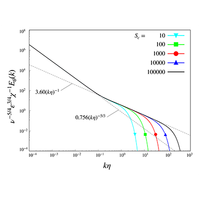
    <title>Osmotic motion of a semipermeable vesicle</title>
    <link>http://link.aps.org/doi/10.1103/vcwd-hnb8</link>
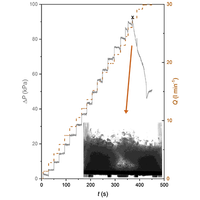
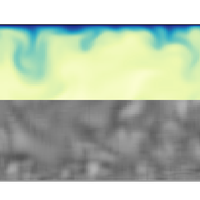
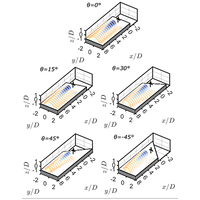
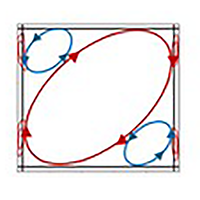
    <description>Author(s): Ehud Yariv&lt;br/&gt;&lt;p&gt;When the solute concentration is different in the two sides of a semipermeable membrane, solvent flows from the solute-depleted side to the solute-enriched side. More generally, when a vesicle is placed in a solute-concentration gradient, it experiences inward osmosis on the low-concentration side and outward osmosis on the high-concentration side. This paper investigates the resulting motion of the vesicle down the gradient.&lt;/p&gt;&lt;img src="//cdn.journals.aps.org/journals/PRFLUIDS/key_images/10.1103/vcwd-hnb8.png" width="200" height=\"100\"&gt;&lt;br/&gt;[Phys. Rev. Fluids 11, 053603] Published Thu May 07, 2026</description>
    <content:encoded><![CDATA[<p>Author(s): Ehud Yariv</p><p>When the solute concentration is different in the two sides of a semipermeable membrane, solvent flows from the solute-depleted side to the solute-enriched side. More generally, when a vesicle is placed in a solute-concentration gradient, it experiences inward osmosis on the low-concentration side and outward osmosis on the high-concentration side. This paper investigates the resulting motion of the vesicle down the gradient.</p><img src="//cdn.journals.aps.org/journals/PRFLUIDS/key_images/10.1103/vcwd-hnb8.png" width="200" height=\"100\"><br/><p>[Phys. Rev. Fluids 11, 053603] Published Thu May 07, 2026</p>]]></content:encoded>
    <dc:title>Osmotic motion of a semipermeable vesicle</dc:title>
    <dc:creator>Ehud Yariv</dc:creator>
    <dc:date>2026-05-07T10:00:00+00:00</dc:date>
    <dc:rights>Personal use only, all commercial or other reuse prohibited</dc:rights>
    <dc:source>Phys. Rev. Fluids 11, 053603 (2026)</dc:source>
    <dc:type>article</dc:type>
    <dc:identifier>doi:10.1103/vcwd-hnb8</dc:identifier>
    <prism:doi>10.1103/vcwd-hnb8</prism:doi>
    <prism:publicationName>Physical Review Fluids</prism:publicationName>
    <prism:volume>11</prism:volume>
    <prism:number>5</prism:number>
    <prism:publicationDate>2026-05-07T10:00:00+00:00</prism:publicationDate>
    <prism:url>http://link.aps.org/doi/10.1103/vcwd-hnb8</prism:url>
    <prism:startingPage>053603</prism:startingPage>
    <dc:subject>Drops, Bubbles, Capsules, and Vesicles</dc:subject>
    <prism:section>Drops, Bubbles, Capsules, and Vesicles</prism:section>
  </item>
  <item rdf:about="http://link.aps.org/doi/10.1103/xp9w-f6ks">
    <title>Asymptotically exact formulation of superfluid turbulence with discrete topological defects at all continuum scales</title>
    <link>http://link.aps.org/doi/10.1103/xp9w-f6ks</link>
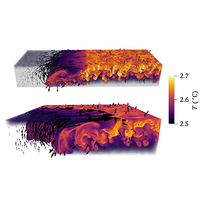
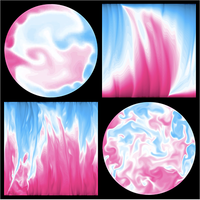
    <description>Author(s): Demosthenes Kivotides&lt;br/&gt;&lt;p&gt;Quantized vortex filaments in Bose superfluids act as line-like sources for microhydrodynamic (low Reynolds number) normal-fluid motion on scales that standard turbulence grids cannot resolve. We develop a two-level multiscale framework that couples a filtered normal-fluid solver to an explicit microhydrodynamic Stokes Linear Response (LRT), incorporating these effects self-consistently into both vortex dynamics and the resolved normal-fluid equations. The approach enables efficient superfluid-turbulence computations for laboratory, cryogenic, and astrophysical settings.&lt;/p&gt;&lt;img src="//cdn.journals.aps.org/journals/PRFLUIDS/key_images/10.1103/xp9w-f6ks.png" width="200" height=\"100\"&gt;&lt;br/&gt;[Phys. Rev. Fluids 11, 054602] Published Thu May 07, 2026</description>
    <content:encoded><![CDATA[<p>Author(s): Demosthenes Kivotides</p><p>Quantized vortex filaments in Bose superfluids act as line-like sources for microhydrodynamic (low Reynolds number) normal-fluid motion on scales that standard turbulence grids cannot resolve. We develop a two-level multiscale framework that couples a filtered normal-fluid solver to an explicit microhydrodynamic Stokes Linear Response (LRT), incorporating these effects self-consistently into both vortex dynamics and the resolved normal-fluid equations. The approach enables efficient superfluid-turbulence computations for laboratory, cryogenic, and astrophysical settings.</p><img src="//cdn.journals.aps.org/journals/PRFLUIDS/key_images/10.1103/xp9w-f6ks.png" width="200" height=\"100\"><br/><p>[Phys. Rev. Fluids 11, 054602] Published Thu May 07, 2026</p>]]></content:encoded>
    <dc:title>Asymptotically exact formulation of superfluid turbulence with discrete topological defects at all continuum scales</dc:title>
    <dc:creator>Demosthenes Kivotides</dc:creator>
    <dc:date>2026-05-07T10:00:00+00:00</dc:date>
    <dc:rights>Personal use only, all commercial or other reuse prohibited</dc:rights>
    <dc:source>Phys. Rev. Fluids 11, 054602 (2026)</dc:source>
    <dc:type>article</dc:type>
    <dc:identifier>doi:10.1103/xp9w-f6ks</dc:identifier>
    <prism:doi>10.1103/xp9w-f6ks</prism:doi>
    <prism:publicationName>Physical Review Fluids</prism:publicationName>
    <prism:volume>11</prism:volume>
    <prism:number>5</prism:number>
    <prism:publicationDate>2026-05-07T10:00:00+00:00</prism:publicationDate>
    <prism:url>http://link.aps.org/doi/10.1103/xp9w-f6ks</prism:url>
    <prism:startingPage>054602</prism:startingPage>
    <dc:subject>Turbulent Flows</dc:subject>
    <prism:section>Turbulent Flows</prism:section>
  </item>
  <item rdf:about="http://link.aps.org/doi/10.1103/3f4m-4s3q">
    <title>Electro-vortex flows in cylindrical cells: Theoretical estimate and flow characteristics</title>
    <link>http://link.aps.org/doi/10.1103/3f4m-4s3q</link>
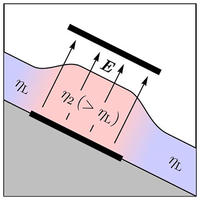
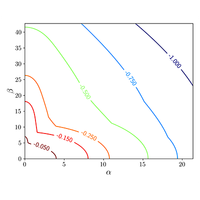
    <description>Author(s): Swapnil Soni and Avishek Ranjan&lt;br/&gt;&lt;p&gt;We derive a new theoretical estimate of the root mean square velocity of the electro-vortex flow (EVF) – a current-driven MHD flow – for high Reynolds number regime using an inertia-Lorentz balance in the vorticity transport equation. This estimate accounts for the dimension of the current collector, an important parameter that governs the EVF. There is an excellent agreement between the theory and numerical simulations performed using the custom-built code in OpenFOAM. We also explain the EVF characteristics using these results. Our numerical results reveal a distinct flow feature stemming from the domain finiteness at relatively higher current collector radii.&lt;/p&gt;&lt;img src="//cdn.journals.aps.org/journals/PRFLUIDS/key_images/10.1103/3f4m-4s3q.png" width="200" height=\"100\"&gt;&lt;br/&gt;[Phys. Rev. Fluids 11, 053701] Published Wed May 06, 2026</description>
    <content:encoded><![CDATA[<p>Author(s): Swapnil Soni and Avishek Ranjan</p><p>We derive a new theoretical estimate of the root mean square velocity of the electro-vortex flow (EVF) – a current-driven MHD flow – for high Reynolds number regime using an inertia-Lorentz balance in the vorticity transport equation. This estimate accounts for the dimension of the current collector, an important parameter that governs the EVF. There is an excellent agreement between the theory and numerical simulations performed using the custom-built code in OpenFOAM. We also explain the EVF characteristics using these results. Our numerical results reveal a distinct flow feature stemming from the domain finiteness at relatively higher current collector radii.</p><img src="//cdn.journals.aps.org/journals/PRFLUIDS/key_images/10.1103/3f4m-4s3q.png" width="200" height=\"100\"><br/><p>[Phys. Rev. Fluids 11, 053701] Published Wed May 06, 2026</p>]]></content:encoded>
    <dc:title>Electro-vortex flows in cylindrical cells: Theoretical estimate and flow characteristics</dc:title>
    <dc:creator>Swapnil Soni and Avishek Ranjan</dc:creator>
    <dc:date>2026-05-06T10:00:00+00:00</dc:date>
    <dc:rights>Personal use only, all commercial or other reuse prohibited</dc:rights>
    <dc:source>Phys. Rev. Fluids 11, 053701 (2026)</dc:source>
    <dc:type>article</dc:type>
    <dc:identifier>doi:10.1103/3f4m-4s3q</dc:identifier>
    <prism:doi>10.1103/3f4m-4s3q</prism:doi>
    <prism:publicationName>Physical Review Fluids</prism:publicationName>
    <prism:volume>11</prism:volume>
    <prism:number>5</prism:number>
    <prism:publicationDate>2026-05-06T10:00:00+00:00</prism:publicationDate>
    <prism:url>http://link.aps.org/doi/10.1103/3f4m-4s3q</prism:url>
    <prism:startingPage>053701</prism:startingPage>
    <dc:subject>Electrokinetic Phenomena, Electrohydrodynamics, and Magnetohydrodynamics</dc:subject>
    <prism:section>Electrokinetic Phenomena, Electrohydrodynamics, and Magnetohydrodynamics</prism:section>
  </item>
  <item rdf:about="http://link.aps.org/doi/10.1103/l1b2-blw2">
    <title>Newtonian die-swell phenomenon revisited: Theory and simulations</title>
    <link>http://link.aps.org/doi/10.1103/l1b2-blw2</link>
    <description>Author(s): W.-P. Breugem and Y. E. Kamis&lt;br/&gt;&lt;p&gt;We investigated the dynamics of a Newtonian liquid jet issued from a long circular nozzle into a gaseous environment. While the jet contracts at high Reynolds number, it swells at low Reynolds number. To analyze this, we derived an integral momentum balance for the flow in both the nozzle and jet. The swell at low Reynolds number is associated with an excess integral wall shear stress near nozzle exit relative to perfect Poiseuille flow. Numerical simulations revealed self-similar behavior of the flow within the nozzle, which is explained from the stick-slip transition at the nozzle lip and the subsequent development of a boundary layer along the jet interface.&lt;/p&gt;&lt;img src="//cdn.journals.aps.org/journals/PRFLUIDS/key_images/10.1103/l1b2-blw2.png" width="200" height=\"100\"&gt;&lt;br/&gt;[Phys. Rev. Fluids 11, 054101] Published Wed May 06, 2026</description>
    <content:encoded><![CDATA[<p>Author(s): W.-P. Breugem and Y. E. Kamis</p><p>We investigated the dynamics of a Newtonian liquid jet issued from a long circular nozzle into a gaseous environment. While the jet contracts at high Reynolds number, it swells at low Reynolds number. To analyze this, we derived an integral momentum balance for the flow in both the nozzle and jet. The swell at low Reynolds number is associated with an excess integral wall shear stress near nozzle exit relative to perfect Poiseuille flow. Numerical simulations revealed self-similar behavior of the flow within the nozzle, which is explained from the stick-slip transition at the nozzle lip and the subsequent development of a boundary layer along the jet interface.</p><img src="//cdn.journals.aps.org/journals/PRFLUIDS/key_images/10.1103/l1b2-blw2.png" width="200" height=\"100\"><br/><p>[Phys. Rev. Fluids 11, 054101] Published Wed May 06, 2026</p>]]></content:encoded>
    <dc:title>Newtonian die-swell phenomenon revisited: Theory and simulations</dc:title>
    <dc:creator>W.-P. Breugem and Y. E. Kamis</dc:creator>
    <dc:date>2026-05-06T10:00:00+00:00</dc:date>
    <dc:rights>Personal use only, all commercial or other reuse prohibited</dc:rights>
    <dc:source>Phys. Rev. Fluids 11, 054101 (2026)</dc:source>
    <dc:type>article</dc:type>
    <dc:identifier>doi:10.1103/l1b2-blw2</dc:identifier>
    <prism:doi>10.1103/l1b2-blw2</prism:doi>
    <prism:publicationName>Physical Review Fluids</prism:publicationName>
    <prism:volume>11</prism:volume>
    <prism:number>5</prism:number>
    <prism:publicationDate>2026-05-06T10:00:00+00:00</prism:publicationDate>
    <prism:url>http://link.aps.org/doi/10.1103/l1b2-blw2</prism:url>
    <prism:startingPage>054101</prism:startingPage>
    <dc:subject>Laminar and Viscous Flows</dc:subject>
    <prism:section>Laminar and Viscous Flows</prism:section>
  </item>
  <item rdf:about="http://link.aps.org/doi/10.1103/bb9p-47jt">
    <title>Turbulent heat transfer enhancement by compliant walls</title>
    <link>http://link.aps.org/doi/10.1103/bb9p-47jt</link>
    <description>Author(s): Morie Koseki and Marco Edoardo Rosti&lt;br/&gt;&lt;p&gt;This study investigates the effect of compliant walls on the turbulent heat transfer in channel flows over viscous-hyperelastic walls. We show that the compliant wall leads to an increase not only of the momentum transfer but also of the heat transfer, and that the heat transfer enhancement is favorable compared to the momentum one&lt;/p&gt;&lt;img src="//cdn.journals.aps.org/journals/PRFLUIDS/key_images/10.1103/bb9p-47jt.png" width="200" height=\"100\"&gt;&lt;br/&gt;[Phys. Rev. Fluids 11, 054301] Published Wed May 06, 2026</description>
    <content:encoded><![CDATA[<p>Author(s): Morie Koseki and Marco Edoardo Rosti</p><p>This study investigates the effect of compliant walls on the turbulent heat transfer in channel flows over viscous-hyperelastic walls. We show that the compliant wall leads to an increase not only of the momentum transfer but also of the heat transfer, and that the heat transfer enhancement is favorable compared to the momentum one</p><img src="//cdn.journals.aps.org/journals/PRFLUIDS/key_images/10.1103/bb9p-47jt.png" width="200" height=\"100\"><br/><p>[Phys. Rev. Fluids 11, 054301] Published Wed May 06, 2026</p>]]></content:encoded>
    <dc:title>Turbulent heat transfer enhancement by compliant walls</dc:title>
    <dc:creator>Morie Koseki and Marco Edoardo Rosti</dc:creator>
    <dc:date>2026-05-06T10:00:00+00:00</dc:date>
    <dc:rights>Personal use only, all commercial or other reuse prohibited</dc:rights>
    <dc:source>Phys. Rev. Fluids 11, 054301 (2026)</dc:source>
    <dc:type>article</dc:type>
    <dc:identifier>doi:10.1103/bb9p-47jt</dc:identifier>
    <prism:doi>10.1103/bb9p-47jt</prism:doi>
    <prism:publicationName>Physical Review Fluids</prism:publicationName>
    <prism:volume>11</prism:volume>
    <prism:number>5</prism:number>
    <prism:publicationDate>2026-05-06T10:00:00+00:00</prism:publicationDate>
    <prism:url>http://link.aps.org/doi/10.1103/bb9p-47jt</prism:url>
    <prism:startingPage>054301</prism:startingPage>
    <dc:subject>Multiphase, Granular, and Particle-Laden Flows</dc:subject>
    <prism:section>Multiphase, Granular, and Particle-Laden Flows</prism:section>
  </item>
  <item rdf:about="http://link.aps.org/doi/10.1103/r45p-mn1c">
    <title>Isothermal twin-swirl flows with bluff-swirl, bubble, and conical vortex breakdown: Flow field and coherent structures</title>
    <link>http://link.aps.org/doi/10.1103/r45p-mn1c</link>
    <description>Author(s): Pabitra Badhuk, Atanu Dolai, and R. V. Ravikrishna&lt;br/&gt;&lt;p&gt;Twin-swirl flows can generate various vortex breakdown structures depending on the swirling direction, strength, and the momentum ratio between the swirling streams. The present study uses scale-resolving simulations to analyze the mechanism of radial pressure gradient formation, role of entrainment in mixing, and identification of coherent structures in such flows. We show that while the centripetal acceleration dominates the radial pressure gradient formation with a single swirler, the contribution of advection and turbulence components are also significant in twin-swirl flows. We also show that the entrainment velocity is better estimated by the rms components than the mean velocity.&lt;/p&gt;&lt;img src="//cdn.journals.aps.org/journals/PRFLUIDS/key_images/10.1103/r45p-mn1c.png" width="200" height=\"100\"&gt;&lt;br/&gt;[Phys. Rev. Fluids 11, 054601] Published Wed May 06, 2026</description>
    <content:encoded><![CDATA[<p>Author(s): Pabitra Badhuk, Atanu Dolai, and R. V. Ravikrishna</p><p>Twin-swirl flows can generate various vortex breakdown structures depending on the swirling direction, strength, and the momentum ratio between the swirling streams. The present study uses scale-resolving simulations to analyze the mechanism of radial pressure gradient formation, role of entrainment in mixing, and identification of coherent structures in such flows. We show that while the centripetal acceleration dominates the radial pressure gradient formation with a single swirler, the contribution of advection and turbulence components are also significant in twin-swirl flows. We also show that the entrainment velocity is better estimated by the rms components than the mean velocity.</p><img src="//cdn.journals.aps.org/journals/PRFLUIDS/key_images/10.1103/r45p-mn1c.png" width="200" height=\"100\"><br/><p>[Phys. Rev. Fluids 11, 054601] Published Wed May 06, 2026</p>]]></content:encoded>
    <dc:title>Isothermal twin-swirl flows with bluff-swirl, bubble, and conical vortex breakdown: Flow field and coherent structures</dc:title>
    <dc:creator>Pabitra Badhuk, Atanu Dolai, and R. V. Ravikrishna</dc:creator>
    <dc:date>2026-05-06T10:00:00+00:00</dc:date>
    <dc:rights>Personal use only, all commercial or other reuse prohibited</dc:rights>
    <dc:source>Phys. Rev. Fluids 11, 054601 (2026)</dc:source>
    <dc:type>article</dc:type>
    <dc:identifier>doi:10.1103/r45p-mn1c</dc:identifier>
    <prism:doi>10.1103/r45p-mn1c</prism:doi>
    <prism:publicationName>Physical Review Fluids</prism:publicationName>
    <prism:volume>11</prism:volume>
    <prism:number>5</prism:number>
    <prism:publicationDate>2026-05-06T10:00:00+00:00</prism:publicationDate>
    <prism:url>http://link.aps.org/doi/10.1103/r45p-mn1c</prism:url>
    <prism:startingPage>054601</prism:startingPage>
    <dc:subject>Turbulent Flows</dc:subject>
    <prism:section>Turbulent Flows</prism:section>
  </item>
  <item rdf:about="http://link.aps.org/doi/10.1103/ytmw-sc9s">
    <title>Erratum: GPU-accelerated simulations of turbulence: Review of current applications and future perspectives [Phys. Rev. Fluids &lt;b&gt;11&lt;/b&gt;, 034905 (2026)]</title>
    <link>http://link.aps.org/doi/10.1103/ytmw-sc9s</link>
    <description>Author(s): A. Roccon, G. Amati, L. Brandt, D. Calhoun, P. Costa, W. Lu, S. Pirozzoli, D. Richter, M. Umair, D. You, T. Zahtila, and C. Marchioli&lt;br/&gt;[Phys. Rev. Fluids 11, 059901] Published Wed May 06, 2026</description>
    <content:encoded><![CDATA[<p>Author(s): A. Roccon, G. Amati, L. Brandt, D. Calhoun, P. Costa, W. Lu, S. Pirozzoli, D. Richter, M. Umair, D. You, T. Zahtila, and C. Marchioli</p><p>[Phys. Rev. Fluids 11, 059901] Published Wed May 06, 2026</p>]]></content:encoded>
    <dc:title>Erratum: GPU-accelerated simulations of turbulence: Review of current applications and future perspectives [Phys. Rev. Fluids &lt;b&gt;11&lt;/b&gt;, 034905 (2026)]</dc:title>
    <dc:creator>A. Roccon, G. Amati, L. Brandt, D. Calhoun, P. Costa, W. Lu, S. Pirozzoli, D. Richter, M. Umair, D. You, T. Zahtila, and C. Marchioli</dc:creator>
    <dc:date>2026-05-06T10:00:00+00:00</dc:date>
    <dc:rights>Personal use only, all commercial or other reuse prohibited</dc:rights>
    <dc:source>Phys. Rev. Fluids 11, 059901 (2026)</dc:source>
    <dc:type>article</dc:type>
    <dc:identifier>doi:10.1103/ytmw-sc9s</dc:identifier>
    <prism:doi>10.1103/ytmw-sc9s</prism:doi>
    <prism:publicationName>Physical Review Fluids</prism:publicationName>
    <prism:volume>11</prism:volume>
    <prism:number>5</prism:number>
    <prism:publicationDate>2026-05-06T10:00:00+00:00</prism:publicationDate>
    <prism:url>http://link.aps.org/doi/10.1103/ytmw-sc9s</prism:url>
    <prism:startingPage>059901</prism:startingPage>
    <dc:subject>Errata</dc:subject>
    <prism:section>Errata</prism:section>
  </item>
  <item rdf:about="http://link.aps.org/doi/10.1103/xpff-b2l8">
    <title>Retraction dynamics of surfactant-covered liquid sheets with surface rheological effects</title>
    <link>http://link.aps.org/doi/10.1103/xpff-b2l8</link>
    <description>Author(s): Naresh K. Dhanwani, Ajay Harishankar Kumar, Hansol Wee, and Osman A. Basaran&lt;br/&gt;&lt;p&gt;Using theory and simulation we analyze the retraction of a highly slender Newtonian liquid sheet with surface covered by a surfactant monolayer surrounded by air primarily in the Stokes limit with 1/Oh=0 where Oh is the Ohnesorge number. As the two surfaces of the sheet remain planar for long times after retraction is initiated, a control volume analysis is used to analytically calculate the maximum film thickness and retraction velocity. The role of finite inertia is also studied and it is shown that rim formation is suppressed if Oh &lt;math xmlns="http://www.w3.org/1998/Math/MathML" display="inline"&gt;&lt;mrow&gt;&lt;mo lspace="0" rspace="0" stretchy="false"&gt;(&lt;/mo&gt;&lt;mn&gt;1&lt;/mn&gt;&lt;mo lspace="0.222em" rspace="0.222em"&gt;+&lt;/mo&gt;&lt;msub&gt;&lt;mi&gt;B&lt;/mi&gt;&lt;mn&gt;0&lt;/mn&gt;&lt;/msub&gt;&lt;mspace width="0"&gt;&lt;/mspace&gt;&lt;msub&gt;&lt;mi mathvariant="normal"&gt;Γ&lt;/mi&gt;&lt;mn&gt;0&lt;/mn&gt;&lt;/msub&gt;&lt;mo lspace="0" rspace="0.278em" stretchy="false"&gt;)&lt;/mo&gt;&lt;mo lspace="0" rspace="0.278em"&gt;≫&lt;/mo&gt;&lt;msub&gt;&lt;mi&gt;L&lt;/mi&gt;&lt;mn&gt;0&lt;/mn&gt;&lt;/msub&gt;&lt;/mrow&gt;&lt;/math&gt; where &lt;math xmlns="http://www.w3.org/1998/Math/MathML" display="inline"&gt;&lt;msub&gt;&lt;mi&gt;B&lt;/mi&gt;&lt;mn&gt;0&lt;/mn&gt;&lt;/msub&gt;&lt;/math&gt; and &lt;math xmlns="http://www.w3.org/1998/Math/MathML" display="inline"&gt;&lt;msub&gt;&lt;mi&gt;L&lt;/mi&gt;&lt;mn&gt;0&lt;/mn&gt;&lt;/msub&gt;&lt;/math&gt; are the Boussinesq-Scriven number and initial sheet aspect ratio and &lt;math xmlns="http://www.w3.org/1998/Math/MathML" display="inline"&gt;&lt;msub&gt;&lt;mi mathvariant="normal"&gt;Γ&lt;/mi&gt;&lt;mn&gt;0&lt;/mn&gt;&lt;/msub&gt;&lt;/math&gt; the initial surfactant concentration.&lt;/p&gt;&lt;img src="//cdn.journals.aps.org/journals/PRFLUIDS/key_images/10.1103/xpff-b2l8.png" width="200" height=\"100\"&gt;&lt;br/&gt;[Phys. Rev. Fluids 11, 053602] Published Mon May 04, 2026</description>
    <content:encoded><![CDATA[<p>Author(s): Naresh K. Dhanwani, Ajay Harishankar Kumar, Hansol Wee, and Osman A. Basaran</p><p>Using theory and simulation we analyze the retraction of a highly slender Newtonian liquid sheet with surface covered by a surfactant monolayer surrounded by air primarily in the Stokes limit with 1/Oh=0 where Oh is the Ohnesorge number. As the two surfaces of the sheet remain planar for long times after retraction is initiated, a control volume analysis is used to analytically calculate the maximum film thickness and retraction velocity. The role of finite inertia is also studied and it is shown that rim formation is suppressed if Oh <math xmlns="http://www.w3.org/1998/Math/MathML" display="inline"><mrow><mo lspace="0" rspace="0" stretchy="false">(</mo><mn>1</mn><mo lspace="0.222em" rspace="0.222em">+</mo><msub><mi>B</mi><mn>0</mn></msub><mspace width="0"></mspace><msub><mi mathvariant="normal">Γ</mi><mn>0</mn></msub><mo lspace="0" rspace="0.278em" stretchy="false">)</mo><mo lspace="0" rspace="0.278em">≫</mo><msub><mi>L</mi><mn>0</mn></msub></mrow></math> where <math xmlns="http://www.w3.org/1998/Math/MathML" display="inline"><msub><mi>B</mi><mn>0</mn></msub></math> and <math xmlns="http://www.w3.org/1998/Math/MathML" display="inline"><msub><mi>L</mi><mn>0</mn></msub></math> are the Boussinesq-Scriven number and initial sheet aspect ratio and <math xmlns="http://www.w3.org/1998/Math/MathML" display="inline"><msub><mi mathvariant="normal">Γ</mi><mn>0</mn></msub></math> the initial surfactant concentration.</p><img src="//cdn.journals.aps.org/journals/PRFLUIDS/key_images/10.1103/xpff-b2l8.png" width="200" height=\"100\"><br/><p>[Phys. Rev. Fluids 11, 053602] Published Mon May 04, 2026</p>]]></content:encoded>
    <dc:title>Retraction dynamics of surfactant-covered liquid sheets with surface rheological effects</dc:title>
    <dc:creator>Naresh K. Dhanwani, Ajay Harishankar Kumar, Hansol Wee, and Osman A. Basaran</dc:creator>
    <dc:date>2026-05-04T10:00:00+00:00</dc:date>
    <dc:rights>Personal use only, all commercial or other reuse prohibited</dc:rights>
    <dc:source>Phys. Rev. Fluids 11, 053602 (2026)</dc:source>
    <dc:type>article</dc:type>
    <dc:identifier>doi:10.1103/xpff-b2l8</dc:identifier>
    <prism:doi>10.1103/xpff-b2l8</prism:doi>
    <prism:publicationName>Physical Review Fluids</prism:publicationName>
    <prism:volume>11</prism:volume>
    <prism:number>5</prism:number>
    <prism:publicationDate>2026-05-04T10:00:00+00:00</prism:publicationDate>
    <prism:url>http://link.aps.org/doi/10.1103/xpff-b2l8</prism:url>
    <prism:startingPage>053602</prism:startingPage>
    <dc:subject>Drops, Bubbles, Capsules, and Vesicles</dc:subject>
    <prism:section>Drops, Bubbles, Capsules, and Vesicles</prism:section>
  </item>
  <item rdf:about="http://link.aps.org/doi/10.1103/hwkb-nnww">
    <title>Hysteresis in the freeze-thaw cycle of emulsions and suspensions</title>
    <link>http://link.aps.org/doi/10.1103/hwkb-nnww</link>
    <description>Author(s): Wilfried Raffi, Jochem G. Meijer, and Detlef Lohse&lt;br/&gt;&lt;p&gt;Freeze–thaw cycles drive complex interactions between objects and moving solid–liquid interfaces. Using experimental model systems of oil-in-water emulsions and polystyrene particle suspensions, we reveal the occurence of hysteresis: Solid particles drift from their initial positions after one freeze-thaw cycle, while deformable oil droplets largely return to their initial positions with reversible shape changes. Our theoretical model captures these trends, highlighting the complexity of freeze–thaw dynamics.&lt;/p&gt;&lt;img src="//cdn.journals.aps.org/journals/PRFLUIDS/key_images/10.1103/hwkb-nnww.png" width="200" height=\"100\"&gt;&lt;br/&gt;[Phys. Rev. Fluids 11, 054001] Published Mon May 04, 2026</description>
    <content:encoded><![CDATA[<p>Author(s): Wilfried Raffi, Jochem G. Meijer, and Detlef Lohse</p><p>Freeze–thaw cycles drive complex interactions between objects and moving solid–liquid interfaces. Using experimental model systems of oil-in-water emulsions and polystyrene particle suspensions, we reveal the occurence of hysteresis: Solid particles drift from their initial positions after one freeze-thaw cycle, while deformable oil droplets largely return to their initial positions with reversible shape changes. Our theoretical model captures these trends, highlighting the complexity of freeze–thaw dynamics.</p><img src="//cdn.journals.aps.org/journals/PRFLUIDS/key_images/10.1103/hwkb-nnww.png" width="200" height=\"100\"><br/><p>[Phys. Rev. Fluids 11, 054001] Published Mon May 04, 2026</p>]]></content:encoded>
    <dc:title>Hysteresis in the freeze-thaw cycle of emulsions and suspensions</dc:title>
    <dc:creator>Wilfried Raffi, Jochem G. Meijer, and Detlef Lohse</dc:creator>
    <dc:date>2026-05-04T10:00:00+00:00</dc:date>
    <dc:rights>Personal use only, all commercial or other reuse prohibited</dc:rights>
    <dc:source>Phys. Rev. Fluids 11, 054001 (2026)</dc:source>
    <dc:type>article</dc:type>
    <dc:identifier>doi:10.1103/hwkb-nnww</dc:identifier>
    <prism:doi>10.1103/hwkb-nnww</prism:doi>
    <prism:publicationName>Physical Review Fluids</prism:publicationName>
    <prism:volume>11</prism:volume>
    <prism:number>5</prism:number>
    <prism:publicationDate>2026-05-04T10:00:00+00:00</prism:publicationDate>
    <prism:url>http://link.aps.org/doi/10.1103/hwkb-nnww</prism:url>
    <prism:startingPage>054001</prism:startingPage>
    <dc:subject>Interfacial Phenomena and Flows</dc:subject>
    <prism:section>Interfacial Phenomena and Flows</prism:section>
  </item>
  <item rdf:about="http://link.aps.org/doi/10.1103/jr19-lxmr">
    <title>Bubble dissolution kinetics in porous media</title>
    <link>http://link.aps.org/doi/10.1103/jr19-lxmr</link>
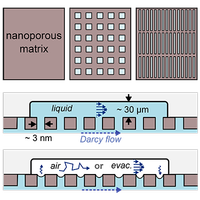
    <description>Author(s): Yuehongjiang Yu, Yang Yang, Jie Qi, Yu Qiu, Mengdi Sun, and Ke Xu&lt;br/&gt;&lt;p&gt;Bubble dissolution in porous media controls key applications including geological carbon sequestration, groundwater remediation, and energy engineering. The classic Epstein-Plesset model for bubble dissolution in open space is invalid in porous medium. We reveal how porous structure fundamentally reshapes dissolution, and derive analytical solutions for three typical bubble morphologies (single-pore, strip-shaped, and block-shaped). Analytical solutions are well verified by experiments and numerical simulations. Our new theory offers critical theoretical support for optimizing subsurface gas storage and gaseous pollutant removal technologies.&lt;/p&gt;&lt;img src="//cdn.journals.aps.org/journals/PRFLUIDS/key_images/10.1103/jr19-lxmr.png" width="200" height=\"100\"&gt;&lt;br/&gt;[Phys. Rev. Fluids 11, 053601] Published Fri May 01, 2026</description>
    <content:encoded><![CDATA[<p>Author(s): Yuehongjiang Yu, Yang Yang, Jie Qi, Yu Qiu, Mengdi Sun, and Ke Xu</p><p>Bubble dissolution in porous media controls key applications including geological carbon sequestration, groundwater remediation, and energy engineering. The classic Epstein-Plesset model for bubble dissolution in open space is invalid in porous medium. We reveal how porous structure fundamentally reshapes dissolution, and derive analytical solutions for three typical bubble morphologies (single-pore, strip-shaped, and block-shaped). Analytical solutions are well verified by experiments and numerical simulations. Our new theory offers critical theoretical support for optimizing subsurface gas storage and gaseous pollutant removal technologies.</p><img src="//cdn.journals.aps.org/journals/PRFLUIDS/key_images/10.1103/jr19-lxmr.png" width="200" height=\"100\"><br/><p>[Phys. Rev. Fluids 11, 053601] Published Fri May 01, 2026</p>]]></content:encoded>
    <dc:title>Bubble dissolution kinetics in porous media</dc:title>
    <dc:creator>Yuehongjiang Yu, Yang Yang, Jie Qi, Yu Qiu, Mengdi Sun, and Ke Xu</dc:creator>
    <dc:date>2026-05-01T10:00:00+00:00</dc:date>
    <dc:rights>Personal use only, all commercial or other reuse prohibited</dc:rights>
    <dc:source>Phys. Rev. Fluids 11, 053601 (2026)</dc:source>
    <dc:type>article</dc:type>
    <dc:identifier>doi:10.1103/jr19-lxmr</dc:identifier>
    <prism:doi>10.1103/jr19-lxmr</prism:doi>
    <prism:publicationName>Physical Review Fluids</prism:publicationName>
    <prism:volume>11</prism:volume>
    <prism:number>5</prism:number>
    <prism:publicationDate>2026-05-01T10:00:00+00:00</prism:publicationDate>
    <prism:url>http://link.aps.org/doi/10.1103/jr19-lxmr</prism:url>
    <prism:startingPage>053601</prism:startingPage>
    <dc:subject>Drops, Bubbles, Capsules, and Vesicles</dc:subject>
    <prism:section>Drops, Bubbles, Capsules, and Vesicles</prism:section>
  </item>
  <item rdf:about="http://link.aps.org/doi/10.1103/mxpb-qhx7">
    <title>Condensation front mechanism of partial cavitation in an axisymmetric Venturi</title>
    <link>http://link.aps.org/doi/10.1103/mxpb-qhx7</link>
    <description>Author(s): Xun Sun (孙逊), Zhizhong Zhou (周智忠), Weibin You (游炜彬), Sivakumar Manickam, Yunqiao Liu (刘筠乔), Wenlong Wang (王文龙), and Benlong Wang (王本龙)&lt;br/&gt;&lt;p&gt;We show that the incompressible Large eddy simulations of the condensation fronts (also referred to as bubbly shocks or condensation shocks) in partial cavitation within a three-dimensional Venturi agree well with the experiments. The condensation front is fundamentally different from traditional shock waves. The density variations due to evaporation and condensation of cavitation, rather than fluid compressibility, govern its formation and propagation. Hence, a compressible solver is unnecessary for simulating condensation fronts. These findings offer a new understanding of the shedding mechanism of partial cavitation.&lt;/p&gt;&lt;img src="//cdn.journals.aps.org/journals/PRFLUIDS/key_images/10.1103/mxpb-qhx7.png" width="200" height=\"100\"&gt;&lt;br/&gt;[Phys. Rev. Fluids 11, 044304] Published Thu Apr 30, 2026</description>
    <content:encoded><![CDATA[<p>Author(s): Xun Sun (孙逊), Zhizhong Zhou (周智忠), Weibin You (游炜彬), Sivakumar Manickam, Yunqiao Liu (刘筠乔), Wenlong Wang (王文龙), and Benlong Wang (王本龙)</p><p>We show that the incompressible Large eddy simulations of the condensation fronts (also referred to as bubbly shocks or condensation shocks) in partial cavitation within a three-dimensional Venturi agree well with the experiments. The condensation front is fundamentally different from traditional shock waves. The density variations due to evaporation and condensation of cavitation, rather than fluid compressibility, govern its formation and propagation. Hence, a compressible solver is unnecessary for simulating condensation fronts. These findings offer a new understanding of the shedding mechanism of partial cavitation.</p><img src="//cdn.journals.aps.org/journals/PRFLUIDS/key_images/10.1103/mxpb-qhx7.png" width="200" height=\"100\"><br/><p>[Phys. Rev. Fluids 11, 044304] Published Thu Apr 30, 2026</p>]]></content:encoded>
    <dc:title>Condensation front mechanism of partial cavitation in an axisymmetric Venturi</dc:title>
    <dc:creator>Xun Sun (孙逊), Zhizhong Zhou (周智忠), Weibin You (游炜彬), Sivakumar Manickam, Yunqiao Liu (刘筠乔), Wenlong Wang (王文龙), and Benlong Wang (王本龙)</dc:creator>
    <dc:date>2026-04-30T10:00:00+00:00</dc:date>
    <dc:rights>Personal use only, all commercial or other reuse prohibited</dc:rights>
    <dc:source>Phys. Rev. Fluids 11, 044304 (2026)</dc:source>
    <dc:type>article</dc:type>
    <dc:identifier>doi:10.1103/mxpb-qhx7</dc:identifier>
    <prism:doi>10.1103/mxpb-qhx7</prism:doi>
    <prism:publicationName>Physical Review Fluids</prism:publicationName>
    <prism:volume>11</prism:volume>
    <prism:number>4</prism:number>
    <prism:publicationDate>2026-04-30T10:00:00+00:00</prism:publicationDate>
    <prism:url>http://link.aps.org/doi/10.1103/mxpb-qhx7</prism:url>
    <prism:startingPage>044304</prism:startingPage>
    <dc:subject>Multiphase, Granular, and Particle-Laden Flows</dc:subject>
    <prism:section>Multiphase, Granular, and Particle-Laden Flows</prism:section>
  </item>
  <item rdf:about="http://link.aps.org/doi/10.1103/tnxb-ckr5">
    <title>Swimming mechanism of a dolphin on the basis of the hierarchy of vortices</title>
    <link>http://link.aps.org/doi/10.1103/tnxb-ckr5</link>
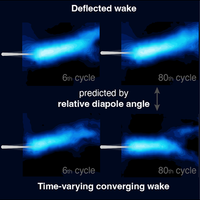
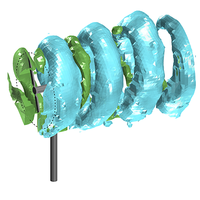
    <description>Author(s): Yutaro Motoori, Hideki Murahata, and Susumu Goto&lt;br/&gt;&lt;p&gt;We numerically investigate the swimming mechanism of a dolphin by focusing on the hierarchy of vortices in its turbulent wake. Using direct numerical simulations of a self-propelled dolphin and scale decomposition of the flow, we show that the caudal fin generates large vortex rings that contribute most of propulsion, whereas smaller vortices are created through the energy cascade but contribute little to propulsion. We also show that this mechanism remains robust regardless of the Reynolds number.&lt;/p&gt;&lt;img src="//cdn.journals.aps.org/journals/PRFLUIDS/key_images/10.1103/tnxb-ckr5.png" width="200" height=\"100\"&gt;&lt;br/&gt;[Phys. Rev. Fluids 11, L042601] Published Thu Apr 30, 2026</description>
    <content:encoded><![CDATA[<p>Author(s): Yutaro Motoori, Hideki Murahata, and Susumu Goto</p><p>We numerically investigate the swimming mechanism of a dolphin by focusing on the hierarchy of vortices in its turbulent wake. Using direct numerical simulations of a self-propelled dolphin and scale decomposition of the flow, we show that the caudal fin generates large vortex rings that contribute most of propulsion, whereas smaller vortices are created through the energy cascade but contribute little to propulsion. We also show that this mechanism remains robust regardless of the Reynolds number.</p><img src="//cdn.journals.aps.org/journals/PRFLUIDS/key_images/10.1103/tnxb-ckr5.png" width="200" height=\"100\"><br/><p>[Phys. Rev. Fluids 11, L042601] Published Thu Apr 30, 2026</p>]]></content:encoded>
    <dc:title>Swimming mechanism of a dolphin on the basis of the hierarchy of vortices</dc:title>
    <dc:creator>Yutaro Motoori, Hideki Murahata, and Susumu Goto</dc:creator>
    <dc:date>2026-04-30T10:00:00+00:00</dc:date>
    <dc:rights>Personal use only, all commercial or other reuse prohibited</dc:rights>
    <dc:source>Phys. Rev. Fluids 11, L042601 (2026)</dc:source>
    <dc:type>article</dc:type>
    <dc:identifier>doi:10.1103/tnxb-ckr5</dc:identifier>
    <prism:doi>10.1103/tnxb-ckr5</prism:doi>
    <prism:publicationName>Physical Review Fluids</prism:publicationName>
    <prism:volume>11</prism:volume>
    <prism:number>4</prism:number>
    <prism:publicationDate>2026-04-30T10:00:00+00:00</prism:publicationDate>
    <prism:url>http://link.aps.org/doi/10.1103/tnxb-ckr5</prism:url>
    <prism:startingPage>L042601</prism:startingPage>
    <dc:subject>Turbulent Flows</dc:subject>
    <prism:section>Turbulent Flows</prism:section>
  </item>
  <item rdf:about="http://link.aps.org/doi/10.1103/p9j4-hp5h">
    <title>Capillary slinky: Equilibrium and dynamics of a droplet in a soft spring</title>
    <link>http://link.aps.org/doi/10.1103/p9j4-hp5h</link>
    <description>Author(s): Bidisha Bhatt and Andreas Carlson&lt;br/&gt;&lt;p&gt;A droplet adopts a complex shape in a spring and can create significant spring compression, potentially functioning as a capillary weight-lifting system. By tuning the ratio between the pitch of the soft spring and the droplet size reveals a range of distinct droplet flow regimes, in which the vertical velocity is directly linked to the droplet’s rotational motion. Active control of the spring’s extension and compression demonstrates how both the static and dynamic states of the droplet can be controlled.&lt;/p&gt;&lt;img src="//cdn.journals.aps.org/journals/PRFLUIDS/key_images/10.1103/p9j4-hp5h.png" width="200" height=\"100\"&gt;&lt;br/&gt;[Phys. Rev. Fluids 11, 043607] Published Wed Apr 29, 2026</description>
    <content:encoded><![CDATA[<p>Author(s): Bidisha Bhatt and Andreas Carlson</p><p>A droplet adopts a complex shape in a spring and can create significant spring compression, potentially functioning as a capillary weight-lifting system. By tuning the ratio between the pitch of the soft spring and the droplet size reveals a range of distinct droplet flow regimes, in which the vertical velocity is directly linked to the droplet’s rotational motion. Active control of the spring’s extension and compression demonstrates how both the static and dynamic states of the droplet can be controlled.</p><img src="//cdn.journals.aps.org/journals/PRFLUIDS/key_images/10.1103/p9j4-hp5h.png" width="200" height=\"100\"><br/><p>[Phys. Rev. Fluids 11, 043607] Published Wed Apr 29, 2026</p>]]></content:encoded>
    <dc:title>Capillary slinky: Equilibrium and dynamics of a droplet in a soft spring</dc:title>
    <dc:creator>Bidisha Bhatt and Andreas Carlson</dc:creator>
    <dc:date>2026-04-29T10:00:00+00:00</dc:date>
    <dc:rights>Personal use only, all commercial or other reuse prohibited</dc:rights>
    <dc:source>Phys. Rev. Fluids 11, 043607 (2026)</dc:source>
    <dc:type>article</dc:type>
    <dc:identifier>doi:10.1103/p9j4-hp5h</dc:identifier>
    <prism:doi>10.1103/p9j4-hp5h</prism:doi>
    <prism:publicationName>Physical Review Fluids</prism:publicationName>
    <prism:volume>11</prism:volume>
    <prism:number>4</prism:number>
    <prism:publicationDate>2026-04-29T10:00:00+00:00</prism:publicationDate>
    <prism:url>http://link.aps.org/doi/10.1103/p9j4-hp5h</prism:url>
    <prism:startingPage>043607</prism:startingPage>
    <dc:subject>Drops, Bubbles, Capsules, and Vesicles</dc:subject>
    <prism:section>Drops, Bubbles, Capsules, and Vesicles</prism:section>
  </item>
  <item rdf:about="http://link.aps.org/doi/10.1103/prg3-bclc">
    <title>Theoretical one-dimensional model for variable-density Rayleigh-Taylor turbulence</title>
    <link>http://link.aps.org/doi/10.1103/prg3-bclc</link>
    <description>Author(s): Chian Yeh Goh and Guillaume Blanquart&lt;br/&gt;&lt;p&gt;We revisit a largely overlooked theoretical model from Belen’kii and Fradkin (1965) and show that it captures many key features of non-Boussinesq Rayleigh-Taylor mixing observed in modern studies. By extending the analysis of this pioneering study, we uncover new physical insight and develop a practical, analytically tractable representation. Calibrated with DNS data, this work bridges classical theory and modern turbulence modeling, offering a compact tool for understanding and predicting variable-density turbulent flows.&lt;/p&gt;&lt;img src="//cdn.journals.aps.org/journals/PRFLUIDS/key_images/10.1103/prg3-bclc.png" width="200" height=\"100\"&gt;&lt;br/&gt;[Phys. Rev. Fluids 11, 044501] Published Wed Apr 29, 2026</description>
    <content:encoded><![CDATA[<p>Author(s): Chian Yeh Goh and Guillaume Blanquart</p><p>We revisit a largely overlooked theoretical model from Belen’kii and Fradkin (1965) and show that it captures many key features of non-Boussinesq Rayleigh-Taylor mixing observed in modern studies. By extending the analysis of this pioneering study, we uncover new physical insight and develop a practical, analytically tractable representation. Calibrated with DNS data, this work bridges classical theory and modern turbulence modeling, offering a compact tool for understanding and predicting variable-density turbulent flows.</p><img src="//cdn.journals.aps.org/journals/PRFLUIDS/key_images/10.1103/prg3-bclc.png" width="200" height=\"100\"><br/><p>[Phys. Rev. Fluids 11, 044501] Published Wed Apr 29, 2026</p>]]></content:encoded>
    <dc:title>Theoretical one-dimensional model for variable-density Rayleigh-Taylor turbulence</dc:title>
    <dc:creator>Chian Yeh Goh and Guillaume Blanquart</dc:creator>
    <dc:date>2026-04-29T10:00:00+00:00</dc:date>
    <dc:rights>Personal use only, all commercial or other reuse prohibited</dc:rights>
    <dc:source>Phys. Rev. Fluids 11, 044501 (2026)</dc:source>
    <dc:type>article</dc:type>
    <dc:identifier>doi:10.1103/prg3-bclc</dc:identifier>
    <prism:doi>10.1103/prg3-bclc</prism:doi>
    <prism:publicationName>Physical Review Fluids</prism:publicationName>
    <prism:volume>11</prism:volume>
    <prism:number>4</prism:number>
    <prism:publicationDate>2026-04-29T10:00:00+00:00</prism:publicationDate>
    <prism:url>http://link.aps.org/doi/10.1103/prg3-bclc</prism:url>
    <prism:startingPage>044501</prism:startingPage>
    <dc:subject>Transport and Mixing</dc:subject>
    <prism:section>Transport and Mixing</prism:section>
  </item>
  <item rdf:about="http://link.aps.org/doi/10.1103/srzb-5ksp">
    <title>Transitions in unsteady capillary-gravity wakes of surface swimmers</title>
    <link>http://link.aps.org/doi/10.1103/srzb-5ksp</link>
    <description>Author(s): Max Roccuzzo and Johann Herault&lt;br/&gt;&lt;p&gt;Surface-swimming organisms generate a rich variety of wave patterns. By studying the wakes produced by two juvenile snakes, we show that their surface waves strongly deviate from classical predictions for uniform straight-line motion. A simple slaloming-source model reproduces these patterns and shows they emerge from the superposition of translating, pulsating wave sources. Overall, our results provide a new framework for understanding capillary-gravity waves generated by non-uniform motion and enable the construction of a phase diagram describing these regimes.&lt;/p&gt;&lt;img src="//cdn.journals.aps.org/journals/PRFLUIDS/key_images/10.1103/srzb-5ksp.png" width="200" height=\"100\"&gt;&lt;br/&gt;[Phys. Rev. Fluids 11, 044805] Published Wed Apr 29, 2026</description>
    <content:encoded><![CDATA[<p>Author(s): Max Roccuzzo and Johann Herault</p><p>Surface-swimming organisms generate a rich variety of wave patterns. By studying the wakes produced by two juvenile snakes, we show that their surface waves strongly deviate from classical predictions for uniform straight-line motion. A simple slaloming-source model reproduces these patterns and shows they emerge from the superposition of translating, pulsating wave sources. Overall, our results provide a new framework for understanding capillary-gravity waves generated by non-uniform motion and enable the construction of a phase diagram describing these regimes.</p><img src="//cdn.journals.aps.org/journals/PRFLUIDS/key_images/10.1103/srzb-5ksp.png" width="200" height=\"100\"><br/><p>[Phys. Rev. Fluids 11, 044805] Published Wed Apr 29, 2026</p>]]></content:encoded>
    <dc:title>Transitions in unsteady capillary-gravity wakes of surface swimmers</dc:title>
    <dc:creator>Max Roccuzzo and Johann Herault</dc:creator>
    <dc:date>2026-04-29T10:00:00+00:00</dc:date>
    <dc:rights>Personal use only, all commercial or other reuse prohibited</dc:rights>
    <dc:source>Phys. Rev. Fluids 11, 044805 (2026)</dc:source>
    <dc:type>article</dc:type>
    <dc:identifier>doi:10.1103/srzb-5ksp</dc:identifier>
    <prism:doi>10.1103/srzb-5ksp</prism:doi>
    <prism:publicationName>Physical Review Fluids</prism:publicationName>
    <prism:volume>11</prism:volume>
    <prism:number>4</prism:number>
    <prism:publicationDate>2026-04-29T10:00:00+00:00</prism:publicationDate>
    <prism:url>http://link.aps.org/doi/10.1103/srzb-5ksp</prism:url>
    <prism:startingPage>044805</prism:startingPage>
    <dc:subject>Wave Dynamics, Free Surface Flows, Stratified, and Rotating Flows</dc:subject>
    <prism:section>Wave Dynamics, Free Surface Flows, Stratified, and Rotating Flows</prism:section>
  </item>
  <item rdf:about="http://link.aps.org/doi/10.1103/77zf-ks57">
    <title>Integral modeling and reinforcement learning control of three-dimensional liquid metal coating on a moving substrate</title>
    <link>http://link.aps.org/doi/10.1103/77zf-ks57</link>
    <description>Author(s): Fabio Pino, Edoardo Fracchia, Benoit Scheid, and Miguel A. Mendez&lt;br/&gt;&lt;p&gt;Metallic coatings play a vital role in protecting metal surfaces from corrosion, but achieving uniform, defect-free layers remain a major challenge due to undulation instabilities. This work investigates a novel control strategy for liquid films on moving substrates using coordinated gas jets and electromagnetic actuators. By extending integral film models and embedding them in a reinforcement-learning framework, a proximal policy optimization (PPO) algorithm learns to actively suppress instabilities. The resulting control exploits a new physical mechanism: gas jets damp wave crests while electromagnetic forces lift troughs, leading to smoother coatings.&lt;/p&gt;&lt;img src="//cdn.journals.aps.org/journals/PRFLUIDS/key_images/10.1103/77zf-ks57.png" width="200" height=\"100\"&gt;&lt;br/&gt;[Phys. Rev. Fluids 11, 044003] Published Tue Apr 28, 2026</description>
    <content:encoded><![CDATA[<p>Author(s): Fabio Pino, Edoardo Fracchia, Benoit Scheid, and Miguel A. Mendez</p><p>Metallic coatings play a vital role in protecting metal surfaces from corrosion, but achieving uniform, defect-free layers remain a major challenge due to undulation instabilities. This work investigates a novel control strategy for liquid films on moving substrates using coordinated gas jets and electromagnetic actuators. By extending integral film models and embedding them in a reinforcement-learning framework, a proximal policy optimization (PPO) algorithm learns to actively suppress instabilities. The resulting control exploits a new physical mechanism: gas jets damp wave crests while electromagnetic forces lift troughs, leading to smoother coatings.</p><img src="//cdn.journals.aps.org/journals/PRFLUIDS/key_images/10.1103/77zf-ks57.png" width="200" height=\"100\"><br/><p>[Phys. Rev. Fluids 11, 044003] Published Tue Apr 28, 2026</p>]]></content:encoded>
    <dc:title>Integral modeling and reinforcement learning control of three-dimensional liquid metal coating on a moving substrate</dc:title>
    <dc:creator>Fabio Pino, Edoardo Fracchia, Benoit Scheid, and Miguel A. Mendez</dc:creator>
    <dc:date>2026-04-28T10:00:00+00:00</dc:date>
    <dc:rights>Personal use only, all commercial or other reuse prohibited</dc:rights>
    <dc:source>Phys. Rev. Fluids 11, 044003 (2026)</dc:source>
    <dc:type>article</dc:type>
    <dc:identifier>doi:10.1103/77zf-ks57</dc:identifier>
    <prism:doi>10.1103/77zf-ks57</prism:doi>
    <prism:publicationName>Physical Review Fluids</prism:publicationName>
    <prism:volume>11</prism:volume>
    <prism:number>4</prism:number>
    <prism:publicationDate>2026-04-28T10:00:00+00:00</prism:publicationDate>
    <prism:url>http://link.aps.org/doi/10.1103/77zf-ks57</prism:url>
    <prism:startingPage>044003</prism:startingPage>
    <dc:subject>Interfacial Phenomena and Flows</dc:subject>
    <prism:section>Interfacial Phenomena and Flows</prism:section>
  </item>
  <item rdf:about="http://link.aps.org/doi/10.1103/bjp7-pwnp">
    <title>Spontaneous breakup and satellite formation of an inviscid liquid bridge</title>
    <link>http://link.aps.org/doi/10.1103/bjp7-pwnp</link>
    <description>Author(s): Jinshun Gao, Xiaofeng Wei, Dege Li, Dongyao Wu, Lulu Pan, Dongyun Wang, Mingbo Li, Yuliang Zhang, and Benoit Scheid&lt;br/&gt;&lt;p&gt;We investigate the breakup dynamics of an inviscid liquid bridge under slow drainage. The transition from symmetric to asymmetric breakup occurs at a length-to-radius ratio of 4.1, corresponding to a shift from even-mode to odd-mode dominance. Contrary to previous experimental conclusions, we show that satellite droplet momentum originates from capillary impulses beginning at the flattening moment before the first pinch-off. A new scaling law is proposed and validated.&lt;/p&gt;&lt;img src="//cdn.journals.aps.org/journals/PRFLUIDS/key_images/10.1103/bjp7-pwnp.png" width="200" height=\"100\"&gt;&lt;br/&gt;[Phys. Rev. Fluids 11, 043606] Published Mon Apr 27, 2026</description>
    <content:encoded><![CDATA[<p>Author(s): Jinshun Gao, Xiaofeng Wei, Dege Li, Dongyao Wu, Lulu Pan, Dongyun Wang, Mingbo Li, Yuliang Zhang, and Benoit Scheid</p><p>We investigate the breakup dynamics of an inviscid liquid bridge under slow drainage. The transition from symmetric to asymmetric breakup occurs at a length-to-radius ratio of 4.1, corresponding to a shift from even-mode to odd-mode dominance. Contrary to previous experimental conclusions, we show that satellite droplet momentum originates from capillary impulses beginning at the flattening moment before the first pinch-off. A new scaling law is proposed and validated.</p><img src="//cdn.journals.aps.org/journals/PRFLUIDS/key_images/10.1103/bjp7-pwnp.png" width="200" height=\"100\"><br/><p>[Phys. Rev. Fluids 11, 043606] Published Mon Apr 27, 2026</p>]]></content:encoded>
    <dc:title>Spontaneous breakup and satellite formation of an inviscid liquid bridge</dc:title>
    <dc:creator>Jinshun Gao, Xiaofeng Wei, Dege Li, Dongyao Wu, Lulu Pan, Dongyun Wang, Mingbo Li, Yuliang Zhang, and Benoit Scheid</dc:creator>
    <dc:date>2026-04-27T10:00:00+00:00</dc:date>
    <dc:rights>Personal use only, all commercial or other reuse prohibited</dc:rights>
    <dc:source>Phys. Rev. Fluids 11, 043606 (2026)</dc:source>
    <dc:type>article</dc:type>
    <dc:identifier>doi:10.1103/bjp7-pwnp</dc:identifier>
    <prism:doi>10.1103/bjp7-pwnp</prism:doi>
    <prism:publicationName>Physical Review Fluids</prism:publicationName>
    <prism:volume>11</prism:volume>
    <prism:number>4</prism:number>
    <prism:publicationDate>2026-04-27T10:00:00+00:00</prism:publicationDate>
    <prism:url>http://link.aps.org/doi/10.1103/bjp7-pwnp</prism:url>
    <prism:startingPage>043606</prism:startingPage>
    <dc:subject>Drops, Bubbles, Capsules, and Vesicles</dc:subject>
    <prism:section>Drops, Bubbles, Capsules, and Vesicles</prism:section>
  </item>
  <item rdf:about="http://link.aps.org/doi/10.1103/wqm2-pcz1">
    <title>Influence of temporally varying canopy drag force on turbulence characteristics in open-channel flow</title>
    <link>http://link.aps.org/doi/10.1103/wqm2-pcz1</link>
    <description>Author(s): Jialiang Sun, Ning Huang, Binbin Pei, and Jie Zhang&lt;br/&gt;&lt;p&gt;Vegetation canopies in open-channel flows often experience time-dependent drag that reshapes turbulence near the canopy top. Using large-eddy simulation with a variable-drag model, we show that oscillatory drag reorganizes coherent vortices and shifts turbulent kinetic energy activity from the canopy-top shear layer into the canopy interior. The framework provides an efficient way to isolate how prescribed canopy drag affects turbulence structure and energy transport in large-domain simulations.&lt;/p&gt;&lt;img src="//cdn.journals.aps.org/journals/PRFLUIDS/key_images/10.1103/wqm2-pcz1.png" width="200" height=\"100\"&gt;&lt;br/&gt;[Phys. Rev. Fluids 11, 044610] Published Mon Apr 27, 2026</description>
    <content:encoded><![CDATA[<p>Author(s): Jialiang Sun, Ning Huang, Binbin Pei, and Jie Zhang</p><p>Vegetation canopies in open-channel flows often experience time-dependent drag that reshapes turbulence near the canopy top. Using large-eddy simulation with a variable-drag model, we show that oscillatory drag reorganizes coherent vortices and shifts turbulent kinetic energy activity from the canopy-top shear layer into the canopy interior. The framework provides an efficient way to isolate how prescribed canopy drag affects turbulence structure and energy transport in large-domain simulations.</p><img src="//cdn.journals.aps.org/journals/PRFLUIDS/key_images/10.1103/wqm2-pcz1.png" width="200" height=\"100\"><br/><p>[Phys. Rev. Fluids 11, 044610] Published Mon Apr 27, 2026</p>]]></content:encoded>
    <dc:title>Influence of temporally varying canopy drag force on turbulence characteristics in open-channel flow</dc:title>
    <dc:creator>Jialiang Sun, Ning Huang, Binbin Pei, and Jie Zhang</dc:creator>
    <dc:date>2026-04-27T10:00:00+00:00</dc:date>
    <dc:rights>Personal use only, all commercial or other reuse prohibited</dc:rights>
    <dc:source>Phys. Rev. Fluids 11, 044610 (2026)</dc:source>
    <dc:type>article</dc:type>
    <dc:identifier>doi:10.1103/wqm2-pcz1</dc:identifier>
    <prism:doi>10.1103/wqm2-pcz1</prism:doi>
    <prism:publicationName>Physical Review Fluids</prism:publicationName>
    <prism:volume>11</prism:volume>
    <prism:number>4</prism:number>
    <prism:publicationDate>2026-04-27T10:00:00+00:00</prism:publicationDate>
    <prism:url>http://link.aps.org/doi/10.1103/wqm2-pcz1</prism:url>
    <prism:startingPage>044610</prism:startingPage>
    <dc:subject>Turbulent Flows</dc:subject>
    <prism:section>Turbulent Flows</prism:section>
  </item>
  <item rdf:about="http://link.aps.org/doi/10.1103/9rz3-7p2k">
    <title>Generation and propagation of mode-1 and mode-2 internal waves over bottom topography in a three-layer system</title>
    <link>http://link.aps.org/doi/10.1103/9rz3-7p2k</link>
    <description>Author(s): Chunxin Yuan, Shuying Zhang, Zhan Wang, and Xueen Chen&lt;br/&gt;&lt;p&gt;The Fully Dispersive Internal Wave (FDIW) equations, related on the two interface fluctuations in three-layer fluid, is derived from the stratified Euler equations using multiscale asymptotic expansion valid up to second-order nonlinearity. It can accommodate both mode-1 and mode-2 nonlinear internal waves and their transformations without further assumptions like the comparable phase speed of two modes needed in the well-known coupled Korteweg-de Vries (KdV) system, due to capturing all wavelengths without long-wave assumptions. The results indicate that coupled KdV equations should be used in the ocean with great caution as the difference between the KdV and FDIW equations is shown.&lt;/p&gt;&lt;img src="//cdn.journals.aps.org/journals/PRFLUIDS/key_images/10.1103/9rz3-7p2k.png" width="200" height=\"100\"&gt;&lt;br/&gt;[Phys. Rev. Fluids 11, 044804] Published Mon Apr 27, 2026</description>
    <content:encoded><![CDATA[<p>Author(s): Chunxin Yuan, Shuying Zhang, Zhan Wang, and Xueen Chen</p><p>The Fully Dispersive Internal Wave (FDIW) equations, related on the two interface fluctuations in three-layer fluid, is derived from the stratified Euler equations using multiscale asymptotic expansion valid up to second-order nonlinearity. It can accommodate both mode-1 and mode-2 nonlinear internal waves and their transformations without further assumptions like the comparable phase speed of two modes needed in the well-known coupled Korteweg-de Vries (KdV) system, due to capturing all wavelengths without long-wave assumptions. The results indicate that coupled KdV equations should be used in the ocean with great caution as the difference between the KdV and FDIW equations is shown.</p><img src="//cdn.journals.aps.org/journals/PRFLUIDS/key_images/10.1103/9rz3-7p2k.png" width="200" height=\"100\"><br/><p>[Phys. Rev. Fluids 11, 044804] Published Mon Apr 27, 2026</p>]]></content:encoded>
    <dc:title>Generation and propagation of mode-1 and mode-2 internal waves over bottom topography in a three-layer system</dc:title>
    <dc:creator>Chunxin Yuan, Shuying Zhang, Zhan Wang, and Xueen Chen</dc:creator>
    <dc:date>2026-04-27T10:00:00+00:00</dc:date>
    <dc:rights>Personal use only, all commercial or other reuse prohibited</dc:rights>
    <dc:source>Phys. Rev. Fluids 11, 044804 (2026)</dc:source>
    <dc:type>article</dc:type>
    <dc:identifier>doi:10.1103/9rz3-7p2k</dc:identifier>
    <prism:doi>10.1103/9rz3-7p2k</prism:doi>
    <prism:publicationName>Physical Review Fluids</prism:publicationName>
    <prism:volume>11</prism:volume>
    <prism:number>4</prism:number>
    <prism:publicationDate>2026-04-27T10:00:00+00:00</prism:publicationDate>
    <prism:url>http://link.aps.org/doi/10.1103/9rz3-7p2k</prism:url>
    <prism:startingPage>044804</prism:startingPage>
    <dc:subject>Wave Dynamics, Free Surface Flows, Stratified, and Rotating Flows</dc:subject>
    <prism:section>Wave Dynamics, Free Surface Flows, Stratified, and Rotating Flows</prism:section>
  </item>
  <item rdf:about="http://link.aps.org/doi/10.1103/nwsz-5d6f">
    <title>Modified suspension-balance model for deformable particle suspensions: Application to blood flows with cell-free layer</title>
    <link>http://link.aps.org/doi/10.1103/nwsz-5d6f</link>
    <description>Author(s): Hugo A. Castillo-Sánchez, Weston Ortiz, Richard Martin, Rukiye Tuna, Rekha R. Rao, and Z. Leonardo Liu&lt;br/&gt;&lt;p&gt;Blood flow in microcirculation exhibits complex, non-Newtonian behavior arising from red blood cell (RBC) migration and the formation of a near-wall cell-free layer (CFL), which remain challenging to capture with continuum models. Here, we introduce a modified suspension-balance model with a lift-force closure that bridges cell-level microrheology to continuum transport. The model quantitatively predicts CFL formation, hematocrit redistribution, and velocity blunting, while recovering key physiological signatures. This work provides an efficient continuum framework for capturing heterogeneous transport in concentrated deformable particle suspensions under confinement.&lt;/p&gt;&lt;img src="//cdn.journals.aps.org/journals/PRFLUIDS/key_images/10.1103/nwsz-5d6f.png" width="200" height=\"100\"&gt;&lt;br/&gt;[Phys. Rev. Fluids 11, 043102] Published Fri Apr 24, 2026</description>
    <content:encoded><![CDATA[<p>Author(s): Hugo A. Castillo-Sánchez, Weston Ortiz, Richard Martin, Rukiye Tuna, Rekha R. Rao, and Z. Leonardo Liu</p><p>Blood flow in microcirculation exhibits complex, non-Newtonian behavior arising from red blood cell (RBC) migration and the formation of a near-wall cell-free layer (CFL), which remain challenging to capture with continuum models. Here, we introduce a modified suspension-balance model with a lift-force closure that bridges cell-level microrheology to continuum transport. The model quantitatively predicts CFL formation, hematocrit redistribution, and velocity blunting, while recovering key physiological signatures. This work provides an efficient continuum framework for capturing heterogeneous transport in concentrated deformable particle suspensions under confinement.</p><img src="//cdn.journals.aps.org/journals/PRFLUIDS/key_images/10.1103/nwsz-5d6f.png" width="200" height=\"100\"><br/><p>[Phys. Rev. Fluids 11, 043102] Published Fri Apr 24, 2026</p>]]></content:encoded>
    <dc:title>Modified suspension-balance model for deformable particle suspensions: Application to blood flows with cell-free layer</dc:title>
    <dc:creator>Hugo A. Castillo-Sánchez, Weston Ortiz, Richard Martin, Rukiye Tuna, Rekha R. Rao, and Z. Leonardo Liu</dc:creator>
    <dc:date>2026-04-24T10:00:00+00:00</dc:date>
    <dc:rights>Personal use only, all commercial or other reuse prohibited</dc:rights>
    <dc:source>Phys. Rev. Fluids 11, 043102 (2026)</dc:source>
    <dc:type>article</dc:type>
    <dc:identifier>doi:10.1103/nwsz-5d6f</dc:identifier>
    <prism:doi>10.1103/nwsz-5d6f</prism:doi>
    <prism:publicationName>Physical Review Fluids</prism:publicationName>
    <prism:volume>11</prism:volume>
    <prism:number>4</prism:number>
    <prism:publicationDate>2026-04-24T10:00:00+00:00</prism:publicationDate>
    <prism:url>http://link.aps.org/doi/10.1103/nwsz-5d6f</prism:url>
    <prism:startingPage>043102</prism:startingPage>
    <dc:subject>Biological and Biomedical Flows</dc:subject>
    <prism:section>Biological and Biomedical Flows</prism:section>
  </item>
  <item rdf:about="http://link.aps.org/doi/10.1103/rw31-rmgk">
    <title>Study on the stationary characteristics of oblique detonation across various reaction rate distributions</title>
    <link>http://link.aps.org/doi/10.1103/rw31-rmgk</link>
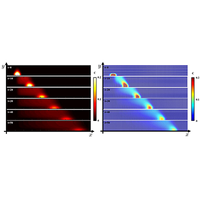
    <description>Author(s): Kepeng Yao, Wenbin Liao, Guilai Han, and Zonglin Jiang&lt;br/&gt;&lt;p&gt;Oblique detonation waves are pivotal for hypersonic propulsion, but their stationary characteristics are rarely studied under controlled reaction rate distributions. Two-dimensional Euler simulations coupled with a two-step kinetic model are employed, and the effects of activation energy and reaction rate constant are isolated while induction and exothermic zone lengths are fixed. It is demonstrated that higher activation energy delays initiation and stabilizes oblique detonation, while unsteady upstream motion via thermal choking is triggered when a critical reaction rate is exceeded. A new stability criterion for oblique detonation is provided by these results.&lt;/p&gt;&lt;img src="//cdn.journals.aps.org/journals/PRFLUIDS/key_images/10.1103/rw31-rmgk.png" width="200" height=\"100\"&gt;&lt;br/&gt;[Phys. Rev. Fluids 11, 043202] Published Fri Apr 24, 2026</description>
    <content:encoded><![CDATA[<p>Author(s): Kepeng Yao, Wenbin Liao, Guilai Han, and Zonglin Jiang</p><p>Oblique detonation waves are pivotal for hypersonic propulsion, but their stationary characteristics are rarely studied under controlled reaction rate distributions. Two-dimensional Euler simulations coupled with a two-step kinetic model are employed, and the effects of activation energy and reaction rate constant are isolated while induction and exothermic zone lengths are fixed. It is demonstrated that higher activation energy delays initiation and stabilizes oblique detonation, while unsteady upstream motion via thermal choking is triggered when a critical reaction rate is exceeded. A new stability criterion for oblique detonation is provided by these results.</p><img src="//cdn.journals.aps.org/journals/PRFLUIDS/key_images/10.1103/rw31-rmgk.png" width="200" height=\"100\"><br/><p>[Phys. Rev. Fluids 11, 043202] Published Fri Apr 24, 2026</p>]]></content:encoded>
    <dc:title>Study on the stationary characteristics of oblique detonation across various reaction rate distributions</dc:title>
    <dc:creator>Kepeng Yao, Wenbin Liao, Guilai Han, and Zonglin Jiang</dc:creator>
    <dc:date>2026-04-24T10:00:00+00:00</dc:date>
    <dc:rights>Personal use only, all commercial or other reuse prohibited</dc:rights>
    <dc:source>Phys. Rev. Fluids 11, 043202 (2026)</dc:source>
    <dc:type>article</dc:type>
    <dc:identifier>doi:10.1103/rw31-rmgk</dc:identifier>
    <prism:doi>10.1103/rw31-rmgk</prism:doi>
    <prism:publicationName>Physical Review Fluids</prism:publicationName>
    <prism:volume>11</prism:volume>
    <prism:number>4</prism:number>
    <prism:publicationDate>2026-04-24T10:00:00+00:00</prism:publicationDate>
    <prism:url>http://link.aps.org/doi/10.1103/rw31-rmgk</prism:url>
    <prism:startingPage>043202</prism:startingPage>
    <dc:subject>Combustion Fluid Mechanics and Reacting Flows</dc:subject>
    <prism:section>Combustion Fluid Mechanics and Reacting Flows</prism:section>
  </item>
  <item rdf:about="http://link.aps.org/doi/10.1103/1ncf-cqg8">
    <title>Numerical and analytical investigation of droplet dynamics in an alternating and constant superposed electric fields</title>
    <link>http://link.aps.org/doi/10.1103/1ncf-cqg8</link>
    <description>Author(s): Bikash Mohanty, Angshuman Nayak, and Aditya Bandopadhyay&lt;br/&gt;&lt;p&gt;We investigate the dynamics of a leaky dielectric droplet subjected to a superposed alternating and constant electric field using analytical small deformation theory and phase-field simulations. The mean and amplitude of droplet deformation depend on the mixing ratio (MR) and frequency of the superposed electric field. Results show that deformation amplitude under a superposed field is larger than in a purely alternating electric field. When the root-mean-square value of the superposed field exceeds that of the pure AC field, the mean deformation increases with increasing MR. The variation of the nondimensional oscillating interfacial kinetic energy with MR is also explored.&lt;/p&gt;&lt;img src="//cdn.journals.aps.org/journals/PRFLUIDS/key_images/10.1103/1ncf-cqg8.png" width="200" height=\"100\"&gt;&lt;br/&gt;[Phys. Rev. Fluids 11, 043703] Published Fri Apr 24, 2026</description>
    <content:encoded><![CDATA[<p>Author(s): Bikash Mohanty, Angshuman Nayak, and Aditya Bandopadhyay</p><p>We investigate the dynamics of a leaky dielectric droplet subjected to a superposed alternating and constant electric field using analytical small deformation theory and phase-field simulations. The mean and amplitude of droplet deformation depend on the mixing ratio (MR) and frequency of the superposed electric field. Results show that deformation amplitude under a superposed field is larger than in a purely alternating electric field. When the root-mean-square value of the superposed field exceeds that of the pure AC field, the mean deformation increases with increasing MR. The variation of the nondimensional oscillating interfacial kinetic energy with MR is also explored.</p><img src="//cdn.journals.aps.org/journals/PRFLUIDS/key_images/10.1103/1ncf-cqg8.png" width="200" height=\"100\"><br/><p>[Phys. Rev. Fluids 11, 043703] Published Fri Apr 24, 2026</p>]]></content:encoded>
    <dc:title>Numerical and analytical investigation of droplet dynamics in an alternating and constant superposed electric fields</dc:title>
    <dc:creator>Bikash Mohanty, Angshuman Nayak, and Aditya Bandopadhyay</dc:creator>
    <dc:date>2026-04-24T10:00:00+00:00</dc:date>
    <dc:rights>Personal use only, all commercial or other reuse prohibited</dc:rights>
    <dc:source>Phys. Rev. Fluids 11, 043703 (2026)</dc:source>
    <dc:type>article</dc:type>
    <dc:identifier>doi:10.1103/1ncf-cqg8</dc:identifier>
    <prism:doi>10.1103/1ncf-cqg8</prism:doi>
    <prism:publicationName>Physical Review Fluids</prism:publicationName>
    <prism:volume>11</prism:volume>
    <prism:number>4</prism:number>
    <prism:publicationDate>2026-04-24T10:00:00+00:00</prism:publicationDate>
    <prism:url>http://link.aps.org/doi/10.1103/1ncf-cqg8</prism:url>
    <prism:startingPage>043703</prism:startingPage>
    <dc:subject>Electrokinetic Phenomena, Electrohydrodynamics, and Magnetohydrodynamics</dc:subject>
    <prism:section>Electrokinetic Phenomena, Electrohydrodynamics, and Magnetohydrodynamics</prism:section>
  </item>
  <item rdf:about="http://link.aps.org/doi/10.1103/6xlp-5pxq">
    <title>Bypass transition in favorable-adverse pressure gradient flow over a protruding rough surface under inlet free-stream turbulence</title>
    <link>http://link.aps.org/doi/10.1103/6xlp-5pxq</link>
    <description>Author(s): Weihao Ling, Zhiheng Wang, Zhenfei Wang, Wenlin Huang, and Guang Xi&lt;br/&gt;&lt;p&gt;We investigate the bypass transition of a flat-plate boundary layer over a three-dimensional irregular rough surface characterized by isotropic protrusions and a favorable-adverse pressure gradient. By positioning the roughness upstream of or adjacent to the separation point and introducing inlet free-stream turbulence of varying intensities and fundamental frequencies, the combined effects of pressure gradients, three-dimensional roughness, and free-stream turbulence on bypass transition and disturbance amplification are examined. Notably, when the rough surface is upstream of the separation point, intense low-frequency free-stream turbulence can excite novel elongated resonant modes.&lt;/p&gt;&lt;img src="//cdn.journals.aps.org/journals/PRFLUIDS/key_images/10.1103/6xlp-5pxq.png" width="200" height=\"100\"&gt;&lt;br/&gt;[Phys. Rev. Fluids 11, 043905] Published Fri Apr 24, 2026</description>
    <content:encoded><![CDATA[<p>Author(s): Weihao Ling, Zhiheng Wang, Zhenfei Wang, Wenlin Huang, and Guang Xi</p><p>We investigate the bypass transition of a flat-plate boundary layer over a three-dimensional irregular rough surface characterized by isotropic protrusions and a favorable-adverse pressure gradient. By positioning the roughness upstream of or adjacent to the separation point and introducing inlet free-stream turbulence of varying intensities and fundamental frequencies, the combined effects of pressure gradients, three-dimensional roughness, and free-stream turbulence on bypass transition and disturbance amplification are examined. Notably, when the rough surface is upstream of the separation point, intense low-frequency free-stream turbulence can excite novel elongated resonant modes.</p><img src="//cdn.journals.aps.org/journals/PRFLUIDS/key_images/10.1103/6xlp-5pxq.png" width="200" height=\"100\"><br/><p>[Phys. Rev. Fluids 11, 043905] Published Fri Apr 24, 2026</p>]]></content:encoded>
    <dc:title>Bypass transition in favorable-adverse pressure gradient flow over a protruding rough surface under inlet free-stream turbulence</dc:title>
    <dc:creator>Weihao Ling, Zhiheng Wang, Zhenfei Wang, Wenlin Huang, and Guang Xi</dc:creator>
    <dc:date>2026-04-24T10:00:00+00:00</dc:date>
    <dc:rights>Personal use only, all commercial or other reuse prohibited</dc:rights>
    <dc:source>Phys. Rev. Fluids 11, 043905 (2026)</dc:source>
    <dc:type>article</dc:type>
    <dc:identifier>doi:10.1103/6xlp-5pxq</dc:identifier>
    <prism:doi>10.1103/6xlp-5pxq</prism:doi>
    <prism:publicationName>Physical Review Fluids</prism:publicationName>
    <prism:volume>11</prism:volume>
    <prism:number>4</prism:number>
    <prism:publicationDate>2026-04-24T10:00:00+00:00</prism:publicationDate>
    <prism:url>http://link.aps.org/doi/10.1103/6xlp-5pxq</prism:url>
    <prism:startingPage>043905</prism:startingPage>
    <dc:subject>Instability, Transition, and Control</dc:subject>
    <prism:section>Instability, Transition, and Control</prism:section>
  </item>
  <item rdf:about="http://link.aps.org/doi/10.1103/7dsx-n6sk">
    <title>Effects of inertia disparity on atomization of unlike-doublet impinging jets</title>
    <link>http://link.aps.org/doi/10.1103/7dsx-n6sk</link>
    <description>Author(s): Yuan Li and Chenglong Tang&lt;br/&gt;&lt;p&gt;Unlike-doublet impinging jets are widely used in hypergolic liquid rocket engines, but the role of inertia disparity in shaping atomization and mixing has remained unclear. Using high-fidelity Volume of Fluid simulations with intra-liquid species transport, we show that increasing inertia disparity narrows the spray, shortens liquid-sheet breakup, and reduces mixing efficiency. At high disparity, the jets exhibit central-axis collapse and mutual penetration, producing a distinctive flow-rate distribution. Flow topology analysis links these behaviors to Kelvin–Helmholtz type shear instabilities that generate vortices and drive liquid sheet collapse.&lt;/p&gt;&lt;img src="//cdn.journals.aps.org/journals/PRFLUIDS/key_images/10.1103/7dsx-n6sk.png" width="200" height=\"100\"&gt;&lt;br/&gt;[Phys. Rev. Fluids 11, 044303] Published Fri Apr 24, 2026</description>
    <content:encoded><![CDATA[<p>Author(s): Yuan Li and Chenglong Tang</p><p>Unlike-doublet impinging jets are widely used in hypergolic liquid rocket engines, but the role of inertia disparity in shaping atomization and mixing has remained unclear. Using high-fidelity Volume of Fluid simulations with intra-liquid species transport, we show that increasing inertia disparity narrows the spray, shortens liquid-sheet breakup, and reduces mixing efficiency. At high disparity, the jets exhibit central-axis collapse and mutual penetration, producing a distinctive flow-rate distribution. Flow topology analysis links these behaviors to Kelvin–Helmholtz type shear instabilities that generate vortices and drive liquid sheet collapse.</p><img src="//cdn.journals.aps.org/journals/PRFLUIDS/key_images/10.1103/7dsx-n6sk.png" width="200" height=\"100\"><br/><p>[Phys. Rev. Fluids 11, 044303] Published Fri Apr 24, 2026</p>]]></content:encoded>
    <dc:title>Effects of inertia disparity on atomization of unlike-doublet impinging jets</dc:title>
    <dc:creator>Yuan Li and Chenglong Tang</dc:creator>
    <dc:date>2026-04-24T10:00:00+00:00</dc:date>
    <dc:rights>Personal use only, all commercial or other reuse prohibited</dc:rights>
    <dc:source>Phys. Rev. Fluids 11, 044303 (2026)</dc:source>
    <dc:type>article</dc:type>
    <dc:identifier>doi:10.1103/7dsx-n6sk</dc:identifier>
    <prism:doi>10.1103/7dsx-n6sk</prism:doi>
    <prism:publicationName>Physical Review Fluids</prism:publicationName>
    <prism:volume>11</prism:volume>
    <prism:number>4</prism:number>
    <prism:publicationDate>2026-04-24T10:00:00+00:00</prism:publicationDate>
    <prism:url>http://link.aps.org/doi/10.1103/7dsx-n6sk</prism:url>
    <prism:startingPage>044303</prism:startingPage>
    <dc:subject>Multiphase, Granular, and Particle-Laden Flows</dc:subject>
    <prism:section>Multiphase, Granular, and Particle-Laden Flows</prism:section>
  </item>
  <item rdf:about="http://link.aps.org/doi/10.1103/6ftz-9nv8">
    <title>Numerical study of Lagrangian velocity structure functions using acceleration statistics and a spatial-temporal perspective</title>
    <link>http://link.aps.org/doi/10.1103/6ftz-9nv8</link>
    <description>Author(s): Rohini Uma-Vaideswaran and P. K. Yeung&lt;br/&gt;&lt;p&gt;The second-order Lagrangian velocity structure function in turbulence is a fundamental quantity for which clear inertial range scaling has been much more elusive than corresponding Eulerian measures. In this work direct numerical simulation at high Reynolds number is used to better understand the question of asymptotic constancy of the supposed scaling constant through effects of the acceleration autocorrelation function. A spatial-temporal decomposition of the Lagrangian velocity increment exposes strong but incomplete cancellation between convective and local contributions, with rapid approach of particle displacements towards inertial range values having an important role.&lt;/p&gt;&lt;img src="//cdn.journals.aps.org/journals/PRFLUIDS/key_images/10.1103/6ftz-9nv8.png" width="200" height=\"100\"&gt;&lt;br/&gt;[Phys. Rev. Fluids 11, 044607] Published Fri Apr 24, 2026</description>
    <content:encoded><![CDATA[<p>Author(s): Rohini Uma-Vaideswaran and P. K. Yeung</p><p>The second-order Lagrangian velocity structure function in turbulence is a fundamental quantity for which clear inertial range scaling has been much more elusive than corresponding Eulerian measures. In this work direct numerical simulation at high Reynolds number is used to better understand the question of asymptotic constancy of the supposed scaling constant through effects of the acceleration autocorrelation function. A spatial-temporal decomposition of the Lagrangian velocity increment exposes strong but incomplete cancellation between convective and local contributions, with rapid approach of particle displacements towards inertial range values having an important role.</p><img src="//cdn.journals.aps.org/journals/PRFLUIDS/key_images/10.1103/6ftz-9nv8.png" width="200" height=\"100\"><br/><p>[Phys. Rev. Fluids 11, 044607] Published Fri Apr 24, 2026</p>]]></content:encoded>
    <dc:title>Numerical study of Lagrangian velocity structure functions using acceleration statistics and a spatial-temporal perspective</dc:title>
    <dc:creator>Rohini Uma-Vaideswaran and P. K. Yeung</dc:creator>
    <dc:date>2026-04-24T10:00:00+00:00</dc:date>
    <dc:rights>Personal use only, all commercial or other reuse prohibited</dc:rights>
    <dc:source>Phys. Rev. Fluids 11, 044607 (2026)</dc:source>
    <dc:type>article</dc:type>
    <dc:identifier>doi:10.1103/6ftz-9nv8</dc:identifier>
    <prism:doi>10.1103/6ftz-9nv8</prism:doi>
    <prism:publicationName>Physical Review Fluids</prism:publicationName>
    <prism:volume>11</prism:volume>
    <prism:number>4</prism:number>
    <prism:publicationDate>2026-04-24T10:00:00+00:00</prism:publicationDate>
    <prism:url>http://link.aps.org/doi/10.1103/6ftz-9nv8</prism:url>
    <prism:startingPage>044607</prism:startingPage>
    <dc:subject>Turbulent Flows</dc:subject>
    <prism:section>Turbulent Flows</prism:section>
  </item>
  <item rdf:about="http://link.aps.org/doi/10.1103/bbyr-wqyv">
    <title>Momentum decomposition of the pressure field</title>
    <link>http://link.aps.org/doi/10.1103/bbyr-wqyv</link>
    <description>Author(s): Taihang Zhu, Chao Xia, Jiabin Pang, Olivier Cadot, and Jonathan F. Morrison&lt;br/&gt;&lt;p&gt;We introduce a momentum decomposition framework to analyze the pressure field. It establishes a generic relationship between the mean pressure and flow statistics for turbulent flow, manifesting as fundamental mechanisms of pressure-gradient contributions in Cartesian coordinates involving mean flow accelerations, Reynolds stresses, and viscous stresses. With a focus on bluff body flows, this framework is validated in both laminar and turbulent regimes, providing a physical basis for flow analysis and control.&lt;/p&gt;&lt;img src="//cdn.journals.aps.org/journals/PRFLUIDS/key_images/10.1103/bbyr-wqyv.png" width="200" height=\"100\"&gt;&lt;br/&gt;[Phys. Rev. Fluids 11, 044608] Published Fri Apr 24, 2026</description>
    <content:encoded><![CDATA[<p>Author(s): Taihang Zhu, Chao Xia, Jiabin Pang, Olivier Cadot, and Jonathan F. Morrison</p><p>We introduce a momentum decomposition framework to analyze the pressure field. It establishes a generic relationship between the mean pressure and flow statistics for turbulent flow, manifesting as fundamental mechanisms of pressure-gradient contributions in Cartesian coordinates involving mean flow accelerations, Reynolds stresses, and viscous stresses. With a focus on bluff body flows, this framework is validated in both laminar and turbulent regimes, providing a physical basis for flow analysis and control.</p><img src="//cdn.journals.aps.org/journals/PRFLUIDS/key_images/10.1103/bbyr-wqyv.png" width="200" height=\"100\"><br/><p>[Phys. Rev. Fluids 11, 044608] Published Fri Apr 24, 2026</p>]]></content:encoded>
    <dc:title>Momentum decomposition of the pressure field</dc:title>
    <dc:creator>Taihang Zhu, Chao Xia, Jiabin Pang, Olivier Cadot, and Jonathan F. Morrison</dc:creator>
    <dc:date>2026-04-24T10:00:00+00:00</dc:date>
    <dc:rights>Personal use only, all commercial or other reuse prohibited</dc:rights>
    <dc:source>Phys. Rev. Fluids 11, 044608 (2026)</dc:source>
    <dc:type>article</dc:type>
    <dc:identifier>doi:10.1103/bbyr-wqyv</dc:identifier>
    <prism:doi>10.1103/bbyr-wqyv</prism:doi>
    <prism:publicationName>Physical Review Fluids</prism:publicationName>
    <prism:volume>11</prism:volume>
    <prism:number>4</prism:number>
    <prism:publicationDate>2026-04-24T10:00:00+00:00</prism:publicationDate>
    <prism:url>http://link.aps.org/doi/10.1103/bbyr-wqyv</prism:url>
    <prism:startingPage>044608</prism:startingPage>
    <dc:subject>Turbulent Flows</dc:subject>
    <prism:section>Turbulent Flows</prism:section>
  </item>
  <item rdf:about="http://link.aps.org/doi/10.1103/jc7q-qgg9">
    <title>Investigation of countergradient transport structures in stably stratified homogeneous shear turbulence</title>
    <link>http://link.aps.org/doi/10.1103/jc7q-qgg9</link>
    <description>Author(s): Xiaodong Wu, De Li, and Zhiming Lu&lt;br/&gt;&lt;p&gt;Counter-gradient transport in stably stratified shear turbulence remains poorly understood, particularly from a structural perspective. Using direct numerical simulations combined with the clustering method, this study identifies and characterizes coherent structures responsible for counter-gradient transport of heat and momentum. We find that such transport is dominated by structures larger than the Corrsin scale and primarily organized as paired Q1–Q3 events. Distinct physical mechanisms are revealed, with heat transport arising from both vortex-induced rotation and fluid parcel interactions, while momentum transport is governed solely by vortex-induced rotation.&lt;/p&gt;&lt;img src="//cdn.journals.aps.org/journals/PRFLUIDS/key_images/10.1103/jc7q-qgg9.png" width="200" height=\"100\"&gt;&lt;br/&gt;[Phys. Rev. Fluids 11, 044609] Published Fri Apr 24, 2026</description>
    <content:encoded><![CDATA[<p>Author(s): Xiaodong Wu, De Li, and Zhiming Lu</p><p>Counter-gradient transport in stably stratified shear turbulence remains poorly understood, particularly from a structural perspective. Using direct numerical simulations combined with the clustering method, this study identifies and characterizes coherent structures responsible for counter-gradient transport of heat and momentum. We find that such transport is dominated by structures larger than the Corrsin scale and primarily organized as paired Q1–Q3 events. Distinct physical mechanisms are revealed, with heat transport arising from both vortex-induced rotation and fluid parcel interactions, while momentum transport is governed solely by vortex-induced rotation.</p><img src="//cdn.journals.aps.org/journals/PRFLUIDS/key_images/10.1103/jc7q-qgg9.png" width="200" height=\"100\"><br/><p>[Phys. Rev. Fluids 11, 044609] Published Fri Apr 24, 2026</p>]]></content:encoded>
    <dc:title>Investigation of countergradient transport structures in stably stratified homogeneous shear turbulence</dc:title>
    <dc:creator>Xiaodong Wu, De Li, and Zhiming Lu</dc:creator>
    <dc:date>2026-04-24T10:00:00+00:00</dc:date>
    <dc:rights>Personal use only, all commercial or other reuse prohibited</dc:rights>
    <dc:source>Phys. Rev. Fluids 11, 044609 (2026)</dc:source>
    <dc:type>article</dc:type>
    <dc:identifier>doi:10.1103/jc7q-qgg9</dc:identifier>
    <prism:doi>10.1103/jc7q-qgg9</prism:doi>
    <prism:publicationName>Physical Review Fluids</prism:publicationName>
    <prism:volume>11</prism:volume>
    <prism:number>4</prism:number>
    <prism:publicationDate>2026-04-24T10:00:00+00:00</prism:publicationDate>
    <prism:url>http://link.aps.org/doi/10.1103/jc7q-qgg9</prism:url>
    <prism:startingPage>044609</prism:startingPage>
    <dc:subject>Turbulent Flows</dc:subject>
    <prism:section>Turbulent Flows</prism:section>
  </item>
  <item rdf:about="http://link.aps.org/doi/10.1103/y1zd-lpyw">
    <title>Impact of the history force on the motion of droplets in shaken liquids</title>
    <link>http://link.aps.org/doi/10.1103/y1zd-lpyw</link>
    <description>Author(s): Frederik R. Gareis and Walter Zimmermann&lt;br/&gt;&lt;p&gt;Outward-diffusing vorticity fields form around particles and droplets in time-periodic fluid motions. As a result, the time-dependent shear gradients in the fluid and at the particle surface are typically greater than those of the classical steady-state Stokes velocity profile. This leads to an additional viscous force, the Basset–Boussinesq history force (BBH), which depends on the past motion of the particle that created the vortices. An experiment with particles in a shaken fluid is proposed to measure the parameter dependence of the BBH, and parameter ranges are also predicted in which the BBH becomes comparable to or stronger than classical Stokes friction.&lt;/p&gt;&lt;img src="//cdn.journals.aps.org/journals/PRFLUIDS/key_images/10.1103/y1zd-lpyw.png" width="200" height=\"100\"&gt;&lt;br/&gt;[Phys. Rev. Fluids 11, 043604] Published Wed Apr 22, 2026</description>
    <content:encoded><![CDATA[<p>Author(s): Frederik R. Gareis and Walter Zimmermann</p><p>Outward-diffusing vorticity fields form around particles and droplets in time-periodic fluid motions. As a result, the time-dependent shear gradients in the fluid and at the particle surface are typically greater than those of the classical steady-state Stokes velocity profile. This leads to an additional viscous force, the Basset–Boussinesq history force (BBH), which depends on the past motion of the particle that created the vortices. An experiment with particles in a shaken fluid is proposed to measure the parameter dependence of the BBH, and parameter ranges are also predicted in which the BBH becomes comparable to or stronger than classical Stokes friction.</p><img src="//cdn.journals.aps.org/journals/PRFLUIDS/key_images/10.1103/y1zd-lpyw.png" width="200" height=\"100\"><br/><p>[Phys. Rev. Fluids 11, 043604] Published Wed Apr 22, 2026</p>]]></content:encoded>
    <dc:title>Impact of the history force on the motion of droplets in shaken liquids</dc:title>
    <dc:creator>Frederik R. Gareis and Walter Zimmermann</dc:creator>
    <dc:date>2026-04-22T10:00:00+00:00</dc:date>
    <dc:rights>Personal use only, all commercial or other reuse prohibited</dc:rights>
    <dc:source>Phys. Rev. Fluids 11, 043604 (2026)</dc:source>
    <dc:type>article</dc:type>
    <dc:identifier>doi:10.1103/y1zd-lpyw</dc:identifier>
    <prism:doi>10.1103/y1zd-lpyw</prism:doi>
    <prism:publicationName>Physical Review Fluids</prism:publicationName>
    <prism:volume>11</prism:volume>
    <prism:number>4</prism:number>
    <prism:publicationDate>2026-04-22T10:00:00+00:00</prism:publicationDate>
    <prism:url>http://link.aps.org/doi/10.1103/y1zd-lpyw</prism:url>
    <prism:startingPage>043604</prism:startingPage>
    <dc:subject>Drops, Bubbles, Capsules, and Vesicles</dc:subject>
    <prism:section>Drops, Bubbles, Capsules, and Vesicles</prism:section>
  </item>
  <item rdf:about="http://link.aps.org/doi/10.1103/fr1q-m1j9">
    <title>Twin satellites and ring bubbles from coalescing magnetically levitated air bubbles in water</title>
    <link>http://link.aps.org/doi/10.1103/fr1q-m1j9</link>
    <description>Author(s): N. Sampara, G. Hunter-Brown, K. A. Baldwin, M. M. Scase, and R. J. A. Hill&lt;br/&gt;&lt;p&gt;While the coalescence of similarly-sized air bubbles in water is known to eject satellite bubbles, a complete model has remained elusive. Suspending unconstrained air bubbles using magnetic levitation, this study combines experiments and simulations to reveal how initial size ratios dictate the outcome, including twin satellites for equal-sized precursors. A timing model shows satellite production is governed by the coincidence of converging capillary waves and the retraction of the coalescing bubbles’ poles. Analysis of the capillary waves offers insight into why similarly-sized drops do not eject satellites in the same manner as bubbles.&lt;/p&gt;&lt;img src="//cdn.journals.aps.org/journals/PRFLUIDS/key_images/10.1103/fr1q-m1j9.png" width="200" height=\"100\"&gt;&lt;br/&gt;[Phys. Rev. Fluids 11, 043605] Published Wed Apr 22, 2026</description>
    <content:encoded><![CDATA[<p>Author(s): N. Sampara, G. Hunter-Brown, K. A. Baldwin, M. M. Scase, and R. J. A. Hill</p><p>While the coalescence of similarly-sized air bubbles in water is known to eject satellite bubbles, a complete model has remained elusive. Suspending unconstrained air bubbles using magnetic levitation, this study combines experiments and simulations to reveal how initial size ratios dictate the outcome, including twin satellites for equal-sized precursors. A timing model shows satellite production is governed by the coincidence of converging capillary waves and the retraction of the coalescing bubbles’ poles. Analysis of the capillary waves offers insight into why similarly-sized drops do not eject satellites in the same manner as bubbles.</p><img src="//cdn.journals.aps.org/journals/PRFLUIDS/key_images/10.1103/fr1q-m1j9.png" width="200" height=\"100\"><br/><p>[Phys. Rev. Fluids 11, 043605] Published Wed Apr 22, 2026</p>]]></content:encoded>
    <dc:title>Twin satellites and ring bubbles from coalescing magnetically levitated air bubbles in water</dc:title>
    <dc:creator>N. Sampara, G. Hunter-Brown, K. A. Baldwin, M. M. Scase, and R. J. A. Hill</dc:creator>
    <dc:date>2026-04-22T10:00:00+00:00</dc:date>
    <dc:rights>Personal use only, all commercial or other reuse prohibited</dc:rights>
    <dc:source>Phys. Rev. Fluids 11, 043605 (2026)</dc:source>
    <dc:type>article</dc:type>
    <dc:identifier>doi:10.1103/fr1q-m1j9</dc:identifier>
    <prism:doi>10.1103/fr1q-m1j9</prism:doi>
    <prism:publicationName>Physical Review Fluids</prism:publicationName>
    <prism:volume>11</prism:volume>
    <prism:number>4</prism:number>
    <prism:publicationDate>2026-04-22T10:00:00+00:00</prism:publicationDate>
    <prism:url>http://link.aps.org/doi/10.1103/fr1q-m1j9</prism:url>
    <prism:startingPage>043605</prism:startingPage>
    <dc:subject>Drops, Bubbles, Capsules, and Vesicles</dc:subject>
    <prism:section>Drops, Bubbles, Capsules, and Vesicles</prism:section>
  </item>
  <item rdf:about="http://link.aps.org/doi/10.1103/h2hy-crbv">
    <title>Modified far-field hydrodynamic flows induce versatile trajectories of confined microswimmers</title>
    <link>http://link.aps.org/doi/10.1103/h2hy-crbv</link>
    <description>Author(s): Zehan Cao and Alan C. H. Tsang&lt;br/&gt;&lt;p&gt;Microswimmers under weak confinement exhibit flow fields that are highly dependent on the spatial arrangement of their propulsion and drag forces, as well as their geometry. These flow fields can be approximated by placing Stokeslets and source dipoles at proper positions of the swimmer. We observe versatile swimming trajectories, such as centerline sliding and amplified oscillations, depending on the relative strengths of the Stokeslets and source dipoles.&lt;/p&gt;&lt;img src="//cdn.journals.aps.org/journals/PRFLUIDS/key_images/10.1103/h2hy-crbv.png" width="200" height=\"100\"&gt;&lt;br/&gt;[Phys. Rev. Fluids 11, 044402] Published Wed Apr 22, 2026</description>
    <content:encoded><![CDATA[<p>Author(s): Zehan Cao and Alan C. H. Tsang</p><p>Microswimmers under weak confinement exhibit flow fields that are highly dependent on the spatial arrangement of their propulsion and drag forces, as well as their geometry. These flow fields can be approximated by placing Stokeslets and source dipoles at proper positions of the swimmer. We observe versatile swimming trajectories, such as centerline sliding and amplified oscillations, depending on the relative strengths of the Stokeslets and source dipoles.</p><img src="//cdn.journals.aps.org/journals/PRFLUIDS/key_images/10.1103/h2hy-crbv.png" width="200" height=\"100\"><br/><p>[Phys. Rev. Fluids 11, 044402] Published Wed Apr 22, 2026</p>]]></content:encoded>
    <dc:title>Modified far-field hydrodynamic flows induce versatile trajectories of confined microswimmers</dc:title>
    <dc:creator>Zehan Cao and Alan C. H. Tsang</dc:creator>
    <dc:date>2026-04-22T10:00:00+00:00</dc:date>
    <dc:rights>Personal use only, all commercial or other reuse prohibited</dc:rights>
    <dc:source>Phys. Rev. Fluids 11, 044402 (2026)</dc:source>
    <dc:type>article</dc:type>
    <dc:identifier>doi:10.1103/h2hy-crbv</dc:identifier>
    <prism:doi>10.1103/h2hy-crbv</prism:doi>
    <prism:publicationName>Physical Review Fluids</prism:publicationName>
    <prism:volume>11</prism:volume>
    <prism:number>4</prism:number>
    <prism:publicationDate>2026-04-22T10:00:00+00:00</prism:publicationDate>
    <prism:url>http://link.aps.org/doi/10.1103/h2hy-crbv</prism:url>
    <prism:startingPage>044402</prism:startingPage>
    <dc:subject>Nonlinear Dynamical Systems</dc:subject>
    <prism:section>Nonlinear Dynamical Systems</prism:section>
  </item>
  <item rdf:about="http://link.aps.org/doi/10.1103/gl4g-3sxr">
    <title>From soap-film packed droplets to multilayer antibubbles: Formation and stability</title>
    <link>http://link.aps.org/doi/10.1103/gl4g-3sxr</link>
    <description>Author(s): Cyril André, Cyriaque Amerein, Jonas Miguet, Benoit Scheid, and Stéphane Dorbolo&lt;br/&gt;&lt;p&gt;Antibubbles are the structural inverse of soap bubbles: they consist of a liquid core enclosed by a thin quasi-spherical gas shell, immersed in a liquid medium. Producing multilayer antibubbles, i.e. antibubbles enclosed by multiple soap/air films, has been a challenge in the past years, as it requires a delicate balance between surface tension and inertia. In this paper, we investigate a method that uses one or more soap films and a soapy liquid droplet to generate multilayer antibubbles. We also identify the optimal parameters for forming single-layer and multilayer antibubbles across three different viscosities.&lt;/p&gt;&lt;img src="//cdn.journals.aps.org/journals/PRFLUIDS/key_images/10.1103/gl4g-3sxr.png" width="200" height=\"100\"&gt;&lt;br/&gt;[Phys. Rev. Fluids 11, 043603] Published Tue Apr 21, 2026</description>
    <content:encoded><![CDATA[<p>Author(s): Cyril André, Cyriaque Amerein, Jonas Miguet, Benoit Scheid, and Stéphane Dorbolo</p><p>Antibubbles are the structural inverse of soap bubbles: they consist of a liquid core enclosed by a thin quasi-spherical gas shell, immersed in a liquid medium. Producing multilayer antibubbles, i.e. antibubbles enclosed by multiple soap/air films, has been a challenge in the past years, as it requires a delicate balance between surface tension and inertia. In this paper, we investigate a method that uses one or more soap films and a soapy liquid droplet to generate multilayer antibubbles. We also identify the optimal parameters for forming single-layer and multilayer antibubbles across three different viscosities.</p><img src="//cdn.journals.aps.org/journals/PRFLUIDS/key_images/10.1103/gl4g-3sxr.png" width="200" height=\"100\"><br/><p>[Phys. Rev. Fluids 11, 043603] Published Tue Apr 21, 2026</p>]]></content:encoded>
    <dc:title>From soap-film packed droplets to multilayer antibubbles: Formation and stability</dc:title>
    <dc:creator>Cyril André, Cyriaque Amerein, Jonas Miguet, Benoit Scheid, and Stéphane Dorbolo</dc:creator>
    <dc:date>2026-04-21T10:00:00+00:00</dc:date>
    <dc:rights>Personal use only, all commercial or other reuse prohibited</dc:rights>
    <dc:source>Phys. Rev. Fluids 11, 043603 (2026)</dc:source>
    <dc:type>article</dc:type>
    <dc:identifier>doi:10.1103/gl4g-3sxr</dc:identifier>
    <prism:doi>10.1103/gl4g-3sxr</prism:doi>
    <prism:publicationName>Physical Review Fluids</prism:publicationName>
    <prism:volume>11</prism:volume>
    <prism:number>4</prism:number>
    <prism:publicationDate>2026-04-21T10:00:00+00:00</prism:publicationDate>
    <prism:url>http://link.aps.org/doi/10.1103/gl4g-3sxr</prism:url>
    <prism:startingPage>043603</prism:startingPage>
    <dc:subject>Drops, Bubbles, Capsules, and Vesicles</dc:subject>
    <prism:section>Drops, Bubbles, Capsules, and Vesicles</prism:section>
  </item>
  <item rdf:about="http://link.aps.org/doi/10.1103/63hv-wf65">
    <title>Kolmogorov scaling for total energy and cross helicity in magnetohydrodynamic turbulence</title>
    <link>http://link.aps.org/doi/10.1103/63hv-wf65</link>
    <description>Author(s): Manthan Verma, Abhishek K. Jha, and Mahendra K. Verma&lt;br/&gt;&lt;p&gt;The total energy spectrum exhibits a Kolmogorov-like scaling, consistent with the conservation of total energy in the system. However, the kinetic and magnetic energy spectra often diverge from the −5/3 scaling. In this paper, we show that this divergence arises from energy transfer between the velocity and magnetic fields, either from velocity to magnetic field or vice versa. Our extensive numerical simulations therefore demonstrate Kolmogorov-like phenomenology for isotropic MHD turbulence.&lt;/p&gt;&lt;img src="//cdn.journals.aps.org/journals/PRFLUIDS/key_images/10.1103/63hv-wf65.png" width="200" height=\"100\"&gt;&lt;br/&gt;[Phys. Rev. Fluids 11, 043701] Published Tue Apr 21, 2026</description>
    <content:encoded><![CDATA[<p>Author(s): Manthan Verma, Abhishek K. Jha, and Mahendra K. Verma</p><p>The total energy spectrum exhibits a Kolmogorov-like scaling, consistent with the conservation of total energy in the system. However, the kinetic and magnetic energy spectra often diverge from the −5/3 scaling. In this paper, we show that this divergence arises from energy transfer between the velocity and magnetic fields, either from velocity to magnetic field or vice versa. Our extensive numerical simulations therefore demonstrate Kolmogorov-like phenomenology for isotropic MHD turbulence.</p><img src="//cdn.journals.aps.org/journals/PRFLUIDS/key_images/10.1103/63hv-wf65.png" width="200" height=\"100\"><br/><p>[Phys. Rev. Fluids 11, 043701] Published Tue Apr 21, 2026</p>]]></content:encoded>
    <dc:title>Kolmogorov scaling for total energy and cross helicity in magnetohydrodynamic turbulence</dc:title>
    <dc:creator>Manthan Verma, Abhishek K. Jha, and Mahendra K. Verma</dc:creator>
    <dc:date>2026-04-21T10:00:00+00:00</dc:date>
    <dc:rights>Personal use only, all commercial or other reuse prohibited</dc:rights>
    <dc:source>Phys. Rev. Fluids 11, 043701 (2026)</dc:source>
    <dc:type>article</dc:type>
    <dc:identifier>doi:10.1103/63hv-wf65</dc:identifier>
    <prism:doi>10.1103/63hv-wf65</prism:doi>
    <prism:publicationName>Physical Review Fluids</prism:publicationName>
    <prism:volume>11</prism:volume>
    <prism:number>4</prism:number>
    <prism:publicationDate>2026-04-21T10:00:00+00:00</prism:publicationDate>
    <prism:url>http://link.aps.org/doi/10.1103/63hv-wf65</prism:url>
    <prism:startingPage>043701</prism:startingPage>
    <dc:subject>Electrokinetic Phenomena, Electrohydrodynamics, and Magnetohydrodynamics</dc:subject>
    <prism:section>Electrokinetic Phenomena, Electrohydrodynamics, and Magnetohydrodynamics</prism:section>
  </item>
  <item rdf:about="http://link.aps.org/doi/10.1103/jsmp-y6q9">
    <title>Numerical demonstration of Kolmogorov scaling in magnetohydrodynamic turbulence</title>
    <link>http://link.aps.org/doi/10.1103/jsmp-y6q9</link>
    <description>Author(s): Manthan Verma, Abhishek K. Jha, Shashwat Nirgudkar, and Mahendra K. Verma&lt;br/&gt;&lt;p&gt;For isotropic magnetohydrodynamic (MHD) turbulence, we employ high-resolution numerical simulations and compute the energy spectra and fluxes, as well as the structure functions, of Elsässer variables. While the competing spectral indices 5/3 and 3/2 are too close, the 5/3 index still provides a better fit to the energy spectra. More importantly, the structure functions strongly support the Kolmogorov-like phenomenology. Additionally, the energy fluxes in imbalanced MHD are consistent with the predictions of the Kolmogorov-like model. The figure shows normalized cross helicity of 0.65.&lt;/p&gt;&lt;img src="//cdn.journals.aps.org/journals/PRFLUIDS/key_images/10.1103/jsmp-y6q9.png" width="200" height=\"100\"&gt;&lt;br/&gt;[Phys. Rev. Fluids 11, 043702] Published Tue Apr 21, 2026</description>
    <content:encoded><![CDATA[<p>Author(s): Manthan Verma, Abhishek K. Jha, Shashwat Nirgudkar, and Mahendra K. Verma</p><p>For isotropic magnetohydrodynamic (MHD) turbulence, we employ high-resolution numerical simulations and compute the energy spectra and fluxes, as well as the structure functions, of Elsässer variables. While the competing spectral indices 5/3 and 3/2 are too close, the 5/3 index still provides a better fit to the energy spectra. More importantly, the structure functions strongly support the Kolmogorov-like phenomenology. Additionally, the energy fluxes in imbalanced MHD are consistent with the predictions of the Kolmogorov-like model. The figure shows normalized cross helicity of 0.65.</p><img src="//cdn.journals.aps.org/journals/PRFLUIDS/key_images/10.1103/jsmp-y6q9.png" width="200" height=\"100\"><br/><p>[Phys. Rev. Fluids 11, 043702] Published Tue Apr 21, 2026</p>]]></content:encoded>
    <dc:title>Numerical demonstration of Kolmogorov scaling in magnetohydrodynamic turbulence</dc:title>
    <dc:creator>Manthan Verma, Abhishek K. Jha, Shashwat Nirgudkar, and Mahendra K. Verma</dc:creator>
    <dc:date>2026-04-21T10:00:00+00:00</dc:date>
    <dc:rights>Personal use only, all commercial or other reuse prohibited</dc:rights>
    <dc:source>Phys. Rev. Fluids 11, 043702 (2026)</dc:source>
    <dc:type>article</dc:type>
    <dc:identifier>doi:10.1103/jsmp-y6q9</dc:identifier>
    <prism:doi>10.1103/jsmp-y6q9</prism:doi>
    <prism:publicationName>Physical Review Fluids</prism:publicationName>
    <prism:volume>11</prism:volume>
    <prism:number>4</prism:number>
    <prism:publicationDate>2026-04-21T10:00:00+00:00</prism:publicationDate>
    <prism:url>http://link.aps.org/doi/10.1103/jsmp-y6q9</prism:url>
    <prism:startingPage>043702</prism:startingPage>
    <dc:subject>Electrokinetic Phenomena, Electrohydrodynamics, and Magnetohydrodynamics</dc:subject>
    <prism:section>Electrokinetic Phenomena, Electrohydrodynamics, and Magnetohydrodynamics</prism:section>
  </item>
  <item rdf:about="http://link.aps.org/doi/10.1103/kyql-qp7b">
    <title>Viscoelastic flow of an Oldroyd-B fluid through a slowly varying contraction-expansion channel: pressure drop and elastic stress relaxation</title>
    <link>http://link.aps.org/doi/10.1103/kyql-qp7b</link>
    <description>Author(s): Yali Kedem, Bimalendu Mahapatra, and Evgeniy Boyko&lt;br/&gt;&lt;p&gt;Viscoelastic flows through narrow, nonuniform geometries are common in engineering and biological systems, yet the pressure drop behavior of such fluids remains poorly understood. We develop a theoretical model for the flow of an Oldroyd-B fluid in slowly varying constrictions, deriving closed-form expressions for the elastic stresses and pressure drop valid for all Deborah numbers in the ultra-dilute limit. Our theory is in excellent agreement with numerical simulations and reveals key differences between constrictions and contractions, including a plateau in the pressure drop at high Deborah numbers and a significantly shorter relaxation length in the exit channel of the constriction.&lt;/p&gt;&lt;img src="//cdn.journals.aps.org/journals/PRFLUIDS/key_images/10.1103/kyql-qp7b.png" width="200" height=\"100\"&gt;&lt;br/&gt;[Phys. Rev. Fluids 11, 043303] Published Mon Apr 20, 2026</description>
    <content:encoded><![CDATA[<p>Author(s): Yali Kedem, Bimalendu Mahapatra, and Evgeniy Boyko</p><p>Viscoelastic flows through narrow, nonuniform geometries are common in engineering and biological systems, yet the pressure drop behavior of such fluids remains poorly understood. We develop a theoretical model for the flow of an Oldroyd-B fluid in slowly varying constrictions, deriving closed-form expressions for the elastic stresses and pressure drop valid for all Deborah numbers in the ultra-dilute limit. Our theory is in excellent agreement with numerical simulations and reveals key differences between constrictions and contractions, including a plateau in the pressure drop at high Deborah numbers and a significantly shorter relaxation length in the exit channel of the constriction.</p><img src="//cdn.journals.aps.org/journals/PRFLUIDS/key_images/10.1103/kyql-qp7b.png" width="200" height=\"100\"><br/><p>[Phys. Rev. Fluids 11, 043303] Published Mon Apr 20, 2026</p>]]></content:encoded>
    <dc:title>Viscoelastic flow of an Oldroyd-B fluid through a slowly varying contraction-expansion channel: pressure drop and elastic stress relaxation</dc:title>
    <dc:creator>Yali Kedem, Bimalendu Mahapatra, and Evgeniy Boyko</dc:creator>
    <dc:date>2026-04-20T10:00:00+00:00</dc:date>
    <dc:rights>Personal use only, all commercial or other reuse prohibited</dc:rights>
    <dc:source>Phys. Rev. Fluids 11, 043303 (2026)</dc:source>
    <dc:type>article</dc:type>
    <dc:identifier>doi:10.1103/kyql-qp7b</dc:identifier>
    <prism:doi>10.1103/kyql-qp7b</prism:doi>
    <prism:publicationName>Physical Review Fluids</prism:publicationName>
    <prism:volume>11</prism:volume>
    <prism:number>4</prism:number>
    <prism:publicationDate>2026-04-20T10:00:00+00:00</prism:publicationDate>
    <prism:url>http://link.aps.org/doi/10.1103/kyql-qp7b</prism:url>
    <prism:startingPage>043303</prism:startingPage>
    <dc:subject>Complex and Non-Newtonian Fluids</dc:subject>
    <prism:section>Complex and Non-Newtonian Fluids</prism:section>
  </item>
  <item rdf:about="http://link.aps.org/doi/10.1103/cbtx-sfc4">
    <title>Ray-tracing image simulations of transparent objects with complex shape and inhomogeneous refractive index</title>
    <link>http://link.aps.org/doi/10.1103/cbtx-sfc4</link>
    <description>Author(s): Armin Kalita, Bryan Oller, Thomas Paula, Alexander Bußmann, Sebastian Marte, Gabriel Blaj, Raymond G. Sierra, Sandra Mous, Kirk A. Larsen, Xinxin Cheng, Matt J. Hayes, Kelsey Banta, Stella Lisova, Peter Nguyen, Serge A. H. Guillet, Divya Thanasekaran, Silke Nelson, Mengning Liang, Stefan Adami, Nikolaus A. Adams, and Claudiu A. Stan&lt;br/&gt;&lt;p&gt;Optical images of transparent objects depend in a complicated way on their three-dimensional properties, which made it difficult to simulate such images accurately. Using ray tracing with calibrated illumination, we simulated with high fidelity images of drops with complex shapes, and images of pressure waves inside drops. The simulated images can be used to visualize, validate, and refine fluid dynamics models. They can also be used to determine multiple three-dimensional properties from experimental images.&lt;/p&gt;&lt;img src="//cdn.journals.aps.org/journals/PRFLUIDS/key_images/10.1103/cbtx-sfc4.png" width="200" height=\"100\"&gt;&lt;br/&gt;[Phys. Rev. Fluids 11, 044908] Published Mon Apr 20, 2026</description>
    <content:encoded><![CDATA[<p>Author(s): Armin Kalita, Bryan Oller, Thomas Paula, Alexander Bußmann, Sebastian Marte, Gabriel Blaj, Raymond G. Sierra, Sandra Mous, Kirk A. Larsen, Xinxin Cheng, Matt J. Hayes, Kelsey Banta, Stella Lisova, Peter Nguyen, Serge A. H. Guillet, Divya Thanasekaran, Silke Nelson, Mengning Liang, Stefan Adami, Nikolaus A. Adams, and Claudiu A. Stan</p><p>Optical images of transparent objects depend in a complicated way on their three-dimensional properties, which made it difficult to simulate such images accurately. Using ray tracing with calibrated illumination, we simulated with high fidelity images of drops with complex shapes, and images of pressure waves inside drops. The simulated images can be used to visualize, validate, and refine fluid dynamics models. They can also be used to determine multiple three-dimensional properties from experimental images.</p><img src="//cdn.journals.aps.org/journals/PRFLUIDS/key_images/10.1103/cbtx-sfc4.png" width="200" height=\"100\"><br/><p>[Phys. Rev. Fluids 11, 044908] Published Mon Apr 20, 2026</p>]]></content:encoded>
    <dc:title>Ray-tracing image simulations of transparent objects with complex shape and inhomogeneous refractive index</dc:title>
    <dc:creator>Armin Kalita, Bryan Oller, Thomas Paula, Alexander Bußmann, Sebastian Marte, Gabriel Blaj, Raymond G. Sierra, Sandra Mous, Kirk A. Larsen, Xinxin Cheng, Matt J. Hayes, Kelsey Banta, Stella Lisova, Peter Nguyen, Serge A. H. Guillet, Divya Thanasekaran, Silke Nelson, Mengning Liang, Stefan Adami, Nikolaus A. Adams, and Claudiu A. Stan</dc:creator>
    <dc:date>2026-04-20T10:00:00+00:00</dc:date>
    <dc:rights>Personal use only, all commercial or other reuse prohibited</dc:rights>
    <dc:source>Phys. Rev. Fluids 11, 044908 (2026)</dc:source>
    <dc:type>article</dc:type>
    <dc:identifier>doi:10.1103/cbtx-sfc4</dc:identifier>
    <prism:doi>10.1103/cbtx-sfc4</prism:doi>
    <prism:publicationName>Physical Review Fluids</prism:publicationName>
    <prism:volume>11</prism:volume>
    <prism:number>4</prism:number>
    <prism:publicationDate>2026-04-20T10:00:00+00:00</prism:publicationDate>
    <prism:url>http://link.aps.org/doi/10.1103/cbtx-sfc4</prism:url>
    <prism:startingPage>044908</prism:startingPage>
    <dc:subject>Methods: New Experiments, Algorithms, and Theory (NEAT)</dc:subject>
    <prism:section>Methods: New Experiments, Algorithms, and Theory (NEAT)</prism:section>
  </item>
  <item rdf:about="http://link.aps.org/doi/10.1103/8t3k-w3rj">
    <title>Flag models as vortex generators for enhanced heat transfer in laminar channel flows</title>
    <link>http://link.aps.org/doi/10.1103/8t3k-w3rj</link>
    <description>Author(s): Jingyu Cui, Xiang Zhu, Yiting Zhang, Zuchao Zhu, and Yuzhen Jin&lt;br/&gt;&lt;p&gt;We perform a comprehensive numerical study of standard, inverted, and wall-mounted flag models to reveal how flag-induced dynamics and vortex organization control thermal transport. The results identify distinct vortex-generation mechanisms for each configuration and map their high-efficiency regimes in the parameter space of bending stiffness and Reynolds number. These findings clarify the thermo-hydraulic performance limits of flexible flags and provide guidance for designing efficient passive heat transfer enhancers.&lt;/p&gt;&lt;img src="//cdn.journals.aps.org/journals/PRFLUIDS/key_images/10.1103/8t3k-w3rj.png" width="200" height=\"100\"&gt;&lt;br/&gt;[Phys. Rev. Fluids 11, 044103] Published Fri Apr 17, 2026</description>
    <content:encoded><![CDATA[<p>Author(s): Jingyu Cui, Xiang Zhu, Yiting Zhang, Zuchao Zhu, and Yuzhen Jin</p><p>We perform a comprehensive numerical study of standard, inverted, and wall-mounted flag models to reveal how flag-induced dynamics and vortex organization control thermal transport. The results identify distinct vortex-generation mechanisms for each configuration and map their high-efficiency regimes in the parameter space of bending stiffness and Reynolds number. These findings clarify the thermo-hydraulic performance limits of flexible flags and provide guidance for designing efficient passive heat transfer enhancers.</p><img src="//cdn.journals.aps.org/journals/PRFLUIDS/key_images/10.1103/8t3k-w3rj.png" width="200" height=\"100\"><br/><p>[Phys. Rev. Fluids 11, 044103] Published Fri Apr 17, 2026</p>]]></content:encoded>
    <dc:title>Flag models as vortex generators for enhanced heat transfer in laminar channel flows</dc:title>
    <dc:creator>Jingyu Cui, Xiang Zhu, Yiting Zhang, Zuchao Zhu, and Yuzhen Jin</dc:creator>
    <dc:date>2026-04-17T10:00:00+00:00</dc:date>
    <dc:rights>Personal use only, all commercial or other reuse prohibited</dc:rights>
    <dc:source>Phys. Rev. Fluids 11, 044103 (2026)</dc:source>
    <dc:type>article</dc:type>
    <dc:identifier>doi:10.1103/8t3k-w3rj</dc:identifier>
    <prism:doi>10.1103/8t3k-w3rj</prism:doi>
    <prism:publicationName>Physical Review Fluids</prism:publicationName>
    <prism:volume>11</prism:volume>
    <prism:number>4</prism:number>
    <prism:publicationDate>2026-04-17T10:00:00+00:00</prism:publicationDate>
    <prism:url>http://link.aps.org/doi/10.1103/8t3k-w3rj</prism:url>
    <prism:startingPage>044103</prism:startingPage>
    <dc:subject>Laminar and Viscous Flows</dc:subject>
    <prism:section>Laminar and Viscous Flows</prism:section>
  </item>
  <item rdf:about="http://link.aps.org/doi/10.1103/qc9c-n7ll">
    <title>Erratum: Can we predict the weather? New tools for an old problem [Phys. Rev. Fluids &lt;b&gt;10&lt;/b&gt;, 083801 (2025)]</title>
    <link>http://link.aps.org/doi/10.1103/qc9c-n7ll</link>
    <description>Author(s): Bérengère Dubrulle, Antoine Barlet, Amaury Barral, Adam Cheminet, Guillaume Costa, Pietro Dragoni, Abhishek Harikrishnan, Adrien Lopez, Kirone Mallick, and Quentin Pikeroen&lt;br/&gt;[Phys. Rev. Fluids 11, 049901] Published Fri Apr 17, 2026</description>
    <content:encoded><![CDATA[<p>Author(s): Bérengère Dubrulle, Antoine Barlet, Amaury Barral, Adam Cheminet, Guillaume Costa, Pietro Dragoni, Abhishek Harikrishnan, Adrien Lopez, Kirone Mallick, and Quentin Pikeroen</p><p>[Phys. Rev. Fluids 11, 049901] Published Fri Apr 17, 2026</p>]]></content:encoded>
    <dc:title>Erratum: Can we predict the weather? New tools for an old problem [Phys. Rev. Fluids &lt;b&gt;10&lt;/b&gt;, 083801 (2025)]</dc:title>
    <dc:creator>Bérengère Dubrulle, Antoine Barlet, Amaury Barral, Adam Cheminet, Guillaume Costa, Pietro Dragoni, Abhishek Harikrishnan, Adrien Lopez, Kirone Mallick, and Quentin Pikeroen</dc:creator>
    <dc:date>2026-04-17T10:00:00+00:00</dc:date>
    <dc:rights>Personal use only, all commercial or other reuse prohibited</dc:rights>
    <dc:source>Phys. Rev. Fluids 11, 049901 (2026)</dc:source>
    <dc:type>article</dc:type>
    <dc:identifier>doi:10.1103/qc9c-n7ll</dc:identifier>
    <prism:doi>10.1103/qc9c-n7ll</prism:doi>
    <prism:publicationName>Physical Review Fluids</prism:publicationName>
    <prism:volume>11</prism:volume>
    <prism:number>4</prism:number>
    <prism:publicationDate>2026-04-17T10:00:00+00:00</prism:publicationDate>
    <prism:url>http://link.aps.org/doi/10.1103/qc9c-n7ll</prism:url>
    <prism:startingPage>049901</prism:startingPage>
    <dc:subject>Errata</dc:subject>
    <prism:section>Errata</prism:section>
  </item>
  <item rdf:about="http://link.aps.org/doi/10.1103/c89k-5fp4">
    <title>Mathematical analysis of a nonlinear viscoelastic fluid-structure interaction and wave dynamics in compliant arteries</title>
    <link>http://link.aps.org/doi/10.1103/c89k-5fp4</link>
    <description>Author(s): Manoj Mahawar, Bharat Soni, and Ameeya kumar Nayak&lt;br/&gt;&lt;p&gt;The purpose of the work is to understand the coupled influence of fluid and arterial wall viscoelasticity on wave dynamics, flow impedance, and energy dissipation in a compliant artery. Most theoretical models simplify this coupling by assuming Newtonian flow or purely elastic vessel walls. This study presents a comprehensive model for detailed profiling of vascular mechanics that utilizes physiological arterial parameters to assess the frequency-dependent impedance and energy dissipation behavior within the fluid-structure model.&lt;/p&gt;&lt;img src="//cdn.journals.aps.org/journals/PRFLUIDS/key_images/10.1103/c89k-5fp4.png" width="200" height=\"100\"&gt;&lt;br/&gt;[Phys. Rev. Fluids 11, 043101] Published Thu Apr 16, 2026</description>
    <content:encoded><![CDATA[<p>Author(s): Manoj Mahawar, Bharat Soni, and Ameeya kumar Nayak</p><p>The purpose of the work is to understand the coupled influence of fluid and arterial wall viscoelasticity on wave dynamics, flow impedance, and energy dissipation in a compliant artery. Most theoretical models simplify this coupling by assuming Newtonian flow or purely elastic vessel walls. This study presents a comprehensive model for detailed profiling of vascular mechanics that utilizes physiological arterial parameters to assess the frequency-dependent impedance and energy dissipation behavior within the fluid-structure model.</p><img src="//cdn.journals.aps.org/journals/PRFLUIDS/key_images/10.1103/c89k-5fp4.png" width="200" height=\"100\"><br/><p>[Phys. Rev. Fluids 11, 043101] Published Thu Apr 16, 2026</p>]]></content:encoded>
    <dc:title>Mathematical analysis of a nonlinear viscoelastic fluid-structure interaction and wave dynamics in compliant arteries</dc:title>
    <dc:creator>Manoj Mahawar, Bharat Soni, and Ameeya kumar Nayak</dc:creator>
    <dc:date>2026-04-16T10:00:00+00:00</dc:date>
    <dc:rights>Personal use only, all commercial or other reuse prohibited</dc:rights>
    <dc:source>Phys. Rev. Fluids 11, 043101 (2026)</dc:source>
    <dc:type>article</dc:type>
    <dc:identifier>doi:10.1103/c89k-5fp4</dc:identifier>
    <prism:doi>10.1103/c89k-5fp4</prism:doi>
    <prism:publicationName>Physical Review Fluids</prism:publicationName>
    <prism:volume>11</prism:volume>
    <prism:number>4</prism:number>
    <prism:publicationDate>2026-04-16T10:00:00+00:00</prism:publicationDate>
    <prism:url>http://link.aps.org/doi/10.1103/c89k-5fp4</prism:url>
    <prism:startingPage>043101</prism:startingPage>
    <dc:subject>Biological and Biomedical Flows</dc:subject>
    <prism:section>Biological and Biomedical Flows</prism:section>
  </item>
  <item rdf:about="http://link.aps.org/doi/10.1103/hs4f-5xmb">
    <title>A phenomenological model for the heat transfer coefficient in turbulent pipe flow of shear-thinning power-law fluids</title>
    <link>http://link.aps.org/doi/10.1103/hs4f-5xmb</link>
    <description>Author(s): Mateus M. Teixeira, Daniel O. A. Cruz, and Fabio Ramos&lt;br/&gt;&lt;p&gt;Traditional heat transfer models for shear-thinning fluids often lack the physical depth to fully capture their complex turbulent transport mechanisms. This study introduces a robust phenomenological model for power-law fluids in pipe flow, integrating Kolmogorov’s theory into an extended Prandtl-Taylor analogy. Furthermore, the introduction of a flow-independent Power-Law Prandtl number decouples the fluid’s intrinsic thermal properties from flow kinematics. The resulting correlation offers superior predictive accuracy and deeper physical insight.&lt;/p&gt;&lt;img src="//cdn.journals.aps.org/journals/PRFLUIDS/key_images/10.1103/hs4f-5xmb.png" width="200" height=\"100\"&gt;&lt;br/&gt;[Phys. Rev. Fluids 11, 043302] Published Thu Apr 16, 2026</description>
    <content:encoded><![CDATA[<p>Author(s): Mateus M. Teixeira, Daniel O. A. Cruz, and Fabio Ramos</p><p>Traditional heat transfer models for shear-thinning fluids often lack the physical depth to fully capture their complex turbulent transport mechanisms. This study introduces a robust phenomenological model for power-law fluids in pipe flow, integrating Kolmogorov’s theory into an extended Prandtl-Taylor analogy. Furthermore, the introduction of a flow-independent Power-Law Prandtl number decouples the fluid’s intrinsic thermal properties from flow kinematics. The resulting correlation offers superior predictive accuracy and deeper physical insight.</p><img src="//cdn.journals.aps.org/journals/PRFLUIDS/key_images/10.1103/hs4f-5xmb.png" width="200" height=\"100\"><br/><p>[Phys. Rev. Fluids 11, 043302] Published Thu Apr 16, 2026</p>]]></content:encoded>
    <dc:title>A phenomenological model for the heat transfer coefficient in turbulent pipe flow of shear-thinning power-law fluids</dc:title>
    <dc:creator>Mateus M. Teixeira, Daniel O. A. Cruz, and Fabio Ramos</dc:creator>
    <dc:date>2026-04-16T10:00:00+00:00</dc:date>
    <dc:rights>Personal use only, all commercial or other reuse prohibited</dc:rights>
    <dc:source>Phys. Rev. Fluids 11, 043302 (2026)</dc:source>
    <dc:type>article</dc:type>
    <dc:identifier>doi:10.1103/hs4f-5xmb</dc:identifier>
    <prism:doi>10.1103/hs4f-5xmb</prism:doi>
    <prism:publicationName>Physical Review Fluids</prism:publicationName>
    <prism:volume>11</prism:volume>
    <prism:number>4</prism:number>
    <prism:publicationDate>2026-04-16T10:00:00+00:00</prism:publicationDate>
    <prism:url>http://link.aps.org/doi/10.1103/hs4f-5xmb</prism:url>
    <prism:startingPage>043302</prism:startingPage>
    <dc:subject>Complex and Non-Newtonian Fluids</dc:subject>
    <prism:section>Complex and Non-Newtonian Fluids</prism:section>
  </item>
  <item rdf:about="http://link.aps.org/doi/10.1103/b6n4-by38">
    <title>Ionic liquid drop impact on solid surfaces under an electric field</title>
    <link>http://link.aps.org/doi/10.1103/b6n4-by38</link>
    <description>Author(s): Lihui Liu, Bohan Jiang, Yufeng Cheng, Runze Zhang, Yongwei Liu, Bijiao He, and Peichun Amy Tsai&lt;br/&gt;&lt;p&gt;Electric fields strongly elongate ionic liquid droplets in flight, but have little effect on their impact dynamics. Experiments show that despite pronounced deformation induced by Maxwell stresses, the splashing threshold and maximum spreading factor remain nearly unchanged, revealing that high viscosity suppresses electrohydrodynamic coupling during impact.&lt;/p&gt;&lt;img src="//cdn.journals.aps.org/journals/PRFLUIDS/key_images/10.1103/b6n4-by38.png" width="200" height=\"100\"&gt;&lt;br/&gt;[Phys. Rev. Fluids 11, 043602] Published Thu Apr 16, 2026</description>
    <content:encoded><![CDATA[<p>Author(s): Lihui Liu, Bohan Jiang, Yufeng Cheng, Runze Zhang, Yongwei Liu, Bijiao He, and Peichun Amy Tsai</p><p>Electric fields strongly elongate ionic liquid droplets in flight, but have little effect on their impact dynamics. Experiments show that despite pronounced deformation induced by Maxwell stresses, the splashing threshold and maximum spreading factor remain nearly unchanged, revealing that high viscosity suppresses electrohydrodynamic coupling during impact.</p><img src="//cdn.journals.aps.org/journals/PRFLUIDS/key_images/10.1103/b6n4-by38.png" width="200" height=\"100\"><br/><p>[Phys. Rev. Fluids 11, 043602] Published Thu Apr 16, 2026</p>]]></content:encoded>
    <dc:title>Ionic liquid drop impact on solid surfaces under an electric field</dc:title>
    <dc:creator>Lihui Liu, Bohan Jiang, Yufeng Cheng, Runze Zhang, Yongwei Liu, Bijiao He, and Peichun Amy Tsai</dc:creator>
    <dc:date>2026-04-16T10:00:00+00:00</dc:date>
    <dc:rights>Personal use only, all commercial or other reuse prohibited</dc:rights>
    <dc:source>Phys. Rev. Fluids 11, 043602 (2026)</dc:source>
    <dc:type>article</dc:type>
    <dc:identifier>doi:10.1103/b6n4-by38</dc:identifier>
    <prism:doi>10.1103/b6n4-by38</prism:doi>
    <prism:publicationName>Physical Review Fluids</prism:publicationName>
    <prism:volume>11</prism:volume>
    <prism:number>4</prism:number>
    <prism:publicationDate>2026-04-16T10:00:00+00:00</prism:publicationDate>
    <prism:url>http://link.aps.org/doi/10.1103/b6n4-by38</prism:url>
    <prism:startingPage>043602</prism:startingPage>
    <dc:subject>Drops, Bubbles, Capsules, and Vesicles</dc:subject>
    <prism:section>Drops, Bubbles, Capsules, and Vesicles</prism:section>
  </item>
  <item rdf:about="http://link.aps.org/doi/10.1103/zbx1-78jb">
    <title>Rare-event detection in a backward-facing-step flow using live optical-flow velocimetry: Observation of an upstream jet burst</title>
    <link>http://link.aps.org/doi/10.1103/zbx1-78jb</link>
    <description>Author(s): Juan Pimienta and Jean-Luc Aider&lt;br/&gt;&lt;p&gt;A new method is proposed to detect rare events in a shear flow. Using Live Optical Flow Velocimetry (L-OFV), it becomes possible to monitor a flow over extended periods (hours or even days) based on quantitative measurements and predefined criteria. Once these criteria are met (typically large standard-deviation excursions in velocity probes), the time history of the 2D velocity field is recorded before and after the event. After 1.5 hours of live monitoring of a backward-facing-step flow, a single extreme event, deep in the velocity-distribution tails, was found. Analysis of the time-resolved 2D velocity fields revealed a strong upstream-directed jet burst piercing the recirculation region.&lt;/p&gt;&lt;img src="//cdn.journals.aps.org/journals/PRFLUIDS/key_images/10.1103/zbx1-78jb.png" width="200" height=\"100\"&gt;&lt;br/&gt;[Phys. Rev. Fluids 11, 044605] Published Thu Apr 16, 2026</description>
    <content:encoded><![CDATA[<p>Author(s): Juan Pimienta and Jean-Luc Aider</p><p>A new method is proposed to detect rare events in a shear flow. Using Live Optical Flow Velocimetry (L-OFV), it becomes possible to monitor a flow over extended periods (hours or even days) based on quantitative measurements and predefined criteria. Once these criteria are met (typically large standard-deviation excursions in velocity probes), the time history of the 2D velocity field is recorded before and after the event. After 1.5 hours of live monitoring of a backward-facing-step flow, a single extreme event, deep in the velocity-distribution tails, was found. Analysis of the time-resolved 2D velocity fields revealed a strong upstream-directed jet burst piercing the recirculation region.</p><img src="//cdn.journals.aps.org/journals/PRFLUIDS/key_images/10.1103/zbx1-78jb.png" width="200" height=\"100\"><br/><p>[Phys. Rev. Fluids 11, 044605] Published Thu Apr 16, 2026</p>]]></content:encoded>
    <dc:title>Rare-event detection in a backward-facing-step flow using live optical-flow velocimetry: Observation of an upstream jet burst</dc:title>
    <dc:creator>Juan Pimienta and Jean-Luc Aider</dc:creator>
    <dc:date>2026-04-16T10:00:00+00:00</dc:date>
    <dc:rights>Personal use only, all commercial or other reuse prohibited</dc:rights>
    <dc:source>Phys. Rev. Fluids 11, 044605 (2026)</dc:source>
    <dc:type>article</dc:type>
    <dc:identifier>doi:10.1103/zbx1-78jb</dc:identifier>
    <prism:doi>10.1103/zbx1-78jb</prism:doi>
    <prism:publicationName>Physical Review Fluids</prism:publicationName>
    <prism:volume>11</prism:volume>
    <prism:number>4</prism:number>
    <prism:publicationDate>2026-04-16T10:00:00+00:00</prism:publicationDate>
    <prism:url>http://link.aps.org/doi/10.1103/zbx1-78jb</prism:url>
    <prism:startingPage>044605</prism:startingPage>
    <dc:subject>Turbulent Flows</dc:subject>
    <prism:section>Turbulent Flows</prism:section>
  </item>
  <item rdf:about="http://link.aps.org/doi/10.1103/ftw5-8jvh">
    <title>Flow and noise characteristics of a hot supersonic rectangular jet with V-shaped trailing edges</title>
    <link>http://link.aps.org/doi/10.1103/ftw5-8jvh</link>
    <description>Author(s): Bao Chen, Yitong Fan, Zifei Yin, and Weipeng Li&lt;br/&gt;&lt;p&gt;Rectangular exhaust nozzles are an attractive option in the design of high-speed propulsion systems. This study investigates the effects of V- shaped trailing edges (VTEs), a feature that improves stealth performance, on the flow and noise radiation of a hot over-expanded rectangular jet. Results show that the VTEs can effectively suppress the screech tone and overall sound pressure levels in the upstream and downstream directions. This study also demonstrates that the energy redistribution during wave interactions is modulated by the VTEs, providing an inherent explanation for the screech reduction.&lt;/p&gt;&lt;img src="//cdn.journals.aps.org/journals/PRFLUIDS/key_images/10.1103/ftw5-8jvh.png" width="200" height=\"100\"&gt;&lt;br/&gt;[Phys. Rev. Fluids 11, 044606] Published Thu Apr 16, 2026</description>
    <content:encoded><![CDATA[<p>Author(s): Bao Chen, Yitong Fan, Zifei Yin, and Weipeng Li</p><p>Rectangular exhaust nozzles are an attractive option in the design of high-speed propulsion systems. This study investigates the effects of V- shaped trailing edges (VTEs), a feature that improves stealth performance, on the flow and noise radiation of a hot over-expanded rectangular jet. Results show that the VTEs can effectively suppress the screech tone and overall sound pressure levels in the upstream and downstream directions. This study also demonstrates that the energy redistribution during wave interactions is modulated by the VTEs, providing an inherent explanation for the screech reduction.</p><img src="//cdn.journals.aps.org/journals/PRFLUIDS/key_images/10.1103/ftw5-8jvh.png" width="200" height=\"100\"><br/><p>[Phys. Rev. Fluids 11, 044606] Published Thu Apr 16, 2026</p>]]></content:encoded>
    <dc:title>Flow and noise characteristics of a hot supersonic rectangular jet with V-shaped trailing edges</dc:title>
    <dc:creator>Bao Chen, Yitong Fan, Zifei Yin, and Weipeng Li</dc:creator>
    <dc:date>2026-04-16T10:00:00+00:00</dc:date>
    <dc:rights>Personal use only, all commercial or other reuse prohibited</dc:rights>
    <dc:source>Phys. Rev. Fluids 11, 044606 (2026)</dc:source>
    <dc:type>article</dc:type>
    <dc:identifier>doi:10.1103/ftw5-8jvh</dc:identifier>
    <prism:doi>10.1103/ftw5-8jvh</prism:doi>
    <prism:publicationName>Physical Review Fluids</prism:publicationName>
    <prism:volume>11</prism:volume>
    <prism:number>4</prism:number>
    <prism:publicationDate>2026-04-16T10:00:00+00:00</prism:publicationDate>
    <prism:url>http://link.aps.org/doi/10.1103/ftw5-8jvh</prism:url>
    <prism:startingPage>044606</prism:startingPage>
    <dc:subject>Turbulent Flows</dc:subject>
    <prism:section>Turbulent Flows</prism:section>
  </item>
  <item rdf:about="http://link.aps.org/doi/10.1103/26js-tpg4">
    <title>Sharper predictions: The role of loss functions for enhanced turbulent-flow sensing</title>
    <link>http://link.aps.org/doi/10.1103/26js-tpg4</link>
    <description>Author(s): A. G. Balasubramanian, A. Cremades, R. Vinuesa, and O. Tammisola&lt;br/&gt;&lt;p&gt;Accurate reconstruction of near-wall turbulence from limited wallmeasurements remains a central challenge in non-intrusive flow sensing, especially because conventional learning approaches often sacrifice small-scale fidelity. Building on recent data-driven advances, this study shows that a spectrally informed composite loss can markedly outperform standard mean-squared-error training for reconstructing velocity fluctuations from wall-shear and pressure signals. The method improves statistical and spectral accuracy, preserves fine-scale energy, and remains robust under noisy and coarse inputs, strengthening the case for practical turbulence sensing with neural networks.&lt;/p&gt;&lt;img src="//cdn.journals.aps.org/journals/PRFLUIDS/key_images/10.1103/26js-tpg4.png" width="200" height=\"100\"&gt;&lt;br/&gt;[Phys. Rev. Fluids 11, 044907] Published Thu Apr 16, 2026</description>
    <content:encoded><![CDATA[<p>Author(s): A. G. Balasubramanian, A. Cremades, R. Vinuesa, and O. Tammisola</p><p>Accurate reconstruction of near-wall turbulence from limited wallmeasurements remains a central challenge in non-intrusive flow sensing, especially because conventional learning approaches often sacrifice small-scale fidelity. Building on recent data-driven advances, this study shows that a spectrally informed composite loss can markedly outperform standard mean-squared-error training for reconstructing velocity fluctuations from wall-shear and pressure signals. The method improves statistical and spectral accuracy, preserves fine-scale energy, and remains robust under noisy and coarse inputs, strengthening the case for practical turbulence sensing with neural networks.</p><img src="//cdn.journals.aps.org/journals/PRFLUIDS/key_images/10.1103/26js-tpg4.png" width="200" height=\"100\"><br/><p>[Phys. Rev. Fluids 11, 044907] Published Thu Apr 16, 2026</p>]]></content:encoded>
    <dc:title>Sharper predictions: The role of loss functions for enhanced turbulent-flow sensing</dc:title>
    <dc:creator>A. G. Balasubramanian, A. Cremades, R. Vinuesa, and O. Tammisola</dc:creator>
    <dc:date>2026-04-16T10:00:00+00:00</dc:date>
    <dc:rights>Personal use only, all commercial or other reuse prohibited</dc:rights>
    <dc:source>Phys. Rev. Fluids 11, 044907 (2026)</dc:source>
    <dc:type>article</dc:type>
    <dc:identifier>doi:10.1103/26js-tpg4</dc:identifier>
    <prism:doi>10.1103/26js-tpg4</prism:doi>
    <prism:publicationName>Physical Review Fluids</prism:publicationName>
    <prism:volume>11</prism:volume>
    <prism:number>4</prism:number>
    <prism:publicationDate>2026-04-16T10:00:00+00:00</prism:publicationDate>
    <prism:url>http://link.aps.org/doi/10.1103/26js-tpg4</prism:url>
    <prism:startingPage>044907</prism:startingPage>
    <dc:subject>Methods: New Experiments, Algorithms, and Theory (NEAT)</dc:subject>
    <prism:section>Methods: New Experiments, Algorithms, and Theory (NEAT)</prism:section>
  </item>
  <item rdf:about="http://link.aps.org/doi/10.1103/vgrv-6gmz">
    <title>Differential diffusion effects on the structure of reactive flows in Marangoni-reaction-diffusion processes</title>
    <link>http://link.aps.org/doi/10.1103/vgrv-6gmz</link>
    <description>Author(s): Reda Tiani and Laurence Rongy&lt;br/&gt;&lt;p&gt;Chemical reactions in liquid solutions can generate self-sustained Marangoni flows driven by concentration gradients of reacting species. A nonequilibrium regime emerges involving the interplay of hydrodynamics and chemistry. Here, we show how differential diffusion shapes complex spatiotemporal dynamics by driving more extrema (2 or more) in the surface tension profiles and more convection rolls/vortices in the bulk. A striking example is the occurrence of spatial oscillations of surface tension in the strongly coupled regime. As a response to the formation of an extremum, we compute the delay time required for a roll to emerge from the continuity and tangential stress balance equations.&lt;/p&gt;&lt;img src="//cdn.journals.aps.org/journals/PRFLUIDS/key_images/10.1103/vgrv-6gmz.png" width="200" height=\"100\"&gt;&lt;br/&gt;[Phys. Rev. Fluids 11, 044002] Published Wed Apr 15, 2026</description>
    <content:encoded><![CDATA[<p>Author(s): Reda Tiani and Laurence Rongy</p><p>Chemical reactions in liquid solutions can generate self-sustained Marangoni flows driven by concentration gradients of reacting species. A nonequilibrium regime emerges involving the interplay of hydrodynamics and chemistry. Here, we show how differential diffusion shapes complex spatiotemporal dynamics by driving more extrema (2 or more) in the surface tension profiles and more convection rolls/vortices in the bulk. A striking example is the occurrence of spatial oscillations of surface tension in the strongly coupled regime. As a response to the formation of an extremum, we compute the delay time required for a roll to emerge from the continuity and tangential stress balance equations.</p><img src="//cdn.journals.aps.org/journals/PRFLUIDS/key_images/10.1103/vgrv-6gmz.png" width="200" height=\"100\"><br/><p>[Phys. Rev. Fluids 11, 044002] Published Wed Apr 15, 2026</p>]]></content:encoded>
    <dc:title>Differential diffusion effects on the structure of reactive flows in Marangoni-reaction-diffusion processes</dc:title>
    <dc:creator>Reda Tiani and Laurence Rongy</dc:creator>
    <dc:date>2026-04-15T10:00:00+00:00</dc:date>
    <dc:rights>Personal use only, all commercial or other reuse prohibited</dc:rights>
    <dc:source>Phys. Rev. Fluids 11, 044002 (2026)</dc:source>
    <dc:type>article</dc:type>
    <dc:identifier>doi:10.1103/vgrv-6gmz</dc:identifier>
    <prism:doi>10.1103/vgrv-6gmz</prism:doi>
    <prism:publicationName>Physical Review Fluids</prism:publicationName>
    <prism:volume>11</prism:volume>
    <prism:number>4</prism:number>
    <prism:publicationDate>2026-04-15T10:00:00+00:00</prism:publicationDate>
    <prism:url>http://link.aps.org/doi/10.1103/vgrv-6gmz</prism:url>
    <prism:startingPage>044002</prism:startingPage>
    <dc:subject>Interfacial Phenomena and Flows</dc:subject>
    <prism:section>Interfacial Phenomena and Flows</prism:section>
  </item>
  <item rdf:about="http://link.aps.org/doi/10.1103/kl2z-kh4x">
    <title>Attention on flow control: Transformer-based reinforcement learning for lift regulation in highly disturbed flows</title>
    <link>http://link.aps.org/doi/10.1103/kl2z-kh4x</link>
    <description>Author(s): Zhecheng Liu and Jeff D. Eldredge&lt;br/&gt;&lt;p&gt;We propose a transformer-based reinforcement learning framework to learn an effective control strategy for regulating aerodynamic lift in arbitrary gust sequences via pitch control, showing that this approach can be successfully applied to disturbed flows. By using two machine learning techniques, pretraining and transfer learning, we also show that the approach can extend control policies to regimes far from the training regimes, such as arbitrarily long gust sequences. We also investigate the impact of pivot point location and show that quarter-chord pitching control can achieve superior lift regulation with substantially less control effort compared to mid-chord pitching control.&lt;/p&gt;&lt;img src="//cdn.journals.aps.org/journals/PRFLUIDS/key_images/10.1103/kl2z-kh4x.png" width="200" height=\"100\"&gt;&lt;br/&gt;[Phys. Rev. Fluids 11, 044102] Published Wed Apr 15, 2026</description>
    <content:encoded><![CDATA[<p>Author(s): Zhecheng Liu and Jeff D. Eldredge</p><p>We propose a transformer-based reinforcement learning framework to learn an effective control strategy for regulating aerodynamic lift in arbitrary gust sequences via pitch control, showing that this approach can be successfully applied to disturbed flows. By using two machine learning techniques, pretraining and transfer learning, we also show that the approach can extend control policies to regimes far from the training regimes, such as arbitrarily long gust sequences. We also investigate the impact of pivot point location and show that quarter-chord pitching control can achieve superior lift regulation with substantially less control effort compared to mid-chord pitching control.</p><img src="//cdn.journals.aps.org/journals/PRFLUIDS/key_images/10.1103/kl2z-kh4x.png" width="200" height=\"100\"><br/><p>[Phys. Rev. Fluids 11, 044102] Published Wed Apr 15, 2026</p>]]></content:encoded>
    <dc:title>Attention on flow control: Transformer-based reinforcement learning for lift regulation in highly disturbed flows</dc:title>
    <dc:creator>Zhecheng Liu and Jeff D. Eldredge</dc:creator>
    <dc:date>2026-04-15T10:00:00+00:00</dc:date>
    <dc:rights>Personal use only, all commercial or other reuse prohibited</dc:rights>
    <dc:source>Phys. Rev. Fluids 11, 044102 (2026)</dc:source>
    <dc:type>article</dc:type>
    <dc:identifier>doi:10.1103/kl2z-kh4x</dc:identifier>
    <prism:doi>10.1103/kl2z-kh4x</prism:doi>
    <prism:publicationName>Physical Review Fluids</prism:publicationName>
    <prism:volume>11</prism:volume>
    <prism:number>4</prism:number>
    <prism:publicationDate>2026-04-15T10:00:00+00:00</prism:publicationDate>
    <prism:url>http://link.aps.org/doi/10.1103/kl2z-kh4x</prism:url>
    <prism:startingPage>044102</prism:startingPage>
    <dc:subject>Laminar and Viscous Flows</dc:subject>
    <prism:section>Laminar and Viscous Flows</prism:section>
  </item>
  <item rdf:about="http://link.aps.org/doi/10.1103/jp36-ktbh">
    <title>Geometric and kinematic indicators of breaking inception in surface gravity waves</title>
    <link>http://link.aps.org/doi/10.1103/jp36-ktbh</link>
    <description>Author(s): Daniel G. Boettger, Shane R. Keating, Michael L. Banner, Russel P. Morison, and Xavier Barthélémy&lt;br/&gt;&lt;p&gt;We examine an ensemble of numerically simulated breaking surface gravity waves and show that the inception of breaking can be characterized by the maximum local interface angle. In our simulations that include surface tension effects, we find that breaking inception occurs when the local interface angle exceeds 60°; a value twice that reported in previous studies without surface tension. We explore this result in the context of the commonly utilized kinematic inception parameter and show that these two indicators of breaking inception are related through the relative flux of energy into the wave crest.&lt;/p&gt;&lt;img src="//cdn.journals.aps.org/journals/PRFLUIDS/key_images/10.1103/jp36-ktbh.png" width="200" height=\"100\"&gt;&lt;br/&gt;[Phys. Rev. Fluids 11, 044803] Published Wed Apr 15, 2026</description>
    <content:encoded><![CDATA[<p>Author(s): Daniel G. Boettger, Shane R. Keating, Michael L. Banner, Russel P. Morison, and Xavier Barthélémy</p><p>We examine an ensemble of numerically simulated breaking surface gravity waves and show that the inception of breaking can be characterized by the maximum local interface angle. In our simulations that include surface tension effects, we find that breaking inception occurs when the local interface angle exceeds 60°; a value twice that reported in previous studies without surface tension. We explore this result in the context of the commonly utilized kinematic inception parameter and show that these two indicators of breaking inception are related through the relative flux of energy into the wave crest.</p><img src="//cdn.journals.aps.org/journals/PRFLUIDS/key_images/10.1103/jp36-ktbh.png" width="200" height=\"100\"><br/><p>[Phys. Rev. Fluids 11, 044803] Published Wed Apr 15, 2026</p>]]></content:encoded>
    <dc:title>Geometric and kinematic indicators of breaking inception in surface gravity waves</dc:title>
    <dc:creator>Daniel G. Boettger, Shane R. Keating, Michael L. Banner, Russel P. Morison, and Xavier Barthélémy</dc:creator>
    <dc:date>2026-04-15T10:00:00+00:00</dc:date>
    <dc:rights>Personal use only, all commercial or other reuse prohibited</dc:rights>
    <dc:source>Phys. Rev. Fluids 11, 044803 (2026)</dc:source>
    <dc:type>article</dc:type>
    <dc:identifier>doi:10.1103/jp36-ktbh</dc:identifier>
    <prism:doi>10.1103/jp36-ktbh</prism:doi>
    <prism:publicationName>Physical Review Fluids</prism:publicationName>
    <prism:volume>11</prism:volume>
    <prism:number>4</prism:number>
    <prism:publicationDate>2026-04-15T10:00:00+00:00</prism:publicationDate>
    <prism:url>http://link.aps.org/doi/10.1103/jp36-ktbh</prism:url>
    <prism:startingPage>044803</prism:startingPage>
    <dc:subject>Wave Dynamics, Free Surface Flows, Stratified, and Rotating Flows</dc:subject>
    <prism:section>Wave Dynamics, Free Surface Flows, Stratified, and Rotating Flows</prism:section>
  </item>
  <item rdf:about="http://link.aps.org/doi/10.1103/gjnj-b4bl">
    <title>Thermoviscous instability of flow in a weakly heat-conducting channel</title>
    <link>http://link.aps.org/doi/10.1103/gjnj-b4bl</link>
    <description>Author(s): Federico Lanza, Gaute Linga, Fabian Barras, and Eirik G. Flekkøy&lt;br/&gt;&lt;p&gt;An instability may arise when a hot viscous fluid enters a thin gap and cools through heat transfer to a colder surrounding environment. In this paper, we investigate this mechanism in the small Biot number regime, where cooling through the plates is weak but acts over sufficiently long times that the temperature becomes nearly uniform across the gap. From numerical simulations we show that fingering instabilities emerge in response to small inlet perturbations within a range of Péclet numbers and viscosity contrasts. From linear stability analysis we find the dispersion relation and quantify how the fastest growth rate and corresponding wavenumber depend on the global parameters.&lt;/p&gt;&lt;img src="//cdn.journals.aps.org/journals/PRFLUIDS/key_images/10.1103/gjnj-b4bl.png" width="200" height=\"100\"&gt;&lt;br/&gt;[Phys. Rev. Fluids 11, 044101] Published Tue Apr 14, 2026</description>
    <content:encoded><![CDATA[<p>Author(s): Federico Lanza, Gaute Linga, Fabian Barras, and Eirik G. Flekkøy</p><p>An instability may arise when a hot viscous fluid enters a thin gap and cools through heat transfer to a colder surrounding environment. In this paper, we investigate this mechanism in the small Biot number regime, where cooling through the plates is weak but acts over sufficiently long times that the temperature becomes nearly uniform across the gap. From numerical simulations we show that fingering instabilities emerge in response to small inlet perturbations within a range of Péclet numbers and viscosity contrasts. From linear stability analysis we find the dispersion relation and quantify how the fastest growth rate and corresponding wavenumber depend on the global parameters.</p><img src="//cdn.journals.aps.org/journals/PRFLUIDS/key_images/10.1103/gjnj-b4bl.png" width="200" height=\"100\"><br/><p>[Phys. Rev. Fluids 11, 044101] Published Tue Apr 14, 2026</p>]]></content:encoded>
    <dc:title>Thermoviscous instability of flow in a weakly heat-conducting channel</dc:title>
    <dc:creator>Federico Lanza, Gaute Linga, Fabian Barras, and Eirik G. Flekkøy</dc:creator>
    <dc:date>2026-04-14T10:00:00+00:00</dc:date>
    <dc:rights>Personal use only, all commercial or other reuse prohibited</dc:rights>
    <dc:source>Phys. Rev. Fluids 11, 044101 (2026)</dc:source>
    <dc:type>article</dc:type>
    <dc:identifier>doi:10.1103/gjnj-b4bl</dc:identifier>
    <prism:doi>10.1103/gjnj-b4bl</prism:doi>
    <prism:publicationName>Physical Review Fluids</prism:publicationName>
    <prism:volume>11</prism:volume>
    <prism:number>4</prism:number>
    <prism:publicationDate>2026-04-14T10:00:00+00:00</prism:publicationDate>
    <prism:url>http://link.aps.org/doi/10.1103/gjnj-b4bl</prism:url>
    <prism:startingPage>044101</prism:startingPage>
    <dc:subject>Laminar and Viscous Flows</dc:subject>
    <prism:section>Laminar and Viscous Flows</prism:section>
  </item>
  <item rdf:about="http://link.aps.org/doi/10.1103/ydt9-qq91">
    <title>Intermittent viscoelastic turbulence in strongly coupled plasmas</title>
    <link>http://link.aps.org/doi/10.1103/ydt9-qq91</link>
    <description>Author(s): Rauoof Wani and Sanat Tiwari&lt;br/&gt;&lt;p&gt;Turbulence in viscoelastic media is typically associated with polymeric fluids, where elasticity drives chaotic flows even at low Reynolds numbers. Here, we demonstrate that strongly coupled plasmas, despite lacking molecular chains, exhibit intermittent viscoelastic turbulence arising from long-range inter-particle interactions. Using large-scale three-dimensional molecular dynamics simulations, we uncover a cascade of kinetic and elastic energy with steeper power-law scaling than Kolmogorov &lt;math xmlns="http://www.w3.org/1998/Math/MathML" display="inline"&gt;&lt;msup&gt;&lt;mi&gt;k&lt;/mi&gt;&lt;mrow&gt;&lt;mo lspace="0" rspace="0"&gt;−&lt;/mo&gt;&lt;mn&gt;5&lt;/mn&gt;&lt;mo lspace="0" rspace="0" stretchy="false"&gt;/&lt;/mo&gt;&lt;mn&gt;3&lt;/mn&gt;&lt;/mrow&gt;&lt;/msup&gt;&lt;/math&gt; and intermittency. These results establish dusty plasmas as a microscopic platform for exploring viscoelastic turbulence beyond conventional fluid systems.&lt;/p&gt;&lt;img src="//cdn.journals.aps.org/journals/PRFLUIDS/key_images/10.1103/ydt9-qq91.png" width="200" height=\"100\"&gt;&lt;br/&gt;[Phys. Rev. Fluids 11, 043301] Published Mon Apr 13, 2026</description>
    <content:encoded><![CDATA[<p>Author(s): Rauoof Wani and Sanat Tiwari</p><p>Turbulence in viscoelastic media is typically associated with polymeric fluids, where elasticity drives chaotic flows even at low Reynolds numbers. Here, we demonstrate that strongly coupled plasmas, despite lacking molecular chains, exhibit intermittent viscoelastic turbulence arising from long-range inter-particle interactions. Using large-scale three-dimensional molecular dynamics simulations, we uncover a cascade of kinetic and elastic energy with steeper power-law scaling than Kolmogorov <math xmlns="http://www.w3.org/1998/Math/MathML" display="inline"><msup><mi>k</mi><mrow><mo lspace="0" rspace="0">−</mo><mn>5</mn><mo lspace="0" rspace="0" stretchy="false">/</mo><mn>3</mn></mrow></msup></math> and intermittency. These results establish dusty plasmas as a microscopic platform for exploring viscoelastic turbulence beyond conventional fluid systems.</p><img src="//cdn.journals.aps.org/journals/PRFLUIDS/key_images/10.1103/ydt9-qq91.png" width="200" height=\"100\"><br/><p>[Phys. Rev. Fluids 11, 043301] Published Mon Apr 13, 2026</p>]]></content:encoded>
    <dc:title>Intermittent viscoelastic turbulence in strongly coupled plasmas</dc:title>
    <dc:creator>Rauoof Wani and Sanat Tiwari</dc:creator>
    <dc:date>2026-04-13T10:00:00+00:00</dc:date>
    <dc:rights>Personal use only, all commercial or other reuse prohibited</dc:rights>
    <dc:source>Phys. Rev. Fluids 11, 043301 (2026)</dc:source>
    <dc:type>article</dc:type>
    <dc:identifier>doi:10.1103/ydt9-qq91</dc:identifier>
    <prism:doi>10.1103/ydt9-qq91</prism:doi>
    <prism:publicationName>Physical Review Fluids</prism:publicationName>
    <prism:volume>11</prism:volume>
    <prism:number>4</prism:number>
    <prism:publicationDate>2026-04-13T10:00:00+00:00</prism:publicationDate>
    <prism:url>http://link.aps.org/doi/10.1103/ydt9-qq91</prism:url>
    <prism:startingPage>043301</prism:startingPage>
    <dc:subject>Complex and Non-Newtonian Fluids</dc:subject>
    <prism:section>Complex and Non-Newtonian Fluids</prism:section>
  </item>
  <item rdf:about="http://link.aps.org/doi/10.1103/7ygz-2s6s">
    <title>Jet drop production from bubbles with neighbors</title>
    <link>http://link.aps.org/doi/10.1103/7ygz-2s6s</link>
    <description>Author(s): Tristan Aurégan, Noé Daniel, Megan Mazzatenta, and Luc Deike&lt;br/&gt;&lt;p&gt;When bubbles burst at the surface, they eject droplets through the formation of a fast upwards jet. We study how this jet is modified when bubbles are grouped together in rafts at the surface, and find that the presence of these neighbors strongly reduces the size of the ejected droplets and increases their upwards velocity. This effect significantly broadens the drop size distribution of the whole raft and shifts the peak towards smaller sizes.&lt;/p&gt;&lt;img src="//cdn.journals.aps.org/journals/PRFLUIDS/key_images/10.1103/7ygz-2s6s.png" width="200" height=\"100\"&gt;&lt;br/&gt;[Phys. Rev. Fluids 11, 043601] Published Mon Apr 13, 2026</description>
    <content:encoded><![CDATA[<p>Author(s): Tristan Aurégan, Noé Daniel, Megan Mazzatenta, and Luc Deike</p><p>When bubbles burst at the surface, they eject droplets through the formation of a fast upwards jet. We study how this jet is modified when bubbles are grouped together in rafts at the surface, and find that the presence of these neighbors strongly reduces the size of the ejected droplets and increases their upwards velocity. This effect significantly broadens the drop size distribution of the whole raft and shifts the peak towards smaller sizes.</p><img src="//cdn.journals.aps.org/journals/PRFLUIDS/key_images/10.1103/7ygz-2s6s.png" width="200" height=\"100\"><br/><p>[Phys. Rev. Fluids 11, 043601] Published Mon Apr 13, 2026</p>]]></content:encoded>
    <dc:title>Jet drop production from bubbles with neighbors</dc:title>
    <dc:creator>Tristan Aurégan, Noé Daniel, Megan Mazzatenta, and Luc Deike</dc:creator>
    <dc:date>2026-04-13T10:00:00+00:00</dc:date>
    <dc:rights>Personal use only, all commercial or other reuse prohibited</dc:rights>
    <dc:source>Phys. Rev. Fluids 11, 043601 (2026)</dc:source>
    <dc:type>article</dc:type>
    <dc:identifier>doi:10.1103/7ygz-2s6s</dc:identifier>
    <prism:doi>10.1103/7ygz-2s6s</prism:doi>
    <prism:publicationName>Physical Review Fluids</prism:publicationName>
    <prism:volume>11</prism:volume>
    <prism:number>4</prism:number>
    <prism:publicationDate>2026-04-13T10:00:00+00:00</prism:publicationDate>
    <prism:url>http://link.aps.org/doi/10.1103/7ygz-2s6s</prism:url>
    <prism:startingPage>043601</prism:startingPage>
    <dc:subject>Drops, Bubbles, Capsules, and Vesicles</dc:subject>
    <prism:section>Drops, Bubbles, Capsules, and Vesicles</prism:section>
  </item>
  <item rdf:about="http://link.aps.org/doi/10.1103/q3gt-v8jm">
    <title>Constructing wall turbulence using hierarchical hairpin vortices</title>
    <link>http://link.aps.org/doi/10.1103/q3gt-v8jm</link>
    <description>Author(s): Weiyu Shen, Yuchen Ge, Zishuo Han, Yaomin Zhao, and Yue Yang&lt;br/&gt;&lt;p&gt;Wall-bounded turbulence exhibits coherent vortical structures whose geometry and multiscale organization remain difficult to capture in physics-based models. We construct turbulence fields as ensembles of hierarchically organized hairpin vortex packets with height-dependent core size. The model quantitatively reproduces statistical and structural features of high-Reynolds-number turbulence, including both attached and detached motions. It further elucidates how vortex geometry and packet organization govern these features, while enabling rapid initialization of fully developed turbulence at substantially reduced cost.&lt;/p&gt;&lt;img src="//cdn.journals.aps.org/journals/PRFLUIDS/key_images/10.1103/q3gt-v8jm.png" width="200" height=\"100\"&gt;&lt;br/&gt;[Phys. Rev. Fluids 11, 044604] Published Mon Apr 13, 2026</description>
    <content:encoded><![CDATA[<p>Author(s): Weiyu Shen, Yuchen Ge, Zishuo Han, Yaomin Zhao, and Yue Yang</p><p>Wall-bounded turbulence exhibits coherent vortical structures whose geometry and multiscale organization remain difficult to capture in physics-based models. We construct turbulence fields as ensembles of hierarchically organized hairpin vortex packets with height-dependent core size. The model quantitatively reproduces statistical and structural features of high-Reynolds-number turbulence, including both attached and detached motions. It further elucidates how vortex geometry and packet organization govern these features, while enabling rapid initialization of fully developed turbulence at substantially reduced cost.</p><img src="//cdn.journals.aps.org/journals/PRFLUIDS/key_images/10.1103/q3gt-v8jm.png" width="200" height=\"100\"><br/><p>[Phys. Rev. Fluids 11, 044604] Published Mon Apr 13, 2026</p>]]></content:encoded>
    <dc:title>Constructing wall turbulence using hierarchical hairpin vortices</dc:title>
    <dc:creator>Weiyu Shen, Yuchen Ge, Zishuo Han, Yaomin Zhao, and Yue Yang</dc:creator>
    <dc:date>2026-04-13T10:00:00+00:00</dc:date>
    <dc:rights>Personal use only, all commercial or other reuse prohibited</dc:rights>
    <dc:source>Phys. Rev. Fluids 11, 044604 (2026)</dc:source>
    <dc:type>article</dc:type>
    <dc:identifier>doi:10.1103/q3gt-v8jm</dc:identifier>
    <prism:doi>10.1103/q3gt-v8jm</prism:doi>
    <prism:publicationName>Physical Review Fluids</prism:publicationName>
    <prism:volume>11</prism:volume>
    <prism:number>4</prism:number>
    <prism:publicationDate>2026-04-13T10:00:00+00:00</prism:publicationDate>
    <prism:url>http://link.aps.org/doi/10.1103/q3gt-v8jm</prism:url>
    <prism:startingPage>044604</prism:startingPage>
    <dc:subject>Turbulent Flows</dc:subject>
    <prism:section>Turbulent Flows</prism:section>
  </item>
  <item rdf:about="http://link.aps.org/doi/10.1103/c5ny-1r7x">
    <title>Unraveling scaling laws for periodic oscillations in laser-sustained plasmas</title>
    <link>http://link.aps.org/doi/10.1103/c5ny-1r7x</link>
    <description>Author(s): Dongheyu Zhang, Junkang Mao, Peng Zhang, John P. Verboncoeur, and Yangyang Fu&lt;br/&gt;&lt;p&gt;Laser-sustained plasma (LSP) is a novel light source for bright-field wafer defect inspection in chip manufacturing, but the inherent spatiotemporal instabilities severely limit performance. Through experiments and multiphysics modeling, this work reveals that these periodic fluctuations originate from buoyancy-driven vortex ring dynamics. A generalized scaling law incorporating the gas density ratio is established for accurate frequency prediction, demonstrating that the Prandtl and Péclet numbers govern the oscillation threshold and patterns. These findings provide a mechanistic framework for the development of stable LSP light sources.&lt;/p&gt;&lt;img src="//cdn.journals.aps.org/journals/PRFLUIDS/key_images/10.1103/c5ny-1r7x.png" width="200" height=\"100\"&gt;&lt;br/&gt;[Phys. Rev. Fluids 11, 044701] Published Mon Apr 13, 2026</description>
    <content:encoded><![CDATA[<p>Author(s): Dongheyu Zhang, Junkang Mao, Peng Zhang, John P. Verboncoeur, and Yangyang Fu</p><p>Laser-sustained plasma (LSP) is a novel light source for bright-field wafer defect inspection in chip manufacturing, but the inherent spatiotemporal instabilities severely limit performance. Through experiments and multiphysics modeling, this work reveals that these periodic fluctuations originate from buoyancy-driven vortex ring dynamics. A generalized scaling law incorporating the gas density ratio is established for accurate frequency prediction, demonstrating that the Prandtl and Péclet numbers govern the oscillation threshold and patterns. These findings provide a mechanistic framework for the development of stable LSP light sources.</p><img src="//cdn.journals.aps.org/journals/PRFLUIDS/key_images/10.1103/c5ny-1r7x.png" width="200" height=\"100\"><br/><p>[Phys. Rev. Fluids 11, 044701] Published Mon Apr 13, 2026</p>]]></content:encoded>
    <dc:title>Unraveling scaling laws for periodic oscillations in laser-sustained plasmas</dc:title>
    <dc:creator>Dongheyu Zhang, Junkang Mao, Peng Zhang, John P. Verboncoeur, and Yangyang Fu</dc:creator>
    <dc:date>2026-04-13T10:00:00+00:00</dc:date>
    <dc:rights>Personal use only, all commercial or other reuse prohibited</dc:rights>
    <dc:source>Phys. Rev. Fluids 11, 044701 (2026)</dc:source>
    <dc:type>article</dc:type>
    <dc:identifier>doi:10.1103/c5ny-1r7x</dc:identifier>
    <prism:doi>10.1103/c5ny-1r7x</prism:doi>
    <prism:publicationName>Physical Review Fluids</prism:publicationName>
    <prism:volume>11</prism:volume>
    <prism:number>4</prism:number>
    <prism:publicationDate>2026-04-13T10:00:00+00:00</prism:publicationDate>
    <prism:url>http://link.aps.org/doi/10.1103/c5ny-1r7x</prism:url>
    <prism:startingPage>044701</prism:startingPage>
    <dc:subject>Vortex Dynamics</dc:subject>
    <prism:section>Vortex Dynamics</prism:section>
  </item>
  <item rdf:about="http://link.aps.org/doi/10.1103/965n-ccvj">
    <title>Numerical investigation on detonation attenuation and flame acceleration in channels with obstacle arrays</title>
    <link>http://link.aps.org/doi/10.1103/965n-ccvj</link>
    <description>Author(s): Jie Sun, Yicun Wang, Shumeng Xie, Salim M. Shaik, and Huangwei Zhang&lt;br/&gt;&lt;p&gt;Building on prior studies of obstacle–detonation interactions, this work uses two-dimensional detailed-chemistry simulations to examine how obstacle configurations affect detonation attenuation and flame acceleration. Increased dispersion enhances attenuation by fragmenting the front and leads to distinct reinitiation modes compared to concentrated obstacles. With extended obstacle sections, propagation transitions from quasi-detonation to choking, governed by a critical blockage ratio that decreases with increasing cell width. A scaling is proposed to predict regime transitions and capture the balance between shock attenuation and flame acceleration.&lt;/p&gt;&lt;img src="//cdn.journals.aps.org/journals/PRFLUIDS/key_images/10.1103/965n-ccvj.png" width="200" height=\"100\"&gt;&lt;br/&gt;[Phys. Rev. Fluids 11, 043201] Published Thu Apr 09, 2026</description>
    <content:encoded><![CDATA[<p>Author(s): Jie Sun, Yicun Wang, Shumeng Xie, Salim M. Shaik, and Huangwei Zhang</p><p>Building on prior studies of obstacle–detonation interactions, this work uses two-dimensional detailed-chemistry simulations to examine how obstacle configurations affect detonation attenuation and flame acceleration. Increased dispersion enhances attenuation by fragmenting the front and leads to distinct reinitiation modes compared to concentrated obstacles. With extended obstacle sections, propagation transitions from quasi-detonation to choking, governed by a critical blockage ratio that decreases with increasing cell width. A scaling is proposed to predict regime transitions and capture the balance between shock attenuation and flame acceleration.</p><img src="//cdn.journals.aps.org/journals/PRFLUIDS/key_images/10.1103/965n-ccvj.png" width="200" height=\"100\"><br/><p>[Phys. Rev. Fluids 11, 043201] Published Thu Apr 09, 2026</p>]]></content:encoded>
    <dc:title>Numerical investigation on detonation attenuation and flame acceleration in channels with obstacle arrays</dc:title>
    <dc:creator>Jie Sun, Yicun Wang, Shumeng Xie, Salim M. Shaik, and Huangwei Zhang</dc:creator>
    <dc:date>2026-04-09T10:00:00+00:00</dc:date>
    <dc:rights>Personal use only, all commercial or other reuse prohibited</dc:rights>
    <dc:source>Phys. Rev. Fluids 11, 043201 (2026)</dc:source>
    <dc:type>article</dc:type>
    <dc:identifier>doi:10.1103/965n-ccvj</dc:identifier>
    <prism:doi>10.1103/965n-ccvj</prism:doi>
    <prism:publicationName>Physical Review Fluids</prism:publicationName>
    <prism:volume>11</prism:volume>
    <prism:number>4</prism:number>
    <prism:publicationDate>2026-04-09T10:00:00+00:00</prism:publicationDate>
    <prism:url>http://link.aps.org/doi/10.1103/965n-ccvj</prism:url>
    <prism:startingPage>043201</prism:startingPage>
    <dc:subject>Combustion Fluid Mechanics and Reacting Flows</dc:subject>
    <prism:section>Combustion Fluid Mechanics and Reacting Flows</prism:section>
  </item>
  <item rdf:about="http://link.aps.org/doi/10.1103/y7cc-2xh7">
    <title>Deep reinforcement learning-guided active control of turbulent flows</title>
    <link>http://link.aps.org/doi/10.1103/y7cc-2xh7</link>
    <description>Author(s): Feng Ren, Yuanpu Zhao, Jian Song, Boo Cheong Khoo, Yongdong Cui, Zhaokun Wang, and Dong Song&lt;br/&gt;&lt;p&gt;Deep reinforcement learning (DRL) for active flow control in turbulent regimes has been challenging due to prohibitive computational costs. This study overcomes this barrier by integrating a GPU-accelerated lattice Boltzmann solver with a two-stage exploration strategy, making DRL feasible for turbulent flow applications. For the canonical case of flow past a circular cylinder, the DRL-guided controller reduces drag by 55% and lift fluctuation by 26%, through significantly modifying the wake dynamics and turbulent features. Follow-up tests demonstrate that online-smoothed actuation performs as effectively as high-frequency inputs, offering practical advantages for real-world implementation.&lt;/p&gt;&lt;img src="//cdn.journals.aps.org/journals/PRFLUIDS/key_images/10.1103/y7cc-2xh7.png" width="200" height=\"100\"&gt;&lt;br/&gt;[Phys. Rev. Fluids 11, 043903] Published Wed Apr 08, 2026</description>
    <content:encoded><![CDATA[<p>Author(s): Feng Ren, Yuanpu Zhao, Jian Song, Boo Cheong Khoo, Yongdong Cui, Zhaokun Wang, and Dong Song</p><p>Deep reinforcement learning (DRL) for active flow control in turbulent regimes has been challenging due to prohibitive computational costs. This study overcomes this barrier by integrating a GPU-accelerated lattice Boltzmann solver with a two-stage exploration strategy, making DRL feasible for turbulent flow applications. For the canonical case of flow past a circular cylinder, the DRL-guided controller reduces drag by 55% and lift fluctuation by 26%, through significantly modifying the wake dynamics and turbulent features. Follow-up tests demonstrate that online-smoothed actuation performs as effectively as high-frequency inputs, offering practical advantages for real-world implementation.</p><img src="//cdn.journals.aps.org/journals/PRFLUIDS/key_images/10.1103/y7cc-2xh7.png" width="200" height=\"100\"><br/><p>[Phys. Rev. Fluids 11, 043903] Published Wed Apr 08, 2026</p>]]></content:encoded>
    <dc:title>Deep reinforcement learning-guided active control of turbulent flows</dc:title>
    <dc:creator>Feng Ren, Yuanpu Zhao, Jian Song, Boo Cheong Khoo, Yongdong Cui, Zhaokun Wang, and Dong Song</dc:creator>
    <dc:date>2026-04-08T10:00:00+00:00</dc:date>
    <dc:rights>Personal use only, all commercial or other reuse prohibited</dc:rights>
    <dc:source>Phys. Rev. Fluids 11, 043903 (2026)</dc:source>
    <dc:type>article</dc:type>
    <dc:identifier>doi:10.1103/y7cc-2xh7</dc:identifier>
    <prism:doi>10.1103/y7cc-2xh7</prism:doi>
    <prism:publicationName>Physical Review Fluids</prism:publicationName>
    <prism:volume>11</prism:volume>
    <prism:number>4</prism:number>
    <prism:publicationDate>2026-04-08T10:00:00+00:00</prism:publicationDate>
    <prism:url>http://link.aps.org/doi/10.1103/y7cc-2xh7</prism:url>
    <prism:startingPage>043903</prism:startingPage>
    <dc:subject>Instability, Transition, and Control</dc:subject>
    <prism:section>Instability, Transition, and Control</prism:section>
  </item>
  <item rdf:about="http://link.aps.org/doi/10.1103/gyvp-3j9b">
    <title>Transient flow dynamics following impulsive rotor speed acceleration in laminar and turbulent rotor-stator cavities</title>
    <link>http://link.aps.org/doi/10.1103/gyvp-3j9b</link>
    <description>Author(s): Siyi Li, Zihao Zhu, Lei Xie, Yaguang Xie, Ruonan Wang, Qiang Du, and Junqiang Zhu&lt;br/&gt;&lt;p&gt;Under transient conditions, the evolution of flow in the rotor-stator cavity of an aero-engine differs markedly from the steady state. Using theory together with three-dimensional direct numerical simulations, we capture the nonlinearity and unsteady behavior in the transient evolution of rotating cavity flows. For a laminar enclosed rotor-stator cavity, the transient process primarily generates and dissipates circular waves whereas a turbulent one features small-scale fragmented vortical structures. This study elucidates three-dimensional transient evolution and flow structures in rotating cavities, providing a foundation for further investigations of transient rotating cavity flows.&lt;/p&gt;&lt;img src="//cdn.journals.aps.org/journals/PRFLUIDS/key_images/10.1103/gyvp-3j9b.png" width="200" height=\"100\"&gt;&lt;br/&gt;[Phys. Rev. Fluids 11, 043904] Published Wed Apr 08, 2026</description>
    <content:encoded><![CDATA[<p>Author(s): Siyi Li, Zihao Zhu, Lei Xie, Yaguang Xie, Ruonan Wang, Qiang Du, and Junqiang Zhu</p><p>Under transient conditions, the evolution of flow in the rotor-stator cavity of an aero-engine differs markedly from the steady state. Using theory together with three-dimensional direct numerical simulations, we capture the nonlinearity and unsteady behavior in the transient evolution of rotating cavity flows. For a laminar enclosed rotor-stator cavity, the transient process primarily generates and dissipates circular waves whereas a turbulent one features small-scale fragmented vortical structures. This study elucidates three-dimensional transient evolution and flow structures in rotating cavities, providing a foundation for further investigations of transient rotating cavity flows.</p><img src="//cdn.journals.aps.org/journals/PRFLUIDS/key_images/10.1103/gyvp-3j9b.png" width="200" height=\"100\"><br/><p>[Phys. Rev. Fluids 11, 043904] Published Wed Apr 08, 2026</p>]]></content:encoded>
    <dc:title>Transient flow dynamics following impulsive rotor speed acceleration in laminar and turbulent rotor-stator cavities</dc:title>
    <dc:creator>Siyi Li, Zihao Zhu, Lei Xie, Yaguang Xie, Ruonan Wang, Qiang Du, and Junqiang Zhu</dc:creator>
    <dc:date>2026-04-08T10:00:00+00:00</dc:date>
    <dc:rights>Personal use only, all commercial or other reuse prohibited</dc:rights>
    <dc:source>Phys. Rev. Fluids 11, 043904 (2026)</dc:source>
    <dc:type>article</dc:type>
    <dc:identifier>doi:10.1103/gyvp-3j9b</dc:identifier>
    <prism:doi>10.1103/gyvp-3j9b</prism:doi>
    <prism:publicationName>Physical Review Fluids</prism:publicationName>
    <prism:volume>11</prism:volume>
    <prism:number>4</prism:number>
    <prism:publicationDate>2026-04-08T10:00:00+00:00</prism:publicationDate>
    <prism:url>http://link.aps.org/doi/10.1103/gyvp-3j9b</prism:url>
    <prism:startingPage>043904</prism:startingPage>
    <dc:subject>Instability, Transition, and Control</dc:subject>
    <prism:section>Instability, Transition, and Control</prism:section>
  </item>
  <item rdf:about="http://link.aps.org/doi/10.1103/xcbx-h1kc">
    <title>Waviness and self-sustained turbulence in plane Couette-Poiseuille flow</title>
    <link>http://link.aps.org/doi/10.1103/xcbx-h1kc</link>
    <description>Author(s): M. Etchevest, P. Dmitruk, S. Karmakar, B. Semin, R. Godoy-Diana, and J. E. Wesfreid&lt;br/&gt;&lt;p&gt;Transition to turbulence in wall-bounded shear flows is often explained through the self-sustaining process proposed by Waleffe, where streaks, streamwise vortices, and streak waviness interact nonlinearly. Using direct numerical simulations of plane Couette–Poiseuille flow near transition, we examine how streak waviness relates to the underlying roll structures. The results show that, once the rolls reach sufficient amplitude, the waviness of the streaks scales quadratically with the rolls, clarifying a key nonlinear step of the self-sustaining process in this asymmetric shear flow.&lt;/p&gt;&lt;img src="//cdn.journals.aps.org/journals/PRFLUIDS/key_images/10.1103/xcbx-h1kc.png" width="200" height=\"100\"&gt;&lt;br/&gt;[Phys. Rev. Fluids 11, 044603] Published Tue Apr 07, 2026</description>
    <content:encoded><![CDATA[<p>Author(s): M. Etchevest, P. Dmitruk, S. Karmakar, B. Semin, R. Godoy-Diana, and J. E. Wesfreid</p><p>Transition to turbulence in wall-bounded shear flows is often explained through the self-sustaining process proposed by Waleffe, where streaks, streamwise vortices, and streak waviness interact nonlinearly. Using direct numerical simulations of plane Couette–Poiseuille flow near transition, we examine how streak waviness relates to the underlying roll structures. The results show that, once the rolls reach sufficient amplitude, the waviness of the streaks scales quadratically with the rolls, clarifying a key nonlinear step of the self-sustaining process in this asymmetric shear flow.</p><img src="//cdn.journals.aps.org/journals/PRFLUIDS/key_images/10.1103/xcbx-h1kc.png" width="200" height=\"100\"><br/><p>[Phys. Rev. Fluids 11, 044603] Published Tue Apr 07, 2026</p>]]></content:encoded>
    <dc:title>Waviness and self-sustained turbulence in plane Couette-Poiseuille flow</dc:title>
    <dc:creator>M. Etchevest, P. Dmitruk, S. Karmakar, B. Semin, R. Godoy-Diana, and J. E. Wesfreid</dc:creator>
    <dc:date>2026-04-07T10:00:00+00:00</dc:date>
    <dc:rights>Personal use only, all commercial or other reuse prohibited</dc:rights>
    <dc:source>Phys. Rev. Fluids 11, 044603 (2026)</dc:source>
    <dc:type>article</dc:type>
    <dc:identifier>doi:10.1103/xcbx-h1kc</dc:identifier>
    <prism:doi>10.1103/xcbx-h1kc</prism:doi>
    <prism:publicationName>Physical Review Fluids</prism:publicationName>
    <prism:volume>11</prism:volume>
    <prism:number>4</prism:number>
    <prism:publicationDate>2026-04-07T10:00:00+00:00</prism:publicationDate>
    <prism:url>http://link.aps.org/doi/10.1103/xcbx-h1kc</prism:url>
    <prism:startingPage>044603</prism:startingPage>
    <dc:subject>Turbulent Flows</dc:subject>
    <prism:section>Turbulent Flows</prism:section>
  </item>
  <item rdf:about="http://link.aps.org/doi/10.1103/psz6-f48t">
    <title>Transition to the ultimate regime of turbulent convection in stratified inclined duct flow</title>
    <link>http://link.aps.org/doi/10.1103/psz6-f48t</link>
    <description>Author(s): Rundong Zhou, Adrien Lefauve, Roberto Verzicco, and Detlef Lohse&lt;br/&gt;&lt;p&gt;What bridges convection and stratified turbulence? Using direct numerical simulations, we reveal that in highly turbulent stratified inclined duct (SID) flow, these two phenomena can coexist within a single canonical system. At sufficiently large Reynolds number, SID undergoes a transition to the ultimate regime of turbulent convection, marked by the enhanced transport scaling Nu~Ra&lt;math xmlns="http://www.w3.org/1998/Math/MathML" display="inline"&gt;&lt;msup&gt;&lt;mrow&gt;&lt;/mrow&gt;&lt;mrow&gt;&lt;mn&gt;1&lt;/mn&gt;&lt;mo lspace="0" rspace="0" stretchy="false"&gt;/&lt;/mo&gt;&lt;mn&gt;2&lt;/mn&gt;&lt;/mrow&gt;&lt;/msup&gt;&lt;/math&gt;. The transition coincides with the onset of turbulent boundary layers and is subcritical and hysteretic, as expected for the non-normal-nonlinear route to turbulence in shear flows.&lt;/p&gt;&lt;img src="//cdn.journals.aps.org/journals/PRFLUIDS/key_images/10.1103/psz6-f48t.png" width="200" height=\"100\"&gt;&lt;br/&gt;[Phys. Rev. Fluids 11, 044802] Published Tue Apr 07, 2026</description>
    <content:encoded><![CDATA[<p>Author(s): Rundong Zhou, Adrien Lefauve, Roberto Verzicco, and Detlef Lohse</p><p>What bridges convection and stratified turbulence? Using direct numerical simulations, we reveal that in highly turbulent stratified inclined duct (SID) flow, these two phenomena can coexist within a single canonical system. At sufficiently large Reynolds number, SID undergoes a transition to the ultimate regime of turbulent convection, marked by the enhanced transport scaling Nu~Ra<math xmlns="http://www.w3.org/1998/Math/MathML" display="inline"><msup><mrow></mrow><mrow><mn>1</mn><mo lspace="0" rspace="0" stretchy="false">/</mo><mn>2</mn></mrow></msup></math>. The transition coincides with the onset of turbulent boundary layers and is subcritical and hysteretic, as expected for the non-normal-nonlinear route to turbulence in shear flows.</p><img src="//cdn.journals.aps.org/journals/PRFLUIDS/key_images/10.1103/psz6-f48t.png" width="200" height=\"100\"><br/><p>[Phys. Rev. Fluids 11, 044802] Published Tue Apr 07, 2026</p>]]></content:encoded>
    <dc:title>Transition to the ultimate regime of turbulent convection in stratified inclined duct flow</dc:title>
    <dc:creator>Rundong Zhou, Adrien Lefauve, Roberto Verzicco, and Detlef Lohse</dc:creator>
    <dc:date>2026-04-07T10:00:00+00:00</dc:date>
    <dc:rights>Personal use only, all commercial or other reuse prohibited</dc:rights>
    <dc:source>Phys. Rev. Fluids 11, 044802 (2026)</dc:source>
    <dc:type>article</dc:type>
    <dc:identifier>doi:10.1103/psz6-f48t</dc:identifier>
    <prism:doi>10.1103/psz6-f48t</prism:doi>
    <prism:publicationName>Physical Review Fluids</prism:publicationName>
    <prism:volume>11</prism:volume>
    <prism:number>4</prism:number>
    <prism:publicationDate>2026-04-07T10:00:00+00:00</prism:publicationDate>
    <prism:url>http://link.aps.org/doi/10.1103/psz6-f48t</prism:url>
    <prism:startingPage>044802</prism:startingPage>
    <dc:subject>Wave Dynamics, Free Surface Flows, Stratified, and Rotating Flows</dc:subject>
    <prism:section>Wave Dynamics, Free Surface Flows, Stratified, and Rotating Flows</prism:section>
  </item>
  <item rdf:about="http://link.aps.org/doi/10.1103/llrp-vkln">
    <title>Identifying spatially localized instability mechanisms using sparse optimization</title>
    <link>http://link.aps.org/doi/10.1103/llrp-vkln</link>
    <description>Author(s): Talha Mushtaq and Maziar S. Hemati&lt;br/&gt;&lt;p&gt;Spatially localized flow perturbations that maximize perturbation-energy amplification can reveal underlying drivers of flow instability. In this paper, we show that such spatially localized perturbations can be found by solving a particular sparse optimization problem and propose an efficient iterative method for doing so. Our approach is demonstrated on a subcritical plane Poiseuille flow, wherein we find that a subset of the perturbations identified by our method yield a comparable degree of energy amplification as their global counterparts.&lt;/p&gt;&lt;img src="//cdn.journals.aps.org/journals/PRFLUIDS/key_images/10.1103/llrp-vkln.png" width="200" height=\"100\"&gt;&lt;br/&gt;[Phys. Rev. Fluids 11, 043901] Published Mon Apr 06, 2026</description>
    <content:encoded><![CDATA[<p>Author(s): Talha Mushtaq and Maziar S. Hemati</p><p>Spatially localized flow perturbations that maximize perturbation-energy amplification can reveal underlying drivers of flow instability. In this paper, we show that such spatially localized perturbations can be found by solving a particular sparse optimization problem and propose an efficient iterative method for doing so. Our approach is demonstrated on a subcritical plane Poiseuille flow, wherein we find that a subset of the perturbations identified by our method yield a comparable degree of energy amplification as their global counterparts.</p><img src="//cdn.journals.aps.org/journals/PRFLUIDS/key_images/10.1103/llrp-vkln.png" width="200" height=\"100\"><br/><p>[Phys. Rev. Fluids 11, 043901] Published Mon Apr 06, 2026</p>]]></content:encoded>
    <dc:title>Identifying spatially localized instability mechanisms using sparse optimization</dc:title>
    <dc:creator>Talha Mushtaq and Maziar S. Hemati</dc:creator>
    <dc:date>2026-04-06T10:00:00+00:00</dc:date>
    <dc:rights>Personal use only, all commercial or other reuse prohibited</dc:rights>
    <dc:source>Phys. Rev. Fluids 11, 043901 (2026)</dc:source>
    <dc:type>article</dc:type>
    <dc:identifier>doi:10.1103/llrp-vkln</dc:identifier>
    <prism:doi>10.1103/llrp-vkln</prism:doi>
    <prism:publicationName>Physical Review Fluids</prism:publicationName>
    <prism:volume>11</prism:volume>
    <prism:number>4</prism:number>
    <prism:publicationDate>2026-04-06T10:00:00+00:00</prism:publicationDate>
    <prism:url>http://link.aps.org/doi/10.1103/llrp-vkln</prism:url>
    <prism:startingPage>043901</prism:startingPage>
    <dc:subject>Instability, Transition, and Control</dc:subject>
    <prism:section>Instability, Transition, and Control</prism:section>
  </item>
  <item rdf:about="http://link.aps.org/doi/10.1103/62zg-wqzy">
    <title>New subcritical oblique modes: On an extension of Squire's theorem for spatiotemporally evolving modes</title>
    <link>http://link.aps.org/doi/10.1103/62zg-wqzy</link>
    <description>Author(s): Martin Oberlack, Kilian Vinzenz Wilhelm, Simon Görtz, Johannes Conrad, Alparslan Yalcin, Lara De Broeck, and Yongqi Wang&lt;br/&gt;&lt;p&gt;We revisit Squire’s theorem, a fundamental concept in hydrodynamic stability theory, but only valid for temporal modes, and extend it to spatiotemporal modes. This extension reveals a new class of subcritical oblique modes in which three-dimensional disturbances can become unstable at lower Reynolds numbers than their two-dimensional equivalents. While individual modes are unphysical, their superposition within a framework such as Briggs’ theory yields finite-energy perturbations. The theory provides a framework to describe spatially growing oblique structures, such as those observed in transitional shear flows.&lt;/p&gt;&lt;img src="//cdn.journals.aps.org/journals/PRFLUIDS/key_images/10.1103/62zg-wqzy.png" width="200" height=\"100\"&gt;&lt;br/&gt;[Phys. Rev. Fluids 11, 043902] Published Mon Apr 06, 2026</description>
    <content:encoded><![CDATA[<p>Author(s): Martin Oberlack, Kilian Vinzenz Wilhelm, Simon Görtz, Johannes Conrad, Alparslan Yalcin, Lara De Broeck, and Yongqi Wang</p><p>We revisit Squire’s theorem, a fundamental concept in hydrodynamic stability theory, but only valid for temporal modes, and extend it to spatiotemporal modes. This extension reveals a new class of subcritical oblique modes in which three-dimensional disturbances can become unstable at lower Reynolds numbers than their two-dimensional equivalents. While individual modes are unphysical, their superposition within a framework such as Briggs’ theory yields finite-energy perturbations. The theory provides a framework to describe spatially growing oblique structures, such as those observed in transitional shear flows.</p><img src="//cdn.journals.aps.org/journals/PRFLUIDS/key_images/10.1103/62zg-wqzy.png" width="200" height=\"100\"><br/><p>[Phys. Rev. Fluids 11, 043902] Published Mon Apr 06, 2026</p>]]></content:encoded>
    <dc:title>New subcritical oblique modes: On an extension of Squire's theorem for spatiotemporally evolving modes</dc:title>
    <dc:creator>Martin Oberlack, Kilian Vinzenz Wilhelm, Simon Görtz, Johannes Conrad, Alparslan Yalcin, Lara De Broeck, and Yongqi Wang</dc:creator>
    <dc:date>2026-04-06T10:00:00+00:00</dc:date>
    <dc:rights>Personal use only, all commercial or other reuse prohibited</dc:rights>
    <dc:source>Phys. Rev. Fluids 11, 043902 (2026)</dc:source>
    <dc:type>article</dc:type>
    <dc:identifier>doi:10.1103/62zg-wqzy</dc:identifier>
    <prism:doi>10.1103/62zg-wqzy</prism:doi>
    <prism:publicationName>Physical Review Fluids</prism:publicationName>
    <prism:volume>11</prism:volume>
    <prism:number>4</prism:number>
    <prism:publicationDate>2026-04-06T10:00:00+00:00</prism:publicationDate>
    <prism:url>http://link.aps.org/doi/10.1103/62zg-wqzy</prism:url>
    <prism:startingPage>043902</prism:startingPage>
    <dc:subject>Instability, Transition, and Control</dc:subject>
    <prism:section>Instability, Transition, and Control</prism:section>
  </item>
  <item rdf:about="http://link.aps.org/doi/10.1103/bv7v-z8gq">
    <title>Investigation of flow and interface dynamics near a moving contact line at obtuse contact angles</title>
    <link>http://link.aps.org/doi/10.1103/bv7v-z8gq</link>
    <description>Author(s): Charul Gupta, Venkata Sai Anvesh Sangadi, Lakshmana Dora Chandrala, and Harish N Dixit&lt;br/&gt;&lt;p&gt;Experiments and numerical simulations of flow near a moving contact line are presented for dynamic contact angles exceeding 90°. High-resolution PIV and interface tracking deliver simultaneous measurements of velocity fields, interface shapes, and interfacial speeds across low to moderate Reynolds numbers. A central finding is the pronounced slowing down of fluid particles along the interface as they approach the contact line, providing direct experimental evidence toward resolving the classical singularity. Complementary VOF simulations with a variable-slip model reproduce the observations and demonstrate that such simulations can resolve detailed flow fields with experimental fidelity.&lt;/p&gt;&lt;img src="//cdn.journals.aps.org/journals/PRFLUIDS/key_images/10.1103/bv7v-z8gq.png" width="200" height=\"100\"&gt;&lt;br/&gt;[Phys. Rev. Fluids 11, 044001] Published Mon Apr 06, 2026</description>
    <content:encoded><![CDATA[<p>Author(s): Charul Gupta, Venkata Sai Anvesh Sangadi, Lakshmana Dora Chandrala, and Harish N Dixit</p><p>Experiments and numerical simulations of flow near a moving contact line are presented for dynamic contact angles exceeding 90°. High-resolution PIV and interface tracking deliver simultaneous measurements of velocity fields, interface shapes, and interfacial speeds across low to moderate Reynolds numbers. A central finding is the pronounced slowing down of fluid particles along the interface as they approach the contact line, providing direct experimental evidence toward resolving the classical singularity. Complementary VOF simulations with a variable-slip model reproduce the observations and demonstrate that such simulations can resolve detailed flow fields with experimental fidelity.</p><img src="//cdn.journals.aps.org/journals/PRFLUIDS/key_images/10.1103/bv7v-z8gq.png" width="200" height=\"100\"><br/><p>[Phys. Rev. Fluids 11, 044001] Published Mon Apr 06, 2026</p>]]></content:encoded>
    <dc:title>Investigation of flow and interface dynamics near a moving contact line at obtuse contact angles</dc:title>
    <dc:creator>Charul Gupta, Venkata Sai Anvesh Sangadi, Lakshmana Dora Chandrala, and Harish N Dixit</dc:creator>
    <dc:date>2026-04-06T10:00:00+00:00</dc:date>
    <dc:rights>Personal use only, all commercial or other reuse prohibited</dc:rights>
    <dc:source>Phys. Rev. Fluids 11, 044001 (2026)</dc:source>
    <dc:type>article</dc:type>
    <dc:identifier>doi:10.1103/bv7v-z8gq</dc:identifier>
    <prism:doi>10.1103/bv7v-z8gq</prism:doi>
    <prism:publicationName>Physical Review Fluids</prism:publicationName>
    <prism:volume>11</prism:volume>
    <prism:number>4</prism:number>
    <prism:publicationDate>2026-04-06T10:00:00+00:00</prism:publicationDate>
    <prism:url>http://link.aps.org/doi/10.1103/bv7v-z8gq</prism:url>
    <prism:startingPage>044001</prism:startingPage>
    <dc:subject>Interfacial Phenomena and Flows</dc:subject>
    <prism:section>Interfacial Phenomena and Flows</prism:section>
  </item>
  <item rdf:about="http://link.aps.org/doi/10.1103/kr2n-ckjv">
    <title>Slip over liquid-infused gratings in the singular limit of a nearly inviscid lubricant</title>
    <link>http://link.aps.org/doi/10.1103/kr2n-ckjv</link>
    <description>Author(s): Gunnar G. Peng, Ehud Yariv, and Ory Schnitzer&lt;br/&gt;&lt;p&gt;This study investigates shear-driven flow over a microstructured surface of zero-thickness ridges separating rectangular grooves infused with a relatively low-viscosity lubricant. Asymptotic analysis in that limit reveals that viscous resistance is dominated by a boundary layer about the ridge tips that is exponentially small in the viscosity ratio &lt;math xmlns="http://www.w3.org/1998/Math/MathML" display="inline"&gt;&lt;mrow&gt;&lt;mi&gt;μ&lt;/mi&gt;&lt;mo lspace="0.278em" rspace="0.278em"&gt;≪&lt;/mo&gt;&lt;mn&gt;1&lt;/mn&gt;&lt;/mrow&gt;&lt;/math&gt;, resulting in a surprising &lt;math xmlns="http://www.w3.org/1998/Math/MathML" display="inline"&gt;&lt;msup&gt;&lt;mi&gt;μ&lt;/mi&gt;&lt;mrow&gt;&lt;mo lspace="0" rspace="0"&gt;−&lt;/mo&gt;&lt;mn&gt;1&lt;/mn&gt;&lt;mo lspace="0" rspace="0" stretchy="false"&gt;/&lt;/mo&gt;&lt;mn&gt;2&lt;/mn&gt;&lt;/mrow&gt;&lt;/msup&gt;&lt;/math&gt; scaling for the effective slip length.&lt;/p&gt;&lt;img src="//cdn.journals.aps.org/journals/PRFLUIDS/key_images/10.1103/kr2n-ckjv.png" width="200" height=\"100\"&gt;&lt;br/&gt;[Phys. Rev. Fluids 11, 044201] Published Mon Apr 06, 2026</description>
    <content:encoded><![CDATA[<p>Author(s): Gunnar G. Peng, Ehud Yariv, and Ory Schnitzer</p><p>This study investigates shear-driven flow over a microstructured surface of zero-thickness ridges separating rectangular grooves infused with a relatively low-viscosity lubricant. Asymptotic analysis in that limit reveals that viscous resistance is dominated by a boundary layer about the ridge tips that is exponentially small in the viscosity ratio <math xmlns="http://www.w3.org/1998/Math/MathML" display="inline"><mrow><mi>μ</mi><mo lspace="0.278em" rspace="0.278em">≪</mo><mn>1</mn></mrow></math>, resulting in a surprising <math xmlns="http://www.w3.org/1998/Math/MathML" display="inline"><msup><mi>μ</mi><mrow><mo lspace="0" rspace="0">−</mo><mn>1</mn><mo lspace="0" rspace="0" stretchy="false">/</mo><mn>2</mn></mrow></msup></math> scaling for the effective slip length.</p><img src="//cdn.journals.aps.org/journals/PRFLUIDS/key_images/10.1103/kr2n-ckjv.png" width="200" height=\"100\"><br/><p>[Phys. Rev. Fluids 11, 044201] Published Mon Apr 06, 2026</p>]]></content:encoded>
    <dc:title>Slip over liquid-infused gratings in the singular limit of a nearly inviscid lubricant</dc:title>
    <dc:creator>Gunnar G. Peng, Ehud Yariv, and Ory Schnitzer</dc:creator>
    <dc:date>2026-04-06T10:00:00+00:00</dc:date>
    <dc:rights>Personal use only, all commercial or other reuse prohibited</dc:rights>
    <dc:source>Phys. Rev. Fluids 11, 044201 (2026)</dc:source>
    <dc:type>article</dc:type>
    <dc:identifier>doi:10.1103/kr2n-ckjv</dc:identifier>
    <prism:doi>10.1103/kr2n-ckjv</prism:doi>
    <prism:publicationName>Physical Review Fluids</prism:publicationName>
    <prism:volume>11</prism:volume>
    <prism:number>4</prism:number>
    <prism:publicationDate>2026-04-06T10:00:00+00:00</prism:publicationDate>
    <prism:url>http://link.aps.org/doi/10.1103/kr2n-ckjv</prism:url>
    <prism:startingPage>044201</prism:startingPage>
    <dc:subject>Micro- and Nanofluidics</dc:subject>
    <prism:section>Micro- and Nanofluidics</prism:section>
  </item>
  <item rdf:about="http://link.aps.org/doi/10.1103/tn6w-6xy6">
    <title>Trapping of a flexible disk in a vortical flow: Reconstruction process, measurements, and theory</title>
    <link>http://link.aps.org/doi/10.1103/tn6w-6xy6</link>
    <description>Author(s): Eric Ibarra, Fabien Candelier, and Gautier Verhille&lt;br/&gt;&lt;p&gt;From previous studies on rigid isotropic particles, one might expect that heavy particles would be centrifuged out of vortices. However, during experimental runs, we observed thin, heavy, flexible discs trapped in stable orbits near a vortex core. By reconstructing their three-dimensional shape and motion, we show how deformability and anisotropy alter the classical force balance. The results raise new questions about how form and flexibility impact transport in vortical flows.&lt;/p&gt;&lt;img src="//cdn.journals.aps.org/journals/PRFLUIDS/key_images/10.1103/tn6w-6xy6.png" width="200" height=\"100\"&gt;&lt;br/&gt;[Phys. Rev. Fluids 11, 044302] Published Mon Apr 06, 2026</description>
    <content:encoded><![CDATA[<p>Author(s): Eric Ibarra, Fabien Candelier, and Gautier Verhille</p><p>From previous studies on rigid isotropic particles, one might expect that heavy particles would be centrifuged out of vortices. However, during experimental runs, we observed thin, heavy, flexible discs trapped in stable orbits near a vortex core. By reconstructing their three-dimensional shape and motion, we show how deformability and anisotropy alter the classical force balance. The results raise new questions about how form and flexibility impact transport in vortical flows.</p><img src="//cdn.journals.aps.org/journals/PRFLUIDS/key_images/10.1103/tn6w-6xy6.png" width="200" height=\"100\"><br/><p>[Phys. Rev. Fluids 11, 044302] Published Mon Apr 06, 2026</p>]]></content:encoded>
    <dc:title>Trapping of a flexible disk in a vortical flow: Reconstruction process, measurements, and theory</dc:title>
    <dc:creator>Eric Ibarra, Fabien Candelier, and Gautier Verhille</dc:creator>
    <dc:date>2026-04-06T10:00:00+00:00</dc:date>
    <dc:rights>Personal use only, all commercial or other reuse prohibited</dc:rights>
    <dc:source>Phys. Rev. Fluids 11, 044302 (2026)</dc:source>
    <dc:type>article</dc:type>
    <dc:identifier>doi:10.1103/tn6w-6xy6</dc:identifier>
    <prism:doi>10.1103/tn6w-6xy6</prism:doi>
    <prism:publicationName>Physical Review Fluids</prism:publicationName>
    <prism:volume>11</prism:volume>
    <prism:number>4</prism:number>
    <prism:publicationDate>2026-04-06T10:00:00+00:00</prism:publicationDate>
    <prism:url>http://link.aps.org/doi/10.1103/tn6w-6xy6</prism:url>
    <prism:startingPage>044302</prism:startingPage>
    <dc:subject>Multiphase, Granular, and Particle-Laden Flows</dc:subject>
    <prism:section>Multiphase, Granular, and Particle-Laden Flows</prism:section>
  </item>
  <item rdf:about="http://link.aps.org/doi/10.1103/ck8l-pv89">
    <title>Unsteady relaxation of a thin sheet in a quiescent fluid</title>
    <link>http://link.aps.org/doi/10.1103/ck8l-pv89</link>
    <description>Author(s): Kirill Goncharuk, Saichand Chowkampally, Yuri Feldman, and Oz Oshri&lt;br/&gt;&lt;p&gt;The relaxation of a buckled elastic sheet in a fluid involves a balance between bending, inertia, and hydrodynamic forces. We show that a minimal inviscid model predicts both the oscillation frequency about the stable mode and the growth rate of unstable modes, in agreement with more general viscous simulations. The framework also captures the temporal transition from unstable to stable configurations.&lt;/p&gt;&lt;img src="//cdn.journals.aps.org/journals/PRFLUIDS/key_images/10.1103/ck8l-pv89.png" width="200" height=\"100\"&gt;&lt;br/&gt;[Phys. Rev. Fluids 11, 044401] Published Mon Apr 06, 2026</description>
    <content:encoded><![CDATA[<p>Author(s): Kirill Goncharuk, Saichand Chowkampally, Yuri Feldman, and Oz Oshri</p><p>The relaxation of a buckled elastic sheet in a fluid involves a balance between bending, inertia, and hydrodynamic forces. We show that a minimal inviscid model predicts both the oscillation frequency about the stable mode and the growth rate of unstable modes, in agreement with more general viscous simulations. The framework also captures the temporal transition from unstable to stable configurations.</p><img src="//cdn.journals.aps.org/journals/PRFLUIDS/key_images/10.1103/ck8l-pv89.png" width="200" height=\"100\"><br/><p>[Phys. Rev. Fluids 11, 044401] Published Mon Apr 06, 2026</p>]]></content:encoded>
    <dc:title>Unsteady relaxation of a thin sheet in a quiescent fluid</dc:title>
    <dc:creator>Kirill Goncharuk, Saichand Chowkampally, Yuri Feldman, and Oz Oshri</dc:creator>
    <dc:date>2026-04-06T10:00:00+00:00</dc:date>
    <dc:rights>Personal use only, all commercial or other reuse prohibited</dc:rights>
    <dc:source>Phys. Rev. Fluids 11, 044401 (2026)</dc:source>
    <dc:type>article</dc:type>
    <dc:identifier>doi:10.1103/ck8l-pv89</dc:identifier>
    <prism:doi>10.1103/ck8l-pv89</prism:doi>
    <prism:publicationName>Physical Review Fluids</prism:publicationName>
    <prism:volume>11</prism:volume>
    <prism:number>4</prism:number>
    <prism:publicationDate>2026-04-06T10:00:00+00:00</prism:publicationDate>
    <prism:url>http://link.aps.org/doi/10.1103/ck8l-pv89</prism:url>
    <prism:startingPage>044401</prism:startingPage>
    <dc:subject>Nonlinear Dynamical Systems</dc:subject>
    <prism:section>Nonlinear Dynamical Systems</prism:section>
  </item>
  <item rdf:about="http://link.aps.org/doi/10.1103/jgy2-c788">
    <title>Modelling and synthesizing turbulence with multiscale coherent vortices</title>
    <link>http://link.aps.org/doi/10.1103/jgy2-c788</link>
    <description>Author(s): Zishuo Han, Weiyu Shen, and Yue Yang&lt;br/&gt;&lt;p&gt;We model turbulence using coherent vortices distributed within a multiscale statistical framework, termed woven turbulence, which naturally captures key turbulence features. Based on explicitly controllable vortices, we find that the scale-independent hierarchical vortex density corresponds to the −5/3 law of the energy spectrum, while the Reynolds-number-independent total vortex density corresponds to the intermittent scaling of the structure function. Woven turbulence also serves as a fast turbulence synthesis method, requiring only the Taylor-Reynolds number as input and exhibiting extremely low computational cost comparable to the random Fourier modes method.&lt;/p&gt;&lt;img src="//cdn.journals.aps.org/journals/PRFLUIDS/key_images/10.1103/jgy2-c788.png" width="200" height=\"100\"&gt;&lt;br/&gt;[Phys. Rev. Fluids 11, 044602] Published Mon Apr 06, 2026</description>
    <content:encoded><![CDATA[<p>Author(s): Zishuo Han, Weiyu Shen, and Yue Yang</p><p>We model turbulence using coherent vortices distributed within a multiscale statistical framework, termed woven turbulence, which naturally captures key turbulence features. Based on explicitly controllable vortices, we find that the scale-independent hierarchical vortex density corresponds to the −5/3 law of the energy spectrum, while the Reynolds-number-independent total vortex density corresponds to the intermittent scaling of the structure function. Woven turbulence also serves as a fast turbulence synthesis method, requiring only the Taylor-Reynolds number as input and exhibiting extremely low computational cost comparable to the random Fourier modes method.</p><img src="//cdn.journals.aps.org/journals/PRFLUIDS/key_images/10.1103/jgy2-c788.png" width="200" height=\"100\"><br/><p>[Phys. Rev. Fluids 11, 044602] Published Mon Apr 06, 2026</p>]]></content:encoded>
    <dc:title>Modelling and synthesizing turbulence with multiscale coherent vortices</dc:title>
    <dc:creator>Zishuo Han, Weiyu Shen, and Yue Yang</dc:creator>
    <dc:date>2026-04-06T10:00:00+00:00</dc:date>
    <dc:rights>Personal use only, all commercial or other reuse prohibited</dc:rights>
    <dc:source>Phys. Rev. Fluids 11, 044602 (2026)</dc:source>
    <dc:type>article</dc:type>
    <dc:identifier>doi:10.1103/jgy2-c788</dc:identifier>
    <prism:doi>10.1103/jgy2-c788</prism:doi>
    <prism:publicationName>Physical Review Fluids</prism:publicationName>
    <prism:volume>11</prism:volume>
    <prism:number>4</prism:number>
    <prism:publicationDate>2026-04-06T10:00:00+00:00</prism:publicationDate>
    <prism:url>http://link.aps.org/doi/10.1103/jgy2-c788</prism:url>
    <prism:startingPage>044602</prism:startingPage>
    <dc:subject>Turbulent Flows</dc:subject>
    <prism:section>Turbulent Flows</prism:section>
  </item>
  <item rdf:about="http://link.aps.org/doi/10.1103/vjms-vp99">
    <title>Free surface deformations in shallow electrolyte flows</title>
    <link>http://link.aps.org/doi/10.1103/vjms-vp99</link>
    <description>Author(s): Prem Chand Chandolu and Balachandra Suri&lt;br/&gt;&lt;p&gt;Horizontally driven shallow electrolyte flows are widely employed laboratory analogs of oceanic and two-dimensional flows. Although previous studies investigated the presence of three-dimensional circulations within the bulk of turbulent shallow flows, relatively little attention was paid to whether the fluid layer thickness itself remains spatiotemporally uniform. In this study, we report experimental measurements of free-surface deformations in shallow flows. For certain Reynolds number and fluid layer height combinations that characterize the flow, we show that the free surface undergoes significant deformation, thereby rendering an otherwise shallow flow geometrically three-dimensional.&lt;/p&gt;&lt;img src="//cdn.journals.aps.org/journals/PRFLUIDS/key_images/10.1103/vjms-vp99.png" width="200" height=\"100\"&gt;&lt;br/&gt;[Phys. Rev. Fluids 11, 044801] Published Mon Apr 06, 2026</description>
    <content:encoded><![CDATA[<p>Author(s): Prem Chand Chandolu and Balachandra Suri</p><p>Horizontally driven shallow electrolyte flows are widely employed laboratory analogs of oceanic and two-dimensional flows. Although previous studies investigated the presence of three-dimensional circulations within the bulk of turbulent shallow flows, relatively little attention was paid to whether the fluid layer thickness itself remains spatiotemporally uniform. In this study, we report experimental measurements of free-surface deformations in shallow flows. For certain Reynolds number and fluid layer height combinations that characterize the flow, we show that the free surface undergoes significant deformation, thereby rendering an otherwise shallow flow geometrically three-dimensional.</p><img src="//cdn.journals.aps.org/journals/PRFLUIDS/key_images/10.1103/vjms-vp99.png" width="200" height=\"100\"><br/><p>[Phys. Rev. Fluids 11, 044801] Published Mon Apr 06, 2026</p>]]></content:encoded>
    <dc:title>Free surface deformations in shallow electrolyte flows</dc:title>
    <dc:creator>Prem Chand Chandolu and Balachandra Suri</dc:creator>
    <dc:date>2026-04-06T10:00:00+00:00</dc:date>
    <dc:rights>Personal use only, all commercial or other reuse prohibited</dc:rights>
    <dc:source>Phys. Rev. Fluids 11, 044801 (2026)</dc:source>
    <dc:type>article</dc:type>
    <dc:identifier>doi:10.1103/vjms-vp99</dc:identifier>
    <prism:doi>10.1103/vjms-vp99</prism:doi>
    <prism:publicationName>Physical Review Fluids</prism:publicationName>
    <prism:volume>11</prism:volume>
    <prism:number>4</prism:number>
    <prism:publicationDate>2026-04-06T10:00:00+00:00</prism:publicationDate>
    <prism:url>http://link.aps.org/doi/10.1103/vjms-vp99</prism:url>
    <prism:startingPage>044801</prism:startingPage>
    <dc:subject>Wave Dynamics, Free Surface Flows, Stratified, and Rotating Flows</dc:subject>
    <prism:section>Wave Dynamics, Free Surface Flows, Stratified, and Rotating Flows</prism:section>
  </item>
  <item rdf:about="http://link.aps.org/doi/10.1103/1gqq-vx2h">
    <title>Stabilizing Rayleigh-Bénard convection with reinforcement learning trained on a reduced-order model</title>
    <link>http://link.aps.org/doi/10.1103/1gqq-vx2h</link>
    <description>Author(s): Qiwei Chen and C. Ricardo Constante-Amores&lt;br/&gt;&lt;p&gt;Rayleigh–Bénard convection is a canonical system for studying turbulent heat transport, yet controlling it at high Rayleigh numbers remains computationally prohibitive. Here, we combine data-driven manifold dynamics with reinforcement learning to construct a reduced-order environment that enables efficient training of control policies. When deployed in direct numerical simulations, the learned strategies achieve up to 23% reduction in heat transfer by stabilizing near-wall dynamics and suppressing plume emission. This work establishes a scalable and physically interpretable route to controlling high-dimensional turbulent flows.&lt;/p&gt;&lt;img src="//cdn.journals.aps.org/journals/PRFLUIDS/key_images/10.1103/1gqq-vx2h.png" width="200" height=\"100\"&gt;&lt;br/&gt;[Phys. Rev. Fluids 11, 044903] Published Mon Apr 06, 2026</description>
    <content:encoded><![CDATA[<p>Author(s): Qiwei Chen and C. Ricardo Constante-Amores</p><p>Rayleigh–Bénard convection is a canonical system for studying turbulent heat transport, yet controlling it at high Rayleigh numbers remains computationally prohibitive. Here, we combine data-driven manifold dynamics with reinforcement learning to construct a reduced-order environment that enables efficient training of control policies. When deployed in direct numerical simulations, the learned strategies achieve up to 23% reduction in heat transfer by stabilizing near-wall dynamics and suppressing plume emission. This work establishes a scalable and physically interpretable route to controlling high-dimensional turbulent flows.</p><img src="//cdn.journals.aps.org/journals/PRFLUIDS/key_images/10.1103/1gqq-vx2h.png" width="200" height=\"100\"><br/><p>[Phys. Rev. Fluids 11, 044903] Published Mon Apr 06, 2026</p>]]></content:encoded>
    <dc:title>Stabilizing Rayleigh-Bénard convection with reinforcement learning trained on a reduced-order model</dc:title>
    <dc:creator>Qiwei Chen and C. Ricardo Constante-Amores</dc:creator>
    <dc:date>2026-04-06T10:00:00+00:00</dc:date>
    <dc:rights>Personal use only, all commercial or other reuse prohibited</dc:rights>
    <dc:source>Phys. Rev. Fluids 11, 044903 (2026)</dc:source>
    <dc:type>article</dc:type>
    <dc:identifier>doi:10.1103/1gqq-vx2h</dc:identifier>
    <prism:doi>10.1103/1gqq-vx2h</prism:doi>
    <prism:publicationName>Physical Review Fluids</prism:publicationName>
    <prism:volume>11</prism:volume>
    <prism:number>4</prism:number>
    <prism:publicationDate>2026-04-06T10:00:00+00:00</prism:publicationDate>
    <prism:url>http://link.aps.org/doi/10.1103/1gqq-vx2h</prism:url>
    <prism:startingPage>044903</prism:startingPage>
    <dc:subject>Methods: New Experiments, Algorithms, and Theory (NEAT)</dc:subject>
    <prism:section>Methods: New Experiments, Algorithms, and Theory (NEAT)</prism:section>
  </item>
  <item rdf:about="http://link.aps.org/doi/10.1103/b4mq-2hm6">
    <title>Lattice Boltzmann approaches to the Euler-Euler equations for two-phase flows</title>
    <link>http://link.aps.org/doi/10.1103/b4mq-2hm6</link>
    <description>Author(s): Githin Tom Zachariah and Harry E. A. Van den Akker&lt;br/&gt;&lt;p&gt;The Lattice Boltzmann Method (LBM) exploits its nearly incompressible nature to relate local density to pressure, avoiding iterative Poisson solvers. However, this pressure–density coupling makes robust extension of LBM to the Two-Fluid equations particularly challenging. In this work, we propose two complementary approaches to address this problem: a mixture model for dilute suspensions prioritizing computational efficiency, and a well-balanced formulation employing a pressure-free LBM with an explicit Poisson solver for maximum accuracy. Both methods are validated on standard benchmarks and isotropic turbulent flows, demonstrating accuracy and robustness across challenging flow regimes.&lt;/p&gt;&lt;img src="//cdn.journals.aps.org/journals/PRFLUIDS/key_images/10.1103/b4mq-2hm6.png" width="200" height=\"100\"&gt;&lt;br/&gt;[Phys. Rev. Fluids 11, 044904] Published Mon Apr 06, 2026</description>
    <content:encoded><![CDATA[<p>Author(s): Githin Tom Zachariah and Harry E. A. Van den Akker</p><p>The Lattice Boltzmann Method (LBM) exploits its nearly incompressible nature to relate local density to pressure, avoiding iterative Poisson solvers. However, this pressure–density coupling makes robust extension of LBM to the Two-Fluid equations particularly challenging. In this work, we propose two complementary approaches to address this problem: a mixture model for dilute suspensions prioritizing computational efficiency, and a well-balanced formulation employing a pressure-free LBM with an explicit Poisson solver for maximum accuracy. Both methods are validated on standard benchmarks and isotropic turbulent flows, demonstrating accuracy and robustness across challenging flow regimes.</p><img src="//cdn.journals.aps.org/journals/PRFLUIDS/key_images/10.1103/b4mq-2hm6.png" width="200" height=\"100\"><br/><p>[Phys. Rev. Fluids 11, 044904] Published Mon Apr 06, 2026</p>]]></content:encoded>
    <dc:title>Lattice Boltzmann approaches to the Euler-Euler equations for two-phase flows</dc:title>
    <dc:creator>Githin Tom Zachariah and Harry E. A. Van den Akker</dc:creator>
    <dc:date>2026-04-06T10:00:00+00:00</dc:date>
    <dc:rights>Personal use only, all commercial or other reuse prohibited</dc:rights>
    <dc:source>Phys. Rev. Fluids 11, 044904 (2026)</dc:source>
    <dc:type>article</dc:type>
    <dc:identifier>doi:10.1103/b4mq-2hm6</dc:identifier>
    <prism:doi>10.1103/b4mq-2hm6</prism:doi>
    <prism:publicationName>Physical Review Fluids</prism:publicationName>
    <prism:volume>11</prism:volume>
    <prism:number>4</prism:number>
    <prism:publicationDate>2026-04-06T10:00:00+00:00</prism:publicationDate>
    <prism:url>http://link.aps.org/doi/10.1103/b4mq-2hm6</prism:url>
    <prism:startingPage>044904</prism:startingPage>
    <dc:subject>Methods: New Experiments, Algorithms, and Theory (NEAT)</dc:subject>
    <prism:section>Methods: New Experiments, Algorithms, and Theory (NEAT)</prism:section>
  </item>
  <item rdf:about="http://link.aps.org/doi/10.1103/bhlm-qwfh">
    <title>Hilbert proper orthogonal decomposition: A tool for educing advective wave packets from flow field data</title>
    <link>http://link.aps.org/doi/10.1103/bhlm-qwfh</link>
    <description>Author(s): Marco Raiola and Jochen Kriegseis&lt;br/&gt;&lt;p&gt;Advective flows are often characterized by wavepackets. Hilbert proper orthogonal decomposition (HPOD) extracts these coherent structures from flow field data by exploiting their representation as modulated traveling waves. HPOD is a complex valued extension of proper orthogonal decomposition, where the analytic signal is obtained via a Hilbert transform applied either in time (conventional HPOD) or along the advection direction (space-only HPOD). Both HPOD formulations yield equivalent decompositions for advecting wavepackets. The resulting modes exhibit amplitude and frequency modulation in space and time, enabling instantaneous, local flow analysis.&lt;/p&gt;&lt;img src="//cdn.journals.aps.org/journals/PRFLUIDS/key_images/10.1103/bhlm-qwfh.png" width="200" height=\"100\"&gt;&lt;br/&gt;[Phys. Rev. Fluids 11, 044905] Published Mon Apr 06, 2026</description>
    <content:encoded><![CDATA[<p>Author(s): Marco Raiola and Jochen Kriegseis</p><p>Advective flows are often characterized by wavepackets. Hilbert proper orthogonal decomposition (HPOD) extracts these coherent structures from flow field data by exploiting their representation as modulated traveling waves. HPOD is a complex valued extension of proper orthogonal decomposition, where the analytic signal is obtained via a Hilbert transform applied either in time (conventional HPOD) or along the advection direction (space-only HPOD). Both HPOD formulations yield equivalent decompositions for advecting wavepackets. The resulting modes exhibit amplitude and frequency modulation in space and time, enabling instantaneous, local flow analysis.</p><img src="//cdn.journals.aps.org/journals/PRFLUIDS/key_images/10.1103/bhlm-qwfh.png" width="200" height=\"100\"><br/><p>[Phys. Rev. Fluids 11, 044905] Published Mon Apr 06, 2026</p>]]></content:encoded>
    <dc:title>Hilbert proper orthogonal decomposition: A tool for educing advective wave packets from flow field data</dc:title>
    <dc:creator>Marco Raiola and Jochen Kriegseis</dc:creator>
    <dc:date>2026-04-06T10:00:00+00:00</dc:date>
    <dc:rights>Personal use only, all commercial or other reuse prohibited</dc:rights>
    <dc:source>Phys. Rev. Fluids 11, 044905 (2026)</dc:source>
    <dc:type>article</dc:type>
    <dc:identifier>doi:10.1103/bhlm-qwfh</dc:identifier>
    <prism:doi>10.1103/bhlm-qwfh</prism:doi>
    <prism:publicationName>Physical Review Fluids</prism:publicationName>
    <prism:volume>11</prism:volume>
    <prism:number>4</prism:number>
    <prism:publicationDate>2026-04-06T10:00:00+00:00</prism:publicationDate>
    <prism:url>http://link.aps.org/doi/10.1103/bhlm-qwfh</prism:url>
    <prism:startingPage>044905</prism:startingPage>
    <dc:subject>Methods: New Experiments, Algorithms, and Theory (NEAT)</dc:subject>
    <prism:section>Methods: New Experiments, Algorithms, and Theory (NEAT)</prism:section>
  </item>
  <item rdf:about="http://link.aps.org/doi/10.1103/z9ds-1yfc">
    <title>Quantifying the impact of coherent structures on the turbulent kinetic energy decay rate: A Proper Orthogonal Decomposition approach</title>
    <link>http://link.aps.org/doi/10.1103/z9ds-1yfc</link>
    <description>Author(s): Ankit Gautam and Tim Berk&lt;br/&gt;&lt;p&gt;The decay of turbulent kinetic energy is strongly influenced by large-scale coherent structures. Using a synthetic-jet-driven turbulence facility and the Proper Orthogonal Decomposition (POD) method, we show that slowly decaying modes persistent across repeated experiments bias the observed decay rates. Removing these modes reveals a stochastic turbulence field with decay consistent with classical theory. This framework helps resolve discrepancies in reported decay rates and distinguishes whether variations arise from specific coherent modes or changes in the underlying stochastic turbulence.&lt;/p&gt;&lt;img src="//cdn.journals.aps.org/journals/PRFLUIDS/key_images/10.1103/z9ds-1yfc.png" width="200" height=\"100\"&gt;&lt;br/&gt;[Phys. Rev. Fluids 11, 044906] Published Mon Apr 06, 2026</description>
    <content:encoded><![CDATA[<p>Author(s): Ankit Gautam and Tim Berk</p><p>The decay of turbulent kinetic energy is strongly influenced by large-scale coherent structures. Using a synthetic-jet-driven turbulence facility and the Proper Orthogonal Decomposition (POD) method, we show that slowly decaying modes persistent across repeated experiments bias the observed decay rates. Removing these modes reveals a stochastic turbulence field with decay consistent with classical theory. This framework helps resolve discrepancies in reported decay rates and distinguishes whether variations arise from specific coherent modes or changes in the underlying stochastic turbulence.</p><img src="//cdn.journals.aps.org/journals/PRFLUIDS/key_images/10.1103/z9ds-1yfc.png" width="200" height=\"100\"><br/><p>[Phys. Rev. Fluids 11, 044906] Published Mon Apr 06, 2026</p>]]></content:encoded>
    <dc:title>Quantifying the impact of coherent structures on the turbulent kinetic energy decay rate: A Proper Orthogonal Decomposition approach</dc:title>
    <dc:creator>Ankit Gautam and Tim Berk</dc:creator>
    <dc:date>2026-04-06T10:00:00+00:00</dc:date>
    <dc:rights>Personal use only, all commercial or other reuse prohibited</dc:rights>
    <dc:source>Phys. Rev. Fluids 11, 044906 (2026)</dc:source>
    <dc:type>article</dc:type>
    <dc:identifier>doi:10.1103/z9ds-1yfc</dc:identifier>
    <prism:doi>10.1103/z9ds-1yfc</prism:doi>
    <prism:publicationName>Physical Review Fluids</prism:publicationName>
    <prism:volume>11</prism:volume>
    <prism:number>4</prism:number>
    <prism:publicationDate>2026-04-06T10:00:00+00:00</prism:publicationDate>
    <prism:url>http://link.aps.org/doi/10.1103/z9ds-1yfc</prism:url>
    <prism:startingPage>044906</prism:startingPage>
    <dc:subject>Methods: New Experiments, Algorithms, and Theory (NEAT)</dc:subject>
    <prism:section>Methods: New Experiments, Algorithms, and Theory (NEAT)</prism:section>
  </item>
  <item rdf:about="http://link.aps.org/doi/10.1103/t7d2-mv5c">
    <title>VIVALDy: A hybrid generative reduced-order model for turbulent flows, applied to vortex-induced vibrations</title>
    <link>http://link.aps.org/doi/10.1103/t7d2-mv5c</link>
    <description>Author(s): Niccolò Tonioni, Lionel Agostini, Franck Kerhervé, Laurent Cordier, and Ricardo Vinuesa&lt;br/&gt;&lt;p&gt;Sparse-sensing reconstruction of turbulent flows remains challenging due to high sensor requirements and poor fidelity near solid interfaces. VIVALDy, a machine learning framework, addresses these limitations through a hybrid β-Variational Autoencoder-Generative Adversarial Network (β-VAE-GAN) and a bidirectional transformer to compress flow fields into a compact latent space and predict temporal evolution from minimal inputs. Masked convolutions are used to enhance fidelity at solid boundaries. Validated against experimental data for a moving cylinder, the framework reconstructs diverse fluid-structure interaction regimes using only cylinder displacement.&lt;/p&gt;&lt;img src="//cdn.journals.aps.org/journals/PRFLUIDS/key_images/10.1103/t7d2-mv5c.png" width="200" height=\"100\"&gt;&lt;br/&gt;[Phys. Rev. Fluids 11, 044902] Published Fri Apr 03, 2026</description>
    <content:encoded><![CDATA[<p>Author(s): Niccolò Tonioni, Lionel Agostini, Franck Kerhervé, Laurent Cordier, and Ricardo Vinuesa</p><p>Sparse-sensing reconstruction of turbulent flows remains challenging due to high sensor requirements and poor fidelity near solid interfaces. VIVALDy, a machine learning framework, addresses these limitations through a hybrid β-Variational Autoencoder-Generative Adversarial Network (β-VAE-GAN) and a bidirectional transformer to compress flow fields into a compact latent space and predict temporal evolution from minimal inputs. Masked convolutions are used to enhance fidelity at solid boundaries. Validated against experimental data for a moving cylinder, the framework reconstructs diverse fluid-structure interaction regimes using only cylinder displacement.</p><img src="//cdn.journals.aps.org/journals/PRFLUIDS/key_images/10.1103/t7d2-mv5c.png" width="200" height=\"100\"><br/><p>[Phys. Rev. Fluids 11, 044902] Published Fri Apr 03, 2026</p>]]></content:encoded>
    <dc:title>VIVALDy: A hybrid generative reduced-order model for turbulent flows, applied to vortex-induced vibrations</dc:title>
    <dc:creator>Niccolò Tonioni, Lionel Agostini, Franck Kerhervé, Laurent Cordier, and Ricardo Vinuesa</dc:creator>
    <dc:date>2026-04-03T10:00:00+00:00</dc:date>
    <dc:rights>Personal use only, all commercial or other reuse prohibited</dc:rights>
    <dc:source>Phys. Rev. Fluids 11, 044902 (2026)</dc:source>
    <dc:type>article</dc:type>
    <dc:identifier>doi:10.1103/t7d2-mv5c</dc:identifier>
    <prism:doi>10.1103/t7d2-mv5c</prism:doi>
    <prism:publicationName>Physical Review Fluids</prism:publicationName>
    <prism:volume>11</prism:volume>
    <prism:number>4</prism:number>
    <prism:publicationDate>2026-04-03T10:00:00+00:00</prism:publicationDate>
    <prism:url>http://link.aps.org/doi/10.1103/t7d2-mv5c</prism:url>
    <prism:startingPage>044902</prism:startingPage>
    <dc:subject>Methods: New Experiments, Algorithms, and Theory (NEAT)</dc:subject>
    <prism:section>Methods: New Experiments, Algorithms, and Theory (NEAT)</prism:section>
  </item>
  <item rdf:about="http://link.aps.org/doi/10.1103/gb42-zcpj">
    <title>Numerical analysis of the interaction between planar shock waves and cylindrical droplets containing a solid particle rod</title>
    <link>http://link.aps.org/doi/10.1103/gb42-zcpj</link>
    <description>Author(s): Haojun Zhao, Wei Wang, Sheng Xu, and Bing Wang&lt;br/&gt;&lt;p&gt;When a cylindrical droplet containing a solid particle rod interacts with a planar shock wave, a complex evolution of its internal wave structure ensues. We simulate the interaction numerically, and the ray analysis method is specifically adopted to analyze the evolution of the wave structure in detail. The results show that the particle rod separates negative pressure regions more distinctly, raises the droplet’s minimum pressure, leads to cavitation at high shock wave intensity, and that particle eccentricity influences wave structure and cavitation. These findings are expected to contribute to advancements in fuel atomization and biomedical applications.&lt;/p&gt;&lt;img src="//cdn.journals.aps.org/journals/PRFLUIDS/key_images/10.1103/gb42-zcpj.png" width="200" height=\"100\"&gt;&lt;br/&gt;[Phys. Rev. Fluids 11, 044301] Published Thu Apr 02, 2026</description>
    <content:encoded><![CDATA[<p>Author(s): Haojun Zhao, Wei Wang, Sheng Xu, and Bing Wang</p><p>When a cylindrical droplet containing a solid particle rod interacts with a planar shock wave, a complex evolution of its internal wave structure ensues. We simulate the interaction numerically, and the ray analysis method is specifically adopted to analyze the evolution of the wave structure in detail. The results show that the particle rod separates negative pressure regions more distinctly, raises the droplet’s minimum pressure, leads to cavitation at high shock wave intensity, and that particle eccentricity influences wave structure and cavitation. These findings are expected to contribute to advancements in fuel atomization and biomedical applications.</p><img src="//cdn.journals.aps.org/journals/PRFLUIDS/key_images/10.1103/gb42-zcpj.png" width="200" height=\"100\"><br/><p>[Phys. Rev. Fluids 11, 044301] Published Thu Apr 02, 2026</p>]]></content:encoded>
    <dc:title>Numerical analysis of the interaction between planar shock waves and cylindrical droplets containing a solid particle rod</dc:title>
    <dc:creator>Haojun Zhao, Wei Wang, Sheng Xu, and Bing Wang</dc:creator>
    <dc:date>2026-04-02T10:00:00+00:00</dc:date>
    <dc:rights>Personal use only, all commercial or other reuse prohibited</dc:rights>
    <dc:source>Phys. Rev. Fluids 11, 044301 (2026)</dc:source>
    <dc:type>article</dc:type>
    <dc:identifier>doi:10.1103/gb42-zcpj</dc:identifier>
    <prism:doi>10.1103/gb42-zcpj</prism:doi>
    <prism:publicationName>Physical Review Fluids</prism:publicationName>
    <prism:volume>11</prism:volume>
    <prism:number>4</prism:number>
    <prism:publicationDate>2026-04-02T10:00:00+00:00</prism:publicationDate>
    <prism:url>http://link.aps.org/doi/10.1103/gb42-zcpj</prism:url>
    <prism:startingPage>044301</prism:startingPage>
    <dc:subject>Multiphase, Granular, and Particle-Laden Flows</dc:subject>
    <prism:section>Multiphase, Granular, and Particle-Laden Flows</prism:section>
  </item>
  <item rdf:about="http://link.aps.org/doi/10.1103/y9cr-4698">
    <title>Phase dynamics and their role determining energy flux in hydrodynamic shell models</title>
    <link>http://link.aps.org/doi/10.1103/y9cr-4698</link>
    <description>Author(s): Santiago J. Benavides and Miguel D. Bustamante&lt;br/&gt;&lt;p&gt;The transfer of energy and other conserved quantities across scales is a central aspect of out-of-equilibrium systems such as turbulent hydrodynamic flows. Despite its role in the few predictive theories that exist, a dynamical understanding of what determines said transfer (and its direction in scale) has yet to be established. In this study, we investigate how the dynamics of complex Fourier velocity phases influence the flux of conserved quantities in simplified (“shell”) models of hydrodynamic turbulence. We develop an analytically tractable model for the statistics of the phases, validate the model using simulations, and use the model to predict properties of the energy cascade.&lt;/p&gt;&lt;img src="//cdn.journals.aps.org/journals/PRFLUIDS/key_images/10.1103/y9cr-4698.png" width="200" height=\"100\"&gt;&lt;br/&gt;[Phys. Rev. Fluids 11, 044601] Published Thu Apr 02, 2026</description>
    <content:encoded><![CDATA[<p>Author(s): Santiago J. Benavides and Miguel D. Bustamante</p><p>The transfer of energy and other conserved quantities across scales is a central aspect of out-of-equilibrium systems such as turbulent hydrodynamic flows. Despite its role in the few predictive theories that exist, a dynamical understanding of what determines said transfer (and its direction in scale) has yet to be established. In this study, we investigate how the dynamics of complex Fourier velocity phases influence the flux of conserved quantities in simplified (“shell”) models of hydrodynamic turbulence. We develop an analytically tractable model for the statistics of the phases, validate the model using simulations, and use the model to predict properties of the energy cascade.</p><img src="//cdn.journals.aps.org/journals/PRFLUIDS/key_images/10.1103/y9cr-4698.png" width="200" height=\"100\"><br/><p>[Phys. Rev. Fluids 11, 044601] Published Thu Apr 02, 2026</p>]]></content:encoded>
    <dc:title>Phase dynamics and their role determining energy flux in hydrodynamic shell models</dc:title>
    <dc:creator>Santiago J. Benavides and Miguel D. Bustamante</dc:creator>
    <dc:date>2026-04-02T10:00:00+00:00</dc:date>
    <dc:rights>Personal use only, all commercial or other reuse prohibited</dc:rights>
    <dc:source>Phys. Rev. Fluids 11, 044601 (2026)</dc:source>
    <dc:type>article</dc:type>
    <dc:identifier>doi:10.1103/y9cr-4698</dc:identifier>
    <prism:doi>10.1103/y9cr-4698</prism:doi>
    <prism:publicationName>Physical Review Fluids</prism:publicationName>
    <prism:volume>11</prism:volume>
    <prism:number>4</prism:number>
    <prism:publicationDate>2026-04-02T10:00:00+00:00</prism:publicationDate>
    <prism:url>http://link.aps.org/doi/10.1103/y9cr-4698</prism:url>
    <prism:startingPage>044601</prism:startingPage>
    <dc:subject>Turbulent Flows</dc:subject>
    <prism:section>Turbulent Flows</prism:section>
  </item>
  <item rdf:about="http://link.aps.org/doi/10.1103/wzv1-j4s2">
    <title>Combined aspect ratio and viscoelastic effects on natural convection in rectangular cavities</title>
    <link>http://link.aps.org/doi/10.1103/wzv1-j4s2</link>
    <description>Author(s): Alireza Khoshnood, Vedad Dzanic, Zhongzheng Wang, and Emilie Sauret&lt;br/&gt;&lt;p&gt;Viscoelastic natural convection differs from its purely Newtonian analogue due to polymer-induced elastic stresses and shear-dependent viscosity. When coupled to buoyancy-driven flow, these viscoelastic effects modify velocity and thermal boundary layers. We examine the role of cavity aspect ratio in governing the spatial distribution of elastic stresses. Coupled effects of cavity aspect ratio and viscoelasticity determine whether polymer forces enhance or suppress convection, thus affecting local and overall heat transfer performance. These insights offer guidance for controlling heat transfer under low-inertia, with implications for thermal management and process design in polymeric flows.&lt;/p&gt;&lt;img src="//cdn.journals.aps.org/journals/PRFLUIDS/key_images/10.1103/wzv1-j4s2.png" width="200" height=\"100\"&gt;&lt;br/&gt;[Phys. Rev. Fluids 11, 043501] Published Wed Apr 01, 2026</description>
    <content:encoded><![CDATA[<p>Author(s): Alireza Khoshnood, Vedad Dzanic, Zhongzheng Wang, and Emilie Sauret</p><p>Viscoelastic natural convection differs from its purely Newtonian analogue due to polymer-induced elastic stresses and shear-dependent viscosity. When coupled to buoyancy-driven flow, these viscoelastic effects modify velocity and thermal boundary layers. We examine the role of cavity aspect ratio in governing the spatial distribution of elastic stresses. Coupled effects of cavity aspect ratio and viscoelasticity determine whether polymer forces enhance or suppress convection, thus affecting local and overall heat transfer performance. These insights offer guidance for controlling heat transfer under low-inertia, with implications for thermal management and process design in polymeric flows.</p><img src="//cdn.journals.aps.org/journals/PRFLUIDS/key_images/10.1103/wzv1-j4s2.png" width="200" height=\"100\"><br/><p>[Phys. Rev. Fluids 11, 043501] Published Wed Apr 01, 2026</p>]]></content:encoded>
    <dc:title>Combined aspect ratio and viscoelastic effects on natural convection in rectangular cavities</dc:title>
    <dc:creator>Alireza Khoshnood, Vedad Dzanic, Zhongzheng Wang, and Emilie Sauret</dc:creator>
    <dc:date>2026-04-01T10:00:00+00:00</dc:date>
    <dc:rights>Personal use only, all commercial or other reuse prohibited</dc:rights>
    <dc:source>Phys. Rev. Fluids 11, 043501 (2026)</dc:source>
    <dc:type>article</dc:type>
    <dc:identifier>doi:10.1103/wzv1-j4s2</dc:identifier>
    <prism:doi>10.1103/wzv1-j4s2</prism:doi>
    <prism:publicationName>Physical Review Fluids</prism:publicationName>
    <prism:volume>11</prism:volume>
    <prism:number>4</prism:number>
    <prism:publicationDate>2026-04-01T10:00:00+00:00</prism:publicationDate>
    <prism:url>http://link.aps.org/doi/10.1103/wzv1-j4s2</prism:url>
    <prism:startingPage>043501</prism:startingPage>
    <dc:subject>Convection</dc:subject>
    <prism:section>Convection</prism:section>
  </item>
  <item rdf:about="http://link.aps.org/doi/10.1103/vrng-v5pb">
    <title>Particle-resolved LBM-DEM simulations of sheared suspensions using Lees–Edwards boundary conditions</title>
    <link>http://link.aps.org/doi/10.1103/vrng-v5pb</link>
    <description>Author(s): Yasushi Mino, Hazuki Tanaka, Koichi Nakaso, Kuniaki Gotoh, and Rei Tatsumi&lt;br/&gt;&lt;p&gt;Numerical simulations of sheared particle suspensions often require large domains to avoid wall effects. We implement Lees–Edwards boundary conditions in particle-resolved Lattice Boltzmann Method–Discrete Element Method (LBM–DEM) simulations to model homogeneous shear flows without physical boundaries. The method enables computationally efficient simulations while resolving particle-scale hydrodynamic interactions. It provides a practical tool for studying suspension rheology quantitatively by capturing how particles interact with the surrounding fluid and with each other across a range of concentrations.&lt;/p&gt;&lt;img src="//cdn.journals.aps.org/journals/PRFLUIDS/key_images/10.1103/vrng-v5pb.png" width="200" height=\"100\"&gt;&lt;br/&gt;[Phys. Rev. Fluids 11, 044901] Published Wed Apr 01, 2026</description>
    <content:encoded><![CDATA[<p>Author(s): Yasushi Mino, Hazuki Tanaka, Koichi Nakaso, Kuniaki Gotoh, and Rei Tatsumi</p><p>Numerical simulations of sheared particle suspensions often require large domains to avoid wall effects. We implement Lees–Edwards boundary conditions in particle-resolved Lattice Boltzmann Method–Discrete Element Method (LBM–DEM) simulations to model homogeneous shear flows without physical boundaries. The method enables computationally efficient simulations while resolving particle-scale hydrodynamic interactions. It provides a practical tool for studying suspension rheology quantitatively by capturing how particles interact with the surrounding fluid and with each other across a range of concentrations.</p><img src="//cdn.journals.aps.org/journals/PRFLUIDS/key_images/10.1103/vrng-v5pb.png" width="200" height=\"100\"><br/><p>[Phys. Rev. Fluids 11, 044901] Published Wed Apr 01, 2026</p>]]></content:encoded>
    <dc:title>Particle-resolved LBM-DEM simulations of sheared suspensions using Lees–Edwards boundary conditions</dc:title>
    <dc:creator>Yasushi Mino, Hazuki Tanaka, Koichi Nakaso, Kuniaki Gotoh, and Rei Tatsumi</dc:creator>
    <dc:date>2026-04-01T10:00:00+00:00</dc:date>
    <dc:rights>Personal use only, all commercial or other reuse prohibited</dc:rights>
    <dc:source>Phys. Rev. Fluids 11, 044901 (2026)</dc:source>
    <dc:type>article</dc:type>
    <dc:identifier>doi:10.1103/vrng-v5pb</dc:identifier>
    <prism:doi>10.1103/vrng-v5pb</prism:doi>
    <prism:publicationName>Physical Review Fluids</prism:publicationName>
    <prism:volume>11</prism:volume>
    <prism:number>4</prism:number>
    <prism:publicationDate>2026-04-01T10:00:00+00:00</prism:publicationDate>
    <prism:url>http://link.aps.org/doi/10.1103/vrng-v5pb</prism:url>
    <prism:startingPage>044901</prism:startingPage>
    <dc:subject>Methods: New Experiments, Algorithms, and Theory (NEAT)</dc:subject>
    <prism:section>Methods: New Experiments, Algorithms, and Theory (NEAT)</prism:section>
  </item>
  <item rdf:about="http://link.aps.org/doi/10.1103/4n14-wm9n">
    <title>Near-wall turbulence of semidilute polymer solution flows subjected to varying favorable pressure gradient</title>
    <link>http://link.aps.org/doi/10.1103/4n14-wm9n</link>
    <description>Author(s): Reza Azadi and David S. Nobes&lt;br/&gt;&lt;p&gt;While drag reduction in fully developed viscoelastic flows is widely studied, the combined influence of polymer additives and strong spatial acceleration remains largely unexplored. This study employs high-resolution velocimetry to examine near-wall turbulence in semidilute polymer solutions subjected to varying favorable pressure gradients. The results demonstrate that the interplay of viscoelasticity and acceleration profoundly suppresses Reynolds shear stresses, driving the boundary layer toward a distinct quasi-relaminarized state dominated by elastic effects.&lt;/p&gt;&lt;img src="//cdn.journals.aps.org/journals/PRFLUIDS/key_images/10.1103/4n14-wm9n.png" width="200" height=\"100\"&gt;&lt;br/&gt;[Phys. Rev. Fluids 11, 034611] Published Tue Mar 31, 2026</description>
    <content:encoded><![CDATA[<p>Author(s): Reza Azadi and David S. Nobes</p><p>While drag reduction in fully developed viscoelastic flows is widely studied, the combined influence of polymer additives and strong spatial acceleration remains largely unexplored. This study employs high-resolution velocimetry to examine near-wall turbulence in semidilute polymer solutions subjected to varying favorable pressure gradients. The results demonstrate that the interplay of viscoelasticity and acceleration profoundly suppresses Reynolds shear stresses, driving the boundary layer toward a distinct quasi-relaminarized state dominated by elastic effects.</p><img src="//cdn.journals.aps.org/journals/PRFLUIDS/key_images/10.1103/4n14-wm9n.png" width="200" height=\"100\"><br/><p>[Phys. Rev. Fluids 11, 034611] Published Tue Mar 31, 2026</p>]]></content:encoded>
    <dc:title>Near-wall turbulence of semidilute polymer solution flows subjected to varying favorable pressure gradient</dc:title>
    <dc:creator>Reza Azadi and David S. Nobes</dc:creator>
    <dc:date>2026-03-31T10:00:00+00:00</dc:date>
    <dc:rights>Personal use only, all commercial or other reuse prohibited</dc:rights>
    <dc:source>Phys. Rev. Fluids 11, 034611 (2026)</dc:source>
    <dc:type>article</dc:type>
    <dc:identifier>doi:10.1103/4n14-wm9n</dc:identifier>
    <prism:doi>10.1103/4n14-wm9n</prism:doi>
    <prism:publicationName>Physical Review Fluids</prism:publicationName>
    <prism:volume>11</prism:volume>
    <prism:number>3</prism:number>
    <prism:publicationDate>2026-03-31T10:00:00+00:00</prism:publicationDate>
    <prism:url>http://link.aps.org/doi/10.1103/4n14-wm9n</prism:url>
    <prism:startingPage>034611</prism:startingPage>
    <dc:subject>Turbulent Flows</dc:subject>
    <prism:section>Turbulent Flows</prism:section>
  </item>
  <item rdf:about="http://link.aps.org/doi/10.1103/j3lw-9875">
    <title>Controlling capillary fingering morphology in patterned porous media</title>
    <link>http://link.aps.org/doi/10.1103/j3lw-9875</link>
    <description>Author(s): Saideep Pavuluri, Thomas Daniel Seers, Ali Saeibehrouzi, Ran Holtzman, Soroush Abolfathi, Petr Denissenko, and Harris Sajjad Rabbani&lt;br/&gt;&lt;p&gt;Controlling capillary fingering via patterned porous media (PPM) optimizes industrial processes (e.g., fuel cells). We introduce a 2D Zoned Sequential Deposition method to fabricate PPM with tunable porous media features. Direct numerical simulations across varying capillary numbers and heterogeneity factors show that highly heterogeneous PPM (having larger pore-diameter contrasts between different zones) promotes structured drainage: flow follows underlying porous microstructure, draining through large pores with less than 10% occupancy of finer spaces. This coupling of fabricated morphology and flow behavior provides a framework for designing porous materials with predictable flow patterns.&lt;/p&gt;&lt;img src="//cdn.journals.aps.org/journals/PRFLUIDS/key_images/10.1103/j3lw-9875.png" width="200" height=\"100\"&gt;&lt;br/&gt;[Phys. Rev. Fluids 11, 034001] Published Thu Mar 26, 2026</description>
    <content:encoded><![CDATA[<p>Author(s): Saideep Pavuluri, Thomas Daniel Seers, Ali Saeibehrouzi, Ran Holtzman, Soroush Abolfathi, Petr Denissenko, and Harris Sajjad Rabbani</p><p>Controlling capillary fingering via patterned porous media (PPM) optimizes industrial processes (e.g., fuel cells). We introduce a 2D Zoned Sequential Deposition method to fabricate PPM with tunable porous media features. Direct numerical simulations across varying capillary numbers and heterogeneity factors show that highly heterogeneous PPM (having larger pore-diameter contrasts between different zones) promotes structured drainage: flow follows underlying porous microstructure, draining through large pores with less than 10% occupancy of finer spaces. This coupling of fabricated morphology and flow behavior provides a framework for designing porous materials with predictable flow patterns.</p><img src="//cdn.journals.aps.org/journals/PRFLUIDS/key_images/10.1103/j3lw-9875.png" width="200" height=\"100\"><br/><p>[Phys. Rev. Fluids 11, 034001] Published Thu Mar 26, 2026</p>]]></content:encoded>
    <dc:title>Controlling capillary fingering morphology in patterned porous media</dc:title>
    <dc:creator>Saideep Pavuluri, Thomas Daniel Seers, Ali Saeibehrouzi, Ran Holtzman, Soroush Abolfathi, Petr Denissenko, and Harris Sajjad Rabbani</dc:creator>
    <dc:date>2026-03-26T10:00:00+00:00</dc:date>
    <dc:rights>Personal use only, all commercial or other reuse prohibited</dc:rights>
    <dc:source>Phys. Rev. Fluids 11, 034001 (2026)</dc:source>
    <dc:type>article</dc:type>
    <dc:identifier>doi:10.1103/j3lw-9875</dc:identifier>
    <prism:doi>10.1103/j3lw-9875</prism:doi>
    <prism:publicationName>Physical Review Fluids</prism:publicationName>
    <prism:volume>11</prism:volume>
    <prism:number>3</prism:number>
    <prism:publicationDate>2026-03-26T10:00:00+00:00</prism:publicationDate>
    <prism:url>http://link.aps.org/doi/10.1103/j3lw-9875</prism:url>
    <prism:startingPage>034001</prism:startingPage>
    <dc:subject>Interfacial Phenomena and Flows</dc:subject>
    <prism:section>Interfacial Phenomena and Flows</prism:section>
  </item>
  <item rdf:about="http://link.aps.org/doi/10.1103/8z43-zzny">
    <title>Chirality tomography: Measuring local helicity from trajectory linking</title>
    <link>http://link.aps.org/doi/10.1103/8z43-zzny</link>
    <description>Author(s): M. Noseda, B. L. Español, P. D. Mininni, and P. J. Cobelli&lt;br/&gt;&lt;p&gt;Helicity, the volume integral of the velocity-vorticity scalar product, is a key dynamical invariant encoding flow topology; however, measuring it in turbulence is a significant challenge due to the requirement for high-resolution velocity gradients. We introduce chirality tomography, a Lagrangian method that reconstructs three-dimensional helicity maps from the entanglement of particle trajectories. By establishing a robust proxy between trajectory linking and local helicity, we provide the first spatially resolved maps of chiral structures in fully developed turbulence. The approach bridges trajectory-level topology with fundamental physics, with a practical diagnostic for complex flows.&lt;/p&gt;&lt;img src="//cdn.journals.aps.org/journals/PRFLUIDS/key_images/10.1103/8z43-zzny.png" width="200" height=\"100\"&gt;&lt;br/&gt;[Phys. Rev. Fluids 11, 034609] Published Wed Mar 25, 2026</description>
    <content:encoded><![CDATA[<p>Author(s): M. Noseda, B. L. Español, P. D. Mininni, and P. J. Cobelli</p><p>Helicity, the volume integral of the velocity-vorticity scalar product, is a key dynamical invariant encoding flow topology; however, measuring it in turbulence is a significant challenge due to the requirement for high-resolution velocity gradients. We introduce chirality tomography, a Lagrangian method that reconstructs three-dimensional helicity maps from the entanglement of particle trajectories. By establishing a robust proxy between trajectory linking and local helicity, we provide the first spatially resolved maps of chiral structures in fully developed turbulence. The approach bridges trajectory-level topology with fundamental physics, with a practical diagnostic for complex flows.</p><img src="//cdn.journals.aps.org/journals/PRFLUIDS/key_images/10.1103/8z43-zzny.png" width="200" height=\"100\"><br/><p>[Phys. Rev. Fluids 11, 034609] Published Wed Mar 25, 2026</p>]]></content:encoded>
    <dc:title>Chirality tomography: Measuring local helicity from trajectory linking</dc:title>
    <dc:creator>M. Noseda, B. L. Español, P. D. Mininni, and P. J. Cobelli</dc:creator>
    <dc:date>2026-03-25T10:00:00+00:00</dc:date>
    <dc:rights>Personal use only, all commercial or other reuse prohibited</dc:rights>
    <dc:source>Phys. Rev. Fluids 11, 034609 (2026)</dc:source>
    <dc:type>article</dc:type>
    <dc:identifier>doi:10.1103/8z43-zzny</dc:identifier>
    <prism:doi>10.1103/8z43-zzny</prism:doi>
    <prism:publicationName>Physical Review Fluids</prism:publicationName>
    <prism:volume>11</prism:volume>
    <prism:number>3</prism:number>
    <prism:publicationDate>2026-03-25T10:00:00+00:00</prism:publicationDate>
    <prism:url>http://link.aps.org/doi/10.1103/8z43-zzny</prism:url>
    <prism:startingPage>034609</prism:startingPage>
    <dc:subject>Turbulent Flows</dc:subject>
    <prism:section>Turbulent Flows</prism:section>
  </item>
  <item rdf:about="http://link.aps.org/doi/10.1103/yzzb-59y2">
    <title>Inequalities and realizability constraints between thermodynamic fluctuations in compressible aerodynamic turbulence</title>
    <link>http://link.aps.org/doi/10.1103/yzzb-59y2</link>
    <description>Author(s): G. A. Gerolymos and I. Vallet&lt;br/&gt;&lt;p&gt;In turbulent flows of dilute gases, the amplitudes and correlations of the turbulent fluctuations of the thermodynamic variables (pressure, density and temperature), satisfy exact nonlinear compatibility relations and inequalities. These define realizability constraints on the thermodynamic turbulence structure, valid from the quasi-incompressible-flow limit to hypersonic Mach numbers. Furthermore, the ratios between fluctuation intensities define the signs of correlations between the thermodynamic fluctuations, and define bivariate mappings of the thermodynamic turbulence structure.&lt;/p&gt;&lt;img src="//cdn.journals.aps.org/journals/PRFLUIDS/key_images/10.1103/yzzb-59y2.png" width="200" height=\"100\"&gt;&lt;br/&gt;[Phys. Rev. Fluids 11, 034610] Published Wed Mar 25, 2026</description>
    <content:encoded><![CDATA[<p>Author(s): G. A. Gerolymos and I. Vallet</p><p>In turbulent flows of dilute gases, the amplitudes and correlations of the turbulent fluctuations of the thermodynamic variables (pressure, density and temperature), satisfy exact nonlinear compatibility relations and inequalities. These define realizability constraints on the thermodynamic turbulence structure, valid from the quasi-incompressible-flow limit to hypersonic Mach numbers. Furthermore, the ratios between fluctuation intensities define the signs of correlations between the thermodynamic fluctuations, and define bivariate mappings of the thermodynamic turbulence structure.</p><img src="//cdn.journals.aps.org/journals/PRFLUIDS/key_images/10.1103/yzzb-59y2.png" width="200" height=\"100\"><br/><p>[Phys. Rev. Fluids 11, 034610] Published Wed Mar 25, 2026</p>]]></content:encoded>
    <dc:title>Inequalities and realizability constraints between thermodynamic fluctuations in compressible aerodynamic turbulence</dc:title>
    <dc:creator>G. A. Gerolymos and I. Vallet</dc:creator>
    <dc:date>2026-03-25T10:00:00+00:00</dc:date>
    <dc:rights>Personal use only, all commercial or other reuse prohibited</dc:rights>
    <dc:source>Phys. Rev. Fluids 11, 034610 (2026)</dc:source>
    <dc:type>article</dc:type>
    <dc:identifier>doi:10.1103/yzzb-59y2</dc:identifier>
    <prism:doi>10.1103/yzzb-59y2</prism:doi>
    <prism:publicationName>Physical Review Fluids</prism:publicationName>
    <prism:volume>11</prism:volume>
    <prism:number>3</prism:number>
    <prism:publicationDate>2026-03-25T10:00:00+00:00</prism:publicationDate>
    <prism:url>http://link.aps.org/doi/10.1103/yzzb-59y2</prism:url>
    <prism:startingPage>034610</prism:startingPage>
    <dc:subject>Turbulent Flows</dc:subject>
    <prism:section>Turbulent Flows</prism:section>
  </item>
  <item rdf:about="http://link.aps.org/doi/10.1103/8m3x-g2gx">
    <title>Influence of ion-solvent interactions and ion correlations on the electroosmotic flow of multivalent electrolytes through charged polarizable conical nanopores</title>
    <link>http://link.aps.org/doi/10.1103/8m3x-g2gx</link>
    <description>Author(s): Bapan Mondal, Shubhra Sahu, and Somnath Bhattacharyya&lt;br/&gt;&lt;p&gt;Present continuum based modified electrokinetic model capture the nonclassical pattern of the electric double layer arises in the strong coupling regime i.e., layered structure of ions, counterion saturation, overscreening of surface charge, and reversal in electroosmotic flow. Based on the present modified model we have established qualitative agreement with several experimental observations, which the mean-field based models fails to envisage. The short-range effects on ion transport and their impact on membrane polarization are quantified in this study, which has not been addressed in previous studies. It may provide useful insights on tuning the electroosmosis and particle trapping.&lt;/p&gt;&lt;img src="//cdn.journals.aps.org/journals/PRFLUIDS/key_images/10.1103/8m3x-g2gx.png" width="200" height=\"100\"&gt;&lt;br/&gt;[Phys. Rev. Fluids 11, 034202] Published Tue Mar 24, 2026</description>
    <content:encoded><![CDATA[<p>Author(s): Bapan Mondal, Shubhra Sahu, and Somnath Bhattacharyya</p><p>Present continuum based modified electrokinetic model capture the nonclassical pattern of the electric double layer arises in the strong coupling regime i.e., layered structure of ions, counterion saturation, overscreening of surface charge, and reversal in electroosmotic flow. Based on the present modified model we have established qualitative agreement with several experimental observations, which the mean-field based models fails to envisage. The short-range effects on ion transport and their impact on membrane polarization are quantified in this study, which has not been addressed in previous studies. It may provide useful insights on tuning the electroosmosis and particle trapping.</p><img src="//cdn.journals.aps.org/journals/PRFLUIDS/key_images/10.1103/8m3x-g2gx.png" width="200" height=\"100\"><br/><p>[Phys. Rev. Fluids 11, 034202] Published Tue Mar 24, 2026</p>]]></content:encoded>
    <dc:title>Influence of ion-solvent interactions and ion correlations on the electroosmotic flow of multivalent electrolytes through charged polarizable conical nanopores</dc:title>
    <dc:creator>Bapan Mondal, Shubhra Sahu, and Somnath Bhattacharyya</dc:creator>
    <dc:date>2026-03-24T10:00:00+00:00</dc:date>
    <dc:rights>Personal use only, all commercial or other reuse prohibited</dc:rights>
    <dc:source>Phys. Rev. Fluids 11, 034202 (2026)</dc:source>
    <dc:type>article</dc:type>
    <dc:identifier>doi:10.1103/8m3x-g2gx</dc:identifier>
    <prism:doi>10.1103/8m3x-g2gx</prism:doi>
    <prism:publicationName>Physical Review Fluids</prism:publicationName>
    <prism:volume>11</prism:volume>
    <prism:number>3</prism:number>
    <prism:publicationDate>2026-03-24T10:00:00+00:00</prism:publicationDate>
    <prism:url>http://link.aps.org/doi/10.1103/8m3x-g2gx</prism:url>
    <prism:startingPage>034202</prism:startingPage>
    <dc:subject>Micro- and Nanofluidics</dc:subject>
    <prism:section>Micro- and Nanofluidics</prism:section>
  </item>
  <item rdf:about="http://link.aps.org/doi/10.1103/mxk3-jx9f">
    <title>Unraveling self-similar energy transfer dynamics: A case study for the one-dimensional Burgers system</title>
    <link>http://link.aps.org/doi/10.1103/mxk3-jx9f</link>
    <description>Author(s): Pritpal Matharu, Bartosz Protas, and Tsuyoshi Yoneda&lt;br/&gt;&lt;p&gt;A key open question in turbulence research concerns the nature of fluid motions that can produce a self-similar energy cascade consistent with Kolmogorov’s statistical theory of turbulence. We approach this problem by considering the one-dimensional viscous Burgers equation as a toy model, and frame the question in terms of a family of partial-differential-equation-constrained optimization problems which are solved numerically. Our results represent a successful effort to construct time-dependent solutions of this model characterized by self-similar energy transfers, providing a framework that may be used to search for self-similar behavior in three-dimensional turbulence.&lt;/p&gt;&lt;img src="//cdn.journals.aps.org/journals/PRFLUIDS/key_images/10.1103/mxk3-jx9f.png" width="200" height=\"100\"&gt;&lt;br/&gt;[Phys. Rev. Fluids 11, 034608] Published Mon Mar 23, 2026</description>
    <content:encoded><![CDATA[<p>Author(s): Pritpal Matharu, Bartosz Protas, and Tsuyoshi Yoneda</p><p>A key open question in turbulence research concerns the nature of fluid motions that can produce a self-similar energy cascade consistent with Kolmogorov’s statistical theory of turbulence. We approach this problem by considering the one-dimensional viscous Burgers equation as a toy model, and frame the question in terms of a family of partial-differential-equation-constrained optimization problems which are solved numerically. Our results represent a successful effort to construct time-dependent solutions of this model characterized by self-similar energy transfers, providing a framework that may be used to search for self-similar behavior in three-dimensional turbulence.</p><img src="//cdn.journals.aps.org/journals/PRFLUIDS/key_images/10.1103/mxk3-jx9f.png" width="200" height=\"100\"><br/><p>[Phys. Rev. Fluids 11, 034608] Published Mon Mar 23, 2026</p>]]></content:encoded>
    <dc:title>Unraveling self-similar energy transfer dynamics: A case study for the one-dimensional Burgers system</dc:title>
    <dc:creator>Pritpal Matharu, Bartosz Protas, and Tsuyoshi Yoneda</dc:creator>
    <dc:date>2026-03-23T10:00:00+00:00</dc:date>
    <dc:rights>Personal use only, all commercial or other reuse prohibited</dc:rights>
    <dc:source>Phys. Rev. Fluids 11, 034608 (2026)</dc:source>
    <dc:type>article</dc:type>
    <dc:identifier>doi:10.1103/mxk3-jx9f</dc:identifier>
    <prism:doi>10.1103/mxk3-jx9f</prism:doi>
    <prism:publicationName>Physical Review Fluids</prism:publicationName>
    <prism:volume>11</prism:volume>
    <prism:number>3</prism:number>
    <prism:publicationDate>2026-03-23T10:00:00+00:00</prism:publicationDate>
    <prism:url>http://link.aps.org/doi/10.1103/mxk3-jx9f</prism:url>
    <prism:startingPage>034608</prism:startingPage>
    <dc:subject>Turbulent Flows</dc:subject>
    <prism:section>Turbulent Flows</prism:section>
  </item>
  <item rdf:about="http://link.aps.org/doi/10.1103/txkf-nsst">
    <title>Vortex transition and thermal mixing by pitching a perforated flexible panel</title>
    <link>http://link.aps.org/doi/10.1103/txkf-nsst</link>
    <description>Author(s): Yicong Fu, Zhengyang Liu, Samir Tandon, Jake Gelfand, and Sunghwan Jung&lt;br/&gt;&lt;p&gt;Flexible vortex generators enhance heat and mass transport, but most studies focus on solid, non-porous panels or passive flexible reeds. Inspired by porous, compliant fish-gill filaments, we demonstrate the mixing benefit of pitching flexible perforated panels. Pitching drives unsteady entrainment; perforation yields spatially discretized vortices without a conventional leading-edge contribution, while chord-wise flexibility sustains mixing via wake-mode transitions. We examined the Lagrangian coherent structures to link vortex dynamics to convective–diffusive transport, and proposed three indices to quantify mixing by uniformity, mean increase, and spatial dispersion.&lt;/p&gt;&lt;img src="//cdn.journals.aps.org/journals/PRFLUIDS/key_images/10.1103/txkf-nsst.png" width="200" height=\"100\"&gt;&lt;br/&gt;[Phys. Rev. Fluids 11, 034703] Published Mon Mar 23, 2026</description>
    <content:encoded><![CDATA[<p>Author(s): Yicong Fu, Zhengyang Liu, Samir Tandon, Jake Gelfand, and Sunghwan Jung</p><p>Flexible vortex generators enhance heat and mass transport, but most studies focus on solid, non-porous panels or passive flexible reeds. Inspired by porous, compliant fish-gill filaments, we demonstrate the mixing benefit of pitching flexible perforated panels. Pitching drives unsteady entrainment; perforation yields spatially discretized vortices without a conventional leading-edge contribution, while chord-wise flexibility sustains mixing via wake-mode transitions. We examined the Lagrangian coherent structures to link vortex dynamics to convective–diffusive transport, and proposed three indices to quantify mixing by uniformity, mean increase, and spatial dispersion.</p><img src="//cdn.journals.aps.org/journals/PRFLUIDS/key_images/10.1103/txkf-nsst.png" width="200" height=\"100\"><br/><p>[Phys. Rev. Fluids 11, 034703] Published Mon Mar 23, 2026</p>]]></content:encoded>
    <dc:title>Vortex transition and thermal mixing by pitching a perforated flexible panel</dc:title>
    <dc:creator>Yicong Fu, Zhengyang Liu, Samir Tandon, Jake Gelfand, and Sunghwan Jung</dc:creator>
    <dc:date>2026-03-23T10:00:00+00:00</dc:date>
    <dc:rights>Personal use only, all commercial or other reuse prohibited</dc:rights>
    <dc:source>Phys. Rev. Fluids 11, 034703 (2026)</dc:source>
    <dc:type>article</dc:type>
    <dc:identifier>doi:10.1103/txkf-nsst</dc:identifier>
    <prism:doi>10.1103/txkf-nsst</prism:doi>
    <prism:publicationName>Physical Review Fluids</prism:publicationName>
    <prism:volume>11</prism:volume>
    <prism:number>3</prism:number>
    <prism:publicationDate>2026-03-23T10:00:00+00:00</prism:publicationDate>
    <prism:url>http://link.aps.org/doi/10.1103/txkf-nsst</prism:url>
    <prism:startingPage>034703</prism:startingPage>
    <dc:subject>Vortex Dynamics</dc:subject>
    <prism:section>Vortex Dynamics</prism:section>
  </item>
  <item rdf:about="http://link.aps.org/doi/10.1103/vz9c-bbzm">
    <title>GPU-accelerated simulations of turbulence: Review of current applications and future perspectives</title>
    <link>http://link.aps.org/doi/10.1103/vz9c-bbzm</link>
    <description>Author(s): A. Roccon, G. Amati, L. Brandt, D. Calhoun, P. Costa, W. Lu, S. Pirozzoli, D. Richter, M. Umair, D. You, T. Zahtila, and C. Marchioli&lt;br/&gt;&lt;p&gt;Resolving turbulent flows pushes both computations and algorithms to their limits. As a result, high-fidelity turbulence simulations increasingly rely on GPU-accelerated solvers that adapt to massive parallelism and memory constraints to overcome the computational limits of CPU-based solvers. This review maps the rapidly expanding ecosystem of GPU-accelerated DNS and LES codes for single- and multiphase turbulence for both compressible and incompressible flow, analyzing algorithmic strategies, porting challenges, and performance bottlenecks. By linking numerical methods to hardware evolution and memory constraints, we outline the path toward efficient, exascale turbulence simulations.&lt;/p&gt;&lt;img src="//cdn.journals.aps.org/journals/PRFLUIDS/key_images/10.1103/vz9c-bbzm.png" width="200" height=\"100\"&gt;&lt;br/&gt;[Phys. Rev. Fluids 11, 034905] Published Mon Mar 23, 2026</description>
    <content:encoded><![CDATA[<p>Author(s): A. Roccon, G. Amati, L. Brandt, D. Calhoun, P. Costa, W. Lu, S. Pirozzoli, D. Richter, M. Umair, D. You, T. Zahtila, and C. Marchioli</p><p>Resolving turbulent flows pushes both computations and algorithms to their limits. As a result, high-fidelity turbulence simulations increasingly rely on GPU-accelerated solvers that adapt to massive parallelism and memory constraints to overcome the computational limits of CPU-based solvers. This review maps the rapidly expanding ecosystem of GPU-accelerated DNS and LES codes for single- and multiphase turbulence for both compressible and incompressible flow, analyzing algorithmic strategies, porting challenges, and performance bottlenecks. By linking numerical methods to hardware evolution and memory constraints, we outline the path toward efficient, exascale turbulence simulations.</p><img src="//cdn.journals.aps.org/journals/PRFLUIDS/key_images/10.1103/vz9c-bbzm.png" width="200" height=\"100\"><br/><p>[Phys. Rev. Fluids 11, 034905] Published Mon Mar 23, 2026</p>]]></content:encoded>
    <dc:title>GPU-accelerated simulations of turbulence: Review of current applications and future perspectives</dc:title>
    <dc:creator>A. Roccon, G. Amati, L. Brandt, D. Calhoun, P. Costa, W. Lu, S. Pirozzoli, D. Richter, M. Umair, D. You, T. Zahtila, and C. Marchioli</dc:creator>
    <dc:date>2026-03-23T10:00:00+00:00</dc:date>
    <dc:rights>Personal use only, all commercial or other reuse prohibited</dc:rights>
    <dc:source>Phys. Rev. Fluids 11, 034905 (2026)</dc:source>
    <dc:type>article</dc:type>
    <dc:identifier>doi:10.1103/vz9c-bbzm</dc:identifier>
    <prism:doi>10.1103/vz9c-bbzm</prism:doi>
    <prism:publicationName>Physical Review Fluids</prism:publicationName>
    <prism:volume>11</prism:volume>
    <prism:number>3</prism:number>
    <prism:publicationDate>2026-03-23T10:00:00+00:00</prism:publicationDate>
    <prism:url>http://link.aps.org/doi/10.1103/vz9c-bbzm</prism:url>
    <prism:startingPage>034905</prism:startingPage>
    <dc:subject>Methods: New Experiments, Algorithms, and Theory (NEAT)</dc:subject>
    <prism:section>Methods: New Experiments, Algorithms, and Theory (NEAT)</prism:section>
  </item>
  <item rdf:about="http://link.aps.org/doi/10.1103/m3v2-bdvj">
    <title>Active caustics</title>
    <link>http://link.aps.org/doi/10.1103/m3v2-bdvj</link>
    <description>Author(s): Rahul Chajwa, C. Rajarshi, Rama Govindarajan, and Sriram Ramaswamy&lt;br/&gt;&lt;p&gt;When the worldlines of inertial particles in background flows cross, they generate low-dimensional structures with diverging particle number-density, formally similar to optical caustics. We show that orientable motile particles in flows can form caustics even when their mechanical inertia is neglected. Singular perturbation analysis of self-propelled particles around a point vortex and numerical simulations of their motion in a turbulent flow uncover the various regimes of caustics, demarcating the necessary conditions for their formation. Active caustics greatly enhance encounters between Stokesian swimmers, and an order-of-magnitude estimate points to their ecological relevance.&lt;/p&gt;&lt;img src="//cdn.journals.aps.org/journals/PRFLUIDS/key_images/10.1103/m3v2-bdvj.png" width="200" height=\"100\"&gt;&lt;br/&gt;[Phys. Rev. Fluids 11, 033104] Published Fri Mar 20, 2026</description>
    <content:encoded><![CDATA[<p>Author(s): Rahul Chajwa, C. Rajarshi, Rama Govindarajan, and Sriram Ramaswamy</p><p>When the worldlines of inertial particles in background flows cross, they generate low-dimensional structures with diverging particle number-density, formally similar to optical caustics. We show that orientable motile particles in flows can form caustics even when their mechanical inertia is neglected. Singular perturbation analysis of self-propelled particles around a point vortex and numerical simulations of their motion in a turbulent flow uncover the various regimes of caustics, demarcating the necessary conditions for their formation. Active caustics greatly enhance encounters between Stokesian swimmers, and an order-of-magnitude estimate points to their ecological relevance.</p><img src="//cdn.journals.aps.org/journals/PRFLUIDS/key_images/10.1103/m3v2-bdvj.png" width="200" height=\"100\"><br/><p>[Phys. Rev. Fluids 11, 033104] Published Fri Mar 20, 2026</p>]]></content:encoded>
    <dc:title>Active caustics</dc:title>
    <dc:creator>Rahul Chajwa, C. Rajarshi, Rama Govindarajan, and Sriram Ramaswamy</dc:creator>
    <dc:date>2026-03-20T10:00:00+00:00</dc:date>
    <dc:rights>Personal use only, all commercial or other reuse prohibited</dc:rights>
    <dc:source>Phys. Rev. Fluids 11, 033104 (2026)</dc:source>
    <dc:type>article</dc:type>
    <dc:identifier>doi:10.1103/m3v2-bdvj</dc:identifier>
    <prism:doi>10.1103/m3v2-bdvj</prism:doi>
    <prism:publicationName>Physical Review Fluids</prism:publicationName>
    <prism:volume>11</prism:volume>
    <prism:number>3</prism:number>
    <prism:publicationDate>2026-03-20T10:00:00+00:00</prism:publicationDate>
    <prism:url>http://link.aps.org/doi/10.1103/m3v2-bdvj</prism:url>
    <prism:startingPage>033104</prism:startingPage>
    <dc:subject>Biological and Biomedical Flows</dc:subject>
    <prism:section>Biological and Biomedical Flows</prism:section>
  </item>
  <item rdf:about="http://link.aps.org/doi/10.1103/mxyg-j917">
    <title>Data-driven transient growth analysis</title>
    <link>http://link.aps.org/doi/10.1103/mxyg-j917</link>
    <description>Author(s): Zhicheng Kai, Peter Frame, and Aaron Towne&lt;br/&gt;&lt;p&gt;The transient growth of disturbances is typically investigated using the matrix exponential of the linearized Navier-Stokes operator. We introduce a data-driven algorithm that computes optimal initial conditions, response modes, and their associated energy growth directly from snapshots of flow data. Our method simplifies and broadens the application of transient growth analysis, eliminating the need for access to the linearized operator and enabling application to experimental data. We demonstrate the method, including a regularization to mitigate the sensitivity to noise, using a Ginzburg-Landau equation, Poiseuille flow, and a transitional boundary layer.&lt;/p&gt;&lt;img src="//cdn.journals.aps.org/journals/PRFLUIDS/key_images/10.1103/mxyg-j917.png" width="200" height=\"100\"&gt;&lt;br/&gt;[Phys. Rev. Fluids 11, 034904] Published Fri Mar 20, 2026</description>
    <content:encoded><![CDATA[<p>Author(s): Zhicheng Kai, Peter Frame, and Aaron Towne</p><p>The transient growth of disturbances is typically investigated using the matrix exponential of the linearized Navier-Stokes operator. We introduce a data-driven algorithm that computes optimal initial conditions, response modes, and their associated energy growth directly from snapshots of flow data. Our method simplifies and broadens the application of transient growth analysis, eliminating the need for access to the linearized operator and enabling application to experimental data. We demonstrate the method, including a regularization to mitigate the sensitivity to noise, using a Ginzburg-Landau equation, Poiseuille flow, and a transitional boundary layer.</p><img src="//cdn.journals.aps.org/journals/PRFLUIDS/key_images/10.1103/mxyg-j917.png" width="200" height=\"100\"><br/><p>[Phys. Rev. Fluids 11, 034904] Published Fri Mar 20, 2026</p>]]></content:encoded>
    <dc:title>Data-driven transient growth analysis</dc:title>
    <dc:creator>Zhicheng Kai, Peter Frame, and Aaron Towne</dc:creator>
    <dc:date>2026-03-20T10:00:00+00:00</dc:date>
    <dc:rights>Personal use only, all commercial or other reuse prohibited</dc:rights>
    <dc:source>Phys. Rev. Fluids 11, 034904 (2026)</dc:source>
    <dc:type>article</dc:type>
    <dc:identifier>doi:10.1103/mxyg-j917</dc:identifier>
    <prism:doi>10.1103/mxyg-j917</prism:doi>
    <prism:publicationName>Physical Review Fluids</prism:publicationName>
    <prism:volume>11</prism:volume>
    <prism:number>3</prism:number>
    <prism:publicationDate>2026-03-20T10:00:00+00:00</prism:publicationDate>
    <prism:url>http://link.aps.org/doi/10.1103/mxyg-j917</prism:url>
    <prism:startingPage>034904</prism:startingPage>
    <dc:subject>Methods: New Experiments, Algorithms, and Theory (NEAT)</dc:subject>
    <prism:section>Methods: New Experiments, Algorithms, and Theory (NEAT)</prism:section>
  </item>
  <item rdf:about="http://link.aps.org/doi/10.1103/mp9z-tlk3">
    <title>Comparative analysis of detonation  and shock waves interacting with droplets: Characteristics and mechanisms</title>
    <link>http://link.aps.org/doi/10.1103/mp9z-tlk3</link>
    <description>Author(s): Hanbing Zou, Xin Jin, Haotian Chen, Wei Wang, Sheng Xu, and Bing Wang&lt;br/&gt;&lt;p&gt;Understanding droplet dynamics under detonation loading is vital for advanced propulsion technologies like rotating detonation engines. This study reveals fundamental differences between detonation and shock wave interactions with water droplets using high-resolution simulations. We demonstrate that the rapid post-wave pressure attenuation in detonations accelerates cavitation collapse and suppresses the Rayleigh-Taylor forward jet typical of shock impacts, leading instead to unique leeward-side flattening.&lt;/p&gt;&lt;img src="//cdn.journals.aps.org/journals/PRFLUIDS/key_images/10.1103/mp9z-tlk3.png" width="200" height=\"100\"&gt;&lt;br/&gt;[Phys. Rev. Fluids 11, 034303] Published Wed Mar 18, 2026</description>
    <content:encoded><![CDATA[<p>Author(s): Hanbing Zou, Xin Jin, Haotian Chen, Wei Wang, Sheng Xu, and Bing Wang</p><p>Understanding droplet dynamics under detonation loading is vital for advanced propulsion technologies like rotating detonation engines. This study reveals fundamental differences between detonation and shock wave interactions with water droplets using high-resolution simulations. We demonstrate that the rapid post-wave pressure attenuation in detonations accelerates cavitation collapse and suppresses the Rayleigh-Taylor forward jet typical of shock impacts, leading instead to unique leeward-side flattening.</p><img src="//cdn.journals.aps.org/journals/PRFLUIDS/key_images/10.1103/mp9z-tlk3.png" width="200" height=\"100\"><br/><p>[Phys. Rev. Fluids 11, 034303] Published Wed Mar 18, 2026</p>]]></content:encoded>
    <dc:title>Comparative analysis of detonation  and shock waves interacting with droplets: Characteristics and mechanisms</dc:title>
    <dc:creator>Hanbing Zou, Xin Jin, Haotian Chen, Wei Wang, Sheng Xu, and Bing Wang</dc:creator>
    <dc:date>2026-03-18T10:00:00+00:00</dc:date>
    <dc:rights>Personal use only, all commercial or other reuse prohibited</dc:rights>
    <dc:source>Phys. Rev. Fluids 11, 034303 (2026)</dc:source>
    <dc:type>article</dc:type>
    <dc:identifier>doi:10.1103/mp9z-tlk3</dc:identifier>
    <prism:doi>10.1103/mp9z-tlk3</prism:doi>
    <prism:publicationName>Physical Review Fluids</prism:publicationName>
    <prism:volume>11</prism:volume>
    <prism:number>3</prism:number>
    <prism:publicationDate>2026-03-18T10:00:00+00:00</prism:publicationDate>
    <prism:url>http://link.aps.org/doi/10.1103/mp9z-tlk3</prism:url>
    <prism:startingPage>034303</prism:startingPage>
    <dc:subject>Multiphase, Granular, and Particle-Laden Flows</dc:subject>
    <prism:section>Multiphase, Granular, and Particle-Laden Flows</prism:section>
  </item>
  <item rdf:about="http://link.aps.org/doi/10.1103/bxwj-qlxf">
    <title>Bicuspid valve closure and backflow prevention: Role of leaflet geometry</title>
    <link>http://link.aps.org/doi/10.1103/bxwj-qlxf</link>
    <description>Author(s): B. Kaoui, A. Bou Orm, P. Navet, J. Baish, and L. L. Munn&lt;br/&gt;&lt;p&gt;Bicuspid valves with crescent-shaped leaflets in veins and lymphatics ensure unidirectional flow to the heart by preventing reflux. While longer leaflets increase hydrodynamic resistance and excessive stiffness hinders proper valve closure, a key question remains: why is the leaflet crescent-shaped, and to what extent should it be creased to optimize performance? This study isolates geometry by varying only leaflet length under backward flow, revealing a transition from reflux to full blockage. The threshold and, thus, valve competency depend strongly on cusp shape, explaining reflux in short, immature, or abnormal valves.&lt;/p&gt;&lt;img src="//cdn.journals.aps.org/journals/PRFLUIDS/key_images/10.1103/bxwj-qlxf.png" width="200" height=\"100\"&gt;&lt;br/&gt;[Phys. Rev. Fluids 11, 033103] Published Tue Mar 17, 2026</description>
    <content:encoded><![CDATA[<p>Author(s): B. Kaoui, A. Bou Orm, P. Navet, J. Baish, and L. L. Munn</p><p>Bicuspid valves with crescent-shaped leaflets in veins and lymphatics ensure unidirectional flow to the heart by preventing reflux. While longer leaflets increase hydrodynamic resistance and excessive stiffness hinders proper valve closure, a key question remains: why is the leaflet crescent-shaped, and to what extent should it be creased to optimize performance? This study isolates geometry by varying only leaflet length under backward flow, revealing a transition from reflux to full blockage. The threshold and, thus, valve competency depend strongly on cusp shape, explaining reflux in short, immature, or abnormal valves.</p><img src="//cdn.journals.aps.org/journals/PRFLUIDS/key_images/10.1103/bxwj-qlxf.png" width="200" height=\"100\"><br/><p>[Phys. Rev. Fluids 11, 033103] Published Tue Mar 17, 2026</p>]]></content:encoded>
    <dc:title>Bicuspid valve closure and backflow prevention: Role of leaflet geometry</dc:title>
    <dc:creator>B. Kaoui, A. Bou Orm, P. Navet, J. Baish, and L. L. Munn</dc:creator>
    <dc:date>2026-03-17T10:00:00+00:00</dc:date>
    <dc:rights>Personal use only, all commercial or other reuse prohibited</dc:rights>
    <dc:source>Phys. Rev. Fluids 11, 033103 (2026)</dc:source>
    <dc:type>article</dc:type>
    <dc:identifier>doi:10.1103/bxwj-qlxf</dc:identifier>
    <prism:doi>10.1103/bxwj-qlxf</prism:doi>
    <prism:publicationName>Physical Review Fluids</prism:publicationName>
    <prism:volume>11</prism:volume>
    <prism:number>3</prism:number>
    <prism:publicationDate>2026-03-17T10:00:00+00:00</prism:publicationDate>
    <prism:url>http://link.aps.org/doi/10.1103/bxwj-qlxf</prism:url>
    <prism:startingPage>033103</prism:startingPage>
    <dc:subject>Biological and Biomedical Flows</dc:subject>
    <prism:section>Biological and Biomedical Flows</prism:section>
  </item>
  <item rdf:about="http://link.aps.org/doi/10.1103/4xnq-mztf">
    <title>Residual-driven sensitivity analysis for pressure drop prediction in packed beds of spherical particles</title>
    <link>http://link.aps.org/doi/10.1103/4xnq-mztf</link>
    <description>Author(s): Maxim Nikitin, Xiyu Xie, Qinrong Yu, and Dmitry Pashchenko&lt;br/&gt;&lt;p&gt;Classical pressure-drop correlations for packed beds often yield inconsistent predictions across different geometric scales and flow rates. By applying a residual-driven sensitivity analysis to an extensive experimental dataset, this work reveals that while geometric wall effects initially dominate prediction errors, the superficial velocity overwhelmingly dictates residual behavior once these are minimized. This finding indicates that future model improvements should prioritize flow-regime-dependent corrections over further geometric refinement.&lt;/p&gt;&lt;img src="//cdn.journals.aps.org/journals/PRFLUIDS/key_images/10.1103/4xnq-mztf.png" width="200" height=\"100\"&gt;&lt;br/&gt;[Phys. Rev. Fluids 11, 034302] Published Tue Mar 17, 2026</description>
    <content:encoded><![CDATA[<p>Author(s): Maxim Nikitin, Xiyu Xie, Qinrong Yu, and Dmitry Pashchenko</p><p>Classical pressure-drop correlations for packed beds often yield inconsistent predictions across different geometric scales and flow rates. By applying a residual-driven sensitivity analysis to an extensive experimental dataset, this work reveals that while geometric wall effects initially dominate prediction errors, the superficial velocity overwhelmingly dictates residual behavior once these are minimized. This finding indicates that future model improvements should prioritize flow-regime-dependent corrections over further geometric refinement.</p><img src="//cdn.journals.aps.org/journals/PRFLUIDS/key_images/10.1103/4xnq-mztf.png" width="200" height=\"100\"><br/><p>[Phys. Rev. Fluids 11, 034302] Published Tue Mar 17, 2026</p>]]></content:encoded>
    <dc:title>Residual-driven sensitivity analysis for pressure drop prediction in packed beds of spherical particles</dc:title>
    <dc:creator>Maxim Nikitin, Xiyu Xie, Qinrong Yu, and Dmitry Pashchenko</dc:creator>
    <dc:date>2026-03-17T10:00:00+00:00</dc:date>
    <dc:rights>Personal use only, all commercial or other reuse prohibited</dc:rights>
    <dc:source>Phys. Rev. Fluids 11, 034302 (2026)</dc:source>
    <dc:type>article</dc:type>
    <dc:identifier>doi:10.1103/4xnq-mztf</dc:identifier>
    <prism:doi>10.1103/4xnq-mztf</prism:doi>
    <prism:publicationName>Physical Review Fluids</prism:publicationName>
    <prism:volume>11</prism:volume>
    <prism:number>3</prism:number>
    <prism:publicationDate>2026-03-17T10:00:00+00:00</prism:publicationDate>
    <prism:url>http://link.aps.org/doi/10.1103/4xnq-mztf</prism:url>
    <prism:startingPage>034302</prism:startingPage>
    <dc:subject>Multiphase, Granular, and Particle-Laden Flows</dc:subject>
    <prism:section>Multiphase, Granular, and Particle-Laden Flows</prism:section>
  </item>
  <item rdf:about="http://link.aps.org/doi/10.1103/g9nd-jlc9">
    <title>Stability of particle clusters bound by capillary bridges in extensional flow</title>
    <link>http://link.aps.org/doi/10.1103/g9nd-jlc9</link>
    <description>Author(s): Sagar Chaudhary, Dimitrios Fraggedakis, and Charles M. Schroeder&lt;br/&gt;&lt;p&gt;Capillary suspensions are defined by liquid-bound particle clusters, yet despite decades of study, their stability in strong flows remains incompletely understood. Here, we establish a universal set of stability criteria for a liquid-bound particle doublet in extensional flow. A critical capillary number governing stability is identified through a combination of analytical theory and experiments. Below this threshold, stability depends sensitively on initial particle separation, whereas above it, clusters are unconditionally unstable. These results provide a quantitative framework for predicting and controlling flow-induced breakup in capillary suspensions.&lt;/p&gt;&lt;img src="//cdn.journals.aps.org/journals/PRFLUIDS/key_images/10.1103/g9nd-jlc9.png" width="200" height=\"100\"&gt;&lt;br/&gt;[Phys. Rev. Fluids 11, L032301] Published Tue Mar 17, 2026</description>
    <content:encoded><![CDATA[<p>Author(s): Sagar Chaudhary, Dimitrios Fraggedakis, and Charles M. Schroeder</p><p>Capillary suspensions are defined by liquid-bound particle clusters, yet despite decades of study, their stability in strong flows remains incompletely understood. Here, we establish a universal set of stability criteria for a liquid-bound particle doublet in extensional flow. A critical capillary number governing stability is identified through a combination of analytical theory and experiments. Below this threshold, stability depends sensitively on initial particle separation, whereas above it, clusters are unconditionally unstable. These results provide a quantitative framework for predicting and controlling flow-induced breakup in capillary suspensions.</p><img src="//cdn.journals.aps.org/journals/PRFLUIDS/key_images/10.1103/g9nd-jlc9.png" width="200" height=\"100\"><br/><p>[Phys. Rev. Fluids 11, L032301] Published Tue Mar 17, 2026</p>]]></content:encoded>
    <dc:title>Stability of particle clusters bound by capillary bridges in extensional flow</dc:title>
    <dc:creator>Sagar Chaudhary, Dimitrios Fraggedakis, and Charles M. Schroeder</dc:creator>
    <dc:date>2026-03-17T10:00:00+00:00</dc:date>
    <dc:rights>Personal use only, all commercial or other reuse prohibited</dc:rights>
    <dc:source>Phys. Rev. Fluids 11, L032301 (2026)</dc:source>
    <dc:type>article</dc:type>
    <dc:identifier>doi:10.1103/g9nd-jlc9</dc:identifier>
    <prism:doi>10.1103/g9nd-jlc9</prism:doi>
    <prism:publicationName>Physical Review Fluids</prism:publicationName>
    <prism:volume>11</prism:volume>
    <prism:number>3</prism:number>
    <prism:publicationDate>2026-03-17T10:00:00+00:00</prism:publicationDate>
    <prism:url>http://link.aps.org/doi/10.1103/g9nd-jlc9</prism:url>
    <prism:startingPage>L032301</prism:startingPage>
    <dc:subject>Multiphase, Granular, and Particle-Laden Flows</dc:subject>
    <prism:section>Multiphase, Granular, and Particle-Laden Flows</prism:section>
  </item>
  <item rdf:about="http://link.aps.org/doi/10.1103/9v66-vk6q">
    <title>Flow structure and volume capture in idealized stereo inhalation flows at low-intermediate Reynolds number</title>
    <link>http://link.aps.org/doi/10.1103/9v66-vk6q</link>
    <description>Author(s): Derek Goulet, Anna Pauls, Aaron True, and John Crimaldi&lt;br/&gt;&lt;p&gt;Many animals leverage stereo inhalation for respiration and olfaction, drawing fluid and odors into a spatially separated pair of nares. Olfaction efficacy is known to be enhanced by the structure and dynamics of flow exterior and interior to the nares. We characterized stereo inhalation flow kinematics and capture volumes using numerical models of an idealized, dual siphon geometry, providing further context for sensory adaptations. We find capture volumes that are modulated by Reynolds number and siphon geometry, suggesting that organisms may alter morphology and inhalation dynamics at behavioral or evolutionary timescales to increase fitness.&lt;/p&gt;&lt;img src="//cdn.journals.aps.org/journals/PRFLUIDS/key_images/10.1103/9v66-vk6q.png" width="200" height=\"100\"&gt;&lt;br/&gt;[Phys. Rev. Fluids 11, 033102] Published Mon Mar 16, 2026</description>
    <content:encoded><![CDATA[<p>Author(s): Derek Goulet, Anna Pauls, Aaron True, and John Crimaldi</p><p>Many animals leverage stereo inhalation for respiration and olfaction, drawing fluid and odors into a spatially separated pair of nares. Olfaction efficacy is known to be enhanced by the structure and dynamics of flow exterior and interior to the nares. We characterized stereo inhalation flow kinematics and capture volumes using numerical models of an idealized, dual siphon geometry, providing further context for sensory adaptations. We find capture volumes that are modulated by Reynolds number and siphon geometry, suggesting that organisms may alter morphology and inhalation dynamics at behavioral or evolutionary timescales to increase fitness.</p><img src="//cdn.journals.aps.org/journals/PRFLUIDS/key_images/10.1103/9v66-vk6q.png" width="200" height=\"100\"><br/><p>[Phys. Rev. Fluids 11, 033102] Published Mon Mar 16, 2026</p>]]></content:encoded>
    <dc:title>Flow structure and volume capture in idealized stereo inhalation flows at low-intermediate Reynolds number</dc:title>
    <dc:creator>Derek Goulet, Anna Pauls, Aaron True, and John Crimaldi</dc:creator>
    <dc:date>2026-03-16T10:00:00+00:00</dc:date>
    <dc:rights>Personal use only, all commercial or other reuse prohibited</dc:rights>
    <dc:source>Phys. Rev. Fluids 11, 033102 (2026)</dc:source>
    <dc:type>article</dc:type>
    <dc:identifier>doi:10.1103/9v66-vk6q</dc:identifier>
    <prism:doi>10.1103/9v66-vk6q</prism:doi>
    <prism:publicationName>Physical Review Fluids</prism:publicationName>
    <prism:volume>11</prism:volume>
    <prism:number>3</prism:number>
    <prism:publicationDate>2026-03-16T10:00:00+00:00</prism:publicationDate>
    <prism:url>http://link.aps.org/doi/10.1103/9v66-vk6q</prism:url>
    <prism:startingPage>033102</prism:startingPage>
    <dc:subject>Biological and Biomedical Flows</dc:subject>
    <prism:section>Biological and Biomedical Flows</prism:section>
  </item>
  <item rdf:about="http://link.aps.org/doi/10.1103/p475-xggm">
    <title>Translational dynamics of lipid-coated microbubbles driven by ultrasound</title>
    <link>http://link.aps.org/doi/10.1103/p475-xggm</link>
    <description>Author(s): Marco Cattaneo and Outi Supponen&lt;br/&gt;&lt;p&gt;Acoustic radiation force can be used to steer ultrasound contrast microbubbles toward the desired clinical target, but the link between their oscillations, displacement, and stability has remained unclear. By tracking single lipid-coated microbubbles in free space, we show that their displacement is accurately captured only when history drag is included in the force balance. A simple linear scaling connects volumetric expansion to transport distance. Above a critical radial expansion, however, shape-mode oscillations emerge and dissolution rises sharply, revealing a trade-off between transport efficiency and bubble integrity.&lt;/p&gt;&lt;img src="//cdn.journals.aps.org/journals/PRFLUIDS/key_images/10.1103/p475-xggm.png" width="200" height=\"100\"&gt;&lt;br/&gt;[Phys. Rev. Fluids 11, 033606] Published Mon Mar 16, 2026</description>
    <content:encoded><![CDATA[<p>Author(s): Marco Cattaneo and Outi Supponen</p><p>Acoustic radiation force can be used to steer ultrasound contrast microbubbles toward the desired clinical target, but the link between their oscillations, displacement, and stability has remained unclear. By tracking single lipid-coated microbubbles in free space, we show that their displacement is accurately captured only when history drag is included in the force balance. A simple linear scaling connects volumetric expansion to transport distance. Above a critical radial expansion, however, shape-mode oscillations emerge and dissolution rises sharply, revealing a trade-off between transport efficiency and bubble integrity.</p><img src="//cdn.journals.aps.org/journals/PRFLUIDS/key_images/10.1103/p475-xggm.png" width="200" height=\"100\"><br/><p>[Phys. Rev. Fluids 11, 033606] Published Mon Mar 16, 2026</p>]]></content:encoded>
    <dc:title>Translational dynamics of lipid-coated microbubbles driven by ultrasound</dc:title>
    <dc:creator>Marco Cattaneo and Outi Supponen</dc:creator>
    <dc:date>2026-03-16T10:00:00+00:00</dc:date>
    <dc:rights>Personal use only, all commercial or other reuse prohibited</dc:rights>
    <dc:source>Phys. Rev. Fluids 11, 033606 (2026)</dc:source>
    <dc:type>article</dc:type>
    <dc:identifier>doi:10.1103/p475-xggm</dc:identifier>
    <prism:doi>10.1103/p475-xggm</prism:doi>
    <prism:publicationName>Physical Review Fluids</prism:publicationName>
    <prism:volume>11</prism:volume>
    <prism:number>3</prism:number>
    <prism:publicationDate>2026-03-16T10:00:00+00:00</prism:publicationDate>
    <prism:url>http://link.aps.org/doi/10.1103/p475-xggm</prism:url>
    <prism:startingPage>033606</prism:startingPage>
    <dc:subject>Drops, Bubbles, Capsules, and Vesicles</dc:subject>
    <prism:section>Drops, Bubbles, Capsules, and Vesicles</prism:section>
  </item>
  <item rdf:about="http://link.aps.org/doi/10.1103/9dgt-rkp5">
    <title>Rheology of two-dimensional dilute emulsions</title>
    <link>http://link.aps.org/doi/10.1103/9dgt-rkp5</link>
    <description>Author(s): Thomas Appleford, Vatsal Sanjay, and Maziyar Jalaal&lt;br/&gt;&lt;p&gt;This paper addresses the problem of a two-dimensional (2D) droplet under shear. We introduce an analytical approach, utilizing a 2D Lamb solution to derive an expression for the apparent viscosity of a dilute 2D emulsion and to develop a deformation theory for small capillary numbers. Validated through direct numerical simulations, our findings establish benchmarks for computational fluid dynamics methods and for interpreting 2D droplet behavior.&lt;/p&gt;&lt;img src="//cdn.journals.aps.org/journals/PRFLUIDS/key_images/10.1103/9dgt-rkp5.png" width="200" height=\"100\"&gt;&lt;br/&gt;[Phys. Rev. Fluids 11, 033607] Published Mon Mar 16, 2026</description>
    <content:encoded><![CDATA[<p>Author(s): Thomas Appleford, Vatsal Sanjay, and Maziyar Jalaal</p><p>This paper addresses the problem of a two-dimensional (2D) droplet under shear. We introduce an analytical approach, utilizing a 2D Lamb solution to derive an expression for the apparent viscosity of a dilute 2D emulsion and to develop a deformation theory for small capillary numbers. Validated through direct numerical simulations, our findings establish benchmarks for computational fluid dynamics methods and for interpreting 2D droplet behavior.</p><img src="//cdn.journals.aps.org/journals/PRFLUIDS/key_images/10.1103/9dgt-rkp5.png" width="200" height=\"100\"><br/><p>[Phys. Rev. Fluids 11, 033607] Published Mon Mar 16, 2026</p>]]></content:encoded>
    <dc:title>Rheology of two-dimensional dilute emulsions</dc:title>
    <dc:creator>Thomas Appleford, Vatsal Sanjay, and Maziyar Jalaal</dc:creator>
    <dc:date>2026-03-16T10:00:00+00:00</dc:date>
    <dc:rights>Personal use only, all commercial or other reuse prohibited</dc:rights>
    <dc:source>Phys. Rev. Fluids 11, 033607 (2026)</dc:source>
    <dc:type>article</dc:type>
    <dc:identifier>doi:10.1103/9dgt-rkp5</dc:identifier>
    <prism:doi>10.1103/9dgt-rkp5</prism:doi>
    <prism:publicationName>Physical Review Fluids</prism:publicationName>
    <prism:volume>11</prism:volume>
    <prism:number>3</prism:number>
    <prism:publicationDate>2026-03-16T10:00:00+00:00</prism:publicationDate>
    <prism:url>http://link.aps.org/doi/10.1103/9dgt-rkp5</prism:url>
    <prism:startingPage>033607</prism:startingPage>
    <dc:subject>Drops, Bubbles, Capsules, and Vesicles</dc:subject>
    <prism:section>Drops, Bubbles, Capsules, and Vesicles</prism:section>
  </item>
  <item rdf:about="http://link.aps.org/doi/10.1103/6fmp-sp7q">
    <title>Hele-Shaw flow in multi-connected regions</title>
    <link>http://link.aps.org/doi/10.1103/6fmp-sp7q</link>
    <description>Author(s): Amlan K. Barua, Shuwang Li, John S. Lowengrub, Wenjun Ying, and Meng Zhao&lt;br/&gt;&lt;p&gt;While classical Hele-Shaw models focus on single interface dynamics, the mechanisms driving instabilities in multi-connected fluid domains remain largely unexplored. We reveal that the spatial configuration and viscosity of internal fluid domains fundamentally break radial symmetry, triggering viscous fingering on the outer boundary. By strategically arranging these inner interfaces under a time dependent injection flux, one can suppress unfavorable instabilities and actively promote preselected, self-similar limiting shapes.&lt;/p&gt;&lt;img src="//cdn.journals.aps.org/journals/PRFLUIDS/key_images/10.1103/6fmp-sp7q.png" width="200" height=\"100\"&gt;&lt;br/&gt;[Phys. Rev. Fluids 11, 033902] Published Mon Mar 16, 2026</description>
    <content:encoded><![CDATA[<p>Author(s): Amlan K. Barua, Shuwang Li, John S. Lowengrub, Wenjun Ying, and Meng Zhao</p><p>While classical Hele-Shaw models focus on single interface dynamics, the mechanisms driving instabilities in multi-connected fluid domains remain largely unexplored. We reveal that the spatial configuration and viscosity of internal fluid domains fundamentally break radial symmetry, triggering viscous fingering on the outer boundary. By strategically arranging these inner interfaces under a time dependent injection flux, one can suppress unfavorable instabilities and actively promote preselected, self-similar limiting shapes.</p><img src="//cdn.journals.aps.org/journals/PRFLUIDS/key_images/10.1103/6fmp-sp7q.png" width="200" height=\"100\"><br/><p>[Phys. Rev. Fluids 11, 033902] Published Mon Mar 16, 2026</p>]]></content:encoded>
    <dc:title>Hele-Shaw flow in multi-connected regions</dc:title>
    <dc:creator>Amlan K. Barua, Shuwang Li, John S. Lowengrub, Wenjun Ying, and Meng Zhao</dc:creator>
    <dc:date>2026-03-16T10:00:00+00:00</dc:date>
    <dc:rights>Personal use only, all commercial or other reuse prohibited</dc:rights>
    <dc:source>Phys. Rev. Fluids 11, 033902 (2026)</dc:source>
    <dc:type>article</dc:type>
    <dc:identifier>doi:10.1103/6fmp-sp7q</dc:identifier>
    <prism:doi>10.1103/6fmp-sp7q</prism:doi>
    <prism:publicationName>Physical Review Fluids</prism:publicationName>
    <prism:volume>11</prism:volume>
    <prism:number>3</prism:number>
    <prism:publicationDate>2026-03-16T10:00:00+00:00</prism:publicationDate>
    <prism:url>http://link.aps.org/doi/10.1103/6fmp-sp7q</prism:url>
    <prism:startingPage>033902</prism:startingPage>
    <dc:subject>Instability, Transition, and Control</dc:subject>
    <prism:section>Instability, Transition, and Control</prism:section>
  </item>
  <item rdf:about="http://link.aps.org/doi/10.1103/x3j5-b15s">
    <title>Advection-modulated gaseous diffusion through an orifice</title>
    <link>http://link.aps.org/doi/10.1103/x3j5-b15s</link>
    <description>Author(s): Mario Sánchez Sanz and Antonio L. Sánchez&lt;br/&gt;&lt;p&gt;Classic orifice flow models, originally developed for low-Reynolds-number liquids, use the decoupling between velocity and concentration fields to simplify the analysis. This simplification fails for gaseous mixing, where composition changes directly alter the velocity field. Our study addresses the coupling in the Sc &lt;math xmlns="http://www.w3.org/1998/Math/MathML" display="inline"&gt;&lt;mo&gt;∼&lt;/mo&gt;&lt;/math&gt; Pe &lt;math xmlns="http://www.w3.org/1998/Math/MathML" display="inline"&gt;&lt;mrow&gt;&lt;mo lspace="0" rspace="0.278em"&gt;∼&lt;/mo&gt;&lt;mn&gt;1&lt;/mn&gt;&lt;/mrow&gt;&lt;/math&gt; regime typical of gas-delivery systems. We introduce a unified framework that combines new analytical solutions for low Pe with simulations. This approach provides quantitative predictions for mass-transfer rates and pressure drops, and can help design the restrictive orifices critical to semiconductor manufacturing and precision gas-delivery technology.&lt;/p&gt;&lt;img src="//cdn.journals.aps.org/journals/PRFLUIDS/key_images/10.1103/x3j5-b15s.png" width="200" height=\"100\"&gt;&lt;br/&gt;[Phys. Rev. Fluids 11, 034103] Published Mon Mar 16, 2026</description>
    <content:encoded><![CDATA[<p>Author(s): Mario Sánchez Sanz and Antonio L. Sánchez</p><p>Classic orifice flow models, originally developed for low-Reynolds-number liquids, use the decoupling between velocity and concentration fields to simplify the analysis. This simplification fails for gaseous mixing, where composition changes directly alter the velocity field. Our study addresses the coupling in the Sc <math xmlns="http://www.w3.org/1998/Math/MathML" display="inline"><mo>∼</mo></math> Pe <math xmlns="http://www.w3.org/1998/Math/MathML" display="inline"><mrow><mo lspace="0" rspace="0.278em">∼</mo><mn>1</mn></mrow></math> regime typical of gas-delivery systems. We introduce a unified framework that combines new analytical solutions for low Pe with simulations. This approach provides quantitative predictions for mass-transfer rates and pressure drops, and can help design the restrictive orifices critical to semiconductor manufacturing and precision gas-delivery technology.</p><img src="//cdn.journals.aps.org/journals/PRFLUIDS/key_images/10.1103/x3j5-b15s.png" width="200" height=\"100\"><br/><p>[Phys. Rev. Fluids 11, 034103] Published Mon Mar 16, 2026</p>]]></content:encoded>
    <dc:title>Advection-modulated gaseous diffusion through an orifice</dc:title>
    <dc:creator>Mario Sánchez Sanz and Antonio L. Sánchez</dc:creator>
    <dc:date>2026-03-16T10:00:00+00:00</dc:date>
    <dc:rights>Personal use only, all commercial or other reuse prohibited</dc:rights>
    <dc:source>Phys. Rev. Fluids 11, 034103 (2026)</dc:source>
    <dc:type>article</dc:type>
    <dc:identifier>doi:10.1103/x3j5-b15s</dc:identifier>
    <prism:doi>10.1103/x3j5-b15s</prism:doi>
    <prism:publicationName>Physical Review Fluids</prism:publicationName>
    <prism:volume>11</prism:volume>
    <prism:number>3</prism:number>
    <prism:publicationDate>2026-03-16T10:00:00+00:00</prism:publicationDate>
    <prism:url>http://link.aps.org/doi/10.1103/x3j5-b15s</prism:url>
    <prism:startingPage>034103</prism:startingPage>
    <dc:subject>Laminar and Viscous Flows</dc:subject>
    <prism:section>Laminar and Viscous Flows</prism:section>
  </item>
  <item rdf:about="http://link.aps.org/doi/10.1103/4znm-mtxs">
    <title>Lattice Boltzmann simulation on species transfer across the two-phase interface</title>
    <link>http://link.aps.org/doi/10.1103/4znm-mtxs</link>
    <description>Author(s): Chengbin Zhang, Suchen Wu, Xiangdong Liu, and Yongping Chen&lt;br/&gt;&lt;p&gt;Simulations of interfacial mass transfer often interpolate the diffusion flux at the interface, making concentration predictions artificially sensitive to the chosen interface width. In this study, we propose a source-free phase-field-lattice-Boltzmann model that ensures bulk concentration profiles remain completely independent of interface thickness. We also introduce an additional free parameter to the evolution equation of the model, which significantly improves its numerical stability under low Henry constants. The proposed framework is highly beneficial for investigating complex multiphase systems, such as those involving surfactants or Marangoni effects.&lt;/p&gt;&lt;img src="//cdn.journals.aps.org/journals/PRFLUIDS/key_images/10.1103/4znm-mtxs.png" width="200" height=\"100\"&gt;&lt;br/&gt;[Phys. Rev. Fluids 11, 034501] Published Mon Mar 16, 2026</description>
    <content:encoded><![CDATA[<p>Author(s): Chengbin Zhang, Suchen Wu, Xiangdong Liu, and Yongping Chen</p><p>Simulations of interfacial mass transfer often interpolate the diffusion flux at the interface, making concentration predictions artificially sensitive to the chosen interface width. In this study, we propose a source-free phase-field-lattice-Boltzmann model that ensures bulk concentration profiles remain completely independent of interface thickness. We also introduce an additional free parameter to the evolution equation of the model, which significantly improves its numerical stability under low Henry constants. The proposed framework is highly beneficial for investigating complex multiphase systems, such as those involving surfactants or Marangoni effects.</p><img src="//cdn.journals.aps.org/journals/PRFLUIDS/key_images/10.1103/4znm-mtxs.png" width="200" height=\"100\"><br/><p>[Phys. Rev. Fluids 11, 034501] Published Mon Mar 16, 2026</p>]]></content:encoded>
    <dc:title>Lattice Boltzmann simulation on species transfer across the two-phase interface</dc:title>
    <dc:creator>Chengbin Zhang, Suchen Wu, Xiangdong Liu, and Yongping Chen</dc:creator>
    <dc:date>2026-03-16T10:00:00+00:00</dc:date>
    <dc:rights>Personal use only, all commercial or other reuse prohibited</dc:rights>
    <dc:source>Phys. Rev. Fluids 11, 034501 (2026)</dc:source>
    <dc:type>article</dc:type>
    <dc:identifier>doi:10.1103/4znm-mtxs</dc:identifier>
    <prism:doi>10.1103/4znm-mtxs</prism:doi>
    <prism:publicationName>Physical Review Fluids</prism:publicationName>
    <prism:volume>11</prism:volume>
    <prism:number>3</prism:number>
    <prism:publicationDate>2026-03-16T10:00:00+00:00</prism:publicationDate>
    <prism:url>http://link.aps.org/doi/10.1103/4znm-mtxs</prism:url>
    <prism:startingPage>034501</prism:startingPage>
    <dc:subject>Transport and Mixing</dc:subject>
    <prism:section>Transport and Mixing</prism:section>
  </item>
  <item rdf:about="http://link.aps.org/doi/10.1103/kxbq-ynzd">
    <title>Coherent structures driving broadband trailing-edge noise: Spanwise wavenumber selection and low-order modeling</title>
    <link>http://link.aps.org/doi/10.1103/kxbq-ynzd</link>
    <description>Author(s): Zhenyang Yuan, Simon Demange, Kilian Oberleithner, André V. G. Cavalieri, and Ardeshir Hanifi&lt;br/&gt;&lt;p&gt;Broadband trailing edge noise is generated by the scattering of three-dimensional hydrodynamic structures, but the role of spanwise wavenumber selection in acoustic radiation for a finite spanwidth airfoil remains unresolved. Wall resolved compressible large eddy simulation of a NACA0012 airfoil shows that nonzero spanwise modes become dominant above the acoustic cut-on frequency associated with obliquely convecting wavepackets identified via spectral proper orthogonal decomposition (SPOD). A reduced-order model based on extended SPOD reproduces far-field noise using only a small number of modes, providing a compact and control oriented framework for noise prediction and mitigation.&lt;/p&gt;&lt;img src="//cdn.journals.aps.org/journals/PRFLUIDS/key_images/10.1103/kxbq-ynzd.png" width="200" height=\"100\"&gt;&lt;br/&gt;[Phys. Rev. Fluids 11, 034606] Published Mon Mar 16, 2026</description>
    <content:encoded><![CDATA[<p>Author(s): Zhenyang Yuan, Simon Demange, Kilian Oberleithner, André V. G. Cavalieri, and Ardeshir Hanifi</p><p>Broadband trailing edge noise is generated by the scattering of three-dimensional hydrodynamic structures, but the role of spanwise wavenumber selection in acoustic radiation for a finite spanwidth airfoil remains unresolved. Wall resolved compressible large eddy simulation of a NACA0012 airfoil shows that nonzero spanwise modes become dominant above the acoustic cut-on frequency associated with obliquely convecting wavepackets identified via spectral proper orthogonal decomposition (SPOD). A reduced-order model based on extended SPOD reproduces far-field noise using only a small number of modes, providing a compact and control oriented framework for noise prediction and mitigation.</p><img src="//cdn.journals.aps.org/journals/PRFLUIDS/key_images/10.1103/kxbq-ynzd.png" width="200" height=\"100\"><br/><p>[Phys. Rev. Fluids 11, 034606] Published Mon Mar 16, 2026</p>]]></content:encoded>
    <dc:title>Coherent structures driving broadband trailing-edge noise: Spanwise wavenumber selection and low-order modeling</dc:title>
    <dc:creator>Zhenyang Yuan, Simon Demange, Kilian Oberleithner, André V. G. Cavalieri, and Ardeshir Hanifi</dc:creator>
    <dc:date>2026-03-16T10:00:00+00:00</dc:date>
    <dc:rights>Personal use only, all commercial or other reuse prohibited</dc:rights>
    <dc:source>Phys. Rev. Fluids 11, 034606 (2026)</dc:source>
    <dc:type>article</dc:type>
    <dc:identifier>doi:10.1103/kxbq-ynzd</dc:identifier>
    <prism:doi>10.1103/kxbq-ynzd</prism:doi>
    <prism:publicationName>Physical Review Fluids</prism:publicationName>
    <prism:volume>11</prism:volume>
    <prism:number>3</prism:number>
    <prism:publicationDate>2026-03-16T10:00:00+00:00</prism:publicationDate>
    <prism:url>http://link.aps.org/doi/10.1103/kxbq-ynzd</prism:url>
    <prism:startingPage>034606</prism:startingPage>
    <dc:subject>Turbulent Flows</dc:subject>
    <prism:section>Turbulent Flows</prism:section>
  </item>
  <item rdf:about="http://link.aps.org/doi/10.1103/572s-84gk">
    <title>Effect of expansion geometry on turbulence in axisymmetric pipe flows</title>
    <link>http://link.aps.org/doi/10.1103/572s-84gk</link>
    <description>Author(s): Jibu Tom Jose, Gal Friedmann, Dvir Feld, and Omri Ram&lt;br/&gt;&lt;p&gt;Turbulent flow through sudden pipe expansions is widely studied, yet the role of expansion angle in shaping turbulence structure remains poorly understood. Using high-resolution stereo-Particle-Imaging-Velocimetry in a refractive-index-matched facility, we directly compare abrupt (90°) and gradual (45°) axisymmetric expansions. We show that slope fundamentally reorganizes the return flow, amplifying shear-layer interaction, turbulence production, and anisotropy in gradual expansions. The results provide a mechanistic explanation for the higher losses long observed in sloped geometries.&lt;/p&gt;&lt;img src="//cdn.journals.aps.org/journals/PRFLUIDS/key_images/10.1103/572s-84gk.png" width="200" height=\"100\"&gt;&lt;br/&gt;[Phys. Rev. Fluids 11, 034607] Published Mon Mar 16, 2026</description>
    <content:encoded><![CDATA[<p>Author(s): Jibu Tom Jose, Gal Friedmann, Dvir Feld, and Omri Ram</p><p>Turbulent flow through sudden pipe expansions is widely studied, yet the role of expansion angle in shaping turbulence structure remains poorly understood. Using high-resolution stereo-Particle-Imaging-Velocimetry in a refractive-index-matched facility, we directly compare abrupt (90°) and gradual (45°) axisymmetric expansions. We show that slope fundamentally reorganizes the return flow, amplifying shear-layer interaction, turbulence production, and anisotropy in gradual expansions. The results provide a mechanistic explanation for the higher losses long observed in sloped geometries.</p><img src="//cdn.journals.aps.org/journals/PRFLUIDS/key_images/10.1103/572s-84gk.png" width="200" height=\"100\"><br/><p>[Phys. Rev. Fluids 11, 034607] Published Mon Mar 16, 2026</p>]]></content:encoded>
    <dc:title>Effect of expansion geometry on turbulence in axisymmetric pipe flows</dc:title>
    <dc:creator>Jibu Tom Jose, Gal Friedmann, Dvir Feld, and Omri Ram</dc:creator>
    <dc:date>2026-03-16T10:00:00+00:00</dc:date>
    <dc:rights>Personal use only, all commercial or other reuse prohibited</dc:rights>
    <dc:source>Phys. Rev. Fluids 11, 034607 (2026)</dc:source>
    <dc:type>article</dc:type>
    <dc:identifier>doi:10.1103/572s-84gk</dc:identifier>
    <prism:doi>10.1103/572s-84gk</prism:doi>
    <prism:publicationName>Physical Review Fluids</prism:publicationName>
    <prism:volume>11</prism:volume>
    <prism:number>3</prism:number>
    <prism:publicationDate>2026-03-16T10:00:00+00:00</prism:publicationDate>
    <prism:url>http://link.aps.org/doi/10.1103/572s-84gk</prism:url>
    <prism:startingPage>034607</prism:startingPage>
    <dc:subject>Turbulent Flows</dc:subject>
    <prism:section>Turbulent Flows</prism:section>
  </item>
  <item rdf:about="http://link.aps.org/doi/10.1103/5759-yrmd">
    <title>Theoretical and numerical investigation of rotating stall in a reversible pump-turbine runner</title>
    <link>http://link.aps.org/doi/10.1103/5759-yrmd</link>
    <description>Author(s): Shuangqian Han, Zhe Ma, Yonglin Qin, and Baoshan Zhu&lt;br/&gt;&lt;p&gt;Rotating stall in reversible pump-turbines operating in the S-shaped region degrades stability and drives strong torque and pressure oscillations, yet quantitative inception prediction remains limited. Based on small-disturbance theory, we couple runner perturbation dynamics with the external system characteristic to analyze resonance and stability of disturbance waves and predict stall onset, wave speed, and cell number. Unsteady CFD ramp-downs from runaway to low flow under four guide-vane openings, with wavelet analysis of vaneless area pressure, validate the model’s accuracy in predicting stall onset.&lt;/p&gt;&lt;img src="//cdn.journals.aps.org/journals/PRFLUIDS/key_images/10.1103/5759-yrmd.png" width="200" height=\"100\"&gt;&lt;br/&gt;[Phys. Rev. Fluids 11, 034702] Published Mon Mar 16, 2026</description>
    <content:encoded><![CDATA[<p>Author(s): Shuangqian Han, Zhe Ma, Yonglin Qin, and Baoshan Zhu</p><p>Rotating stall in reversible pump-turbines operating in the S-shaped region degrades stability and drives strong torque and pressure oscillations, yet quantitative inception prediction remains limited. Based on small-disturbance theory, we couple runner perturbation dynamics with the external system characteristic to analyze resonance and stability of disturbance waves and predict stall onset, wave speed, and cell number. Unsteady CFD ramp-downs from runaway to low flow under four guide-vane openings, with wavelet analysis of vaneless area pressure, validate the model’s accuracy in predicting stall onset.</p><img src="//cdn.journals.aps.org/journals/PRFLUIDS/key_images/10.1103/5759-yrmd.png" width="200" height=\"100\"><br/><p>[Phys. Rev. Fluids 11, 034702] Published Mon Mar 16, 2026</p>]]></content:encoded>
    <dc:title>Theoretical and numerical investigation of rotating stall in a reversible pump-turbine runner</dc:title>
    <dc:creator>Shuangqian Han, Zhe Ma, Yonglin Qin, and Baoshan Zhu</dc:creator>
    <dc:date>2026-03-16T10:00:00+00:00</dc:date>
    <dc:rights>Personal use only, all commercial or other reuse prohibited</dc:rights>
    <dc:source>Phys. Rev. Fluids 11, 034702 (2026)</dc:source>
    <dc:type>article</dc:type>
    <dc:identifier>doi:10.1103/5759-yrmd</dc:identifier>
    <prism:doi>10.1103/5759-yrmd</prism:doi>
    <prism:publicationName>Physical Review Fluids</prism:publicationName>
    <prism:volume>11</prism:volume>
    <prism:number>3</prism:number>
    <prism:publicationDate>2026-03-16T10:00:00+00:00</prism:publicationDate>
    <prism:url>http://link.aps.org/doi/10.1103/5759-yrmd</prism:url>
    <prism:startingPage>034702</prism:startingPage>
    <dc:subject>Vortex Dynamics</dc:subject>
    <prism:section>Vortex Dynamics</prism:section>
  </item>
  <item rdf:about="http://link.aps.org/doi/10.1103/ythq-41w3">
    <title>Spectral-fundamental solution approach for fully nonlinear ship wave simulations</title>
    <link>http://link.aps.org/doi/10.1103/ythq-41w3</link>
    <description>Author(s): Kaiyuan Shi, Renchuan Zhu, and Yulong Li&lt;br/&gt;&lt;p&gt;Traditional simulations of large-scale fully nonlinear free-surface wave–body interactions remain computationally demanding. We present a spectral–fundamental solution (SFS) method that combines global spectral bases with local fundamental solutions, achieving high efficiency across large domains while maintaining accuracy near the body surface. Using this method, we investigate nonlinear ship-wave dynamics in extensive domains. The simulations reveal the physical origins of distinct energy bands in ship wakes, the effects of acceleration on wake evolution, and the mechanism behind wake-angle narrowing at high speeds.&lt;/p&gt;&lt;img src="//cdn.journals.aps.org/journals/PRFLUIDS/key_images/10.1103/ythq-41w3.png" width="200" height=\"100\"&gt;&lt;br/&gt;[Phys. Rev. Fluids 11, 034801] Published Mon Mar 16, 2026</description>
    <content:encoded><![CDATA[<p>Author(s): Kaiyuan Shi, Renchuan Zhu, and Yulong Li</p><p>Traditional simulations of large-scale fully nonlinear free-surface wave–body interactions remain computationally demanding. We present a spectral–fundamental solution (SFS) method that combines global spectral bases with local fundamental solutions, achieving high efficiency across large domains while maintaining accuracy near the body surface. Using this method, we investigate nonlinear ship-wave dynamics in extensive domains. The simulations reveal the physical origins of distinct energy bands in ship wakes, the effects of acceleration on wake evolution, and the mechanism behind wake-angle narrowing at high speeds.</p><img src="//cdn.journals.aps.org/journals/PRFLUIDS/key_images/10.1103/ythq-41w3.png" width="200" height=\"100\"><br/><p>[Phys. Rev. Fluids 11, 034801] Published Mon Mar 16, 2026</p>]]></content:encoded>
    <dc:title>Spectral-fundamental solution approach for fully nonlinear ship wave simulations</dc:title>
    <dc:creator>Kaiyuan Shi, Renchuan Zhu, and Yulong Li</dc:creator>
    <dc:date>2026-03-16T10:00:00+00:00</dc:date>
    <dc:rights>Personal use only, all commercial or other reuse prohibited</dc:rights>
    <dc:source>Phys. Rev. Fluids 11, 034801 (2026)</dc:source>
    <dc:type>article</dc:type>
    <dc:identifier>doi:10.1103/ythq-41w3</dc:identifier>
    <prism:doi>10.1103/ythq-41w3</prism:doi>
    <prism:publicationName>Physical Review Fluids</prism:publicationName>
    <prism:volume>11</prism:volume>
    <prism:number>3</prism:number>
    <prism:publicationDate>2026-03-16T10:00:00+00:00</prism:publicationDate>
    <prism:url>http://link.aps.org/doi/10.1103/ythq-41w3</prism:url>
    <prism:startingPage>034801</prism:startingPage>
    <dc:subject>Wave Dynamics, Free Surface Flows, Stratified, and Rotating Flows</dc:subject>
    <prism:section>Wave Dynamics, Free Surface Flows, Stratified, and Rotating Flows</prism:section>
  </item>
  <item rdf:about="http://link.aps.org/doi/10.1103/k6gl-1zqm">
    <title>Self-propulsion of floating ice blocks caused by melting in water</title>
    <link>http://link.aps.org/doi/10.1103/k6gl-1zqm</link>
    <description>Author(s): Michael Berhanu, Amit Dawadi, Martin Chaigne, Jérôme Jovet, and Arshad Kudrolli&lt;br/&gt;&lt;p&gt;We demonstrate that asymmetric ice blocks floating in water can self‑propel while melting. Experiments with triangular ice prisms show that melting generates a directed, buoyancy‑driven gravity current along the inclined face, producing steady translation. A momentum‑balance model quantitatively predicts the propulsion velocity as a function of ice geometry and bath temperature. This mechanism persists in saltwater at sufficiently warm temperatures, highlighting melting as a generic propulsion mechanism in buoyancy‑driven flows and a possible secondary contributor to iceberg drift.&lt;/p&gt;&lt;img src="//cdn.journals.aps.org/journals/PRFLUIDS/key_images/10.1103/k6gl-1zqm.png" width="200" height=\"100\"&gt;&lt;br/&gt;[Phys. Rev. Fluids 11, 033802] Published Fri Mar 13, 2026</description>
    <content:encoded><![CDATA[<p>Author(s): Michael Berhanu, Amit Dawadi, Martin Chaigne, Jérôme Jovet, and Arshad Kudrolli</p><p>We demonstrate that asymmetric ice blocks floating in water can self‑propel while melting. Experiments with triangular ice prisms show that melting generates a directed, buoyancy‑driven gravity current along the inclined face, producing steady translation. A momentum‑balance model quantitatively predicts the propulsion velocity as a function of ice geometry and bath temperature. This mechanism persists in saltwater at sufficiently warm temperatures, highlighting melting as a generic propulsion mechanism in buoyancy‑driven flows and a possible secondary contributor to iceberg drift.</p><img src="//cdn.journals.aps.org/journals/PRFLUIDS/key_images/10.1103/k6gl-1zqm.png" width="200" height=\"100\"><br/><p>[Phys. Rev. Fluids 11, 033802] Published Fri Mar 13, 2026</p>]]></content:encoded>
    <dc:title>Self-propulsion of floating ice blocks caused by melting in water</dc:title>
    <dc:creator>Michael Berhanu, Amit Dawadi, Martin Chaigne, Jérôme Jovet, and Arshad Kudrolli</dc:creator>
    <dc:date>2026-03-13T10:00:00+00:00</dc:date>
    <dc:rights>Personal use only, all commercial or other reuse prohibited</dc:rights>
    <dc:source>Phys. Rev. Fluids 11, 033802 (2026)</dc:source>
    <dc:type>article</dc:type>
    <dc:identifier>doi:10.1103/k6gl-1zqm</dc:identifier>
    <prism:doi>10.1103/k6gl-1zqm</prism:doi>
    <prism:publicationName>Physical Review Fluids</prism:publicationName>
    <prism:volume>11</prism:volume>
    <prism:number>3</prism:number>
    <prism:publicationDate>2026-03-13T10:00:00+00:00</prism:publicationDate>
    <prism:url>http://link.aps.org/doi/10.1103/k6gl-1zqm</prism:url>
    <prism:startingPage>033802</prism:startingPage>
    <dc:subject>Geophysical, Geological, Urban, and Ecological Flows</dc:subject>
    <prism:section>Geophysical, Geological, Urban, and Ecological Flows</prism:section>
  </item>
  <item rdf:about="http://link.aps.org/doi/10.1103/jt65-63vb">
    <title>Green function and singularities in Stokes flow confined by cylindrical walls</title>
    <link>http://link.aps.org/doi/10.1103/jt65-63vb</link>
    <description>Author(s): Giuseppe Procopio&lt;br/&gt;&lt;p&gt;Singular solutions in the stationary Stokes regime are reported for fluids confined by cylindrical walls. The stokeslet, stresslet, couplet, point source, and point source dipole are obtained internally, externally, and within the annular region between cylindrical walls using bitensorial calculus. Beyond providing hydrodynamic solutions relevant to particle transport in confined environments, this work highlights the strength of bitensorial calculus in handling curved geometries and systematically yielding hydrodynamic singularities within a unified framework. Forces on sedimenting particles and active microswimmers near cylindrical walls are investigated as an application.&lt;/p&gt;&lt;img src="//cdn.journals.aps.org/journals/PRFLUIDS/key_images/10.1103/jt65-63vb.png" width="200" height=\"100\"&gt;&lt;br/&gt;[Phys. Rev. Fluids 11, 034201] Published Fri Mar 13, 2026</description>
    <content:encoded><![CDATA[<p>Author(s): Giuseppe Procopio</p><p>Singular solutions in the stationary Stokes regime are reported for fluids confined by cylindrical walls. The stokeslet, stresslet, couplet, point source, and point source dipole are obtained internally, externally, and within the annular region between cylindrical walls using bitensorial calculus. Beyond providing hydrodynamic solutions relevant to particle transport in confined environments, this work highlights the strength of bitensorial calculus in handling curved geometries and systematically yielding hydrodynamic singularities within a unified framework. Forces on sedimenting particles and active microswimmers near cylindrical walls are investigated as an application.</p><img src="//cdn.journals.aps.org/journals/PRFLUIDS/key_images/10.1103/jt65-63vb.png" width="200" height=\"100\"><br/><p>[Phys. Rev. Fluids 11, 034201] Published Fri Mar 13, 2026</p>]]></content:encoded>
    <dc:title>Green function and singularities in Stokes flow confined by cylindrical walls</dc:title>
    <dc:creator>Giuseppe Procopio</dc:creator>
    <dc:date>2026-03-13T10:00:00+00:00</dc:date>
    <dc:rights>Personal use only, all commercial or other reuse prohibited</dc:rights>
    <dc:source>Phys. Rev. Fluids 11, 034201 (2026)</dc:source>
    <dc:type>article</dc:type>
    <dc:identifier>doi:10.1103/jt65-63vb</dc:identifier>
    <prism:doi>10.1103/jt65-63vb</prism:doi>
    <prism:publicationName>Physical Review Fluids</prism:publicationName>
    <prism:volume>11</prism:volume>
    <prism:number>3</prism:number>
    <prism:publicationDate>2026-03-13T10:00:00+00:00</prism:publicationDate>
    <prism:url>http://link.aps.org/doi/10.1103/jt65-63vb</prism:url>
    <prism:startingPage>034201</prism:startingPage>
    <dc:subject>Micro- and Nanofluidics</dc:subject>
    <prism:section>Micro- and Nanofluidics</prism:section>
  </item>
  <item rdf:about="http://link.aps.org/doi/10.1103/zrxb-t8vq">
    <title>Dimensional regimes in Kolmogorov flow</title>
    <link>http://link.aps.org/doi/10.1103/zrxb-t8vq</link>
    <description>Author(s): Melisa Y. Vinograd, Joaquín Cullen, and Patricio Clark Di Leoni&lt;br/&gt;&lt;p&gt;How many degrees of freedom characterize turbulent flow? We investigate the dimensionality of two-dimensional Kolmogorov flow across Reynolds numbers and forcing scales using convolutional autoencoders and Lyapunov analysis. Two dynamical transitions are identified, first associated with periodic-orbit destabilization and later with large-scale saturation. The resulting saturation dimension scales linearly with the forcing wavenumber rather than with the total number of available Fourier modes.&lt;/p&gt;&lt;img src="//cdn.journals.aps.org/journals/PRFLUIDS/key_images/10.1103/zrxb-t8vq.png" width="200" height=\"100\"&gt;&lt;br/&gt;[Phys. Rev. Fluids 11, 034402] Published Fri Mar 13, 2026</description>
    <content:encoded><![CDATA[<p>Author(s): Melisa Y. Vinograd, Joaquín Cullen, and Patricio Clark Di Leoni</p><p>How many degrees of freedom characterize turbulent flow? We investigate the dimensionality of two-dimensional Kolmogorov flow across Reynolds numbers and forcing scales using convolutional autoencoders and Lyapunov analysis. Two dynamical transitions are identified, first associated with periodic-orbit destabilization and later with large-scale saturation. The resulting saturation dimension scales linearly with the forcing wavenumber rather than with the total number of available Fourier modes.</p><img src="//cdn.journals.aps.org/journals/PRFLUIDS/key_images/10.1103/zrxb-t8vq.png" width="200" height=\"100\"><br/><p>[Phys. Rev. Fluids 11, 034402] Published Fri Mar 13, 2026</p>]]></content:encoded>
    <dc:title>Dimensional regimes in Kolmogorov flow</dc:title>
    <dc:creator>Melisa Y. Vinograd, Joaquín Cullen, and Patricio Clark Di Leoni</dc:creator>
    <dc:date>2026-03-13T10:00:00+00:00</dc:date>
    <dc:rights>Personal use only, all commercial or other reuse prohibited</dc:rights>
    <dc:source>Phys. Rev. Fluids 11, 034402 (2026)</dc:source>
    <dc:type>article</dc:type>
    <dc:identifier>doi:10.1103/zrxb-t8vq</dc:identifier>
    <prism:doi>10.1103/zrxb-t8vq</prism:doi>
    <prism:publicationName>Physical Review Fluids</prism:publicationName>
    <prism:volume>11</prism:volume>
    <prism:number>3</prism:number>
    <prism:publicationDate>2026-03-13T10:00:00+00:00</prism:publicationDate>
    <prism:url>http://link.aps.org/doi/10.1103/zrxb-t8vq</prism:url>
    <prism:startingPage>034402</prism:startingPage>
    <dc:subject>Nonlinear Dynamical Systems</dc:subject>
    <prism:section>Nonlinear Dynamical Systems</prism:section>
  </item>
</rdf:RDF>