<?xml version="1.0" encoding="UTF-8"?>
<rdf:RDF xmlns:rdf="http://www.w3.org/1999/02/22-rdf-syntax-ns#" xmlns:prism="http://prismstandard.org/namespaces/basic/2.0/" xmlns:dc="http://purl.org/dc/elements/1.1/" xmlns:syn="http://purl.org/rss/1.0/modules/syndication/" xmlns:content="http://purl.org/rss/1.0/modules/content/" xmlns="http://purl.org/rss/1.0/">
  <channel rdf:about="http://journals.aps.org/prb/">
    <title>Recent Articles in Phys. Rev. B</title>
    <link>http://journals.aps.org/prb/</link>
    <description>Recent articles in Physical Review B</description>
    <syn:updatePeriod>hourly</syn:updatePeriod>
    <syn:updateFrequency>1</syn:updateFrequency>
    <syn:updateBase>2026-04-11T16:16:32+00:00</syn:updateBase>
    <dc:creator>rss@aps.org</dc:creator>
    <dc:publisher>assocpub@aps.org</dc:publisher>
    <dc:date>2026-04-11T16:16:32+00:00</dc:date>
    <dc:language>en</dc:language>
    <dc:rights>Copyright © 2026 the American Physical Society. Personal use only, all commercial or other reuse prohibited</dc:rights>
    <prism:copyright>Copyright © 2026 the American Physical Society</prism:copyright>
    <prism:rightsAgent>assocpub@aps.org</prism:rightsAgent>
    <items>
      <rdf:Seq>
        <rdf:li rdf:resource="http://link.aps.org/doi/10.1103/svww-ycws"/>
        <rdf:li rdf:resource="http://link.aps.org/doi/10.1103/kf72-283n"/>
        <rdf:li rdf:resource="http://link.aps.org/doi/10.1103/gdls-q39l"/>
        <rdf:li rdf:resource="http://link.aps.org/doi/10.1103/j9sm-h996"/>
        <rdf:li rdf:resource="http://link.aps.org/doi/10.1103/schp-qjmz"/>
        <rdf:li rdf:resource="http://link.aps.org/doi/10.1103/lr39-lgtx"/>
        <rdf:li rdf:resource="http://link.aps.org/doi/10.1103/48sy-dmsc"/>
        <rdf:li rdf:resource="http://link.aps.org/doi/10.1103/kfhc-2hwv"/>
        <rdf:li rdf:resource="http://link.aps.org/doi/10.1103/sd5w-n7fw"/>
        <rdf:li rdf:resource="http://link.aps.org/doi/10.1103/428b-p4d5"/>
        <rdf:li rdf:resource="http://link.aps.org/doi/10.1103/nvbk-27dx"/>
        <rdf:li rdf:resource="http://link.aps.org/doi/10.1103/47x9-r87b"/>
        <rdf:li rdf:resource="http://link.aps.org/doi/10.1103/dqc7-zsvc"/>
        <rdf:li rdf:resource="http://link.aps.org/doi/10.1103/m2xx-pg59"/>
        <rdf:li rdf:resource="http://link.aps.org/doi/10.1103/rkd8-q6yl"/>
        <rdf:li rdf:resource="http://link.aps.org/doi/10.1103/bwx9-xk4d"/>
        <rdf:li rdf:resource="http://link.aps.org/doi/10.1103/4nc4-b5hn"/>
        <rdf:li rdf:resource="http://link.aps.org/doi/10.1103/cq25-xjrh"/>
        <rdf:li rdf:resource="http://link.aps.org/doi/10.1103/ycqy-tyy2"/>
        <rdf:li rdf:resource="http://link.aps.org/doi/10.1103/myd5-l4f4"/>
        <rdf:li rdf:resource="http://link.aps.org/doi/10.1103/hbln-hk8k"/>
        <rdf:li rdf:resource="http://link.aps.org/doi/10.1103/56px-qsxx"/>
        <rdf:li rdf:resource="http://link.aps.org/doi/10.1103/b2q3-mgvf"/>
        <rdf:li rdf:resource="http://link.aps.org/doi/10.1103/f9zt-ckbp"/>
        <rdf:li rdf:resource="http://link.aps.org/doi/10.1103/vwx9-3zwj"/>
        <rdf:li rdf:resource="http://link.aps.org/doi/10.1103/1c3q-yps4"/>
        <rdf:li rdf:resource="http://link.aps.org/doi/10.1103/9jdy-b418"/>
        <rdf:li rdf:resource="http://link.aps.org/doi/10.1103/597n-n66p"/>
        <rdf:li rdf:resource="http://link.aps.org/doi/10.1103/scjr-r3hj"/>
        <rdf:li rdf:resource="http://link.aps.org/doi/10.1103/4tgf-9hmc"/>
        <rdf:li rdf:resource="http://link.aps.org/doi/10.1103/xd61-j7bz"/>
        <rdf:li rdf:resource="http://link.aps.org/doi/10.1103/ht3d-1kj8"/>
        <rdf:li rdf:resource="http://link.aps.org/doi/10.1103/jrvy-fy1f"/>
        <rdf:li rdf:resource="http://link.aps.org/doi/10.1103/5vr6-fswh"/>
        <rdf:li rdf:resource="http://link.aps.org/doi/10.1103/82qf-9z61"/>
        <rdf:li rdf:resource="http://link.aps.org/doi/10.1103/v686-2c9f"/>
        <rdf:li rdf:resource="http://link.aps.org/doi/10.1103/33w8-jlfr"/>
        <rdf:li rdf:resource="http://link.aps.org/doi/10.1103/qvdz-qwf8"/>
        <rdf:li rdf:resource="http://link.aps.org/doi/10.1103/k4gw-7k8h"/>
        <rdf:li rdf:resource="http://link.aps.org/doi/10.1103/jg33-gljj"/>
        <rdf:li rdf:resource="http://link.aps.org/doi/10.1103/cjxf-jdl2"/>
        <rdf:li rdf:resource="http://link.aps.org/doi/10.1103/xnf8-kntz"/>
        <rdf:li rdf:resource="http://link.aps.org/doi/10.1103/7dnk-crq7"/>
        <rdf:li rdf:resource="http://link.aps.org/doi/10.1103/ymq6-y12n"/>
        <rdf:li rdf:resource="http://link.aps.org/doi/10.1103/hszk-ymf3"/>
        <rdf:li rdf:resource="http://link.aps.org/doi/10.1103/kr31-q93l"/>
        <rdf:li rdf:resource="http://link.aps.org/doi/10.1103/w446-987t"/>
        <rdf:li rdf:resource="http://link.aps.org/doi/10.1103/rmpm-z25r"/>
        <rdf:li rdf:resource="http://link.aps.org/doi/10.1103/9xbq-t64b"/>
        <rdf:li rdf:resource="http://link.aps.org/doi/10.1103/b5pl-fcby"/>
        <rdf:li rdf:resource="http://link.aps.org/doi/10.1103/qw2f-1mzr"/>
        <rdf:li rdf:resource="http://link.aps.org/doi/10.1103/kknv-7ypx"/>
        <rdf:li rdf:resource="http://link.aps.org/doi/10.1103/h3ws-zx8f"/>
        <rdf:li rdf:resource="http://link.aps.org/doi/10.1103/kncn-qvcf"/>
        <rdf:li rdf:resource="http://link.aps.org/doi/10.1103/pnry-ysbl"/>
        <rdf:li rdf:resource="http://link.aps.org/doi/10.1103/hrbm-xxw7"/>
        <rdf:li rdf:resource="http://link.aps.org/doi/10.1103/q2br-g63y"/>
        <rdf:li rdf:resource="http://link.aps.org/doi/10.1103/2hg4-d5np"/>
        <rdf:li rdf:resource="http://link.aps.org/doi/10.1103/6t32-g4cr"/>
        <rdf:li rdf:resource="http://link.aps.org/doi/10.1103/7rx9-12rw"/>
        <rdf:li rdf:resource="http://link.aps.org/doi/10.1103/1hqb-qpyg"/>
        <rdf:li rdf:resource="http://link.aps.org/doi/10.1103/2qs3-ssjz"/>
        <rdf:li rdf:resource="http://link.aps.org/doi/10.1103/l374-1b44"/>
        <rdf:li rdf:resource="http://link.aps.org/doi/10.1103/qnqv-4jrl"/>
        <rdf:li rdf:resource="http://link.aps.org/doi/10.1103/5rcy-h92q"/>
        <rdf:li rdf:resource="http://link.aps.org/doi/10.1103/1yh5-zc63"/>
        <rdf:li rdf:resource="http://link.aps.org/doi/10.1103/c721-178b"/>
        <rdf:li rdf:resource="http://link.aps.org/doi/10.1103/47fj-dvv9"/>
        <rdf:li rdf:resource="http://link.aps.org/doi/10.1103/nh6l-p322"/>
        <rdf:li rdf:resource="http://link.aps.org/doi/10.1103/c6v8-vx4h"/>
        <rdf:li rdf:resource="http://link.aps.org/doi/10.1103/1tg5-qhtf"/>
        <rdf:li rdf:resource="http://link.aps.org/doi/10.1103/hckh-kxx5"/>
        <rdf:li rdf:resource="http://link.aps.org/doi/10.1103/d6bc-52rr"/>
        <rdf:li rdf:resource="http://link.aps.org/doi/10.1103/4kq1-8244"/>
        <rdf:li rdf:resource="http://link.aps.org/doi/10.1103/1szk-xwh1"/>
        <rdf:li rdf:resource="http://link.aps.org/doi/10.1103/gl5b-prf4"/>
        <rdf:li rdf:resource="http://link.aps.org/doi/10.1103/ddls-1138"/>
        <rdf:li rdf:resource="http://link.aps.org/doi/10.1103/c2gr-zxxh"/>
        <rdf:li rdf:resource="http://link.aps.org/doi/10.1103/1vbc-5tlh"/>
        <rdf:li rdf:resource="http://link.aps.org/doi/10.1103/q3b4-dd7r"/>
        <rdf:li rdf:resource="http://link.aps.org/doi/10.1103/zp5y-6d5w"/>
        <rdf:li rdf:resource="http://link.aps.org/doi/10.1103/k9k2-29sq"/>
        <rdf:li rdf:resource="http://link.aps.org/doi/10.1103/rvpc-jw1n"/>
        <rdf:li rdf:resource="http://link.aps.org/doi/10.1103/c8p4-637v"/>
        <rdf:li rdf:resource="http://link.aps.org/doi/10.1103/ccyk-yzqm"/>
        <rdf:li rdf:resource="http://link.aps.org/doi/10.1103/95kq-fss8"/>
        <rdf:li rdf:resource="http://link.aps.org/doi/10.1103/27xw-hjqk"/>
        <rdf:li rdf:resource="http://link.aps.org/doi/10.1103/hsmv-pgd7"/>
        <rdf:li rdf:resource="http://link.aps.org/doi/10.1103/5ys6-pq68"/>
        <rdf:li rdf:resource="http://link.aps.org/doi/10.1103/cpp8-bgz5"/>
        <rdf:li rdf:resource="http://link.aps.org/doi/10.1103/nwz7-v76r"/>
        <rdf:li rdf:resource="http://link.aps.org/doi/10.1103/bq31-trs1"/>
        <rdf:li rdf:resource="http://link.aps.org/doi/10.1103/vqlz-4rtz"/>
        <rdf:li rdf:resource="http://link.aps.org/doi/10.1103/5fp1-y42d"/>
        <rdf:li rdf:resource="http://link.aps.org/doi/10.1103/3mgx-x6t5"/>
        <rdf:li rdf:resource="http://link.aps.org/doi/10.1103/fcy2-2py5"/>
        <rdf:li rdf:resource="http://link.aps.org/doi/10.1103/4dyh-rbfq"/>
        <rdf:li rdf:resource="http://link.aps.org/doi/10.1103/d3bx-gnhq"/>
        <rdf:li rdf:resource="http://link.aps.org/doi/10.1103/p5dz-j14w"/>
        <rdf:li rdf:resource="http://link.aps.org/doi/10.1103/jtq8-5x57"/>
      </rdf:Seq>
    </items>
  </channel>
  <item rdf:about="http://link.aps.org/doi/10.1103/svww-ycws">
    <title>Experimental observation of topological disclination states in lossy electric circuits</title>
    <link>http://link.aps.org/doi/10.1103/svww-ycws</link>
    <description>Author(s): Jin Liu, Wei-Wu Jin, Zhao-Fan Cai, Xin Wang, Yu-Ran Zhang, Xiaomin Wei, Wenbo Ju, Zhongmin Yang, and Tao Liu&lt;br/&gt;&lt;p&gt;Topological phase transitions can be remarkably induced purely by manipulating gain and loss mechanisms, offering a novel approach to engineering topological properties. Recent theoretical studies have revealed gain-loss-induced topological disclination states, along with the associated fractional c…&lt;/p&gt;&lt;br/&gt;[Phys. Rev. B 113, 134108] Published Fri Apr 10, 2026</description>
    <content:encoded><![CDATA[<p>Author(s): Jin Liu, Wei-Wu Jin, Zhao-Fan Cai, Xin Wang, Yu-Ran Zhang, Xiaomin Wei, Wenbo Ju, Zhongmin Yang, and Tao Liu</p><p>Topological phase transitions can be remarkably induced purely by manipulating gain and loss mechanisms, offering a novel approach to engineering topological properties. Recent theoretical studies have revealed gain-loss-induced topological disclination states, along with the associated fractional c…</p><br/><p>[Phys. Rev. B 113, 134108] Published Fri Apr 10, 2026</p>]]></content:encoded>
    <dc:title>Experimental observation of topological disclination states in lossy electric circuits</dc:title>
    <dc:creator>Jin Liu, Wei-Wu Jin, Zhao-Fan Cai, Xin Wang, Yu-Ran Zhang, Xiaomin Wei, Wenbo Ju, Zhongmin Yang, and Tao Liu</dc:creator>
    <dc:date>2026-04-10T10:00:00+00:00</dc:date>
    <dc:rights>Personal use only, all commercial or other reuse prohibited</dc:rights>
    <dc:source>Phys. Rev. B 113, 134108 (2026)</dc:source>
    <dc:type>article</dc:type>
    <dc:identifier>doi:10.1103/svww-ycws</dc:identifier>
    <prism:doi>10.1103/svww-ycws</prism:doi>
    <prism:publicationName>Physical Review B</prism:publicationName>
    <prism:volume>113</prism:volume>
    <prism:number>13</prism:number>
    <prism:publicationDate>2026-04-10T10:00:00+00:00</prism:publicationDate>
    <prism:url>http://link.aps.org/doi/10.1103/svww-ycws</prism:url>
    <prism:startingPage>134108</prism:startingPage>
    <dc:subject>Structure, structural phase transitions, mechanical properties, defects</dc:subject>
    <prism:section>Structure, structural phase transitions, mechanical properties, defects</prism:section>
  </item>
  <item rdf:about="http://link.aps.org/doi/10.1103/kf72-283n">
    <title>Inequivalence of Landau-Lifshitz and Landau-Lifshitz-Gilbert dynamics for a single quantum spin</title>
    <link>http://link.aps.org/doi/10.1103/kf72-283n</link>
    <description>Author(s): Yuefei Liu, Olle Eriksson, and Erik Sjöqvist&lt;br/&gt;&lt;p&gt;We examine the relation between the quantum Landau-Lifshitz equation ($q$-LL) [Wieser, &lt;a href="http://dx.doi.org/10.1103/PhysRevLett.110.147201"&gt;&lt;span&gt;Phys. Rev. Lett.&lt;/span&gt; &lt;b&gt;110&lt;/b&gt;, 147201 (2013)&lt;/a&gt;] and quantum Landau-Lifshitz-Gilbert equation ($q$-LLG) [Liu &lt;i&gt;et al.&lt;/i&gt;, &lt;a href="http://dx.doi.org/10.1103/PhysRevLett.133.266704"&gt;&lt;span&gt;Phys. Rev. Lett.&lt;/span&gt; &lt;b&gt;133&lt;/b&gt;, 266704 (2024)&lt;/a&gt;], two nonlinear purity preserving master equations that extend classical…&lt;/p&gt;&lt;br/&gt;[Phys. Rev. B 113, 134305] Published Fri Apr 10, 2026</description>
    <content:encoded><![CDATA[<p>Author(s): Yuefei Liu, Olle Eriksson, and Erik Sjöqvist</p><p>We examine the relation between the quantum Landau-Lifshitz equation (<math xmlns="http://www.w3.org/1998/Math/MathML"><mi>q</mi></math>-LL) [Wieser, <a href="http://dx.doi.org/10.1103/PhysRevLett.110.147201"><span>Phys. Rev. Lett.</span> <b>110</b>, 147201 (2013)</a>] and quantum Landau-Lifshitz-Gilbert equation (<math xmlns="http://www.w3.org/1998/Math/MathML"><mi>q</mi></math>-LLG) [Liu <i>et al.</i>, <a href="http://dx.doi.org/10.1103/PhysRevLett.133.266704"><span>Phys. Rev. Lett.</span> <b>133</b>, 266704 (2024)</a>], two nonlinear purity preserving master equations that extend classical ato…</p><br/><p>[Phys. Rev. B 113, 134305] Published Fri Apr 10, 2026</p>]]></content:encoded>
    <dc:title>Inequivalence of Landau-Lifshitz and Landau-Lifshitz-Gilbert dynamics for a single quantum spin</dc:title>
    <dc:creator>Yuefei Liu, Olle Eriksson, and Erik Sjöqvist</dc:creator>
    <dc:date>2026-04-10T10:00:00+00:00</dc:date>
    <dc:rights>Personal use only, all commercial or other reuse prohibited</dc:rights>
    <dc:source>Phys. Rev. B 113, 134305 (2026)</dc:source>
    <dc:type>article</dc:type>
    <dc:identifier>doi:10.1103/kf72-283n</dc:identifier>
    <prism:doi>10.1103/kf72-283n</prism:doi>
    <prism:publicationName>Physical Review B</prism:publicationName>
    <prism:volume>113</prism:volume>
    <prism:number>13</prism:number>
    <prism:publicationDate>2026-04-10T10:00:00+00:00</prism:publicationDate>
    <prism:url>http://link.aps.org/doi/10.1103/kf72-283n</prism:url>
    <prism:startingPage>134305</prism:startingPage>
    <dc:subject>Dynamics, dynamical systems, lattice effects</dc:subject>
    <prism:section>Dynamics, dynamical systems, lattice effects</prism:section>
  </item>
  <item rdf:about="http://link.aps.org/doi/10.1103/gdls-q39l">
    <title>Field-induced evolution of the ferrimagnetic ground state and possible thermally induced spin chirality in $\mathrm{T}{\mathrm{b}}_{3}\mathrm{R}{\mathrm{u}}_{4}\mathrm{A}{\mathrm{l}}_{12}$</title>
    <link>http://link.aps.org/doi/10.1103/gdls-q39l</link>
    <description>Author(s): Kosuke Karube, Shang Gao, Nguyen Duy Khanh, Akiko Kikkawa, Hironori Nakao, Hajime Sagayama, Max Hirschberger, Taro Nakajima, Taka-hisa Arima, Masahito Mochizuki, Yoshinori Tokura, and Yasujiro Taguchi&lt;br/&gt;&lt;p&gt;Magnetic frustration in kagomé lattice materials has attracted considerable attention as a source of novel magnetic properties and magnetotransport phenomena. Here we report experimental evidence for collinear ferrimagnetic ordering and multiple field-induced magnetic transitions in $\mathrm{T}{\mat…&lt;/p&gt;&lt;br/&gt;[Phys. Rev. B 113, 134417] Published Fri Apr 10, 2026</description>
    <content:encoded><![CDATA[<p>Author(s): Kosuke Karube, Shang Gao, Nguyen Duy Khanh, Akiko Kikkawa, Hironori Nakao, Hajime Sagayama, Max Hirschberger, Taro Nakajima, Taka-hisa Arima, Masahito Mochizuki, Yoshinori Tokura, and Yasujiro Taguchi</p><p>Magnetic frustration in kagomé lattice materials has attracted considerable attention as a source of novel magnetic properties and magnetotransport phenomena. Here we report experimental evidence for collinear ferrimagnetic ordering and multiple field-induced magnetic transitions in <math xmlns="http://www.w3.org/1998/Math/MathML"><mrow><mi mathvariant="normal">T</mi><msub><mi mathvariant="normal">b</mi><mn>3</mn></msub><mi mathvariant="normal">R</mi><msub><mi mathvariant="normal">u</mi><mn>4</mn></msub><mi mathvariant="normal">A</mi><msub><mi mathvariant="normal">l</mi><mn>12</mn></msub></mrow></math> with …</p><br/><p>[Phys. Rev. B 113, 134417] Published Fri Apr 10, 2026</p>]]></content:encoded>
    <dc:title>Field-induced evolution of the ferrimagnetic ground state and possible thermally induced spin chirality in $\mathrm{T}{\mathrm{b}}_{3}\mathrm{R}{\mathrm{u}}_{4}\mathrm{A}{\mathrm{l}}_{12}$</dc:title>
    <dc:creator>Kosuke Karube, Shang Gao, Nguyen Duy Khanh, Akiko Kikkawa, Hironori Nakao, Hajime Sagayama, Max Hirschberger, Taro Nakajima, Taka-hisa Arima, Masahito Mochizuki, Yoshinori Tokura, and Yasujiro Taguchi</dc:creator>
    <dc:date>2026-04-10T10:00:00+00:00</dc:date>
    <dc:rights>Personal use only, all commercial or other reuse prohibited</dc:rights>
    <dc:source>Phys. Rev. B 113, 134417 (2026)</dc:source>
    <dc:type>article</dc:type>
    <dc:identifier>doi:10.1103/gdls-q39l</dc:identifier>
    <prism:doi>10.1103/gdls-q39l</prism:doi>
    <prism:publicationName>Physical Review B</prism:publicationName>
    <prism:volume>113</prism:volume>
    <prism:number>13</prism:number>
    <prism:publicationDate>2026-04-10T10:00:00+00:00</prism:publicationDate>
    <prism:url>http://link.aps.org/doi/10.1103/gdls-q39l</prism:url>
    <prism:startingPage>134417</prism:startingPage>
    <dc:subject>Magnetism</dc:subject>
    <prism:section>Magnetism</prism:section>
  </item>
  <item rdf:about="http://link.aps.org/doi/10.1103/j9sm-h996">
    <title>Ultrastrong magnon-photon coupling in superconductor/antiferromagnet/superconductor heterostructures at terahertz frequencies</title>
    <link>http://link.aps.org/doi/10.1103/j9sm-h996</link>
    <description>Author(s): V. M. Gordeeva, Yanmeng Lei, Xiyin Ye, G. A. Bobkov, A. M. Bobkov, Tao Yu, and I. V. Bobkova&lt;br/&gt;&lt;p&gt;We predict the realization of ultrastrong coupling between magnons of antiferromagnets and photons in superconductor/antiferromagnet/superconductor heterostructures at terahertz frequencies, from both quantum and classical perspectives. The hybridization of the two magnon modes with photons strongly…&lt;/p&gt;&lt;br/&gt;[Phys. Rev. B 113, 134418] Published Fri Apr 10, 2026</description>
    <content:encoded><![CDATA[<p>Author(s): V. M. Gordeeva, Yanmeng Lei, Xiyin Ye, G. A. Bobkov, A. M. Bobkov, Tao Yu, and I. V. Bobkova</p><p>We predict the realization of ultrastrong coupling between magnons of antiferromagnets and photons in superconductor/antiferromagnet/superconductor heterostructures at terahertz frequencies, from both quantum and classical perspectives. The hybridization of the two magnon modes with photons strongly…</p><br/><p>[Phys. Rev. B 113, 134418] Published Fri Apr 10, 2026</p>]]></content:encoded>
    <dc:title>Ultrastrong magnon-photon coupling in superconductor/antiferromagnet/superconductor heterostructures at terahertz frequencies</dc:title>
    <dc:creator>V. M. Gordeeva, Yanmeng Lei, Xiyin Ye, G. A. Bobkov, A. M. Bobkov, Tao Yu, and I. V. Bobkova</dc:creator>
    <dc:date>2026-04-10T10:00:00+00:00</dc:date>
    <dc:rights>Personal use only, all commercial or other reuse prohibited</dc:rights>
    <dc:source>Phys. Rev. B 113, 134418 (2026)</dc:source>
    <dc:type>article</dc:type>
    <dc:identifier>doi:10.1103/j9sm-h996</dc:identifier>
    <prism:doi>10.1103/j9sm-h996</prism:doi>
    <prism:publicationName>Physical Review B</prism:publicationName>
    <prism:volume>113</prism:volume>
    <prism:number>13</prism:number>
    <prism:publicationDate>2026-04-10T10:00:00+00:00</prism:publicationDate>
    <prism:url>http://link.aps.org/doi/10.1103/j9sm-h996</prism:url>
    <prism:startingPage>134418</prism:startingPage>
    <dc:subject>Magnetism</dc:subject>
    <prism:section>Magnetism</prism:section>
  </item>
  <item rdf:about="http://link.aps.org/doi/10.1103/schp-qjmz">
    <title>Spin relaxation in a polariton fluid: Quantum hydrodynamic approach</title>
    <link>http://link.aps.org/doi/10.1103/schp-qjmz</link>
    <description>Author(s): D. A. Saltykova, A. V. Yulin, and I. A. Shelykh&lt;br/&gt;&lt;p&gt;We present a generalized mean-field description of spinor polariton fluids and introduce a model that incorporates pure energy relaxation, while conserving particle number. This model constitutes the spinor extension of our quantum-hydrodynamic theory, enabling a consistent treatment of two-componen…&lt;/p&gt;&lt;br/&gt;[Phys. Rev. B 113, 134513] Published Fri Apr 10, 2026</description>
    <content:encoded><![CDATA[<p>Author(s): D. A. Saltykova, A. V. Yulin, and I. A. Shelykh</p><p>We present a generalized mean-field description of spinor polariton fluids and introduce a model that incorporates pure energy relaxation, while conserving particle number. This model constitutes the spinor extension of our quantum-hydrodynamic theory, enabling a consistent treatment of two-componen…</p><br/><p>[Phys. Rev. B 113, 134513] Published Fri Apr 10, 2026</p>]]></content:encoded>
    <dc:title>Spin relaxation in a polariton fluid: Quantum hydrodynamic approach</dc:title>
    <dc:creator>D. A. Saltykova, A. V. Yulin, and I. A. Shelykh</dc:creator>
    <dc:date>2026-04-10T10:00:00+00:00</dc:date>
    <dc:rights>Personal use only, all commercial or other reuse prohibited</dc:rights>
    <dc:source>Phys. Rev. B 113, 134513 (2026)</dc:source>
    <dc:type>article</dc:type>
    <dc:identifier>doi:10.1103/schp-qjmz</dc:identifier>
    <prism:doi>10.1103/schp-qjmz</prism:doi>
    <prism:publicationName>Physical Review B</prism:publicationName>
    <prism:volume>113</prism:volume>
    <prism:number>13</prism:number>
    <prism:publicationDate>2026-04-10T10:00:00+00:00</prism:publicationDate>
    <prism:url>http://link.aps.org/doi/10.1103/schp-qjmz</prism:url>
    <prism:startingPage>134513</prism:startingPage>
    <dc:subject>Superfluidity and superconductivity</dc:subject>
    <prism:section>Superfluidity and superconductivity</prism:section>
  </item>
  <item rdf:about="http://link.aps.org/doi/10.1103/lr39-lgtx">
    <title>Controlling spin waves by inhomogeneous spin-transfer torques</title>
    <link>http://link.aps.org/doi/10.1103/lr39-lgtx</link>
    <description>Author(s): Lorenzo Gnoatto, Jean F. O. da Silva, Artim L. Bassant, Rai M. Menezes, Rembert A. Duine, Milorad V. Milošević, and Reinoud Lavrijsen&lt;br/&gt;&lt;p&gt;We investigate the interplay between spin currents and spin waves in nanofabricated Permalloy waveguides with geometrical constrictions. Using propagating spin-wave spectroscopy, micromagnetic simulations, and analytical modeling, we provide experimental evidence that spin-wave phase can be modulate…&lt;/p&gt;&lt;br/&gt;[Phys. Rev. B 113, 144416] Published Fri Apr 10, 2026</description>
    <content:encoded><![CDATA[<p>Author(s): Lorenzo Gnoatto, Jean F. O. da Silva, Artim L. Bassant, Rai M. Menezes, Rembert A. Duine, Milorad V. Milošević, and Reinoud Lavrijsen</p><p>We investigate the interplay between spin currents and spin waves in nanofabricated Permalloy waveguides with geometrical constrictions. Using propagating spin-wave spectroscopy, micromagnetic simulations, and analytical modeling, we provide experimental evidence that spin-wave phase can be modulate…</p><br/><p>[Phys. Rev. B 113, 144416] Published Fri Apr 10, 2026</p>]]></content:encoded>
    <dc:title>Controlling spin waves by inhomogeneous spin-transfer torques</dc:title>
    <dc:creator>Lorenzo Gnoatto, Jean F. O. da Silva, Artim L. Bassant, Rai M. Menezes, Rembert A. Duine, Milorad V. Milošević, and Reinoud Lavrijsen</dc:creator>
    <dc:date>2026-04-10T10:00:00+00:00</dc:date>
    <dc:rights>Personal use only, all commercial or other reuse prohibited</dc:rights>
    <dc:source>Phys. Rev. B 113, 144416 (2026)</dc:source>
    <dc:type>article</dc:type>
    <dc:identifier>doi:10.1103/lr39-lgtx</dc:identifier>
    <prism:doi>10.1103/lr39-lgtx</prism:doi>
    <prism:publicationName>Physical Review B</prism:publicationName>
    <prism:volume>113</prism:volume>
    <prism:number>14</prism:number>
    <prism:publicationDate>2026-04-10T10:00:00+00:00</prism:publicationDate>
    <prism:url>http://link.aps.org/doi/10.1103/lr39-lgtx</prism:url>
    <prism:startingPage>144416</prism:startingPage>
    <dc:subject>Magnetism</dc:subject>
    <prism:section>Magnetism</prism:section>
  </item>
  <item rdf:about="http://link.aps.org/doi/10.1103/48sy-dmsc">
    <title>Interface engineering of $\mathrm{FeNi}/\mathrm{Pt}/{\mathrm{Bi}}_{2}{\mathrm{Se}}_{3}$ heterostructures boosts broadband spin-to-charge conversion</title>
    <link>http://link.aps.org/doi/10.1103/48sy-dmsc</link>
    <description>Author(s): Qi Zhang, Yalu Zuo, Xu Liu, Pengcheng Ji, Yiwen Song, Chenxia Guo, Yang Ren, Kun Tao, Lan Ding, Baoshan Cui, Zongzhi Zhang, Chenglong Jia, Xiaoxi Liu, and Li Xi&lt;br/&gt;&lt;p&gt;Efficient spin-to-charge is crucial for developing high-performance spintronic devices, such as terahertz (THz) emitters and spin batteries. Here, we demonstrate that precise engineering of the Pt layer in $\mathrm{FeNi}/\mathrm{Pt}/\mathrm{B}{\mathrm{i}}_{2}\mathrm{S}{\mathrm{e}}_{3}$, using scalab…&lt;/p&gt;&lt;br/&gt;[Phys. Rev. B 113, 144417] Published Fri Apr 10, 2026</description>
    <content:encoded><![CDATA[<p>Author(s): Qi Zhang, Yalu Zuo, Xu Liu, Pengcheng Ji, Yiwen Song, Chenxia Guo, Yang Ren, Kun Tao, Lan Ding, Baoshan Cui, Zongzhi Zhang, Chenglong Jia, Xiaoxi Liu, and Li Xi</p><p>Efficient spin-to-charge is crucial for developing high-performance spintronic devices, such as terahertz (THz) emitters and spin batteries. Here, we demonstrate that precise engineering of the Pt layer in <math xmlns="http://www.w3.org/1998/Math/MathML"><mrow><mi>FeNi</mi><mo>/</mo><mi>Pt</mi><mo>/</mo><mi mathvariant="normal">B</mi><msub><mi mathvariant="normal">i</mi><mn>2</mn></msub><mi mathvariant="normal">S</mi><msub><mi mathvariant="normal">e</mi><mn>3</mn></msub></mrow></math>, using scalable magnetron sputtering, significantly enhances conversion efficie…</p><br/><p>[Phys. Rev. B 113, 144417] Published Fri Apr 10, 2026</p>]]></content:encoded>
    <dc:title>Interface engineering of $\mathrm{FeNi}/\mathrm{Pt}/{\mathrm{Bi}}_{2}{\mathrm{Se}}_{3}$ heterostructures boosts broadband spin-to-charge conversion</dc:title>
    <dc:creator>Qi Zhang, Yalu Zuo, Xu Liu, Pengcheng Ji, Yiwen Song, Chenxia Guo, Yang Ren, Kun Tao, Lan Ding, Baoshan Cui, Zongzhi Zhang, Chenglong Jia, Xiaoxi Liu, and Li Xi</dc:creator>
    <dc:date>2026-04-10T10:00:00+00:00</dc:date>
    <dc:rights>Personal use only, all commercial or other reuse prohibited</dc:rights>
    <dc:source>Phys. Rev. B 113, 144417 (2026)</dc:source>
    <dc:type>article</dc:type>
    <dc:identifier>doi:10.1103/48sy-dmsc</dc:identifier>
    <prism:doi>10.1103/48sy-dmsc</prism:doi>
    <prism:publicationName>Physical Review B</prism:publicationName>
    <prism:volume>113</prism:volume>
    <prism:number>14</prism:number>
    <prism:publicationDate>2026-04-10T10:00:00+00:00</prism:publicationDate>
    <prism:url>http://link.aps.org/doi/10.1103/48sy-dmsc</prism:url>
    <prism:startingPage>144417</prism:startingPage>
    <dc:subject>Magnetism</dc:subject>
    <prism:section>Magnetism</prism:section>
  </item>
  <item rdf:about="http://link.aps.org/doi/10.1103/kfhc-2hwv">
    <title>Strain-induced antiferromagnetic to altermagnetic phase transition and topology in ${({\mathrm{CrO}}_{2})}_{1}/{({\mathrm{TaO}}_{2})}_{2}$ superlattice</title>
    <link>http://link.aps.org/doi/10.1103/kfhc-2hwv</link>
    <description>Author(s): Wanfei Shan, Qun Yang, and Prineha Narang&lt;br/&gt;&lt;p&gt;Topological aspects in altermagnets have come into focus recently, and tuning the antiferromagnetic state into an altermagnetic phase remains an active frontier. We realize both within a rutile superlattice here in this paper. With first-principles calculation, we show that a uniaxial strain of only…&lt;/p&gt;&lt;br/&gt;[Phys. Rev. B 113, 144418] Published Fri Apr 10, 2026</description>
    <content:encoded><![CDATA[<p>Author(s): Wanfei Shan, Qun Yang, and Prineha Narang</p><p>Topological aspects in altermagnets have come into focus recently, and tuning the antiferromagnetic state into an altermagnetic phase remains an active frontier. We realize both within a rutile superlattice here in this paper. With first-principles calculation, we show that a uniaxial strain of only…</p><br/><p>[Phys. Rev. B 113, 144418] Published Fri Apr 10, 2026</p>]]></content:encoded>
    <dc:title>Strain-induced antiferromagnetic to altermagnetic phase transition and topology in ${({\mathrm{CrO}}_{2})}_{1}/{({\mathrm{TaO}}_{2})}_{2}$ superlattice</dc:title>
    <dc:creator>Wanfei Shan, Qun Yang, and Prineha Narang</dc:creator>
    <dc:date>2026-04-10T10:00:00+00:00</dc:date>
    <dc:rights>Personal use only, all commercial or other reuse prohibited</dc:rights>
    <dc:source>Phys. Rev. B 113, 144418 (2026)</dc:source>
    <dc:type>article</dc:type>
    <dc:identifier>doi:10.1103/kfhc-2hwv</dc:identifier>
    <prism:doi>10.1103/kfhc-2hwv</prism:doi>
    <prism:publicationName>Physical Review B</prism:publicationName>
    <prism:volume>113</prism:volume>
    <prism:number>14</prism:number>
    <prism:publicationDate>2026-04-10T10:00:00+00:00</prism:publicationDate>
    <prism:url>http://link.aps.org/doi/10.1103/kfhc-2hwv</prism:url>
    <prism:startingPage>144418</prism:startingPage>
    <dc:subject>Magnetism</dc:subject>
    <prism:section>Magnetism</prism:section>
  </item>
  <item rdf:about="http://link.aps.org/doi/10.1103/sd5w-n7fw">
    <title>Field-tuning of ultrafast magnetization fluctuations in $\mathrm{S}{\mathrm{m}}_{0.7}\mathrm{E}{\mathrm{r}}_{0.3}\mathrm{Fe}{\mathrm{O}}_{3}$</title>
    <link>http://link.aps.org/doi/10.1103/sd5w-n7fw</link>
    <description>Author(s): M. A. Weiss, J. Schlegel, D. Anić, E. Steiner, F. S. Herbst, M. Nakajima, T. Kurihara, A. Leitenstorfer, U. Nowak, and S. T. B. Goennenwein&lt;br/&gt;&lt;p&gt;The properties of spin fluctuations in antiferromagnets are largely unexplored, in particular at ultrafast timescales. Here, we employ femtosecond noise correlation spectroscopy to experimentally study magnetization fluctuations in the canted antiferromagnet $\mathrm{S}{\mathrm{m}}_{0.7}\mathrm{E}{\…&lt;/p&gt;&lt;br/&gt;[Phys. Rev. B 113, 144419] Published Fri Apr 10, 2026</description>
    <content:encoded><![CDATA[<p>Author(s): M. A. Weiss, J. Schlegel, D. Anić, E. Steiner, F. S. Herbst, M. Nakajima, T. Kurihara, A. Leitenstorfer, U. Nowak, and S. T. B. Goennenwein</p><p>The properties of spin fluctuations in antiferromagnets are largely unexplored, in particular at ultrafast timescales. Here, we employ femtosecond noise correlation spectroscopy to experimentally study magnetization fluctuations in the canted antiferromagnet <math xmlns="http://www.w3.org/1998/Math/MathML"><mrow><mi mathvariant="normal">S</mi><msub><mi mathvariant="normal">m</mi><mrow><mn>0.7</mn></mrow></msub><mi mathvariant="normal">E</mi><msub><mi mathvariant="normal">r</mi><mrow><mn>0.3</mn></mrow></msub><mi>Fe</mi><msub><mi mathvariant="normal">O</mi><mn>3</mn></msub></mrow></math> across its spin-reorientat…</p><br/><p>[Phys. Rev. B 113, 144419] Published Fri Apr 10, 2026</p>]]></content:encoded>
    <dc:title>Field-tuning of ultrafast magnetization fluctuations in $\mathrm{S}{\mathrm{m}}_{0.7}\mathrm{E}{\mathrm{r}}_{0.3}\mathrm{Fe}{\mathrm{O}}_{3}$</dc:title>
    <dc:creator>M. A. Weiss, J. Schlegel, D. Anić, E. Steiner, F. S. Herbst, M. Nakajima, T. Kurihara, A. Leitenstorfer, U. Nowak, and S. T. B. Goennenwein</dc:creator>
    <dc:date>2026-04-10T10:00:00+00:00</dc:date>
    <dc:rights>Personal use only, all commercial or other reuse prohibited</dc:rights>
    <dc:source>Phys. Rev. B 113, 144419 (2026)</dc:source>
    <dc:type>article</dc:type>
    <dc:identifier>doi:10.1103/sd5w-n7fw</dc:identifier>
    <prism:doi>10.1103/sd5w-n7fw</prism:doi>
    <prism:publicationName>Physical Review B</prism:publicationName>
    <prism:volume>113</prism:volume>
    <prism:number>14</prism:number>
    <prism:publicationDate>2026-04-10T10:00:00+00:00</prism:publicationDate>
    <prism:url>http://link.aps.org/doi/10.1103/sd5w-n7fw</prism:url>
    <prism:startingPage>144419</prism:startingPage>
    <dc:subject>Magnetism</dc:subject>
    <prism:section>Magnetism</prism:section>
  </item>
  <item rdf:about="http://link.aps.org/doi/10.1103/428b-p4d5">
    <title>Effect of off-stoichiometry on structural, transport, and magnetic properties of altermagnetic CrSb</title>
    <link>http://link.aps.org/doi/10.1103/428b-p4d5</link>
    <description>Author(s): Astha Tiwari, P. D. Babu, Mehmet Acet, K. R. Priolkar, and P. A. Bhobe&lt;br/&gt;&lt;p&gt;We investigate the effects of Cr off-stoichiometry on the structural, magnetic, thermodynamic, and electrical transport properties of the antiferromagnetic compound CrSb. Single-phase hexagonal NiAs-type structure is stabilized only in the Cr-rich regime, where excess Cr atoms preferentially occupy …&lt;/p&gt;&lt;br/&gt;[Phys. Rev. B 113, 144420] Published Fri Apr 10, 2026</description>
    <content:encoded><![CDATA[<p>Author(s): Astha Tiwari, P. D. Babu, Mehmet Acet, K. R. Priolkar, and P. A. Bhobe</p><p>We investigate the effects of Cr off-stoichiometry on the structural, magnetic, thermodynamic, and electrical transport properties of the antiferromagnetic compound CrSb. Single-phase hexagonal NiAs-type structure is stabilized only in the Cr-rich regime, where excess Cr atoms preferentially occupy …</p><br/><p>[Phys. Rev. B 113, 144420] Published Fri Apr 10, 2026</p>]]></content:encoded>
    <dc:title>Effect of off-stoichiometry on structural, transport, and magnetic properties of altermagnetic CrSb</dc:title>
    <dc:creator>Astha Tiwari, P. D. Babu, Mehmet Acet, K. R. Priolkar, and P. A. Bhobe</dc:creator>
    <dc:date>2026-04-10T10:00:00+00:00</dc:date>
    <dc:rights>Personal use only, all commercial or other reuse prohibited</dc:rights>
    <dc:source>Phys. Rev. B 113, 144420 (2026)</dc:source>
    <dc:type>article</dc:type>
    <dc:identifier>doi:10.1103/428b-p4d5</dc:identifier>
    <prism:doi>10.1103/428b-p4d5</prism:doi>
    <prism:publicationName>Physical Review B</prism:publicationName>
    <prism:volume>113</prism:volume>
    <prism:number>14</prism:number>
    <prism:publicationDate>2026-04-10T10:00:00+00:00</prism:publicationDate>
    <prism:url>http://link.aps.org/doi/10.1103/428b-p4d5</prism:url>
    <prism:startingPage>144420</prism:startingPage>
    <dc:subject>Magnetism</dc:subject>
    <prism:section>Magnetism</prism:section>
  </item>
  <item rdf:about="http://link.aps.org/doi/10.1103/nvbk-27dx">
    <title>Polarization-controlled supercurrent in ferroelectric Josephson junctions</title>
    <link>http://link.aps.org/doi/10.1103/nvbk-27dx</link>
    <description>Author(s): Yaozu Tang, Mazhar N. Ali, Gerrit E. W. Bauer, and Yaroslav M. Blanter&lt;br/&gt;&lt;p&gt;Electrical control of superconductivity is a central goal for next-generation superconducting electronics. Here, the authors demonstrate polarization-tunable supercurrent in an asymmetric ferroelectric Josephson junction: reversing the ferroelectric polarization switches the junction between high- and low-critical-current states, enabling nonvolatile, low-power control of superconducting transport. This study provides an alternative route toward controllable superconducting devices without relying on magnetism, and offers theoretical insights into superconducting memory and logic applications.&lt;/p&gt;&lt;img src="//cdn.journals.aps.org/journals/PRB/key_images/10.1103/nvbk-27dx.png" width="200" height=\"100\"&gt;&lt;br/&gt;[Phys. Rev. B 113, 144503] Published Fri Apr 10, 2026</description>
    <content:encoded><![CDATA[<p>Author(s): Yaozu Tang, Mazhar N. Ali, Gerrit E. W. Bauer, and Yaroslav M. Blanter</p><p>Electrical control of superconductivity is a central goal for next-generation superconducting electronics. Here, the authors demonstrate polarization-tunable supercurrent in an asymmetric ferroelectric Josephson junction: reversing the ferroelectric polarization switches the junction between high- and low-critical-current states, enabling nonvolatile, low-power control of superconducting transport. This study provides an alternative route toward controllable superconducting devices without relying on magnetism, and offers theoretical insights into superconducting memory and logic applications.</p><img src="//cdn.journals.aps.org/journals/PRB/key_images/10.1103/nvbk-27dx.png" width="200" height=\"100\"><br/><p>[Phys. Rev. B 113, 144503] Published Fri Apr 10, 2026</p>]]></content:encoded>
    <dc:title>Polarization-controlled supercurrent in ferroelectric Josephson junctions</dc:title>
    <dc:creator>Yaozu Tang, Mazhar N. Ali, Gerrit E. W. Bauer, and Yaroslav M. Blanter</dc:creator>
    <dc:date>2026-04-10T10:00:00+00:00</dc:date>
    <dc:rights>Personal use only, all commercial or other reuse prohibited</dc:rights>
    <dc:source>Phys. Rev. B 113, 144503 (2026)</dc:source>
    <dc:type>article</dc:type>
    <dc:identifier>doi:10.1103/nvbk-27dx</dc:identifier>
    <prism:doi>10.1103/nvbk-27dx</prism:doi>
    <prism:publicationName>Physical Review B</prism:publicationName>
    <prism:volume>113</prism:volume>
    <prism:number>14</prism:number>
    <prism:publicationDate>2026-04-10T10:00:00+00:00</prism:publicationDate>
    <prism:url>http://link.aps.org/doi/10.1103/nvbk-27dx</prism:url>
    <prism:startingPage>144503</prism:startingPage>
    <dc:subject>Superfluidity and superconductivity</dc:subject>
    <prism:section>Superfluidity and superconductivity</prism:section>
  </item>
  <item rdf:about="http://link.aps.org/doi/10.1103/47x9-r87b">
    <title>Nitrogen vacancy mediated electron transport processes in nitrogen-deficient ${γ}^{′′}\text{−}\mathrm{FeN}$ and ${γ}^{′′′}\text{−}\mathrm{FeN}$ epitaxial films</title>
    <link>http://link.aps.org/doi/10.1103/47x9-r87b</link>
    <description>Author(s): Yu Shang, Shun Niu, Xiao-Xu Zhang, Ming-Yue Zhao, Guo-Ke Li, De-Wei Zhao, Ma Li, Cong-Mian Zhen, and Deng-Lu Hou&lt;br/&gt;&lt;p&gt;Research on the electrical transport properties of iron mononitrides (FeN), including ${γ}^{′′}\text{−}\mathrm{FeN}$ and ${γ}^{′′′}\text{−}\mathrm{FeN}$, has been hindered by difficulties in fabricating single-phase samples. In this study, nitrogen-deficient ${γ}^{′′}\text{−}\mathrm{FeN}$ and ${γ}^{…&lt;/p&gt;&lt;br/&gt;[Phys. Rev. B 113, 155120] Published Fri Apr 10, 2026</description>
    <content:encoded><![CDATA[<p>Author(s): Yu Shang, Shun Niu, Xiao-Xu Zhang, Ming-Yue Zhao, Guo-Ke Li, De-Wei Zhao, Ma Li, Cong-Mian Zhen, and Deng-Lu Hou</p><p>Research on the electrical transport properties of iron mononitrides (FeN), including <math xmlns="http://www.w3.org/1998/Math/MathML"><mrow><msup><mi>γ</mi><mrow><mo>′</mo><mo>′</mo></mrow></msup><mrow><mtext>−</mtext><mi>FeN</mi></mrow></mrow></math> and <math xmlns="http://www.w3.org/1998/Math/MathML"><mrow><msup><mi>γ</mi><mrow><mo>′</mo><mo>′</mo><mo>′</mo></mrow></msup><mrow><mtext>−</mtext><mi>FeN</mi></mrow></mrow></math>, has been hindered by difficulties in fabricating single-phase samples. In this study, nitrogen-deficient <math xmlns="http://www.w3.org/1998/Math/MathML"><mrow><msup><mi>γ</mi><mrow><mo>′</mo><mo>′</mo></mrow></msup><mrow><mtext>−</mtext><mi>FeN</mi></mrow></mrow></math> and <math xmlns="http://www.w3.org/1998/Math/MathML"><mrow><msup><mi>γ</mi><mrow><mo>′</mo><mo>′</mo><mo>′</mo></mrow></msup><mrow><mtext>−</mtext><mi>FeN</mi></mrow></mrow></math> epitaxial films were successfully grown on <math xmlns="http://www.w3.org/1998/Math/MathML"><mrow><msub><mi mathvariant="normal">Al</mi><mn>2</mn></msub><msub><mi mathvariant="normal">O</mi><mn>3</mn></msub><mrow><mo>(</mo><mn>0001</mn><mo>)</mo></mrow></mrow></math> substrates.…</p><br/><p>[Phys. Rev. B 113, 155120] Published Fri Apr 10, 2026</p>]]></content:encoded>
    <dc:title>Nitrogen vacancy mediated electron transport processes in nitrogen-deficient ${γ}^{′′}\text{−}\mathrm{FeN}$ and ${γ}^{′′′}\text{−}\mathrm{FeN}$ epitaxial films</dc:title>
    <dc:creator>Yu Shang, Shun Niu, Xiao-Xu Zhang, Ming-Yue Zhao, Guo-Ke Li, De-Wei Zhao, Ma Li, Cong-Mian Zhen, and Deng-Lu Hou</dc:creator>
    <dc:date>2026-04-10T10:00:00+00:00</dc:date>
    <dc:rights>Personal use only, all commercial or other reuse prohibited</dc:rights>
    <dc:source>Phys. Rev. B 113, 155120 (2026)</dc:source>
    <dc:type>article</dc:type>
    <dc:identifier>doi:10.1103/47x9-r87b</dc:identifier>
    <prism:doi>10.1103/47x9-r87b</prism:doi>
    <prism:publicationName>Physical Review B</prism:publicationName>
    <prism:volume>113</prism:volume>
    <prism:number>15</prism:number>
    <prism:publicationDate>2026-04-10T10:00:00+00:00</prism:publicationDate>
    <prism:url>http://link.aps.org/doi/10.1103/47x9-r87b</prism:url>
    <prism:startingPage>155120</prism:startingPage>
    <dc:subject>Electronic structure and strongly correlated systems</dc:subject>
    <prism:section>Electronic structure and strongly correlated systems</prism:section>
  </item>
  <item rdf:about="http://link.aps.org/doi/10.1103/dqc7-zsvc">
    <title>Investigating the Fermi-Hubbard model by the tensor-backflow method</title>
    <link>http://link.aps.org/doi/10.1103/dqc7-zsvc</link>
    <description>Author(s): Xiao Liang&lt;br/&gt;&lt;p&gt;Recently, a variational wave function based on the tensor representation of backflow corrections along with a Lanczos step has achieved state-of-the-art energy precision for Fermi-Hubbard-type models. However, solving the Fermi-Hubbard model remains challenging, and the validity of any method must b…&lt;/p&gt;&lt;br/&gt;[Phys. Rev. B 113, 155121] Published Fri Apr 10, 2026</description>
    <content:encoded><![CDATA[<p>Author(s): Xiao Liang</p><p>Recently, a variational wave function based on the tensor representation of backflow corrections along with a Lanczos step has achieved state-of-the-art energy precision for Fermi-Hubbard-type models. However, solving the Fermi-Hubbard model remains challenging, and the validity of any method must b…</p><br/><p>[Phys. Rev. B 113, 155121] Published Fri Apr 10, 2026</p>]]></content:encoded>
    <dc:title>Investigating the Fermi-Hubbard model by the tensor-backflow method</dc:title>
    <dc:creator>Xiao Liang</dc:creator>
    <dc:date>2026-04-10T10:00:00+00:00</dc:date>
    <dc:rights>Personal use only, all commercial or other reuse prohibited</dc:rights>
    <dc:source>Phys. Rev. B 113, 155121 (2026)</dc:source>
    <dc:type>article</dc:type>
    <dc:identifier>doi:10.1103/dqc7-zsvc</dc:identifier>
    <prism:doi>10.1103/dqc7-zsvc</prism:doi>
    <prism:publicationName>Physical Review B</prism:publicationName>
    <prism:volume>113</prism:volume>
    <prism:number>15</prism:number>
    <prism:publicationDate>2026-04-10T10:00:00+00:00</prism:publicationDate>
    <prism:url>http://link.aps.org/doi/10.1103/dqc7-zsvc</prism:url>
    <prism:startingPage>155121</prism:startingPage>
    <dc:subject>Electronic structure and strongly correlated systems</dc:subject>
    <prism:section>Electronic structure and strongly correlated systems</prism:section>
  </item>
  <item rdf:about="http://link.aps.org/doi/10.1103/m2xx-pg59">
    <title>Resonant fields inducing energy towers in Lieb quantum spin lattices</title>
    <link>http://link.aps.org/doi/10.1103/m2xx-pg59</link>
    <description>Author(s): J. Y. Liu-Sun and Z. Song&lt;br/&gt;&lt;p&gt;We study a ferromagnetic &lt;i&gt;XXZ&lt;/i&gt; Heisenberg model on a Lieb lattice. A set of exact eigenstates is constructed based on the restricted spectrum generating algebra (RSGA) when a resonant staggered magnetic field is applied. These states are identical to the eigenstates of a system of two coupled angular …&lt;/p&gt;&lt;br/&gt;[Phys. Rev. B 113, 155122] Published Fri Apr 10, 2026</description>
    <content:encoded><![CDATA[<p>Author(s): J. Y. Liu-Sun and Z. Song</p><p>We study a ferromagnetic <i>XXZ</i> Heisenberg model on a Lieb lattice. A set of exact eigenstates is constructed based on the restricted spectrum generating algebra (RSGA) when a resonant staggered magnetic field is applied. These states are identical to the eigenstates of a system of two coupled angular …</p><br/><p>[Phys. Rev. B 113, 155122] Published Fri Apr 10, 2026</p>]]></content:encoded>
    <dc:title>Resonant fields inducing energy towers in Lieb quantum spin lattices</dc:title>
    <dc:creator>J. Y. Liu-Sun and Z. Song</dc:creator>
    <dc:date>2026-04-10T10:00:00+00:00</dc:date>
    <dc:rights>Personal use only, all commercial or other reuse prohibited</dc:rights>
    <dc:source>Phys. Rev. B 113, 155122 (2026)</dc:source>
    <dc:type>article</dc:type>
    <dc:identifier>doi:10.1103/m2xx-pg59</dc:identifier>
    <prism:doi>10.1103/m2xx-pg59</prism:doi>
    <prism:publicationName>Physical Review B</prism:publicationName>
    <prism:volume>113</prism:volume>
    <prism:number>15</prism:number>
    <prism:publicationDate>2026-04-10T10:00:00+00:00</prism:publicationDate>
    <prism:url>http://link.aps.org/doi/10.1103/m2xx-pg59</prism:url>
    <prism:startingPage>155122</prism:startingPage>
    <dc:subject>Electronic structure and strongly correlated systems</dc:subject>
    <prism:section>Electronic structure and strongly correlated systems</prism:section>
  </item>
  <item rdf:about="http://link.aps.org/doi/10.1103/rkd8-q6yl">
    <title>Neural-quantum-states impurity solver for quantum embedding problems</title>
    <link>http://link.aps.org/doi/10.1103/rkd8-q6yl</link>
    <description>Author(s): Zhanghao Zhouyin, Tsung-Han Lee, Ao Chen, Nicola Lanatà, and Hong Guo&lt;br/&gt;&lt;p&gt;Neural quantum states (NQS) have emerged as a promising approach to solve second-quantized Hamiltonians, because of their scalability and flexibility. In this work, we design and benchmark an NQS impurity solver for the quantum embedding (QE) methods, focusing on the ghost Gutzwiller approximation (…&lt;/p&gt;&lt;br/&gt;[Phys. Rev. B 113, 155123] Published Fri Apr 10, 2026</description>
    <content:encoded><![CDATA[<p>Author(s): Zhanghao Zhouyin, Tsung-Han Lee, Ao Chen, Nicola Lanatà, and Hong Guo</p><p>Neural quantum states (NQS) have emerged as a promising approach to solve second-quantized Hamiltonians, because of their scalability and flexibility. In this work, we design and benchmark an NQS impurity solver for the quantum embedding (QE) methods, focusing on the ghost Gutzwiller approximation (…</p><br/><p>[Phys. Rev. B 113, 155123] Published Fri Apr 10, 2026</p>]]></content:encoded>
    <dc:title>Neural-quantum-states impurity solver for quantum embedding problems</dc:title>
    <dc:creator>Zhanghao Zhouyin, Tsung-Han Lee, Ao Chen, Nicola Lanatà, and Hong Guo</dc:creator>
    <dc:date>2026-04-10T10:00:00+00:00</dc:date>
    <dc:rights>Personal use only, all commercial or other reuse prohibited</dc:rights>
    <dc:source>Phys. Rev. B 113, 155123 (2026)</dc:source>
    <dc:type>article</dc:type>
    <dc:identifier>doi:10.1103/rkd8-q6yl</dc:identifier>
    <prism:doi>10.1103/rkd8-q6yl</prism:doi>
    <prism:publicationName>Physical Review B</prism:publicationName>
    <prism:volume>113</prism:volume>
    <prism:number>15</prism:number>
    <prism:publicationDate>2026-04-10T10:00:00+00:00</prism:publicationDate>
    <prism:url>http://link.aps.org/doi/10.1103/rkd8-q6yl</prism:url>
    <prism:startingPage>155123</prism:startingPage>
    <dc:subject>Electronic structure and strongly correlated systems</dc:subject>
    <prism:section>Electronic structure and strongly correlated systems</prism:section>
  </item>
  <item rdf:about="http://link.aps.org/doi/10.1103/bwx9-xk4d">
    <title>Stacking dependence of electronic and optical properties in the chiral van der Waals material ${\mathrm{SnP}}_{2}{\mathrm{Se}}_{6}$</title>
    <link>http://link.aps.org/doi/10.1103/bwx9-xk4d</link>
    <description>Author(s): Huicong Li, Yali Yang, Zhongjuan Han, Lingzhi Cao, Yateng Wang, Zhonghao Xia, Zhilong Yang, Jiangang He, and Rongming Wang&lt;br/&gt;&lt;p&gt;The weak interlayer bonding in van der Waals layered materials results in low energy barriers for sliding and twisting, facilitating access to diverse metastable stacking configurations. Since stacking order governs crystal symmetry and physical properties, it serves as an extra degree of freedom fo…&lt;/p&gt;&lt;br/&gt;[Phys. Rev. B 113, 155202] Published Fri Apr 10, 2026</description>
    <content:encoded><![CDATA[<p>Author(s): Huicong Li, Yali Yang, Zhongjuan Han, Lingzhi Cao, Yateng Wang, Zhonghao Xia, Zhilong Yang, Jiangang He, and Rongming Wang</p><p>The weak interlayer bonding in van der Waals layered materials results in low energy barriers for sliding and twisting, facilitating access to diverse metastable stacking configurations. Since stacking order governs crystal symmetry and physical properties, it serves as an extra degree of freedom fo…</p><br/><p>[Phys. Rev. B 113, 155202] Published Fri Apr 10, 2026</p>]]></content:encoded>
    <dc:title>Stacking dependence of electronic and optical properties in the chiral van der Waals material ${\mathrm{SnP}}_{2}{\mathrm{Se}}_{6}$</dc:title>
    <dc:creator>Huicong Li, Yali Yang, Zhongjuan Han, Lingzhi Cao, Yateng Wang, Zhonghao Xia, Zhilong Yang, Jiangang He, and Rongming Wang</dc:creator>
    <dc:date>2026-04-10T10:00:00+00:00</dc:date>
    <dc:rights>Personal use only, all commercial or other reuse prohibited</dc:rights>
    <dc:source>Phys. Rev. B 113, 155202 (2026)</dc:source>
    <dc:type>article</dc:type>
    <dc:identifier>doi:10.1103/bwx9-xk4d</dc:identifier>
    <prism:doi>10.1103/bwx9-xk4d</prism:doi>
    <prism:publicationName>Physical Review B</prism:publicationName>
    <prism:volume>113</prism:volume>
    <prism:number>15</prism:number>
    <prism:publicationDate>2026-04-10T10:00:00+00:00</prism:publicationDate>
    <prism:url>http://link.aps.org/doi/10.1103/bwx9-xk4d</prism:url>
    <prism:startingPage>155202</prism:startingPage>
    <dc:subject>Semiconductors I: bulk</dc:subject>
    <prism:section>Semiconductors I: bulk</prism:section>
  </item>
  <item rdf:about="http://link.aps.org/doi/10.1103/4nc4-b5hn">
    <title>Potential barriers are nearly ideal quantum thermoelectrics at finite power output</title>
    <link>http://link.aps.org/doi/10.1103/4nc4-b5hn</link>
    <description>Author(s): Chaimae Chrirou, Abderrahim El Allati, and Robert S. Whitney&lt;br/&gt;&lt;p&gt;Quantum thermodynamics defines the ideal quantum thermoelectric, with maximum possible efficiency at finite power output. However, such an ideal thermoelectric is challenging to implement experimentally. Instead, here we consider two types of thermoelectrics regularly implemented in experiments: (i)…&lt;/p&gt;&lt;br/&gt;[Phys. Rev. B 113, 155304] Published Fri Apr 10, 2026</description>
    <content:encoded><![CDATA[<p>Author(s): Chaimae Chrirou, Abderrahim El Allati, and Robert S. Whitney</p><p>Quantum thermodynamics defines the ideal quantum thermoelectric, with maximum possible efficiency at finite power output. However, such an ideal thermoelectric is challenging to implement experimentally. Instead, here we consider two types of thermoelectrics regularly implemented in experiments: (i)…</p><br/><p>[Phys. Rev. B 113, 155304] Published Fri Apr 10, 2026</p>]]></content:encoded>
    <dc:title>Potential barriers are nearly ideal quantum thermoelectrics at finite power output</dc:title>
    <dc:creator>Chaimae Chrirou, Abderrahim El Allati, and Robert S. Whitney</dc:creator>
    <dc:date>2026-04-10T10:00:00+00:00</dc:date>
    <dc:rights>Personal use only, all commercial or other reuse prohibited</dc:rights>
    <dc:source>Phys. Rev. B 113, 155304 (2026)</dc:source>
    <dc:type>article</dc:type>
    <dc:identifier>doi:10.1103/4nc4-b5hn</dc:identifier>
    <prism:doi>10.1103/4nc4-b5hn</prism:doi>
    <prism:publicationName>Physical Review B</prism:publicationName>
    <prism:volume>113</prism:volume>
    <prism:number>15</prism:number>
    <prism:publicationDate>2026-04-10T10:00:00+00:00</prism:publicationDate>
    <prism:url>http://link.aps.org/doi/10.1103/4nc4-b5hn</prism:url>
    <prism:startingPage>155304</prism:startingPage>
    <dc:subject>Semiconductors II: surfaces, interfaces, microstructures, and related topics</dc:subject>
    <prism:section>Semiconductors II: surfaces, interfaces, microstructures, and related topics</prism:section>
  </item>
  <item rdf:about="http://link.aps.org/doi/10.1103/cq25-xjrh">
    <title>Intrinsic carrier mobility in the two-dimensional polar semiconductor ${\mathrm{SnP}}_{2}{\mathrm{Se}}_{6}$: From monolayer to multilayer</title>
    <link>http://link.aps.org/doi/10.1103/cq25-xjrh</link>
    <description>Author(s): Huiwen Zhang, Tiancheng Ma, Mingfeng Zhu, Liwei Jiang, and Yisong Zheng&lt;br/&gt;&lt;p&gt;${\mathrm{SnP}}_{2}{\mathrm{Se}}_{6}$, a recently synthesized two-dimensional (2D) polar semiconductor, exhibits significant discrepancies in reported carrier mobilities between experimental and theoretical studies. Here, based on first-principles calculations, we first investigate the electron-phon…&lt;/p&gt;&lt;br/&gt;[Phys. Rev. B 113, 155417] Published Fri Apr 10, 2026</description>
    <content:encoded><![CDATA[<p>Author(s): Huiwen Zhang, Tiancheng Ma, Mingfeng Zhu, Liwei Jiang, and Yisong Zheng</p><p><math xmlns="http://www.w3.org/1998/Math/MathML"><mrow><msub><mi>SnP</mi><mn>2</mn></msub><msub><mi>Se</mi><mn>6</mn></msub></mrow></math>, a recently synthesized two-dimensional (2D) polar semiconductor, exhibits significant discrepancies in reported carrier mobilities between experimental and theoretical studies. Here, based on first-principles calculations, we first investigate the electron-phonon (el-ph) scattering-limited …</p><br/><p>[Phys. Rev. B 113, 155417] Published Fri Apr 10, 2026</p>]]></content:encoded>
    <dc:title>Intrinsic carrier mobility in the two-dimensional polar semiconductor ${\mathrm{SnP}}_{2}{\mathrm{Se}}_{6}$: From monolayer to multilayer</dc:title>
    <dc:creator>Huiwen Zhang, Tiancheng Ma, Mingfeng Zhu, Liwei Jiang, and Yisong Zheng</dc:creator>
    <dc:date>2026-04-10T10:00:00+00:00</dc:date>
    <dc:rights>Personal use only, all commercial or other reuse prohibited</dc:rights>
    <dc:source>Phys. Rev. B 113, 155417 (2026)</dc:source>
    <dc:type>article</dc:type>
    <dc:identifier>doi:10.1103/cq25-xjrh</dc:identifier>
    <prism:doi>10.1103/cq25-xjrh</prism:doi>
    <prism:publicationName>Physical Review B</prism:publicationName>
    <prism:volume>113</prism:volume>
    <prism:number>15</prism:number>
    <prism:publicationDate>2026-04-10T10:00:00+00:00</prism:publicationDate>
    <prism:url>http://link.aps.org/doi/10.1103/cq25-xjrh</prism:url>
    <prism:startingPage>155417</prism:startingPage>
    <dc:subject>Surface physics, nanoscale physics, low-dimensional systems</dc:subject>
    <prism:section>Surface physics, nanoscale physics, low-dimensional systems</prism:section>
  </item>
  <item rdf:about="http://link.aps.org/doi/10.1103/ycqy-tyy2">
    <title>Superconducting phase-difference-free route to second-order topological superconductivity in Rashba-Dresselhaus bilayers</title>
    <link>http://link.aps.org/doi/10.1103/ycqy-tyy2</link>
    <description>Author(s): Hai-Yuan Sun, Lizhou Liu, Cheng-Ming Miao, Qing-Feng Sun, and Ying-Tao Zhang&lt;br/&gt;&lt;p&gt;We propose a superconducting phase-difference-free approach to realizing second-order topological superconductivity in bilayers of coupled two-dimensional electron gases. In this setup, one layer hosts Rashba and the other hosts Dresselhaus spin-orbit coupling. With proximity-induced conventional $s…&lt;/p&gt;&lt;br/&gt;[Phys. Rev. B 113, 155418] Published Fri Apr 10, 2026</description>
    <content:encoded><![CDATA[<p>Author(s): Hai-Yuan Sun, Lizhou Liu, Cheng-Ming Miao, Qing-Feng Sun, and Ying-Tao Zhang</p><p>We propose a superconducting phase-difference-free approach to realizing second-order topological superconductivity in bilayers of coupled two-dimensional electron gases. In this setup, one layer hosts Rashba and the other hosts Dresselhaus spin-orbit coupling. With proximity-induced conventional <math xmlns="http://www.w3.org/1998/Math/MathML"><mi>s</mi></math>-…</p><br/><p>[Phys. Rev. B 113, 155418] Published Fri Apr 10, 2026</p>]]></content:encoded>
    <dc:title>Superconducting phase-difference-free route to second-order topological superconductivity in Rashba-Dresselhaus bilayers</dc:title>
    <dc:creator>Hai-Yuan Sun, Lizhou Liu, Cheng-Ming Miao, Qing-Feng Sun, and Ying-Tao Zhang</dc:creator>
    <dc:date>2026-04-10T10:00:00+00:00</dc:date>
    <dc:rights>Personal use only, all commercial or other reuse prohibited</dc:rights>
    <dc:source>Phys. Rev. B 113, 155418 (2026)</dc:source>
    <dc:type>article</dc:type>
    <dc:identifier>doi:10.1103/ycqy-tyy2</dc:identifier>
    <prism:doi>10.1103/ycqy-tyy2</prism:doi>
    <prism:publicationName>Physical Review B</prism:publicationName>
    <prism:volume>113</prism:volume>
    <prism:number>15</prism:number>
    <prism:publicationDate>2026-04-10T10:00:00+00:00</prism:publicationDate>
    <prism:url>http://link.aps.org/doi/10.1103/ycqy-tyy2</prism:url>
    <prism:startingPage>155418</prism:startingPage>
    <dc:subject>Surface physics, nanoscale physics, low-dimensional systems</dc:subject>
    <prism:section>Surface physics, nanoscale physics, low-dimensional systems</prism:section>
  </item>
  <item rdf:about="http://link.aps.org/doi/10.1103/myd5-l4f4">
    <title>Reducing self-interaction error in transition-metal oxides with different exact-exchange fractions for energy and density</title>
    <link>http://link.aps.org/doi/10.1103/myd5-l4f4</link>
    <description>Author(s): Harshan Reddy Gopidi, Ruiqi Zhang, Yanyong Wang, Abhirup Patra, Jianwei Sun, Adrienn Ruzsinszky, John P. Perdew, and Pieremanuele Canepa&lt;br/&gt;&lt;p&gt;Density functional theory (DFT) in chemistry and materials science aims for “chemical accuracy,” but this goal is challenged by the need to approximate the exact exchange-correlation (XC) energy functional. The restored-regularized strongly constrained and appropriately normed (${\mathrm{r}}^{2}\mat…&lt;/p&gt;&lt;br/&gt;[Phys. Rev. B 113, 165115] Published Fri Apr 10, 2026</description>
    <content:encoded><![CDATA[<p>Author(s): Harshan Reddy Gopidi, Ruiqi Zhang, Yanyong Wang, Abhirup Patra, Jianwei Sun, Adrienn Ruzsinszky, John P. Perdew, and Pieremanuele Canepa</p><p>Density functional theory (DFT) in chemistry and materials science aims for “chemical accuracy,” but this goal is challenged by the need to approximate the exact exchange-correlation (XC) energy functional. The restored-regularized strongly constrained and appropriately normed (<math xmlns="http://www.w3.org/1998/Math/MathML"><mrow><msup><mrow><mi mathvariant="normal">r</mi></mrow><mn>2</mn></msup><mi>SCAN</mi></mrow></math>), meta-general…</p><br/><p>[Phys. Rev. B 113, 165115] Published Fri Apr 10, 2026</p>]]></content:encoded>
    <dc:title>Reducing self-interaction error in transition-metal oxides with different exact-exchange fractions for energy and density</dc:title>
    <dc:creator>Harshan Reddy Gopidi, Ruiqi Zhang, Yanyong Wang, Abhirup Patra, Jianwei Sun, Adrienn Ruzsinszky, John P. Perdew, and Pieremanuele Canepa</dc:creator>
    <dc:date>2026-04-10T10:00:00+00:00</dc:date>
    <dc:rights>Personal use only, all commercial or other reuse prohibited</dc:rights>
    <dc:source>Phys. Rev. B 113, 165115 (2026)</dc:source>
    <dc:type>article</dc:type>
    <dc:identifier>doi:10.1103/myd5-l4f4</dc:identifier>
    <prism:doi>10.1103/myd5-l4f4</prism:doi>
    <prism:publicationName>Physical Review B</prism:publicationName>
    <prism:volume>113</prism:volume>
    <prism:number>16</prism:number>
    <prism:publicationDate>2026-04-10T10:00:00+00:00</prism:publicationDate>
    <prism:url>http://link.aps.org/doi/10.1103/myd5-l4f4</prism:url>
    <prism:startingPage>165115</prism:startingPage>
    <dc:subject>Electronic structure and strongly correlated systems</dc:subject>
    <prism:section>Electronic structure and strongly correlated systems</prism:section>
  </item>
  <item rdf:about="http://link.aps.org/doi/10.1103/hbln-hk8k">
    <title>Spin-dependent signatures of Majorana modes in thermoelectric transport through double quantum dots</title>
    <link>http://link.aps.org/doi/10.1103/hbln-hk8k</link>
    <description>Author(s): Piotr Majek and Ireneusz Weymann&lt;br/&gt;&lt;p&gt;We present a comprehensive theoretical analysis of the spin-dependent thermoelectric properties of a double quantum dot system coupled to a topological superconducting nanowire and ferromagnetic leads. The study focuses on the behavior of the Seebeck coefficient and its spin-resolved counterparts, w…&lt;/p&gt;&lt;br/&gt;[Phys. Rev. B 113, 165116] Published Fri Apr 10, 2026</description>
    <content:encoded><![CDATA[<p>Author(s): Piotr Majek and Ireneusz Weymann</p><p>We present a comprehensive theoretical analysis of the spin-dependent thermoelectric properties of a double quantum dot system coupled to a topological superconducting nanowire and ferromagnetic leads. The study focuses on the behavior of the Seebeck coefficient and its spin-resolved counterparts, w…</p><br/><p>[Phys. Rev. B 113, 165116] Published Fri Apr 10, 2026</p>]]></content:encoded>
    <dc:title>Spin-dependent signatures of Majorana modes in thermoelectric transport through double quantum dots</dc:title>
    <dc:creator>Piotr Majek and Ireneusz Weymann</dc:creator>
    <dc:date>2026-04-10T10:00:00+00:00</dc:date>
    <dc:rights>Personal use only, all commercial or other reuse prohibited</dc:rights>
    <dc:source>Phys. Rev. B 113, 165116 (2026)</dc:source>
    <dc:type>article</dc:type>
    <dc:identifier>doi:10.1103/hbln-hk8k</dc:identifier>
    <prism:doi>10.1103/hbln-hk8k</prism:doi>
    <prism:publicationName>Physical Review B</prism:publicationName>
    <prism:volume>113</prism:volume>
    <prism:number>16</prism:number>
    <prism:publicationDate>2026-04-10T10:00:00+00:00</prism:publicationDate>
    <prism:url>http://link.aps.org/doi/10.1103/hbln-hk8k</prism:url>
    <prism:startingPage>165116</prism:startingPage>
    <dc:subject>Electronic structure and strongly correlated systems</dc:subject>
    <prism:section>Electronic structure and strongly correlated systems</prism:section>
  </item>
  <item rdf:about="http://link.aps.org/doi/10.1103/56px-qsxx">
    <title>Diagonal isometric form for tensor network states in two dimensions</title>
    <link>http://link.aps.org/doi/10.1103/56px-qsxx</link>
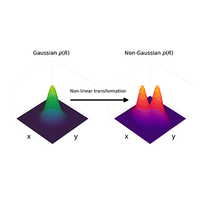
    <description>Author(s): Benjamin Sappler, Masataka Kawano, Michael P. Zaletel, and Frank Pollmann&lt;br/&gt;&lt;p&gt;Isometric tensor network states (isoTNS) generalize the isometric form of the one-dimensional matrix product states (MPS) to tensor networks in two and higher dimensions. Here, the authors introduce an alternative isometric form for isoTNS by incorporating auxiliary tensors to represent the orthogonality hypersurface. The authors demonstrate the viability of the method by performing ground-state search and real-time evolution of the transverse field Ising model on large square lattices of up to 1250 sites.&lt;/p&gt;&lt;img src="//cdn.journals.aps.org/journals/PRB/key_images/10.1103/56px-qsxx.png" width="200" height=\"100\"&gt;&lt;br/&gt;[Phys. Rev. B 113, 165117] Published Fri Apr 10, 2026</description>
    <content:encoded><![CDATA[<p>Author(s): Benjamin Sappler, Masataka Kawano, Michael P. Zaletel, and Frank Pollmann</p><p>Isometric tensor network states (isoTNS) generalize the isometric form of the one-dimensional matrix product states (MPS) to tensor networks in two and higher dimensions. Here, the authors introduce an alternative isometric form for isoTNS by incorporating auxiliary tensors to represent the orthogonality hypersurface. The authors demonstrate the viability of the method by performing ground-state search and real-time evolution of the transverse field Ising model on large square lattices of up to 1250 sites.</p><img src="//cdn.journals.aps.org/journals/PRB/key_images/10.1103/56px-qsxx.png" width="200" height=\"100\"><br/><p>[Phys. Rev. B 113, 165117] Published Fri Apr 10, 2026</p>]]></content:encoded>
    <dc:title>Diagonal isometric form for tensor network states in two dimensions</dc:title>
    <dc:creator>Benjamin Sappler, Masataka Kawano, Michael P. Zaletel, and Frank Pollmann</dc:creator>
    <dc:date>2026-04-10T10:00:00+00:00</dc:date>
    <dc:rights>Personal use only, all commercial or other reuse prohibited</dc:rights>
    <dc:source>Phys. Rev. B 113, 165117 (2026)</dc:source>
    <dc:type>article</dc:type>
    <dc:identifier>doi:10.1103/56px-qsxx</dc:identifier>
    <prism:doi>10.1103/56px-qsxx</prism:doi>
    <prism:publicationName>Physical Review B</prism:publicationName>
    <prism:volume>113</prism:volume>
    <prism:number>16</prism:number>
    <prism:publicationDate>2026-04-10T10:00:00+00:00</prism:publicationDate>
    <prism:url>http://link.aps.org/doi/10.1103/56px-qsxx</prism:url>
    <prism:startingPage>165117</prism:startingPage>
    <dc:subject>Electronic structure and strongly correlated systems</dc:subject>
    <prism:section>Electronic structure and strongly correlated systems</prism:section>
  </item>
  <item rdf:about="http://link.aps.org/doi/10.1103/b2q3-mgvf">
    <title>Classical fracton spin liquid and Hilbert space fragmentation in a 2D spin-$1/2$ model</title>
    <link>http://link.aps.org/doi/10.1103/b2q3-mgvf</link>
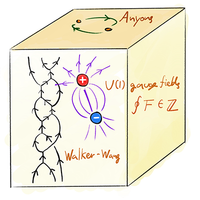
    <description>Author(s): Nils Niggemann, Meghadeepa Adhikary, Yannik Schaden-Thillmann, and Johannes Reuther&lt;br/&gt;&lt;p&gt;Classical U(1) fracton spin liquids feature an extensive ground state degeneracy and follow an effective description in terms of a tensor Gauss's law where charges, so-called fractons, have restricted mobility. Here we introduce a simple spin model that realizes such a state by straightforward discr…&lt;/p&gt;&lt;br/&gt;[Phys. Rev. B 113, 165118] Published Fri Apr 10, 2026</description>
    <content:encoded><![CDATA[<p>Author(s): Nils Niggemann, Meghadeepa Adhikary, Yannik Schaden-Thillmann, and Johannes Reuther</p><p>Classical U(1) fracton spin liquids feature an extensive ground state degeneracy and follow an effective description in terms of a tensor Gauss's law where charges, so-called fractons, have restricted mobility. Here we introduce a simple spin model that realizes such a state by straightforward discr…</p><br/><p>[Phys. Rev. B 113, 165118] Published Fri Apr 10, 2026</p>]]></content:encoded>
    <dc:title>Classical fracton spin liquid and Hilbert space fragmentation in a 2D spin-$1/2$ model</dc:title>
    <dc:creator>Nils Niggemann, Meghadeepa Adhikary, Yannik Schaden-Thillmann, and Johannes Reuther</dc:creator>
    <dc:date>2026-04-10T10:00:00+00:00</dc:date>
    <dc:rights>Personal use only, all commercial or other reuse prohibited</dc:rights>
    <dc:source>Phys. Rev. B 113, 165118 (2026)</dc:source>
    <dc:type>article</dc:type>
    <dc:identifier>doi:10.1103/b2q3-mgvf</dc:identifier>
    <prism:doi>10.1103/b2q3-mgvf</prism:doi>
    <prism:publicationName>Physical Review B</prism:publicationName>
    <prism:volume>113</prism:volume>
    <prism:number>16</prism:number>
    <prism:publicationDate>2026-04-10T10:00:00+00:00</prism:publicationDate>
    <prism:url>http://link.aps.org/doi/10.1103/b2q3-mgvf</prism:url>
    <prism:startingPage>165118</prism:startingPage>
    <dc:subject>Electronic structure and strongly correlated systems</dc:subject>
    <prism:section>Electronic structure and strongly correlated systems</prism:section>
  </item>
  <item rdf:about="http://link.aps.org/doi/10.1103/f9zt-ckbp">
    <title>Dynamical correlations and nonequilibrium sum rules in photodoped Hubbard ladders</title>
    <link>http://link.aps.org/doi/10.1103/f9zt-ckbp</link>
    <description>Author(s): E. Merhej, J. P. Hague, R. M. Konik, and A. J. A. James&lt;br/&gt;&lt;p&gt;Using matrix product state techniques we study the nonequilibrium dynamical response of the half-filled Hubbard ladder when subject to an optical pump. Optical pumping offers a way of producing and manipulating new strongly correlated phenomena by suppressing existing magnetic correlations. The ladd…&lt;/p&gt;&lt;br/&gt;[Phys. Rev. B 113, 165119] Published Fri Apr 10, 2026</description>
    <content:encoded><![CDATA[<p>Author(s): E. Merhej, J. P. Hague, R. M. Konik, and A. J. A. James</p><p>Using matrix product state techniques we study the nonequilibrium dynamical response of the half-filled Hubbard ladder when subject to an optical pump. Optical pumping offers a way of producing and manipulating new strongly correlated phenomena by suppressing existing magnetic correlations. The ladd…</p><br/><p>[Phys. Rev. B 113, 165119] Published Fri Apr 10, 2026</p>]]></content:encoded>
    <dc:title>Dynamical correlations and nonequilibrium sum rules in photodoped Hubbard ladders</dc:title>
    <dc:creator>E. Merhej, J. P. Hague, R. M. Konik, and A. J. A. James</dc:creator>
    <dc:date>2026-04-10T10:00:00+00:00</dc:date>
    <dc:rights>Personal use only, all commercial or other reuse prohibited</dc:rights>
    <dc:source>Phys. Rev. B 113, 165119 (2026)</dc:source>
    <dc:type>article</dc:type>
    <dc:identifier>doi:10.1103/f9zt-ckbp</dc:identifier>
    <prism:doi>10.1103/f9zt-ckbp</prism:doi>
    <prism:publicationName>Physical Review B</prism:publicationName>
    <prism:volume>113</prism:volume>
    <prism:number>16</prism:number>
    <prism:publicationDate>2026-04-10T10:00:00+00:00</prism:publicationDate>
    <prism:url>http://link.aps.org/doi/10.1103/f9zt-ckbp</prism:url>
    <prism:startingPage>165119</prism:startingPage>
    <dc:subject>Electronic structure and strongly correlated systems</dc:subject>
    <prism:section>Electronic structure and strongly correlated systems</prism:section>
  </item>
  <item rdf:about="http://link.aps.org/doi/10.1103/vwx9-3zwj">
    <title>Exotic transition and reentrance on the 1/9 magnetization plateau in a spin-1/2 anisotropic kagome antiferromagnet</title>
    <link>http://link.aps.org/doi/10.1103/vwx9-3zwj</link>
    <description>Author(s): Da-zhi Fang, Shi-Ju Ran, and Gang Su&lt;br/&gt;&lt;p&gt;With the intriguing coexistence of local magnetic orders and nonlocal valence bond patterns, unconventional magnetic plateau phases in geometrically frustrated quantum systems have attracted significant attention. This work investigates the spin-1/2 anisotropic kagome antiferromagnet, uncovering an …&lt;/p&gt;&lt;br/&gt;[Phys. Rev. B 113, L140405] Published Fri Apr 10, 2026</description>
    <content:encoded><![CDATA[<p>Author(s): Da-zhi Fang, Shi-Ju Ran, and Gang Su</p><p>With the intriguing coexistence of local magnetic orders and nonlocal valence bond patterns, unconventional magnetic plateau phases in geometrically frustrated quantum systems have attracted significant attention. This work investigates the spin-1/2 anisotropic kagome antiferromagnet, uncovering an …</p><br/><p>[Phys. Rev. B 113, L140405] Published Fri Apr 10, 2026</p>]]></content:encoded>
    <dc:title>Exotic transition and reentrance on the 1/9 magnetization plateau in a spin-1/2 anisotropic kagome antiferromagnet</dc:title>
    <dc:creator>Da-zhi Fang, Shi-Ju Ran, and Gang Su</dc:creator>
    <dc:date>2026-04-10T10:00:00+00:00</dc:date>
    <dc:rights>Personal use only, all commercial or other reuse prohibited</dc:rights>
    <dc:source>Phys. Rev. B 113, L140405 (2026)</dc:source>
    <dc:type>article</dc:type>
    <dc:identifier>doi:10.1103/vwx9-3zwj</dc:identifier>
    <prism:doi>10.1103/vwx9-3zwj</prism:doi>
    <prism:publicationName>Physical Review B</prism:publicationName>
    <prism:volume>113</prism:volume>
    <prism:number>14</prism:number>
    <prism:publicationDate>2026-04-10T10:00:00+00:00</prism:publicationDate>
    <prism:url>http://link.aps.org/doi/10.1103/vwx9-3zwj</prism:url>
    <prism:startingPage>L140405</prism:startingPage>
    <dc:subject>Magnetism</dc:subject>
    <prism:section>Magnetism</prism:section>
  </item>
  <item rdf:about="http://link.aps.org/doi/10.1103/1c3q-yps4">
    <title>Many-particle hybridization of optical transitions from zero-mode Landau levels in HgTe quantum wells</title>
    <link>http://link.aps.org/doi/10.1103/1c3q-yps4</link>
    <description>Author(s): S. Ruffenach, S. S. Krishtopenko, A. V. Ikonnikov, C. Consejo, J. Torres, X. Baudry, P. Ballet, B. Jouault, and F. Teppe&lt;br/&gt;&lt;p&gt;We present far-infrared magnetospectroscopy measurements of a HgTe quantum well in the inverted band structure regime over the temperature range of 2 to 60 K. The particularly low electron concentration enables us to probe the temperature evolution of all four possible optical transitions originatin…&lt;/p&gt;&lt;br/&gt;[Phys. Rev. B 113, L161108] Published Fri Apr 10, 2026</description>
    <content:encoded><![CDATA[<p>Author(s): S. Ruffenach, S. S. Krishtopenko, A. V. Ikonnikov, C. Consejo, J. Torres, X. Baudry, P. Ballet, B. Jouault, and F. Teppe</p><p>We present far-infrared magnetospectroscopy measurements of a HgTe quantum well in the inverted band structure regime over the temperature range of 2 to 60 K. The particularly low electron concentration enables us to probe the temperature evolution of all four possible optical transitions originatin…</p><br/><p>[Phys. Rev. B 113, L161108] Published Fri Apr 10, 2026</p>]]></content:encoded>
    <dc:title>Many-particle hybridization of optical transitions from zero-mode Landau levels in HgTe quantum wells</dc:title>
    <dc:creator>S. Ruffenach, S. S. Krishtopenko, A. V. Ikonnikov, C. Consejo, J. Torres, X. Baudry, P. Ballet, B. Jouault, and F. Teppe</dc:creator>
    <dc:date>2026-04-10T10:00:00+00:00</dc:date>
    <dc:rights>Personal use only, all commercial or other reuse prohibited</dc:rights>
    <dc:source>Phys. Rev. B 113, L161108 (2026)</dc:source>
    <dc:type>article</dc:type>
    <dc:identifier>doi:10.1103/1c3q-yps4</dc:identifier>
    <prism:doi>10.1103/1c3q-yps4</prism:doi>
    <prism:publicationName>Physical Review B</prism:publicationName>
    <prism:volume>113</prism:volume>
    <prism:number>16</prism:number>
    <prism:publicationDate>2026-04-10T10:00:00+00:00</prism:publicationDate>
    <prism:url>http://link.aps.org/doi/10.1103/1c3q-yps4</prism:url>
    <prism:startingPage>L161108</prism:startingPage>
    <dc:subject>Electronic structure and strongly correlated systems</dc:subject>
    <prism:section>Electronic structure and strongly correlated systems</prism:section>
  </item>
  <item rdf:about="http://link.aps.org/doi/10.1103/9jdy-b418">
    <title>Non-Hermitian skin effect and electronic nonlocal transport</title>
    <link>http://link.aps.org/doi/10.1103/9jdy-b418</link>
    <description>Author(s): Carlos Payá, Oliver Solow, Elsa Prada, Ramón Aguado, and Karsten Flensberg&lt;br/&gt;&lt;p&gt;Open quantum systems governed by non-Hermitian &lt;i&gt;effective&lt;/i&gt; Hamiltonians exhibit unique phenomena, such as the non-Hermitian skin effect, where eigenstates localize at system boundaries. We investigate this effect in a Rashba nanowire coupled to a ferromagnetic lead and demonstrate that it can be detec…&lt;/p&gt;&lt;br/&gt;[Phys. Rev. B 113, L161405] Published Fri Apr 10, 2026</description>
    <content:encoded><![CDATA[<p>Author(s): Carlos Payá, Oliver Solow, Elsa Prada, Ramón Aguado, and Karsten Flensberg</p><p>Open quantum systems governed by non-Hermitian <i>effective</i> Hamiltonians exhibit unique phenomena, such as the non-Hermitian skin effect, where eigenstates localize at system boundaries. We investigate this effect in a Rashba nanowire coupled to a ferromagnetic lead and demonstrate that it can be detec…</p><br/><p>[Phys. Rev. B 113, L161405] Published Fri Apr 10, 2026</p>]]></content:encoded>
    <dc:title>Non-Hermitian skin effect and electronic nonlocal transport</dc:title>
    <dc:creator>Carlos Payá, Oliver Solow, Elsa Prada, Ramón Aguado, and Karsten Flensberg</dc:creator>
    <dc:date>2026-04-10T10:00:00+00:00</dc:date>
    <dc:rights>Personal use only, all commercial or other reuse prohibited</dc:rights>
    <dc:source>Phys. Rev. B 113, L161405 (2026)</dc:source>
    <dc:type>article</dc:type>
    <dc:identifier>doi:10.1103/9jdy-b418</dc:identifier>
    <prism:doi>10.1103/9jdy-b418</prism:doi>
    <prism:publicationName>Physical Review B</prism:publicationName>
    <prism:volume>113</prism:volume>
    <prism:number>16</prism:number>
    <prism:publicationDate>2026-04-10T10:00:00+00:00</prism:publicationDate>
    <prism:url>http://link.aps.org/doi/10.1103/9jdy-b418</prism:url>
    <prism:startingPage>L161405</prism:startingPage>
    <dc:subject>Surface physics, nanoscale physics, low-dimensional systems</dc:subject>
    <prism:section>Surface physics, nanoscale physics, low-dimensional systems</prism:section>
  </item>
  <item rdf:about="http://link.aps.org/doi/10.1103/597n-n66p">
    <title>First-principles study of intrinsic and ${\mathrm{Fe}}^{3+}$-related luminescence mechanisms in feldspar</title>
    <link>http://link.aps.org/doi/10.1103/597n-n66p</link>
    <description>Author(s): Mingxue Fu, Arghya Bhowmik, Mayank Jain, and Juan Maria Lastra-García&lt;br/&gt;&lt;p&gt;Feldspar is the most abundant mineral group in the Earth's continental crust and almost invariably contains ${\mathrm{Fe}}^{3+}$ impurities in natural samples. These impurities dominate the characteristic deep-red luminescence of feldspar, while the host lattice itself also exhibits intrinsic lumine…&lt;/p&gt;&lt;br/&gt;[Phys. Rev. B 113, 134107] Published Thu Apr 09, 2026</description>
    <content:encoded><![CDATA[<p>Author(s): Mingxue Fu, Arghya Bhowmik, Mayank Jain, and Juan Maria Lastra-García</p><p>Feldspar is the most abundant mineral group in the Earth's continental crust and almost invariably contains <math xmlns="http://www.w3.org/1998/Math/MathML"><msup><mrow><mi>Fe</mi></mrow><mrow><mn>3</mn><mo>+</mo></mrow></msup></math> impurities in natural samples. These impurities dominate the characteristic deep-red luminescence of feldspar, while the host lattice itself also exhibits intrinsic luminescence associate…</p><br/><p>[Phys. Rev. B 113, 134107] Published Thu Apr 09, 2026</p>]]></content:encoded>
    <dc:title>First-principles study of intrinsic and ${\mathrm{Fe}}^{3+}$-related luminescence mechanisms in feldspar</dc:title>
    <dc:creator>Mingxue Fu, Arghya Bhowmik, Mayank Jain, and Juan Maria Lastra-García</dc:creator>
    <dc:date>2026-04-09T10:00:00+00:00</dc:date>
    <dc:rights>Personal use only, all commercial or other reuse prohibited</dc:rights>
    <dc:source>Phys. Rev. B 113, 134107 (2026)</dc:source>
    <dc:type>article</dc:type>
    <dc:identifier>doi:10.1103/597n-n66p</dc:identifier>
    <prism:doi>10.1103/597n-n66p</prism:doi>
    <prism:publicationName>Physical Review B</prism:publicationName>
    <prism:volume>113</prism:volume>
    <prism:number>13</prism:number>
    <prism:publicationDate>2026-04-09T10:00:00+00:00</prism:publicationDate>
    <prism:url>http://link.aps.org/doi/10.1103/597n-n66p</prism:url>
    <prism:startingPage>134107</prism:startingPage>
    <dc:subject>Structure, structural phase transitions, mechanical properties, defects</dc:subject>
    <prism:section>Structure, structural phase transitions, mechanical properties, defects</prism:section>
  </item>
  <item rdf:about="http://link.aps.org/doi/10.1103/scjr-r3hj">
    <title>Finite-time scaling with two characteristic time scales: Driven critical dynamics with emergent symmetry</title>
    <link>http://link.aps.org/doi/10.1103/scjr-r3hj</link>
    <description>Author(s): Yu-Rong Shu, Li-Ying Yang, and Shuai Yin&lt;br/&gt;&lt;p&gt;Critical points with emergent symmetry exhibit intriguing scaling properties induced by two divergent length scales, attracting extensive investigations recently. We study the driven critical dynamics in three-dimensional $q$-state clock models, in which the ordered phase breaks the ${Z}_{q}$ discre…&lt;/p&gt;&lt;br/&gt;[Phys. Rev. B 113, 134303] Published Thu Apr 09, 2026</description>
    <content:encoded><![CDATA[<p>Author(s): Yu-Rong Shu, Li-Ying Yang, and Shuai Yin</p><p>Critical points with emergent symmetry exhibit intriguing scaling properties induced by two divergent length scales, attracting extensive investigations recently. We study the driven critical dynamics in three-dimensional <math xmlns="http://www.w3.org/1998/Math/MathML"><mi>q</mi></math>-state clock models, in which the ordered phase breaks the <math xmlns="http://www.w3.org/1998/Math/MathML"><msub><mi>Z</mi><mi>q</mi></msub></math> discrete symmet…</p><br/><p>[Phys. Rev. B 113, 134303] Published Thu Apr 09, 2026</p>]]></content:encoded>
    <dc:title>Finite-time scaling with two characteristic time scales: Driven critical dynamics with emergent symmetry</dc:title>
    <dc:creator>Yu-Rong Shu, Li-Ying Yang, and Shuai Yin</dc:creator>
    <dc:date>2026-04-09T10:00:00+00:00</dc:date>
    <dc:rights>Personal use only, all commercial or other reuse prohibited</dc:rights>
    <dc:source>Phys. Rev. B 113, 134303 (2026)</dc:source>
    <dc:type>article</dc:type>
    <dc:identifier>doi:10.1103/scjr-r3hj</dc:identifier>
    <prism:doi>10.1103/scjr-r3hj</prism:doi>
    <prism:publicationName>Physical Review B</prism:publicationName>
    <prism:volume>113</prism:volume>
    <prism:number>13</prism:number>
    <prism:publicationDate>2026-04-09T10:00:00+00:00</prism:publicationDate>
    <prism:url>http://link.aps.org/doi/10.1103/scjr-r3hj</prism:url>
    <prism:startingPage>134303</prism:startingPage>
    <dc:subject>Dynamics, dynamical systems, lattice effects</dc:subject>
    <prism:section>Dynamics, dynamical systems, lattice effects</prism:section>
  </item>
  <item rdf:about="http://link.aps.org/doi/10.1103/4tgf-9hmc">
    <title>Quantum pontus-Mpemba effects in real- and imaginary-time dynamics</title>
    <link>http://link.aps.org/doi/10.1103/4tgf-9hmc</link>
    <description>Author(s): Hui Yu, Jiangping Hu, and Shi-Xin Zhang&lt;br/&gt;&lt;p&gt;The quantum Pontus-Mpemba effect (QPME) is a counterintuitive phenomenon wherein a quantum system relaxes more rapidly through a two-step evolution protocol than through direct evolution under a symmetric Hamiltonian alone. In this protocol, the system first evolves under a symmetry-breaking Hamilto…&lt;/p&gt;&lt;br/&gt;[Phys. Rev. B 113, 134304] Published Thu Apr 09, 2026</description>
    <content:encoded><![CDATA[<p>Author(s): Hui Yu, Jiangping Hu, and Shi-Xin Zhang</p><p>The quantum Pontus-Mpemba effect (QPME) is a counterintuitive phenomenon wherein a quantum system relaxes more rapidly through a two-step evolution protocol than through direct evolution under a symmetric Hamiltonian alone. In this protocol, the system first evolves under a symmetry-breaking Hamilto…</p><br/><p>[Phys. Rev. B 113, 134304] Published Thu Apr 09, 2026</p>]]></content:encoded>
    <dc:title>Quantum pontus-Mpemba effects in real- and imaginary-time dynamics</dc:title>
    <dc:creator>Hui Yu, Jiangping Hu, and Shi-Xin Zhang</dc:creator>
    <dc:date>2026-04-09T10:00:00+00:00</dc:date>
    <dc:rights>Personal use only, all commercial or other reuse prohibited</dc:rights>
    <dc:source>Phys. Rev. B 113, 134304 (2026)</dc:source>
    <dc:type>article</dc:type>
    <dc:identifier>doi:10.1103/4tgf-9hmc</dc:identifier>
    <prism:doi>10.1103/4tgf-9hmc</prism:doi>
    <prism:publicationName>Physical Review B</prism:publicationName>
    <prism:volume>113</prism:volume>
    <prism:number>13</prism:number>
    <prism:publicationDate>2026-04-09T10:00:00+00:00</prism:publicationDate>
    <prism:url>http://link.aps.org/doi/10.1103/4tgf-9hmc</prism:url>
    <prism:startingPage>134304</prism:startingPage>
    <dc:subject>Dynamics, dynamical systems, lattice effects</dc:subject>
    <prism:section>Dynamics, dynamical systems, lattice effects</prism:section>
  </item>
  <item rdf:about="http://link.aps.org/doi/10.1103/xd61-j7bz">
    <title>Sliding barrier effects on magnetoresistance and spin-transfer torque in $\mathrm{F}{\mathrm{e}}_{3}\mathrm{GaT}{\mathrm{e}}_{2}$-based magnetic tunnel junctions</title>
    <link>http://link.aps.org/doi/10.1103/xd61-j7bz</link>
    <description>Author(s): Baochun Wu, Jie Yang, Shiqi Liu, and Jing Lu&lt;br/&gt;&lt;p&gt;Electronic properties of van der Waals materials are highly sensitive to their stacking modes. To explore sliding effects in the two-dimensional (2D) spintronics, we construct a magnetic tunnel junction (MTJ) using sliding bilayer graphene or $h$-BN as barriers and the recently synthesized room-temp…&lt;/p&gt;&lt;br/&gt;[Phys. Rev. B 113, 134415] Published Thu Apr 09, 2026</description>
    <content:encoded><![CDATA[<p>Author(s): Baochun Wu, Jie Yang, Shiqi Liu, and Jing Lu</p><p>Electronic properties of van der Waals materials are highly sensitive to their stacking modes. To explore sliding effects in the two-dimensional (2D) spintronics, we construct a magnetic tunnel junction (MTJ) using sliding bilayer graphene or <math xmlns="http://www.w3.org/1998/Math/MathML"><mi>h</mi></math>-BN as barriers and the recently synthesized room-temper…</p><br/><p>[Phys. Rev. B 113, 134415] Published Thu Apr 09, 2026</p>]]></content:encoded>
    <dc:title>Sliding barrier effects on magnetoresistance and spin-transfer torque in $\mathrm{F}{\mathrm{e}}_{3}\mathrm{GaT}{\mathrm{e}}_{2}$-based magnetic tunnel junctions</dc:title>
    <dc:creator>Baochun Wu, Jie Yang, Shiqi Liu, and Jing Lu</dc:creator>
    <dc:date>2026-04-09T10:00:00+00:00</dc:date>
    <dc:rights>Personal use only, all commercial or other reuse prohibited</dc:rights>
    <dc:source>Phys. Rev. B 113, 134415 (2026)</dc:source>
    <dc:type>article</dc:type>
    <dc:identifier>doi:10.1103/xd61-j7bz</dc:identifier>
    <prism:doi>10.1103/xd61-j7bz</prism:doi>
    <prism:publicationName>Physical Review B</prism:publicationName>
    <prism:volume>113</prism:volume>
    <prism:number>13</prism:number>
    <prism:publicationDate>2026-04-09T10:00:00+00:00</prism:publicationDate>
    <prism:url>http://link.aps.org/doi/10.1103/xd61-j7bz</prism:url>
    <prism:startingPage>134415</prism:startingPage>
    <dc:subject>Magnetism</dc:subject>
    <prism:section>Magnetism</prism:section>
  </item>
  <item rdf:about="http://link.aps.org/doi/10.1103/ht3d-1kj8">
    <title>Magnetoelastic properties in the high-temperature magnetic phase of the skyrmion compound ${\mathrm{GdRu}}_{2}{\mathrm{Si}}_{2}$</title>
    <link>http://link.aps.org/doi/10.1103/ht3d-1kj8</link>
    <description>Author(s): J. Sourd, D. A. Mayoh, G. Balakrishnan, M. Uhlarz, J. Wosnitza, and S. Zherlitsyn&lt;br/&gt;&lt;p&gt;The metallic skyrmion magnet GdRu&lt;math xmlns="http://www.w3.org/1998/Math/MathML" display="inline"&gt;&lt;msub&gt;&lt;mrow&gt;&lt;/mrow&gt;&lt;mn&gt;2&lt;/mn&gt;&lt;/msub&gt;&lt;/math&gt;Si&lt;math xmlns="http://www.w3.org/1998/Math/MathML" display="inline"&gt;&lt;msub&gt;&lt;mrow&gt;&lt;/mrow&gt;&lt;mn&gt;2&lt;/mn&gt;&lt;/msub&gt;&lt;/math&gt; exhibits a fascinating sequence of complex and topological spin textures. Here, the authors focus on the recently discovered high-temperature phase, denoted phase VI. Using ultrasound techniques, they map precise phase boundaries and reveal a strong dependence of phase VI on the field direction. They further present evidence of tetragonal symmetry breaking driven by the magnetic order parameter in this phase.&lt;/p&gt;&lt;img src="//cdn.journals.aps.org/journals/PRB/key_images/10.1103/ht3d-1kj8.png" width="200" height=\"100\"&gt;&lt;br/&gt;[Phys. Rev. B 113, 134416] Published Thu Apr 09, 2026</description>
    <content:encoded><![CDATA[<p>Author(s): J. Sourd, D. A. Mayoh, G. Balakrishnan, M. Uhlarz, J. Wosnitza, and S. Zherlitsyn</p><p>The metallic skyrmion magnet GdRu<math xmlns="http://www.w3.org/1998/Math/MathML" display="inline"><msub><mrow></mrow><mn>2</mn></msub></math>Si<math xmlns="http://www.w3.org/1998/Math/MathML" display="inline"><msub><mrow></mrow><mn>2</mn></msub></math> exhibits a fascinating sequence of complex and topological spin textures. Here, the authors focus on the recently discovered high-temperature phase, denoted phase VI. Using ultrasound techniques, they map precise phase boundaries and reveal a strong dependence of phase VI on the field direction. They further present evidence of tetragonal symmetry breaking driven by the magnetic order parameter in this phase.</p><img src="//cdn.journals.aps.org/journals/PRB/key_images/10.1103/ht3d-1kj8.png" width="200" height=\"100\"><br/><p>[Phys. Rev. B 113, 134416] Published Thu Apr 09, 2026</p>]]></content:encoded>
    <dc:title>Magnetoelastic properties in the high-temperature magnetic phase of the skyrmion compound ${\mathrm{GdRu}}_{2}{\mathrm{Si}}_{2}$</dc:title>
    <dc:creator>J. Sourd, D. A. Mayoh, G. Balakrishnan, M. Uhlarz, J. Wosnitza, and S. Zherlitsyn</dc:creator>
    <dc:date>2026-04-09T10:00:00+00:00</dc:date>
    <dc:rights>Personal use only, all commercial or other reuse prohibited</dc:rights>
    <dc:source>Phys. Rev. B 113, 134416 (2026)</dc:source>
    <dc:type>article</dc:type>
    <dc:identifier>doi:10.1103/ht3d-1kj8</dc:identifier>
    <prism:doi>10.1103/ht3d-1kj8</prism:doi>
    <prism:publicationName>Physical Review B</prism:publicationName>
    <prism:volume>113</prism:volume>
    <prism:number>13</prism:number>
    <prism:publicationDate>2026-04-09T10:00:00+00:00</prism:publicationDate>
    <prism:url>http://link.aps.org/doi/10.1103/ht3d-1kj8</prism:url>
    <prism:startingPage>134416</prism:startingPage>
    <dc:subject>Magnetism</dc:subject>
    <prism:section>Magnetism</prism:section>
  </item>
  <item rdf:about="http://link.aps.org/doi/10.1103/jrvy-fy1f">
    <title>Above 136 K superconductivity in hole-doped diamond and c-BN under ambient pressure</title>
    <link>http://link.aps.org/doi/10.1103/jrvy-fy1f</link>
    <description>Author(s): Chen Chen, Xin Zhong, Lei Shen, and Cheng Lu&lt;br/&gt;&lt;p&gt;Identifying superconducting materials with strong electron phonon coupling and high critical temperatures under ambient pressure constitutes a frontier in contemporary condensed matter physics. Here, we report a pioneering investigation of the influence of carrier concentration and phonon softening …&lt;/p&gt;&lt;br/&gt;[Phys. Rev. B 113, 134512] Published Thu Apr 09, 2026</description>
    <content:encoded><![CDATA[<p>Author(s): Chen Chen, Xin Zhong, Lei Shen, and Cheng Lu</p><p>Identifying superconducting materials with strong electron phonon coupling and high critical temperatures under ambient pressure constitutes a frontier in contemporary condensed matter physics. Here, we report a pioneering investigation of the influence of carrier concentration and phonon softening …</p><br/><p>[Phys. Rev. B 113, 134512] Published Thu Apr 09, 2026</p>]]></content:encoded>
    <dc:title>Above 136 K superconductivity in hole-doped diamond and c-BN under ambient pressure</dc:title>
    <dc:creator>Chen Chen, Xin Zhong, Lei Shen, and Cheng Lu</dc:creator>
    <dc:date>2026-04-09T10:00:00+00:00</dc:date>
    <dc:rights>Personal use only, all commercial or other reuse prohibited</dc:rights>
    <dc:source>Phys. Rev. B 113, 134512 (2026)</dc:source>
    <dc:type>article</dc:type>
    <dc:identifier>doi:10.1103/jrvy-fy1f</dc:identifier>
    <prism:doi>10.1103/jrvy-fy1f</prism:doi>
    <prism:publicationName>Physical Review B</prism:publicationName>
    <prism:volume>113</prism:volume>
    <prism:number>13</prism:number>
    <prism:publicationDate>2026-04-09T10:00:00+00:00</prism:publicationDate>
    <prism:url>http://link.aps.org/doi/10.1103/jrvy-fy1f</prism:url>
    <prism:startingPage>134512</prism:startingPage>
    <dc:subject>Superfluidity and superconductivity</dc:subject>
    <prism:section>Superfluidity and superconductivity</prism:section>
  </item>
  <item rdf:about="http://link.aps.org/doi/10.1103/5vr6-fswh">
    <title>Resonant dynamics of one-dimensional dipole-conserving Bose-Hubbard model with time-dependent tensor electric fields</title>
    <link>http://link.aps.org/doi/10.1103/5vr6-fswh</link>
    <description>Author(s): Jiali Zhang and Shaoliang Zhang&lt;br/&gt;&lt;p&gt;Recently, tensor gauge fields and their coupling to fracton phases of matter have attracted more and more research interest, and a series of novel quantum phenomena arising from the coupling has been predicted. Here, we propose a tunable platform using a one-dimensional dipole-conserving Bose-Hubbar…&lt;/p&gt;&lt;br/&gt;[Phys. Rev. B 113, 144305] Published Thu Apr 09, 2026</description>
    <content:encoded><![CDATA[<p>Author(s): Jiali Zhang and Shaoliang Zhang</p><p>Recently, tensor gauge fields and their coupling to fracton phases of matter have attracted more and more research interest, and a series of novel quantum phenomena arising from the coupling has been predicted. Here, we propose a tunable platform using a one-dimensional dipole-conserving Bose-Hubbar…</p><br/><p>[Phys. Rev. B 113, 144305] Published Thu Apr 09, 2026</p>]]></content:encoded>
    <dc:title>Resonant dynamics of one-dimensional dipole-conserving Bose-Hubbard model with time-dependent tensor electric fields</dc:title>
    <dc:creator>Jiali Zhang and Shaoliang Zhang</dc:creator>
    <dc:date>2026-04-09T10:00:00+00:00</dc:date>
    <dc:rights>Personal use only, all commercial or other reuse prohibited</dc:rights>
    <dc:source>Phys. Rev. B 113, 144305 (2026)</dc:source>
    <dc:type>article</dc:type>
    <dc:identifier>doi:10.1103/5vr6-fswh</dc:identifier>
    <prism:doi>10.1103/5vr6-fswh</prism:doi>
    <prism:publicationName>Physical Review B</prism:publicationName>
    <prism:volume>113</prism:volume>
    <prism:number>14</prism:number>
    <prism:publicationDate>2026-04-09T10:00:00+00:00</prism:publicationDate>
    <prism:url>http://link.aps.org/doi/10.1103/5vr6-fswh</prism:url>
    <prism:startingPage>144305</prism:startingPage>
    <dc:subject>Dynamics, dynamical systems, lattice effects</dc:subject>
    <prism:section>Dynamics, dynamical systems, lattice effects</prism:section>
  </item>
  <item rdf:about="http://link.aps.org/doi/10.1103/82qf-9z61">
    <title>High-efficiency nonrelativistic charge-spin conversion in X-type antiferromagnets</title>
    <link>http://link.aps.org/doi/10.1103/82qf-9z61</link>
    <description>Author(s): Jiabin Wang, Wancheng Zhang, Zhenhua Zhang, Rui Xiong, Yong Liu, and Zhihong Lu&lt;br/&gt;&lt;p&gt;Antiferromagnetic materials with spin splitting have attracted considerable attention for their symmetry-enabled anisotropic spin textures that sustain a zero net magnetization, thereby facilitating efficient spin-current generation. In this work, the highly efficient generation of nonrelativistic s…&lt;/p&gt;&lt;br/&gt;[Phys. Rev. B 113, 144414] Published Thu Apr 09, 2026</description>
    <content:encoded><![CDATA[<p>Author(s): Jiabin Wang, Wancheng Zhang, Zhenhua Zhang, Rui Xiong, Yong Liu, and Zhihong Lu</p><p>Antiferromagnetic materials with spin splitting have attracted considerable attention for their symmetry-enabled anisotropic spin textures that sustain a zero net magnetization, thereby facilitating efficient spin-current generation. In this work, the highly efficient generation of nonrelativistic s…</p><br/><p>[Phys. Rev. B 113, 144414] Published Thu Apr 09, 2026</p>]]></content:encoded>
    <dc:title>High-efficiency nonrelativistic charge-spin conversion in X-type antiferromagnets</dc:title>
    <dc:creator>Jiabin Wang, Wancheng Zhang, Zhenhua Zhang, Rui Xiong, Yong Liu, and Zhihong Lu</dc:creator>
    <dc:date>2026-04-09T10:00:00+00:00</dc:date>
    <dc:rights>Personal use only, all commercial or other reuse prohibited</dc:rights>
    <dc:source>Phys. Rev. B 113, 144414 (2026)</dc:source>
    <dc:type>article</dc:type>
    <dc:identifier>doi:10.1103/82qf-9z61</dc:identifier>
    <prism:doi>10.1103/82qf-9z61</prism:doi>
    <prism:publicationName>Physical Review B</prism:publicationName>
    <prism:volume>113</prism:volume>
    <prism:number>14</prism:number>
    <prism:publicationDate>2026-04-09T10:00:00+00:00</prism:publicationDate>
    <prism:url>http://link.aps.org/doi/10.1103/82qf-9z61</prism:url>
    <prism:startingPage>144414</prism:startingPage>
    <dc:subject>Magnetism</dc:subject>
    <prism:section>Magnetism</prism:section>
  </item>
  <item rdf:about="http://link.aps.org/doi/10.1103/v686-2c9f">
    <title>Stretched exponential scaling of parity-restricted energy gaps in a random transverse-field Ising model</title>
    <link>http://link.aps.org/doi/10.1103/v686-2c9f</link>
    <description>Author(s): G.-X. Tang, J.-Z. Zhuang, L.-M. Duan, and Y.-K. Wu&lt;br/&gt;&lt;p&gt;The success of a quantum annealing algorithm requires a polynomial scaling of the energy gap. Recently it was shown that a two-dimensional transverse-field Ising model on a square lattice with nearest-neighbor $±J$ random coupling has a polynomial energy gap in the symmetric subspace of the parity o…&lt;/p&gt;&lt;br/&gt;[Phys. Rev. B 113, 144415] Published Thu Apr 09, 2026</description>
    <content:encoded><![CDATA[<p>Author(s): G.-X. Tang, J.-Z. Zhuang, L.-M. Duan, and Y.-K. Wu</p><p>The success of a quantum annealing algorithm requires a polynomial scaling of the energy gap. Recently it was shown that a two-dimensional transverse-field Ising model on a square lattice with nearest-neighbor <math xmlns="http://www.w3.org/1998/Math/MathML"><mrow><mo>±</mo><mi>J</mi></mrow></math> random coupling has a polynomial energy gap in the symmetric subspace of the parity ope…</p><br/><p>[Phys. Rev. B 113, 144415] Published Thu Apr 09, 2026</p>]]></content:encoded>
    <dc:title>Stretched exponential scaling of parity-restricted energy gaps in a random transverse-field Ising model</dc:title>
    <dc:creator>G.-X. Tang, J.-Z. Zhuang, L.-M. Duan, and Y.-K. Wu</dc:creator>
    <dc:date>2026-04-09T10:00:00+00:00</dc:date>
    <dc:rights>Personal use only, all commercial or other reuse prohibited</dc:rights>
    <dc:source>Phys. Rev. B 113, 144415 (2026)</dc:source>
    <dc:type>article</dc:type>
    <dc:identifier>doi:10.1103/v686-2c9f</dc:identifier>
    <prism:doi>10.1103/v686-2c9f</prism:doi>
    <prism:publicationName>Physical Review B</prism:publicationName>
    <prism:volume>113</prism:volume>
    <prism:number>14</prism:number>
    <prism:publicationDate>2026-04-09T10:00:00+00:00</prism:publicationDate>
    <prism:url>http://link.aps.org/doi/10.1103/v686-2c9f</prism:url>
    <prism:startingPage>144415</prism:startingPage>
    <dc:subject>Magnetism</dc:subject>
    <prism:section>Magnetism</prism:section>
  </item>
  <item rdf:about="http://link.aps.org/doi/10.1103/33w8-jlfr">
    <title>Mechanism of the Mott-like insulator-to-metal transition of heavy-ion irradiated $\mathrm{Cr}X{\mathrm{Te}}_{3}$ ($X=\mathrm{Si}$ and Ge)</title>
    <link>http://link.aps.org/doi/10.1103/33w8-jlfr</link>
    <description>Author(s): Siyue Zhang, Yasuhiro Niwa, Haruto Ejiri, Jun Fujioka, Kazuya Harii, Satoru Okayasu, and Yuki Shiomi&lt;br/&gt;&lt;p&gt;It was recently reported that heavy-ion irradiation to layered ferromagnetic insulators $\mathrm{Cr}X{\mathrm{Te}}_{3}$ ($X=\mathrm{Si}$ and Ge) produces amorphous ferromagnetic metals with approximately three times higher transition temperatures (${T}_{C}$) than those of single crystals. This high-…&lt;/p&gt;&lt;br/&gt;[Phys. Rev. B 113, 155116] Published Thu Apr 09, 2026</description>
    <content:encoded><![CDATA[<p>Author(s): Siyue Zhang, Yasuhiro Niwa, Haruto Ejiri, Jun Fujioka, Kazuya Harii, Satoru Okayasu, and Yuki Shiomi</p><p>It was recently reported that heavy-ion irradiation to layered ferromagnetic insulators <math xmlns="http://www.w3.org/1998/Math/MathML"><mrow><mi>Cr</mi><mi>X</mi><msub><mi>Te</mi><mn>3</mn></msub></mrow></math> (<math xmlns="http://www.w3.org/1998/Math/MathML"><mrow><mi>X</mi><mo>=</mo><mi>Si</mi></mrow></math> and Ge) produces amorphous ferromagnetic metals with approximately three times higher transition temperatures (<math xmlns="http://www.w3.org/1998/Math/MathML"><msub><mi>T</mi><mi>C</mi></msub></math>) than those of single crystals. This high-<math xmlns="http://www.w3.org/1998/Math/MathML"><msub><mi>T</mi><mi>C</mi></msub></math> metallic state is reminiscent of the cor…</p><br/><p>[Phys. Rev. B 113, 155116] Published Thu Apr 09, 2026</p>]]></content:encoded>
    <dc:title>Mechanism of the Mott-like insulator-to-metal transition of heavy-ion irradiated $\mathrm{Cr}X{\mathrm{Te}}_{3}$ ($X=\mathrm{Si}$ and Ge)</dc:title>
    <dc:creator>Siyue Zhang, Yasuhiro Niwa, Haruto Ejiri, Jun Fujioka, Kazuya Harii, Satoru Okayasu, and Yuki Shiomi</dc:creator>
    <dc:date>2026-04-09T10:00:00+00:00</dc:date>
    <dc:rights>Personal use only, all commercial or other reuse prohibited</dc:rights>
    <dc:source>Phys. Rev. B 113, 155116 (2026)</dc:source>
    <dc:type>article</dc:type>
    <dc:identifier>doi:10.1103/33w8-jlfr</dc:identifier>
    <prism:doi>10.1103/33w8-jlfr</prism:doi>
    <prism:publicationName>Physical Review B</prism:publicationName>
    <prism:volume>113</prism:volume>
    <prism:number>15</prism:number>
    <prism:publicationDate>2026-04-09T10:00:00+00:00</prism:publicationDate>
    <prism:url>http://link.aps.org/doi/10.1103/33w8-jlfr</prism:url>
    <prism:startingPage>155116</prism:startingPage>
    <dc:subject>Electronic structure and strongly correlated systems</dc:subject>
    <prism:section>Electronic structure and strongly correlated systems</prism:section>
  </item>
  <item rdf:about="http://link.aps.org/doi/10.1103/qvdz-qwf8">
    <title>Light-induced pseudomagnetic fields in three-dimensional topological semimetals</title>
    <link>http://link.aps.org/doi/10.1103/qvdz-qwf8</link>
    <description>Author(s): Arpit Raj, Swati Chaudhary, Martin Rodriguez-Vega, Maia G. Vergniory, Roni Ilan, and Gregory A. Fiete&lt;br/&gt;&lt;p&gt;In this work, we show that suitably designed spatially varying linearly polarized light provides a versatile route to generate and control pseudomagnetic fields in Weyl semimetals through Floquet engineering. Within a high-frequency expansion, we derive an effective axial gauge potential ${\mathbit{…&lt;/p&gt;&lt;br/&gt;[Phys. Rev. B 113, 155117] Published Thu Apr 09, 2026</description>
    <content:encoded><![CDATA[<p>Author(s): Arpit Raj, Swati Chaudhary, Martin Rodriguez-Vega, Maia G. Vergniory, Roni Ilan, and Gregory A. Fiete</p><p>In this work, we show that suitably designed spatially varying linearly polarized light provides a versatile route to generate and control pseudomagnetic fields in Weyl semimetals through Floquet engineering. Within a high-frequency expansion, we derive an effective axial gauge potential <math xmlns="http://www.w3.org/1998/Math/MathML"><mrow><msub><mi mathvariant="bold-italic">A</mi><mn>5</mn></msub><mrow><mo>(</mo><mi mathvariant="bold-italic">r</mi><mo>)</mo></mrow></mrow></math> whose…</p><br/><p>[Phys. Rev. B 113, 155117] Published Thu Apr 09, 2026</p>]]></content:encoded>
    <dc:title>Light-induced pseudomagnetic fields in three-dimensional topological semimetals</dc:title>
    <dc:creator>Arpit Raj, Swati Chaudhary, Martin Rodriguez-Vega, Maia G. Vergniory, Roni Ilan, and Gregory A. Fiete</dc:creator>
    <dc:date>2026-04-09T10:00:00+00:00</dc:date>
    <dc:rights>Personal use only, all commercial or other reuse prohibited</dc:rights>
    <dc:source>Phys. Rev. B 113, 155117 (2026)</dc:source>
    <dc:type>article</dc:type>
    <dc:identifier>doi:10.1103/qvdz-qwf8</dc:identifier>
    <prism:doi>10.1103/qvdz-qwf8</prism:doi>
    <prism:publicationName>Physical Review B</prism:publicationName>
    <prism:volume>113</prism:volume>
    <prism:number>15</prism:number>
    <prism:publicationDate>2026-04-09T10:00:00+00:00</prism:publicationDate>
    <prism:url>http://link.aps.org/doi/10.1103/qvdz-qwf8</prism:url>
    <prism:startingPage>155117</prism:startingPage>
    <dc:subject>Electronic structure and strongly correlated systems</dc:subject>
    <prism:section>Electronic structure and strongly correlated systems</prism:section>
  </item>
  <item rdf:about="http://link.aps.org/doi/10.1103/k4gw-7k8h">
    <title>Effect of slowly decaying long-range interactions on topological qubits</title>
    <link>http://link.aps.org/doi/10.1103/k4gw-7k8h</link>
    <description>Author(s): Etienne Granet and Michael Levin&lt;br/&gt;&lt;p&gt;We study the robustness of topological ground state degeneracy to long-range interactions in quantum many-body systems. We focus on slowly decaying two-body interactions that scale like a power law $1/{r}^{α}$ where $α$ is smaller than the spatial dimension; such interactions are beyond the reach of…&lt;/p&gt;&lt;br/&gt;[Phys. Rev. B 113, 155118] Published Thu Apr 09, 2026</description>
    <content:encoded><![CDATA[<p>Author(s): Etienne Granet and Michael Levin</p><p>We study the robustness of topological ground state degeneracy to long-range interactions in quantum many-body systems. We focus on slowly decaying two-body interactions that scale like a power law <math xmlns="http://www.w3.org/1998/Math/MathML"><mrow><mn>1</mn><mo>/</mo><msup><mi>r</mi><mi>α</mi></msup></mrow></math> where <math xmlns="http://www.w3.org/1998/Math/MathML"><mi>α</mi></math> is smaller than the spatial dimension; such interactions are beyond the reach of known st…</p><br/><p>[Phys. Rev. B 113, 155118] Published Thu Apr 09, 2026</p>]]></content:encoded>
    <dc:title>Effect of slowly decaying long-range interactions on topological qubits</dc:title>
    <dc:creator>Etienne Granet and Michael Levin</dc:creator>
    <dc:date>2026-04-09T10:00:00+00:00</dc:date>
    <dc:rights>Personal use only, all commercial or other reuse prohibited</dc:rights>
    <dc:source>Phys. Rev. B 113, 155118 (2026)</dc:source>
    <dc:type>article</dc:type>
    <dc:identifier>doi:10.1103/k4gw-7k8h</dc:identifier>
    <prism:doi>10.1103/k4gw-7k8h</prism:doi>
    <prism:publicationName>Physical Review B</prism:publicationName>
    <prism:volume>113</prism:volume>
    <prism:number>15</prism:number>
    <prism:publicationDate>2026-04-09T10:00:00+00:00</prism:publicationDate>
    <prism:url>http://link.aps.org/doi/10.1103/k4gw-7k8h</prism:url>
    <prism:startingPage>155118</prism:startingPage>
    <dc:subject>Electronic structure and strongly correlated systems</dc:subject>
    <prism:section>Electronic structure and strongly correlated systems</prism:section>
  </item>
  <item rdf:about="http://link.aps.org/doi/10.1103/jg33-gljj">
    <title>Applicability of the cumulant expansion method for the calculation of transport properties in electron-phonon systems</title>
    <link>http://link.aps.org/doi/10.1103/jg33-gljj</link>
    <description>Author(s): Petar Mitrić, Veljko Janković, Darko Tanasković, and Nenad Vukmirović&lt;br/&gt;&lt;p&gt;We assess the accuracy of the cumulant expansion (CE) method, combined with the independent-particle approximation (IPA), for calculating charge mobility in electron-phonon systems. As representative testbeds, we consider the Peierls and Fröhlich models, which serve as simplified frameworks where ac…&lt;/p&gt;&lt;br/&gt;[Phys. Rev. B 113, 155119] Published Thu Apr 09, 2026</description>
    <content:encoded><![CDATA[<p>Author(s): Petar Mitrić, Veljko Janković, Darko Tanasković, and Nenad Vukmirović</p><p>We assess the accuracy of the cumulant expansion (CE) method, combined with the independent-particle approximation (IPA), for calculating charge mobility in electron-phonon systems. As representative testbeds, we consider the Peierls and Fröhlich models, which serve as simplified frameworks where ac…</p><br/><p>[Phys. Rev. B 113, 155119] Published Thu Apr 09, 2026</p>]]></content:encoded>
    <dc:title>Applicability of the cumulant expansion method for the calculation of transport properties in electron-phonon systems</dc:title>
    <dc:creator>Petar Mitrić, Veljko Janković, Darko Tanasković, and Nenad Vukmirović</dc:creator>
    <dc:date>2026-04-09T10:00:00+00:00</dc:date>
    <dc:rights>Personal use only, all commercial or other reuse prohibited</dc:rights>
    <dc:source>Phys. Rev. B 113, 155119 (2026)</dc:source>
    <dc:type>article</dc:type>
    <dc:identifier>doi:10.1103/jg33-gljj</dc:identifier>
    <prism:doi>10.1103/jg33-gljj</prism:doi>
    <prism:publicationName>Physical Review B</prism:publicationName>
    <prism:volume>113</prism:volume>
    <prism:number>15</prism:number>
    <prism:publicationDate>2026-04-09T10:00:00+00:00</prism:publicationDate>
    <prism:url>http://link.aps.org/doi/10.1103/jg33-gljj</prism:url>
    <prism:startingPage>155119</prism:startingPage>
    <dc:subject>Electronic structure and strongly correlated systems</dc:subject>
    <prism:section>Electronic structure and strongly correlated systems</prism:section>
  </item>
  <item rdf:about="http://link.aps.org/doi/10.1103/cjxf-jdl2">
    <title>Reflection symmetry enhances four-phonon scattering in monolayer transition-metal semiconductors with large acoustic-optical gaps</title>
    <link>http://link.aps.org/doi/10.1103/cjxf-jdl2</link>
    <description>Author(s): Yuan Yao, Hao Chen, Wen-Wen Liu, Chang-Hao Ding, Xiong Wu, Yu-Jia Zeng, Nannan Luo, Jiang Zeng, Li-Ming Tang, and Ke-Qiu Chen&lt;br/&gt;&lt;p&gt;Understanding how crystal symmetry governs phonon-phonon scattering is essential for predicting heat transport in two-dimensional semiconductors. While most studies focus on three-phonon (3ph) interactions, growing evidence shows that four-phonon (4ph) processes can be equally important for thermal …&lt;/p&gt;&lt;br/&gt;[Phys. Rev. B 113, 155416] Published Thu Apr 09, 2026</description>
    <content:encoded><![CDATA[<p>Author(s): Yuan Yao, Hao Chen, Wen-Wen Liu, Chang-Hao Ding, Xiong Wu, Yu-Jia Zeng, Nannan Luo, Jiang Zeng, Li-Ming Tang, and Ke-Qiu Chen</p><p>Understanding how crystal symmetry governs phonon-phonon scattering is essential for predicting heat transport in two-dimensional semiconductors. While most studies focus on three-phonon (3ph) interactions, growing evidence shows that four-phonon (4ph) processes can be equally important for thermal …</p><br/><p>[Phys. Rev. B 113, 155416] Published Thu Apr 09, 2026</p>]]></content:encoded>
    <dc:title>Reflection symmetry enhances four-phonon scattering in monolayer transition-metal semiconductors with large acoustic-optical gaps</dc:title>
    <dc:creator>Yuan Yao, Hao Chen, Wen-Wen Liu, Chang-Hao Ding, Xiong Wu, Yu-Jia Zeng, Nannan Luo, Jiang Zeng, Li-Ming Tang, and Ke-Qiu Chen</dc:creator>
    <dc:date>2026-04-09T10:00:00+00:00</dc:date>
    <dc:rights>Personal use only, all commercial or other reuse prohibited</dc:rights>
    <dc:source>Phys. Rev. B 113, 155416 (2026)</dc:source>
    <dc:type>article</dc:type>
    <dc:identifier>doi:10.1103/cjxf-jdl2</dc:identifier>
    <prism:doi>10.1103/cjxf-jdl2</prism:doi>
    <prism:publicationName>Physical Review B</prism:publicationName>
    <prism:volume>113</prism:volume>
    <prism:number>15</prism:number>
    <prism:publicationDate>2026-04-09T10:00:00+00:00</prism:publicationDate>
    <prism:url>http://link.aps.org/doi/10.1103/cjxf-jdl2</prism:url>
    <prism:startingPage>155416</prism:startingPage>
    <dc:subject>Surface physics, nanoscale physics, low-dimensional systems</dc:subject>
    <prism:section>Surface physics, nanoscale physics, low-dimensional systems</prism:section>
  </item>
  <item rdf:about="http://link.aps.org/doi/10.1103/xnf8-kntz">
    <title>Predictor-corrector method based on dynamic mode decomposition for tensor-train nonequilibrium Green's function calculations</title>
    <link>http://link.aps.org/doi/10.1103/xnf8-kntz</link>
    <description>Author(s): Maksymilian Środa, Ken Inayoshi, Michael Schüler, Hiroshi Shinaoka, and Philipp Werner&lt;br/&gt;&lt;p&gt;The nonequilibrium Green's function (NEGF) formalism is a powerful tool to study the nonequilibrium dynamics of correlated lattice systems, but its applicability to realistic system sizes and long timescales is limited by unfavorable memory scaling. While compressed representations, such as the rece…&lt;/p&gt;&lt;br/&gt;[Phys. Rev. B 113, 165113] Published Thu Apr 09, 2026</description>
    <content:encoded><![CDATA[<p>Author(s): Maksymilian Środa, Ken Inayoshi, Michael Schüler, Hiroshi Shinaoka, and Philipp Werner</p><p>The nonequilibrium Green's function (NEGF) formalism is a powerful tool to study the nonequilibrium dynamics of correlated lattice systems, but its applicability to realistic system sizes and long timescales is limited by unfavorable memory scaling. While compressed representations, such as the rece…</p><br/><p>[Phys. Rev. B 113, 165113] Published Thu Apr 09, 2026</p>]]></content:encoded>
    <dc:title>Predictor-corrector method based on dynamic mode decomposition for tensor-train nonequilibrium Green's function calculations</dc:title>
    <dc:creator>Maksymilian Środa, Ken Inayoshi, Michael Schüler, Hiroshi Shinaoka, and Philipp Werner</dc:creator>
    <dc:date>2026-04-09T10:00:00+00:00</dc:date>
    <dc:rights>Personal use only, all commercial or other reuse prohibited</dc:rights>
    <dc:source>Phys. Rev. B 113, 165113 (2026)</dc:source>
    <dc:type>article</dc:type>
    <dc:identifier>doi:10.1103/xnf8-kntz</dc:identifier>
    <prism:doi>10.1103/xnf8-kntz</prism:doi>
    <prism:publicationName>Physical Review B</prism:publicationName>
    <prism:volume>113</prism:volume>
    <prism:number>16</prism:number>
    <prism:publicationDate>2026-04-09T10:00:00+00:00</prism:publicationDate>
    <prism:url>http://link.aps.org/doi/10.1103/xnf8-kntz</prism:url>
    <prism:startingPage>165113</prism:startingPage>
    <dc:subject>Electronic structure and strongly correlated systems</dc:subject>
    <prism:section>Electronic structure and strongly correlated systems</prism:section>
  </item>
  <item rdf:about="http://link.aps.org/doi/10.1103/7dnk-crq7">
    <title>Higher-order topological insulators in two-dimensional antiferromagnetic and altermagnetic chromium-based group-IV chalcogenides</title>
    <link>http://link.aps.org/doi/10.1103/7dnk-crq7</link>
    <description>Author(s): Ruo-Yu Ning, Yong-Kun Wang, Shifeng Qian, Si Li, and Wen-Li Yang&lt;br/&gt;&lt;p&gt;Based on first-principles calculations combined with theoretical analysis, we identify a family of monolayer chromium-based group-IV chalcogenides as a new class of two-dimensional (2D) magnetic higher-order topological insulators (HOTIs). Specifically, the $\mathrm{CrC}{X}_{3}$ ($X=\phantom{\rule{0…&lt;/p&gt;&lt;br/&gt;[Phys. Rev. B 113, 165114] Published Thu Apr 09, 2026</description>
    <content:encoded><![CDATA[<p>Author(s): Ruo-Yu Ning, Yong-Kun Wang, Shifeng Qian, Si Li, and Wen-Li Yang</p><p>Based on first-principles calculations combined with theoretical analysis, we identify a family of monolayer chromium-based group-IV chalcogenides as a new class of two-dimensional (2D) magnetic higher-order topological insulators (HOTIs). Specifically, the <math xmlns="http://www.w3.org/1998/Math/MathML"><mrow><mi>CrC</mi><msub><mi>X</mi><mn>3</mn></msub></mrow></math> (<math xmlns="http://www.w3.org/1998/Math/MathML"><mrow><mi>X</mi><mo>=</mo><mspace width="0.16em"></mspace><mi mathvariant="normal">S</mi></mrow></math>, Se, Te) and <math xmlns="http://www.w3.org/1998/Math/MathML"><msub><mi>CrSiS</mi><mn>3</mn></msub></math> monolayers …</p><br/><p>[Phys. Rev. B 113, 165114] Published Thu Apr 09, 2026</p>]]></content:encoded>
    <dc:title>Higher-order topological insulators in two-dimensional antiferromagnetic and altermagnetic chromium-based group-IV chalcogenides</dc:title>
    <dc:creator>Ruo-Yu Ning, Yong-Kun Wang, Shifeng Qian, Si Li, and Wen-Li Yang</dc:creator>
    <dc:date>2026-04-09T10:00:00+00:00</dc:date>
    <dc:rights>Personal use only, all commercial or other reuse prohibited</dc:rights>
    <dc:source>Phys. Rev. B 113, 165114 (2026)</dc:source>
    <dc:type>article</dc:type>
    <dc:identifier>doi:10.1103/7dnk-crq7</dc:identifier>
    <prism:doi>10.1103/7dnk-crq7</prism:doi>
    <prism:publicationName>Physical Review B</prism:publicationName>
    <prism:volume>113</prism:volume>
    <prism:number>16</prism:number>
    <prism:publicationDate>2026-04-09T10:00:00+00:00</prism:publicationDate>
    <prism:url>http://link.aps.org/doi/10.1103/7dnk-crq7</prism:url>
    <prism:startingPage>165114</prism:startingPage>
    <dc:subject>Electronic structure and strongly correlated systems</dc:subject>
    <prism:section>Electronic structure and strongly correlated systems</prism:section>
  </item>
  <item rdf:about="http://link.aps.org/doi/10.1103/ymq6-y12n">
    <title>Low lattice thermal conductivity in thermoelectric ${\mathrm{PbBi}}_{2}{\mathrm{Te}}_{4}$ induced by double lone pair electrons</title>
    <link>http://link.aps.org/doi/10.1103/ymq6-y12n</link>
    <description>Author(s): Jingyi Zhang, Shulin Bai, Shuai Sun, Pengfei Zhang, Peng Ai, Junhao Peng, Yanwei Liang, Shuwei Tang, and Huafeng Dong&lt;br/&gt;&lt;p&gt;Materials with low thermal conductivity effectively reduce heat dissipation, finding significant applications in thermoelectric devices and thermal barrier coatings. We report the low lattice thermal conductivity and high thermoelectric figure-of-merit ($\mathit{ZT}$) of a new ${\mathrm{PbBi}}_{2}{\…&lt;/p&gt;&lt;br/&gt;[Phys. Rev. B 113, 165203] Published Thu Apr 09, 2026</description>
    <content:encoded><![CDATA[<p>Author(s): Jingyi Zhang, Shulin Bai, Shuai Sun, Pengfei Zhang, Peng Ai, Junhao Peng, Yanwei Liang, Shuwei Tang, and Huafeng Dong</p><p>Materials with low thermal conductivity effectively reduce heat dissipation, finding significant applications in thermoelectric devices and thermal barrier coatings. We report the low lattice thermal conductivity and high thermoelectric figure-of-merit (<math xmlns="http://www.w3.org/1998/Math/MathML"><mrow><mi mathvariant="italic">ZT</mi></mrow></math>) of a new <math xmlns="http://www.w3.org/1998/Math/MathML"><mrow><msub><mi>PbBi</mi><mn>2</mn></msub><msub><mi>Te</mi><mn>4</mn></msub></mrow></math> phase. Based on the dual…</p><br/><p>[Phys. Rev. B 113, 165203] Published Thu Apr 09, 2026</p>]]></content:encoded>
    <dc:title>Low lattice thermal conductivity in thermoelectric ${\mathrm{PbBi}}_{2}{\mathrm{Te}}_{4}$ induced by double lone pair electrons</dc:title>
    <dc:creator>Jingyi Zhang, Shulin Bai, Shuai Sun, Pengfei Zhang, Peng Ai, Junhao Peng, Yanwei Liang, Shuwei Tang, and Huafeng Dong</dc:creator>
    <dc:date>2026-04-09T10:00:00+00:00</dc:date>
    <dc:rights>Personal use only, all commercial or other reuse prohibited</dc:rights>
    <dc:source>Phys. Rev. B 113, 165203 (2026)</dc:source>
    <dc:type>article</dc:type>
    <dc:identifier>doi:10.1103/ymq6-y12n</dc:identifier>
    <prism:doi>10.1103/ymq6-y12n</prism:doi>
    <prism:publicationName>Physical Review B</prism:publicationName>
    <prism:volume>113</prism:volume>
    <prism:number>16</prism:number>
    <prism:publicationDate>2026-04-09T10:00:00+00:00</prism:publicationDate>
    <prism:url>http://link.aps.org/doi/10.1103/ymq6-y12n</prism:url>
    <prism:startingPage>165203</prism:startingPage>
    <dc:subject>Semiconductors I: bulk</dc:subject>
    <prism:section>Semiconductors I: bulk</prism:section>
  </item>
  <item rdf:about="http://link.aps.org/doi/10.1103/hszk-ymf3">
    <title>Fermion parity switching in a short Kitaev chain coupled to a photonic cavity</title>
    <link>http://link.aps.org/doi/10.1103/hszk-ymf3</link>
    <description>Author(s): Victor Fernandez Becerra and Olesia Dmytruk&lt;br/&gt;&lt;p&gt;We study a finite-length Kitaev chain coupled to a single mode photonic cavity. The topological phase of the finite-length Kitaev chain is characterized by the presence of fermion parity switching points that correspond to the degeneracy between even and odd parity ground states. Using exact diagona…&lt;/p&gt;&lt;br/&gt;[Phys. Rev. B 113, 165410] Published Thu Apr 09, 2026</description>
    <content:encoded><![CDATA[<p>Author(s): Victor Fernandez Becerra and Olesia Dmytruk</p><p>We study a finite-length Kitaev chain coupled to a single mode photonic cavity. The topological phase of the finite-length Kitaev chain is characterized by the presence of fermion parity switching points that correspond to the degeneracy between even and odd parity ground states. Using exact diagona…</p><br/><p>[Phys. Rev. B 113, 165410] Published Thu Apr 09, 2026</p>]]></content:encoded>
    <dc:title>Fermion parity switching in a short Kitaev chain coupled to a photonic cavity</dc:title>
    <dc:creator>Victor Fernandez Becerra and Olesia Dmytruk</dc:creator>
    <dc:date>2026-04-09T10:00:00+00:00</dc:date>
    <dc:rights>Personal use only, all commercial or other reuse prohibited</dc:rights>
    <dc:source>Phys. Rev. B 113, 165410 (2026)</dc:source>
    <dc:type>article</dc:type>
    <dc:identifier>doi:10.1103/hszk-ymf3</dc:identifier>
    <prism:doi>10.1103/hszk-ymf3</prism:doi>
    <prism:publicationName>Physical Review B</prism:publicationName>
    <prism:volume>113</prism:volume>
    <prism:number>16</prism:number>
    <prism:publicationDate>2026-04-09T10:00:00+00:00</prism:publicationDate>
    <prism:url>http://link.aps.org/doi/10.1103/hszk-ymf3</prism:url>
    <prism:startingPage>165410</prism:startingPage>
    <dc:subject>Surface physics, nanoscale physics, low-dimensional systems</dc:subject>
    <prism:section>Surface physics, nanoscale physics, low-dimensional systems</prism:section>
  </item>
  <item rdf:about="http://link.aps.org/doi/10.1103/kr31-q93l">
    <title>Engineering helical superconductors with multiple Majorana Kramers pairs via higher-order Rashba spin-orbit coupling</title>
    <link>http://link.aps.org/doi/10.1103/kr31-q93l</link>
    <description>Author(s): Qi-Sheng Xu, Zi-Ming Wang, Chui-Zhen Chen, Lun-Hui Hu, Rui Wang, and Dong-Hui Xu&lt;br/&gt;&lt;p&gt;The momentum dependence of Rashba spin-orbit coupling (RSOC) is a key ingredient for engineering topological superconductors (TSCs), yet research has overwhelmingly focused on its linear-in-momentum form. This focus has restricted time-reversal invariant TSCs to helical $p$-wave states, which are ch…&lt;/p&gt;&lt;br/&gt;[Phys. Rev. B 113, L161404] Published Thu Apr 09, 2026</description>
    <content:encoded><![CDATA[<p>Author(s): Qi-Sheng Xu, Zi-Ming Wang, Chui-Zhen Chen, Lun-Hui Hu, Rui Wang, and Dong-Hui Xu</p><p>The momentum dependence of Rashba spin-orbit coupling (RSOC) is a key ingredient for engineering topological superconductors (TSCs), yet research has overwhelmingly focused on its linear-in-momentum form. This focus has restricted time-reversal invariant TSCs to helical <math xmlns="http://www.w3.org/1998/Math/MathML"><mi>p</mi></math>-wave states, which are char…</p><br/><p>[Phys. Rev. B 113, L161404] Published Thu Apr 09, 2026</p>]]></content:encoded>
    <dc:title>Engineering helical superconductors with multiple Majorana Kramers pairs via higher-order Rashba spin-orbit coupling</dc:title>
    <dc:creator>Qi-Sheng Xu, Zi-Ming Wang, Chui-Zhen Chen, Lun-Hui Hu, Rui Wang, and Dong-Hui Xu</dc:creator>
    <dc:date>2026-04-09T10:00:00+00:00</dc:date>
    <dc:rights>Personal use only, all commercial or other reuse prohibited</dc:rights>
    <dc:source>Phys. Rev. B 113, L161404 (2026)</dc:source>
    <dc:type>article</dc:type>
    <dc:identifier>doi:10.1103/kr31-q93l</dc:identifier>
    <prism:doi>10.1103/kr31-q93l</prism:doi>
    <prism:publicationName>Physical Review B</prism:publicationName>
    <prism:volume>113</prism:volume>
    <prism:number>16</prism:number>
    <prism:publicationDate>2026-04-09T10:00:00+00:00</prism:publicationDate>
    <prism:url>http://link.aps.org/doi/10.1103/kr31-q93l</prism:url>
    <prism:startingPage>L161404</prism:startingPage>
    <dc:subject>Surface physics, nanoscale physics, low-dimensional systems</dc:subject>
    <prism:section>Surface physics, nanoscale physics, low-dimensional systems</prism:section>
  </item>
  <item rdf:about="http://link.aps.org/doi/10.1103/w446-987t">
    <title>Tunable Chern insulator states with coexisting magnonic and electronic topology in two-dimensional honeycomb Kitaev ferromagnets</title>
    <link>http://link.aps.org/doi/10.1103/w446-987t</link>
    <description>Author(s): Haozhou Cai, Zhiming Xu, Jian Wu, and Weiyi Pan&lt;br/&gt;&lt;p&gt;The coexistence of topological magnons and electrons in magnetic materials presents a compelling route toward developing low-dissipation, multifunctional spintronic devices. However, material systems enabling their simultaneous realization and control remain largely unexplored. Here, we propose the …&lt;/p&gt;&lt;br/&gt;[Phys. Rev. B 113, 134413] Published Wed Apr 08, 2026</description>
    <content:encoded><![CDATA[<p>Author(s): Haozhou Cai, Zhiming Xu, Jian Wu, and Weiyi Pan</p><p>The coexistence of topological magnons and electrons in magnetic materials presents a compelling route toward developing low-dissipation, multifunctional spintronic devices. However, material systems enabling their simultaneous realization and control remain largely unexplored. Here, we propose the …</p><br/><p>[Phys. Rev. B 113, 134413] Published Wed Apr 08, 2026</p>]]></content:encoded>
    <dc:title>Tunable Chern insulator states with coexisting magnonic and electronic topology in two-dimensional honeycomb Kitaev ferromagnets</dc:title>
    <dc:creator>Haozhou Cai, Zhiming Xu, Jian Wu, and Weiyi Pan</dc:creator>
    <dc:date>2026-04-08T10:00:00+00:00</dc:date>
    <dc:rights>Personal use only, all commercial or other reuse prohibited</dc:rights>
    <dc:source>Phys. Rev. B 113, 134413 (2026)</dc:source>
    <dc:type>article</dc:type>
    <dc:identifier>doi:10.1103/w446-987t</dc:identifier>
    <prism:doi>10.1103/w446-987t</prism:doi>
    <prism:publicationName>Physical Review B</prism:publicationName>
    <prism:volume>113</prism:volume>
    <prism:number>13</prism:number>
    <prism:publicationDate>2026-04-08T10:00:00+00:00</prism:publicationDate>
    <prism:url>http://link.aps.org/doi/10.1103/w446-987t</prism:url>
    <prism:startingPage>134413</prism:startingPage>
    <dc:subject>Magnetism</dc:subject>
    <prism:section>Magnetism</prism:section>
  </item>
  <item rdf:about="http://link.aps.org/doi/10.1103/rmpm-z25r">
    <title>Revisiting nonvolatile control of magnetism in bilayer ${\mathrm{CrI}}_{3}$ through a ferroelectric substrate</title>
    <link>http://link.aps.org/doi/10.1103/rmpm-z25r</link>
    <description>Author(s): Bin Wu, Wenfang Deng, Zhigang Gui, and Li Huang&lt;br/&gt;&lt;p&gt;Nonvolatile manipulation of magnetic orderings in two-dimensional (2D) van der Waals (vdW) materials presents a promising avenue for advanced spintronic applications. Bilayer ${\mathrm{CrI}}_{3}$ (BL-${\mathrm{CrI}}_{3}$) exhibits an interlayer antiferromagnetic (AFM) ground state, distinct from the…&lt;/p&gt;&lt;br/&gt;[Phys. Rev. B 113, 134414] Published Wed Apr 08, 2026</description>
    <content:encoded><![CDATA[<p>Author(s): Bin Wu, Wenfang Deng, Zhigang Gui, and Li Huang</p><p>Nonvolatile manipulation of magnetic orderings in two-dimensional (2D) van der Waals (vdW) materials presents a promising avenue for advanced spintronic applications. Bilayer <math xmlns="http://www.w3.org/1998/Math/MathML"><msub><mi>CrI</mi><mn>3</mn></msub></math> (BL-<math xmlns="http://www.w3.org/1998/Math/MathML"><msub><mi>CrI</mi><mn>3</mn></msub></math>) exhibits an interlayer antiferromagnetic (AFM) ground state, distinct from the interlayer ferromagnetic (FM) o…</p><br/><p>[Phys. Rev. B 113, 134414] Published Wed Apr 08, 2026</p>]]></content:encoded>
    <dc:title>Revisiting nonvolatile control of magnetism in bilayer ${\mathrm{CrI}}_{3}$ through a ferroelectric substrate</dc:title>
    <dc:creator>Bin Wu, Wenfang Deng, Zhigang Gui, and Li Huang</dc:creator>
    <dc:date>2026-04-08T10:00:00+00:00</dc:date>
    <dc:rights>Personal use only, all commercial or other reuse prohibited</dc:rights>
    <dc:source>Phys. Rev. B 113, 134414 (2026)</dc:source>
    <dc:type>article</dc:type>
    <dc:identifier>doi:10.1103/rmpm-z25r</dc:identifier>
    <prism:doi>10.1103/rmpm-z25r</prism:doi>
    <prism:publicationName>Physical Review B</prism:publicationName>
    <prism:volume>113</prism:volume>
    <prism:number>13</prism:number>
    <prism:publicationDate>2026-04-08T10:00:00+00:00</prism:publicationDate>
    <prism:url>http://link.aps.org/doi/10.1103/rmpm-z25r</prism:url>
    <prism:startingPage>134414</prism:startingPage>
    <dc:subject>Magnetism</dc:subject>
    <prism:section>Magnetism</prism:section>
  </item>
  <item rdf:about="http://link.aps.org/doi/10.1103/9xbq-t64b">
    <title>Direct evidence of the quasiparticle conversion length in proximity Josephson junctions</title>
    <link>http://link.aps.org/doi/10.1103/9xbq-t64b</link>
    <description>Author(s): S. V. Bakurskiy, O. V. Skryabina, V. I. Ruzhickiy, A. A. Elistratova, K. B. Polevoy, P. R. Kuznetsova, A. G. Shishkin, N. V. Klenov, I. I. Soloviev, M. Yu. Kupriyanov, A. A. Golubov, and V. S. Stolyarov&lt;br/&gt;&lt;p&gt;The miniaturization of superconducting electronics demands precise control over quasiparticle dynamics at the nanoscale. Understanding and controlling quasiparticle dynamics is essential for advancing superconducting electronics, particularly as device dimensions approach the nanoscale. Here we pres…&lt;/p&gt;&lt;br/&gt;[Phys. Rev. B 113, 134509] Published Wed Apr 08, 2026</description>
    <content:encoded><![CDATA[<p>Author(s): S. V. Bakurskiy, O. V. Skryabina, V. I. Ruzhickiy, A. A. Elistratova, K. B. Polevoy, P. R. Kuznetsova, A. G. Shishkin, N. V. Klenov, I. I. Soloviev, M. Yu. Kupriyanov, A. A. Golubov, and V. S. Stolyarov</p><p>The miniaturization of superconducting electronics demands precise control over quasiparticle dynamics at the nanoscale. Understanding and controlling quasiparticle dynamics is essential for advancing superconducting electronics, particularly as device dimensions approach the nanoscale. Here we pres…</p><br/><p>[Phys. Rev. B 113, 134509] Published Wed Apr 08, 2026</p>]]></content:encoded>
    <dc:title>Direct evidence of the quasiparticle conversion length in proximity Josephson junctions</dc:title>
    <dc:creator>S. V. Bakurskiy, O. V. Skryabina, V. I. Ruzhickiy, A. A. Elistratova, K. B. Polevoy, P. R. Kuznetsova, A. G. Shishkin, N. V. Klenov, I. I. Soloviev, M. Yu. Kupriyanov, A. A. Golubov, and V. S. Stolyarov</dc:creator>
    <dc:date>2026-04-08T10:00:00+00:00</dc:date>
    <dc:rights>Personal use only, all commercial or other reuse prohibited</dc:rights>
    <dc:source>Phys. Rev. B 113, 134509 (2026)</dc:source>
    <dc:type>article</dc:type>
    <dc:identifier>doi:10.1103/9xbq-t64b</dc:identifier>
    <prism:doi>10.1103/9xbq-t64b</prism:doi>
    <prism:publicationName>Physical Review B</prism:publicationName>
    <prism:volume>113</prism:volume>
    <prism:number>13</prism:number>
    <prism:publicationDate>2026-04-08T10:00:00+00:00</prism:publicationDate>
    <prism:url>http://link.aps.org/doi/10.1103/9xbq-t64b</prism:url>
    <prism:startingPage>134509</prism:startingPage>
    <dc:subject>Superfluidity and superconductivity</dc:subject>
    <prism:section>Superfluidity and superconductivity</prism:section>
  </item>
  <item rdf:about="http://link.aps.org/doi/10.1103/b5pl-fcby">
    <title>Indirect tunneling enabled spontaneous time-reversal symmetry breaking and Josephson diode effect in $\mathrm{TiN}/{\mathrm{Al}}_{2}{\mathrm{O}}_{3}/\phantom{\rule{1.0pt}{0ex}}{\mathrm{Hf}}_{0.8}{\mathrm{Zr}}_{0.2}{\mathrm{O}}_{2}/\phantom{\rule{1.0pt}{0ex}}\mathrm{Nb}$ tunnel junctions</title>
    <link>http://link.aps.org/doi/10.1103/b5pl-fcby</link>
    <description>Author(s): Shaoqing Ding, Jinyuan Yao, Zhen Bi, Quyen Tran, Bangzhi Liu, Qi Li, Susan Trolier-McKinstry, Thomas N. Jackson, and Ying Liu&lt;br/&gt;&lt;p&gt;Josephson diode (JD) effect in Josephson tunnel junctions (JTJs) has attracted a great deal of attention due to its importance for developing superconducting-circuitry-based quantum technologies. Even though the preparation of high-quality JTJs by techniques employed in the semiconductor industry ha…&lt;/p&gt;&lt;br/&gt;[Phys. Rev. B 113, 134510] Published Wed Apr 08, 2026</description>
    <content:encoded><![CDATA[<p>Author(s): Shaoqing Ding, Jinyuan Yao, Zhen Bi, Quyen Tran, Bangzhi Liu, Qi Li, Susan Trolier-McKinstry, Thomas N. Jackson, and Ying Liu</p><p>Josephson diode (JD) effect in Josephson tunnel junctions (JTJs) has attracted a great deal of attention due to its importance for developing superconducting-circuitry-based quantum technologies. Even though the preparation of high-quality JTJs by techniques employed in the semiconductor industry ha…</p><br/><p>[Phys. Rev. B 113, 134510] Published Wed Apr 08, 2026</p>]]></content:encoded>
    <dc:title>Indirect tunneling enabled spontaneous time-reversal symmetry breaking and Josephson diode effect in $\mathrm{TiN}/{\mathrm{Al}}_{2}{\mathrm{O}}_{3}/\phantom{\rule{1.0pt}{0ex}}{\mathrm{Hf}}_{0.8}{\mathrm{Zr}}_{0.2}{\mathrm{O}}_{2}/\phantom{\rule{1.0pt}{0ex}}\mathrm{Nb}$ tunnel junctions</dc:title>
    <dc:creator>Shaoqing Ding, Jinyuan Yao, Zhen Bi, Quyen Tran, Bangzhi Liu, Qi Li, Susan Trolier-McKinstry, Thomas N. Jackson, and Ying Liu</dc:creator>
    <dc:date>2026-04-08T10:00:00+00:00</dc:date>
    <dc:rights>Personal use only, all commercial or other reuse prohibited</dc:rights>
    <dc:source>Phys. Rev. B 113, 134510 (2026)</dc:source>
    <dc:type>article</dc:type>
    <dc:identifier>doi:10.1103/b5pl-fcby</dc:identifier>
    <prism:doi>10.1103/b5pl-fcby</prism:doi>
    <prism:publicationName>Physical Review B</prism:publicationName>
    <prism:volume>113</prism:volume>
    <prism:number>13</prism:number>
    <prism:publicationDate>2026-04-08T10:00:00+00:00</prism:publicationDate>
    <prism:url>http://link.aps.org/doi/10.1103/b5pl-fcby</prism:url>
    <prism:startingPage>134510</prism:startingPage>
    <dc:subject>Superfluidity and superconductivity</dc:subject>
    <prism:section>Superfluidity and superconductivity</prism:section>
  </item>
  <item rdf:about="http://link.aps.org/doi/10.1103/qw2f-1mzr">
    <title>Dynamic magnetoelectric effect and magnetostriction of the polar magnet ${\mathrm{NiCo}}_{2}{\mathrm{TeO}}_{6}$</title>
    <link>http://link.aps.org/doi/10.1103/qw2f-1mzr</link>
    <description>Author(s): Yingjie He, Zhongyuan Liu, Xiaonan Yuan, Xiaocheng Hong, Deshun Hong, and Young Sun&lt;br/&gt;&lt;p&gt;${\mathrm{Ni}}_{3}{\mathrm{TeO}}_{6}$ is a polar magnet with a pronounced magnetoelectric (ME) effect under high magnetic fields ($≈9\phantom{\rule{0.28em}{0ex}}\mathrm{T}$). Substitution of Ni with Co in ${\mathrm{Ni}}_{3}{\mathrm{TeO}}_{6}$ modulates the magnetic structure and reduces the critical…&lt;/p&gt;&lt;br/&gt;[Phys. Rev. B 113, 144412] Published Wed Apr 08, 2026</description>
    <content:encoded><![CDATA[<p>Author(s): Yingjie He, Zhongyuan Liu, Xiaonan Yuan, Xiaocheng Hong, Deshun Hong, and Young Sun</p><p><math xmlns="http://www.w3.org/1998/Math/MathML"><mrow><msub><mi>Ni</mi><mn>3</mn></msub><msub><mi>TeO</mi><mn>6</mn></msub></mrow></math> is a polar magnet with a pronounced magnetoelectric (ME) effect under high magnetic fields (<math xmlns="http://www.w3.org/1998/Math/MathML"><mrow><mo>≈</mo><mn>9</mn><mspace width="0.28em"></mspace><mi mathvariant="normal">T</mi></mrow></math>). Substitution of Ni with Co in <math xmlns="http://www.w3.org/1998/Math/MathML"><mrow><msub><mi>Ni</mi><mn>3</mn></msub><msub><mi>TeO</mi><mn>6</mn></msub></mrow></math> modulates the magnetic structure and reduces the critical field required to induce the ME response. In this study, we have grown single crystals of <math xmlns="http://www.w3.org/1998/Math/MathML"><mrow><msub><mi>NiCo</mi><mn>2</mn></msub><msub><mi>TeO</mi><mn>…</mn></msub></mrow></math></p><br/><p>[Phys. Rev. B 113, 144412] Published Wed Apr 08, 2026</p>]]></content:encoded>
    <dc:title>Dynamic magnetoelectric effect and magnetostriction of the polar magnet ${\mathrm{NiCo}}_{2}{\mathrm{TeO}}_{6}$</dc:title>
    <dc:creator>Yingjie He, Zhongyuan Liu, Xiaonan Yuan, Xiaocheng Hong, Deshun Hong, and Young Sun</dc:creator>
    <dc:date>2026-04-08T10:00:00+00:00</dc:date>
    <dc:rights>Personal use only, all commercial or other reuse prohibited</dc:rights>
    <dc:source>Phys. Rev. B 113, 144412 (2026)</dc:source>
    <dc:type>article</dc:type>
    <dc:identifier>doi:10.1103/qw2f-1mzr</dc:identifier>
    <prism:doi>10.1103/qw2f-1mzr</prism:doi>
    <prism:publicationName>Physical Review B</prism:publicationName>
    <prism:volume>113</prism:volume>
    <prism:number>14</prism:number>
    <prism:publicationDate>2026-04-08T10:00:00+00:00</prism:publicationDate>
    <prism:url>http://link.aps.org/doi/10.1103/qw2f-1mzr</prism:url>
    <prism:startingPage>144412</prism:startingPage>
    <dc:subject>Magnetism</dc:subject>
    <prism:section>Magnetism</prism:section>
  </item>
  <item rdf:about="http://link.aps.org/doi/10.1103/kknv-7ypx">
    <title>Smooth overlap of spin orientations: Machine learning exchange fields for &lt;i&gt;ab initio&lt;/i&gt; spin dynamics</title>
    <link>http://link.aps.org/doi/10.1103/kknv-7ypx</link>
    <description>Author(s): Yuqiang Gao, Menno Bokdam, and Paul J. Kelly&lt;br/&gt;&lt;p&gt;&lt;i&gt;Ab initio&lt;/i&gt; molecular dynamics (AIMD) refers to the solution of Newton's equations of motion for ions with forces ${\mathbf{f}}_{i}=−∂E/∂{\mathbf{R}}_{i}$ calculated from self-consistent electronic structure calculations. So-called machine-learning force field (ML-FF) schemes parametrize the potential…&lt;/p&gt;&lt;br/&gt;[Phys. Rev. B 113, 144413] Published Wed Apr 08, 2026</description>
    <content:encoded><![CDATA[<p>Author(s): Yuqiang Gao, Menno Bokdam, and Paul J. Kelly</p><p><i>Ab initio</i> molecular dynamics (AIMD) refers to the solution of Newton's equations of motion for ions with forces <math xmlns="http://www.w3.org/1998/Math/MathML"><mrow><msub><mi mathvariant="bold">f</mi><mi>i</mi></msub><mo>=</mo><mo>−</mo><mi>∂</mi><mi>E</mi><mo>/</mo><mi>∂</mi><msub><mi mathvariant="bold">R</mi><mi>i</mi></msub></mrow></math> calculated from self-consistent electronic structure calculations. So-called machine-learning force field (ML-FF) schemes parametrize the potential energy surface very efficient…</p><br/><p>[Phys. Rev. B 113, 144413] Published Wed Apr 08, 2026</p>]]></content:encoded>
    <dc:title>Smooth overlap of spin orientations: Machine learning exchange fields for &lt;i&gt;ab initio&lt;/i&gt; spin dynamics</dc:title>
    <dc:creator>Yuqiang Gao, Menno Bokdam, and Paul J. Kelly</dc:creator>
    <dc:date>2026-04-08T10:00:00+00:00</dc:date>
    <dc:rights>Personal use only, all commercial or other reuse prohibited</dc:rights>
    <dc:source>Phys. Rev. B 113, 144413 (2026)</dc:source>
    <dc:type>article</dc:type>
    <dc:identifier>doi:10.1103/kknv-7ypx</dc:identifier>
    <prism:doi>10.1103/kknv-7ypx</prism:doi>
    <prism:publicationName>Physical Review B</prism:publicationName>
    <prism:volume>113</prism:volume>
    <prism:number>14</prism:number>
    <prism:publicationDate>2026-04-08T10:00:00+00:00</prism:publicationDate>
    <prism:url>http://link.aps.org/doi/10.1103/kknv-7ypx</prism:url>
    <prism:startingPage>144413</prism:startingPage>
    <dc:subject>Magnetism</dc:subject>
    <prism:section>Magnetism</prism:section>
  </item>
  <item rdf:about="http://link.aps.org/doi/10.1103/h3ws-zx8f">
    <title>Tunneling in multisite mesoscopic quantum Hall circuits</title>
    <link>http://link.aps.org/doi/10.1103/h3ws-zx8f</link>
    <description>Author(s): D. B. Karki&lt;br/&gt;&lt;p&gt;Transport properties of single- and two-site mesoscopic quantum Hall (QH) circuits at high transparencies can be described in terms of the lowest-order backscattering processes, enabling a mapping to the boundary sine-Gordon model. We show that this description breaks down in circuits with four or m…&lt;/p&gt;&lt;br/&gt;[Phys. Rev. B 113, 155411] Published Wed Apr 08, 2026</description>
    <content:encoded><![CDATA[<p>Author(s): D. B. Karki</p><p>Transport properties of single- and two-site mesoscopic quantum Hall (QH) circuits at high transparencies can be described in terms of the lowest-order backscattering processes, enabling a mapping to the boundary sine-Gordon model. We show that this description breaks down in circuits with four or m…</p><br/><p>[Phys. Rev. B 113, 155411] Published Wed Apr 08, 2026</p>]]></content:encoded>
    <dc:title>Tunneling in multisite mesoscopic quantum Hall circuits</dc:title>
    <dc:creator>D. B. Karki</dc:creator>
    <dc:date>2026-04-08T10:00:00+00:00</dc:date>
    <dc:rights>Personal use only, all commercial or other reuse prohibited</dc:rights>
    <dc:source>Phys. Rev. B 113, 155411 (2026)</dc:source>
    <dc:type>article</dc:type>
    <dc:identifier>doi:10.1103/h3ws-zx8f</dc:identifier>
    <prism:doi>10.1103/h3ws-zx8f</prism:doi>
    <prism:publicationName>Physical Review B</prism:publicationName>
    <prism:volume>113</prism:volume>
    <prism:number>15</prism:number>
    <prism:publicationDate>2026-04-08T10:00:00+00:00</prism:publicationDate>
    <prism:url>http://link.aps.org/doi/10.1103/h3ws-zx8f</prism:url>
    <prism:startingPage>155411</prism:startingPage>
    <dc:subject>Surface physics, nanoscale physics, low-dimensional systems</dc:subject>
    <prism:section>Surface physics, nanoscale physics, low-dimensional systems</prism:section>
  </item>
  <item rdf:about="http://link.aps.org/doi/10.1103/kncn-qvcf">
    <title>Absence of parity anomaly in massive Dirac fermions on a lattice</title>
    <link>http://link.aps.org/doi/10.1103/kncn-qvcf</link>
    <description>Author(s): Shun-Qing Shen&lt;br/&gt;&lt;p&gt;The author shows here that the parity anomaly or half quantized Hall effect is absent in two-dimensional massive Dirac fermions and, instead, is an intrinsic property of a single massless Dirac cone on a lattice. The result subverts the longstanding theory of parity anomaly in massive Dirac fermions and challenges its extensive applications in condensed matter physics, such as the quantum valley Hall effect in 2D materials and metamaterials, and the half-quantized surface Hall effect and related effects in topological insulators.&lt;/p&gt;&lt;img src="//cdn.journals.aps.org/journals/PRB/key_images/10.1103/kncn-qvcf.png" width="200" height=\"100\"&gt;&lt;br/&gt;[Phys. Rev. B 113, 155412] Published Wed Apr 08, 2026</description>
    <content:encoded><![CDATA[<p>Author(s): Shun-Qing Shen</p><p>The author shows here that the parity anomaly or half quantized Hall effect is absent in two-dimensional massive Dirac fermions and, instead, is an intrinsic property of a single massless Dirac cone on a lattice. The result subverts the longstanding theory of parity anomaly in massive Dirac fermions and challenges its extensive applications in condensed matter physics, such as the quantum valley Hall effect in 2D materials and metamaterials, and the half-quantized surface Hall effect and related effects in topological insulators.</p><img src="//cdn.journals.aps.org/journals/PRB/key_images/10.1103/kncn-qvcf.png" width="200" height=\"100\"><br/><p>[Phys. Rev. B 113, 155412] Published Wed Apr 08, 2026</p>]]></content:encoded>
    <dc:title>Absence of parity anomaly in massive Dirac fermions on a lattice</dc:title>
    <dc:creator>Shun-Qing Shen</dc:creator>
    <dc:date>2026-04-08T10:00:00+00:00</dc:date>
    <dc:rights>Personal use only, all commercial or other reuse prohibited</dc:rights>
    <dc:source>Phys. Rev. B 113, 155412 (2026)</dc:source>
    <dc:type>article</dc:type>
    <dc:identifier>doi:10.1103/kncn-qvcf</dc:identifier>
    <prism:doi>10.1103/kncn-qvcf</prism:doi>
    <prism:publicationName>Physical Review B</prism:publicationName>
    <prism:volume>113</prism:volume>
    <prism:number>15</prism:number>
    <prism:publicationDate>2026-04-08T10:00:00+00:00</prism:publicationDate>
    <prism:url>http://link.aps.org/doi/10.1103/kncn-qvcf</prism:url>
    <prism:startingPage>155412</prism:startingPage>
    <dc:subject>Surface physics, nanoscale physics, low-dimensional systems</dc:subject>
    <prism:section>Surface physics, nanoscale physics, low-dimensional systems</prism:section>
  </item>
  <item rdf:about="http://link.aps.org/doi/10.1103/pnry-ysbl">
    <title>Topological electronic states, superconductivity, and ferromagnetism in two-dimensional $\mathrm{Sc}X{\mathrm{S}}_{2}$ ($X$=Rh, Ta, Mo) monolayers</title>
    <link>http://link.aps.org/doi/10.1103/pnry-ysbl</link>
    <description>Author(s): Haifei Qin and Hong Sun&lt;br/&gt;&lt;p&gt;The two-dimensional (2D) materials with coexistence of Dirac points and Van Hove singularities (VHSs) provide a promising platform for seeking topological superconductivity or ferromagnetism at high critical temperatures. However, ideal examples combining electronic topological properties with super…&lt;/p&gt;&lt;br/&gt;[Phys. Rev. B 113, 155413] Published Wed Apr 08, 2026</description>
    <content:encoded><![CDATA[<p>Author(s): Haifei Qin and Hong Sun</p><p>The two-dimensional (2D) materials with coexistence of Dirac points and Van Hove singularities (VHSs) provide a promising platform for seeking topological superconductivity or ferromagnetism at high critical temperatures. However, ideal examples combining electronic topological properties with super…</p><br/><p>[Phys. Rev. B 113, 155413] Published Wed Apr 08, 2026</p>]]></content:encoded>
    <dc:title>Topological electronic states, superconductivity, and ferromagnetism in two-dimensional $\mathrm{Sc}X{\mathrm{S}}_{2}$ ($X$=Rh, Ta, Mo) monolayers</dc:title>
    <dc:creator>Haifei Qin and Hong Sun</dc:creator>
    <dc:date>2026-04-08T10:00:00+00:00</dc:date>
    <dc:rights>Personal use only, all commercial or other reuse prohibited</dc:rights>
    <dc:source>Phys. Rev. B 113, 155413 (2026)</dc:source>
    <dc:type>article</dc:type>
    <dc:identifier>doi:10.1103/pnry-ysbl</dc:identifier>
    <prism:doi>10.1103/pnry-ysbl</prism:doi>
    <prism:publicationName>Physical Review B</prism:publicationName>
    <prism:volume>113</prism:volume>
    <prism:number>15</prism:number>
    <prism:publicationDate>2026-04-08T10:00:00+00:00</prism:publicationDate>
    <prism:url>http://link.aps.org/doi/10.1103/pnry-ysbl</prism:url>
    <prism:startingPage>155413</prism:startingPage>
    <dc:subject>Surface physics, nanoscale physics, low-dimensional systems</dc:subject>
    <prism:section>Surface physics, nanoscale physics, low-dimensional systems</prism:section>
  </item>
  <item rdf:about="http://link.aps.org/doi/10.1103/hrbm-xxw7">
    <title>Trion polaron problem in bulk and two-dimensional materials</title>
    <link>http://link.aps.org/doi/10.1103/hrbm-xxw7</link>
    <description>Author(s): V. Shahnazaryan, A. Kudlis, K. Varga, I. A. Shelykh, and I. V. Tokatly&lt;br/&gt;&lt;p&gt;We develop a microscopic theory of the &lt;i&gt;trion polaron&lt;/i&gt;: a bound state of two electrons and one hole, dressed by longitudinal optical (LO) phonons. Starting from the Fröhlich Hamiltonian, which describes the interaction of charged particles with LO phonons in three-dimensional (bulk) and two-dimensiona…&lt;/p&gt;&lt;br/&gt;[Phys. Rev. B 113, 155414] Published Wed Apr 08, 2026</description>
    <content:encoded><![CDATA[<p>Author(s): V. Shahnazaryan, A. Kudlis, K. Varga, I. A. Shelykh, and I. V. Tokatly</p><p>We develop a microscopic theory of the <i>trion polaron</i>: a bound state of two electrons and one hole, dressed by longitudinal optical (LO) phonons. Starting from the Fröhlich Hamiltonian, which describes the interaction of charged particles with LO phonons in three-dimensional (bulk) and two-dimensiona…</p><br/><p>[Phys. Rev. B 113, 155414] Published Wed Apr 08, 2026</p>]]></content:encoded>
    <dc:title>Trion polaron problem in bulk and two-dimensional materials</dc:title>
    <dc:creator>V. Shahnazaryan, A. Kudlis, K. Varga, I. A. Shelykh, and I. V. Tokatly</dc:creator>
    <dc:date>2026-04-08T10:00:00+00:00</dc:date>
    <dc:rights>Personal use only, all commercial or other reuse prohibited</dc:rights>
    <dc:source>Phys. Rev. B 113, 155414 (2026)</dc:source>
    <dc:type>article</dc:type>
    <dc:identifier>doi:10.1103/hrbm-xxw7</dc:identifier>
    <prism:doi>10.1103/hrbm-xxw7</prism:doi>
    <prism:publicationName>Physical Review B</prism:publicationName>
    <prism:volume>113</prism:volume>
    <prism:number>15</prism:number>
    <prism:publicationDate>2026-04-08T10:00:00+00:00</prism:publicationDate>
    <prism:url>http://link.aps.org/doi/10.1103/hrbm-xxw7</prism:url>
    <prism:startingPage>155414</prism:startingPage>
    <dc:subject>Surface physics, nanoscale physics, low-dimensional systems</dc:subject>
    <prism:section>Surface physics, nanoscale physics, low-dimensional systems</prism:section>
  </item>
  <item rdf:about="http://link.aps.org/doi/10.1103/q2br-g63y">
    <title>Nonlinearity-driven topology via spontaneous symmetry breaking</title>
    <link>http://link.aps.org/doi/10.1103/q2br-g63y</link>
    <description>Author(s): Alessandro Coppo, Alexandre Le Boité, Simone Felicetti, and Valentina Brosco&lt;br/&gt;&lt;p&gt;Topology and nonlinearity are deeply connected. However, whether topological effects can arise solely from the structure of nonlinear interaction terms, and the nature of the resulting topological phases, remain to large extent open questions. Here we consider a chain of parametrically driven quantu…&lt;/p&gt;&lt;br/&gt;[Phys. Rev. B 113, 155415] Published Wed Apr 08, 2026</description>
    <content:encoded><![CDATA[<p>Author(s): Alessandro Coppo, Alexandre Le Boité, Simone Felicetti, and Valentina Brosco</p><p>Topology and nonlinearity are deeply connected. However, whether topological effects can arise solely from the structure of nonlinear interaction terms, and the nature of the resulting topological phases, remain to large extent open questions. Here we consider a chain of parametrically driven quantu…</p><br/><p>[Phys. Rev. B 113, 155415] Published Wed Apr 08, 2026</p>]]></content:encoded>
    <dc:title>Nonlinearity-driven topology via spontaneous symmetry breaking</dc:title>
    <dc:creator>Alessandro Coppo, Alexandre Le Boité, Simone Felicetti, and Valentina Brosco</dc:creator>
    <dc:date>2026-04-08T10:00:00+00:00</dc:date>
    <dc:rights>Personal use only, all commercial or other reuse prohibited</dc:rights>
    <dc:source>Phys. Rev. B 113, 155415 (2026)</dc:source>
    <dc:type>article</dc:type>
    <dc:identifier>doi:10.1103/q2br-g63y</dc:identifier>
    <prism:doi>10.1103/q2br-g63y</prism:doi>
    <prism:publicationName>Physical Review B</prism:publicationName>
    <prism:volume>113</prism:volume>
    <prism:number>15</prism:number>
    <prism:publicationDate>2026-04-08T10:00:00+00:00</prism:publicationDate>
    <prism:url>http://link.aps.org/doi/10.1103/q2br-g63y</prism:url>
    <prism:startingPage>155415</prism:startingPage>
    <dc:subject>Surface physics, nanoscale physics, low-dimensional systems</dc:subject>
    <prism:section>Surface physics, nanoscale physics, low-dimensional systems</prism:section>
  </item>
  <item rdf:about="http://link.aps.org/doi/10.1103/2hg4-d5np">
    <title>Erratum: Tunneling spectroscopy as a probe of fractionalization in two-dimensional magnetic heterostructures [Phys. Rev. B &lt;b&gt;102&lt;/b&gt;, 085412 (2020)]</title>
    <link>http://link.aps.org/doi/10.1103/2hg4-d5np</link>
    <description>Author(s): Matteo Carrega, Ivan J. Vera-Marun, and Alessandro Principi&lt;br/&gt;[Phys. Rev. B 113, 159901] Published Wed Apr 08, 2026</description>
    <content:encoded><![CDATA[<p>Author(s): Matteo Carrega, Ivan J. Vera-Marun, and Alessandro Principi</p><p>[Phys. Rev. B 113, 159901] Published Wed Apr 08, 2026</p>]]></content:encoded>
    <dc:title>Erratum: Tunneling spectroscopy as a probe of fractionalization in two-dimensional magnetic heterostructures [Phys. Rev. B &lt;b&gt;102&lt;/b&gt;, 085412 (2020)]</dc:title>
    <dc:creator>Matteo Carrega, Ivan J. Vera-Marun, and Alessandro Principi</dc:creator>
    <dc:date>2026-04-08T10:00:00+00:00</dc:date>
    <dc:rights>Personal use only, all commercial or other reuse prohibited</dc:rights>
    <dc:source>Phys. Rev. B 113, 159901 (2026)</dc:source>
    <dc:type>article</dc:type>
    <dc:identifier>doi:10.1103/2hg4-d5np</dc:identifier>
    <prism:doi>10.1103/2hg4-d5np</prism:doi>
    <prism:publicationName>Physical Review B</prism:publicationName>
    <prism:volume>113</prism:volume>
    <prism:number>15</prism:number>
    <prism:publicationDate>2026-04-08T10:00:00+00:00</prism:publicationDate>
    <prism:url>http://link.aps.org/doi/10.1103/2hg4-d5np</prism:url>
    <prism:startingPage>159901</prism:startingPage>
    <dc:subject>Errata</dc:subject>
    <prism:section>Errata</prism:section>
  </item>
  <item rdf:about="http://link.aps.org/doi/10.1103/6t32-g4cr">
    <title>Specific heat and density anomaly in the Hubbard model</title>
    <link>http://link.aps.org/doi/10.1103/6t32-g4cr</link>
    <description>Author(s): M. A. Habitzreuter, Willdauany C. de Freitas Silva, Eduardo O. Rizzatti, Thereza Paiva, and Marcia C. Barbosa&lt;br/&gt;&lt;p&gt;Understanding thermal properties of materials is fundamental to technological applications and to discovering new phenomena. In particular, advances in experimental techniques such as cold-atom measurements allow the simulation of paradigmatic Hamiltonians with great control over model parameters, s…&lt;/p&gt;&lt;br/&gt;[Phys. Rev. B 113, 165111] Published Wed Apr 08, 2026</description>
    <content:encoded><![CDATA[<p>Author(s): M. A. Habitzreuter, Willdauany C. de Freitas Silva, Eduardo O. Rizzatti, Thereza Paiva, and Marcia C. Barbosa</p><p>Understanding thermal properties of materials is fundamental to technological applications and to discovering new phenomena. In particular, advances in experimental techniques such as cold-atom measurements allow the simulation of paradigmatic Hamiltonians with great control over model parameters, s…</p><br/><p>[Phys. Rev. B 113, 165111] Published Wed Apr 08, 2026</p>]]></content:encoded>
    <dc:title>Specific heat and density anomaly in the Hubbard model</dc:title>
    <dc:creator>M. A. Habitzreuter, Willdauany C. de Freitas Silva, Eduardo O. Rizzatti, Thereza Paiva, and Marcia C. Barbosa</dc:creator>
    <dc:date>2026-04-08T10:00:00+00:00</dc:date>
    <dc:rights>Personal use only, all commercial or other reuse prohibited</dc:rights>
    <dc:source>Phys. Rev. B 113, 165111 (2026)</dc:source>
    <dc:type>article</dc:type>
    <dc:identifier>doi:10.1103/6t32-g4cr</dc:identifier>
    <prism:doi>10.1103/6t32-g4cr</prism:doi>
    <prism:publicationName>Physical Review B</prism:publicationName>
    <prism:volume>113</prism:volume>
    <prism:number>16</prism:number>
    <prism:publicationDate>2026-04-08T10:00:00+00:00</prism:publicationDate>
    <prism:url>http://link.aps.org/doi/10.1103/6t32-g4cr</prism:url>
    <prism:startingPage>165111</prism:startingPage>
    <dc:subject>Electronic structure and strongly correlated systems</dc:subject>
    <prism:section>Electronic structure and strongly correlated systems</prism:section>
  </item>
  <item rdf:about="http://link.aps.org/doi/10.1103/7rx9-12rw">
    <title>Thermoelectric evidence of the electronic structure changes from the charge density wave transition in FeGe</title>
    <link>http://link.aps.org/doi/10.1103/7rx9-12rw</link>
    <description>Author(s): Kaila Jenkins, Yuan Zhu, Dechen Zhang, Guoxin Zheng, Kuan-Wen Chen, Aaron Chan, Sijie Xu, Mason L. Klemm, Bin Gao, Ming Yi, Pengcheng Dai, and Lu Li&lt;br/&gt;&lt;p&gt;Kagome metals provide a material platform for probing new correlated quantum phenomena due to the naturally incorporated linear dispersions, flat bands, and Van Hove singularities in their electronic structures. Among these quantum phenomena is the charge density wave (CDW), or the distortion of the…&lt;/p&gt;&lt;br/&gt;[Phys. Rev. B 113, 165112] Published Wed Apr 08, 2026</description>
    <content:encoded><![CDATA[<p>Author(s): Kaila Jenkins, Yuan Zhu, Dechen Zhang, Guoxin Zheng, Kuan-Wen Chen, Aaron Chan, Sijie Xu, Mason L. Klemm, Bin Gao, Ming Yi, Pengcheng Dai, and Lu Li</p><p>Kagome metals provide a material platform for probing new correlated quantum phenomena due to the naturally incorporated linear dispersions, flat bands, and Van Hove singularities in their electronic structures. Among these quantum phenomena is the charge density wave (CDW), or the distortion of the…</p><br/><p>[Phys. Rev. B 113, 165112] Published Wed Apr 08, 2026</p>]]></content:encoded>
    <dc:title>Thermoelectric evidence of the electronic structure changes from the charge density wave transition in FeGe</dc:title>
    <dc:creator>Kaila Jenkins, Yuan Zhu, Dechen Zhang, Guoxin Zheng, Kuan-Wen Chen, Aaron Chan, Sijie Xu, Mason L. Klemm, Bin Gao, Ming Yi, Pengcheng Dai, and Lu Li</dc:creator>
    <dc:date>2026-04-08T10:00:00+00:00</dc:date>
    <dc:rights>Personal use only, all commercial or other reuse prohibited</dc:rights>
    <dc:source>Phys. Rev. B 113, 165112 (2026)</dc:source>
    <dc:type>article</dc:type>
    <dc:identifier>doi:10.1103/7rx9-12rw</dc:identifier>
    <prism:doi>10.1103/7rx9-12rw</prism:doi>
    <prism:publicationName>Physical Review B</prism:publicationName>
    <prism:volume>113</prism:volume>
    <prism:number>16</prism:number>
    <prism:publicationDate>2026-04-08T10:00:00+00:00</prism:publicationDate>
    <prism:url>http://link.aps.org/doi/10.1103/7rx9-12rw</prism:url>
    <prism:startingPage>165112</prism:startingPage>
    <dc:subject>Electronic structure and strongly correlated systems</dc:subject>
    <prism:section>Electronic structure and strongly correlated systems</prism:section>
  </item>
  <item rdf:about="http://link.aps.org/doi/10.1103/1hqb-qpyg">
    <title>Split-ring plasma resonance in a two-dimensional electron system</title>
    <link>http://link.aps.org/doi/10.1103/1hqb-qpyg</link>
    <description>Author(s): A. S. Kazakov, I. V. Andreev, I. S. Shinko, P. A. Gusikhin, V. M. Muravev, and I. V. Kukushkin&lt;br/&gt;&lt;p&gt;We investigate the microwave absorption spectra of a split-ring resonator (SRR) based on a high-mobility two-dimensional electron system (2DES) in an AlGaAs/GaAs heterostructure. Introducing a split into the ring-shaped mesa gives rise to an additional plasmon resonance exhibiting strong polarizatio…&lt;/p&gt;&lt;br/&gt;[Phys. Rev. B 113, 165301] Published Wed Apr 08, 2026</description>
    <content:encoded><![CDATA[<p>Author(s): A. S. Kazakov, I. V. Andreev, I. S. Shinko, P. A. Gusikhin, V. M. Muravev, and I. V. Kukushkin</p><p>We investigate the microwave absorption spectra of a split-ring resonator (SRR) based on a high-mobility two-dimensional electron system (2DES) in an AlGaAs/GaAs heterostructure. Introducing a split into the ring-shaped mesa gives rise to an additional plasmon resonance exhibiting strong polarizatio…</p><br/><p>[Phys. Rev. B 113, 165301] Published Wed Apr 08, 2026</p>]]></content:encoded>
    <dc:title>Split-ring plasma resonance in a two-dimensional electron system</dc:title>
    <dc:creator>A. S. Kazakov, I. V. Andreev, I. S. Shinko, P. A. Gusikhin, V. M. Muravev, and I. V. Kukushkin</dc:creator>
    <dc:date>2026-04-08T10:00:00+00:00</dc:date>
    <dc:rights>Personal use only, all commercial or other reuse prohibited</dc:rights>
    <dc:source>Phys. Rev. B 113, 165301 (2026)</dc:source>
    <dc:type>article</dc:type>
    <dc:identifier>doi:10.1103/1hqb-qpyg</dc:identifier>
    <prism:doi>10.1103/1hqb-qpyg</prism:doi>
    <prism:publicationName>Physical Review B</prism:publicationName>
    <prism:volume>113</prism:volume>
    <prism:number>16</prism:number>
    <prism:publicationDate>2026-04-08T10:00:00+00:00</prism:publicationDate>
    <prism:url>http://link.aps.org/doi/10.1103/1hqb-qpyg</prism:url>
    <prism:startingPage>165301</prism:startingPage>
    <dc:subject>Semiconductors II: surfaces, interfaces, microstructures, and related topics</dc:subject>
    <prism:section>Semiconductors II: surfaces, interfaces, microstructures, and related topics</prism:section>
  </item>
  <item rdf:about="http://link.aps.org/doi/10.1103/2qs3-ssjz">
    <title>Topological thermal transport of sliding electron crystals</title>
    <link>http://link.aps.org/doi/10.1103/2qs3-ssjz</link>
    <description>Author(s): Ning-Jing Yang, Zhigao Huang, and Jian-Min Zhang&lt;br/&gt;&lt;p&gt;Topological thermal transport offers a quantum route to regulate heat flow through Berry-curvature-driven responses. However, approaches for dynamically switchable control of such transport are lacking. Here, we propose an interlayer-sliding-driven dynamical evolution mechanism to control topologica…&lt;/p&gt;&lt;br/&gt;[Phys. Rev. B 113, 165408] Published Wed Apr 08, 2026</description>
    <content:encoded><![CDATA[<p>Author(s): Ning-Jing Yang, Zhigao Huang, and Jian-Min Zhang</p><p>Topological thermal transport offers a quantum route to regulate heat flow through Berry-curvature-driven responses. However, approaches for dynamically switchable control of such transport are lacking. Here, we propose an interlayer-sliding-driven dynamical evolution mechanism to control topologica…</p><br/><p>[Phys. Rev. B 113, 165408] Published Wed Apr 08, 2026</p>]]></content:encoded>
    <dc:title>Topological thermal transport of sliding electron crystals</dc:title>
    <dc:creator>Ning-Jing Yang, Zhigao Huang, and Jian-Min Zhang</dc:creator>
    <dc:date>2026-04-08T10:00:00+00:00</dc:date>
    <dc:rights>Personal use only, all commercial or other reuse prohibited</dc:rights>
    <dc:source>Phys. Rev. B 113, 165408 (2026)</dc:source>
    <dc:type>article</dc:type>
    <dc:identifier>doi:10.1103/2qs3-ssjz</dc:identifier>
    <prism:doi>10.1103/2qs3-ssjz</prism:doi>
    <prism:publicationName>Physical Review B</prism:publicationName>
    <prism:volume>113</prism:volume>
    <prism:number>16</prism:number>
    <prism:publicationDate>2026-04-08T10:00:00+00:00</prism:publicationDate>
    <prism:url>http://link.aps.org/doi/10.1103/2qs3-ssjz</prism:url>
    <prism:startingPage>165408</prism:startingPage>
    <dc:subject>Surface physics, nanoscale physics, low-dimensional systems</dc:subject>
    <prism:section>Surface physics, nanoscale physics, low-dimensional systems</prism:section>
  </item>
  <item rdf:about="http://link.aps.org/doi/10.1103/l374-1b44">
    <title>Gate tuning of multichannel electronic transport in three-dimensional ${\mathrm{Bi}}_{y}{\mathrm{Sb}}_{2y}{\mathrm{Te}}_{3x}{\mathrm{Se}}_{x}$ topological insulator films</title>
    <link>http://link.aps.org/doi/10.1103/l374-1b44</link>
    <description>Author(s): N. P. Stepina, A. O. Bazhenov, A. V. Shumilin, J. J. Baldoví, A. V. Nenashev, E. Yu. Zhdanov, D. V. Ishchenko, M. S. Aksenov, and O. E. Tereshchenko&lt;br/&gt;&lt;p&gt;We report a gate-tunable magnetoresistance and nonlinear Hall effect in thin ${\mathrm{Bi}}_{y}{\mathrm{Sb}}_{2−y}{\mathrm{Te}}_{3−x}{\mathrm{Se}}_{x}$ films grown by molecular beam epitaxy. The Hall coefficient ${R}_{H}$ exhibits distinct nonlinear behavior controlled by the gate voltage: a $∼2%−3%…&lt;/p&gt;&lt;br/&gt;[Phys. Rev. B 113, 165409] Published Wed Apr 08, 2026</description>
    <content:encoded><![CDATA[<p>Author(s): N. P. Stepina, A. O. Bazhenov, A. V. Shumilin, J. J. Baldoví, A. V. Nenashev, E. Yu. Zhdanov, D. V. Ishchenko, M. S. Aksenov, and O. E. Tereshchenko</p><p>We report a gate-tunable magnetoresistance and nonlinear Hall effect in thin <math xmlns="http://www.w3.org/1998/Math/MathML"><mrow><msub><mi>Bi</mi><mi>y</mi></msub><msub><mi>Sb</mi><mrow><mn>2</mn><mo>−</mo><mi>y</mi></mrow></msub><msub><mi>Te</mi><mrow><mn>3</mn><mo>−</mo><mi>x</mi></mrow></msub><msub><mi>Se</mi><mi>x</mi></msub></mrow></math> films grown by molecular beam epitaxy. The Hall coefficient <math xmlns="http://www.w3.org/1998/Math/MathML"><msub><mi>R</mi><mi>H</mi></msub></math> exhibits distinct nonlinear behavior controlled by the gate voltage: a <math xmlns="http://www.w3.org/1998/Math/MathML"><mrow><mo>∼</mo><mn>2</mn><mo>%</mo><mo>−</mo><mn>3</mn><mo>%</mo></mrow></math> increase at low field (<math xmlns="http://www.w3.org/1998/Math/MathML"><mrow><mi>B</mi><mo>∼</mo><mn>0.5</mn><mspace width="0.16em"></mspace><mi mathvariant="normal">T</mi></mrow></math>), opposite slopes for positive and …</p><br/><p>[Phys. Rev. B 113, 165409] Published Wed Apr 08, 2026</p>]]></content:encoded>
    <dc:title>Gate tuning of multichannel electronic transport in three-dimensional ${\mathrm{Bi}}_{y}{\mathrm{Sb}}_{2y}{\mathrm{Te}}_{3x}{\mathrm{Se}}_{x}$ topological insulator films</dc:title>
    <dc:creator>N. P. Stepina, A. O. Bazhenov, A. V. Shumilin, J. J. Baldoví, A. V. Nenashev, E. Yu. Zhdanov, D. V. Ishchenko, M. S. Aksenov, and O. E. Tereshchenko</dc:creator>
    <dc:date>2026-04-08T10:00:00+00:00</dc:date>
    <dc:rights>Personal use only, all commercial or other reuse prohibited</dc:rights>
    <dc:source>Phys. Rev. B 113, 165409 (2026)</dc:source>
    <dc:type>article</dc:type>
    <dc:identifier>doi:10.1103/l374-1b44</dc:identifier>
    <prism:doi>10.1103/l374-1b44</prism:doi>
    <prism:publicationName>Physical Review B</prism:publicationName>
    <prism:volume>113</prism:volume>
    <prism:number>16</prism:number>
    <prism:publicationDate>2026-04-08T10:00:00+00:00</prism:publicationDate>
    <prism:url>http://link.aps.org/doi/10.1103/l374-1b44</prism:url>
    <prism:startingPage>165409</prism:startingPage>
    <dc:subject>Surface physics, nanoscale physics, low-dimensional systems</dc:subject>
    <prism:section>Surface physics, nanoscale physics, low-dimensional systems</prism:section>
  </item>
  <item rdf:about="http://link.aps.org/doi/10.1103/qnqv-4jrl">
    <title>Suspension-free integrated cavity Brillouin optomechanics on a chip</title>
    <link>http://link.aps.org/doi/10.1103/qnqv-4jrl</link>
    <description>Author(s): Yuan-Hao Yang, Jia-Qi Wang, Zheng-Xu Zhu, Xin-Biao Xu, Ming Li, Juanjuan Lu, Guang-Can Guo, Luyan Sun, and Chang-Ling Zou&lt;br/&gt;&lt;p&gt;Cavity optomechanical systems enable coherent photon-phonon interactions essential for quantum technologies, yet high-performance devices have been limited to suspended structures. Here, we overcome this limitation by demonstrating cavity Brillouin optomechanics in a suspension-free racetrack micror…&lt;/p&gt;&lt;br/&gt;[Phys. Rev. B 113, L161106] Published Wed Apr 08, 2026</description>
    <content:encoded><![CDATA[<p>Author(s): Yuan-Hao Yang, Jia-Qi Wang, Zheng-Xu Zhu, Xin-Biao Xu, Ming Li, Juanjuan Lu, Guang-Can Guo, Luyan Sun, and Chang-Ling Zou</p><p>Cavity optomechanical systems enable coherent photon-phonon interactions essential for quantum technologies, yet high-performance devices have been limited to suspended structures. Here, we overcome this limitation by demonstrating cavity Brillouin optomechanics in a suspension-free racetrack micror…</p><br/><p>[Phys. Rev. B 113, L161106] Published Wed Apr 08, 2026</p>]]></content:encoded>
    <dc:title>Suspension-free integrated cavity Brillouin optomechanics on a chip</dc:title>
    <dc:creator>Yuan-Hao Yang, Jia-Qi Wang, Zheng-Xu Zhu, Xin-Biao Xu, Ming Li, Juanjuan Lu, Guang-Can Guo, Luyan Sun, and Chang-Ling Zou</dc:creator>
    <dc:date>2026-04-08T10:00:00+00:00</dc:date>
    <dc:rights>Personal use only, all commercial or other reuse prohibited</dc:rights>
    <dc:source>Phys. Rev. B 113, L161106 (2026)</dc:source>
    <dc:type>article</dc:type>
    <dc:identifier>doi:10.1103/qnqv-4jrl</dc:identifier>
    <prism:doi>10.1103/qnqv-4jrl</prism:doi>
    <prism:publicationName>Physical Review B</prism:publicationName>
    <prism:volume>113</prism:volume>
    <prism:number>16</prism:number>
    <prism:publicationDate>2026-04-08T10:00:00+00:00</prism:publicationDate>
    <prism:url>http://link.aps.org/doi/10.1103/qnqv-4jrl</prism:url>
    <prism:startingPage>L161106</prism:startingPage>
    <dc:subject>Electronic structure and strongly correlated systems</dc:subject>
    <prism:section>Electronic structure and strongly correlated systems</prism:section>
  </item>
  <item rdf:about="http://link.aps.org/doi/10.1103/5rcy-h92q">
    <title>Extending nonlocal kinetic energy density functionals to isolated systems via a density-functional-dependent kernel</title>
    <link>http://link.aps.org/doi/10.1103/5rcy-h92q</link>
    <description>Author(s): Liang Sun and Mohan Chen&lt;br/&gt;&lt;p&gt;The Wang-Teter (WT)-like nonlocal kinetic energy density functional (KEDF) in the framework of orbital-free density functional theory, while successful in some bulk systems, exhibits a critical Blanc-Cancès instability [&lt;a href="http://dx.doi.org/10.1063/1.1924595"&gt;&lt;span&gt;J. Chem. Phys.&lt;/span&gt; &lt;b&gt;122&lt;/b&gt;, 214106 (2005)&lt;/a&gt;] when applied to isolated systems, where the t…&lt;/p&gt;&lt;br/&gt;[Phys. Rev. B 113, L161107] Published Wed Apr 08, 2026</description>
    <content:encoded><![CDATA[<p>Author(s): Liang Sun and Mohan Chen</p><p>The Wang-Teter (WT)-like nonlocal kinetic energy density functional (KEDF) in the framework of orbital-free density functional theory, while successful in some bulk systems, exhibits a critical Blanc-Cancès instability [<a href="http://dx.doi.org/10.1063/1.1924595"><span>J. Chem. Phys.</span> <b>122</b>, 214106 (2005)</a>] when applied to isolated systems, where the t…</p><br/><p>[Phys. Rev. B 113, L161107] Published Wed Apr 08, 2026</p>]]></content:encoded>
    <dc:title>Extending nonlocal kinetic energy density functionals to isolated systems via a density-functional-dependent kernel</dc:title>
    <dc:creator>Liang Sun and Mohan Chen</dc:creator>
    <dc:date>2026-04-08T10:00:00+00:00</dc:date>
    <dc:rights>Personal use only, all commercial or other reuse prohibited</dc:rights>
    <dc:source>Phys. Rev. B 113, L161107 (2026)</dc:source>
    <dc:type>article</dc:type>
    <dc:identifier>doi:10.1103/5rcy-h92q</dc:identifier>
    <prism:doi>10.1103/5rcy-h92q</prism:doi>
    <prism:publicationName>Physical Review B</prism:publicationName>
    <prism:volume>113</prism:volume>
    <prism:number>16</prism:number>
    <prism:publicationDate>2026-04-08T10:00:00+00:00</prism:publicationDate>
    <prism:url>http://link.aps.org/doi/10.1103/5rcy-h92q</prism:url>
    <prism:startingPage>L161107</prism:startingPage>
    <dc:subject>Electronic structure and strongly correlated systems</dc:subject>
    <prism:section>Electronic structure and strongly correlated systems</prism:section>
  </item>
  <item rdf:about="http://link.aps.org/doi/10.1103/1yh5-zc63">
    <title>Topological point states in non-Hermitian quasicrystals</title>
    <link>http://link.aps.org/doi/10.1103/1yh5-zc63</link>
    <description>Author(s): Jianzhi Chen, Aoqian Shi, Yuchen Peng, Peng Peng, and Jianjun Liu&lt;br/&gt;&lt;p&gt;Topological point states (TPSs) have the same physical mechanism as that of the topological corner states (TCSs) in higher-order topological insulators (HOTIs) in two-dimensional (2D) systems and bring a new physical perspective and application prospect to HOTI. However, the current research on TPSs…&lt;/p&gt;&lt;br/&gt;[Phys. Rev. B 113, 134106] Published Tue Apr 07, 2026</description>
    <content:encoded><![CDATA[<p>Author(s): Jianzhi Chen, Aoqian Shi, Yuchen Peng, Peng Peng, and Jianjun Liu</p><p>Topological point states (TPSs) have the same physical mechanism as that of the topological corner states (TCSs) in higher-order topological insulators (HOTIs) in two-dimensional (2D) systems and bring a new physical perspective and application prospect to HOTI. However, the current research on TPSs…</p><br/><p>[Phys. Rev. B 113, 134106] Published Tue Apr 07, 2026</p>]]></content:encoded>
    <dc:title>Topological point states in non-Hermitian quasicrystals</dc:title>
    <dc:creator>Jianzhi Chen, Aoqian Shi, Yuchen Peng, Peng Peng, and Jianjun Liu</dc:creator>
    <dc:date>2026-04-07T10:00:00+00:00</dc:date>
    <dc:rights>Personal use only, all commercial or other reuse prohibited</dc:rights>
    <dc:source>Phys. Rev. B 113, 134106 (2026)</dc:source>
    <dc:type>article</dc:type>
    <dc:identifier>doi:10.1103/1yh5-zc63</dc:identifier>
    <prism:doi>10.1103/1yh5-zc63</prism:doi>
    <prism:publicationName>Physical Review B</prism:publicationName>
    <prism:volume>113</prism:volume>
    <prism:number>13</prism:number>
    <prism:publicationDate>2026-04-07T10:00:00+00:00</prism:publicationDate>
    <prism:url>http://link.aps.org/doi/10.1103/1yh5-zc63</prism:url>
    <prism:startingPage>134106</prism:startingPage>
    <dc:subject>Structure, structural phase transitions, mechanical properties, defects</dc:subject>
    <prism:section>Structure, structural phase transitions, mechanical properties, defects</prism:section>
  </item>
  <item rdf:about="http://link.aps.org/doi/10.1103/c721-178b">
    <title>Spin-wave resonance in yttrium iron garnet stripe domains</title>
    <link>http://link.aps.org/doi/10.1103/c721-178b</link>
    <description>Author(s): Daniel Prestwood, Christopher E. A. Barker, Kilian D. Stenning, Charlie W. F. Freeman, Tianyi Wei, Takashi Kikkawa, Troy Dion, Daniel Stoeffler, Yves Henry, Matthieu Bailleul, Noora Naushad, William Griggs, Thomas Thomson, Murat Cubukcu, Jack C. Gartside, Eiji Saitoh, Will R. Branford, and Hidekazu Kurebayashi&lt;br/&gt;&lt;p&gt;By combining static and dynamic measurement techniques, the authors reveal here a rich set of resonant spin wave modes due to stripe domain formations in a YIG film. The authors show how the micromagnetic state of the film greatly impacts the resonant modes observed, and provide detailed analysis of both the static and dynamic behavior using micromagnetic simulations.&lt;/p&gt;&lt;img src="//cdn.journals.aps.org/journals/PRB/key_images/10.1103/c721-178b.png" width="200" height=\"100\"&gt;&lt;br/&gt;[Phys. Rev. B 113, 134410] Published Tue Apr 07, 2026</description>
    <content:encoded><![CDATA[<p>Author(s): Daniel Prestwood, Christopher E. A. Barker, Kilian D. Stenning, Charlie W. F. Freeman, Tianyi Wei, Takashi Kikkawa, Troy Dion, Daniel Stoeffler, Yves Henry, Matthieu Bailleul, Noora Naushad, William Griggs, Thomas Thomson, Murat Cubukcu, Jack C. Gartside, Eiji Saitoh, Will R. Branford, and Hidekazu Kurebayashi</p><p>By combining static and dynamic measurement techniques, the authors reveal here a rich set of resonant spin wave modes due to stripe domain formations in a YIG film. The authors show how the micromagnetic state of the film greatly impacts the resonant modes observed, and provide detailed analysis of both the static and dynamic behavior using micromagnetic simulations.</p><img src="//cdn.journals.aps.org/journals/PRB/key_images/10.1103/c721-178b.png" width="200" height=\"100\"><br/><p>[Phys. Rev. B 113, 134410] Published Tue Apr 07, 2026</p>]]></content:encoded>
    <dc:title>Spin-wave resonance in yttrium iron garnet stripe domains</dc:title>
    <dc:creator>Daniel Prestwood, Christopher E. A. Barker, Kilian D. Stenning, Charlie W. F. Freeman, Tianyi Wei, Takashi Kikkawa, Troy Dion, Daniel Stoeffler, Yves Henry, Matthieu Bailleul, Noora Naushad, William Griggs, Thomas Thomson, Murat Cubukcu, Jack C. Gartside, Eiji Saitoh, Will R. Branford, and Hidekazu Kurebayashi</dc:creator>
    <dc:date>2026-04-07T10:00:00+00:00</dc:date>
    <dc:rights>Personal use only, all commercial or other reuse prohibited</dc:rights>
    <dc:source>Phys. Rev. B 113, 134410 (2026)</dc:source>
    <dc:type>article</dc:type>
    <dc:identifier>doi:10.1103/c721-178b</dc:identifier>
    <prism:doi>10.1103/c721-178b</prism:doi>
    <prism:publicationName>Physical Review B</prism:publicationName>
    <prism:volume>113</prism:volume>
    <prism:number>13</prism:number>
    <prism:publicationDate>2026-04-07T10:00:00+00:00</prism:publicationDate>
    <prism:url>http://link.aps.org/doi/10.1103/c721-178b</prism:url>
    <prism:startingPage>134410</prism:startingPage>
    <dc:subject>Magnetism</dc:subject>
    <prism:section>Magnetism</prism:section>
  </item>
  <item rdf:about="http://link.aps.org/doi/10.1103/47fj-dvv9">
    <title>Microscopic mechanism of polarization-dependent magnetic anisotropy in ferroelectric monolayer ${\mathrm{InCrTe}}_{3}$</title>
    <link>http://link.aps.org/doi/10.1103/47fj-dvv9</link>
    <description>Author(s): Jiaqi Li, Yaxin Pan, Jiazhuang Si, Fengzhu Ren, Bing Wang, and Jun-Hyung Cho&lt;br/&gt;&lt;p&gt;The coupling between ferroelectricity and ferromagnetism in two-dimensional (2D) materials provides a promising pathway for the realization of electric-field-controlled spintronic devices. In this work, we unveil the microscopic mechanism underlying polarization-dependent magnetic anisotropy in the …&lt;/p&gt;&lt;br/&gt;[Phys. Rev. B 113, 134412] Published Tue Apr 07, 2026</description>
    <content:encoded><![CDATA[<p>Author(s): Jiaqi Li, Yaxin Pan, Jiazhuang Si, Fengzhu Ren, Bing Wang, and Jun-Hyung Cho</p><p>The coupling between ferroelectricity and ferromagnetism in two-dimensional (2D) materials provides a promising pathway for the realization of electric-field-controlled spintronic devices. In this work, we unveil the microscopic mechanism underlying polarization-dependent magnetic anisotropy in the …</p><br/><p>[Phys. Rev. B 113, 134412] Published Tue Apr 07, 2026</p>]]></content:encoded>
    <dc:title>Microscopic mechanism of polarization-dependent magnetic anisotropy in ferroelectric monolayer ${\mathrm{InCrTe}}_{3}$</dc:title>
    <dc:creator>Jiaqi Li, Yaxin Pan, Jiazhuang Si, Fengzhu Ren, Bing Wang, and Jun-Hyung Cho</dc:creator>
    <dc:date>2026-04-07T10:00:00+00:00</dc:date>
    <dc:rights>Personal use only, all commercial or other reuse prohibited</dc:rights>
    <dc:source>Phys. Rev. B 113, 134412 (2026)</dc:source>
    <dc:type>article</dc:type>
    <dc:identifier>doi:10.1103/47fj-dvv9</dc:identifier>
    <prism:doi>10.1103/47fj-dvv9</prism:doi>
    <prism:publicationName>Physical Review B</prism:publicationName>
    <prism:volume>113</prism:volume>
    <prism:number>13</prism:number>
    <prism:publicationDate>2026-04-07T10:00:00+00:00</prism:publicationDate>
    <prism:url>http://link.aps.org/doi/10.1103/47fj-dvv9</prism:url>
    <prism:startingPage>134412</prism:startingPage>
    <dc:subject>Magnetism</dc:subject>
    <prism:section>Magnetism</prism:section>
  </item>
  <item rdf:about="http://link.aps.org/doi/10.1103/nh6l-p322">
    <title>Bonding insights for hydrogen-based superconductors: Nearly free electrons from rare earth $4f$ orbitals</title>
    <link>http://link.aps.org/doi/10.1103/nh6l-p322</link>
    <description>Author(s): Yuan Ma, Xin Zhong, Qiang Xu, and Hanyu Liu&lt;br/&gt;&lt;p&gt;The moderate synthesis conditions of $\mathrm{Ce}{\mathrm{H}}_{9}$ under cold compression demonstrate its remarkable chemical precompression effect, while the single occupied $4f$ electron configuration of Ce contributes to the rich chemical and physical properties observed in cerium-bearing compoun…&lt;/p&gt;&lt;br/&gt;[Phys. Rev. B 113, 134508] Published Tue Apr 07, 2026</description>
    <content:encoded><![CDATA[<p>Author(s): Yuan Ma, Xin Zhong, Qiang Xu, and Hanyu Liu</p><p>The moderate synthesis conditions of <math xmlns="http://www.w3.org/1998/Math/MathML"><mrow><mi>Ce</mi><msub><mi mathvariant="normal">H</mi><mn>9</mn></msub></mrow></math> under cold compression demonstrate its remarkable chemical precompression effect, while the single occupied <math xmlns="http://www.w3.org/1998/Math/MathML"><mrow><mn>4</mn><mi>f</mi></mrow></math> electron configuration of Ce contributes to the rich chemical and physical properties observed in cerium-bearing compounds. In collaboration with m…</p><br/><p>[Phys. Rev. B 113, 134508] Published Tue Apr 07, 2026</p>]]></content:encoded>
    <dc:title>Bonding insights for hydrogen-based superconductors: Nearly free electrons from rare earth $4f$ orbitals</dc:title>
    <dc:creator>Yuan Ma, Xin Zhong, Qiang Xu, and Hanyu Liu</dc:creator>
    <dc:date>2026-04-07T10:00:00+00:00</dc:date>
    <dc:rights>Personal use only, all commercial or other reuse prohibited</dc:rights>
    <dc:source>Phys. Rev. B 113, 134508 (2026)</dc:source>
    <dc:type>article</dc:type>
    <dc:identifier>doi:10.1103/nh6l-p322</dc:identifier>
    <prism:doi>10.1103/nh6l-p322</prism:doi>
    <prism:publicationName>Physical Review B</prism:publicationName>
    <prism:volume>113</prism:volume>
    <prism:number>13</prism:number>
    <prism:publicationDate>2026-04-07T10:00:00+00:00</prism:publicationDate>
    <prism:url>http://link.aps.org/doi/10.1103/nh6l-p322</prism:url>
    <prism:startingPage>134508</prism:startingPage>
    <dc:subject>Superfluidity and superconductivity</dc:subject>
    <prism:section>Superfluidity and superconductivity</prism:section>
  </item>
  <item rdf:about="http://link.aps.org/doi/10.1103/c6v8-vx4h">
    <title>Crystal field scheme and field-induced critical behavior in effective spin-$\frac{1}{2}$ ${\mathrm{NdVO}}_{4}$</title>
    <link>http://link.aps.org/doi/10.1103/c6v8-vx4h</link>
    <description>Author(s): Dheeraj Ranaut, D. T. Adroja, Mohamed Aouane, Prashanta K. Mukharjee, Philipp Gegenwart, and D. Jaiswal-Nagar&lt;br/&gt;&lt;p&gt;Quantum fluctuations in low-spin $(S=\frac{1}{2})$ systems make them potential materials to investigate various intriguing field-induced quantum phenomena. In this context, rare-earth $(4f)$-based effective spin $({J}_{\mathrm{eff}}=\frac{1}{2})$ systems with localized magnetic moments and low energ…&lt;/p&gt;&lt;br/&gt;[Phys. Rev. B 113, 144411] Published Tue Apr 07, 2026</description>
    <content:encoded><![CDATA[<p>Author(s): Dheeraj Ranaut, D. T. Adroja, Mohamed Aouane, Prashanta K. Mukharjee, Philipp Gegenwart, and D. Jaiswal-Nagar</p><p>Quantum fluctuations in low-spin <math xmlns="http://www.w3.org/1998/Math/MathML"><mrow><mo>(</mo><mi>S</mi><mo>=</mo><mfrac><mn>1</mn><mn>2</mn></mfrac><mo>)</mo></mrow></math> systems make them potential materials to investigate various intriguing field-induced quantum phenomena. In this context, rare-earth <math xmlns="http://www.w3.org/1998/Math/MathML"><mrow><mo>(</mo><mn>4</mn><mi>f</mi><mo>)</mo></mrow></math>-based effective spin <math xmlns="http://www.w3.org/1998/Math/MathML"><mrow><mo>(</mo><msub><mi>J</mi><mi>eff</mi></msub><mo>=</mo><mfrac><mn>1</mn><mn>2</mn></mfrac><mo>)</mo></mrow></math> systems with localized magnetic moments and low energy scales offer an advantage of low cri…</p><br/><p>[Phys. Rev. B 113, 144411] Published Tue Apr 07, 2026</p>]]></content:encoded>
    <dc:title>Crystal field scheme and field-induced critical behavior in effective spin-$\frac{1}{2}$ ${\mathrm{NdVO}}_{4}$</dc:title>
    <dc:creator>Dheeraj Ranaut, D. T. Adroja, Mohamed Aouane, Prashanta K. Mukharjee, Philipp Gegenwart, and D. Jaiswal-Nagar</dc:creator>
    <dc:date>2026-04-07T10:00:00+00:00</dc:date>
    <dc:rights>Personal use only, all commercial or other reuse prohibited</dc:rights>
    <dc:source>Phys. Rev. B 113, 144411 (2026)</dc:source>
    <dc:type>article</dc:type>
    <dc:identifier>doi:10.1103/c6v8-vx4h</dc:identifier>
    <prism:doi>10.1103/c6v8-vx4h</prism:doi>
    <prism:publicationName>Physical Review B</prism:publicationName>
    <prism:volume>113</prism:volume>
    <prism:number>14</prism:number>
    <prism:publicationDate>2026-04-07T10:00:00+00:00</prism:publicationDate>
    <prism:url>http://link.aps.org/doi/10.1103/c6v8-vx4h</prism:url>
    <prism:startingPage>144411</prism:startingPage>
    <dc:subject>Magnetism</dc:subject>
    <prism:section>Magnetism</prism:section>
  </item>
  <item rdf:about="http://link.aps.org/doi/10.1103/1tg5-qhtf">
    <title>Pairing around a single Dirac point: A unifying view of Kohn-Luttinger superconductivity in Chern bands, quarter metals, and topological surface states</title>
    <link>http://link.aps.org/doi/10.1103/1tg5-qhtf</link>
    <description>Author(s): Omid Tavakol and Thomas Scaffidi&lt;br/&gt;&lt;p&gt;Superconductivity of a single two-dimensional Dirac fermion offers a natural route to topological superconductivity. While usually considered extrinsic—arising from proximity to a conventional superconductor—we investigate when a doped Dirac cone can &lt;i&gt;spontaneously&lt;/i&gt; develop superconductivity from a sh…&lt;/p&gt;&lt;br/&gt;[Phys. Rev. B 113, 144502] Published Tue Apr 07, 2026</description>
    <content:encoded><![CDATA[<p>Author(s): Omid Tavakol and Thomas Scaffidi</p><p>Superconductivity of a single two-dimensional Dirac fermion offers a natural route to topological superconductivity. While usually considered extrinsic—arising from proximity to a conventional superconductor—we investigate when a doped Dirac cone can <i>spontaneously</i> develop superconductivity from a sh…</p><br/><p>[Phys. Rev. B 113, 144502] Published Tue Apr 07, 2026</p>]]></content:encoded>
    <dc:title>Pairing around a single Dirac point: A unifying view of Kohn-Luttinger superconductivity in Chern bands, quarter metals, and topological surface states</dc:title>
    <dc:creator>Omid Tavakol and Thomas Scaffidi</dc:creator>
    <dc:date>2026-04-07T10:00:00+00:00</dc:date>
    <dc:rights>Personal use only, all commercial or other reuse prohibited</dc:rights>
    <dc:source>Phys. Rev. B 113, 144502 (2026)</dc:source>
    <dc:type>article</dc:type>
    <dc:identifier>doi:10.1103/1tg5-qhtf</dc:identifier>
    <prism:doi>10.1103/1tg5-qhtf</prism:doi>
    <prism:publicationName>Physical Review B</prism:publicationName>
    <prism:volume>113</prism:volume>
    <prism:number>14</prism:number>
    <prism:publicationDate>2026-04-07T10:00:00+00:00</prism:publicationDate>
    <prism:url>http://link.aps.org/doi/10.1103/1tg5-qhtf</prism:url>
    <prism:startingPage>144502</prism:startingPage>
    <dc:subject>Superfluidity and superconductivity</dc:subject>
    <prism:section>Superfluidity and superconductivity</prism:section>
  </item>
  <item rdf:about="http://link.aps.org/doi/10.1103/hckh-kxx5">
    <title>Spin-orbit driven topological phases in kagome materials</title>
    <link>http://link.aps.org/doi/10.1103/hckh-kxx5</link>
    <description>Author(s): Chi Wu and Tiantian Zhang&lt;br/&gt;&lt;p&gt;Here, the authors investigate spin-orbit coupling (SOC) effects in kagome-type IAMX materials through a combination of theoretical modeling and first-principles calculations (IA = alkali metal, M = rare earth metal, and X = carbon group element). By developing a minimal four-band spinful model, the study captures SOC-induced topological phase transitions, illustrating the continuous evolution of phase diagrams and topological surface states. The model is supported by systematic DFT calculations across different materials, bridging theoretical models with real-world materials. This research serves as a valuable guide for leveraging IAMX materials in multifunctional device applications.&lt;/p&gt;&lt;img src="//cdn.journals.aps.org/journals/PRB/key_images/10.1103/hckh-kxx5.png" width="200" height=\"100\"&gt;&lt;br/&gt;[Phys. Rev. B 113, 155115] Published Tue Apr 07, 2026</description>
    <content:encoded><![CDATA[<p>Author(s): Chi Wu and Tiantian Zhang</p><p>Here, the authors investigate spin-orbit coupling (SOC) effects in kagome-type IAMX materials through a combination of theoretical modeling and first-principles calculations (IA = alkali metal, M = rare earth metal, and X = carbon group element). By developing a minimal four-band spinful model, the study captures SOC-induced topological phase transitions, illustrating the continuous evolution of phase diagrams and topological surface states. The model is supported by systematic DFT calculations across different materials, bridging theoretical models with real-world materials. This research serves as a valuable guide for leveraging IAMX materials in multifunctional device applications.</p><img src="//cdn.journals.aps.org/journals/PRB/key_images/10.1103/hckh-kxx5.png" width="200" height=\"100\"><br/><p>[Phys. Rev. B 113, 155115] Published Tue Apr 07, 2026</p>]]></content:encoded>
    <dc:title>Spin-orbit driven topological phases in kagome materials</dc:title>
    <dc:creator>Chi Wu and Tiantian Zhang</dc:creator>
    <dc:date>2026-04-07T10:00:00+00:00</dc:date>
    <dc:rights>Personal use only, all commercial or other reuse prohibited</dc:rights>
    <dc:source>Phys. Rev. B 113, 155115 (2026)</dc:source>
    <dc:type>article</dc:type>
    <dc:identifier>doi:10.1103/hckh-kxx5</dc:identifier>
    <prism:doi>10.1103/hckh-kxx5</prism:doi>
    <prism:publicationName>Physical Review B</prism:publicationName>
    <prism:volume>113</prism:volume>
    <prism:number>15</prism:number>
    <prism:publicationDate>2026-04-07T10:00:00+00:00</prism:publicationDate>
    <prism:url>http://link.aps.org/doi/10.1103/hckh-kxx5</prism:url>
    <prism:startingPage>155115</prism:startingPage>
    <dc:subject>Electronic structure and strongly correlated systems</dc:subject>
    <prism:section>Electronic structure and strongly correlated systems</prism:section>
  </item>
  <item rdf:about="http://link.aps.org/doi/10.1103/d6bc-52rr">
    <title>Predicting sliding ferroelectricity in heterobilayers via physical descriptors without explicit bilayer modeling</title>
    <link>http://link.aps.org/doi/10.1103/d6bc-52rr</link>
    <description>Author(s): Xian Wang, Qun Zeng, Jun Zhou, Xuesen Wang, Mingli Yang, Lei Shen, and Yuan Ping Feng&lt;br/&gt;&lt;p&gt;Two-dimensional ferroelectrics hold great promise for ultrathin, energy-efficient electronic and memory devices. Unlike homobilayers, where the number of candidate bilayers scales linearly with the number of monolayers, the vast design space of heterobilayers, combined with their intrinsically spars…&lt;/p&gt;&lt;br/&gt;[Phys. Rev. B 113, 155410] Published Tue Apr 07, 2026</description>
    <content:encoded><![CDATA[<p>Author(s): Xian Wang, Qun Zeng, Jun Zhou, Xuesen Wang, Mingli Yang, Lei Shen, and Yuan Ping Feng</p><p>Two-dimensional ferroelectrics hold great promise for ultrathin, energy-efficient electronic and memory devices. Unlike homobilayers, where the number of candidate bilayers scales linearly with the number of monolayers, the vast design space of heterobilayers, combined with their intrinsically spars…</p><br/><p>[Phys. Rev. B 113, 155410] Published Tue Apr 07, 2026</p>]]></content:encoded>
    <dc:title>Predicting sliding ferroelectricity in heterobilayers via physical descriptors without explicit bilayer modeling</dc:title>
    <dc:creator>Xian Wang, Qun Zeng, Jun Zhou, Xuesen Wang, Mingli Yang, Lei Shen, and Yuan Ping Feng</dc:creator>
    <dc:date>2026-04-07T10:00:00+00:00</dc:date>
    <dc:rights>Personal use only, all commercial or other reuse prohibited</dc:rights>
    <dc:source>Phys. Rev. B 113, 155410 (2026)</dc:source>
    <dc:type>article</dc:type>
    <dc:identifier>doi:10.1103/d6bc-52rr</dc:identifier>
    <prism:doi>10.1103/d6bc-52rr</prism:doi>
    <prism:publicationName>Physical Review B</prism:publicationName>
    <prism:volume>113</prism:volume>
    <prism:number>15</prism:number>
    <prism:publicationDate>2026-04-07T10:00:00+00:00</prism:publicationDate>
    <prism:url>http://link.aps.org/doi/10.1103/d6bc-52rr</prism:url>
    <prism:startingPage>155410</prism:startingPage>
    <dc:subject>Surface physics, nanoscale physics, low-dimensional systems</dc:subject>
    <prism:section>Surface physics, nanoscale physics, low-dimensional systems</prism:section>
  </item>
  <item rdf:about="http://link.aps.org/doi/10.1103/4kq1-8244">
    <title>Nonlinear magnetic damping induced by phonon pumping in ${\mathrm{Y}}_{3}{\mathrm{Fe}}_{5}{\mathrm{O}}_{12}/{\mathrm{LiNbO}}_{3}$ heterostructures</title>
    <link>http://link.aps.org/doi/10.1103/4kq1-8244</link>
    <description>Author(s): Tengfei Zhang, Zimu Li, Feng Li, Yixin Fan, Quwen Wang, Qian Zhao, Qingfang Liu, Jianbo Wang, Guoqiang Yu, and Jinwu Wei&lt;br/&gt;&lt;p&gt;The phonon pumping effect has been studied theoretically and the frequency-dependent contribution to the magnetic damping is predicted. Here, we experimentally investigate the magnetic damping arising from phonon pumping in the ${\mathrm{LiNbO}}_{3}/{\mathrm{Y}}_{3}{\mathrm{Fe}}_{5}{\mathrm{O}}_{12}…&lt;/p&gt;&lt;br/&gt;[Phys. Rev. B 113, L140404] Published Tue Apr 07, 2026</description>
    <content:encoded><![CDATA[<p>Author(s): Tengfei Zhang, Zimu Li, Feng Li, Yixin Fan, Quwen Wang, Qian Zhao, Qingfang Liu, Jianbo Wang, Guoqiang Yu, and Jinwu Wei</p><p>The phonon pumping effect has been studied theoretically and the frequency-dependent contribution to the magnetic damping is predicted. Here, we experimentally investigate the magnetic damping arising from phonon pumping in the <math xmlns="http://www.w3.org/1998/Math/MathML"><mrow><msub><mi>LiNbO</mi><mn>3</mn></msub><mo>/</mo><msub><mi mathvariant="normal">Y</mi><mn>3</mn></msub><msub><mi>Fe</mi><mn>5</mn></msub><msub><mi mathvariant="normal">O</mi><mn>12</mn></msub></mrow></math> heterostructures. The broadband ferromagnetic resonance …</p><br/><p>[Phys. Rev. B 113, L140404] Published Tue Apr 07, 2026</p>]]></content:encoded>
    <dc:title>Nonlinear magnetic damping induced by phonon pumping in ${\mathrm{Y}}_{3}{\mathrm{Fe}}_{5}{\mathrm{O}}_{12}/{\mathrm{LiNbO}}_{3}$ heterostructures</dc:title>
    <dc:creator>Tengfei Zhang, Zimu Li, Feng Li, Yixin Fan, Quwen Wang, Qian Zhao, Qingfang Liu, Jianbo Wang, Guoqiang Yu, and Jinwu Wei</dc:creator>
    <dc:date>2026-04-07T10:00:00+00:00</dc:date>
    <dc:rights>Personal use only, all commercial or other reuse prohibited</dc:rights>
    <dc:source>Phys. Rev. B 113, L140404 (2026)</dc:source>
    <dc:type>article</dc:type>
    <dc:identifier>doi:10.1103/4kq1-8244</dc:identifier>
    <prism:doi>10.1103/4kq1-8244</prism:doi>
    <prism:publicationName>Physical Review B</prism:publicationName>
    <prism:volume>113</prism:volume>
    <prism:number>14</prism:number>
    <prism:publicationDate>2026-04-07T10:00:00+00:00</prism:publicationDate>
    <prism:url>http://link.aps.org/doi/10.1103/4kq1-8244</prism:url>
    <prism:startingPage>L140404</prism:startingPage>
    <dc:subject>Magnetism</dc:subject>
    <prism:section>Magnetism</prism:section>
  </item>
  <item rdf:about="http://link.aps.org/doi/10.1103/1szk-xwh1">
    <title>Strong enhancements to superconducting properties of one-dimensional systems from metallic reservoirs</title>
    <link>http://link.aps.org/doi/10.1103/1szk-xwh1</link>
    <description>Author(s): J. E. Ebot, Sam Mardazad, Lorenzo Pizzino, Johannes S. Hofmann, Thierry Giamarchi, and Adrian Kantian&lt;br/&gt;&lt;p&gt;Using an asymmetric two-leg ladder comprising pairing and metallic chains, this Letter proves the striking power of reservoir-mediated boosting of superconductivity. Using many-body numerics on large systems at zero and finite temperature, we unravel the processes by which the metal parameters can i…&lt;/p&gt;&lt;br/&gt;[Phys. Rev. B 113, L140501] Published Tue Apr 07, 2026</description>
    <content:encoded><![CDATA[<p>Author(s): J. E. Ebot, Sam Mardazad, Lorenzo Pizzino, Johannes S. Hofmann, Thierry Giamarchi, and Adrian Kantian</p><p>Using an asymmetric two-leg ladder comprising pairing and metallic chains, this Letter proves the striking power of reservoir-mediated boosting of superconductivity. Using many-body numerics on large systems at zero and finite temperature, we unravel the processes by which the metal parameters can i…</p><br/><p>[Phys. Rev. B 113, L140501] Published Tue Apr 07, 2026</p>]]></content:encoded>
    <dc:title>Strong enhancements to superconducting properties of one-dimensional systems from metallic reservoirs</dc:title>
    <dc:creator>J. E. Ebot, Sam Mardazad, Lorenzo Pizzino, Johannes S. Hofmann, Thierry Giamarchi, and Adrian Kantian</dc:creator>
    <dc:date>2026-04-07T10:00:00+00:00</dc:date>
    <dc:rights>Personal use only, all commercial or other reuse prohibited</dc:rights>
    <dc:source>Phys. Rev. B 113, L140501 (2026)</dc:source>
    <dc:type>article</dc:type>
    <dc:identifier>doi:10.1103/1szk-xwh1</dc:identifier>
    <prism:doi>10.1103/1szk-xwh1</prism:doi>
    <prism:publicationName>Physical Review B</prism:publicationName>
    <prism:volume>113</prism:volume>
    <prism:number>14</prism:number>
    <prism:publicationDate>2026-04-07T10:00:00+00:00</prism:publicationDate>
    <prism:url>http://link.aps.org/doi/10.1103/1szk-xwh1</prism:url>
    <prism:startingPage>L140501</prism:startingPage>
    <dc:subject>Superfluidity and superconductivity</dc:subject>
    <prism:section>Superfluidity and superconductivity</prism:section>
  </item>
  <item rdf:about="http://link.aps.org/doi/10.1103/gl5b-prf4">
    <title>Temperature and conductivity in shock compressed bridgmanite ${\mathrm{MgSiO}}_{3}$ up to $2\phantom{\rule{0.28em}{0ex}}\mathrm{TPa}$</title>
    <link>http://link.aps.org/doi/10.1103/gl5b-prf4</link>
    <description>Author(s): M. F. Huff, M. C. Marshall, L. E. Hansen, N. Ozaki, T. Suer, Z. Lin, D. N. Polsin, D. J. Erskine, F. Gonzalez-Cataldo, T. Sato, K. Katagiri, T. Okuchi, D. E. Fratanduono, T. Sano, M. Noda, T. Inoue, T. Irifune, T. Shinmei, K. Ohara, B. J. Henderson, X. Gong, Z. K. Sprowal, S. Seager, J. R. Rygg, and G. W. Collins&lt;br/&gt;&lt;p&gt;Bridgmanite (MgSiO&lt;math xmlns="http://www.w3.org/1998/Math/MathML" display="inline"&gt;&lt;msub&gt;&lt;mrow&gt;&lt;/mrow&gt;&lt;mn&gt;3&lt;/mn&gt;&lt;/msub&gt;&lt;/math&gt;) is a major mantle constituent of rocky planets. Here, experimental temperature and reflectivity measurements in shock-compressed bridgmanite constrain its electrical conductivity at conditions relevant to super-Earth interiors. Comparison with prior studies indicates conductivity rises at lower pressures and temperatures than many models assume, suggesting silicate mantles may contribute to magnetic field generation over a broader range of conditions than previously believed.&lt;/p&gt;&lt;img src="//cdn.journals.aps.org/journals/PRB/key_images/10.1103/gl5b-prf4.png" width="200" height=\"100\"&gt;&lt;br/&gt;[Phys. Rev. B 113, 134104] Published Mon Apr 06, 2026</description>
    <content:encoded><![CDATA[<p>Author(s): M. F. Huff, M. C. Marshall, L. E. Hansen, N. Ozaki, T. Suer, Z. Lin, D. N. Polsin, D. J. Erskine, F. Gonzalez-Cataldo, T. Sato, K. Katagiri, T. Okuchi, D. E. Fratanduono, T. Sano, M. Noda, T. Inoue, T. Irifune, T. Shinmei, K. Ohara, B. J. Henderson, X. Gong, Z. K. Sprowal, S. Seager, J. R. Rygg, and G. W. Collins</p><p>Bridgmanite (MgSiO<math xmlns="http://www.w3.org/1998/Math/MathML" display="inline"><msub><mrow></mrow><mn>3</mn></msub></math>) is a major mantle constituent of rocky planets. Here, experimental temperature and reflectivity measurements in shock-compressed bridgmanite constrain its electrical conductivity at conditions relevant to super-Earth interiors. Comparison with prior studies indicates conductivity rises at lower pressures and temperatures than many models assume, suggesting silicate mantles may contribute to magnetic field generation over a broader range of conditions than previously believed.</p><img src="//cdn.journals.aps.org/journals/PRB/key_images/10.1103/gl5b-prf4.png" width="200" height=\"100\"><br/><p>[Phys. Rev. B 113, 134104] Published Mon Apr 06, 2026</p>]]></content:encoded>
    <dc:title>Temperature and conductivity in shock compressed bridgmanite ${\mathrm{MgSiO}}_{3}$ up to $2\phantom{\rule{0.28em}{0ex}}\mathrm{TPa}$</dc:title>
    <dc:creator>M. F. Huff, M. C. Marshall, L. E. Hansen, N. Ozaki, T. Suer, Z. Lin, D. N. Polsin, D. J. Erskine, F. Gonzalez-Cataldo, T. Sato, K. Katagiri, T. Okuchi, D. E. Fratanduono, T. Sano, M. Noda, T. Inoue, T. Irifune, T. Shinmei, K. Ohara, B. J. Henderson, X. Gong, Z. K. Sprowal, S. Seager, J. R. Rygg, and G. W. Collins</dc:creator>
    <dc:date>2026-04-06T10:00:00+00:00</dc:date>
    <dc:rights>Personal use only, all commercial or other reuse prohibited</dc:rights>
    <dc:source>Phys. Rev. B 113, 134104 (2026)</dc:source>
    <dc:type>article</dc:type>
    <dc:identifier>doi:10.1103/gl5b-prf4</dc:identifier>
    <prism:doi>10.1103/gl5b-prf4</prism:doi>
    <prism:publicationName>Physical Review B</prism:publicationName>
    <prism:volume>113</prism:volume>
    <prism:number>13</prism:number>
    <prism:publicationDate>2026-04-06T10:00:00+00:00</prism:publicationDate>
    <prism:url>http://link.aps.org/doi/10.1103/gl5b-prf4</prism:url>
    <prism:startingPage>134104</prism:startingPage>
    <dc:subject>Structure, structural phase transitions, mechanical properties, defects</dc:subject>
    <prism:section>Structure, structural phase transitions, mechanical properties, defects</prism:section>
  </item>
  <item rdf:about="http://link.aps.org/doi/10.1103/ddls-1138">
    <title>Tunable polarization and band gap in ferroelectric nitride perovskites via superlattice design</title>
    <link>http://link.aps.org/doi/10.1103/ddls-1138</link>
    <description>Author(s): Yixin Jiao, Lixiang Rao, Zuolong Jia, Xiao Xie, Zunyi Deng, Bonan Zhu, Gang Tang, and Jiawang Hong&lt;br/&gt;&lt;p&gt;Superlattice engineering has proven to be a practical approach for modulating the functional properties of oxide perovskites in both theoretical and experimental research. Recently, some nitride perovskites have been successfully synthesized; however, several of them display metallic behavior, highl…&lt;/p&gt;&lt;br/&gt;[Phys. Rev. B 113, 134105] Published Mon Apr 06, 2026</description>
    <content:encoded><![CDATA[<p>Author(s): Yixin Jiao, Lixiang Rao, Zuolong Jia, Xiao Xie, Zunyi Deng, Bonan Zhu, Gang Tang, and Jiawang Hong</p><p>Superlattice engineering has proven to be a practical approach for modulating the functional properties of oxide perovskites in both theoretical and experimental research. Recently, some nitride perovskites have been successfully synthesized; however, several of them display metallic behavior, highl…</p><br/><p>[Phys. Rev. B 113, 134105] Published Mon Apr 06, 2026</p>]]></content:encoded>
    <dc:title>Tunable polarization and band gap in ferroelectric nitride perovskites via superlattice design</dc:title>
    <dc:creator>Yixin Jiao, Lixiang Rao, Zuolong Jia, Xiao Xie, Zunyi Deng, Bonan Zhu, Gang Tang, and Jiawang Hong</dc:creator>
    <dc:date>2026-04-06T10:00:00+00:00</dc:date>
    <dc:rights>Personal use only, all commercial or other reuse prohibited</dc:rights>
    <dc:source>Phys. Rev. B 113, 134105 (2026)</dc:source>
    <dc:type>article</dc:type>
    <dc:identifier>doi:10.1103/ddls-1138</dc:identifier>
    <prism:doi>10.1103/ddls-1138</prism:doi>
    <prism:publicationName>Physical Review B</prism:publicationName>
    <prism:volume>113</prism:volume>
    <prism:number>13</prism:number>
    <prism:publicationDate>2026-04-06T10:00:00+00:00</prism:publicationDate>
    <prism:url>http://link.aps.org/doi/10.1103/ddls-1138</prism:url>
    <prism:startingPage>134105</prism:startingPage>
    <dc:subject>Structure, structural phase transitions, mechanical properties, defects</dc:subject>
    <prism:section>Structure, structural phase transitions, mechanical properties, defects</prism:section>
  </item>
  <item rdf:about="http://link.aps.org/doi/10.1103/c2gr-zxxh">
    <title>Magnetoelectric effect in the mixed valence polyoxovanadate cage ${\mathrm{V}}_{12}$</title>
    <link>http://link.aps.org/doi/10.1103/c2gr-zxxh</link>
    <description>Author(s): Piotr Kozłowski&lt;br/&gt;&lt;p&gt;Development of spintronic and quantum computing devices increases demand for efficient, energy saving method of spin manipulation at molecular scale. Polyoxovanadate molecular magnets being susceptible to both electric and magnetic fields may serve here as a good base material. In this paper, two is…&lt;/p&gt;&lt;br/&gt;[Phys. Rev. B 113, 134409] Published Mon Apr 06, 2026</description>
    <content:encoded><![CDATA[<p>Author(s): Piotr Kozłowski</p><p>Development of spintronic and quantum computing devices increases demand for efficient, energy saving method of spin manipulation at molecular scale. Polyoxovanadate molecular magnets being susceptible to both electric and magnetic fields may serve here as a good base material. In this paper, two is…</p><br/><p>[Phys. Rev. B 113, 134409] Published Mon Apr 06, 2026</p>]]></content:encoded>
    <dc:title>Magnetoelectric effect in the mixed valence polyoxovanadate cage ${\mathrm{V}}_{12}$</dc:title>
    <dc:creator>Piotr Kozłowski</dc:creator>
    <dc:date>2026-04-06T10:00:00+00:00</dc:date>
    <dc:rights>Personal use only, all commercial or other reuse prohibited</dc:rights>
    <dc:source>Phys. Rev. B 113, 134409 (2026)</dc:source>
    <dc:type>article</dc:type>
    <dc:identifier>doi:10.1103/c2gr-zxxh</dc:identifier>
    <prism:doi>10.1103/c2gr-zxxh</prism:doi>
    <prism:publicationName>Physical Review B</prism:publicationName>
    <prism:volume>113</prism:volume>
    <prism:number>13</prism:number>
    <prism:publicationDate>2026-04-06T10:00:00+00:00</prism:publicationDate>
    <prism:url>http://link.aps.org/doi/10.1103/c2gr-zxxh</prism:url>
    <prism:startingPage>134409</prism:startingPage>
    <dc:subject>Magnetism</dc:subject>
    <prism:section>Magnetism</prism:section>
  </item>
  <item rdf:about="http://link.aps.org/doi/10.1103/1vbc-5tlh">
    <title>Revised crystal structure, disordered spin dynamics, and dichotomous magnetic excitations in a field-induced intermediate state of the honeycomb Kitaev magnet ${\mathrm{Na}}_{2}{\mathrm{Co}}_{2}{\mathrm{TeO}}_{6}$</title>
    <link>http://link.aps.org/doi/10.1103/1vbc-5tlh</link>
    <description>Author(s): Suheon Lee, Poonam Yadav, Raju Kalaivanan, Xianghan Xu, Kapil Kumar, Matthias J. Gutmann, Christian Balz, J. Ross Stewart, Chennan Wang, Zurab Guguchia, Hubertus Luetkens, Sang-Wook Cheong, Raman Sankar, Kwang-Yong Choi, and Sungkyun Choi&lt;br/&gt;&lt;p&gt;Here, the authors report the dichotomous nature of magnetic excitations in a field-induced intermediate state of Na&lt;math xmlns="http://www.w3.org/1998/Math/MathML" display="inline"&gt;&lt;msub&gt;&lt;mrow&gt;&lt;/mrow&gt;&lt;mn&gt;2&lt;/mn&gt;&lt;/msub&gt;&lt;/math&gt;Co&lt;math xmlns="http://www.w3.org/1998/Math/MathML" display="inline"&gt;&lt;msub&gt;&lt;mrow&gt;&lt;/mrow&gt;&lt;mn&gt;2&lt;/mn&gt;&lt;/msub&gt;&lt;/math&gt;TeO&lt;math xmlns="http://www.w3.org/1998/Math/MathML" display="inline"&gt;&lt;msub&gt;&lt;mrow&gt;&lt;/mrow&gt;&lt;mn&gt;6&lt;/mn&gt;&lt;/msub&gt;&lt;/math&gt;, a leading candidate for a Kitaev quantum spin liquid in 3&lt;math xmlns="http://www.w3.org/1998/Math/MathML" display="inline"&gt;&lt;mi&gt;d&lt;/mi&gt;&lt;/math&gt;-based systems. Using inelastic neutron scattering and muon experiments, they observe low-energy magnons and high-energy spinons in high magnetic fields, along with disordered spin dynamics. A revised crystal structure reveals a triangular Na layer that can better stabilize the spin liquid state under magnetic fields.&lt;/p&gt;&lt;img src="//cdn.journals.aps.org/journals/PRB/key_images/10.1103/1vbc-5tlh.png" width="200" height=\"100\"&gt;&lt;br/&gt;[Phys. Rev. B 113, 134411] Published Mon Apr 06, 2026</description>
    <content:encoded><![CDATA[<p>Author(s): Suheon Lee, Poonam Yadav, Raju Kalaivanan, Xianghan Xu, Kapil Kumar, Matthias J. Gutmann, Christian Balz, J. Ross Stewart, Chennan Wang, Zurab Guguchia, Hubertus Luetkens, Sang-Wook Cheong, Raman Sankar, Kwang-Yong Choi, and Sungkyun Choi</p><p>Here, the authors report the dichotomous nature of magnetic excitations in a field-induced intermediate state of Na<math xmlns="http://www.w3.org/1998/Math/MathML" display="inline"><msub><mrow></mrow><mn>2</mn></msub></math>Co<math xmlns="http://www.w3.org/1998/Math/MathML" display="inline"><msub><mrow></mrow><mn>2</mn></msub></math>TeO<math xmlns="http://www.w3.org/1998/Math/MathML" display="inline"><msub><mrow></mrow><mn>6</mn></msub></math>, a leading candidate for a Kitaev quantum spin liquid in 3<math xmlns="http://www.w3.org/1998/Math/MathML" display="inline"><mi>d</mi></math>-based systems. Using inelastic neutron scattering and muon experiments, they observe low-energy magnons and high-energy spinons in high magnetic fields, along with disordered spin dynamics. A revised crystal structure reveals a triangular Na layer that can better stabilize the spin liquid state under magnetic fields.</p><img src="//cdn.journals.aps.org/journals/PRB/key_images/10.1103/1vbc-5tlh.png" width="200" height=\"100\"><br/><p>[Phys. Rev. B 113, 134411] Published Mon Apr 06, 2026</p>]]></content:encoded>
    <dc:title>Revised crystal structure, disordered spin dynamics, and dichotomous magnetic excitations in a field-induced intermediate state of the honeycomb Kitaev magnet ${\mathrm{Na}}_{2}{\mathrm{Co}}_{2}{\mathrm{TeO}}_{6}$</dc:title>
    <dc:creator>Suheon Lee, Poonam Yadav, Raju Kalaivanan, Xianghan Xu, Kapil Kumar, Matthias J. Gutmann, Christian Balz, J. Ross Stewart, Chennan Wang, Zurab Guguchia, Hubertus Luetkens, Sang-Wook Cheong, Raman Sankar, Kwang-Yong Choi, and Sungkyun Choi</dc:creator>
    <dc:date>2026-04-06T10:00:00+00:00</dc:date>
    <dc:rights>Personal use only, all commercial or other reuse prohibited</dc:rights>
    <dc:source>Phys. Rev. B 113, 134411 (2026)</dc:source>
    <dc:type>article</dc:type>
    <dc:identifier>doi:10.1103/1vbc-5tlh</dc:identifier>
    <prism:doi>10.1103/1vbc-5tlh</prism:doi>
    <prism:publicationName>Physical Review B</prism:publicationName>
    <prism:volume>113</prism:volume>
    <prism:number>13</prism:number>
    <prism:publicationDate>2026-04-06T10:00:00+00:00</prism:publicationDate>
    <prism:url>http://link.aps.org/doi/10.1103/1vbc-5tlh</prism:url>
    <prism:startingPage>134411</prism:startingPage>
    <dc:subject>Magnetism</dc:subject>
    <prism:section>Magnetism</prism:section>
  </item>
  <item rdf:about="http://link.aps.org/doi/10.1103/q3b4-dd7r">
    <title>Origin of abnormal properties in $(\mathrm{Bi},\mathrm{Na})\mathrm{Ti}{\mathrm{O}}_{3}$ based morphotropic phase boundary: The role of oxygen octahedral tilting</title>
    <link>http://link.aps.org/doi/10.1103/q3b4-dd7r</link>
    <description>Author(s): Guanqi Wang, Yang Yang, Zhijian Zhou, Yuanchao Ji, and Xiaobing Ren&lt;br/&gt;&lt;p&gt;The morphotropic phase boundary (MPB) is the cornerstone of designing high-performance piezoelectric ceramics, enabling materials such as $\mathrm{Pb}(\mathrm{Zr},\mathrm{Ti}){\mathrm{O}}_{3}, \mathrm{Pb}(\mathrm{Mg},\mathrm{Nb}){\mathrm{O}}_{3}–\mathrm{PbTi}{\mathrm{O}}_{3}, (\mathrm{K},\mathrm{Na}…&lt;/p&gt;&lt;br/&gt;[Phys. Rev. B 113, 144103] Published Mon Apr 06, 2026</description>
    <content:encoded><![CDATA[<p>Author(s): Guanqi Wang, Yang Yang, Zhijian Zhou, Yuanchao Ji, and Xiaobing Ren</p><p>The morphotropic phase boundary (MPB) is the cornerstone of designing high-performance piezoelectric ceramics, enabling materials such as <math xmlns="http://www.w3.org/1998/Math/MathML"><mrow><mi>Pb</mi><mrow><mo>(</mo><mrow><mi>Zr</mi><mo>,</mo><mi>Ti</mi></mrow><mo>)</mo></mrow><msub><mi mathvariant="normal">O</mi><mn>3</mn></msub></mrow><mo>,</mo><mo> </mo><mrow><mi>Pb</mi><mrow><mo>(</mo><mrow><mi>Mg</mi><mo>,</mo><mi>Nb</mi></mrow><mo>)</mo></mrow><msub><mi mathvariant="normal">O</mi><mn>3</mn></msub><mo>–</mo><mi>PbTi</mi><msub><mi mathvariant="normal">O</mi><mn>3</mn></msub></mrow><mo>,</mo><mo> </mo><mrow><mrow><mo>(</mo><mrow><mi mathvariant="normal">K</mi><mo>,</mo><mi>Na</mi></mrow><mo>)</mo></mrow><mi>Nb</mi><msub><mi mathvariant="normal">O</mi><mn>3</mn></msub></mrow></math>-based and <math xmlns="http://www.w3.org/1998/Math/MathML"><mrow><mi>BaTi</mi><msub><mi mathvariant="normal">O</mi><mn>3</mn></msub></mrow></math>-based (BT) ceramics to have excellent piezoelectric coefficients (exceeding 600 pC/N). In contrast, M…</p><br/><p>[Phys. Rev. B 113, 144103] Published Mon Apr 06, 2026</p>]]></content:encoded>
    <dc:title>Origin of abnormal properties in $(\mathrm{Bi},\mathrm{Na})\mathrm{Ti}{\mathrm{O}}_{3}$ based morphotropic phase boundary: The role of oxygen octahedral tilting</dc:title>
    <dc:creator>Guanqi Wang, Yang Yang, Zhijian Zhou, Yuanchao Ji, and Xiaobing Ren</dc:creator>
    <dc:date>2026-04-06T10:00:00+00:00</dc:date>
    <dc:rights>Personal use only, all commercial or other reuse prohibited</dc:rights>
    <dc:source>Phys. Rev. B 113, 144103 (2026)</dc:source>
    <dc:type>article</dc:type>
    <dc:identifier>doi:10.1103/q3b4-dd7r</dc:identifier>
    <prism:doi>10.1103/q3b4-dd7r</prism:doi>
    <prism:publicationName>Physical Review B</prism:publicationName>
    <prism:volume>113</prism:volume>
    <prism:number>14</prism:number>
    <prism:publicationDate>2026-04-06T10:00:00+00:00</prism:publicationDate>
    <prism:url>http://link.aps.org/doi/10.1103/q3b4-dd7r</prism:url>
    <prism:startingPage>144103</prism:startingPage>
    <dc:subject>Structure, structural phase transitions, mechanical properties, defects</dc:subject>
    <prism:section>Structure, structural phase transitions, mechanical properties, defects</prism:section>
  </item>
  <item rdf:about="http://link.aps.org/doi/10.1103/zp5y-6d5w">
    <title>Absence of thermalization after a local quench and strong violation of the eigenstate thermalization hypothesis</title>
    <link>http://link.aps.org/doi/10.1103/zp5y-6d5w</link>
    <description>Author(s): Peter Reimann and Christian Eidecker-Dunkel&lt;br/&gt;&lt;p&gt;Although thermalization is ubiquitous in nature, most theoretical studies rely on some unproven assumptions like the eigenstate thermalization hypothesis. Here, the authors rigorously show the absence of thermalization in a paradigmatic class of integrable spin chain models by solely employing the basic laws of quantum mechanics. Likewise, the occurrence of thermalization is provable after very minor, integrability preserving changes of some model parameters. In conclusion it seems unlikely that there exist simple general, and reliable thermalization criteria.&lt;/p&gt;&lt;img src="//cdn.journals.aps.org/journals/PRB/key_images/10.1103/zp5y-6d5w.png" width="200" height=\"100\"&gt;&lt;br/&gt;[Phys. Rev. B 113, 144304] Published Mon Apr 06, 2026</description>
    <content:encoded><![CDATA[<p>Author(s): Peter Reimann and Christian Eidecker-Dunkel</p><p>Although thermalization is ubiquitous in nature, most theoretical studies rely on some unproven assumptions like the eigenstate thermalization hypothesis. Here, the authors rigorously show the absence of thermalization in a paradigmatic class of integrable spin chain models by solely employing the basic laws of quantum mechanics. Likewise, the occurrence of thermalization is provable after very minor, integrability preserving changes of some model parameters. In conclusion it seems unlikely that there exist simple general, and reliable thermalization criteria.</p><img src="//cdn.journals.aps.org/journals/PRB/key_images/10.1103/zp5y-6d5w.png" width="200" height=\"100\"><br/><p>[Phys. Rev. B 113, 144304] Published Mon Apr 06, 2026</p>]]></content:encoded>
    <dc:title>Absence of thermalization after a local quench and strong violation of the eigenstate thermalization hypothesis</dc:title>
    <dc:creator>Peter Reimann and Christian Eidecker-Dunkel</dc:creator>
    <dc:date>2026-04-06T10:00:00+00:00</dc:date>
    <dc:rights>Personal use only, all commercial or other reuse prohibited</dc:rights>
    <dc:source>Phys. Rev. B 113, 144304 (2026)</dc:source>
    <dc:type>article</dc:type>
    <dc:identifier>doi:10.1103/zp5y-6d5w</dc:identifier>
    <prism:doi>10.1103/zp5y-6d5w</prism:doi>
    <prism:publicationName>Physical Review B</prism:publicationName>
    <prism:volume>113</prism:volume>
    <prism:number>14</prism:number>
    <prism:publicationDate>2026-04-06T10:00:00+00:00</prism:publicationDate>
    <prism:url>http://link.aps.org/doi/10.1103/zp5y-6d5w</prism:url>
    <prism:startingPage>144304</prism:startingPage>
    <dc:subject>Dynamics, dynamical systems, lattice effects</dc:subject>
    <prism:section>Dynamics, dynamical systems, lattice effects</prism:section>
  </item>
  <item rdf:about="http://link.aps.org/doi/10.1103/k9k2-29sq">
    <title>Interlayer exchange coupling via magnetic proximity effect in amorphous trilayers</title>
    <link>http://link.aps.org/doi/10.1103/k9k2-29sq</link>
    <description>Author(s): Asgeir Tryggvason, Snorri Ingvarsson, and Fridrik Magnus&lt;br/&gt;&lt;p&gt;We have studied ferromagnetic resonance in amorphous trilayers of ${\mathrm{Co}}_{x}$(${\mathrm{Al}}_{0.70}{\mathrm{Zr}}_{0.30}{)}_{1−x}$. The trilayer composition is such that the outer layers are ferromagnetic, with distinct resonance frequencies, while the spacer layer composition is nominally pa…&lt;/p&gt;&lt;br/&gt;[Phys. Rev. B 113, 144410] Published Mon Apr 06, 2026</description>
    <content:encoded><![CDATA[<p>Author(s): Asgeir Tryggvason, Snorri Ingvarsson, and Fridrik Magnus</p><p>We have studied ferromagnetic resonance in amorphous trilayers of <math xmlns="http://www.w3.org/1998/Math/MathML"><msub><mi>Co</mi><mi>x</mi></msub></math>(<math xmlns="http://www.w3.org/1998/Math/MathML"><mrow><msub><mi>Al</mi><mrow><mn>0.70</mn></mrow></msub><msub><mi>Zr</mi><mrow><mn>0.30</mn></mrow></msub><msub><mrow><mo>)</mo></mrow><mrow><mn>1</mn><mo>−</mo><mi>x</mi></mrow></msub></mrow></math>. The trilayer composition is such that the outer layers are ferromagnetic, with distinct resonance frequencies, while the spacer layer composition is nominally paramagnetic. We observe two precessional modes, acou…</p><br/><p>[Phys. Rev. B 113, 144410] Published Mon Apr 06, 2026</p>]]></content:encoded>
    <dc:title>Interlayer exchange coupling via magnetic proximity effect in amorphous trilayers</dc:title>
    <dc:creator>Asgeir Tryggvason, Snorri Ingvarsson, and Fridrik Magnus</dc:creator>
    <dc:date>2026-04-06T10:00:00+00:00</dc:date>
    <dc:rights>Personal use only, all commercial or other reuse prohibited</dc:rights>
    <dc:source>Phys. Rev. B 113, 144410 (2026)</dc:source>
    <dc:type>article</dc:type>
    <dc:identifier>doi:10.1103/k9k2-29sq</dc:identifier>
    <prism:doi>10.1103/k9k2-29sq</prism:doi>
    <prism:publicationName>Physical Review B</prism:publicationName>
    <prism:volume>113</prism:volume>
    <prism:number>14</prism:number>
    <prism:publicationDate>2026-04-06T10:00:00+00:00</prism:publicationDate>
    <prism:url>http://link.aps.org/doi/10.1103/k9k2-29sq</prism:url>
    <prism:startingPage>144410</prism:startingPage>
    <dc:subject>Magnetism</dc:subject>
    <prism:section>Magnetism</prism:section>
  </item>
  <item rdf:about="http://link.aps.org/doi/10.1103/rvpc-jw1n">
    <title>Two-dimensional Rashba-Holstein model: Quantum Monte Carlo approach</title>
    <link>http://link.aps.org/doi/10.1103/rvpc-jw1n</link>
    <description>Author(s): Julián Faúndez, Rodrigo A. Fontenele, S. dos A. Sousa-Júnior, Fakher F. Assaad, and Natanael C. Costa&lt;br/&gt;&lt;p&gt;In this work, we investigate the impact of Rashba spin-orbit coupling (RSOC) on the formation of charge-density-wave (CDW) and superconducting (SC) phases in the Holstein model on a half-filled square lattice. Using unbiased finite-temperature quantum Monte Carlo simulations, we go beyond mean-field…&lt;/p&gt;&lt;br/&gt;[Phys. Rev. B 113, 155109] Published Mon Apr 06, 2026</description>
    <content:encoded><![CDATA[<p>Author(s): Julián Faúndez, Rodrigo A. Fontenele, S. dos A. Sousa-Júnior, Fakher F. Assaad, and Natanael C. Costa</p><p>In this work, we investigate the impact of Rashba spin-orbit coupling (RSOC) on the formation of charge-density-wave (CDW) and superconducting (SC) phases in the Holstein model on a half-filled square lattice. Using unbiased finite-temperature quantum Monte Carlo simulations, we go beyond mean-field…</p><br/><p>[Phys. Rev. B 113, 155109] Published Mon Apr 06, 2026</p>]]></content:encoded>
    <dc:title>Two-dimensional Rashba-Holstein model: Quantum Monte Carlo approach</dc:title>
    <dc:creator>Julián Faúndez, Rodrigo A. Fontenele, S. dos A. Sousa-Júnior, Fakher F. Assaad, and Natanael C. Costa</dc:creator>
    <dc:date>2026-04-06T10:00:00+00:00</dc:date>
    <dc:rights>Personal use only, all commercial or other reuse prohibited</dc:rights>
    <dc:source>Phys. Rev. B 113, 155109 (2026)</dc:source>
    <dc:type>article</dc:type>
    <dc:identifier>doi:10.1103/rvpc-jw1n</dc:identifier>
    <prism:doi>10.1103/rvpc-jw1n</prism:doi>
    <prism:publicationName>Physical Review B</prism:publicationName>
    <prism:volume>113</prism:volume>
    <prism:number>15</prism:number>
    <prism:publicationDate>2026-04-06T10:00:00+00:00</prism:publicationDate>
    <prism:url>http://link.aps.org/doi/10.1103/rvpc-jw1n</prism:url>
    <prism:startingPage>155109</prism:startingPage>
    <dc:subject>Electronic structure and strongly correlated systems</dc:subject>
    <prism:section>Electronic structure and strongly correlated systems</prism:section>
  </item>
  <item rdf:about="http://link.aps.org/doi/10.1103/c8p4-637v">
    <title>Holon metal, charge density wave metal, and chiral superconductor from doping a fractional Chern insulator and an ${\mathrm{SU}(3)}_{1}$ chiral spin liquid</title>
    <link>http://link.aps.org/doi/10.1103/c8p4-637v</link>
    <description>Author(s): Ya-Hui Zhang&lt;br/&gt;&lt;p&gt;Recent experiments have observed superconductivity proximate to the $ν=−2/3$ fractional quantum anomalous Hall (FQAH) insulator in twisted ${\mathrm{MoTe}}_{2}$. A critical open question is whether the underlying normal state is a Fermi liquid with a large Fermi surface or a strongly correlated meta…&lt;/p&gt;&lt;br/&gt;[Phys. Rev. B 113, 155110] Published Mon Apr 06, 2026</description>
    <content:encoded><![CDATA[<p>Author(s): Ya-Hui Zhang</p><p>Recent experiments have observed superconductivity proximate to the <math xmlns="http://www.w3.org/1998/Math/MathML"><mrow><mi>ν</mi><mo>=</mo><mo>−</mo><mn>2</mn><mo>/</mo><mn>3</mn></mrow></math> fractional quantum anomalous Hall (FQAH) insulator in twisted <math xmlns="http://www.w3.org/1998/Math/MathML"><msub><mi>MoTe</mi><mn>2</mn></msub></math>. A critical open question is whether the underlying normal state is a Fermi liquid with a large Fermi surface or a strongly correlated metal with low carrier…</p><br/><p>[Phys. Rev. B 113, 155110] Published Mon Apr 06, 2026</p>]]></content:encoded>
    <dc:title>Holon metal, charge density wave metal, and chiral superconductor from doping a fractional Chern insulator and an ${\mathrm{SU}(3)}_{1}$ chiral spin liquid</dc:title>
    <dc:creator>Ya-Hui Zhang</dc:creator>
    <dc:date>2026-04-06T10:00:00+00:00</dc:date>
    <dc:rights>Personal use only, all commercial or other reuse prohibited</dc:rights>
    <dc:source>Phys. Rev. B 113, 155110 (2026)</dc:source>
    <dc:type>article</dc:type>
    <dc:identifier>doi:10.1103/c8p4-637v</dc:identifier>
    <prism:doi>10.1103/c8p4-637v</prism:doi>
    <prism:publicationName>Physical Review B</prism:publicationName>
    <prism:volume>113</prism:volume>
    <prism:number>15</prism:number>
    <prism:publicationDate>2026-04-06T10:00:00+00:00</prism:publicationDate>
    <prism:url>http://link.aps.org/doi/10.1103/c8p4-637v</prism:url>
    <prism:startingPage>155110</prism:startingPage>
    <dc:subject>Electronic structure and strongly correlated systems</dc:subject>
    <prism:section>Electronic structure and strongly correlated systems</prism:section>
  </item>
  <item rdf:about="http://link.aps.org/doi/10.1103/ccyk-yzqm">
    <title>Phase diagram and spin dynamics of the spin-$\frac{3}{2}$ bilinear-biquadratic-bicubic Heisenberg model on the square lattice</title>
    <link>http://link.aps.org/doi/10.1103/ccyk-yzqm</link>
    <description>Author(s): Long Lian, Shun-Li Yu, Zhao-Yang Dong, and Jian-Xin Li&lt;br/&gt;&lt;p&gt;Multipolar interactions play a pivotal role in governing emergent phenomena in quantum materials, including multiferroics and quantum magnetism. In this work, we determine the ground-state phase diagram of the nearest-neighbor spin-$\frac{3}{2}$ bilinear-biquadratic-bicubic Heisenberg model on the s…&lt;/p&gt;&lt;br/&gt;[Phys. Rev. B 113, 155111] Published Mon Apr 06, 2026</description>
    <content:encoded><![CDATA[<p>Author(s): Long Lian, Shun-Li Yu, Zhao-Yang Dong, and Jian-Xin Li</p><p>Multipolar interactions play a pivotal role in governing emergent phenomena in quantum materials, including multiferroics and quantum magnetism. In this work, we determine the ground-state phase diagram of the nearest-neighbor spin-<math xmlns="http://www.w3.org/1998/Math/MathML"><mfrac><mn>3</mn><mn>2</mn></mfrac></math> bilinear-biquadratic-bicubic Heisenberg model on the square latti…</p><br/><p>[Phys. Rev. B 113, 155111] Published Mon Apr 06, 2026</p>]]></content:encoded>
    <dc:title>Phase diagram and spin dynamics of the spin-$\frac{3}{2}$ bilinear-biquadratic-bicubic Heisenberg model on the square lattice</dc:title>
    <dc:creator>Long Lian, Shun-Li Yu, Zhao-Yang Dong, and Jian-Xin Li</dc:creator>
    <dc:date>2026-04-06T10:00:00+00:00</dc:date>
    <dc:rights>Personal use only, all commercial or other reuse prohibited</dc:rights>
    <dc:source>Phys. Rev. B 113, 155111 (2026)</dc:source>
    <dc:type>article</dc:type>
    <dc:identifier>doi:10.1103/ccyk-yzqm</dc:identifier>
    <prism:doi>10.1103/ccyk-yzqm</prism:doi>
    <prism:publicationName>Physical Review B</prism:publicationName>
    <prism:volume>113</prism:volume>
    <prism:number>15</prism:number>
    <prism:publicationDate>2026-04-06T10:00:00+00:00</prism:publicationDate>
    <prism:url>http://link.aps.org/doi/10.1103/ccyk-yzqm</prism:url>
    <prism:startingPage>155111</prism:startingPage>
    <dc:subject>Electronic structure and strongly correlated systems</dc:subject>
    <prism:section>Electronic structure and strongly correlated systems</prism:section>
  </item>
  <item rdf:about="http://link.aps.org/doi/10.1103/95kq-fss8">
    <title>Chirality-dependent spin polarization in metals: linear and quadratic responses</title>
    <link>http://link.aps.org/doi/10.1103/95kq-fss8</link>
    <description>Author(s): Kosuke Yoshimi, Yusuke Kato, Yuta Suzuki, Shuntaro Sumita, Takuro Sato, Hiroshi M. Yamamoto, Yoshihiko Togawa, Hiroaki Kusunose, and Jun-ichiro Kishine&lt;br/&gt;&lt;p&gt;We study spin polarization induced by locally injected electric currents in a metal whose spin-orbit coupling reflects its structural chirality. We reveal both spin polarization in the bulk in the linear response and antiparallel spin polarization near the interface in the quadratic response to exte…&lt;/p&gt;&lt;br/&gt;[Phys. Rev. B 113, 155112] Published Mon Apr 06, 2026</description>
    <content:encoded><![CDATA[<p>Author(s): Kosuke Yoshimi, Yusuke Kato, Yuta Suzuki, Shuntaro Sumita, Takuro Sato, Hiroshi M. Yamamoto, Yoshihiko Togawa, Hiroaki Kusunose, and Jun-ichiro Kishine</p><p>We study spin polarization induced by locally injected electric currents in a metal whose spin-orbit coupling reflects its structural chirality. We reveal both spin polarization in the bulk in the linear response and antiparallel spin polarization near the interface in the quadratic response to exte…</p><br/><p>[Phys. Rev. B 113, 155112] Published Mon Apr 06, 2026</p>]]></content:encoded>
    <dc:title>Chirality-dependent spin polarization in metals: linear and quadratic responses</dc:title>
    <dc:creator>Kosuke Yoshimi, Yusuke Kato, Yuta Suzuki, Shuntaro Sumita, Takuro Sato, Hiroshi M. Yamamoto, Yoshihiko Togawa, Hiroaki Kusunose, and Jun-ichiro Kishine</dc:creator>
    <dc:date>2026-04-06T10:00:00+00:00</dc:date>
    <dc:rights>Personal use only, all commercial or other reuse prohibited</dc:rights>
    <dc:source>Phys. Rev. B 113, 155112 (2026)</dc:source>
    <dc:type>article</dc:type>
    <dc:identifier>doi:10.1103/95kq-fss8</dc:identifier>
    <prism:doi>10.1103/95kq-fss8</prism:doi>
    <prism:publicationName>Physical Review B</prism:publicationName>
    <prism:volume>113</prism:volume>
    <prism:number>15</prism:number>
    <prism:publicationDate>2026-04-06T10:00:00+00:00</prism:publicationDate>
    <prism:url>http://link.aps.org/doi/10.1103/95kq-fss8</prism:url>
    <prism:startingPage>155112</prism:startingPage>
    <dc:subject>Electronic structure and strongly correlated systems</dc:subject>
    <prism:section>Electronic structure and strongly correlated systems</prism:section>
  </item>
  <item rdf:about="http://link.aps.org/doi/10.1103/27xw-hjqk">
    <title>Dynamical correlations and Mott localization in a paramagnetic ${\mathrm{VI}}_{3}$ bulk crystal</title>
    <link>http://link.aps.org/doi/10.1103/27xw-hjqk</link>
    <description>Author(s): Luis Craco and Sabrina S. Carara&lt;br/&gt;&lt;p&gt;We perform a comprehensive study on the correlated electronic structure reconstruction of paramagnetic ${\mathrm{VI}}_{3}$ crystal in its rhombohedral and monoclinic structural phases. Using density-functional plus dynamical mean-field theory ($\mathrm{DFT}+\mathrm{DMFT}$) calculations, we explicitl…&lt;/p&gt;&lt;br/&gt;[Phys. Rev. B 113, 155113] Published Mon Apr 06, 2026</description>
    <content:encoded><![CDATA[<p>Author(s): Luis Craco and Sabrina S. Carara</p><p>We perform a comprehensive study on the correlated electronic structure reconstruction of paramagnetic <math xmlns="http://www.w3.org/1998/Math/MathML"><msub><mi>VI</mi><mn>3</mn></msub></math> crystal in its rhombohedral and monoclinic structural phases. Using density-functional plus dynamical mean-field theory (<math xmlns="http://www.w3.org/1998/Math/MathML"><mrow><mi>DFT</mi><mo>+</mo><mi>DMFT</mi></mrow></math>) calculations, we explicitly demonstrate the importance of loca…</p><br/><p>[Phys. Rev. B 113, 155113] Published Mon Apr 06, 2026</p>]]></content:encoded>
    <dc:title>Dynamical correlations and Mott localization in a paramagnetic ${\mathrm{VI}}_{3}$ bulk crystal</dc:title>
    <dc:creator>Luis Craco and Sabrina S. Carara</dc:creator>
    <dc:date>2026-04-06T10:00:00+00:00</dc:date>
    <dc:rights>Personal use only, all commercial or other reuse prohibited</dc:rights>
    <dc:source>Phys. Rev. B 113, 155113 (2026)</dc:source>
    <dc:type>article</dc:type>
    <dc:identifier>doi:10.1103/27xw-hjqk</dc:identifier>
    <prism:doi>10.1103/27xw-hjqk</prism:doi>
    <prism:publicationName>Physical Review B</prism:publicationName>
    <prism:volume>113</prism:volume>
    <prism:number>15</prism:number>
    <prism:publicationDate>2026-04-06T10:00:00+00:00</prism:publicationDate>
    <prism:url>http://link.aps.org/doi/10.1103/27xw-hjqk</prism:url>
    <prism:startingPage>155113</prism:startingPage>
    <dc:subject>Electronic structure and strongly correlated systems</dc:subject>
    <prism:section>Electronic structure and strongly correlated systems</prism:section>
  </item>
  <item rdf:about="http://link.aps.org/doi/10.1103/hsmv-pgd7">
    <title>Optical and electronic spectra in a transparent transition metal oxide ${\mathrm{LiTi}}_{2}{\mathrm{O}}_{4}$ from first-principles quasiparticle self-consistent $GW$ calculations</title>
    <link>http://link.aps.org/doi/10.1103/hsmv-pgd7</link>
    <description>Author(s): Haruya Niwa, Masao Obata, Takao Kotani, and Tatsuki Oda&lt;br/&gt;&lt;p&gt;For the transparent transition-metal oxide ${\mathrm{LiTi}}_{2}{\mathrm{O}}_{4}$(LTO), optical and electronic spectra were investigated using a nonempirical computational approach, the quasiparticle self-consistent &lt;i&gt;GW&lt;/i&gt; method (QSGW). The converged one-particle Hamiltonian determined the band dispersi…&lt;/p&gt;&lt;br/&gt;[Phys. Rev. B 113, 155114] Published Mon Apr 06, 2026</description>
    <content:encoded><![CDATA[<p>Author(s): Haruya Niwa, Masao Obata, Takao Kotani, and Tatsuki Oda</p><p>For the transparent transition-metal oxide <math xmlns="http://www.w3.org/1998/Math/MathML"><mrow><msub><mi>LiTi</mi><mn>2</mn></msub><msub><mi mathvariant="normal">O</mi><mn>4</mn></msub></mrow></math>(LTO), optical and electronic spectra were investigated using a nonempirical computational approach, the quasiparticle self-consistent <i>GW</i> method (QSGW). The converged one-particle Hamiltonian determined the band dispersion curves, which exhibited a n…</p><br/><p>[Phys. Rev. B 113, 155114] Published Mon Apr 06, 2026</p>]]></content:encoded>
    <dc:title>Optical and electronic spectra in a transparent transition metal oxide ${\mathrm{LiTi}}_{2}{\mathrm{O}}_{4}$ from first-principles quasiparticle self-consistent $GW$ calculations</dc:title>
    <dc:creator>Haruya Niwa, Masao Obata, Takao Kotani, and Tatsuki Oda</dc:creator>
    <dc:date>2026-04-06T10:00:00+00:00</dc:date>
    <dc:rights>Personal use only, all commercial or other reuse prohibited</dc:rights>
    <dc:source>Phys. Rev. B 113, 155114 (2026)</dc:source>
    <dc:type>article</dc:type>
    <dc:identifier>doi:10.1103/hsmv-pgd7</dc:identifier>
    <prism:doi>10.1103/hsmv-pgd7</prism:doi>
    <prism:publicationName>Physical Review B</prism:publicationName>
    <prism:volume>113</prism:volume>
    <prism:number>15</prism:number>
    <prism:publicationDate>2026-04-06T10:00:00+00:00</prism:publicationDate>
    <prism:url>http://link.aps.org/doi/10.1103/hsmv-pgd7</prism:url>
    <prism:startingPage>155114</prism:startingPage>
    <dc:subject>Electronic structure and strongly correlated systems</dc:subject>
    <prism:section>Electronic structure and strongly correlated systems</prism:section>
  </item>
  <item rdf:about="http://link.aps.org/doi/10.1103/5ys6-pq68">
    <title>Tunneling magnetoresistance in a junction made of $X$-wave magnets with $X=p,$ $d,$ $f,$ $g,$ $i$</title>
    <link>http://link.aps.org/doi/10.1103/5ys6-pq68</link>
    <description>Author(s): Motohiko Ezawa&lt;br/&gt;&lt;p&gt;We investigate the tunneling magnetoresistance (TMR) of a bilayer system made of $X$-wave magnets with $X=p,d,f,g,i$, where $X=d,g,i$ corresponds to altermagnets. A universal analytic formula is derived for the TMR ratio. It is proportional to $|J|/({N}_{X}\mathrm{Γ})$ for small $\mathrm{Γ}$, where …&lt;/p&gt;&lt;br/&gt;[Phys. Rev. B 113, 155303] Published Mon Apr 06, 2026</description>
    <content:encoded><![CDATA[<p>Author(s): Motohiko Ezawa</p><p>We investigate the tunneling magnetoresistance (TMR) of a bilayer system made of <math xmlns="http://www.w3.org/1998/Math/MathML"><mi>X</mi></math>-wave magnets with <math xmlns="http://www.w3.org/1998/Math/MathML"><mrow><mi>X</mi><mo>=</mo><mi>p</mi><mo>,</mo><mi>d</mi><mo>,</mo><mi>f</mi><mo>,</mo><mi>g</mi><mo>,</mo><mi>i</mi></mrow></math>, where <math xmlns="http://www.w3.org/1998/Math/MathML"><mrow><mi>X</mi><mo>=</mo><mi>d</mi><mo>,</mo><mi>g</mi><mo>,</mo><mi>i</mi></mrow></math> corresponds to altermagnets. A universal analytic formula is derived for the TMR ratio. It is proportional to <math xmlns="http://www.w3.org/1998/Math/MathML"><mrow><mo>|</mo><mi>J</mi><mo>|</mo><mo>/</mo><mo>(</mo><msub><mi>N</mi><mi>X</mi></msub><mi mathvariant="normal">Γ</mi><mo>)</mo></mrow></math> for small <math xmlns="http://www.w3.org/1998/Math/MathML"><mi mathvariant="normal">Γ</mi></math>, where <math xmlns="http://www.w3.org/1998/Math/MathML"><msub><mi>N</mi><mi>X</mi></msub></math> is the number of the nodes of …</p><br/><p>[Phys. Rev. B 113, 155303] Published Mon Apr 06, 2026</p>]]></content:encoded>
    <dc:title>Tunneling magnetoresistance in a junction made of $X$-wave magnets with $X=p,$ $d,$ $f,$ $g,$ $i$</dc:title>
    <dc:creator>Motohiko Ezawa</dc:creator>
    <dc:date>2026-04-06T10:00:00+00:00</dc:date>
    <dc:rights>Personal use only, all commercial or other reuse prohibited</dc:rights>
    <dc:source>Phys. Rev. B 113, 155303 (2026)</dc:source>
    <dc:type>article</dc:type>
    <dc:identifier>doi:10.1103/5ys6-pq68</dc:identifier>
    <prism:doi>10.1103/5ys6-pq68</prism:doi>
    <prism:publicationName>Physical Review B</prism:publicationName>
    <prism:volume>113</prism:volume>
    <prism:number>15</prism:number>
    <prism:publicationDate>2026-04-06T10:00:00+00:00</prism:publicationDate>
    <prism:url>http://link.aps.org/doi/10.1103/5ys6-pq68</prism:url>
    <prism:startingPage>155303</prism:startingPage>
    <dc:subject>Semiconductors II: surfaces, interfaces, microstructures, and related topics</dc:subject>
    <prism:section>Semiconductors II: surfaces, interfaces, microstructures, and related topics</prism:section>
  </item>
  <item rdf:about="http://link.aps.org/doi/10.1103/cpp8-bgz5">
    <title>Robust quantized thermal conductance of Majorana floating edge bands in $d$-wave superconductors</title>
    <link>http://link.aps.org/doi/10.1103/cpp8-bgz5</link>
    <description>Author(s): Yanmiao Han, Yu-Hao Wan, Zhaoqin Cao, Rundong Zhao, and Qing-Feng Sun&lt;br/&gt;&lt;p&gt;We propose and characterize a different class of Majorana boundary states, i.e., floating Majorana edge bands (FMEBs), which emerge in two-dimensional superconductors that break time-reversal symmetry yet host helical-like transport. In contrast to conventional chiral or helical edge modes, FMEBs fo…&lt;/p&gt;&lt;br/&gt;[Phys. Rev. B 113, 155407] Published Mon Apr 06, 2026</description>
    <content:encoded><![CDATA[<p>Author(s): Yanmiao Han, Yu-Hao Wan, Zhaoqin Cao, Rundong Zhao, and Qing-Feng Sun</p><p>We propose and characterize a different class of Majorana boundary states, i.e., floating Majorana edge bands (FMEBs), which emerge in two-dimensional superconductors that break time-reversal symmetry yet host helical-like transport. In contrast to conventional chiral or helical edge modes, FMEBs fo…</p><br/><p>[Phys. Rev. B 113, 155407] Published Mon Apr 06, 2026</p>]]></content:encoded>
    <dc:title>Robust quantized thermal conductance of Majorana floating edge bands in $d$-wave superconductors</dc:title>
    <dc:creator>Yanmiao Han, Yu-Hao Wan, Zhaoqin Cao, Rundong Zhao, and Qing-Feng Sun</dc:creator>
    <dc:date>2026-04-06T10:00:00+00:00</dc:date>
    <dc:rights>Personal use only, all commercial or other reuse prohibited</dc:rights>
    <dc:source>Phys. Rev. B 113, 155407 (2026)</dc:source>
    <dc:type>article</dc:type>
    <dc:identifier>doi:10.1103/cpp8-bgz5</dc:identifier>
    <prism:doi>10.1103/cpp8-bgz5</prism:doi>
    <prism:publicationName>Physical Review B</prism:publicationName>
    <prism:volume>113</prism:volume>
    <prism:number>15</prism:number>
    <prism:publicationDate>2026-04-06T10:00:00+00:00</prism:publicationDate>
    <prism:url>http://link.aps.org/doi/10.1103/cpp8-bgz5</prism:url>
    <prism:startingPage>155407</prism:startingPage>
    <dc:subject>Surface physics, nanoscale physics, low-dimensional systems</dc:subject>
    <prism:section>Surface physics, nanoscale physics, low-dimensional systems</prism:section>
  </item>
  <item rdf:about="http://link.aps.org/doi/10.1103/nwz7-v76r">
    <title>Electron energy loss function in a graphene-hBN-graphene nanostructure</title>
    <link>http://link.aps.org/doi/10.1103/nwz7-v76r</link>
    <description>Author(s): Ana Kalinić, Vito Despoja, Ivan Radović, Lazar Karbunar, and Zoran L. Mišković&lt;br/&gt;&lt;p&gt;The aim of this study is to theoretically investigate the loss function of ${\mathrm{layer}}_{1}$-hBN-${\mathrm{layer}}_{2}$ nanostructures, where layers 1 and 2 may be doped graphene, pristine graphene, or vacuum. This was achieved by comparing results obtained from the &lt;i&gt;ab initio&lt;/i&gt; and massless Dirac…&lt;/p&gt;&lt;br/&gt;[Phys. Rev. B 113, 155408] Published Mon Apr 06, 2026</description>
    <content:encoded><![CDATA[<p>Author(s): Ana Kalinić, Vito Despoja, Ivan Radović, Lazar Karbunar, and Zoran L. Mišković</p><p>The aim of this study is to theoretically investigate the loss function of <math xmlns="http://www.w3.org/1998/Math/MathML"><mrow><msub><mi mathvariant="normal">layer</mi><mn>1</mn></msub></mrow></math>-hBN-<math xmlns="http://www.w3.org/1998/Math/MathML"><mrow><msub><mi mathvariant="normal">layer</mi><mn>2</mn></msub></mrow></math> nanostructures, where layers 1 and 2 may be doped graphene, pristine graphene, or vacuum. This was achieved by comparing results obtained from the <i>ab initio</i> and massless Dirac fermion approaches and by exami…</p><br/><p>[Phys. Rev. B 113, 155408] Published Mon Apr 06, 2026</p>]]></content:encoded>
    <dc:title>Electron energy loss function in a graphene-hBN-graphene nanostructure</dc:title>
    <dc:creator>Ana Kalinić, Vito Despoja, Ivan Radović, Lazar Karbunar, and Zoran L. Mišković</dc:creator>
    <dc:date>2026-04-06T10:00:00+00:00</dc:date>
    <dc:rights>Personal use only, all commercial or other reuse prohibited</dc:rights>
    <dc:source>Phys. Rev. B 113, 155408 (2026)</dc:source>
    <dc:type>article</dc:type>
    <dc:identifier>doi:10.1103/nwz7-v76r</dc:identifier>
    <prism:doi>10.1103/nwz7-v76r</prism:doi>
    <prism:publicationName>Physical Review B</prism:publicationName>
    <prism:volume>113</prism:volume>
    <prism:number>15</prism:number>
    <prism:publicationDate>2026-04-06T10:00:00+00:00</prism:publicationDate>
    <prism:url>http://link.aps.org/doi/10.1103/nwz7-v76r</prism:url>
    <prism:startingPage>155408</prism:startingPage>
    <dc:subject>Surface physics, nanoscale physics, low-dimensional systems</dc:subject>
    <prism:section>Surface physics, nanoscale physics, low-dimensional systems</prism:section>
  </item>
  <item rdf:about="http://link.aps.org/doi/10.1103/bq31-trs1">
    <title>Non-Abelian topological edge states in a one-dimensional ladder system with flat bands</title>
    <link>http://link.aps.org/doi/10.1103/bq31-trs1</link>
    <description>Author(s): Xu-Jin Wang, Yu-Peng Li, Zhigang Wang, and Jie-Yun Yan&lt;br/&gt;&lt;p&gt;Non-Abelian topological theory enables the classification of multigap systems and captures complex structures beyond conventional band topology. In this study, we propose a four-band non-Abelian topological insulator model in the one-dimensional ladder lattice. This model features a pair of flat ban…&lt;/p&gt;&lt;br/&gt;[Phys. Rev. B 113, 155409] Published Mon Apr 06, 2026</description>
    <content:encoded><![CDATA[<p>Author(s): Xu-Jin Wang, Yu-Peng Li, Zhigang Wang, and Jie-Yun Yan</p><p>Non-Abelian topological theory enables the classification of multigap systems and captures complex structures beyond conventional band topology. In this study, we propose a four-band non-Abelian topological insulator model in the one-dimensional ladder lattice. This model features a pair of flat ban…</p><br/><p>[Phys. Rev. B 113, 155409] Published Mon Apr 06, 2026</p>]]></content:encoded>
    <dc:title>Non-Abelian topological edge states in a one-dimensional ladder system with flat bands</dc:title>
    <dc:creator>Xu-Jin Wang, Yu-Peng Li, Zhigang Wang, and Jie-Yun Yan</dc:creator>
    <dc:date>2026-04-06T10:00:00+00:00</dc:date>
    <dc:rights>Personal use only, all commercial or other reuse prohibited</dc:rights>
    <dc:source>Phys. Rev. B 113, 155409 (2026)</dc:source>
    <dc:type>article</dc:type>
    <dc:identifier>doi:10.1103/bq31-trs1</dc:identifier>
    <prism:doi>10.1103/bq31-trs1</prism:doi>
    <prism:publicationName>Physical Review B</prism:publicationName>
    <prism:volume>113</prism:volume>
    <prism:number>15</prism:number>
    <prism:publicationDate>2026-04-06T10:00:00+00:00</prism:publicationDate>
    <prism:url>http://link.aps.org/doi/10.1103/bq31-trs1</prism:url>
    <prism:startingPage>155409</prism:startingPage>
    <dc:subject>Surface physics, nanoscale physics, low-dimensional systems</dc:subject>
    <prism:section>Surface physics, nanoscale physics, low-dimensional systems</prism:section>
  </item>
  <item rdf:about="http://link.aps.org/doi/10.1103/vqlz-4rtz">
    <title>Partition function of the Kitaev quantum double model</title>
    <link>http://link.aps.org/doi/10.1103/vqlz-4rtz</link>
    <description>Author(s): Anna Ritz-Zwilling, Benoît Douçot, Steven H. Simon, Julien Vidal, and Jean-Noël Fuchs&lt;br/&gt;&lt;p&gt;Thirty years ago, Kitaev first brought together the ideas of quantum information and topological order in a landmark paper, introducing the famous toric code and its generalization, the so-called quantum double model. In some cases, this model displays non-Abelian anyons that can, in principle, perform universal topological quantum computation. Here, the authors present the first complete solution of the quantum double model (and some of its extensions), including the full eigenspectrum and its exact finite-temperature partition function.&lt;/p&gt;&lt;img src="//cdn.journals.aps.org/journals/PRB/key_images/10.1103/vqlz-4rtz.png" width="200" height=\"100\"&gt;&lt;br/&gt;[Phys. Rev. B 113, 165106] Published Mon Apr 06, 2026</description>
    <content:encoded><![CDATA[<p>Author(s): Anna Ritz-Zwilling, Benoît Douçot, Steven H. Simon, Julien Vidal, and Jean-Noël Fuchs</p><p>Thirty years ago, Kitaev first brought together the ideas of quantum information and topological order in a landmark paper, introducing the famous toric code and its generalization, the so-called quantum double model. In some cases, this model displays non-Abelian anyons that can, in principle, perform universal topological quantum computation. Here, the authors present the first complete solution of the quantum double model (and some of its extensions), including the full eigenspectrum and its exact finite-temperature partition function.</p><img src="//cdn.journals.aps.org/journals/PRB/key_images/10.1103/vqlz-4rtz.png" width="200" height=\"100\"><br/><p>[Phys. Rev. B 113, 165106] Published Mon Apr 06, 2026</p>]]></content:encoded>
    <dc:title>Partition function of the Kitaev quantum double model</dc:title>
    <dc:creator>Anna Ritz-Zwilling, Benoît Douçot, Steven H. Simon, Julien Vidal, and Jean-Noël Fuchs</dc:creator>
    <dc:date>2026-04-06T10:00:00+00:00</dc:date>
    <dc:rights>Personal use only, all commercial or other reuse prohibited</dc:rights>
    <dc:source>Phys. Rev. B 113, 165106 (2026)</dc:source>
    <dc:type>article</dc:type>
    <dc:identifier>doi:10.1103/vqlz-4rtz</dc:identifier>
    <prism:doi>10.1103/vqlz-4rtz</prism:doi>
    <prism:publicationName>Physical Review B</prism:publicationName>
    <prism:volume>113</prism:volume>
    <prism:number>16</prism:number>
    <prism:publicationDate>2026-04-06T10:00:00+00:00</prism:publicationDate>
    <prism:url>http://link.aps.org/doi/10.1103/vqlz-4rtz</prism:url>
    <prism:startingPage>165106</prism:startingPage>
    <dc:subject>Electronic structure and strongly correlated systems</dc:subject>
    <prism:section>Electronic structure and strongly correlated systems</prism:section>
  </item>
  <item rdf:about="http://link.aps.org/doi/10.1103/5fp1-y42d">
    <title>Pairing-based graph neural network for simulating quantum materials</title>
    <link>http://link.aps.org/doi/10.1103/5fp1-y42d</link>
    <description>Author(s): Di Luo, David D. Dai, and Liang Fu&lt;br/&gt;&lt;p&gt;We develop a pairing-based graph neural network for simulating quantum many-body systems. Our architecture augments a BCS-type geminal wave function with a generalized pair amplitude parametrized by a graph neural network. Variational Monte Carlo with our neural network simultaneously provides an ac…&lt;/p&gt;&lt;br/&gt;[Phys. Rev. B 113, 165107] Published Mon Apr 06, 2026</description>
    <content:encoded><![CDATA[<p>Author(s): Di Luo, David D. Dai, and Liang Fu</p><p>We develop a pairing-based graph neural network for simulating quantum many-body systems. Our architecture augments a BCS-type geminal wave function with a generalized pair amplitude parametrized by a graph neural network. Variational Monte Carlo with our neural network simultaneously provides an ac…</p><br/><p>[Phys. Rev. B 113, 165107] Published Mon Apr 06, 2026</p>]]></content:encoded>
    <dc:title>Pairing-based graph neural network for simulating quantum materials</dc:title>
    <dc:creator>Di Luo, David D. Dai, and Liang Fu</dc:creator>
    <dc:date>2026-04-06T10:00:00+00:00</dc:date>
    <dc:rights>Personal use only, all commercial or other reuse prohibited</dc:rights>
    <dc:source>Phys. Rev. B 113, 165107 (2026)</dc:source>
    <dc:type>article</dc:type>
    <dc:identifier>doi:10.1103/5fp1-y42d</dc:identifier>
    <prism:doi>10.1103/5fp1-y42d</prism:doi>
    <prism:publicationName>Physical Review B</prism:publicationName>
    <prism:volume>113</prism:volume>
    <prism:number>16</prism:number>
    <prism:publicationDate>2026-04-06T10:00:00+00:00</prism:publicationDate>
    <prism:url>http://link.aps.org/doi/10.1103/5fp1-y42d</prism:url>
    <prism:startingPage>165107</prism:startingPage>
    <dc:subject>Electronic structure and strongly correlated systems</dc:subject>
    <prism:section>Electronic structure and strongly correlated systems</prism:section>
  </item>
  <item rdf:about="http://link.aps.org/doi/10.1103/3mgx-x6t5">
    <title>Quantum-classical study of charge transport in organic semiconductors with multiple low-frequency vibrational modes</title>
    <link>http://link.aps.org/doi/10.1103/3mgx-x6t5</link>
    <description>Author(s): Darko Tanasković, Maksim Makrushin, and Petar Mitrić&lt;br/&gt;&lt;p&gt;Building on the recent success of a quantum-classical method for computing transport properties in the Holstein model with a single phonon mode [P. Mitrić  &lt;i&gt;et al.&lt;/i&gt;, &lt;a href="http://dx.doi.org/10.1103/PhysRevB.111.L161105"&gt;&lt;span&gt;Phys. Rev. B&lt;/span&gt; &lt;b&gt;111&lt;/b&gt;, L161105 (2025)&lt;/a&gt;], we now assess its reliability in more realistic scenarios involving multiple phonon modes in the Hols…&lt;/p&gt;&lt;br/&gt;[Phys. Rev. B 113, 165108] Published Mon Apr 06, 2026</description>
    <content:encoded><![CDATA[<p>Author(s): Darko Tanasković, Maksim Makrushin, and Petar Mitrić</p><p>Building on the recent success of a quantum-classical method for computing transport properties in the Holstein model with a single phonon mode [P. Mitrić  <i>et al.</i>, <a href="http://dx.doi.org/10.1103/PhysRevB.111.L161105"><span>Phys. Rev. B</span> <b>111</b>, L161105 (2025)</a>], we now assess its reliability in more realistic scenarios involving multiple phonon modes in the Hols…</p><br/><p>[Phys. Rev. B 113, 165108] Published Mon Apr 06, 2026</p>]]></content:encoded>
    <dc:title>Quantum-classical study of charge transport in organic semiconductors with multiple low-frequency vibrational modes</dc:title>
    <dc:creator>Darko Tanasković, Maksim Makrushin, and Petar Mitrić</dc:creator>
    <dc:date>2026-04-06T10:00:00+00:00</dc:date>
    <dc:rights>Personal use only, all commercial or other reuse prohibited</dc:rights>
    <dc:source>Phys. Rev. B 113, 165108 (2026)</dc:source>
    <dc:type>article</dc:type>
    <dc:identifier>doi:10.1103/3mgx-x6t5</dc:identifier>
    <prism:doi>10.1103/3mgx-x6t5</prism:doi>
    <prism:publicationName>Physical Review B</prism:publicationName>
    <prism:volume>113</prism:volume>
    <prism:number>16</prism:number>
    <prism:publicationDate>2026-04-06T10:00:00+00:00</prism:publicationDate>
    <prism:url>http://link.aps.org/doi/10.1103/3mgx-x6t5</prism:url>
    <prism:startingPage>165108</prism:startingPage>
    <dc:subject>Electronic structure and strongly correlated systems</dc:subject>
    <prism:section>Electronic structure and strongly correlated systems</prism:section>
  </item>
  <item rdf:about="http://link.aps.org/doi/10.1103/fcy2-2py5">
    <title>Efficient prediction of topological superlattice bands with spin-orbit coupling</title>
    <link>http://link.aps.org/doi/10.1103/fcy2-2py5</link>
    <description>Author(s): M. Nabil Y. Lhachemi, Valentin Crépel, and Jennifer Cano&lt;br/&gt;&lt;p&gt;The authors introduce here a symmetry‑indicator approach that predicts the topology of superlattice‑induced minibands in the presence of spin‑orbit coupling. By determining how superlattice harmonics determine symmetry eigenvalues at the high‑symmetry points of the folded Brillouin zone, the method yields ℤ&lt;math xmlns="http://www.w3.org/1998/Math/MathML" display="inline"&gt;&lt;msub&gt;&lt;mrow&gt;&lt;/mrow&gt;&lt;mn&gt;2&lt;/mn&gt;&lt;/msub&gt;&lt;/math&gt; indices and Chern numbers without full band‑structure calculations. The analysis reveals clear conditions under which patterned superlattices generate topological minibands — even when the parent system is topologically trivial. The criterion is applied across diverse material platforms, including thin films of topological insulators and transition metal dichalcogenides.&lt;/p&gt;&lt;img src="//cdn.journals.aps.org/journals/PRB/key_images/10.1103/fcy2-2py5.png" width="200" height=\"100\"&gt;&lt;br/&gt;[Phys. Rev. B 113, 165109] Published Mon Apr 06, 2026</description>
    <content:encoded><![CDATA[<p>Author(s): M. Nabil Y. Lhachemi, Valentin Crépel, and Jennifer Cano</p><p>The authors introduce here a symmetry‑indicator approach that predicts the topology of superlattice‑induced minibands in the presence of spin‑orbit coupling. By determining how superlattice harmonics determine symmetry eigenvalues at the high‑symmetry points of the folded Brillouin zone, the method yields ℤ<math xmlns="http://www.w3.org/1998/Math/MathML" display="inline"><msub><mrow></mrow><mn>2</mn></msub></math> indices and Chern numbers without full band‑structure calculations. The analysis reveals clear conditions under which patterned superlattices generate topological minibands — even when the parent system is topologically trivial. The criterion is applied across diverse material platforms, including thin films of topological insulators and transition metal dichalcogenides.</p><img src="//cdn.journals.aps.org/journals/PRB/key_images/10.1103/fcy2-2py5.png" width="200" height=\"100\"><br/><p>[Phys. Rev. B 113, 165109] Published Mon Apr 06, 2026</p>]]></content:encoded>
    <dc:title>Efficient prediction of topological superlattice bands with spin-orbit coupling</dc:title>
    <dc:creator>M. Nabil Y. Lhachemi, Valentin Crépel, and Jennifer Cano</dc:creator>
    <dc:date>2026-04-06T10:00:00+00:00</dc:date>
    <dc:rights>Personal use only, all commercial or other reuse prohibited</dc:rights>
    <dc:source>Phys. Rev. B 113, 165109 (2026)</dc:source>
    <dc:type>article</dc:type>
    <dc:identifier>doi:10.1103/fcy2-2py5</dc:identifier>
    <prism:doi>10.1103/fcy2-2py5</prism:doi>
    <prism:publicationName>Physical Review B</prism:publicationName>
    <prism:volume>113</prism:volume>
    <prism:number>16</prism:number>
    <prism:publicationDate>2026-04-06T10:00:00+00:00</prism:publicationDate>
    <prism:url>http://link.aps.org/doi/10.1103/fcy2-2py5</prism:url>
    <prism:startingPage>165109</prism:startingPage>
    <dc:subject>Electronic structure and strongly correlated systems</dc:subject>
    <prism:section>Electronic structure and strongly correlated systems</prism:section>
  </item>
  <item rdf:about="http://link.aps.org/doi/10.1103/4dyh-rbfq">
    <title>Interplay between non-Fermi liquid and non-Hermiticity: A multimethod study of non-Hermitian multichannel Kondo model</title>
    <link>http://link.aps.org/doi/10.1103/4dyh-rbfq</link>
    <description>Author(s): Wei-Zhu Yi, Yun Chen, Jun-Jun Pang, Hong Chen, Baigeng Wang, and Rui Wang&lt;br/&gt;&lt;p&gt;The authors construct here an open system setup that realizes a non-Hermitian multichannel Kondo problem. By applying multiple nonperturbative analytic and numerical methods, they identify three phases enriched by non-Hermiticity. The computed impurity entropy exceeds the free local moment value of ln2, indicating the emergence of a Yu–Shiba–Rusinov-like impurity state. The corresponding Kondo conductance exhibits an anomalous temperature scaling induced by non-Hermiticity, pointing to transport phenomena distinct from those in conventional Hermitian Kondo systems.&lt;/p&gt;&lt;img src="//cdn.journals.aps.org/journals/PRB/key_images/10.1103/4dyh-rbfq.png" width="200" height=\"100\"&gt;&lt;br/&gt;[Phys. Rev. B 113, 165110] Published Mon Apr 06, 2026</description>
    <content:encoded><![CDATA[<p>Author(s): Wei-Zhu Yi, Yun Chen, Jun-Jun Pang, Hong Chen, Baigeng Wang, and Rui Wang</p><p>The authors construct here an open system setup that realizes a non-Hermitian multichannel Kondo problem. By applying multiple nonperturbative analytic and numerical methods, they identify three phases enriched by non-Hermiticity. The computed impurity entropy exceeds the free local moment value of ln2, indicating the emergence of a Yu–Shiba–Rusinov-like impurity state. The corresponding Kondo conductance exhibits an anomalous temperature scaling induced by non-Hermiticity, pointing to transport phenomena distinct from those in conventional Hermitian Kondo systems.</p><img src="//cdn.journals.aps.org/journals/PRB/key_images/10.1103/4dyh-rbfq.png" width="200" height=\"100\"><br/><p>[Phys. Rev. B 113, 165110] Published Mon Apr 06, 2026</p>]]></content:encoded>
    <dc:title>Interplay between non-Fermi liquid and non-Hermiticity: A multimethod study of non-Hermitian multichannel Kondo model</dc:title>
    <dc:creator>Wei-Zhu Yi, Yun Chen, Jun-Jun Pang, Hong Chen, Baigeng Wang, and Rui Wang</dc:creator>
    <dc:date>2026-04-06T10:00:00+00:00</dc:date>
    <dc:rights>Personal use only, all commercial or other reuse prohibited</dc:rights>
    <dc:source>Phys. Rev. B 113, 165110 (2026)</dc:source>
    <dc:type>article</dc:type>
    <dc:identifier>doi:10.1103/4dyh-rbfq</dc:identifier>
    <prism:doi>10.1103/4dyh-rbfq</prism:doi>
    <prism:publicationName>Physical Review B</prism:publicationName>
    <prism:volume>113</prism:volume>
    <prism:number>16</prism:number>
    <prism:publicationDate>2026-04-06T10:00:00+00:00</prism:publicationDate>
    <prism:url>http://link.aps.org/doi/10.1103/4dyh-rbfq</prism:url>
    <prism:startingPage>165110</prism:startingPage>
    <dc:subject>Electronic structure and strongly correlated systems</dc:subject>
    <prism:section>Electronic structure and strongly correlated systems</prism:section>
  </item>
  <item rdf:about="http://link.aps.org/doi/10.1103/d3bx-gnhq">
    <title>First-principles calculations of quantum defects in bulk ${\mathrm{WS}}_{2}$: Effect of carbon doping in spin-photon interfaces</title>
    <link>http://link.aps.org/doi/10.1103/d3bx-gnhq</link>
    <description>Author(s): Petros-Panagis Filippatos, Tom J. P. Irons, Navaratnarajah Kuganathan, and Alexander Chroneos&lt;br/&gt;&lt;p&gt;Point defects in two-dimensional and layered materials have attracted considerable interest as promising qubit candidates for quantum information processing due to their highly localized electronic states and spin-dependent optical properties. In this work, we use ${\mathrm{r}}^{2}\mathrm{SCAN}$ den…&lt;/p&gt;&lt;br/&gt;[Phys. Rev. B 113, 165202] Published Mon Apr 06, 2026</description>
    <content:encoded><![CDATA[<p>Author(s): Petros-Panagis Filippatos, Tom J. P. Irons, Navaratnarajah Kuganathan, and Alexander Chroneos</p><p>Point defects in two-dimensional and layered materials have attracted considerable interest as promising qubit candidates for quantum information processing due to their highly localized electronic states and spin-dependent optical properties. In this work, we use <math xmlns="http://www.w3.org/1998/Math/MathML"><mrow><msup><mrow><mi mathvariant="normal">r</mi></mrow><mn>2</mn></msup><mi>SCAN</mi></mrow></math> density functional calculati…</p><br/><p>[Phys. Rev. B 113, 165202] Published Mon Apr 06, 2026</p>]]></content:encoded>
    <dc:title>First-principles calculations of quantum defects in bulk ${\mathrm{WS}}_{2}$: Effect of carbon doping in spin-photon interfaces</dc:title>
    <dc:creator>Petros-Panagis Filippatos, Tom J. P. Irons, Navaratnarajah Kuganathan, and Alexander Chroneos</dc:creator>
    <dc:date>2026-04-06T10:00:00+00:00</dc:date>
    <dc:rights>Personal use only, all commercial or other reuse prohibited</dc:rights>
    <dc:source>Phys. Rev. B 113, 165202 (2026)</dc:source>
    <dc:type>article</dc:type>
    <dc:identifier>doi:10.1103/d3bx-gnhq</dc:identifier>
    <prism:doi>10.1103/d3bx-gnhq</prism:doi>
    <prism:publicationName>Physical Review B</prism:publicationName>
    <prism:volume>113</prism:volume>
    <prism:number>16</prism:number>
    <prism:publicationDate>2026-04-06T10:00:00+00:00</prism:publicationDate>
    <prism:url>http://link.aps.org/doi/10.1103/d3bx-gnhq</prism:url>
    <prism:startingPage>165202</prism:startingPage>
    <dc:subject>Semiconductors I: bulk</dc:subject>
    <prism:section>Semiconductors I: bulk</prism:section>
  </item>
  <item rdf:about="http://link.aps.org/doi/10.1103/p5dz-j14w">
    <title>Strain- and doping-tunable optical resonance in Kekulé-Y graphene</title>
    <link>http://link.aps.org/doi/10.1103/p5dz-j14w</link>
    <description>Author(s): Yawar Mohammadi&lt;br/&gt;&lt;p&gt;We investigate the optical response of Kekulé-Y graphene under uniaxial strain and carrier doping. Using a low-energy effective Hamiltonian, we show that strain reshapes the low-energy electronic structure of the Kekulé-Y phase and induces van Hove singularities at energies well below those of prist…&lt;/p&gt;&lt;br/&gt;[Phys. Rev. B 113, 165406] Published Mon Apr 06, 2026</description>
    <content:encoded><![CDATA[<p>Author(s): Yawar Mohammadi</p><p>We investigate the optical response of Kekulé-Y graphene under uniaxial strain and carrier doping. Using a low-energy effective Hamiltonian, we show that strain reshapes the low-energy electronic structure of the Kekulé-Y phase and induces van Hove singularities at energies well below those of prist…</p><br/><p>[Phys. Rev. B 113, 165406] Published Mon Apr 06, 2026</p>]]></content:encoded>
    <dc:title>Strain- and doping-tunable optical resonance in Kekulé-Y graphene</dc:title>
    <dc:creator>Yawar Mohammadi</dc:creator>
    <dc:date>2026-04-06T10:00:00+00:00</dc:date>
    <dc:rights>Personal use only, all commercial or other reuse prohibited</dc:rights>
    <dc:source>Phys. Rev. B 113, 165406 (2026)</dc:source>
    <dc:type>article</dc:type>
    <dc:identifier>doi:10.1103/p5dz-j14w</dc:identifier>
    <prism:doi>10.1103/p5dz-j14w</prism:doi>
    <prism:publicationName>Physical Review B</prism:publicationName>
    <prism:volume>113</prism:volume>
    <prism:number>16</prism:number>
    <prism:publicationDate>2026-04-06T10:00:00+00:00</prism:publicationDate>
    <prism:url>http://link.aps.org/doi/10.1103/p5dz-j14w</prism:url>
    <prism:startingPage>165406</prism:startingPage>
    <dc:subject>Surface physics, nanoscale physics, low-dimensional systems</dc:subject>
    <prism:section>Surface physics, nanoscale physics, low-dimensional systems</prism:section>
  </item>
  <item rdf:about="http://link.aps.org/doi/10.1103/jtq8-5x57">
    <title>Observation of Floquet topological corner and hinge states via higher-order topolectrical space-time circuits</title>
    <link>http://link.aps.org/doi/10.1103/jtq8-5x57</link>
    <description>Author(s): Long Qian, Weixuan Zhang, Wenhui Cao, Fengxiao Di, Xiaoqi Zhou, and Xiangdong Zhang&lt;br/&gt;&lt;p&gt;Floquet higher-order topological insulators (HOTIs), hosting robust corner-/hinge-localized states under periodic driving, represent a pivotal frontier in nonequilibrium topological physics. Although theoretical studies suggest that nonsymmorphic space-time symmetries could stabilize exotic Floquet …&lt;/p&gt;&lt;br/&gt;[Phys. Rev. B 113, 165407] Published Mon Apr 06, 2026</description>
    <content:encoded><![CDATA[<p>Author(s): Long Qian, Weixuan Zhang, Wenhui Cao, Fengxiao Di, Xiaoqi Zhou, and Xiangdong Zhang</p><p>Floquet higher-order topological insulators (HOTIs), hosting robust corner-/hinge-localized states under periodic driving, represent a pivotal frontier in nonequilibrium topological physics. Although theoretical studies suggest that nonsymmorphic space-time symmetries could stabilize exotic Floquet …</p><br/><p>[Phys. Rev. B 113, 165407] Published Mon Apr 06, 2026</p>]]></content:encoded>
    <dc:title>Observation of Floquet topological corner and hinge states via higher-order topolectrical space-time circuits</dc:title>
    <dc:creator>Long Qian, Weixuan Zhang, Wenhui Cao, Fengxiao Di, Xiaoqi Zhou, and Xiangdong Zhang</dc:creator>
    <dc:date>2026-04-06T10:00:00+00:00</dc:date>
    <dc:rights>Personal use only, all commercial or other reuse prohibited</dc:rights>
    <dc:source>Phys. Rev. B 113, 165407 (2026)</dc:source>
    <dc:type>article</dc:type>
    <dc:identifier>doi:10.1103/jtq8-5x57</dc:identifier>
    <prism:doi>10.1103/jtq8-5x57</prism:doi>
    <prism:publicationName>Physical Review B</prism:publicationName>
    <prism:volume>113</prism:volume>
    <prism:number>16</prism:number>
    <prism:publicationDate>2026-04-06T10:00:00+00:00</prism:publicationDate>
    <prism:url>http://link.aps.org/doi/10.1103/jtq8-5x57</prism:url>
    <prism:startingPage>165407</prism:startingPage>
    <dc:subject>Surface physics, nanoscale physics, low-dimensional systems</dc:subject>
    <prism:section>Surface physics, nanoscale physics, low-dimensional systems</prism:section>
  </item>
</rdf:RDF>